Improving at sport shooting: three measurements and a 12-week plan
Published on · Updated on · 10 min read · Anthony Baillon
Improving at sport shooting starts with measuring: 75 seconds allowed per shot in a match, 8 mm of radius to gain for each point on the 10-meter target, a trigger release of 3 to 6 seconds according to the FFTir, the French shooting federation. The twelve-week plan below records those three quantities; it promises no score.
At a glance
| Benchmark | Value | Source |
|---|---|---|
| Time per shot in a match | 75 s (electronic), 90 s (paper) | ISSF |
| One point in 10 m pistol | 8 mm of radius | ISSF |
| Length of the trigger release | 3 to 6 seconds | FFTir manual |
| Length of a level | 10 to 20 weeks | Cibles Couleurs |
- Frequency: one session a week at least in the official progression.
- Cost of the plan: 960 to 2,400 pellets in twelve weeks, or €18 to €45.
Time per shot in sport shooting: 75 seconds in a match
In 10 m pistol, the match is 60 shots, one shot per paper target, in 1 h 15 on electronic targets and 1 h 30 on paper targets, after 15 minutes of preparation and sighters1. That is 75 seconds per shot, or 90 on paper.
The shooting schools, the clubs' youth sections, shoot 40 shots in 50 minutes on electronic targets and 60 minutes on paper, one pellet per target, after 10 minutes of preparation and sighters3: the same pace, 75 or 90 seconds per shot.
Training with several pellets per card and no watch therefore means training outside match conditions. Both corrections cost nothing: one pellet per target, and a stopwatch.
Improving by one point: 8 mm of radius in 10 m pistol
ISSF rule 6.3.4.6 gives the ten zones of the 10 m pistol target, from 11.5 mm for the 10 to 155.5 mm for the 12. Halved, those diameters give radii spaced 8 mm apart, without exception.
What a point costs: 8 mm of radius, from the 1 to the 10
Radius of each scoring zone of the 10 m pistol target, in millimeters; on the x-axis, the value of the zone. Radii obtained by halving the diameters in ISSF rule 6.3.4.6
Check: (27.5 − 11.5) ÷ 2 = 8 mm, (43.5 − 27.5) ÷ 2 = 8 mm, and so on for the ten zones2. Pistol is scored in whole points in qualification2: one point of average corresponds to one zone, and therefore to 8 mm of radius.
View the data
| Zone | Diameter | Radius |
|---|---|---|
| 10 | 11.5 mm | 5.75 mm |
| 9 | 27.5 mm | 13.75 mm |
| 8 | 43.5 mm | 21.75 mm |
| 7 | 59.5 mm | 29.75 mm |
| 6 | 75.5 mm | 37.75 mm |
| 5 | 91.5 mm | 45.75 mm |
| 4 | 107.5 mm | 53.75 mm |
| 3 | 123.5 mm | 61.75 mm |
| 2 | 139.5 mm | 69.75 mm |
| 1 | 155.5 mm | 77.75 mm |
Pistol is scored in whole points in qualification2: gaining one point of average means tightening your group by 8 mm of radius. Every dimension is in our article on sport shooting target dimensions.
The qualifying minimum for the French championship is 400 points over 60 shots, or 6.67 per pellet8, and the prerequisite for a senior selection in 2025-2026 was 579, or 9.65 per pellet9. The full scale is in our article on the 10 m pistol qualifying scores.
Trigger release in shooting: 3 to 6 seconds per the FFTir
The FFTir's Manuel de tir sportif [sport shooting manual] defines the release as the action of the finger which, through progressive pressure, lets the shot go, « durée nécessaire entre 3 et 6 secondes environ » [time needed between about 3 and 6 seconds]4. The justification follows: long enough (over 3 s) to take up the trigger weight, short enough (under 6 s) to break before « une période de grande instabilité » [a period of great instability]. And one instruction: « Le tireur ne doit pas connaître le moment précis du départ du coup ! » [The shooter must not know the precise moment the shot breaks!]4
The manual also recommends shooting « souvent et régulièrement » [often and regularly] to strengthen the shoulder, a warm-up at the start of the session and stretching at the end, with no prescribed duration4. It describes the movement; it publishes no drill, no volume and no plan. That movement, with a pistol as with a rifle, is summed up in learning to shoot: the beginner's basics. Pistol stance and aiming each have their guide: the shooting stance and aiming a pistol; the revolver has its own, shooting single and double action.
Cibles Couleurs: 10 to 20 weeks per level to improve
The FFTir's official progression, the Cibles Couleurs (literally "colored targets"), has seven levels: white, yellow, orange, green, blue, brown, rainbow5. Each level sets rules of behavior, technical skills and an expected success rate, validated by an instructor.
The minimum durations of the Cibles Couleurs progression
Minimum weeks between two levels, validation included, at one session a week at least; the last three levels are counted in seasons
The instructor's guide specifies « 1 séance = 1 semaine » [1 session = 1 week] and requires at least one session a week5. The blue and brown levels take a season each, the rainbow level two5.
View the data
| Level | Minimum duration | Phase |
|---|---|---|
| White target | 10 weeks | Common core |
| Yellow target | 12 weeks | Common core |
| Orange target | 15 weeks | Common core |
| Green target | 20 weeks | Common core |
| Blue target | 1 season | Specialization |
| Brown target | 1 season | Specialization |
| Rainbow target | 2 seasons | Specialization |
Two numerical requirements frame it:
- A minimum duration per level: 10, 12, 15 then 20 weeks for the common core, then one, one and two seasons5.
- One session a week at least: « Une séance minimum par semaine est exigée » [At least one session a week is required]5. It is the only training frequency set by a federal document.
The progression is not reserved for children: it is organized « par niveau de pratique et non par catégorie d'âge » [by level of practice and not by age category]7, and adults accounted for 50.23% of the levels validated in 2024-20256. The guide warns against racing through the levels: the point « n'est pas d'aller le plus vite possible » [is not to go as fast as possible]5.
Training session: warm-up, position, 40 pellets
A club session sheet, session no. 17 of a 10 m pistol cycle, gives an example of structure11:
- Warm-up without the pistol, 5 minutes, then with it, 5 minutes.
- Rereading the logbook from the previous session.
- Position in dry fire, 10 minutes.
- Four series of 10 pellets, one at a pellet a minute and one with a timed arm raise.
- Stretching, 3 minutes.
That is 23 minutes without a shot fired, and 40 pellets, the volume of a shooting-school match3. The target pace, one pellet a minute, is tighter than the match's 75 seconds.
One coach sets a construction rule that is useful for any session: « on ne change qu'une seule donnée à la fois pour mieux en percevoir les effets » [change only one variable at a time, the better to see its effects]13. The same author offers a shot-calling drill, in which you announce where the shot went before looking: thirty shots, one per target, one point for calling the right value and one for the right position, or 60 points at most12.
Dry fire rounds out the session at the range. At the club, the FFTir allows it only « qu'au pas de tir, en direction des cibles » [on the firing line, toward the targets]10; the protocol for measuring it at home is in our article on dry fire.
A 12-week plan of drills: one criterion a week
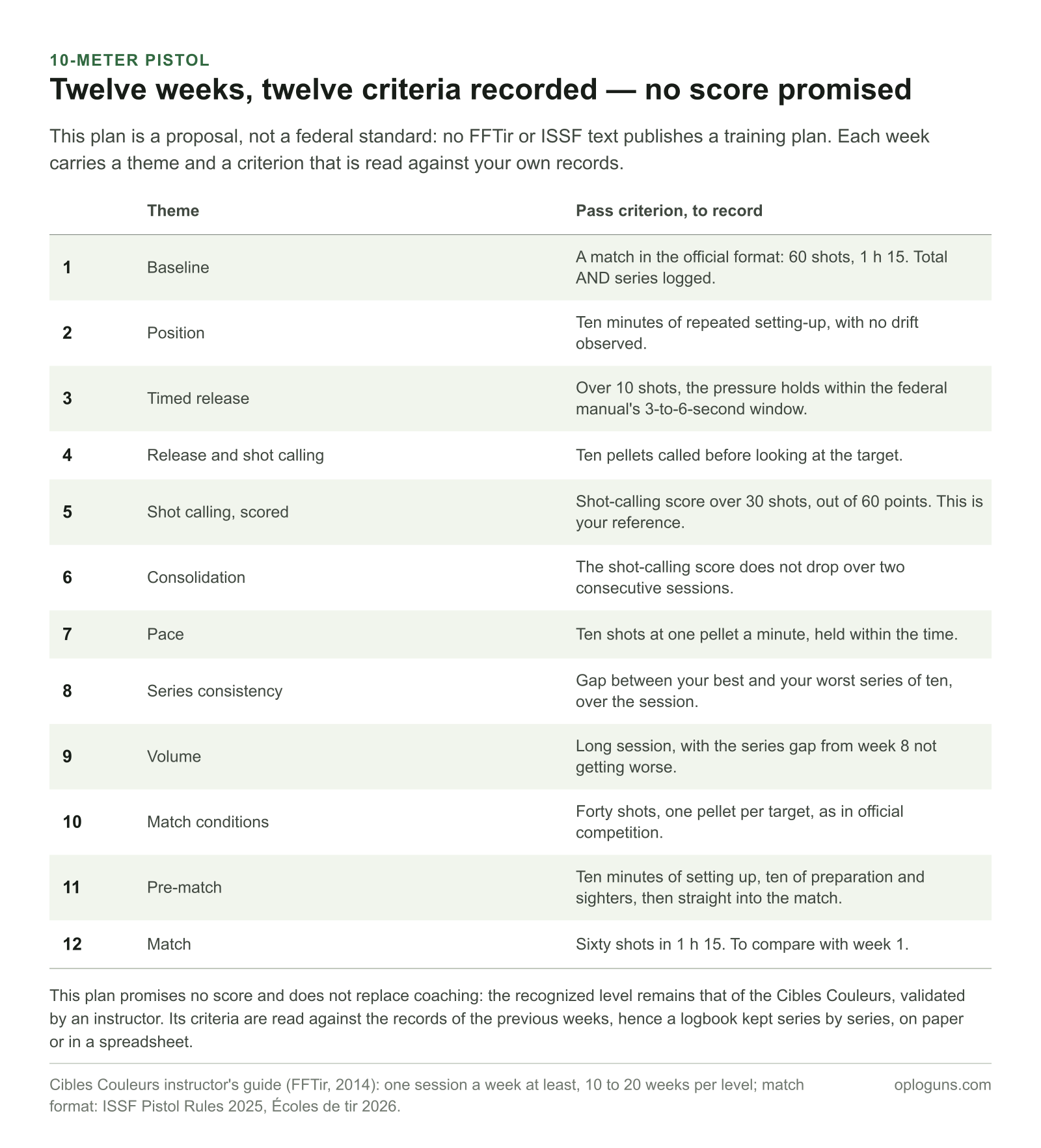
Neither the FFTir nor the ISSF publishes a training plan. The plan below lines up with the two federal benchmarks: one session a week at least, and 10 to 12 weeks for a level of the common core5. Each week carries a theme and a criterion to record, not a score to reach.
| Week | Theme | Criterion to record |
|---|---|---|
| 1 | Baseline | A match in the official format: 60 shots, 1 h 15, one pellet per target; total and series noted |
| 2 | Position | 10 minutes of repeated setting-up, with no drift observed |
| 3 | Timed release | Over 10 shots, the pressure holds between 3 and 6 seconds |
| 4 | Release and shot calling | 10 pellets called before looking at the target |
| 5 | Shot calling, scored | Shot-calling score over 30 shots, out of 60: the reference |
| 6 | Shot calling, consolidation | The shot-calling score does not drop two sessions running |
| 7 | Pace | 10 shots at one pellet a minute, held within the time |
| 8 | Consistency | Gap between the best and the worst series of ten |
| 9 | Volume | Long session, without the week 8 gap widening |
| 10 | Match conditions | 40 shots, one pellet per target |
| 11 | Pre-match | 10 minutes of setting up, 10 of preparation and sighters, then the match |
| 12 | Match | 60 shots in 1 h 15, to compare with week 1 |
The criteria are read against your own records from the previous weeks, hence a logbook kept series by series, on paper or in a spreadsheet; a printable template is offered in our article on the shooting logbook as a PDF.
Training alone with a plan
Pros
- On the shooter's own schedule, with no supervised slot.
- Measurable criteria, recorded at every session.
- Free, apart from pellets and the license.
Cons
- Nobody to correct the movement: a criterion says a fault exists, not which one.
- No official validation of the level reached.
Following the Cibles Couleurs with an instructor
Pros
Budget of the plan: €18 to €45 of pellets in 12 weeks
At two sessions a week, the twelve weeks make 24 sessions.
The pellet volume of twelve weeks of training
Two sessions a week for twelve weeks, or 24 sessions: 40 pellets per session at the low end, 100 at the high end
40 pellets: the volume of a club session sheet, four series of ten11, and of a shooting-school match3. 100 shots: the minimum of a build-up phase described by a coach13. Cost calculated at €8.90 per tin of 500 H&N Sport16.
View the data
| Assumption | Pellets over 12 weeks | Tins of 500 | At €8.90 a tin |
|---|---|---|---|
| 40 pellets per session | 960 | 2 | €18 |
| 100 pellets per session | 2,400 | 5 | €45 |
Training pellets cost €8.90 to €9.99 per tin of 500; match pellets €10.60 to €15.501617. Over a year at the same pace, 104 sessions, the range becomes 9 to 21 tins, or about €80 to €187 in training pellets. The license, the medical certificate and the possible loan of a pistol are extra: the detail is in our article on 10 m pistol.
Improving with a coach: 210 to 240 hours of training
Two qualifications frame coaching at a club:
- The federal coach certificate (brevet fédéral entraîneur): 240 hours over a season, 150 of them at the federation's national sport shooting center (CNTS) in Châteauroux, for €600; its holder prepares shooters for performance and trains instructors14.
- The CQP Moniteur de tir sportif: 210 hours, of which 150 of initial training, 50 of work-study at a club and 10 of certification; an entry shooting test tied to the orange level15.
Three questions tell you what a club offers: whether it is enrolled in the Cibles Couleurs, whether a qualified coach or instructor supervises time slots, and whether the range has electronic targets. The other criteria are in our guide to choosing a shooting club.
Three misconceptions about improving at sport shooting
- "Shooting a lot is enough." The official progression sets minimum durations and a success rate per level, and warns against racing through the levels5.
- "The release should be as fast as possible." The federal manual gives 3 to 6 seconds4.
- "The FFTir publishes a training plan." It publishes a technical model and a progression by levels45, not a plan or a training volume.
Which method for which goal
To validate a recognized level, the Cibles Couleurs provide a framework and an instructor; in return, the pace is set by the scheme.
To work toward the 400 points of the French championship, a plan with recorded criteria shows where the points go: release, shot calling or consistency of the series.
To correct a movement, a qualified coach or instructor sees what no record shows; the plan, for its part, says whether the correction holds.
Sources 17 references
Match formats and target dimensions come from the ISSF rules in their FFTir translation, the technique from the Manuel de tir sportif, the progression from the Cibles Couleurs guide. Club and coach documents illustrate a practice, with no value as a standard. Prices were read on 24 September 2026. All documents are in French. Click a note marker in the text to highlight the matching source.
- FFTir, CNS Arbitrage — Règles Pistolet ISSF, édition 2025, traduction française [ISSF pistol rules, 2025 edition, French translation] (PDF, 2nd printing in force on 1 July 2026), consulted on 24 September 2026: table 8.11, 10 m pistol, 60 shots, 1 shot per paper target, 1 h 15 on electronic targets, 1 h 30 on paper targets, 15 minutes of preparation and sighters.
- FFTir, CNS Arbitrage — Règles techniques ISSF, édition 2025, traduction française [ISSF general technical rules, 2025 edition, French translation] (PDF, updated on 4 July 2026): rule 6.3.4.6, 10 m pistol target, zones from 11.5 to 155.5 mm; rule 6.3.3.2, qualifications scored in whole values, except some rifle events.
- FFTir, CNS Écoles de tir — Règlement Écoles de Tir 2026 [shooting schools rulebook 2026] (PDF, file of 29 October 2025): precision events over 40 shots, « Nombre de coups par cible lors des compétitions de la Gestion Sportive = UN (1) plomb » [number of shots per target in official competitions = ONE (1) pellet]; 10 minutes of preparation and sighters, « 50 min de match (cibles électroniques) ou 60 min de match (cibles « papier ») » [50 min of match (electronic targets) or 60 min of match (paper targets)].
- FFTir — Manuel de tir sportif, édition 03/2026, révision j [sport shooting manual] (PDF), consulted on 24 September 2026: release, « durée nécessaire entre 3 et 6 secondes environ », « suffisamment longue (> à 3 s) pour avoir le temps d'absorber le poids, et suffisamment courte (< 6 s) pour faire partir le coup avant d'entrer dans une période de grande instabilité » [long enough (over 3 s) to have time to take up the weight, and short enough (under 6 s) to let the shot go before entering a period of great instability], « Le tireur ne doit pas connaître le moment précis du départ du coup ! »; stability obtained by shooting « souvent et régulièrement ». Same text in the 03/2025 edition.
- FFTir — « Cibles Couleurs », guide du formateur [instructor's guide] (PDF, 2014): seven levels; table of minimum durations, 10, 12, 15 and 20 weeks, then 1, 1 and 2 seasons, « 1 séance = 1 semaine »; « Une séance minimum par semaine est exigée (contrôle informatique) » [at least one session a week is required (computer check)]; the point « n'est pas d'aller le plus vite possible ».
- FFTir — « Rentrée Cibles Couleurs 2025 », published on 24 September 2025: 10,164 levels validated in 2024-2025, adults 50.23%, 899 clubs enrolled, 64.52% of them active.
- FFTir — Cibles Couleurs, espace responsables de club [club officials' area]: progression open to adults, « organisée par niveau de pratique et non par catégorie d'âge ».
- FFTir — Règlement de gestion sportive, Vie nationale 2026-2027 [sports management rules, national level] (PDF, V1 of 29 September 2026), consulted on 1 November 2026, table D: event 100, 10 m pistol, 400 points to be shot in one go over 60 shots.
- FFTir — Règlement de gestion sportive internationale 2025-2026, pistolet ISSF [international sports management rules, ISSF pistol] (PDF, 8 December 2025): prerequisite to be shot in a match to be considered for selection to the 10 m European championship, seniors 10 m, 579.
- FFTir — règles de sécurité, « L'arrivée au pas de tir » [safety rules, arriving at the firing line], 20 October 2022: dry fire is allowed only « qu'au pas de tir, en direction des cibles ».
- Association Vicinoise de Tir — fiche d'entraînement 10 m, séance n° 17, « Le rythme » [10 m training sheet, session no. 17, pace] (PDF), consulted on 24 September 2026: « But : Tirer un plomb par minute » [Aim: shoot one pellet a minute]; warm-ups, rereading the logbook, position, series of 10 pellets, stretching. ⚠️ Club document, with no value as a standard.
- Benoît Hérault — « Le guide du pistolier » [the pistol shooter's guide] (PDF, 2018): shot-calling drill, one point if the value called is right, another if the position is, « un maximum de 60 pts sur 30 coups tirés » [a maximum of 60 points over 30 shots fired]. ⚠️ Coach's document, with no value as a standard.
- Benoît Hérault — « Construire ses exercices d'entraînement » [building your training drills] (PDF): « on ne change qu'une seule donnée à la fois pour mieux en percevoir les effets ! »; example of two sessions of 1 h 30 a week and of sessions « de 100 coups minimum » [of 100 shots minimum] in the build-up phase. ⚠️ Author's example, presented as such.
- FFTir — page « Entraîneur » [coach], updated on 21 August 2026: federal coach certificate, 240 hours over a season, of which 150 at the CNTS in Châteauroux, 70 on placement at a club, 10 of regional course and 10 of instructor training; €600.
- FFTir — page « CQP Moniteur de tir sportif », consulted on 24 September 2026: « 150 h de formation initiale théorique et pratique » [150 h of initial theoretical and practical training], « 50h en alternance dans un club affilié et homologué FFTir » [50 h of work-study at an affiliated, FFTir-approved club], « 10 h de certifications »; entry test « liée au niveau « Cibles Couleurs » Orange » [tied to the orange Cibles Couleurs level].
- Armurerie Loisir — plombs 4,5 mm [4.5 mm pellets], read on 24 September 2026: H&N Sport €8.90 per 500, RWS Meisterkugeln €10.99, RWS R10 Match €14.90 and €15.50. ⚠️ Commercial data.
- Armurerie Centrale — plombs 4,5 mm, read on 24 September 2026: H&N École de tir €9.99 per 500, RWS Meisterkugeln €10.60, RWS R10 Match €14.90. ⚠️ Commercial data; prices shown with a 5% discount code.
This plan is a method, not a standard. The match formats cited are those of the ISSF rules in force on 1 July 2026 and of the 2026 shooting schools rulebook; the minimums, those of the 2026-2027 season; the selection prerequisite, that of 2025-2026. Correcting a movement is a matter for a qualified coach or instructor.
Frequently asked questions
How do you improve at sport shooting as a beginner?
By measuring rather than feeling. Three benchmarks are written into the federal texts: 75 seconds per shot in a match on electronic targets, a trigger release of 3 to 6 seconds according to the FFTir's Manuel de tir sportif, and 8 mm of radius per point on the 10 m pistol target. A session that records those three quantities can be compared with the next; a session that notes only its total compares with nothing.
How many sessions a week does it take to improve?
The official Cibles Couleurs progression requires one session a week at least to validate a level. No federal text sets a frequency beyond that. One coach describes, as an example, two sessions of an hour and a half or three one-hour sessions a week.
Is a 12-week plan a federal standard?
No. Neither the FFTir nor the ISSF publishes a training plan. The federation publishes a minimum duration per level in its Cibles Couleurs progression: 10 weeks for the white target, 12 for the yellow. A twelve-week plan matches that order of magnitude; its method remains a proposal.
How much time do you have per shot in a 10-meter match?
75 seconds on electronic targets, 90 on paper targets: 60 shots in 1 h 15 or 1 h 30 in 10 m pistol, 40 shots in 50 or 60 minutes in the shooting schools. Preparation and sighters, 15 minutes for a 60-shot match and 10 for a 40-shot match, are not included in that time.
How long should the trigger release last with a pistol?
The FFTir's Manuel de tir sportif gives a duration of about 3 to 6 seconds: long enough to take up the trigger weight, short enough for the shot to break before a period of great instability. The same window appears in the 2025 and 2026 editions.
Are the Cibles Couleurs reserved for young shooters?
No. The progression is open to adults and organized by level of practice, not by age. Adults accounted for 50.23% of the levels validated in 2024-2025.
What score should you aim for in 10 m pistol?
The qualifying minimum for the French championship is 400 points over 60 shots, or 6.67 per pellet. The detail by category is in our article on the 10 m pistol qualifying scores.
Spotted an error, or a rule that has changed since we checked? Report an error