French shooting federation qualifications: BFJE, BFA, BFI, coach and referee
Published on · 13 min read · Anthony Baillon
The FFTir, France's shooting federation, trains its volunteer leaders in four steps: the one-day CAC certificate, then the activity leader (BFA, from 16), instructor (BFI, from 18) and coach (BFE) certificates. Shooters aged 14 to 18 have their own, the BFJE. The instructor course takes 80 hours. None of these qualifications allows paid teaching.
At a glance
| Qualification | To get in | What it allows |
|---|---|---|
| CAC | Age 16, one year of license | Welcoming newcomers, introducing two beginners to shooting |
| BFJE | Age 14, two years of license | Assisting the coach in the shooting school |
| BFA | Age 16, one year of license, CAC | Introducing four beginners to shooting |
| BFI | Age 18, two years of license, BFA | Instructing, training the shooting school |
| BFE | BFI for two years | Coaching, training the leaders |
| Referee | Age 18; young referee from 14 | Judging in competition |
- All volunteers: being paid to supervise takes a professional qualification, the CQP or a state diploma.
- The league organizes the CAC, the BFJE, the BFA, the BFI and refereeing; the federation, the coach certificate.
FFTir qualifications: the pathway in one table
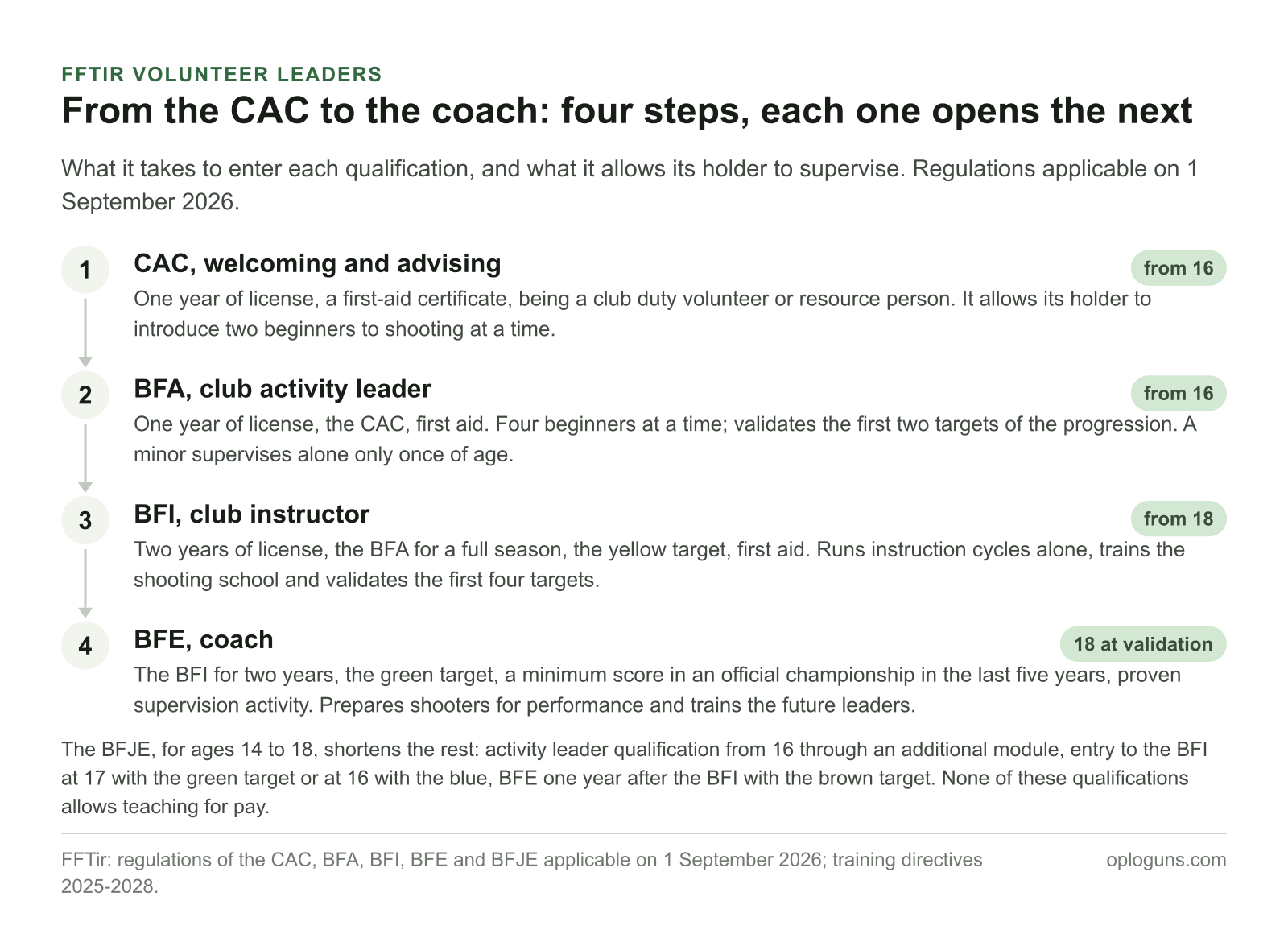
With the CAC certificate alone, a volunteer has two beginners shooting at a time. With a federal certificate (a brevet fédéral), four1. Training volunteers therefore decides how many newcomers a club can take in. The regional leagues (ligues) have been given the job, by the federation, of organizing the activity leader and instructor courses every season1.
The entry conditions, under the regulations applicable on 1 September 2026:
| Qualification | Minimum age | FFTir license for | Other conditions |
|---|---|---|---|
| CAC | 16 | one year | Club duty volunteer or resource person, first aid |
| BFJE | 14 | two years | Green target (or orange in progress), adult tutor, first aid |
| BFA | 16 | one year | CAC, first aid |
| BFI | 18 (16 or 17 by the bridge) | two years | BFA for one season, yellow target, first aid |
| BFE | 18 at validation | license for the season | BFI for two years, green target, minimum score in a championship |
| Judge-referee | 18 | current license | Common core, then one discipline |
Applications for the CAC, the BFA and the BFI go through the league's file and the favorable opinion of the club president234. That opinion is not an authorization. It says the club backs the application; selection belongs to the league's training officer4.
Length of each federation leadership course
Training hours set by the FFTir regulations applicable on 1 September 2026, club placement included
The BFJE counts 35 club sessions of about an hour each, spread over one or two seasons5. The BFE is taken at national level, the others in the regional league61.
View the data
| Qualification | Selection | Training center | Club and placements | Total |
|---|---|---|---|---|
| CAC | — | 7 h | — | 7 h |
| BFJE | 3 h | 12 h | 35 sessions | 50 h |
| BFA | 3 h | 21 h | 40 h | 64 h |
| BFI | 6 h | 34 h | 40 h | 80 h |
| BFE | — | 150 h | 90 h | 240 h |
The "targets" are the levels of the federation's Cibles Couleurs (colored targets) progression: white, yellow, orange, green, blue, brown, up to rainbow56. How long each one takes is in our plan for improving at sport shooting. What each qualification allows its holder to supervise, on the other hand, is counted in shooters.
Supervising the firing line: 4 beginners or 8 shooters
The federation sets how many shooters a leader may have on a firing line at the same time, according to the level of those being supervised1:
| Leader | Discovery, beginners | Instruction or running a firing line |
|---|---|---|
| CAC certificate | 2 | 10 experienced shooters |
| Federal certificate (BFA, BFI) | 4 | 8 shooters under instruction |
| CQP Moniteur de tir sportif | 6 | 10 trained shooters |
A beginner, in the sense of these regulations, is not autonomous in handling the equipment or in the safety rules; a shooter under instruction is4. « Simultanément » [simultaneously] means shooting at the same time. Several shooters can therefore take turns on the same firearm, and the group taken in can grow accordingly1.
Two situations escape these ceilings: laser shooting activities, with no projectile, and training that prepares for competition3. One activity leader alone in front of eight beginners is therefore outside the framework; two activity leaders, or a laser session, stay within it.
CAC: the one-day course that opens the qualifications
Seven hours, in one day, in the league2. The certificate called Capacité à accueillir et conseiller (ability to welcome and advise) teaches two roles. Receiving a new member: tour, license, insurance, information on the FINIADA, the national file of people banned from holding firearms. And keeping the club safe: transporting and handling firearms, range commands, malfunctions7.
Since 1 September 2020, it has been compulsory for entry to the activity leader certificate. Activity leaders who qualified before then do not have to take it7. The 2026 regulations ask for age 16, one year of license, a first-aid certificate and a place among the club's duty volunteers2. They also assume the candidate has absorbed the Manuel de tir sportif, the document that prepares for the federal safety quiz.
BFJE: young leaders aged 14 to 18, in the shooting school
The federal young leader certificate (brevet fédéral jeune encadrant), also called assistant coach, is for license holders in the U14 to U21 categories5. Entry takes age 14, two years of license and the green target, or the orange one with the green in progress. Add parental consent and an adult tutor, a qualified coach from the club5.
The young leader acts only in the shooting school (the école de tir, a club's youth section), at 10 m with rifle and pistol, or in clay target shooting5. They help run the sessions and take shooters through the first three targets. They coach the youngest in competition. Until they turn 18, a federal coach is always with them5. The age conditions of the shooting school itself are in our article on the minimum age for sport shooting.
The BFJE shortens the rest of the route:
- Toward the BFA: an additional module, which counts as the CAC, makes it possible to receive the activity leader qualification from 16, though not to work alone before 185.
- Toward the BFI: entry to the course at 17 with the green target, at 16 with the blue5.
- Toward the BFE: one year after the BFI instead of two, with the brown target5.
The certificate is held for life. The young leader is nevertheless counted as "active" only if they continue the pathway within two years5.
BFA: FFTir club activity leader in 64 hours, from 16
The activity leader (animateur) welcomes, informs and introduces people to shooting3. Their disciplines: pistol at 10 and 25 m, rifle at 10 m standing and 50 m prone, or clay targets on simple trajectories. They also take part in running the club, from firearm loans to organizing sessions8.
The course runs to 64 hours: 3 of selection, 21 at the training center, 40 on placement in a club38. To validate it, you must:
- Pass the white target at selection, and the yellow one during the course3.
- Shoot at least one official competition, in the season or the five years before; the score does not count3.
- Hand in a placement report of four pages at most, validated by the league's training officer3.
A minor can obtain the BFA. They supervise alone only once they come of age, and until then in the shooting school, with a certified adult3. The activity leader validates the first two targets of the progression. The following ones take an instructor.
BFI: the club instructor course in 80 hours
The instructor (initiateur) runs instruction cycles alone. They train the shooting school and follow its cadets and juniors. They steer adults toward competition and act as tutor to young leaders4. They validate the first four targets, from white to green4.
The entry conditions, under the regulations applicable on 1 September 20264:
- Two years of license, meaning at least the third season, and the current year's license.
- Age 18 when the course starts, or 17 and 16 by the BFJE bridge.
- The BFA for a full season, the yellow target and a first-aid certificate.
- A project in the club, realistic and negotiated with its officers, presented at the selection interview.
The course lasts 80 hours: 6 of selection and placement testing, 34 at the training center, 40 on placement in a club49. The orange target is passed at selection, the green one during the course. An official competition in the last five years is required4. The written test is a 40-question multiple-choice quiz in 30 minutes, 5 of the questions being eliminatory ones on safety4.
Three other routes exist. First, the exemption: after three years of license, a holder of a sports-profession diploma, or a shooting instructor from the police, the gendarmerie or the army, can enter directly4. Recognition of prior experience (the validation des acquis de l'expérience) takes 300 hours of supervision over three years and costs €300, support included4. Last, the resit: a block of skills once acquired is kept for three years. Only the missing one is retaken4.
Coach: 240 hours and €600 at the CNTS in Châteauroux
The federal coach certificate (brevet fédéral entraîneur) replaced the first- and second-degree coach certificates on 1 September 20246. Its holder prepares shooters for performance and trains the future leaders, from the BFJE to the BFI6.
The course is taken at national level, in 240 hours over one season6:
- 150 hours at the CNTS, the « Centre national de tir sportif » [national sport shooting center] in Châteauroux, distance learning included;
- 70 hours in a club, alternating with the center;
- 10 hours on a training camp with a regional squad;
- 10 hours in a leaders' course run by the league. The fees are €600, accommodation and meals for the four modules at the center being covered by the federation6.
You need the BFI for two years and the green target. You also need a minimum score in an official championship in the last five years, and proven supervision activity10. The age of 18 is assessed at final validation; entry is possible at 17 by the BFJE bridge10.
Shooting referee: from trainee to national judge-referee
Refereeing is a pathway of its own. The federation considers it preferable to have been a shooter, without requiring it; the training, delivered by the leagues, can stretch over several years11. The first qualification is obtained at 18, with a current license12.
The route follows four grades, described in the booklet of the Commission nationale d'arbitrage, the national refereeing commission12:
- Trainee referee, after a test on the common core: safety, conduct, knowledge of the disciplines. They make no decisions and always officiate alongside a judge of the discipline.
- Departmental referee, a grade reserved for ISSF target disciplines: multiple-choice quiz, practical tests on the firing line, checking of scores and firearms, oral on safety.
- Regional referee, by discipline, before a league jury that includes a national judge: they run a regional firing line.
- National referee, put forward by the league president after running a regional firing line: they run a national firing line.
Judge-referee cards are valid for four years and are renewed only after continuing training12. Each discipline has its own grade: ISSF target or clay target, historical firearms, practical shooting (tir sportif de vitesse), service-arms shooting (tir aux armes réglementaires)12.
Before 18, the route is called young referee (arbitre jeune). It opens at 14, with the green target, a few competitions shot and parental consent. The young referee officiates in the shooting school, under the authority of a federal referee13. This pathway carries weight in competition: a regional championship must have at least one national referee appointed by the league14.
Getting paid to teach shooting: CQP or state diploma
CAC, BFJE, BFA, BFI, BFE: every set of regulations rules out teaching for pay253410. The French sports code (code du sport) reserves paid supervision for a qualification that guarantees the safety of participants. That qualification must appear in the national register of professional certifications15.
In sport shooting, that means three qualifications1:
- The CQP Moniteur de tir sportif, a certificate of the sports industry's professional branch.
- The DEJEPS, sport shooting specialty, a state diploma in sports development.
- The DESJEPS, sport shooting specialty, a higher state diploma in sports performance.
The former state sports educator certificates (brevets d'État d'éducateur sportif), now repealed, keep their rights1. The length of the CQP is set out in our plan for improving at sport shooting, next to that of the coach certificate.
Continuing training: certified for life, active with upkeep
A federal certificate cannot be lost: its validity is permanent4. Being "active", on the other hand, takes upkeep4:
- Supervising regularly, and proving it with your trainer's passport;
- Taking continuing training at least once per Olympic cycle, meaning every four years. The cards are valid only for the current cycle4.
Instructor status stays tied to a valid license and to the federation's disciplinary regulations4. A leader who does not renew their license can therefore no longer supervise on the strength of their certificate.
Three misconceptions about FFTir qualifications
- "An instructor can give paid lessons." No: the BFI regulations rule it out, and the sports code reserves paid supervision for professional qualifications415.
- "You have to be a competitor to train." A single official competition is asked for at the BFA and the BFI, in the last five years, and its score does not count34. Refereeing does not even require having been a shooter11.
- "The BFJE is a small BFA." It prepares for something else: assisting the coach in the shooting school, under a tutor, until 185. The activity leader qualification then takes an additional module.
Federal qualifications: where to start, case by case
License holder aged 14 to 17, already at the green target: the BFJE opens the way. It lets you supervise the shooting school under a tutor and shortens the certificates that follow.
Adult licensed for a year, present at club duty sessions: the CAC, then the BFA. They let you introduce four beginners to shooting at a time.
Activity leader for a season, wanting to train the shooting school: the BFI in 80 hours; the orange target is prepared before selection.
Instructor for two years, drawn to competition: the BFE at the CNTS, for €600.
Keener to judge than to teach: refereeing, from 18, or from 14 as a young referee.
A newly formed club goes through the same certificates: its steps are in our article on starting a shooting club. What an approved club must keep up besides is in our article on a shooting club's obligations. What a shooter can ask of it is in our guide to choosing a club.
The regulations in force prevail. The conditions cited are those of the federal regulations applicable on 1 September 2026 and of the refereeing booklets of October 2017. Ask the league's training officer for session dates and fees.
Sources 15 references
The entry conditions, course lengths and prerogatives come from the regulations of each qualification published by the Fédération française de tir for the 2026-2027 season, and from its presentation pages. Refereeing is described by the booklets of the Commission nationale d'arbitrage, which the federation's page still points to, and by the sporting management regulations. The rule on paid supervision comes from the code du sport. All documents are in French.
- FFTir — Directives formation 2025-2028 [training directives 2025-2028] (PDF, version 1 of September 2024), consulted on 1 November 2026: safety prescriptions (CAC holders: two beginners in discovery, ten experienced shooters when running a firing line; holders of federal certificates: four beginners, eight shooters under instruction; CQP: six beginners, ten trained shooters); delegation of the activity leader and instructor courses to the leagues; qualifications allowing paid supervision (BEES, repealed with rights maintained, CQP « Moniteur de Tir sportif », DEJEPS and DESJEPS with the « Tir sportif » specialty).
- FFTir — Règlement du certificat de compétences CAC, applicable au 1er septembre 2026 [regulations of the CAC skills certificate] (PDF), consulted on 1 November 2026: license holder for one year, age 16, PSC first-aid certificate, member of the club's duty volunteers, « Manuel de Tir sportif » absorbed; length of 7 hours; two beginners in discovery, ten experienced shooters when running a firing line; « il n'est pas possible d'enseigner contre rémunération avec un CAC » [it is not possible to teach for pay with a CAC].
- FFTir — Règlement du brevet fédéral animateur de club, applicable au 1er septembre 2026 [regulations of the federal club activity leader certificate] (PDF), consulted on 1 November 2026: license holder for one year, CAC, age 16, PSC; 64 hours (3 of selection, 21 at the center, 40 on placement); white then yellow targets; official competition in the season or the last five years; four-page report; four beginners or eight shooters under instruction, no limit for laser shooting or competition training; a minor autonomous only at 18; no teaching for pay.
- FFTir — Règlement du brevet fédéral initiateur de club, applicable au 1er septembre 2026 [regulations of the federal club instructor certificate] (PDF, 25 pages, updated on 8 September 2026), consulted on 1 November 2026: license holder for two years (third season), age 18 (17 with the green target, 16 with the blue, by the BFJE), PSC, yellow target, BFA for a full season; 80 hours (6, 34, 40); orange target at selection, green during the course; 40-question multiple-choice quiz in 30 minutes, 5 of them eliminatory; exemption route after three years of license; VAE at 300 hours over three years and €300; skill blocks acquired kept for three years; permanent validity, active status through one continuing training course per Olympic cycle; cards valid for the cycle; no teaching for pay.
- FFTir — Règlement du brevet fédéral jeune encadrant, applicable au 1er septembre 2026 [regulations of the federal young leader certificate] (PDF), consulted on 1 November 2026: U14 to U21 categories; age 14, license holder for two years, PSC, green target (or orange in progress), adult tutor; shooting school only; 50 hours (3, 12, 35 sessions of about an hour); accompanied by a federal coach until 18; bridges to the BFA from 16, the BFI at 17 (green) or 16 (blue), the BFE one year after the BFI (brown); active status if the pathway continues at n + 2; no teaching for pay.
- FFTir — page « Entraîneur » [coach], consulted on 1 November 2026: the BFE has replaced the BFE1 and BFE2 since 1 September 2024; Cibles Couleurs « niveaux bleu à arc-en-ciel » [blue to rainbow levels]; training of BFJE, CAC, BFA and BFI leaders; 240 hours over one season (150 at the CNTS in Châteauroux including distance learning, 70 in a club, 10 on a regional camp, 10 in a leaders' course); fees of €600, accommodation and catering for the four modules covered; regulations updated on 21 August 2026.
- FFTir — page « Certificat de compétences (CAC) » [skills certificate], consulted on 1 November 2026: one-day course (7 hours), compulsory for the BFA since 1 September 2020, earlier BFA holders exempt; content: welcoming, FINIADA, license and insurance, safety, transporting and handling firearms, range commands, malfunctions.
- FFTir — page « Animateur » [activity leader], consulted on 1 November 2026: welcoming, firearm loans, organizing sessions; 64-hour course (3 h, 21 h, 40 h); regulations updated on 8 September 2026.
- FFTir — page « Initiateur » [instructor], consulted on 1 November 2026: 80-hour course (6 h of placement testing, 34 h at the center, 40 h on placement in a club); four skill blocks; regulations updated on 8 September 2026.
- FFTir — Règlement du brevet fédéral entraîneur, applicable au 1er septembre 2026 [regulations of the federal coach certificate] (PDF), consulted on 1 November 2026: age 18 at final validation (entry at 17 by the BFJE with the brown target), PSC, green target, BFI for two years, minimum score in an official championship in the last five years, proven supervision activity; no teaching for pay.
- FFTir — page « Devenir arbitre » [becoming a referee], published on 18 March 2020, consulted on 1 November 2026: « il est préférable d'être ou d'avoir été tireur mais cela ne constitue cependant pas une obligation » [it is preferable to be or to have been a shooter, but this is not an obligation]; league training, common core and practical exercises, over several years; first qualification at 18; reference to booklets 1, 2 and young referee.
- FFTir, Commission nationale d'arbitrage — Livret 2 juge-arbitre : organisation de l'arbitrage [judge-referee booklet 2: organization of refereeing] (PDF, October 2017 edition), consulted on 1 November 2026: minimum age of 18, current license; list of disciplines; departmental grade reserved for ISSF target; trainee, departmental, regional and national grades, exams and competences; four-year cards renewed after continuing training.
- FFTir, Commission nationale d'arbitrage — Livret arbitre jeune [young referee booklet] (PDF, October 2017 edition), consulted on 1 November 2026: license holder aged 14, green target (or in progress during the year), a few competitions, parental consent; officiating in the shooting school under the authority of a federal referee; departmental judge-referee exam possible at 18.
- FFTir — Règlement de gestion sportive Vie nationale 2026-2027 [sporting management regulations, national level] (PDF, version of 29 September 2026), downloaded on 1 November 2026: § A.2.5.2, departmental championships refereed by the departmental commission, regional championships with « au moins un arbitre national désigné obligatoirement par la Ligue » [at least one national referee compulsorily appointed by the league], French championships by the Commission nationale d'arbitrage.
- Légifrance — article L212-1 du code du sport, in force since 1 January 2019: « Seuls peuvent, contre rémunération, enseigner, animer ou encadrer une activité physique ou sportive » [only the following may, for pay, teach, lead or supervise a physical or sporting activity] the holders of a qualification guaranteeing the safety of participants and third parties, entered in the national register of professional certifications.
Frequently asked questions
How do you become a sport shooting instructor in France?
The federal instructor certificate (BFI) is prepared in the regional league, in 80 hours, 40 of them on placement in a club. You must be 18 when the course starts, have held an FFTir license for two years, have held the activity leader certificate for a full season, and hold the yellow target of the Cibles Couleurs progression and a first-aid certificate. The orange target is validated at selection, the green one during the course.
Can you be paid with a federal shooting certificate?
No. The FFTir regulations say so for each of them: CAC, BFJE, BFA, BFI and BFE are volunteers' qualifications. The French sports code reserves paid supervision for holders of a qualification entered in the national register of professional certifications: in shooting, the CQP Moniteur de tir sportif, the DEJEPS or the DESJEPS with the sport shooting specialty.
At what age can you become a sport shooting referee?
At 18 for the first judge-referee qualification. Before that, a license holder can become a young referee from 14, with the green target and parental consent, to officiate in the club's shooting school under the authority of a federal referee. The training is run by the regional league.
How much does an activity leader or instructor course cost?
The federation lets each league set its training fees for the current Olympic cycle: ask the league's training officer for the amount. The federal coach certificate, organized by the federation, costs €600, with accommodation and meals for the four modules at the training center covered.
Spotted an error, or a rule that has changed since we checked? Report an error