Organizing an IPSC match at your club: the Match Director's role
Published on · 12 min read · Anthony Baillon
In France, only a club accredited for tir sportif de vitesse (TSV), the federation's name for IPSC shooting, can organize an IPSC match, once the national commission's president has validated it three months ahead. The rulebook requires two officials appointed before the match: a Match Director for administration, and a Range Master for the range and the rules.
At a glance
| Question | Answer | Text |
|---|---|---|
| Who organizes | An affiliated, TSV-accredited club | Administrative regulations, art. V |
| When to declare it | Three months ahead, Levels 1 to 3 | Administrative regulations, art. X |
| Mandatory officials | Match Director and Range Master | IPSC, 7.3.1 and Appendix A1 |
| Level I or II | One person may hold both roles | IPSC, 7.3.1 |
| Minimum format | Three stages, one type of firearm | IPSC, 6.1.3 |
- The Match Director administers: squads, schedule, construction, staff, services. The Range Master has authority over safety, the stages and the application of the rules.
- The host club answers for the safety of the stages it builds, subject to the Range Master's approval, and provides the safety areas.
Organizing an IPSC match: reserved for accredited clubs
A tir sportif de vitesse match cannot be improvised at just any range. The administrative regulations of the FFTir, the French shooting federation, reserve training and « l'organisation de compétitions » [the organization of competitions] for affiliated associations with their dues paid and holding a TSV accreditation. They add: « Aucune subdélégation ne sera rendue possible » [no sub-delegation will be made possible]2.
Accreditation rests on three conditions2:
- A request from the club president, after consulting the president of the regional league; the national commission puts it to the federal executive committee.
- A TSV lead who holds a valid TSV instructor diploma (moniteur TSV) and is licensed with the association as their first club.
- Approved facilities and suitable equipment, checked by a member of the commission or by the discipline's technical officer.
The club president and the TSV lead then bear « l'entière et pleine responsabilité » [full and entire responsibility] for the practice2. Accreditation as the shooter sees it is described in our article on getting started in TSV. The legal framework of a shooting association, outside TSV, is in a club's legal obligations.
Declaring the match: three months ahead, to the CNS
Forget the declaration and the match risks being banned. The administrative regulations set two obligations2:
- Declare: every TSV event is declared to the president of the national sports commission, the CNS, « sous peine d'interdiction de celle-ci » [on pain of the event being banned].
- Get it validated: a Level 1, 2 or 3 competition is submitted, « au moins trois mois avant » [at least three months beforehand], for the authorization of the Regional Director, the president of the TSV CNS.
The federation encourages its accredited clubs to organize "friendly" Level I or II competitions. It asks them to respect its official calendar and not to schedule them on top of Level III matches2.
The IPSC rulebook leaves the Regional Director the same latitude. International sanctioning is not required at Levels I and II: each Regional Director sets their own criteria for matches held in their region1. At Level III it becomes mandatory, with registration with IPSC three months in advance1. The levels as the shooter sees them are in our article on the first IPSC match.
Match Director: the administration of the match
The IPSC rulebook defines the Match Director in three sentences. The role covers overall administration: squadding, scheduling, range construction, the coordination of all support staff, services. The Match Director's authority prevails in everything, except in the matters the rules entrust to the Range Master. The appointment is made by the host organization1.
Other rules add specific tasks1:
- Appoint the Range Master, most often, and work alongside that official (7.1.5).
- Grant schedule exceptions: without the Match Director's prior approval, a shooter absent at the scheduled time for a stage scores zero on it (6.6.1).
- Allow a shooter to shoot a second division, outside the standings (6.2.4).
- Announce the match's official ammunition, if the organization sells any, and its power factor by division (5.8.1).
- Rule on dress: the Match Director has the last word on clothing that may not be worn (5.3.1).
- Publish the results, on paper or in electronic form, following a procedure announced in advance (9.8.5).
- Convene the Arbitration Committee when an appeal is lodged (11.1.8).
- Declare the results final, which closes the match (6.6.3).
The Range Master also consults the Match Director before two heavy decisions: removing a stage from the match, or suspending shooting because of bad weather1.
The handbook of the international range officers' association, IROA, published in 2012, is addressed to Range Officers, not to Match Directors4. For the latter, the reference text remains the rulebook.
Range Master and Range Officers: authority over the range
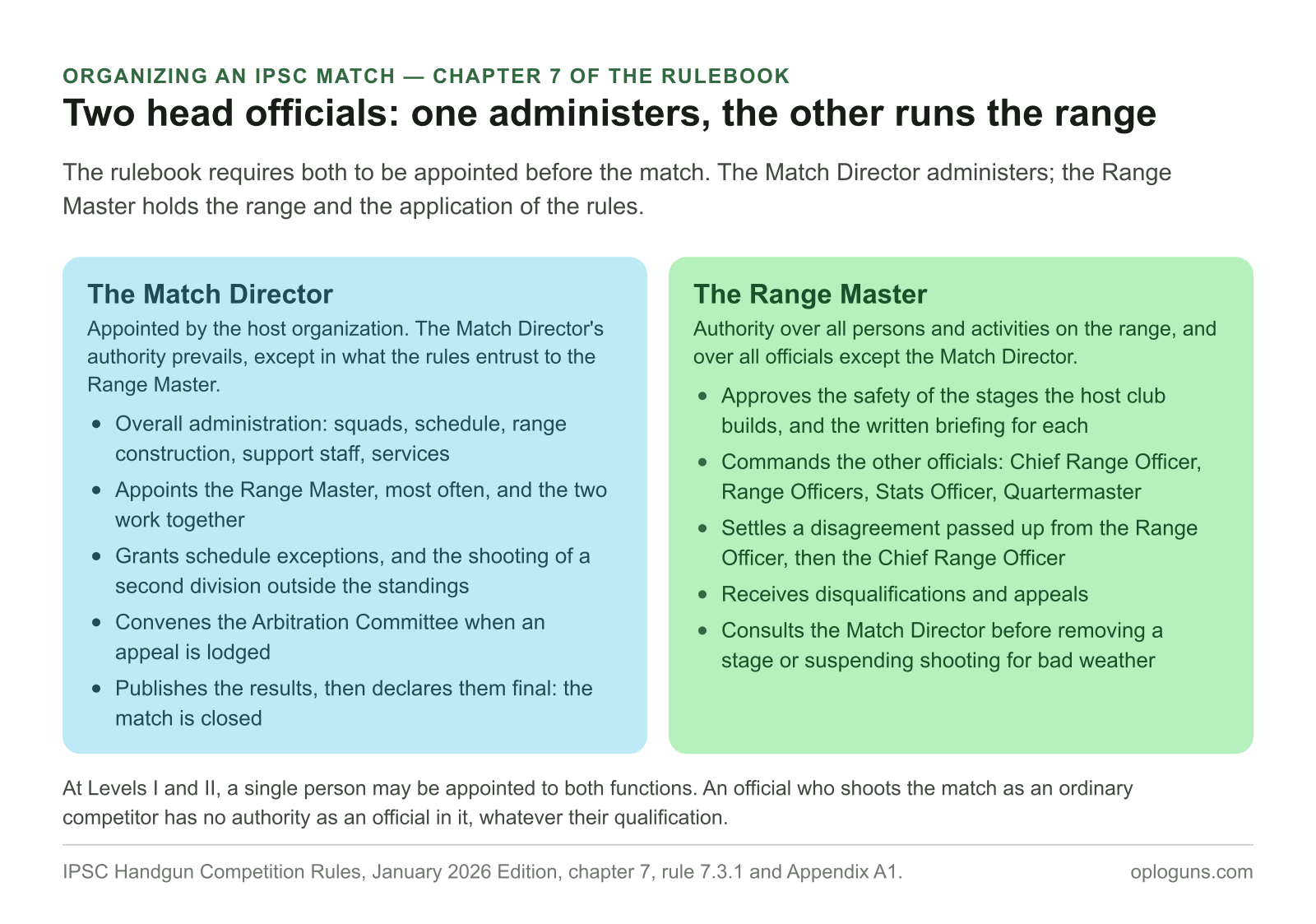
The Match Director does not command the Range Officers. That authority belongs to the Range Master, who exercises it over all officials, except the Match Director1. Chapter 7 of the rulebook hands out the roles as follows1:
| Official | Role | Under the authority of |
|---|---|---|
| Range Officer | Issues range commands, monitors the shooter's safety, declares time, scores and penalties | Chief Range Officer and Range Master |
| Chief Range Officer | Primary authority over the stages under their control; sees that the rules are applied evenly | Range Master |
| Stats Officer | Collects, verifies and retains the score sheets; produces the results | Range Master |
| Quartermaster | Distributes and maintains the equipment: targets, patches, paint, timers, batteries, staplers | Range Master |
| Range Master | Authority over all persons and activities on the range; receives disqualifications and appeals | — |
| Match Director | Overall administration of the match | Host organization |
Three rules frame these appointments1:
- Before the match: the organizers appoint a Match Director and a Range Master. The Range Master is preferably the most competent and experienced certified official present.
- At Levels I and II, a single person may be appointed to both functions.
- An official who shoots the match as an ordinary competitor has no authority as an official in it, whatever their qualification.
In France, TSV officiating training is organized at national level: it trains national TSV Range Officers3. The other federal diplomas are presented in the federation's coaching and officiating qualifications.
Match level: what Appendix A1 asks of the club
Appendix A1 of the IPSC rulebook says, line by line, what is mandatory and what is only recommended1. For the three levels a French club gets validated:
| Line of Appendix A1 | Level I | Level II | Level III |
|---|---|---|---|
| Match Director | Mandatory | Mandatory | Mandatory |
| Range Master | Mandatory | Mandatory | Mandatory |
| Range Master approved by the Regional Director | Recommended | Recommended | Mandatory |
| One national Range Officer per stage | Recommended | Recommended | Mandatory |
| Stages approved by the Regional Director | Recommended | Recommended | Mandatory |
| Stages approved by the IPSC committee | — | — | Mandatory |
| Registration with IPSC three months ahead | — | — | Mandatory |
| Chronograph | — | Recommended | Recommended |
| Post-match reports to IROA | — | — | Mandatory |
| One person for targets per six rounds | Recommended | Recommended | Recommended |
The appendix also recommends minimum entries for handgun: 10 shooters at Level I, 50 at Level II, 120 at Level III1.
Organizing a Level I or II
Pros
- A single head official is possible: the same person directs the match and acts as Range Master1.
- No IPSC sanctioning to obtain1.
- Less constrained stages: freestyle and the round count limits do not apply strictly1.
- A simple Arbitration Committee: three experienced persons, appointed by the Match Director1.
Organizing a Level III
Pros
Cons
- A national Range Officer on every stage, mandatory1.
- Stages to get approved twice: by the Regional Director, then by the IPSC committee1.
- The English rulebook alone valid2.
- A four-member Arbitration Committee: a non-voting chairman and three arbitrators1.
- Reports to file with the international range officers' association1.
This federal certificate opens the purchase of magazines of more than 20 rounds for a handgun, and more than 30 for a long gun5. It is explained in our article on Open division.
IPSC match stages: the construction rules
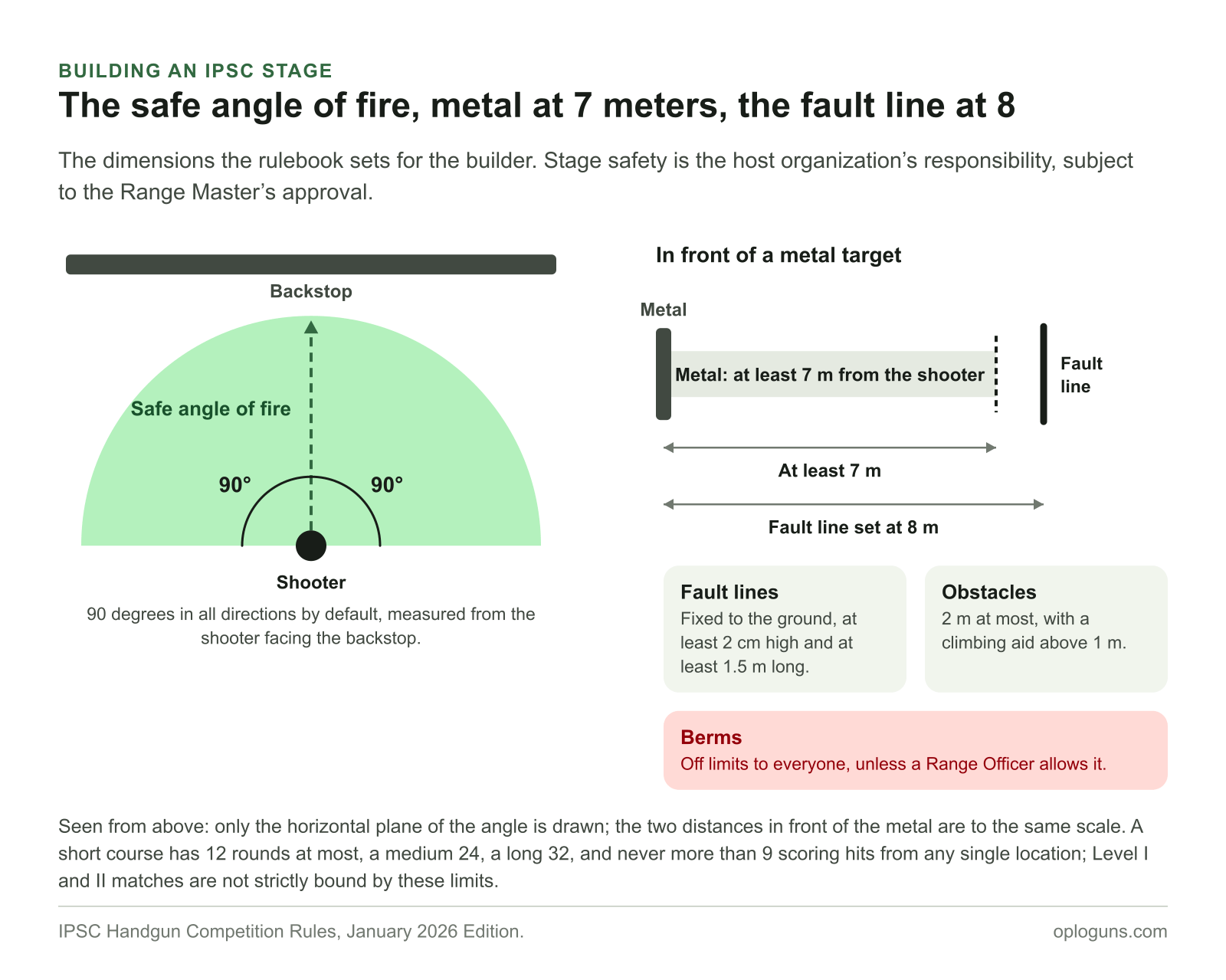
A match has at least three stages, all shot with the same type of firearm1. The safety of their design and construction is the host organization's responsibility, subject to the Range Master's approval1.
The dimensions the rulebook sets for the builder1:
- Three formats: 12 rounds at most for a short course, 24 for a medium, 32 for a long, and never more than 9 scoring hits from any single location.
- A balance: three short courses to two medium and one long; for twelve stages, six short, four medium and two long.
- The safe angle of fire: 90 degrees in all directions by default, measured from the shooter standing square to the backstop.
- Metal at 7 meters at least from the shooter; a fault line guarding the approach is set at 8 meters.
- Fault lines: fixed to the ground, at least 2 centimeters high, at least 1.5 meters long.
- Obstacles: 2 meters at most, with a scaling aid above 1 meter.
- Berms: off limits to everyone, unless a Range Officer gives permission.
Levels I and II are not strictly bound by freestyle or by the round count limits1. The permitted targets and their dimensions are in our article on the IPSC target. A shotgun or rifle match follows other dimensions, those of IPSC Shotgun and Rifle. What remains is to make the range work on match day.
Safety areas, briefing, chronograph: the logistics
Four items fall to the organizer, on top of the stages1:
- The safety areas: enough of them, signposted, with a table, a safe direction and visible boundaries. No ammunition is handled there, not even a dummy round.
- The written briefing for each stage: approved by the Range Master and posted before the match. It states at least the targets, the minimum number of rounds, the firearm's ready condition, the start position, the signal and the procedure. The Range Officer reads it word for word to each squad.
- The chronograph, if there is one: each day, a Range Officer fires three calibration rounds over it with the same firearm. The device is deemed within tolerance if the day's average stays within 5% of the first day's.
- Scoring: at Levels I to III, any program other than the official IPSC programs needs the Regional Director's approval.
The information given before the match is the same for every entrant, within the same notice period1. If a stage is modified after the match has started, the Range Master chooses: the change applies only to the remaining shooters, or everyone shoots it again in its revised version, the previous attempts being removed1.
The Quartermaster's list gives an idea of the small equipment: targets, patches, paint, timers, batteries, staplers, clipboards1. A range's equipment budget is detailed in equipping a shooting club, the timing device in our article on the shot timer.
Protests: the match's Arbitration Committee
A disagreement goes up from the Range Officer to the Chief Range Officer, then to the Range Master. Beyond that, the shooter may take it to an Arbitration Committee1. The organizer carries the burden:
- At Levels I and II, the Match Director may appoint three experienced persons with no interest in the case, certified officials if possible.
- The deadline: the appeal is written and lodged with the Range Master within the hour; the committee gives its decision within 24 hours, or before the results are announced.
- The fee: set by the organizers, 100 US dollars at most; returned if the appeal succeeds, passed to the national range officers institute if it is rejected.
The results are not declared final as long as the appeal period for a disqualification is running1.
Three misconceptions about organizing an IPSC match
- "A friendly match needs no declaration." Every TSV event is declared to the president of the national commission, and Levels 1, 2 and 3 are validated three months ahead2.
- "The Match Director commands the Range Officers." The Range Master has authority over all officials, except the Match Director1.
- "A qualified Range Officer entered in the match can settle a dispute." An official who shoots as a competitor has no authority as an official in that match1.
Organizing an IPSC match by the level you aim for
What you gain, what you give up
For a first club match, Level I has at least three stages, a Match Director and a Range Master, who may be the same person. The trade-off: federal validation must still be requested three months ahead.
To bring neighboring clubs together, Level II recommends six stages and a chronograph. The trade-off: 50 shooters are recommended, and a national Range Officer on every stage.
For a match that counts internationally, Level III brings IPSC sanctioning and the IPSC calendar. The trade-off: stages approved twice, a national Range Officer on each, reports, and the rulebook in English only.
Sources 5 references
The match rules come from the IPSC Handgun rulebook in its January 2026 edition, the French framework from the TSV administrative regulations, the FFTir's pages and the code de la sécurité intérieure [French internal security code]. Click a reference number in the text to highlight the matching source.
- IPSC — IPSC Handgun Competition Rules, January 2026 Edition (PDF, final version of 29 December 2025, linked from IPSC's "Rule Books" page), reread on 15 November 2026. Chapter 7, pp. 22-23: 7.1.1, "Range Officer ('RO') – Issues range commands, oversees competitor compliance with the written stage briefing and closely monitors safe competitor action. He also declares the time, scores and penalties"; 7.1.2, "Chief Range Officer ('CRO') – Is the primary authority over all persons and activities in the courses of fire under his control"; 7.1.3, "Stats Officer ('SO') – Supervises the stats room team, which collects, sorts, verifies, tabulates and retains all score sheets and ultimately produces provisional and final results"; 7.1.4, "Quartermaster ('QM') – Distributes, repairs and maintains all range equipment (e.g. targets, patches, paint, props etc.), other range needs (e.g. timers, batteries, staplers, staples, clipboards etc.)"; 7.1.5, "Range Master ('RM') – Has overall authority over all persons and activities within the entire range, including range safety, the operation of all courses of fire and the application of these rules. All disqualifications and appeals to arbitration must be brought to his attention. The Range Master is usually appointed by and works with the Match Director"; 7.1.6, "Match Director ('MD') – Handles overall match administration including squadding, scheduling, range construction, the coordination of all support staff and the provision of services. His authority and decisions will prevail with regard to all matters except in respect of matters in these rules which are the domain of the Range Master. The Match Director is appointed by the host organization and works with the Range Master"; 7.2.1, "The Range Master has authority over all Match Officials other than the Match Director"; 7.3.1, "Match organizers must, prior to commencement of a match, appoint a Match Director and a Range Master", Range Master "preferably […] the most competent and experienced certified Match Official present", "For Level I and II matches a single person may be appointed to be both the Match Director and the Range Master"; 7.3.2, certified officials entered as competitors "have no standing or authority as Match Officials for that match". Stages: 1.1.5.1, "Level I and Level II matches are not required to comply strictly with the freestyle requirements or round count limitations"; 1.2.1.1 to 1.2.1.4, 12, 24 and 32 rounds, 9 scoring hits at most from any single location, "ratio of 3 Short Courses to 2 Medium Courses to 1 Long Course"; Appendix A4, 12 stages: 6 short, 4 medium, 2 long; 2.1.1, "Safety considerations in the design, physical construction, and stated requirements for any course of fire are the responsibility of the host organization subject to the approval of the Range Master"; 2.1.2, default angle of 90 degrees; 2.1.3, metal at 7 meters, fault lines at 8 meters; 2.1.9, berms "off limits"; 2.2.1.4, fault lines, "rise at least 2 centimeters above ground level", "a minimum of 1.5 meters in length"; 2.2.2, obstacles of 2 meters at most, scaling aids above 1 meter; 2.3.3.1 and 2.3.3.2, stage modified after the match has started: change "affecting only those competitors who have not already completed the stage", or "require all competitors to complete the course of fire as revised with all previous attempts removed from the match results"; 2.3.4 and 2.3.6, stage removed and shooting suspended by the Range Master "in consultation with the Match Director"; 2.4.1, "The host organization is responsible for the construction and placement of a sufficient number of Safety Areas"; 2.4.2 and 2.4.4, table, safe direction, neither ammunition nor dummy rounds; 3.1.1, same information for all; 3.2.1, written briefing "approved by the Range Master" and "posted at each course of fire prior to commencement of the match", minimum content; 3.2.2, read "verbatim"; 5.3.1, dress, "The Match Director will be the final authority"; 5.6.2, chronograph "verified each day by Match Officials", three calibration rounds fired on the first day then each day "using the same firearm and ammunition supply", daily average "within +/- 5%" of the first day's; 5.8.1, official match ammunition; 6.1.3, "Match – Consists of a minimum of 3 stages where all stages use the same type of firearm"; 6.2.4, second division "Subject to the prior approval of the Match Director"; 6.6.1, schedule; 6.6.3, match ended "when the results have been declared final by the Match Director"; 9.8.5, results posted in electronic form; 9.11.1, scoring programs: at levels other than IV and V, "no other scoring program can be used without the approval of the Regional Director of the host Region"; 10.3.3, results not final before the end of the appeal period; 11.1.3 to 11.1.8, avenues of appeal, "the Match Director must convene the Arbitration Committee"; 11.2.1, Level III: non-voting chairman and three arbitrators; 11.2.2, "Level I and II Matches – The Match Director can appoint an Arbitration Committee of three experienced persons"; 11.3.1, written appeal "within one hour"; 11.3.2, decision "within 24 hours"; 11.4.1, fee of "US$100.00" at most; 11.4.2, fee passed to the "Regional or National Range Officers Institute" for Levels I and II. Appendix A1, p. 43: lines 3 and 4, Match Director and Range Master mandatory from I to V; 5, "Range Master approved by Regional Director"; 8, "One NROI official per stage"; 11, "One Range Staff (target restorer) for each 6 rounds"; 12, "COF approval by Regional Director"; 13, "COF approval by IPSC committee"; 14, "IPSC sanctioning"; 15, "Chronograph"; 16, "Three month advance registration with IPSC"; 18, "Inclusion in IPSC Match Calendar"; 19, "Post-match reports to IROA"; 21 and 22, 3, 6 and 12 stages and 10, 50 and 120 shooters recommended; 24, "International sanctioning of Level I and Level II matches is not required. However, each Regional Director is entitled to establish his own criteria and procedures". ⚠️ IPSC also publishes interpretations during the year on its Rule Books page: check before a match.
- FFTir — Règlement administratif du Tir Sportif de Vitesse, saison 2019/2020 [TSV administrative regulations, 2019/2020 season] (4-page PDF, in French), reread on 15 November 2026: article III, accreditation « A la demande des Présidents d'Associations (Clubs FFTir) et après avis du Président de Ligue » [at the request of association presidents and after the league president's opinion], « un responsable TSV (titulaire d'un diplôme de moniteur TSV valide) » « licencié en premier club dans ladite association » [a TSV lead holding a valid TSV instructor diploma, licensed with that association as first club], « installations homologuées et de matériels adaptés » [approved facilities and suitable equipment], approval « effectuée par un membre de la CNS ou par le cadre technique chargé de cette discipline » [carried out by a CNS member or the discipline's technical officer]; article V, « Seules les associations disposant d'un numéro d'affiliation FFTir, à jour de leurs cotisations et disposant d'une habilitation TSV, pourront procéder à des entrainements et/ou à l'organisation de compétitions. Aucune subdélégation ne sera rendue possible à quel qu'autre association. » [only associations with an FFTir affiliation number, dues paid and a TSV accreditation may train or organize competitions; no sub-delegation to any other association]; article VI, « le Président ainsi que le responsable chargé du Tir Sportif de Vitesse auront l'entière et pleine responsabilité de la pratique de cette discipline » [the president and the TSV lead bear full and entire responsibility for the practice of the discipline]; article VII, « seul le règlement officiel de l'IPSC en anglais est valable sur les compétitions de Niveau III et plus » [only the official IPSC rulebook in English is valid at Level III competitions and above]; article X, « Les Associations habilitées sont encouragées à organiser des compétitions amicales de niveau I ou II, mais doivent respecter le calendrier Officiel de la Fédération Française de Tir et ne pas les superposer à celles de Niveau III. La déclaration de toute manifestation TSV au président de la CNS est obligatoire, sous peine d'interdiction de celle-ci. La validation de l'organisation d'une compétition de niveau 1, 2 ou 3 est obligatoire. Elle est soumise au moins trois mois avant à l'autorisation du Regional Director (président de la CNS TSV). » [accredited associations are encouraged to organize friendly Level I or II competitions but must respect the federation's official calendar and not overlap Level III ones; every TSV event must be declared to the CNS president, on pain of being banned; validation of a Level 1, 2 or 3 competition is mandatory, submitted at least three months beforehand for the Regional Director's authorization]; article XVI, extended-magazine certificate, « une compétition de niveau 3 pour la division sollicitée » [a Level 3 competition in the division applied for]. ⚠️ 2019-2020 vintage, the latest version published by the federation; the practical steps of the declaration are not described in it, and the discipline's "Compétitions" page showed only « À venir… » [coming soon] on 15 November 2026.
- FFTir — "Moniteur TSV" page (in French), dated 4 January 2024, consulted on 15 November 2026: « La formation du Tir sportif de vitesse (TSV) est organisée au niveau national, sous l'égide de la FFTir, par les membres du staff de formation de cette discipline. Elle concerne l'arbitrage (Arbitre national TSV) et l'enseignement des gestes techniques permettant de pratiquer la compétition en sécurité (Moniteur TSV). » [TSV training is organized at national level, under the FFTir, by the discipline's training staff; it covers officiating (national TSV Range Officer) and teaching the technical skills needed to compete safely (TSV instructor)]. ⚠️ The discipline's "Formations" page showed, on the same day, only the 2020 calendar.
- IROA — International Range Officers Association, Member Handbook, 2012 Edition (21-page PDF, final version of 30 August 2012, hosted by IPSC's Austrian region), read on 15 November 2026: handbook for international range officers (officials, application, match reports). ⚠️ 2012 edition; it is not a Match Director's handbook, and none was found freely available.
- Légifrance — article R312-45-1 du code de la sécurité intérieure (in French), version in force since 1 August 2018, consulted on 15 November 2026: « les personnes pratiquant une discipline de tir nécessitant l'utilisation de tels systèmes d'alimentation et en possession du certificat fédéral peuvent acquérir et détenir des systèmes d'alimentation permettant le tir de plus de vingt munitions pour les armes de poing et de plus de trente munitions pour les armes d'épaules, dans les conditions définies au 10° de l'article R. 312-5 » [persons practicing a shooting discipline that requires such feeding devices and holding the federal certificate may acquire and hold feeding devices allowing more than twenty rounds to be fired for handguns and more than thirty for long guns, under the conditions set in 10° of article R. 312-5].
The rulebook in force prevails. This article describes the IPSC Handgun rulebook in its January 2026 edition and the FFTir's TSV administrative regulations, dated the 2019-2020 season. A match's validation, a club's accreditation and a range's approval are requested from the national TSV commission: it alone says what it requires today.
Frequently asked questions
What is the Match Director's role in IPSC?
The Match Director administers the match: squadding, scheduling, range construction, coordination of the support staff and services. Rule 7.1.6 of the IPSC rulebook gives this official the last word on everything, except what falls to the Range Master. Appointed by the host organization, the Match Director convenes the Arbitration Committee and declares the results final.
What is the difference between the Match Director and the Range Master?
The Match Director handles administration; the Range Master has authority over all persons and activities on the range, safety, the running of the stages and the application of the rules. The Range Master commands the other officials, not the Match Director. At Levels I and II, one person may hold both roles.
Who can organize an IPSC match in France?
A club affiliated with the FFTir, the French shooting federation, with its dues paid and accredited for tir sportif de vitesse (TSV), the federation's name for IPSC shooting: the TSV administrative regulations reserve the organization of competitions for those associations alone, with no sub-delegation possible. Accreditation requires a TSV lead who holds the instructor diploma, and approved facilities.
How far ahead must a TSV match be declared?
At least three months. The TSV administrative regulations make the organization of a Level 1, 2 or 3 competition subject to the authorization of the Regional Director, the president of the national TSV commission, at least three months beforehand. Every TSV event is declared to that president, on pain of being banned. A Level III is also registered with IPSC three months ahead.
How many Range Officers does an IPSC match need?
Appendix A1 of the IPSC rulebook asks for one national Range Officer per stage: recommended at Levels I and II, mandatory at Level III. A Match Director and a Range Master are mandatory at every level. It also recommends one Chief Range Officer per area and one person to restore targets for every six rounds.
Is there an IPSC Match Director's handbook?
The Match Director's obligations are contained in the IPSC rulebook itself: chapter 7 for the officials, chapters 1 to 3 for the stages, Appendix A1 for the match levels. The handbook published by the international range officers' association, IROA, in its 2012 edition, is addressed to Range Officers.
Spotted an error, or a rule that has changed since we checked? Report an error