Starting TSV in France: approved clubs, training and what the FFTir requires
Published on · Updated on · 11 min read · Anthony Baillon
To start tir sportif de vitesse (TSV), France's IPSC, the FFTir requires a license in an approved club and a TSV instructor present at every session: the draw, shooting on the move, IPSC targets. No federal TSV text imposes a certificate or a course on the shooter: training happens at the club, on the IPSC safety rules.
At a glance
| What you need | Required by | Text |
|---|---|---|
| FFTir license for the season | The federation | Sports management rules, B.10.1 |
| TSV-approved club | The federation | Administrative rules, art. V |
| TSV instructor present | The federation | Administrative rules, art. IV |
| License validated by the doctor, certificate under a year old in competition | The federation | Administrative rules, art. XV; sports management rules, A.1.1 |
| Entry validated before a match | The federation | Administrative rules, art. XV |
| Shooter's certificate, permit or course | No federal TSV text | — |
- Where to shoot: the federal directory lists 173 clubs under the « Tir sportif de vitesse » activity as of 15 November 2026.
- Before the first match: handle the firearm only on the range officer's command, keep the muzzle within the safe angle, the finger outside the trigger guard on the move.
Starting TSV: license, approved club, instructor
Tir sportif de vitesse, literally "speed sport shooting", is « la déclinaison Française de l'IPSC » [the French version of IPSC]9: you draw, you move, you shoot against the clock. The FFTir (Fédération française de tir) is the French shooting federation that governs it. Divisions, power factor and budget are covered in our guide to IPSC in France. That leaves the way in. The federal texts set three conditions:
- A license in an approved club: participation is « réservée aux tireurs licenciés dans les clubs habilités pour cette discipline » [reserved for shooters licensed in the clubs approved for this discipline]2. Only these associations may train and organize competitions1.
- A TSV instructor present: the draw, shooting on the move and the use of IPSC targets are « formellement » [formally] banned outside an approved club, and in an approved club « sans la présence d'un moniteur TSV » [without a TSV instructor present]1.
- Competition as the horizon: the practice « débouche obligatoirement sur la compétition » [necessarily leads to competition]1.
The ban has its sanction: referral to the federation's disciplinary commission, for the shooter and for the club president alike1.
Approval is not automatic. The club president applies for it; after an opinion from the league president, the national TSV commission may propose it to the federation's executive committee. The club needs a TSV manager who holds a valid instructor's diploma, and facilities certified for the discipline1.
A shooter licensed in a non-approved club is not shut out for all that. An approved association may register them « pour la pratique du TSV » [for the practice of TSV]; they are then ranked in competition under that association's colors1. Their training in the approved club, on the other hand, requires the agreement of the president of the national TSV commission1. The license itself is described in our guide to the FFTir license.
TSV training: no certificate required of the shooter
Neither the TSV administrative rules, nor the 2026-2027 sports management rules, nor the 2025-2028 training directives ask the shooter for a certificate, a permit or a safety module specific to the discipline126. The federal TSV diplomas are those of the supervising staff4:
| Diploma | For whom | What the federation says |
|---|---|---|
| TSV instructor (moniteur TSV) | The club's supervisor | They « transmet la gestuelle fondamentale permettant de pratiquer la compétition en sécurité » [pass on the fundamental movements that allow safe competition]; 80 hours of training, entry at 185 |
| National TSV referee (arbitre national TSV) | The match official | National training in officiating, for handgun, rifle and shotgun4 |
Courses follow the same logic. The discipline's « Formations » [training] page announced, in 2020, only courses for supervising staff: referees, instructors, international range officers7. And an approved club may organize neither an information day, nor a course, nor a training session for shooters from non-approved clubs without the agreement of the president of the national TSV commission1. The case of dynamic shooting courses is dealt with separately.
What the texts ask for before competition is a validation, not a diploma:
- For any match: a license « validée par » [validated by] the doctor and an entry validated « par le Président ou le responsable TSV de l'association, ou par le Regional Director » [by the president or the TSV manager of the association, or by the Regional Director]1. For a minor, the president certifies that they hold the parental authorization1.
- For a competition on the federal calendar: a medical certificate less than a year old on the date of the match2.
- For the French championship: access that is « open sous réserve de validation par le moniteur TSV du club, le président du club et le service OCC » [open subject to validation by the club's TSV instructor, the club president and the OCC department]2.
- At federal registration: the club's manager certifies that its shooters are « aptes à concourir en toute sécurité et en toute connaissance des règles » [fit to compete in complete safety and with full knowledge of the rules]2.
The TSV manager, who must be an instructor, is therefore the real filter. With the president, they bear « l'entière et pleine responsabilité » [the entire and full responsibility] for the practice in their club1.
What is up to the club: sessions, quiz, validation
Everything that is not in these texts belongs to the club. The number of sessions before a first course of fire, the order of the exercises, a safety questionnaire: no federal TSV text sets them. A club may ask for them; they are then its rules, not the federation's.
The FFTir does publish a safety questionnaire, whose use depends on each club's rules: it is presented in our article on the FFTir safety quiz.
Three points are settled with the TSV manager before signing up:
- The club's approval, and the name of the instructor who supervises the draw sessions.
- The club's own steps before the first match, and who validates the entry.
- The calendar of TSV sessions: they take place only with the instructor present.
The other criteria, from opening hours to facilities, are in our guide to choosing a shooting club.
Where to shoot TSV: 173 clubs in the federal directory
The FFTir's « Où pratiquer » directory can be filtered by activity. Under « Tir sportif de vitesse », it listed 173 clubs on 15 November 20268. None of the form's 28 leagues is without one.
| FFTir league | Clubs listed for TSV |
|---|---|
| Provence | 12 |
| Languedoc-Roussillon | 11 |
| Lorraine | 11 |
| Lyonnais | 10 |
| Île-de-France | 9 |
| Alsace, Aquitaine, « Centre-Val de Loire », Midi-Pyrénées, Normandie, Pays de la Loire | 8 each |
| Côte d'Azur, Nord/Pas-de-Calais, Picardie | 7 each |
| Fourteen other leagues, overseas included | 1 to 6 each |
The form speaks of an activity, not of an approval. That is confirmed with the club, along with the name of its instructor.
Our directory of shooting ranges shows, on each affiliated club's page, the disciplines it declares to its federation, tir sportif de vitesse included. Its "TSV and related" filter is broader: it also brings together crossbow, historical firearms, bench rest and metallic silhouette.
IPSC safety: the rules to master before you draw
For safety, the administrative rules refer to the FFTir's rules and to the IPSC's sporting rules1. In the January 2026 edition, the latter govern every moment the firearm is in hand3:
| Moment | What the IPSC rules require | Rule |
|---|---|---|
| Arriving at the match | Firearm unloaded, in a case or holstered; in the holster, magazine well empty, hammer or striker decocked | 5.2.1, 5.2.1.2 |
| Taking the firearm out | Only in a safety area, or on the range officer's direct command | 5.2.2 |
| In a safety area | Drawing, reholstering, dry firing with the firearm unloaded; no ammunition in hand, not even dummy rounds | 2.4.3, 2.4.4 |
| During the course of fire | Muzzle at 90 degrees at most, in all directions, measured facing the backstop | 2.1.2 |
| Reloading, moving | Fingers visibly outside the trigger guard | 8.4.1, 8.5.1 |
| Dropped firearm | Do not pick it up: the range officer does | 10.5.15 |
| Eyes and ears | Protection "strongly recommended" at all times, and the organizer may require it | 5.4.1, 5.4.2 |
The safety area is a marked spot, with a table and an indicated muzzle direction. It is the only place where the firearm is handled without a range officer. Loaded magazines stay on the belt or in the bag there3.
Most of these faults do not cost points: they disqualify for the whole match. The list is in our IPSC guide, in the section on the faults that disqualify. The choice of protection is covered in our articles on hearing protection and shooting glasses.
Before the first match: seven things to know how to do
The rules do not measure a level. They describe actions, and each has its rule3:
- Make the firearm ready on command: chamber loaded and hammer down in double action; hammer cocked and safety on in single action (8.1.2).
- Draw and reholster muzzle forward: a loaded firearm pointing more than one meter behind the feet disqualifies (10.5.7).
- Reload with fingers outside the guard, muzzle towards the targets (8.4.1).
- Move with fingers outside the guard whenever you take more than one step or change position (8.5.1).
- Clear a malfunction: muzzle towards the targets, fingers visibly outside the trigger guard, without tools, in two minutes at most (5.7.1 to 5.7.3).
- Stop on "Stop": cease firing, stand still, wait for the range officer (8.3.5).
- Unload and show clear: magazine out, slide open, chamber empty, then dry fire and back to the holster (8.3.6, 8.3.7).
These actions are rehearsed at the club, with the instructor: the draw is not worked on anywhere else1. The trigger press and the sight picture, for their part, can also be worked on without a holster, as our dry fire protocol describes.
Two prohibitions come as a surprise on match day. Sight pictures or dry firing on the stage before the start signal earn a warning, then a procedural penalty (8.7.1). And a course of fire may never require a weak-hand draw (8.2.4)3. The range officer's commands and the run of a match day are in our article on the first IPSC match.
Firearm and gear: what comes on top of the approved club
The pistol is not bought on day one. Every pistol that fires live ammunition is Category B12: the authorization requires three controlled sessions at least two months apart, then an answer from the prefect, whose silence for three months counts as a refusal1011. That makes at least four months after the license. The application is detailed in our guide to the Category B authorization.
The rest is chosen according to the division you are aiming for:
- The pistol: our guide to choosing a TSV pistol division by division.
- Holster, belt and magazine pouches: what the rules impose is in our article on IPSC gear.
- The text itself: where to read it, and which edition prevails, in our article on the IPSC rules in French.
Three misconceptions about TSV training
- "You need a TSV certificate to shoot." None of the federal TSV texts provides for one for the shooter; the TSV diplomas are those of the instructor and the referee46.
- "The draw can be practiced at your usual club." It is banned outside an approved club, and without a TSV instructor present1.
- "You have to go through a regional championship." The regional championship is not compulsory in TSV: qualification there is "open", subject to validation by the instructor, the president and the OCC department2.
Starting TSV according to your situation
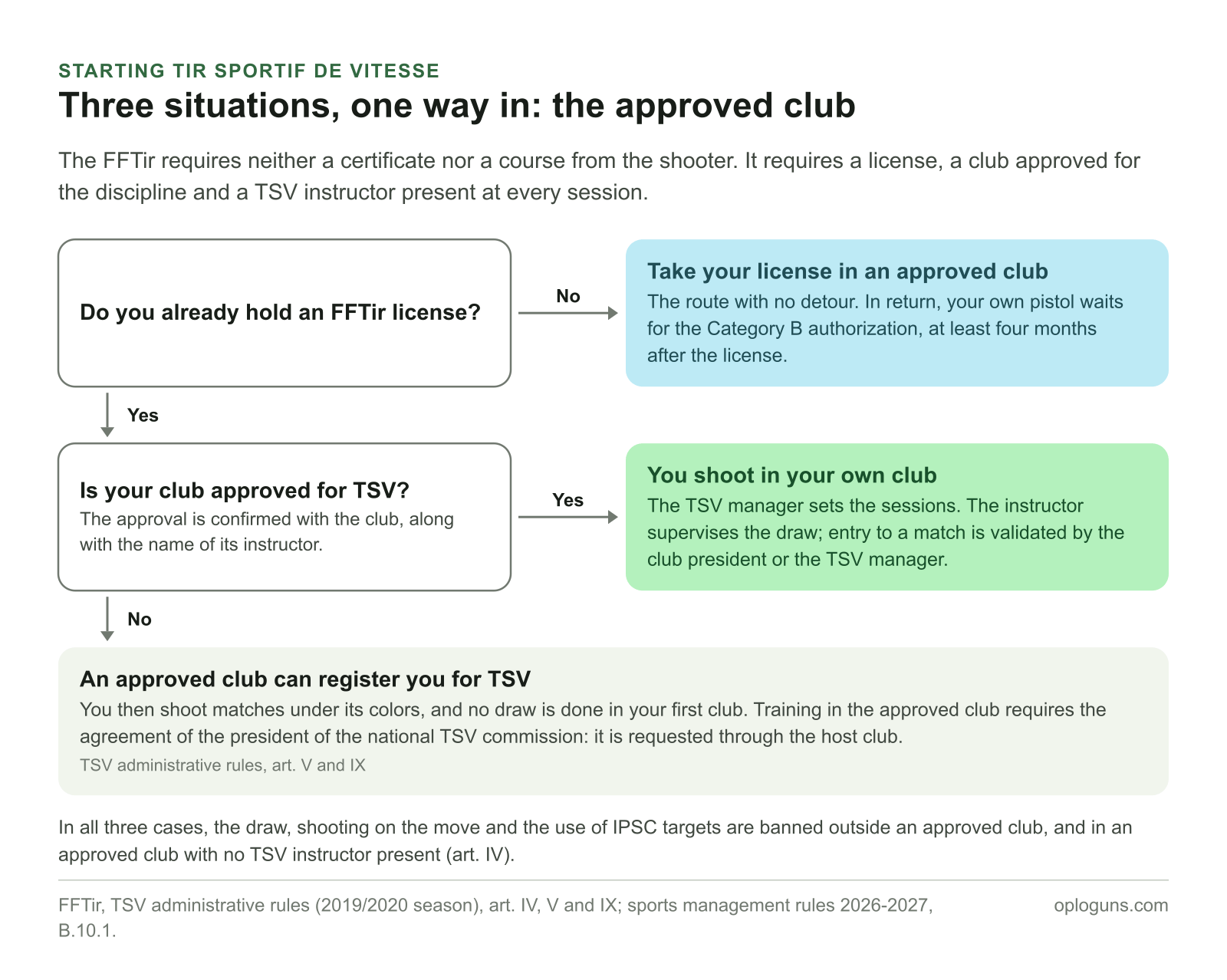
Already licensed in an approved club
The shortest route: the TSV manager sets the sessions, the instructor supervises the draw, and the president or the TSV manager validates the entry for the first match. In return, the pace is that of the club and its instructor.
Licensed in a non-approved club
An approved club may register you for the practice of TSV; you then shoot matches under its colors. In return, two clubs to attend, and no draw at all in the first. Training for a shooter who comes from a non-approved club requires, under article V of the administrative rules, the agreement of the president of the national TSV commission: it is requested through the host club.
Not yet licensed
Taking your license in an approved club avoids that detour. In return, your own pistol waits for the Category B authorization, at least four months after the license.
Sources 12 references
The conditions of access come from the FFTir's rules, the safety rules from the IPSC Handgun rules of January 2026, the number of clubs from the federal directory consulted on the day of publication. The federal and legal documents are in French. Click a note marker in the text to highlight the matching source.
- FFTir — Règlement administratif du Tir Sportif de Vitesse, saison 2019/2020 [TSV administrative rules, 2019/2020 season] (4-page PDF), consulted on 15 November 2026, articles VI and XV reread on 16 November 2026: preamble, « La pratique du Tir Sportif de Vitesse est exclusivement sportive et débouche obligatoirement sur la compétition » [the practice of TSV is exclusively sporting and necessarily leads to competition]; article I, a discipline « reconnue depuis 1978 par la FFTir » [recognized by the FFTir since 1978]; article III, approval proposed « à la demande des Présidents d'Associations (Clubs FFTir) et après avis du Président de Ligue », with « un responsable TSV (titulaire d'un diplôme de moniteur TSV valide) » and « installations homologuées » [at the request of club presidents and after the league president's opinion, with a TSV manager holding a valid TSV instructor's diploma and certified facilities]; article IV, practice « formellement interdite » of « tout exercice de tir comportant l'usage d'une arme portée à l'étui (dégainé) », of shooting on the move and of the use of IPSC targets « en dehors des Associations habilitées ou pour celles qui le sont « sans la présence d'un moniteur TSV » » [formally banned: any shooting exercise using a holstered firearm, outside approved associations or, for those that are approved, without a TSV instructor present], with referral to the national disciplinary commission « pour les tireurs mis en cause et pour le Président de l'Association concernée »; article V, « Seules les associations disposant d'un numéro d'affiliation FFTir, à jour de leurs cotisations et disposant d'une habilitation TSV, pourront procéder à des entrainements et/ou à l'organisation de compétitions » [only affiliated, paid-up associations holding a TSV approval may train and organize competitions], and no information days, courses or training sessions for shooters from non-approved associations « sans l'accord dérogatoire du Président de la CNS »; article VI, the president and the TSV manager have « l'entière et pleine responsabilité de la pratique de cette discipline », and the instructor may not work, without the agreement of the president of the CNS, « auprès de tireurs n'étant pas inscrits dans une Association habilitée »; article IX, « Les Associations habilitées ont la possibilité d'inscrire pour la pratique du TSV des tireurs licenciés venant d'Associations non habilitées. Ces tireurs seront classés, lors de compétitions de Tir Sportif de Vitesse, sous les couleurs de l'Association habilitée » [approved associations may register licensed shooters from non-approved associations for TSV; they are ranked in TSV competitions under the approved association's colors]; article XI, safety rules « conformes aux règles de sécurité de la F.F.Tir et au règlement sportif de l'I.P.S.C. »; article XV, license « validée par : - le médecin, attestant de l'aptitude au tir sportif, - le Président du club, certifiant dans le cas d'un mineur, être en possession de l'autorisation de la personne exerçant l'autorité parentale », and entry to a competition validated « par le Président ou le responsable TSV de l'association, ou par le Regional Director ». ⚠️ 2019/2020 edition: it is the only TSV administrative rulebook linked from the federation's website at this date.
- FFTir — Règlement de Gestion Sportive 2026-2027, Vie Nationale [sports management rules 2026-2027] (PDF, V1, « Version du 29/09/2026 »), consulted on 15 November 2026: B.10.1, « La participation au Tir sportif de vitesse est réservée aux tireurs licenciés dans les clubs habilités pour cette discipline et sous la responsabilité de leur Président de club et du responsable TSV. Lors des compétitions, tout tireur ne pouvant présenter sa licence ne peut en aucun cas y participer. » [participation is reserved for shooters licensed in approved clubs, under the responsibility of their club president and TSV manager; a shooter who cannot show their license may not take part]; B10.2.1, French championship « open sous réserve de validation par le moniteur TSV du club, le président du club et le service OCC »; A.1.1, medical certificate « de moins d'un an à la date de la compétition » [less than a year old on the date of the competition] for a competition on the federal calendar; A.1.6.1, at registration, the club's manager certifies that its shooters « sont aptes à concourir en toute sécurité et en toute connaissance des règles de compétitions »; A.4.1, « La participation aux championnats régionaux est obligatoire, sauf pour les disciplines Bench-Rest gros calibre et Tir Sportif de Vitesse, dont les principes de qualification sont open. » [taking part in regional championships is compulsory, except for centerfire Bench-Rest and TSV, whose qualification is open]. No shooter's certificate appears in it.
- IPSC — IPSC Handgun Competition Rules, January 2026 Edition (81-page PDF, final version of 29 December 2025, linked from the IPSC's "Rule Books" page), consulted on 15 November 2026: 2.1.2, "the default maximum muzzle angle is 90 degrees in all directions, measured from the front of the competitor facing directly center downrange"; 2.4.3 and 2.4.4, activities allowed in a safety area, "Dummy ammunition and live rounds […] must not be handled in a Safety Area under any circumstances"; 5.1.2, minimum caliber of 9x19 mm; 5.2.1 and 5.2.1.2, firearm carried unloaded, in a case or holstered, "empty magazine well, and the hammer or striker must be decocked"; 5.2.2, "Except when within the boundaries of a Safety Area, or when under the supervision and direct command of a Range Officer, competitors must not handle their firearms"; 5.4.1 and 5.4.2, protection "strongly recommended", which the organizer may require; 5.7.1 to 5.7.3, malfunction, two minutes; 8.1.2, handgun ready conditions; 8.2.4, "A course of fire must never require the competitor to draw a handgun from the holster with the weak hand"; 8.3.5 to 8.3.7, "Stop", "If You Are Finished, Unload And Show Clear", "If Clear, Hammer Down, Holster"; 8.4.1 and 8.5.1, fingers outside the trigger guard while reloading and moving, movement starting at "more than one step in any direction"; 8.7.1, sight pictures and dry firing banned before the start signal, warning then procedural penalty; 9.2.1.1, score for a course of fire equal to the points, penalties deducted, divided by the time; 10.5.7, muzzle of a loaded firearm more than one meter behind the feet during the draw; 10.5.13.1, loaded magazines allowed in a safety area if they stay in their pouch, the pocket or the bag; 10.5.15, "Dropped firearms must always be retrieved by a Range Officer". ⚠️ The IPSC website refused automated reading on 15 November 2026: the edition in force is checked on its "Rule Books" page.
- FFTir — Moniteur TSV [TSV instructor], page dated 4 January 2024, consulted on 15 November 2026: « La formation du Tir sportif de vitesse (TSV) est organisée au niveau national […]. Elle concerne l'arbitrage (Arbitre national TSV) et l'enseignement des gestes techniques permettant de pratiquer la compétition en sécurité (Moniteur TSV). Elle s'articule autour des épreuves Handgun (Pistolet), Rifle (Carabine) et Shotgun (Fusil). » [TSV training is organized nationally; it covers officiating (national TSV referee) and the teaching of the technical movements that allow safe competition (TSV instructor), across the Handgun, Rifle and Shotgun events].
- FFTir — Directives de formation 2021-2024, V8 [training directives] (PDF), consulted on 15 November 2026, table of diplomas: « MONITEUR TSV — Formation : 80 h avec l'ETNF — Le moniteur TSV transmet la gestuelle fondamentale permettant de pratiquer la compétition en sécurité. Il organise ses séances, veille à la sécurité et incite les tireurs à pratiquer la compétition. Entrée en formation à partir de 18 ans » [TSV instructor: 80 hours of training; passes on the fundamental movements for safe competition, runs sessions, watches over safety and encourages shooters to compete; entry into training from age 18]. ⚠️ Previous Olympic cycle: the 2025-2028 directives keep the diploma without restating its length.
- FFTir — Directives de formation 2025-2028 [training directives] (V1, 09/2024, PDF), consulted on 15 November 2026: « 2.2) Moniteur Tir sportif de vitesse (TSV) », with a reference to the diploma's page; no TSV shooter's certificate appears in it.
- FFTir — Tir sportif de vitesse — Formations [training], consulted on 15 November 2026: headings « IROA 2020 », « MONITEUR TSV 2020 » (« Pré-requis : Avoir effectué la formation arbitre NROI en 2019 et avoir répondu à l'appel à candidature » [prerequisite: having completed the NROI referee training in 2019 and answered the call for applications]) and « ARBITRES TSV 2020 ». ⚠️ Page not updated since 2020: all that year's courses are announced there as canceled.
- FFTir — « Où pratiquer » [where to shoot], club directory, consulted on 15 November 2026 with the filter « Pratique : Tir sportif de vitesse »: 173 clubs listed; by league, Provence 12, Languedoc-Roussillon 11, Lorraine 11, Lyonnais 10, Île-de-France 9, Alsace, Aquitaine, Centre-Val de Loire, Midi-Pyrénées, Normandie and Pays de la Loire 8, Côte d'Azur, Nord/Pas-de-Calais and Picardie 7, Dauphiné-Savoie and Poitou-Charentes 6, Auvergne, Bretagne and Guadeloupe 5, Bourgogne and Franche-Comté 4, Champagne, Corse and Martinique 3, Guyane, Limousin and Nouvelle-Calédonie 2, La Réunion 1, that is 173 across the form's 28 leagues. ⚠️ The directory shows a declared activity, not the approval.
- FFTir — Tir sportif de vitesse — Organisation, consulted on 15 November 2026: « Le Tir Sportif de Vitesse (TSV) est la déclinaison Française de l'IPSC. » [TSV is the French version of IPSC].
- Légifrance — arrêté du 28 avril 2020 relatif aux avis favorables et aux attestations délivrés par les fédérations [order on the favorable opinions and attestations issued by federations] (JORF of 29 April 2020), article 3: « la participation du tireur, au cours des douze mois précédant sa demande, à trois séances contrôlées de pratique du tir, espacées d'au moins deux mois » [the shooter's participation, during the twelve months preceding their application, in three controlled shooting sessions at least two months apart].
- Service-public.gouv.fr — armes de catégorie B pour un tireur sportif (soumises à autorisation) [Category B firearms for a sport shooter, subject to authorization], sheet F2250: « en l'absence de réponse dans un délai de 3 mois à partir de la date de réception de votre demande, cela signifie que votre demande est refusée » [with no answer within 3 months of the date your application was received, your application is refused].
- Légifrance — article R311-2 du code de la sécurité intérieure, version in force since 7 September 2025 (decree no. 2025-894 of 5 September 2025), consulted on 15 November 2026: Category B, 1°, « Armes à feu de poing et armes converties en armes de poing non comprises dans les autres catégories » [handguns and firearms converted into handguns not included in the other categories].
The rules in force prevail. This article describes the FFTir's texts and the IPSC Handgun rules of January 2026 as they read on 15 November 2026. The TSV administrative rules date from the 2019/2020 season: a club's approval and the conditions of a match are confirmed with the club and the federation.
Frequently asked questions
Where can you shoot TSV in France?
In a club approved for TSV by the FFTir, the French shooting federation, and only there: drawing from the holster is banned anywhere else. The federation's « Où pratiquer » [where to shoot] directory offers a « Tir sportif de vitesse » filter: it listed 173 clubs on 15 November 2026, including 12 in Provence and 11 each in Languedoc-Roussillon and Lorraine. The form shows a declared activity, not an approval: that is confirmed with the club.
What is TSV in shooting?
Tir sportif de vitesse is the French name for IPSC, recognized by the FFTir since 1978. The shooter draws, moves and shoots timed courses of fire on cardboard and metal targets, with a pistol of at least 9 mm carried in a holster. The score divides points by time.
Do you need a certificate or compulsory training to shoot TSV?
No. Neither the TSV administrative rules, nor the 2026-2027 sports management rules, nor the FFTir's training directives require a certificate, a permit or a course from the shooter. The federal diplomas are those of the supervising staff: TSV instructor and national TSV referee. The shooter must hold a license in an approved club, shoot with a TSV instructor present, and have their entry validated before a match.
Are there tir sportif de vitesse training courses?
The discipline's « Formations » [training] page, on the FFTir website, announced in 2020 only courses for supervising staff: referees, instructors and international range officers. An approved club may organize a course or a training session for shooters from non-approved clubs only with the agreement of the president of the national TSV commission. The shooter's training therefore takes place in their approved club.
Can you practice the draw in a non-approved club?
No. The TSV administrative rules ban « formellement » [formally] any shooting exercise with a holstered firearm, shooting on the move and the use of IPSC targets outside approved associations, and inside an approved association with no TSV instructor present. The shooter and the club president face the federation's disciplinary commission.
Which pistol for TSV?
A pistol of at least 9 mm: the IPSC rules set the minimum at the 9x19 mm cartridge. The choice then depends on the division. In Production, only the models on the list published by the IPSC are allowed. Every pistol that fires live ammunition is Category B: it is bought at least four months after the license, once the authorization has been granted.
Spotted an error, or a rule that has changed since we checked? Report an error