French Category B firearm authorization: timelines, file and renewal
Published on · Updated on · 9 min read · Anthony Baillon
Verified by a gunsmithSince the SIA, the French Category B authorization is global: a single title, valid five years, covers every firearm within the quota, fifteen at most, six for a first-time holder. It is requested online after the FFTir's opinion, based on three controlled sessions: four to seven months after the license.
At a glance
| Step | Timeline | Article |
|---|---|---|
| Three controlled sessions | 4 months at least | Order of 28/04/2020 |
| Review at the prefecture | 3 months at most, silence = refusal | R312-10-1 |
| Validity | 5 years, renewal 3 months before | R312-13, R312-14 |
- One authorization for every firearm: 15 at most, 6 for five years for a first-time holder.
- First year: €310 to €639 with the license, the medical certificate and the safe, firearm excluded.
- The license holds up the authorization: three months after a license lapses, the authorization is void.
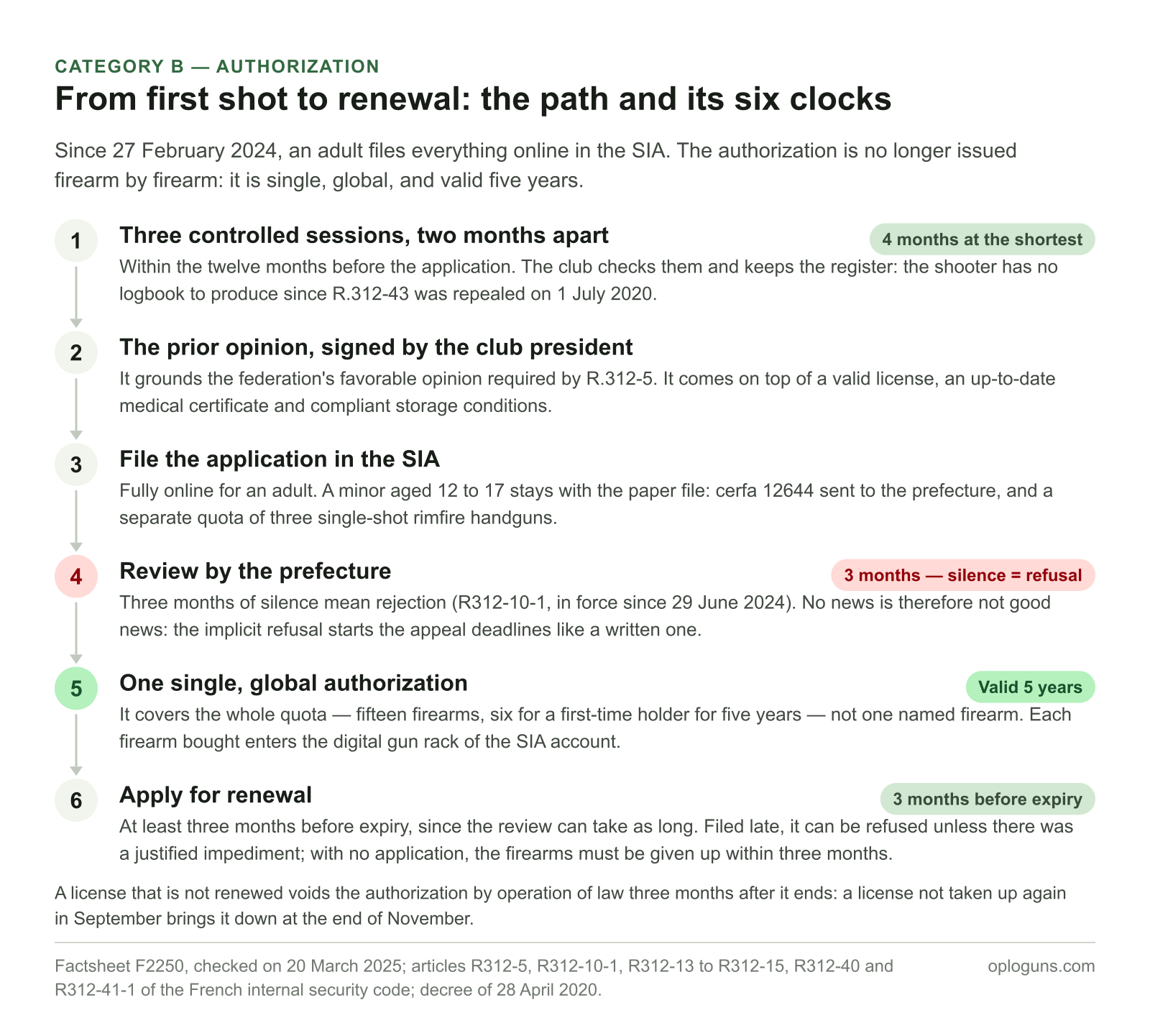
One authorization for every Category B firearm
Every pistol that fires a cartridge, .22 LR included, is a Category B firearm, subject to authorization9. Since the SIA opened to sport shooters on 27 February 2024, that authorization is no longer issued firearm by firearm: the holder receives « une nouvelle autorisation unique » [a new single authorization], which « constitue le titre de détention de toutes vos armes de catégories B » [is the holding title for all your Category B firearms]1.
- What it covers: the firearms within the quota, fifteen at most, six for five years for a first-time holder2.
- What it allows: acquiring and holding the firearms and their ammunition, 3,000 rounds per firearm per twelve-month period10.
- Where the firearms are used: at the ranges of approved sports associations1.
Each firearm bought from a dealer is transferred to the digital gun rack of the SIA account; the purchase is confirmed online, otherwise it is validated automatically after five days1. How the account works is described in the SIA account and digital gun rack.
Four to seven months from license to authorization
The application requires the favorable opinion of a federation delegated for shooting, the FFTir3. For a first application, that opinion rests on the shooter's participation, « au cours des douze mois précédant sa demande, à trois séances contrôlées de pratique du tir, espacées d'au moins deux mois » [in the twelve months before the application, in three controlled shooting sessions at least two months apart]4.
- Taking out a license at a club affiliated to the FFTir.
- Shooting three controlled sessions, the second at least two months after the first, the third two months after the second: four months at the very least.
- Obtaining the prior opinion signed by the club president, which accompanies the application5.
- Filing the application; the prefecture has three months to answer3.
That makes four to seven months between the license and the first purchase. The sessions are recorded in the club's register, not in a shooter's logbook5: see the three controlled sessions rule.
The authorization file: FFTir opinion, birth record, safe
For an adult, factsheet F2250 asks for two documents to upload to the SIA account1:
- A birth certificate extract with marginal notes, less than three months old.
- The FFTir's favorable opinion on acquiring and holding firearms, « lié à la pratique régulière du tir » [linked to regular shooting practice].
The other conditions are not uploaded but checked1:
- A valid FFTir license, and therefore an up-to-date medical certificate.
- No listing in the FINIADA and no conviction on bulletin no. 2 of the criminal record for the listed offences.
- A physical and mental condition compatible with holding a firearm.
- A safe, strong cabinet or strongroom, required by article R314-36.
Authorization: online for adults, by post for minors
| Adult | Minor aged 12 or over | |
|---|---|---|
| Filing | Online, SIA account | Post to the prefecture, cerfa 12644 |
| Firearms | 15, or 6 for a first-time holder | 3 single-shot rimfire handguns |
| Use | Ranges of approved associations | Association ranges, except international competition |
| Specific document | — | A parent's statement |
Cerfa no. 12644 is the « demande d'autorisation d'acquisition et de détention d'armes et de munitions » [application for authorization to acquire and hold firearms and ammunition]8. For a minor, the file also includes an identity document, proof of address, a sworn statement of compliant storage and a statement from a parent specifying that the firearm is held for sport shooting1. Article R312-40 limits a minor aged twelve or over, outside international competition, to three single-shot rimfire handguns, which « ne peuvent être utilisées que dans les stands de tir des associations » [may only be used at the ranges of shooting associations]2.
Three months without an answer mean refusal
« Le silence gardé pendant trois mois par l'autorité compétente vaut décision de rejet de la demande d'autorisation » [three months of silence from the competent authority amount to a decision rejecting the application] (article R312-10-1, in force since 29 June 2024)3. Factsheet F2250 puts it plainly: with no answer three months after the application is received, « cela signifie que votre demande est refusée » [it means your application is refused]1. The same rule applies to a renewal application1.
Three months is a ceiling, not an average: no official source publishes an average review time.
The timelines of a Category B authorization, in months
From application to expiry, articles R312-10-1 to R312-18 of the code de la sécurité intérieure
Three months of silence mean rejection3. The six-month period to acquire the firearm runs from notification of the authorization (R312-12)3. Once the expiry date has passed with no renewal requested, the holder has three months to part with the firearms (R312-18)3.
View the data
| Step | Timeline | Article |
|---|---|---|
| Review, silence meaning rejection | 3 months | R312-10-1 |
| Acquire the firearm after notification | 6 months | R312-12 |
| Validity of the authorization | 5 years | R312-13 |
| Filing the renewal | At least 3 months before expiry | R312-14 |
| Parting with firearms after an unrenewed expiry | 3 months | R312-18 |
Once the authorization is notified, article R312-12 sets six months, « à partir de la date de notification de l'autorisation » [from the date the authorization is notified], to acquire the firearm3.
Refused authorization: two months for each appeal
The authorization, or its renewal, may be refused on grounds of public order or personal safety, or if a condition is no longer met; if it is withdrawn, the holder has three months to part with the firearms1. There are three ways to appeal7:
- An appeal to the prefect (recours gracieux), within two months.
- An appeal to the Minister of the Interior (recours hiérarchique), within two months.
- A court appeal (recours contentieux), before the administrative court, within two months.
Refused authorization: appeal deadlines, in months
From notification of the refusal, or from the implicit refusal after three months of silence
An administrative appeal to the prefect or the minister interrupts the deadline for going to court, which restarts for two months after the answer; with no answer from the administration after two months, the appeal is deemed rejected7.
View the data
| Step | Deadline | Lodged with |
|---|---|---|
| Implicit refusal | 3 months of silence | Prefecture |
| Appeal to the prefect (recours gracieux) | 2 months | The prefect |
| Appeal to the minister (recours hiérarchique) | 2 months | The Minister of the Interior |
| Answer to the appeal | 2 months, silence meaning rejection | — |
| Court appeal (recours contentieux) | 2 months | The administrative court |
An appeal to the prefect or the minister interrupts the deadline for going to court, which restarts for two months. If that appeal gets no answer within two months, it is deemed rejected7: the deadline for going to court runs from that rejection.
Fifteen firearms in the quota, six for a first-time holder
Article R312-40 authorizes licensed adult shooters « dans la limite de quinze armes » [up to fifteen firearms], Category A1 firearms of 3° bis and 7° included2. Those who have never held an authorization, those who held one and were then listed in the FINIADA, and authorized minors who come of age may hold, « pendant une durée de cinq ans à compter de la délivrance de leur première autorisation, qu'un maximum de six armes » [for five years from the issue of their first authorization, a maximum of six firearms] (R312-41-1)2.
How many firearms the authorization covers, by profile
Category A1 and B firearms authorized for sport shooting, rules in force since 1 January 2024
An adult who takes part in national or international competitions goes straight to fifteen firearms, without going through the ceiling of six2. A minor selected for international competition also falls under the ceiling of fifteen2.
View the data
| Profile | A1 and B firearms | Article | How to apply |
|---|---|---|---|
| Adult shooter | 15 | R312-40 | Online, SIA |
| Adult in national or international competition | 15 from the start | R312-41-1 | Online, SIA |
| First-time holder, for 5 years | 6 | R312-41-1 | Online, SIA |
| Minor aged 12 or over | 3 single-shot rimfire handguns | R312-40 | By post, cerfa 12644 |
| Minor in international competition | 15 | R312-40 | By post, cerfa 12644 |
An adult who takes part in national or international competitions escapes the ceiling of six2. A long-standing license holder who has only ever held Category C firearms is still a first-time holder at their first application. The detail, ammunition and magazines included, is in French firearm and ammunition quotas.
Authorization valid five years, renewed three months ahead
« L'autorisation d'acquisition et de détention […] est accordée pour une durée de cinq ans » [the authorization to acquire and hold is granted for five years] (R312-13), and the renewal application « doit être déposée au plus tard trois mois avant la date d'expiration » [must be filed at least three months before the expiry date] (R312-14)3. Renewal is requested online, with the same documents as the initial application1, including a new FFTir opinion: twelve consecutive months without shooting stand in its way4.
A late renewal may be refused, save a justified impediment such as a hospital stay1. With no renewal requested, the holder must part with the firearms or have them deactivated within the three months following expiry3.
An expired license voids the authorization in three months
A sport shooter's authorization depends on the license. Article R312-15 makes it void by operation of law three months after the license expires, if it is not renewed31. The FFTir license runs from 1 September to 31 August11: a license not taken up again in September brings the authorization down at the end of November. Renewal is described in renewing your FFTir license.
Category B budget: €310 to €639 in the first year
Firearm and ammunition aside, Category B costs the license, the medical certificate and the safe.
| Item | First year | Following years |
|---|---|---|
| License and club membership | €165 to €3201213 | €165 to €2701213 |
| Medical certificate | €3014 | €30 |
| Handgun safe | €115 to €2891516 | — |
| Total | €310 to €639 | €195 to €300 |
The safe must be « adapté au type et au nombre de matériels détenus » [suited to the type and number of items held]6: beyond a few handguns, a long-gun cabinet costs €397 to €71515. The price of the firearm and ammunition is covered in choosing a first sport pistol.
Four misconceptions about the Category B authorization
- "You need one authorization per firearm." Not since the SIA: a single authorization « constitue le titre de détention de toutes vos armes de catégories B » [is the holding title for all your Category B firearms]1.
- "No answer from the prefecture means yes." It is the reverse: three months of silence mean rejection3.
- "Three sessions over six months are enough." The text speaks of twelve months and requires two months between sessions: three sessions in three weeks do not count4.
- "The authorization lasts five years whatever happens." It becomes void three months after a license lapses3, and the shooting logbook that once proved the sessions has not existed since 1 July 20202.
Sources 16 references
The articles of the code de la sécurité intérieure and the order of 28 April 2020 were reread on Légifrance in their version in force on 24 September 2026, and the service-public.gouv.fr factsheets the same day. French documents keep their French titles and quotations, with a short translation in brackets. Click a note marker in the text to highlight the matching source.
- Service-Public (DILA) — Armes de catégorie B pour un tireur sportif (soumises à autorisation), fiche F2250 (in French), checked on 20 March 2025, consulted on 24 September 2026: conditions (FINIADA, bulletin no. 2, physical and mental condition, FFTir licence); adults: application « en ligne après avoir créé un compte SIA » [online after creating an SIA account], birth certificate extract less than 3 months old and « Avis favorable de la Fédération française de tir […] lié à la pratique régulière du tir » [favourable opinion of the French shooting federation linked to regular practice]; minors: post, cerfa no. 12644, identity document, proof of address, sworn statement of compliant storage, statement from a person with parental authority; firearms transferred to the digital gun rack, purchase « validé automatiquement au bout de 5 jours » [validated automatically after 5 days]; « En l'absence de réponse dans un délai de 3 mois […] votre demande est refusée » [with no answer within 3 months, your application is refused]; when the SIA account is created from 27 February 2024, « il vous est délivré une nouvelle autorisation unique. Cette nouvelle autorisation constitue le titre de détention de toutes vos armes de catégories B » [you are issued a new single authorisation, which is the holding title for all your Category B firearms]; authorisation granted for 5 years; 15 firearms, 6 for 5 years for a first-time applicant; firearms usable at the ranges of approved sports associations; renewal « au plus tard 3 mois avant » [at least 3 months before], which may be refused if late « sauf empêchement justifié » [save a justified impediment]; withdrawal and parting with firearms within 3 months; « l'autorisation perd sa validité à la fin d'un délai de 3 mois suivant la date de fin de validité de la licence » [the authorisation loses its validity 3 months after the licence expires].
- Légifrance — articles R312-40 à R312-43-1 du code de la sécurité intérieure, « Tir sportif » (in French), consulted on 24 September 2026: R312-40 (version of 1 January 2024, decree no. 2023-557) — firearms « des 3° bis et 7° de la rubrique 1 du I et des 1°, 2°, 4°, 5°, 9° et 10° du II de l'article R. 311-2 » [of 3° bis and 7° of heading 1 of I and of 1°, 2°, 4°, 5°, 9° and 10° of II of article R311-2], « dans la limite de quinze armes » [up to fifteen firearms]; minors aged at least twelve outside international competition: « armes de poing à percussion annulaire à un coup du 1° de la catégorie B, dans la limite de trois » [single-shot rimfire handguns of Category B 1°, up to three], which « ne peuvent être utilisées que dans les stands de tir des associations » [may only be used at the ranges of shooting associations]; R312-41-1 — six firearms for five years for anyone who has never held an authorisation, has been in one of the situations of article L312-16, or comes of age after a minor's authorisation, except for national or international competitions; R312-43, which imposed the shooting logbook, repealed on 1 July 2020 (decree no. 2020-486).
- Légifrance — sous-section « Armes soumises à autorisation » du code de la sécurité intérieure (in French), consulted on 24 September 2026: R312-5 4° c) (version of 19 June 2022) — « Avis favorable concernant l'acquisition et la détention d'armes à l'exclusion de leurs éléments, délivré par une fédération sportive » [favourable opinion on acquiring and holding firearms, excluding their components, issued by a sports federation] delegated for shooting; R312-10-1 (version of 29 June 2024) — « Le silence gardé pendant trois mois par l'autorité compétente vaut décision de rejet » [three months of silence from the competent authority amount to rejection]; R312-12 (version of 1 August 2018) — acquisition « dans un délai de six mois à partir de la date de notification de l'autorisation » [within six months of the date the authorisation is notified]; R312-13 (version of 29 June 2024) — « accordée pour une durée de cinq ans » [granted for five years]; R312-14 — renewal « au plus tard trois mois avant la date d'expiration » [at least three months before the expiry date]; R312-15 (version of 10 February 2022) — authorisation void by operation of law three months after an unrenewed licence expires; R312-17 and R312-18 — parting with firearms « dans le délai de trois mois qui suit soit la date d'expiration de son autorisation » [within three months following the expiry date of the authorisation]. ⚠️ The six-month period of R312-12 has not been rewritten since the move to the SIA's global authorisation; no text consulted specifies how the two fit together.
- Légifrance — arrêté du 28 avril 2020 relatif aux avis favorables et aux attestations délivrés par les fédérations (in French), in force on 24 September 2026: article 3 — « Pour une première demande d'acquisition […], l'attestation porte sur la participation du tireur, au cours des douze mois précédant sa demande, à trois séances contrôlées de pratique du tir, espacées d'au moins deux mois » [for a first application, the certificate covers the shooter's participation, in the twelve months before the application, in three controlled shooting sessions at least two months apart]; article 4 — « L'absence de pratique du tir pendant douze mois consécutifs au moins au cours de cette période fait obstacle à la délivrance de cette attestation et à l'avis favorable de la fédération. » [not shooting for at least twelve consecutive months during that period prevents the certificate and the federation's favourable opinion].
- Fédération française de tir — « 2020, nouveau régime de la délivrance des avis préalables » (in French), 7 May 2020: « seul l'avis préalable signé par le président de l'association devra accompagner les demandes initiales » [only the prior opinion signed by the association's president need accompany initial applications]; « le Carnet de tir et sa vérification par l'Administration seront purement et simplement supprimés » [the shooting logbook and its checking by the administration will be abolished outright], replaced by the register of controlled sessions kept by the association.
- Légifrance — article R314-3 du code de la sécurité intérieure (in French), version in force since 11 May 2017, consulted on 24 September 2026: Category A and B firearms, components and ammunition kept « dans des coffres-forts ou des armoires fortes adaptés au type et au nombre de matériels détenus » [in safes or strong cabinets suited to the type and number of items held], or « à l'intérieur de pièces fortes comportant une porte blindée et dont les ouvrants sont protégés par des barreaux » [inside strongrooms with a reinforced door and barred openings].
- Service-Public (DILA) — contester une décision administrative, fiche F2474 (in French), checked on 11 May 2026, consulted on 24 September 2026: « Le délai est de 2 mois pour faire un recours gracieux » [the deadline for an appeal to the author of the decision is 2 months], likewise for the appeal to the superior authority; « L'envoi du recours interrompt le délai de 2 mois […] dont vous disposez pour saisir le tribunal administratif » [sending the appeal interrupts the 2-month deadline for going to the administrative court]; « L'administration a un délai de 2 mois pour vous répondre. Si vous n'obtenez pas de réponse passé ce délai, votre recours est considéré comme rejeté. » [the administration has 2 months to answer; with no answer after that, the appeal is deemed rejected].
- Service-Public — formulaire cerfa n° 12644*04 (in French): « Demande d'autorisation d'acquisition et de détention d'armes et de munitions, de renouvellement d'autorisation de détention » [application for authorisation to acquire and hold firearms and ammunition, or to renew a holding authorisation].
- Légifrance — article R311-2 du code de la sécurité intérieure (in French), version in force since 7 September 2025, consulted on 24 September 2026: Category B, « armes soumises à autorisation » [firearms subject to authorisation], 1° « Armes à feu de poing et armes converties en armes de poing non comprises dans les autres catégories » [handguns and firearms converted into handguns not included in the other categories].
- Légifrance — article R312-47 du code de la sécurité intérieure (in French), version in force since 1 January 2024, consulted on 24 September 2026: the firearm's authorisation « vaut autorisation d'acquisition et de détention des munitions correspondantes » [is also authorisation to acquire and hold the matching ammunition]; « 3 000 cartouches par arme au titre du 2° de l'article R. 312-40 » [3,000 rounds per firearm under 2° of article R312-40], « par période de douze mois à compter de la date de délivrance de celle-ci » [per twelve-month period from its date of issue].
- Fédération française de tir — « S'inscrire à la FFTir » (in French), consulted on 23 September 2026: licence « valable du 1er septembre au 31 août de l'année suivante » [valid from 1 September to 31 August of the following year].
- USO Tir, FFTir-affiliated club — tarifs, saison 2026-2027 (in French), consulted on 24 September 2026: adult €165; « les tarifs comprennent le coût de la licence fédérale, l'assurance et la cotisation à l'USO Tir » [prices include the federal licence, insurance and USO Tir membership].
- Tir Club Alpin — inscription et tarifs (in French), 2026-2027 season, consulted on 24 September 2026: €318 for a new member, €268 on renewal.
- Assurance maladie — tarifs conventionnels des médecins généralistes (in French), consulted on 24 September 2026: « G : consultation pour le médecin généraliste ou spécialiste de médecine générale » [G: consultation with a general practitioner], €30.00 in mainland France.
- Armurerie Loisir — coffres-forts et armoires fortes, prices read on 24 September 2026: handguns Fortify Delta 1 €115.00, Fortify SC6 €249.00, Infac C3A €259.00; long guns Buffalo 7 guns €397.00, Buffalo River 7 guns €510.90, Buffalo Digital Premium 10 guns €715.00. ⚠️ Commercial data.
- Safepro24 France — coffres-forts pour armes de poing, prices read on 24 September 2026: Profirst Patrol €166.40, Profirst NY 2 €289.00, Rottner Gunmaster XL €392.80, Profirst Pistol EN0 EL €520.80. ⚠️ Commercial data.
The text in force prevails. This article describes the texts as of 24 September 2026. For a specific file, the point of contact is the prefecture of your home address, through the SIA account.
Frequently asked questions
Do you need one authorization per Category B firearm?
No, not since the SIA. The shooter receives a single authorization which « constitue le titre de détention de toutes vos armes de catégories B » [is the holding title for all your Category B firearms], according to service-public factsheet F2250. It covers the firearms within the quota: fifteen at most, six for five years for a first-time holder. Each firearm bought from a dealer enters the digital gun rack of the SIA account.
How long does it take to get a Category B authorization?
Four to seven months after the license. The FFTir's favorable opinion requires three controlled sessions at least two months apart, so four months at the very least, then the prefecture has three months to answer. Three months of silence mean refusal, not approval.
How long is a Category B authorization valid?
Five years, under article R312-13 of the code de la sécurité intérieure. Renewal is requested at least three months before expiry, with the same documents as the first application. The authorization becomes void three months after the shooting license expires if the license is not renewed.
Can a minor get a Category B authorization?
Yes, from age 12, for three single-shot rimfire handguns at most, usable only at the ranges of shooting associations, except in international competition. The application is made by post to the prefecture, with cerfa 12644 and a parent's statement. A minor selected for international competition falls under the ceiling of fifteen firearms.
What happens if the prefecture does not answer?
Three months of silence mean refusal (article R312-10-1). This implicit refusal is challenged like a written one: an appeal to the prefect or to the minister within two months, then an appeal to the administrative court within two months. The administrative appeal interrupts the deadline for going to court.
What safe is required for a Category B firearm?
A safe or strong cabinet « adaptés au type et au nombre de matériels détenus » [suited to the type and number of items held], or a strongroom with a reinforced door and barred openings (article R314-3). No standard is imposed. A handgun safe costs €115 to €289 depending on the model.