Back to news

Which pistol for which FFTir discipline?

Published on · 24 min read · Anthony Baillon

Which pistol for which FFTir discipline? No federal rulebook answers with a model: it sets measurable thresholds — trigger, barrel length, sight radius, caliber, type of sights. What remains is knowing which, and which one most often disqualifies a firearm: the barrel too long in TAR, or the trigger too light.

13 cm maximum pistol barrel length in TAR
1,360 g minimum trigger weight in TAR, every event
.22 LR caliber required for 25 m sport and 50 m pistol
Eligibility thresholds by event: 500 g of trigger weight for the 10 m pistol, 1,000 g and a 153 mm barrel for the 25 m ISSF with a sight radius of 220 mm at most, no restriction for the 50 m free pistol, and 1,360 g of trigger weight with a 130 mm barrel in TAR pistol, 155 mm in TAR revolver.
Two boxes explain most of the refusals on the firing line: the barrel and the trigger. © Oplo

What FFTir equipment control checks

The question "which pistol for which FFTir discipline" has two readings. The dealer's: which firearm to buy. Ours: the firearm I already own, in which events can I present it. The rulebook answers the second — it names no commercial model, it sets thresholds that can be measured, firearm in hand, at equipment control.

The classification of the firearm, first, does not depend on the discipline. A sport pistol falls under Category B, subject to authorization, whether you shoot 10 meters or TAR: article R311-2 places "handguns […] not covered by the other categories" there1. What each event checks is this:

  • The caliber — imposed event by event: 4.5 mm, .22 LR, or centerfire within a precise window.
  • The barrel length — capped in TAR, bounded by a box, or free elsewhere.
  • The trigger weight — a floor that rules out triggers that are too light.
  • The sights — fixed and open in TAR, optics banned.
  • The weight and bulk — a dimensional control box at the ISSF events.

These thresholds are scattered across several federal rulebooks, each with its own date and sometimes in tension with the previous one. So we date every rule. And since classification comes before everything, a reminder: our guide to firearm categories A, B, C and D explains why a sport pistol is almost always in B, whatever the event.

On the discipline side, the sports management rulebook 2025-2026 numbers the pistol events: 100, 102 and 103 at 10 meters; 250, 252 and 253 at 25 meters; 251 for centerfire; 500 at 50 meters36. Service-firearm shooting (TAR) and speed shooting (TSV) come under separate rulebooks. Each sets its own trigger floor, the first threshold to know.

The minimum trigger weight, discipline by discipline

Trigger floor required for pistols, in grams; ISSF figures (2025 edition, Second Print 07/2026) at 10, 25 and 50 m, TAR rulebook 2025-2026 for TAR

TAR 830, 831, 83225 m ISSF pistol10 m air pistolTAR — minimum trigger weight of 1,360 g for every handgun event (2025-2026 rulebook)25 m sport, rapid fire and standard pistol — minimum trigger weight of 1,000 g10 m air pistol — minimum trigger weight of 500 g1,360 g1,000 g500 g0 g375 g750 g1,125 g1,500 g

The TAR floor, 1,360 g, applies "to all firearms used" in every handgun event211. The 10, 25 and 50 m figures are the ISSF rules applied by the federation4, cross-checked against concordant reproductions910; the 50 m free pistol imposes no minimum.

Voir les données
EventDistanceMinimum triggerMaximum weight
TAR 830 / 831 / 83225 m1,360 gnot specified
25 m ISSF pistol25 m1,000 g1,400 g
10 m air pistol10 m500 g1,500 g
50 m pistol (free)50 mno minimumno limit

10 m air pistol: the firearm admitted

The 10 meter pistol (event 100) is shot one-handed, standing, one pellet at a time. Its figures come not from a federal rulebook of its own but from the ISSF rules the federation applies: caliber 4.5 mm, trigger of at least 500 g, maximum weight of 1,500 g, and compulsory passage through a control box of 420 × 200 × 50 mm410.

Those four constraints are enough to rule out most "leisure" air pistols. A blowback model firing steel BBs meets neither the projectile requirement — 4.5 mm lead — nor the weight, nor the box dimensions. The 10 m event is not a matter of power but of dimensional conformity: it calls for a dedicated match pistol, running on compressed air, CO2 or pre-compressed air, never a service replica.

At that level of requirement, the barrel and the sight radius are not capped by figures of their own: they are bounded by the control box. It is the box, and the weight, that govern at equipment control.

25 m pistol: rapid fire, standard and sport

At 25 meters, three events share the same caliber: sport pistol (252), five-target rapid fire pistol (253) and standard pistol (250). All three require .22 Long Rifle, rimfire49. Trigger of at least 1,000 g, maximum weight of 1,400 g, barrel capped at 153 mm, sight radius at 220 mm, and a control box of 300 × 150 × 50 mm.

The consequence is clear, and it is the most frequent error: no centerfire pistol has a place in these three events. Not 9mm, not .40, not .45 ACP. A shooter who owns a service pistol will have to aim at other events — centerfire, TAR or speed shooting — but not 25 meter sport. The ammunition, for its part, must be bare lead: jacketed projectiles are excluded4.

There is one exception at this distance: the centerfire pistol event (251), the only "ISSF" 25 meter event open to centerfire. The caliber window runs from 7.62 mm (.30) to 9.65 mm (.38)49. The 9mm Parabellum fits dimensionally, but the same ammunition rule as the other three 25 meter events applies: lead or soft-material projectiles only, jacketed banned4. And commercial 9mm Parabellum is jacketed. The event is moreover built around dedicated target pistols, in .32 and .38 with low recoil.

9mm in 251: it is the ammunition that blocks it, not the caliber. The ISSF template for 25 meter centerfire — caliber 7.62 to 9.65 mm, trigger of at least 1,000 g, box 300 × 150 × 50 mm — does not dimensionally exclude a 9mm service pistol49. The ammunition rule, by contrast, is an explicit sentence of the rulebook: lead or soft-material projectiles only, jacketed not permitted4. Since commercial 9mm Parabellum is jacketed, the event is closed to it in practice — unless you shoot lead projectiles, which the rule allows. Present your cartridges at equipment control, not just your firearm.

This confusion comes from the nature of calibers themselves: two cartridges of neighboring diameter can belong to different families. We set out those differences in our guide to handgun calibers, and compared the two entry calibers in a 9mm against .22 LR piece that overlaps exactly with this choice of events.

50 m pistol: free precision in .22 LR

The 50 meter pistol (event 500), known as "free pistol", is the most permissive on the firearm and the most demanding on the shooter. Caliber .22 Long Rifle, and above all no minimum trigger weight: the trigger may be set extremely light47. It is the only pistol event with no trigger floor.

No control box, no weight limit bears on the firearm itself, and the grip may wrap the hand — a so-called orthopedic grip is allowed, with no support beyond the wrist. Shooting is one-handed, standing, at fifty meters. The paradox of the discipline: the most permissive on equipment is also the one that in fact excludes every service pistol, since it calls for a free pistol in .22 LR.

At that distance, reading the target becomes a subject in itself; we gathered the official formats in our guide to sport shooting target dimensions. For the choice of firearm, remember above all that 50 meters shares .22 LR with 25 meter sport: one rimfire pistol covers both distances.

TAR: events 830, 831 and 832 at 25 m

Service-firearm shooting has service pistols and revolvers, modern or old, fired at 25 meters27. Its reference rulebook is dated: version 2025-2026, issued 12 January 2026 and approved by the federal executive committee on 6 December 2025. Three handgun events coexist: 830 (recent firearms), 831 (service-firearm rapid fire) and 832 (authentic firearms).

Caliber first: centerfire only, "of a caliber between 7.62 mm and 11.60 mm", in the original caliber211. The .22 LR (5.6 mm), being rimfire, therefore has no place in TAR pistol — it exists there only in rifle. The list is closed: 9mm Parabellum, .45 ACP, .38 Special, 7.65 Browning… A .357 Magnum is admitted only if it fires .38 Special ammunition.

TAR event (25 m) Firearms concerned Common constraints
830 — recent firearms Modern service pistols and revolvers Barrel ≤ 13 cm (pistol) or 15.5 cm (revolver); 7.62–11.60 mm centerfire; trigger ≥ 1,360 g; fixed open sights
831 — service-firearm rapid fire Rapid fire with service firearms Same caliber, trigger and sight thresholds
832 — authentic firearms Models in service until 1970, designed after 1886, in their original condition and caliber Trigger ≥ 1,360 g; original sights; recent reissues excluded

Three equipment constraints apply to every event, whatever the firearm:

  • Trigger ≥ 1,360 g — "the trigger weight of all firearms used may not be less than 1.360 kg"211, no trigger shoe allowed, pistols and revolvers alike.
  • Fixed open sights — "only fixed and open sighting devices are permitted": no laser, no fiber optic, no red dot, no adjustable rear sight in 830211.
  • Standard version — the rulebook expressly admits the "CZ Shadow no. 1 and no. 2" in 830 if they meet these criteria2.

Event 832 deserves a note of its own. An "authentic" firearm is defined there as a model issued to an army in conflict up to 1970, designed after 1886, presented in its original condition and caliber27. The closed list runs to about a hundred and fifty models — Luger P08, Walther P38, PP and PPK, Tokarev TT33, Makarov, Colt 1911 and 1911A1, MAS 35 and 50, Beretta 1934, Webley. Modern reissues of those firearms are excluded from it.

The maximum barrel length allowed, event by event

Barrel length ceiling for pistols, in millimeters; the limit for a semi-automatic pistol in TAR is the lowest, threading included

TAR — semi-automatic pistol25 m ISSF pistolTAR — revolverTAR — barrel of 130 mm maximum for a semi-automatic pistol, threading included25 m ISSF pistol — barrel of 153 mm maximumTAR — barrel of 155 mm maximum for a revolver130 mm153 mm155 mm0 mm40 mm80 mm120 mm160 mm

The 130 mm for pistols and the named exclusion of the "GLOCK 34 and 35" come from the TAR rulebook 2025-2026, which by contrast admits the "CZ Shadow no. 1 and no. 2" in 8302. A CZ 75 Shadow 2 with a 119 mm barrel therefore falls under the bar14. The 155 mm revolver limit appears only in the federal annex.

Voir les données
EventType of firearmMaximum barrelSource
TAR 830 / 831 / 832Semi-automatic pistol130 mm (threading included)TAR rulebook 2025-2026
25 m ISSF pistolPistol153 mmISSF rules
TAR 830 / 831 / 832Revolver155 mmTAR rulebook 2025-2026
10 m / 50 m ISSF pistolPistolbounded by the box / no ceilingISSF rules

The rulebook does not stop at millimeters: it names. The "GLOCK 34 and 35", with long barrels, are explicitly excluded from 8302. In other words, the competition variant of a model otherwise admitted can fall out of the event by its barrel alone — while the standard version enters without discussion.

TAR pistol is shot at 25 meters, not 50. The three handgun events (830, 831, 832) take place at 25 meters. The 50 meters in TAR concerns .22 LR rifles, not pistols. And you do not shoot .22 LR pistol in TAR: centerfire, 7.62 to 11.60 mm, is required2. Both confusions circulate widely; the rulebook does not allow either.

Glock 17, CZ 75: which event to shoot

Let us gather the thresholds around the firearms people actually own. Read by row: start from the firearm, read across the columns. No platform ticks every box — and that is precisely why you choose the event before the model.

Firearm you hold Caliber Events where it is admitted Point to check
9mm service pistol (Glock 17, SIG P226, Beretta 92, CZ 75) 9mm Para TAR 830 and 831; TSV (Production, Standard) Barrel under 13 cm, threading included
CZ 75 Shadow or Shadow 2 9mm Para TAR 830 (admitted by name); TSV Barrel 119 mm, verified
Long-barreled 9mm pistol (Glock 34, Glock 35) 9mm Para TSV only Excluded from TAR by name
1911-type pistol .45 ACP TAR 830 and 831; 832 if an authentic Colt 1911 / 1911A1 Original condition and caliber for 832
.22 LR target pistol (Pardini, Morini) .22 LR 25 m pistol (sport, rapid fire, standard) and 50 m
ISSF air pistol (Walther, Steyr) 4.5 mm 10 m pistol
.38 Special / .357 Magnum revolver .38 Special TAR 830, 831, 832; 25 m centerfire (251) by caliber Barrel under 15.5 cm; .357 firing .38

The logic is obvious once set out this way. A modern 9mm pistol lives in TAR and speed shooting, never in the ISSF events, which do not want centerfire at these distances. A .22 LR opens 25 meter sport and 50 meter. A 4.5 mm air pistol is confined to 10 meters. Only the barrel, on models other than the CZ Shadow 2, remains to be confirmed on a dealer's spec sheet before settling TAR eligibility.

The events open to revolvers

The revolver has its place, provided it respects the 15.5 cm barrel. In TAR it shoots in 830 and 831 among the recent firearms, and in 832 if it is an authentic model — a Webley in its original condition and caliber, for instance2. The same caliber floor, 7.62 to 11.60 mm, and the same 1,360 g trigger apply.

On the ISSF side, a revolver may be presented at 25 meter centerfire (251) if its caliber falls in the window — a .38 Special, typically4. It also finds a place in the metallic silhouette events, which provide revolver categories3. One gray area remains: the national speed shooting program lists no "Revolver" division for pistol, where the IPSC has one. We therefore do not assert it for France.

The choice between the two platforms goes beyond eligibility alone. For conformity, remember that the revolver enjoys a more generous barrel limit — 15.5 against 13 cm — but the same caliber and trigger floors as the pistol.

The pistol in TSV: divisions and a 9mm minimum

Speed shooting (TSV) is the French version of the IPSC. The federal page describes it without ambiguity: it is about "shooting against the clock with pistols of 9 millimeter caliber", and "the Fédération Française de Tir is affiliated to the International Practical Shooting Confederation"5. The 9 × 19 mm is therefore the caliber floor, and the stages run from 10 to 70 meters, in strings that can reach 12, 24 or 32 rounds.

For pistol, the discipline has six divisions in the federal rulebook: Open, Classic, Production, Production Optic, Standard and PCC38. Optics or red dots are allowed in Open and Production Optic, banned in Production, Standard and Classic. This is where a long-barreled 9mm, excluded from TAR, finds a full place — speed shooting does not impose the 13 cm limit.

The fine figures of TSV remain to be confirmed. The divisions come from the federal rulebook 2025-20263. The precise technical values, however — power factor, magazine box dimensions, caliber floor by division — circulate from club documents whose numbers do not agree. We do not publish them here, for want of a dated IPSC or federal rulebook to anchor them to. The only certain floor is the caliber: 9mm minimum.

Barrel length, weight, sights: the thresholds

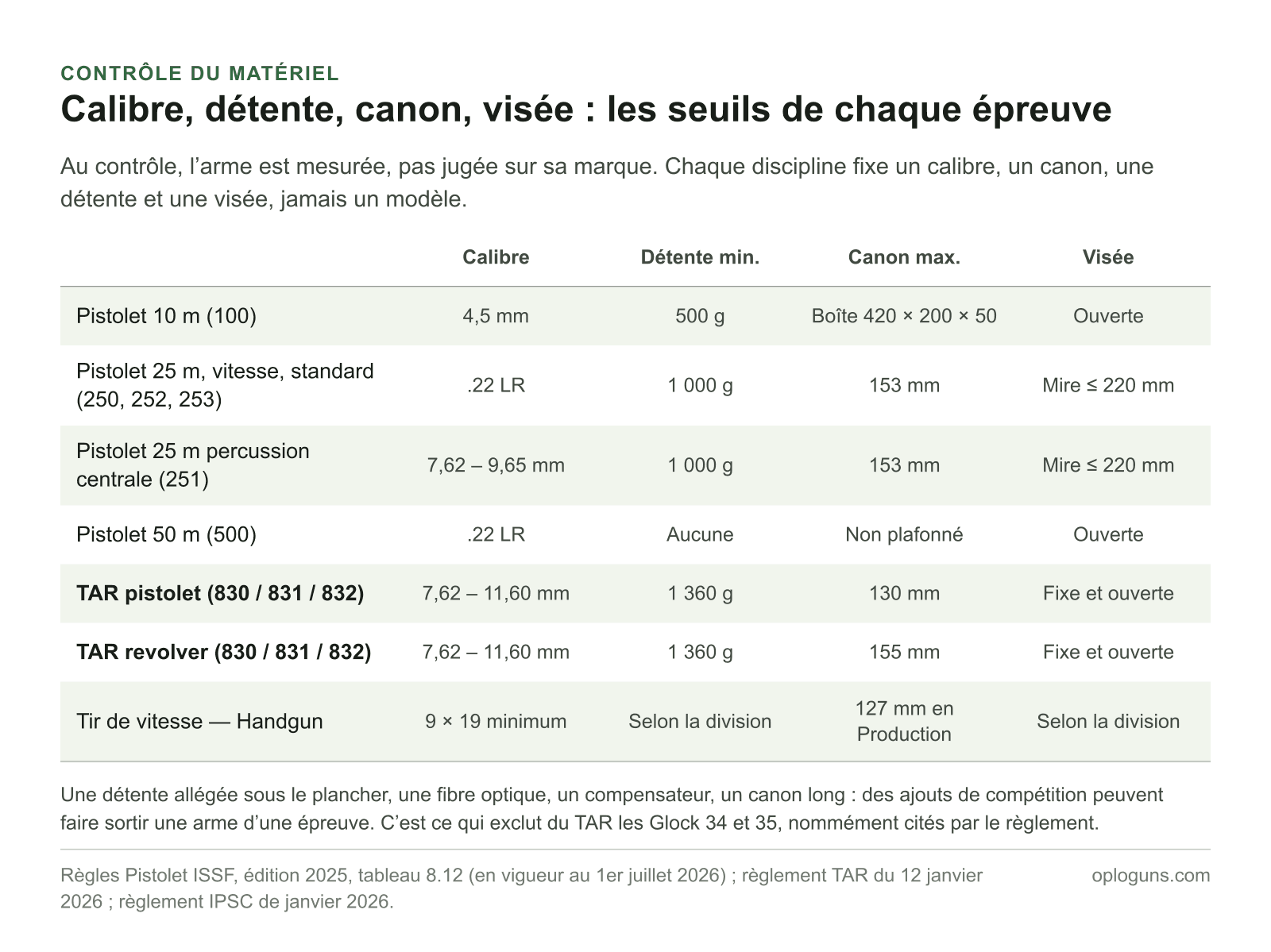
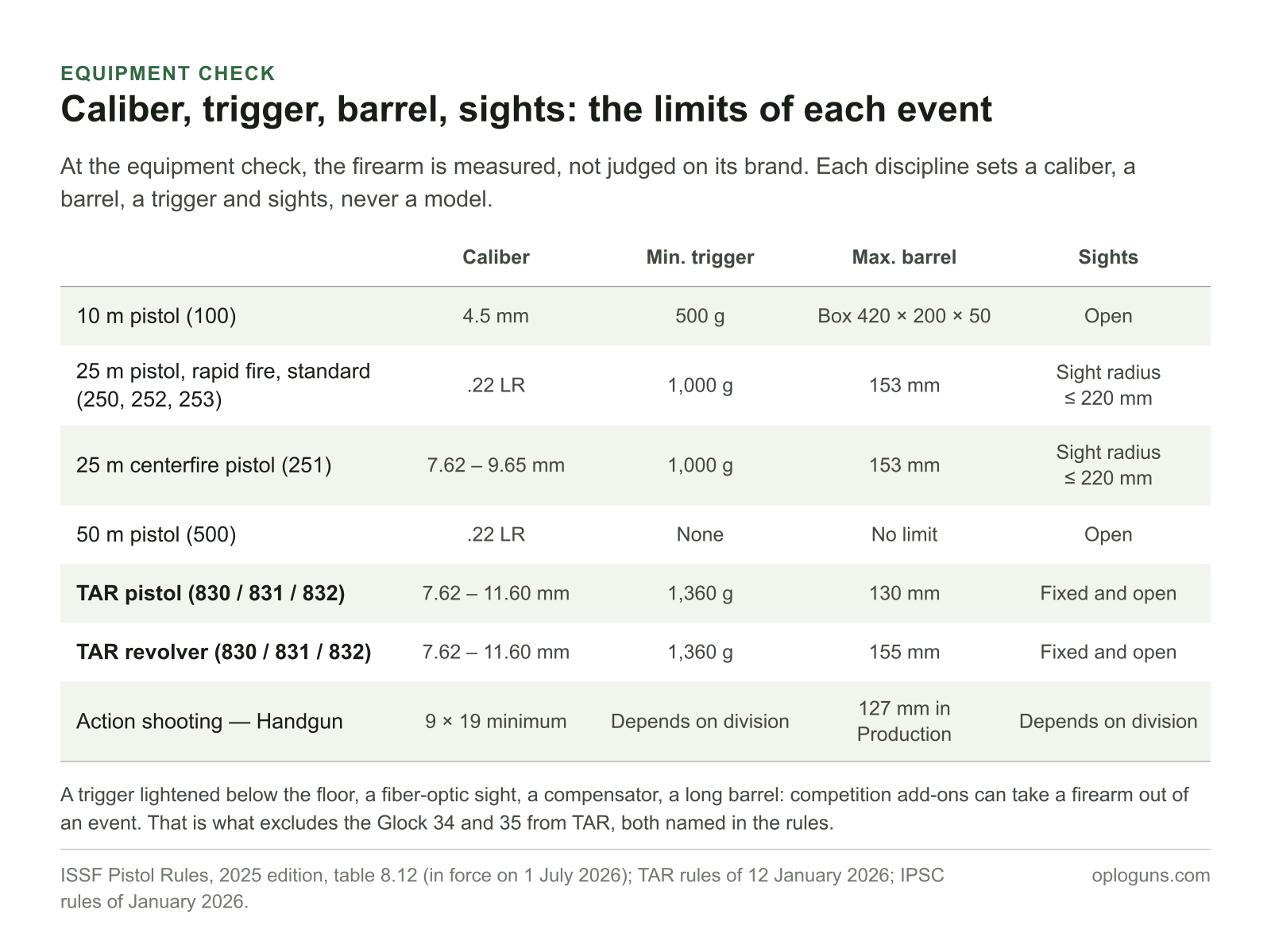
We have seen the thresholds event by event; here they are side by side. This is the reference table to keep — it answers, row by row, the question "does my firearm fit?".

Event (code) Distance Caliber Min trigger Max barrel Sights
10 m pistol (100) 10 m 4.5 mm 500 g Bounded by the 420×200×50 box
25 m sport / rapid fire / standard pistol (252 / 253 / 250) 25 m .22 LR 1,000 g 153 mm Sight radius ≤ 220 mm
25 m centerfire pistol (251) 25 m 7.62–9.65 mm 1,000 g 153 mm Sight radius ≤ 220 mm
50 m free pistol (500) 50 m .22 LR None No ceiling Orthopedic grip allowed
TAR pistol (830 / 831 / 832) 25 m 7.62–11.60 mm 1,360 g 130 mm Fixed and open
TAR revolver (830 / 831 / 832) 25 m 7.62–11.60 mm 1,360 g 155 mm Fixed and open
Speed shooting — Handgun 10–70 m 9 × 19 minimum By division

Three levers do most of the sorting. The caliber eliminates immediately: it separates the rimfire world (.22 LR, 10 and 50 m) from the centerfire world (TAR, speed shooting). The barrel then settles matters in TAR, where it alone distinguishes a standard platform from a competition variant. The trigger finishes everywhere else, from the light floor of 10 meters to the 1,360 g of TAR.

These ISSF figures come from the edition in force at 30 July 2026. The template for 10, 25 and 50 meters is drawn from table 8.12 of the ISSF pistol rulebook, 2025 edition in its second print of July 2026, in force since 1 July 20264. The five 25 meter figures — 1,400 g, 1,000 g, barrel 153 mm, sight radius 220 mm, box 300×150×50 — are identical in the French translation of March 2018 that the federation still distributes4 and in concordant independent reproductions910: the template has not moved. Before entering, confirm the edition applicable to your discipline with your club all the same.

Anthony Baillon Oplo co-founder

The first time I wanted to shoot TAR, I looked into a long-barreled Glock, sold as the "competition" model: clear sight picture, promise of accuracy. I was on the point of buying it when a shooter at the club stopped me — barrel over 13 cm, excluded from 830 by name. The model presented as the most sporting was precisely the one that would not pass control.

I kept a standard 9mm service pistol, which shoots 830 and 831 without discussion. The lesson served as the thread for this whole article: the sales sheet and the rulebook do not speak the same language, and it is the rulebook that measures on the firing line.

What disqualifies a pistol at control

At equipment control, the referee does not judge a model: they measure. Here is what, across every discipline, turns away a firearm that is nonetheless lawfully held.

  • The caliber outside the window — a 9mm at 25 meter sport (reserved for .22 LR), a .22 in TAR pistol (reserved for 7.62–11.60 mm).
  • The barrel too long — beyond 13 cm in TAR for a semi-automatic, 15.5 cm for a revolver; that is what excludes the Glock 34 and 35.
  • The trigger too light — under 500 g at 10 m, under 1,000 g at 25 m, under 1,360 g in TAR.
  • Non-compliant sights — fiber optic, laser, red dot or adjustable rear sight where only fixed open sights are admitted.
  • Jacketed ammunition — where bare lead is required, at the ISSF events.

What these refusals have in common: they often strike the best-tended firearm. A trigger honed below the floor, a fiber optic, a lengthened competition barrel — all improvements that take the firearm out of the event. Conformity, in sport shooting, is not a matter of quality but of boxes ticked; and two of them, the barrel and the trigger, account for most of the refusals on the firing line.

Julien Mercier Technical reviewer

What occupied me on this article was the dates. The reference TAR rulebook is dated to the day — issued 12 January 2026 — while the French translation of the ISSF rules that the federation still distributes sleeps in an edition of March 2018, two prints behind the text in force. An article that cites "the TAR rulebook" without its date already has a one in two chance of being out of date. I dated every rule, and left in shadow what I could not anchor to any open version: the fine figures of speed shooting. The 9mm in 251, by contrast, is settled on an open text — the ISSF ammunition rule bans jacketed projectiles.

Choose your pistol by the event, not the model

Commercial logic ranks pistols by prestige: the "competition" model costs more and promises better. The rulebook ranks them by measurement. And the two rankings do not coincide — sometimes they are opposed.

A pistol's price says nothing about its eligibility

Indicative new prices on the French market, surveyed 30 July 2026; commercial and non-regulatory data, given as a marker

Service 9mm (Glock 17)Precision 9mm (CZ 75 Shadow 2)Match .22 (Pardini SP New)New Glock 17 Gen5 — about €700 to 740, admitted in TAR 830/831 and in TSVNew CZ 75 Shadow 2 — about €1,849, admitted in TAR 830 and in TSVPardini SP New .22 LR — about €2,449, for the ISSF 25 and 50 m events720 €1,849 €2,449 €0 €750 €1,500 €2,250 €3,000 €

Surveyed 30 July 2026, non-regulatory. The new Glock 17 Gen5 is surveyed at €700-740 at two retailers1213; the CZ 75 Shadow 2 at €1,849 at one only, to be reconfirmed14; 10 m air pistols from €1,529 to €2,58015 and a Pardini .22 at €2,44916. A dedicated pistol does not widen the list of events admitted.

Voir les données
Type of pistolModel surveyedIndicative priceEvents targeted
Service 9mmGlock 17 Gen5 (new)€700 to 740TAR 830/831, TSV
Precision 9mmCZ 75 Shadow 2 (new)≈ €1,849TAR 830, TSV
10 m air matchWalther LP500 to Morini 162EI€1,529 to 2,58010 m pistol
Match .22Pardini SP New≈ €2,44925 m / 50 m pistol

The counter-example speaks for itself. A Pardini .22 target pistol is surveyed at around €2,450, more than three times a Glock 17 service pistol at €700-7401612 — and it shoots neither TAR nor speed shooting, for want of the right caliber. Even a CZ 75 Shadow 2 at €1,849, admitted in 830, opens not one event more than a Glock 17 half its price14. Price measures the refinement of the firearm, not the range of events it opens. Hence the only reliable method: start from the event you are aiming at, then check that the firearm fits it.

Caliber first, the barrel in TAR, the trigger everywhere

The caliber sorts fastest. A 9mm lives in TAR and speed shooting; a .22 LR at 25 meter sport and 50 meter; a 4.5 mm at 10 meters alone. No firearm does everything.

In TAR, the barrel decides. Thirteen centimeters for a pistol, 15.5 for a revolver. The long-barreled variants — Glock 34 and 35 — go over and fall out of the event, while the standard model fits.

The trigger and sights finish the sorting. 500 g at 10 m, 1,000 g at 25 m, 1,360 g in TAR, nothing at 50 m; and in TAR, no fiber optic, no laser, no adjustable rear sight.

In doubt about a particular event? The fine figures of speed shooting remain, at this date, an area we could not settle on a text in force. Ask your regional referee before entering.

Sources 16 references

Every regulatory threshold has been tied to its source and its date. The TAR rulebook 2025-2026, the sports management rulebook 2025-2026, the ISSF pistol rules and the TSV page are the federal texts; the barrel lengths of models, the prices and the reproductions of rules are unofficial data, flagged with ⚠️. Click a note marker in the text to highlight the matching source.

  1. Légifrance — article R311-2 of the code de la sécurité intérieure, version in force at 7 September 2025 (page consulted 30 July 2026): classification of firearms, "handguns and firearms converted into handguns not covered by the other categories" in Category B 1°. Establishes that a sport pistol falls under Category B, whatever the discipline practiced. The wording of the paragraph is worth rereading word for word on Légifrance.
  2. FFTir, CNS TAR — Règlement TAR (Tir aux Armes Réglementaires) 2025-2026 (PDF, issued 12 January 2026, approved by the FFTir executive committee on 6 December 2025): the barrel of semi-automatic pistols "may not exceed 13 cm, threading included", a trigger that "may not be less than 1.360 kg" in every event, "only fixed and open sighting devices are permitted", events 830 / 831 / 832 at 25 m, caliber 7.62–11.60 mm centerfire, exclusion by name of the "GLOCK 34 and 35" and admission of the "CZ Shadow no. 1 and no. 2" in 830, definition and list of authentic firearms (832).
  3. FFTir — Règlement de Gestion Sportive (RGS) 2025-2026, Vie Nationale V3 (PDF, version of 23 March 2026, 2025-2026 season): codes of the pistol events (100, 102, 103 at 10 m; 250, 251, 252, 253 at 25 m; 500 at 50 m), divisions of Handgun speed shooting (Open, Classic, Production, Production Optic, Standard, PCC) and metallic silhouette categories.
  4. ISSF — Official Statutes, Rules and Regulations, Pistol rules (chapter 8) (PDF, 2025 edition, Second Print 07/2026, in force since 1 July 2026): table 8.12 "PISTOL SPECIFICATION TABLE", page 375 — 10 m air (weight ≤ 1,500 g, trigger ≥ 500 g, box 420×200×50), 25 m rimfire and centerfire (weight ≤ 1,400 g, trigger ≥ 1,000 g, barrel ≤ 153 mm, sight radius ≤ 220 mm, box 300×150×50), 50 m "No Restriction"; rules 8.4.3.2 (5.6 mm chambered Long Rifle), 8.4.3.3 (centerfire 7.62 to 9.65 mm, single-shot pistols excluded), 8.4.3.4 (50 m), 8.4.3.5 (4.5 mm air) and 8.4.4 (projectiles "only of lead or similar soft material", jacketed not permitted). The French translation of March 2018 that the FFTir distributes gives the same figures: Règles ISSF Pistolet — 10 m, 25 m, 50 m (PDF, updated CNS Arbitrage March 2018). ⚠️ The federal document is a 2018 edition: it is the ISSF text in force that governs.
  5. FFTir — Tir sportif de vitesse (TSV) (official page consulted 30 July 2026): "shooting against the clock with pistols of 9 millimeter caliber", affiliation to the International Practical Shooting Confederation, stages and distances of the discipline.
  6. Mon Tir Sportif — Les disciplines ISSF & FFTir (consulted 30 July 2026): cross-checks the codes of the ISSF / FFTir pistol events (100, 102, 103, 252, 50 m, speed shooting). ⚠️ Educational portal (unofficial source), with no technical threshold and no dated regulatory citation.
  7. ASTAR (club) — Compétitions : disciplines FFTir (consulted 30 July 2026): "TAR: military-type firearms at 25 m" and the running of the events (distances, targets); corroborates TAR as a discipline of military firearms at 25 m and the spirit of the 50 m free pistol. ⚠️ Club source (unofficial), with no stated threshold and no dated citation.
  8. CTSAR (club) — Les disciplines TSV (consulted 30 July 2026): list of the speed shooting divisions (Open, Classic, Production, Production Optic, Standard) and use of optics. ⚠️ Club source (unofficial); its numerical values (power factor, dimensions, caliber by division) proved inconsistent and are not carried over here.
  9. Wikipedia (EN) — ISSF 25 meter rapid fire pistol (consulted 30 July 2026): weight ≤ 1,400 g, trigger ≥ 1,000 g, sight radius ≤ 220 mm, box 300×150×50 mm, barrel ≤ 153 mm. ⚠️ Tertiary source, used to corroborate the official ISSF figures, never as primary proof.
  10. Wikipedia (EN) — ISSF 10 meter air pistol (consulted 30 July 2026): weight ≤ 1.5 kg, trigger ≥ 500 g, box 42 × 20 × 5 cm, caliber 4.5 mm (.177). ⚠️ Tertiary source, corroboration only.
  11. Tir Sportif Chabris (blog) — Quel pistolet choisir pour le TAR (consulted 30 July 2026): caliber 7.62–11.60 mm, fixed open sights, barrel under 13 cm, trigger weight 1.360 kg; cites CZ 75, Glock 17/19, SIG, Beretta. ⚠️ Dealer blog (unofficial source), with no rulebook date, cited only in corroboration of the criteria for event 830.
  12. GunMarket (dealer) — Pistolet Glock 17 Gen5 cal. 9×19, catégorie B (price surveyed 30 July 2026): €739 (down from €850). ⚠️ Commercial data, non-regulatory.
  13. Armurerie Laudier — Pistolet Glock 17 Génération 5 cal. 9 Para, catégorie B (price surveyed 30 July 2026): €699.95 (recommended price of €745 struck through). ⚠️ Commercial data; with [12] it places the new Glock 17 range at around €700-740.
  14. Armurerie Froment — Pistolet CZ 75 Shadow 2 cal. 9×19 (price surveyed 30 July 2026): €1,849 including VAT, Category B, barrel length 119 mm. ⚠️ Commercial data (a single retailer open, to be reconfirmed); the 119 mm barrel length is the only one verified on a product sheet.
  15. ABC Shootings (dealer) — Pistolets à air 10 m (compétition ISSF) (prices surveyed 30 July 2026): Walther LP500 €1,529, Steyr LP2 €1,689, Pardini K12 €1,989, Feinwerkbau P8X €2,189, Morini 162MI €2,350, Morini 162EI €2,580. ⚠️ Commercial data, non-regulatory.
  16. ABC Shootings (dealer) — Pistolet Pardini mod. SP New cal. .22 LR (price surveyed 30 July 2026): €2,449 including VAT, Category B, .22 LR, Standard discipline, total weight 1,060 g. ⚠️ Commercial data; the 1,060 g weight complies with the ISSF 25 m template.

The rulebook in force governs. This article cites the texts applicable at 30 July 2026: the TAR rulebook 2025-2026 (in force since 12 January 2026), the sports management rulebook 2025-2026, the ISSF pistol rules in the 2025 edition, second print of July 2026, and the official speed shooting page. These rulebooks change every season, and some values — the fine figures of speed shooting — could not be settled on an open text. Check the applicable version on Légifrance, your discipline's rulebook on the federation's site, and your firearm's classification in your SIA account.

Frequently asked questions

Which pistol should you choose for which FFTir discipline?

No rulebook reasons by model: it sets thresholds. A 9mm service pistol (Glock, CZ, SIG) shoots in TAR 830 and 831 and in speed shooting. A .22 LR pistol opens 25 meter sport and 50 meter. A 4.5 mm air pistol is reserved for 10 meters. So you start from the event you are aiming at, then check that the firearm meets caliber, barrel, trigger and sight requirements.

Is a Glock 17 admitted in TAR?

Yes. In 9mm Parabellum, with its fixed open sights and a short barrel, it fits events 830 and 831, provided the barrel stays under 13 cm. The long-barreled versions such as the Glock 34 and 35 are, for their part, excluded from 830 by name in the TAR rulebook 2025-2026. Check your model's exact barrel length before entering.

Can you shoot .22 LR pistol in TAR?

No. The TAR handgun events require centerfire, in a caliber window from 7.62 to 11.60 mm. The .22 Long Rifle, being rimfire, has no place there; it does open 25 meter sport pistol and 50 meter at the ISSF. In TAR, the small rimfire caliber exists only in rifle, not in pistol.

Do you need a special firearm to compete in FFTir events?

No for TAR and speed shooting: those use ordinary Category B service pistols and revolvers — Glock, CZ, SIG, 1911. The ISSF events (10, 25 and 50 meters), by contrast, are shot with dedicated target pistols, dearer to buy (Pardini, Morini, Walther). All these firearms remain in Category B, subject to authorization.

What is the minimum caliber in speed shooting?

The 9 × 19 mm, known as 9mm Parabellum. The federation's official page describes speed shooting as shooting "with pistols of 9 millimeter caliber", a discipline affiliated to the IPSC. It is the ideal event for a service pistol, including the long-barreled versions excluded from TAR. The divisions (Open, Production, Standard…) then determine whether an optic may be used.

What is the maximum barrel length in TAR?

Thirteen centimeters for a semi-automatic pistol, threading included where fitted, according to the TAR rulebook 2025-2026. For a revolver the limit rises to 15.5 cm, a figure that appears only in the federal annex and that we could not cross-check elsewhere. Beyond that, the firearm is admitted only if it appears on the list of authentic models for event 832.

Does my 9mm pistol pass in 25 m centerfire?

Dimensionally, yes: the ISSF template for 25 meter centerfire (caliber 7.62 to 9.65 mm, trigger of at least 1,000 g, box 300 × 150 × 50 mm) does not exclude a 9mm service pistol. It is the ammunition that blocks it: the ISSF rule admits only lead or soft-material projectiles and bans jacketed ones, and commercial 9mm Parabellum is jacketed. The event is therefore closed to it in practice, unless you shoot lead projectiles.

What does a sport shooting pistol cost?

That depends on the event. A new 9mm service pistol, admitted in TAR and in speed shooting, is surveyed at around €700 to 740 for a Glock 17. A target pistol dedicated to ISSF events costs two to three times more: from €1,529 to €2,580 for a 10 meter air pistol, about €2,450 for a Pardini .22. Indicative commercial prices, surveyed in 2026.