Competition 9mm pistols compared: eleven guns side by side
Published on · Updated on · 9 min read · Anthony Baillon
Verified by a gunsmithEleven competition 9mm pistols, from 705 to 1,350 g, with breaks from 1,134 to 2,651 g and prices from €780 to €8,450 in France. Only six enter IPSC Production; TAR rules out others. The choice starts with the event, then the action.
At a glance
| Action | Examples | New price |
|---|---|---|
| Double then single action | CZ Shadow 2, Beretta 92X | €1,867 to €1,899 |
| Single action only | 1911, Staccato, DWX | €820 to €8,450 |
| Striker-fired | Glock, Walther PDP, M&P | €780 to €2,242 |
- IPSC Production: no single action only, no barrel over 127 mm; the Glock 34 is out.
- TAR 830: barrel of 13 cm at most, fixed sights without fibre optics.
- Ammunition: €624 a year at 200 rounds a month, for every one of these pistols.
Competition 9mm pistols: three actions, pros and cons
Double then single action
Pros
Single action only
Pros
Striker-fired
Pros
The three actions are detailed in our guide to double action, single action or striker-fired.
9mm pistol weight: from 705 to 1,350 g
Weight of the eleven 9mm pistols
Weight listed by the manufacturers, in grams
The basis differs by manufacturer: empty magazine included at Glock, Beretta and CZ, without magazine for the Staccato XC, not stated elsewhere. Sources12345678910.
View the data
| Pistol | Weight | Barrel | Capacity | Action |
|---|---|---|---|---|
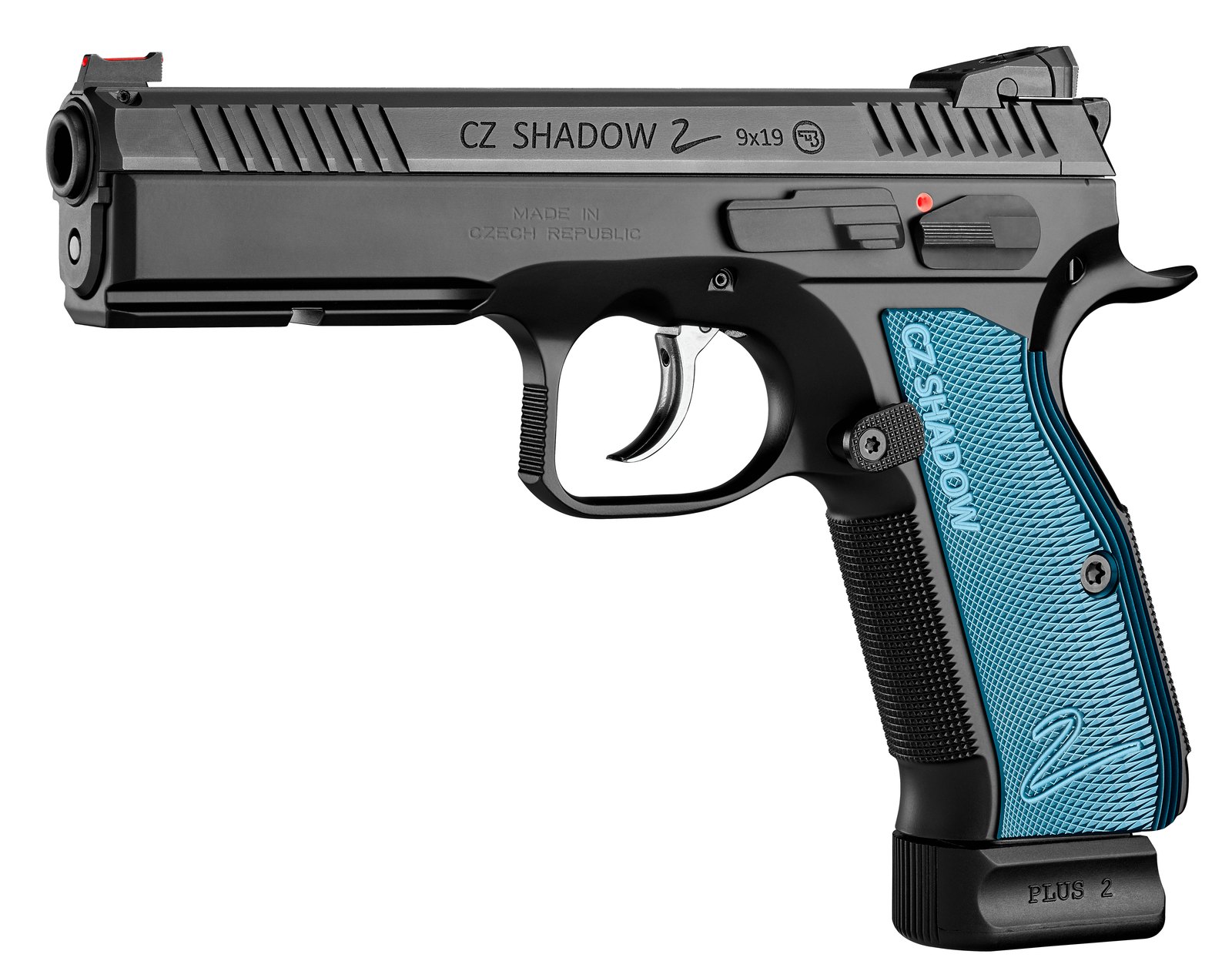
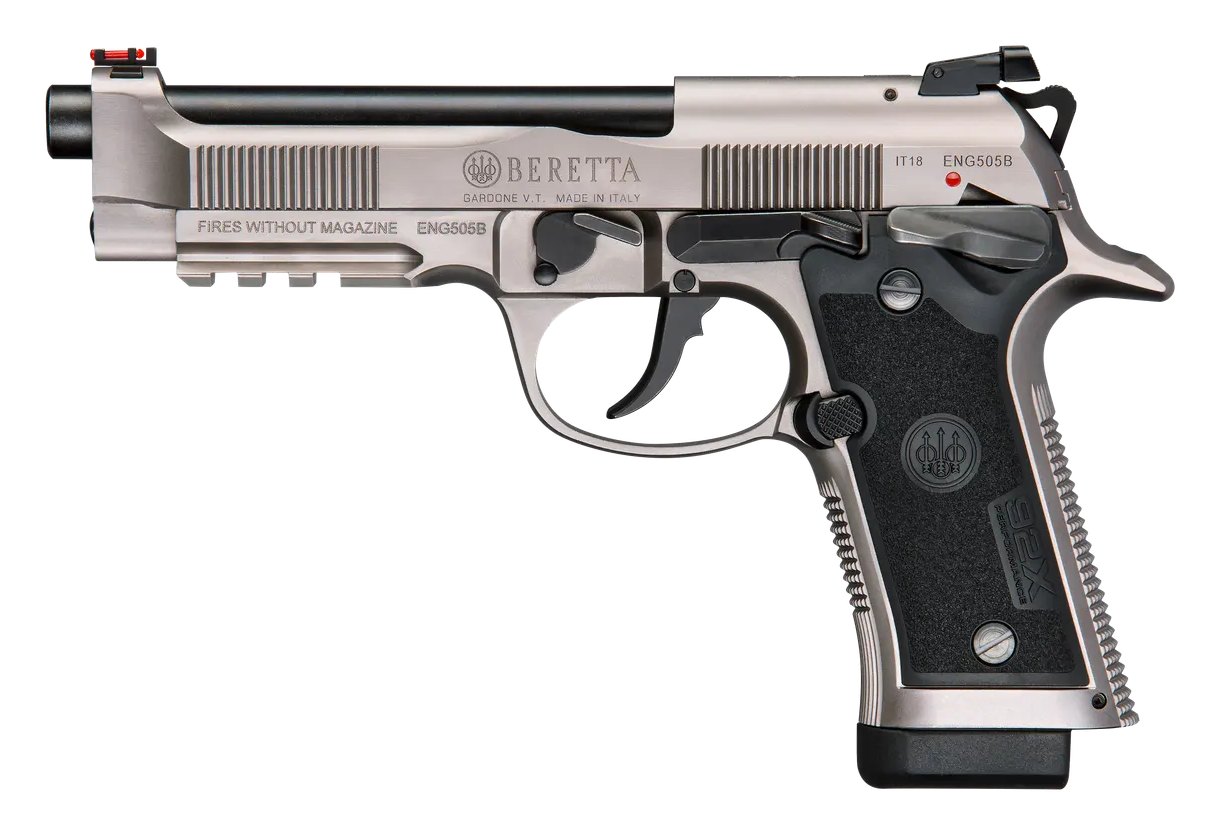
| Beretta 92X Performance | 1,350 g | 125 mm | 15 | Double then single action |
| CZ Shadow 2 | 1,330 g | 120 mm | 19 + 1 | Double then single action |
| Dan Wesson DWX | 1,276 g | 5 inches | 19 + 1 | Single action only |
| Walther PDP Steel Frame Match 5" | 1,195 g | 127 mm | 18 or 20 | Striker-fired |
| 1911 in 9mm (Springfield Ronin) | 1,162 g | 5 inches | 9 | Single action only |
| Staccato XC | 1,065 g | 5 inches, compensated | 17 | Single action only |
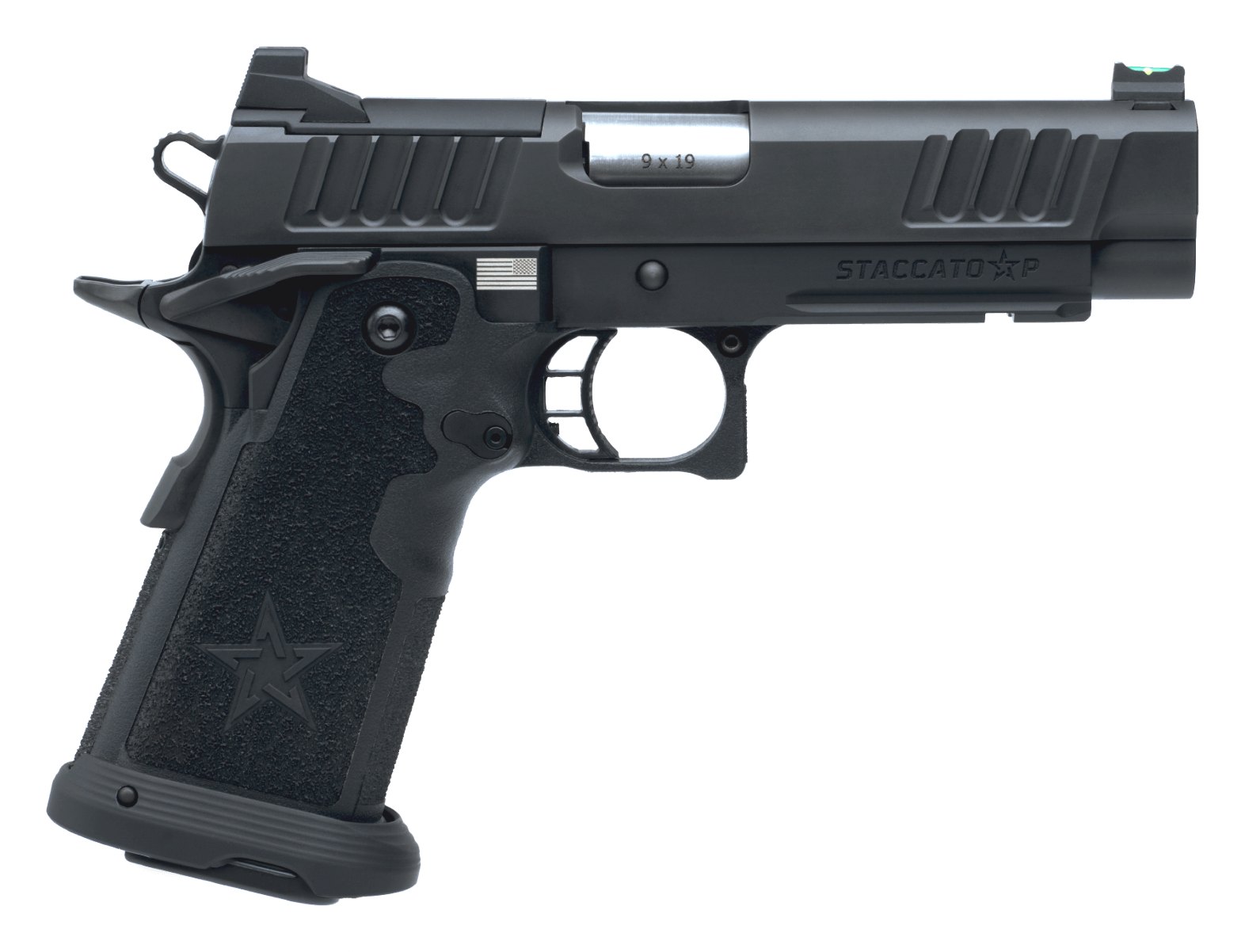
| Staccato P | 936 g | 4.4 inches | 17 + 1 or 20 + 1 | Single action only |
| S&W M&P9 M2.0 Competitor | 822 g | 5 inches | 17 | Striker-fired |
| Walther PDP Full Size 5" | 745 g | 127 mm | 18 | Striker-fired |
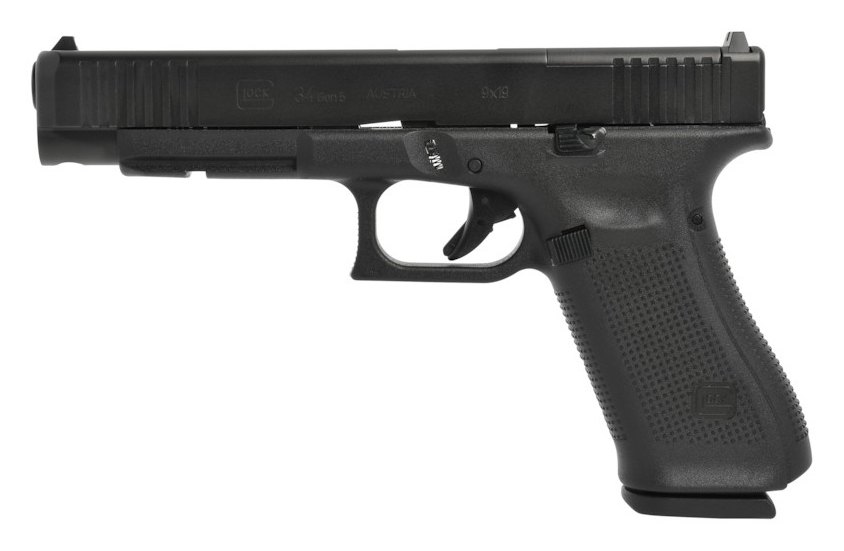
| Glock 34 Gen5 MOS | 743 g | 135 mm | 17 | Striker-fired |
| Glock 17 Gen5 MOS | 705 g | 114 mm | 17 | Striker-fired |
Three groups emerge:
- Above 1,150 g, the steel frames: Beretta 92X Performance, CZ Shadow 2, Dan Wesson DWX, Walther PDP Steel Frame and 191145679.
- Between 900 and 1,100 g, the Staccato P and XC, also steel8.
- Below 850 g, the polymers and the M&P Competitor12310.
Weight dampens muzzle rise between shots and weighs on the arm by the end of a long session. In ISSF 25 m, the limit is 1,400 g including the empty magazine; none of these pistols exceeds it16.
9mm pistol triggers: from 1,134 to 2,651 g
Trigger pull of the 9mm pistols
In grams; manufacturer value unless stated, single action after the first shot for double-action pistols
The first double-action shot breaks at 3,000 g on the Beretta 92X Performance and at 4,691 g on the CZ Shadow 2. The M&P value is a press measurement; the Staccato P value, the bottom of the listed range. Sources123567811.
View the data
| Pistol | Break | First shot | Type of value |
|---|---|---|---|
| Staccato XC | 1,134 g | same | manufacturer, 2.5 lb |
| Dan Wesson DWX | 1,474 g | same | manufacturer, 3.25 lb |
| Beretta 92X Performance | 1,500 g | 3,000 g in double action | manufacturer |
| CZ Shadow 2 | 1,530 g | 4,691 g in double action | manufacturer, 15 and 46 N |
| S&W M&P9 M2.0 Competitor | 1,809 g | same | press measurement |
| Staccato P | 1,814 to 2,041 g | same | manufacturer, 4 to 4.5 lb |
| Glock 34 Gen5 | 2,447 g | same | manufacturer, 24 N |
| Walther PDP (polymer and steel) | 2,500 g | same | manufacturer |
| Glock 17 Gen5 | 2,651 g | same | manufacturer, 26 N |
Breaks range from 1,134 g on a Staccato XC to 2,651 g on a Glock 17 Gen528. For a double-action pistol, the chart gives the break once cocked: the first shot breaks at 3,000 g on a Beretta 92X Performance and at 4,691 g on a CZ Shadow 256.
The rulebooks set minimums121516:
- IPSC Production: 2,270 g on the first shot, or 1,360 g on every shot.
- TAR: 1,360 g.
- ISSF 25 m: 1,000 g.
The details of a trigger break are in our trigger guide.
Capacity: from 9 to 20 rounds depending on the pistol
A 1911 in 9mm takes 9 rounds, a Beretta 92X Performance 15, a Glock 17 or 34 and an M&P 17, a Walther PDP 18 or 20, a DWX 19, a Staccato P up to 201234678910.
The capacity allowed counts for more: 15 rounds at most at the start in Production, 8 or 10 in Classic, 5 per magazine in TAR and ISSF 25 m121516. The subject is covered in our magazine guide.
9mm pistols in IPSC: six of eleven in Production
French practical shooting, the TSV, follows the IPSC rulebook14. Production accepts only the pistols on its list, with a barrel of 127 mm at most, and prohibits single action only1213.
| Pistol | IPSC Production | TAR 830, as shipped |
|---|---|---|
| Beretta 92X Performance | Allowed | No: fibre-optic front sight |
| CZ Shadow 2 | Allowed | Allowed if it meets the criteria |
| Dan Wesson DWX | No: single action only | No: fibre-optic front sight |
| Walther PDP Steel Frame Match | Allowed without removable funnel | Allowed without protruding magwell |
| 1911 in 9mm | No, but Classic | Allowed with fixed sights |
| Staccato XC | No, Open only | No: compensator |
| Staccato P | No | No: fibre optic, flared magwell |
| S&W M&P9 M2.0 Competitor | Allowed without magwell | No: fibre optic, lightening cuts |
| Walther PDP Full Size 5" | Allowed | Allowed |
| Glock 34 Gen5 | No: 135 mm barrel | No: barrel over 13 cm |
| Glock 17 Gen5 | Allowed | Allowed |
Sources: IPSC Production list and 2026 rules, TAR 2025-2026 rulebook, manufacturer and retailer sheets1671012131523. The pistols excluded from Production run in Standard, Optics or Open; the divisions are detailed in our article on IPSC and TSV in France.
9mm pistols in TAR: 13 cm barrel, fixed sights
Event 830 "recent pistols" of TAR, French service-pistol shooting, accepts pistols with a barrel of 13 cm at most, fixed open sights and a caliber from 7.62 to 11.60 mm15. It excludes fibre optics, protruding magwells, lightening cuts and compensators, and names the Glock 34 among the barrels that are too long15. The CZ Shadow no. 1 and no. 2 are allowed if they meet these criteria15.
As shipped, a Glock 17 Gen5, with its 114 mm barrel, or a 5-inch Walther PDP Full Size qualifies23. The other disciplines are covered in our article on pistol eligibility by discipline.
Optics on a competition pistol: factory-ready or not
Eight of the eleven pistols come in an optic-ready version:
- Glock 17 and 34 MOS, factory cut12.
- Walther PDP, the whole range, plate sold separately34.
- M&P9 M2.0 Competitor, plates supplied1011.
- CZ Shadow 2 OR, on the Production list13.
- Beretta 92X Performance Production Optic6.
- Staccato P Optic Ready823.
A red dot moves the pistol from Production to Production Optics and from Standard to Optics; it is prohibited in TAR and ISSF 25 m121516. Footprints and cost are in our red dot guide.
Prices of the eleven pistols: from €780 to €8,450
| Pistol | New price recorded |
|---|---|
| Glock 17 Gen5 MOS | €780 to €8051820 |
| 1911 in 9mm, Tisas Zig M | €820 to €899171923 |
| Polymer Walther PDP, 4.5 to 5 inches | €879 to €1,2991718 |
| Glock 34 Gen5 MOS | €925 to €9591718 |
| S&W M&P9 M2.0 Competitor | €1,790 to €1,7962021 |
| CZ Shadow 2 | €1,867 to €1,870171920 |
| Beretta 92X Performance | €1,870 to €1,8991719 |
| Walther PDP Steel Frame Match 5" | €2,199 to €2,2421722 |
| Staccato P | €4,600 to €4,7901723 |
| Staccato XC | €7,990 to €8,4501724 |
New prices recorded on 24 September 2026.
.22 LR versions of the 9mm pistols: €377 to €679
Several of these pistols have a .22 LR counterpart, for practice at €0.13 a round bought by the case25:
| .22 LR version | Family | New price |
|---|---|---|
| S&W M&P22 Compact | M&P9 | €377 to €6791819 |
| Mauser 1911-22 | 1911 | €415 to €4701819 |
| Walther P22Q | Walther, hammer-fired | €459 to €4691722 |
| Glock 44 | Glock | €539 to €5401718 |
| Beretta 92 FS .22 LR | Beretta 92 | €629 to €6421922 |
The .22 LR runs neither in IPSC, where the minimum caliber is 9 mm, nor in TAR pistol1215. The choice between the two calibers is covered in our comparison of 9mm and .22 LR.
Budget for a 9mm pistol: €624 of ammunition a year
| Item | Amount |
|---|---|
| New 9mm pistol | €780 to €8,450 depending on the model |
| Handgun safe | €115 to €2892627 |
| 9mm ammunition, at 200 rounds a month | €624 a year25 |
| .22 LR ammunition by the case, same volume | €312 a year25 |
Leaving out the license and club fees, the first year comes to about €1,520 to €1,720 with a Glock 17 Gen5, €2,610 to €2,790 with a CZ Shadow 2. In the following years, ammunition remains the main item, the same for all eleven pistols: €624 a year at €0.26 a round25.
The license, the club and the Category B authorization are costed in our first-year budget. In France, these eleven pistols are Category B firearms, like every pistol: buying one requires a prefectural authorization, and storing it a gun safe, a strong cabinet or a strongroom2829.
Compared by objective: Production, Standard, TAR, Open
What each family brings, by objective
For IPSC Production, a double-action pistol such as the CZ Shadow 2 or the Beretta 92X brings a light single action after the first shot; a polymer pistol such as the Glock 17 or the PDP brings the price. In return, the first double-action shot breaks at 3,000 to 4,691 g, and the polymer at 2,447 to 2,651 g on every shot.
For Standard and Optics, a 2011 or a DWX brings a single break of 1,134 to 2,041 g and 17 to 20 rounds. In return, a Staccato P costs €4,600 to €4,790, and the 2011 is out of Production.
For Open, the Staccato XC brings a compensator and a 1,134 g break. In return, it costs €7,990 to €8,450.
For TAR, a Glock 17, a PDP Full Size or a 1911 with fixed sights enters as it is. In return, the Glock 34 and most competition pistols are out.
For a first pistol, our criteria for choosing a first pistol take the question event by event.
Three misconceptions about competition 9mm pistols
- "A 2011 is light because it is aluminum." Staccato lists a 4140 steel frame for the P, at 936 g; only its C, C2 and CS are aluminum8.
- "The Glock 34 is built for every competition." Its 135 mm barrel takes it out of IPSC Production, and the TAR rulebook names it among the excluded pistols11315.
- "A light trigger is prohibited in Production." A pistol that breaks at the same weight on every shot is allowed from 1,360 g12.
Sources 30 references
Specifications come from the manufacturers' sheets and manuals, a press measurement being marked as such; the rules, from the IPSC, ISSF and French federation rulebooks and from Légifrance in the edition stated; prices, from dated readings at several French gunsmiths, marked ⚠️ as commercial data. Click a reference number in the text to highlight the matching source.
- GLOCK — G34 Gen5 MOS, manufacturer specification sheet, re-read 24 September 2026: barrel 135 mm (5.31 in), trigger pull 24 N, weight 665 g without magazine, 743 g with an empty magazine and 980 g loaded, 17 rounds, MOS configuration.
- GLOCK — G17 Gen5 MOS, manufacturer specification sheet, re-read 24 September 2026: barrel 114 mm, sight radius 169 mm with polymer sights, trigger pull 26 N, weight 625 g without magazine and 705 g with an empty magazine, 17 rounds, MOS configuration.
- Carl Walther — PDP Full Size 5" (ref. 2851776), manufacturer specification sheet, re-read 24 September 2026: 18 rounds, weight 745 g, trigger pull 2,500 g, barrel 127 mm, optic-ready slide. ⚠️ The sheet does not say whether the weight includes the magazine.
- Carl Walther — PDP Steel Frame Match FS 5" (ref. 2872218), manufacturer specification sheet, re-read 24 September 2026: 18 or 20 rounds, trigger pull 2,500 g, weight 1,195 g, barrel 127 mm; Walther Arms, PDP Steel Frame Match Full Size 5": "optic plate not included".
- CZ — CZ Shadow 2, manufacturer specification sheet, re-read 24 September 2026: trigger pull 15 N in single action and 46 N in double action, all-steel construction; consulted 20 August 2026 for the 1,330 g weight with an empty magazine, the 120 mm barrel and the listed capacity of 19 + 1.
- Beretta — Pistol User Manual 92X Performance (PDF, latest edition June 2022), re-read 24 September 2026: "The pistol Beretta 92X Performance Production and Production Optic are qualified to compete in the IPSC and USPSA competitions"; 1,350 g with an empty magazine, 15 rounds, barrel 125 mm, "Trigger pull (kg/oz) 3,0/105.8 double action; 1,5/52.9 single action", front sight "Blade with fiber-optic, dovetailed to slide".
- Dan Wesson — DWX (SKU 92003), manufacturer sheet, re-read 24 September 2026: 9 mm, "10+1", "19+1", stainless steel frame, 5-inch barrel, weight 45 ounces, single action, "Fiber Optic" front sight, list price $2,999.00; CZ — Dan Wesson DWX, 19 December 2022: "you simply have to press 3.25 pounds of effort to drop the hammer". ⚠️ US price; no DWX price found at the French gunsmiths consulted on 24 September 2026.
- Staccato — Staccato P and the range comparison table published on the same page, re-read 24 September 2026: P — "Optic Ready" model, trigger "4-4.5 lb", 4.4-inch barrel, "33 oz For Steel", "4140 Steel" frame, "17+1 or 20+1 Capacity"; XC — "2.5 lb", "5.0" Island Comp", 37.56 oz, steel, 2 × 17; C, C2 and CS — aluminium frame.
- Springfield Armory — 1911 Ronin 9mm (PX9119L), manufacturer sheet, re-read 24 September 2026: model marked "Discontinued", 5-inch barrel, "Fiber Optic Front" sight, "(1) 9-Round" magazine, weight 41 oz.
- Smith & Wesson — Performance Center M&P9 M2.0 Competitor 17 Rounds (SKU 13199), manufacturer sheet, re-read 24 September 2026: weight 29 oz, capacity 17, "Metal frame design with 5" barrel", "Slide lightening cuts", "Flared mag well", "Fiber-optic front sight", "Slide cut for optics", four 17-round magazines.
- NRA Shooting Sports USA — M&P9 M2.0 Competitor review, Jake Martens, 10 May 2023, re-read 24 September 2026: "The average of five pulls of the trigger on the Wheeler Digital Scale measured three pounds, 15.8 ounces"; "The kit includes seven different mounting plates". ⚠️ Specialist press; measurement on one pistol.
- IPSC — IPSC Handgun Competition Rules, Jan 2026 Edition, Final 29 Dec 2025, link published by the official IPSC Rule Books page, re-read 24 September 2026: minimum calibre 9 mm in all divisions; appendices D4 and D4a (Production, Production Optics) — Production list mandatory, "handguns deemed by IPSC to be single-action-only are expressly prohibited", "Maximum barrel length 127 mm", "2.27kg (5lbs.) for the first shot fired […] or 1.36kg (3lbs.) for every shot fired", first shot in double action for hammer-fired pistols, 15 rounds at most at the start, flared or add-on magwells prohibited, optic prohibited in Production and required in Production Optics; appendix D3 (Classic) — single-stack 1911, 8 rounds in Major, 10 in Minor; appendix D2 (Standard) — 225 × 150 × 45 mm box, no optic; appendix D6 (Optics) — optic required; appendix D1 (Open) — optics and compensators allowed.
- IPSC — Production Division List, "Updated: 2026-03-09", re-read 24 September 2026: BERETTA "92X Performance"; CZ "Shadow 2, Shadow 2 Urban Grey, Shadow 2 OR (Optical Ready)"; GLOCK "17, 17M, 19 […]" and variants "provided the barrel length does not exceed 127mm", without the 34; WALTHER "PDP (all variants Full Size and Compact, all barrel lengths up to 5 inch including Steel Frame models without detachable Mag Funnel)"; SMITH & WESSON "M&P M2.0 […] PC M&P9 M2.0 COMPETITOR, Tungsten Finish (without Jet-Funnel)"; no Staccato or Dan Wesson model.
- Fédération française de tir — Règlement administratif du tir sportif de vitesse, saison 2019-2020 (PDF, in French), article I: discipline « régie au niveau international par l'IPSC » [governed internationally by IPSC].
- Fédération française de tir — Règlement TAR, saison 2025-2026 (PDF, in French, issued 12 January 2026), re-read 24 September 2026: « La longueur du canon des pistolets automatiques ne peut dépasser 13cm » [the barrel of semi-automatic pistols may not exceed 13 cm], fixed open sights, trigger pull « ne peut être inférieur à 1,360 kg » [may not be under 1.360 kg], 5 rounds per magazine, calibres from 7.62 to 11.60; appendix A, discipline 830 — not allowed: pistols with a barrel over 13 cm « (Ex : GLOCK 34 et 35, AMT long slide, …) », « Tous systèmes de compensation de recul » [all recoil compensation systems], « Tout allègement de l'arme d'origine ou non » [any lightening, factory or not], « Tous systèmes de visée de type laser et fibre optique » [all laser and fibre-optic sighting systems], « Puits de chargeur proéminents » [protruding magwells]; « Les CZ Shadow n°1 et n°2 sont autorisés s'ils respectent les critères des règles applicables à la discipline 830 » [CZ Shadow no. 1 and no. 2 are allowed if they meet the criteria of event 830].
- Fédération française de tir — Règles Pistolet ISSF, mise à jour 08/2026 (PDF, French translation of the 2025 edition, second print in force from 1 July 2026), re-read 24 September 2026: 8.4.1.2 a — « Seules les visées ouvertes sont autorisées » [only open sights are allowed] and fibre-optic sights prohibited; table 8.12, 25 m pistol — 1,400 g at most, trigger of at least 1,000 g; 8.7.6.2 c — five rounds at most in a single magazine.
- Le Pistolier — prices recorded 24 September 2026: Glock 34 Gen 5 MOS €959.00; CZ 75 Shadow II €1,869.00; Beretta 92X Performance €1,899.00; Walther PDP Full Size 4.5 inches €879.00; Walther PDP Match polymer Full Size 5" €1,269.00; Walther PDP SF Match Full Size 5" €2,199.00; Staccato P Standard €4,600.00; Staccato XC €7,990.00; Tisas Zig M 1911 A1, 9 mm or .45 ACP, €899.00; Glock 44 €539.00; Walther P22Q €459.00. ⚠️ Commercial data; the Glock 34 was shown as out of stock that day.
- Armurerie Douillet — prices recorded 24 September 2026: Glock 34 Gen5 MOS FS €925.00 instead of €980.00; Glock 17 Gen5 MOS €805.00; Walther PDP Full Size 4.5" OD Green €879.00; Walther PDP Match polymer FS 5" €1,299.00; Glock 44 Gen5 .22 LR €539.95; Smith & Wesson M&P 22 Compact €679.00; Mauser 1911-22 €415.00 instead of €465.00. ⚠️ Commercial data, promotional prices displayed.
- Armurerie Auxerre — prices recorded 24 September 2026: Beretta 92X Performance 9x19 €1,870.00; CZ Shadow 2 Black 9x19 €1,866.75; Tisas Zig M 1911 A1, « À partir de 819,90 € » [from €819.90]; Beretta 92 FS-22 Umarex .22 LR €629.00; Mauser 1911 .22 LR €470.00; S&W M&P22 Compact, « À partir de 376,60 € » [from €376.60], regular price €569.90. ⚠️ Commercial data.
- Armurerie Lavaux — prices recorded 24 September 2026: Glock 17 Gen5 MOS FS €779.95; CZ 75 Shadow 2 €1,869.95; Smith & Wesson MP9 M2.0 Competitor 5" €1,795.95. ⚠️ Commercial data.
- Armurerie de la Bourse — Smith & Wesson MP9 M2.0 Competitor 5", price recorded 24 September 2026: €1,790.00. ⚠️ Commercial data; shown as out of stock that day.
- Deville Armory — prices recorded 24 September 2026: Walther PDP Match Steel Frame 5" €2,242.00; Beretta 92FS .22 LR 15 rounds €642.00; Walther P22Q STD 3.42" .22 LR €469.00. ⚠️ Commercial data.
- Armurerie Gilles — prices recorded 24 September 2026: Staccato P OR 4.4" Black 9x19 €4,790.00, « Organes de visée : hausse fixe et guidon à fibre optique » [fixed rear sight and fibre-optic front sight], « Puits de chargeur : élargi » [flared magwell], « Prédisposition optique : Optic Ready »; Tisas Zig M1911 A1, .45 ACP or 9 mm €825.00. ⚠️ Commercial data; the Staccato was shown as out of stock that day.
- Falc Armurerie — pistolet Staccato XC 9x19, recorded 24 September 2026: €8,450.00 instead of €8,990.00. ⚠️ Commercial data, promotional price displayed.
- Armurerie Centrale — 1 000 cartouches STV Scorpio 9 mm Luger 124 gr FMJ, price recorded 24 September 2026: €259.00 including VAT, or €0.26 a round; at 200 rounds a month, 2,400 rounds and €624 a year. .22 LR comes to €0.13 a round in cases of 400 to 500, or €312 a year at the same volume (reading of 30 July 2026, taken from our first-pistol guide). ⚠️ Commercial data.
- Armurerie Loisir — prices recorded 24 September 2026: coffre-fort Fortify Delta 1 pour arme de poing €115.00; coffre-fort Infac C3A €259.00. ⚠️ Commercial data.
- Safepro24 France — handgun safes, prices recorded 24 September 2026: Rottner GunBox €68.90, Profirst NY 2 €289.00 instead of €374.95. ⚠️ Commercial data.
- Légifrance — article R311-2 du code de la sécurité intérieure (in French), version in force on 7 September 2025: category B, II, 1° « armes à feu de poing et armes converties en armes de poing non comprises dans les autres catégories » [handguns and weapons converted into handguns not included in the other categories].
- Légifrance — article R314-3 du code de la sécurité intérieure (in French), in force since 11 May 2017: Category A and B firearms stored « soit dans des coffres-forts ou des armoires fortes adaptés au type et au nombre de matériels détenus » [either in safes or strong cabinets suited to the type and number of items held], or in a strongroom. See also Service-public.gouv.fr, fiche F2250 (in French), checked 20 March 2025.
- Images — manufacturer renders and photographs, reproduced without retouching, cropped to their content: Glock, G34 Gen5 MOS; CZ, CZ Shadow 2; Beretta, 92X Performance Production; Staccato, Staccato P.
The version changes the spec sheet and the division. One name covers versions with or without an optic, with or without fibre optics, with or without an add-on magwell: eligibility for Production, Classic or TAR is judged on the exact pistol. When in doubt, the club's range officer settles it before the gunsmith does.
Frequently asked questions
What is the best 9mm for sport shooting?
The one the discipline allows. In IPSC Production, single-action-only pistols — 1911, 2011 and Dan Wesson DWX — are prohibited, as is the Glock 34 with its 135 mm barrel. In TAR, event 830 excludes barrels over 13 cm, fibre optics and protruding magwells. Once the event is set, the choice comes down to three actions: double then single action, single action only, striker-fired.
What trigger pull for sport shooting?
The eleven pistols compared break between 1,134 grams, on a Staccato XC, and 2,651 grams, on a Glock 17 Gen5. The rulebooks set minimums: 1,360 grams on every shot or 2,270 grams on the first shot in IPSC Production, 1,360 grams in TAR, 1,000 grams in ISSF 25 m. On a double-action pistol, the first shot breaks much heavier: 4,691 grams on a CZ Shadow 2.
Is a heavy pistol more accurate?
Weight dampens muzzle rise between shots, but it tires the arm. The eleven pistols range from 705 grams, for a Glock 17 Gen5, to 1,350 grams, for a Beretta 92X Performance. A Staccato P, at 936 grams, sits between the two; its frame is nonetheless 4140 steel.
Which 9mm pistols take a red dot from the factory?
The Glock MOS models, the whole Walther PDP range, the M&P9 M2.0 Competitor, the CZ Shadow 2 OR, the Beretta 92X Performance Production Optic and the Staccato P Optic Ready. Fitting a red dot moves the pistol from Production to Production Optics, and from Standard to Optics.
Are these pistols category B firearms in France?
Yes, all eleven, like every pistol, .22 LR included: under French law, a sport shooter can only buy one with an authorization from the prefect, applied for online after three supervised shooting sessions, or four to seven months between the license and the purchase, then store it in a gun safe, a strong cabinet or a strongroom.