Smith & Wesson M&P: the complete guide before you buy
Published on · Updated on · 9 min read · Anthony Baillon
The Smith & Wesson M&P9 M2.0 is a striker-fired 9mm of 822 g and 17 rounds, offered in polymer at around €900 to €1,100 and as the Competitor, ready for IPSC, at around €1,800. Both enter IPSC Production; only the polymer suits TAR as shipped.
At a glance
| Polymer M&P9 M2.0 | M&P9 M2.0 Competitor | |
|---|---|---|
| Weight | 822 g | 822 g |
| Barrel | 4.25 inches | 5 inches, 127 mm |
| Trigger | 2,637 g measured (Compact) | 1,809 g measured |
| New price | €890 to €1,086 | €1,790 to €1,796 |
- In IPSC: both are allowed in Production, the Competitor without its magwell.
- In TAR: the Competitor is out of event 830 as shipped, because of its fibre optic and lightened slide.
- In .22 LR: the 10-round M&P22 Compact, from €377 to €679.
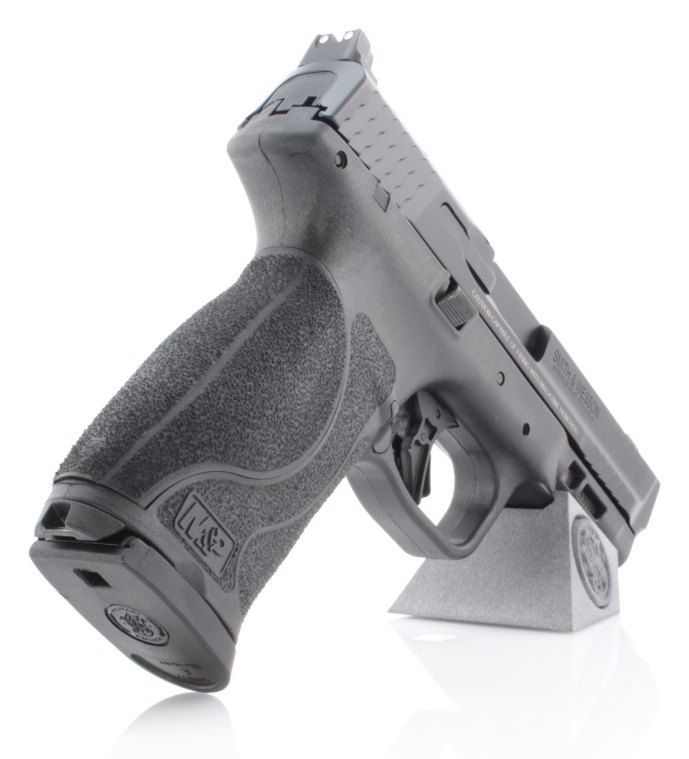
Smith & Wesson M&P: pros and cons
Polymer M&P9 M2.0
Pros
M&P9 M2.0 Competitor
Pros
M&P9 M2.0 range: a polymer, a Competitor, a .22 LR
The M&P name covers several pistols. Three matter for sport shooting123:
| Version | Frame | Capacity | Weight |
|---|---|---|---|
| M&P9 M2.0 Optics Ready | Polymer | 17 | 822 g |
| M&P9 M2.0 Competitor | Metal | 17 or 10 | 822 g |
| M&P22 Compact | Polymer, .22 LR | 10 | 434 g |
The Competitor comes from the Performance Center custom shop. Smith & Wesson adds a 5-inch barrel, lightening cuts on the top and sides of the slide, a flared magwell, a fibre-optic front sight, an oversized reversible magazine release and four magazines1. The manufacturer lists an 18-degree grip angle for the Competitor1. An M&P9 M2.0 Metal version, with a metal frame but without the competition equipment, is also approved for Production7.
M&P pistol weight: 822 g, between polymer and steel
The M&P9 M2.0 against range 9mm pistols
Weight listed by the manufacturers, in grams
The Competitor, with a metal frame and a lightened slide, is listed at the same weight as the polymer M2.0. Not every sheet says whether the magazine is included. Sources12311121314.
View the data
| Pistol | Weight | Capacity | Action |
|---|---|---|---|
| CZ Shadow 2 | 1,330 g | 19 + 1 | Double then single action |
| Staccato P | 936 g | 17 + 1 or 20 + 1 | Single action only |
| M&P9 M2.0 Competitor | 822 g (29 oz) | 17 or 10 | Striker-fired |
| M&P9 M2.0 Optics Ready | 822 g (29 oz) | 17 | Striker-fired |
| Walther PDP Full Size 5" | 745 g | 18 | Striker-fired |
| Glock 34 Gen5 | 743 g | 17 | Striker-fired |
| M&P22 Compact (.22 LR) | 434 g (15.3 oz) | 10 | Single action |
Smith & Wesson lists 29 ounces, or 822 g, for the polymer M2.0 as for the Competitor12. That is 79 g more than a Glock 34 with an empty magazine11, and 508 g less than a CZ Shadow 213.
On the Competitor, the slide cuts take weight off in front of the chamber: Smith & Wesson presents them as a way to improve the balance point under recoil1. The weight moves back towards the hand rather than adding up.
M&P pistol trigger: 1,809 to 2,637 g measured
The M&P9 M2.0 break, measured, against its neighbors
In grams; Smith & Wesson publishes no pull weight, the M&P values are press measurements
IPSC Production requires 1,360 g on every shot, or 2,270 g on the first shot; a striker-fired pistol breaks at the same weight on every shot. Sources468111213.
View the data
| Pistol | Grams | Type of value |
|---|---|---|
| CZ Shadow 2, single action | 1,530 g | manufacturer, 15 N |
| M&P9 M2.0 Competitor | 1,809 g | press measurement, 3 lb 15.8 oz |
| Glock 34 Gen5 | 2,447 g | manufacturer, 24 N |
| Walther PDP Full Size 5" | 2,500 g | manufacturer |
| M&P9 M2.0 Compact, new | 2,637 g | press measurement, 5 lb 13 oz |
| M&P9 M2.0 Compact, after 1,000 rounds | 2,381 g | press measurement, 5 lb 4 oz |
Smith & Wesson publishes no pull weight. The available values are press measurements:
- M&P9 M2.0 Competitor: 1,809 g, or 3 pounds 15.8 ounces, averaged over five pulls on a gauge4. A preview of the same model speaks of about 4¾ pounds set at the factory, or 2,155 g5.
- M&P9 M2.0 Compact: 2,637 g out of the box, 2,381 g after 1,000 rounds6.
The gap comes from the sear: Smith & Wesson fits the Competitor with an enhanced sear "for lighter, crisper trigger let-off"1. The M2.0 trigger is hinged: a safety tab bears on the frame until the finger presses the whole trigger6. The three families of action are compared in our guide to double action, single action or striker-fired.
For the rulebooks, the break is heavy enough: IPSC Production asks for 1,360 g on every shot8, TAR for 1,360 g at least10. Going lighter is gunsmith work, as our trigger guide explains.
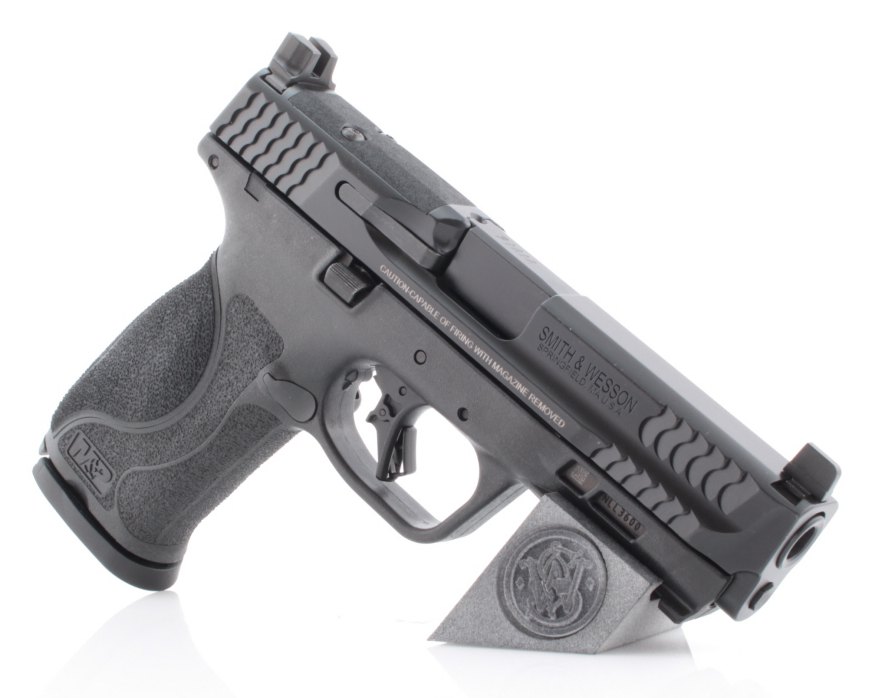
M&P pistol in IPSC: allowed in Production, no magwell
French practical shooting, the TSV, follows the IPSC rulebook9. The Production list, updated on 9 March 2026, approves the "M&P M2.0" and the "PC M&P9 M2.0 COMPETITOR" in Tungsten or two-tone finish, "without Jet-Funnel"7. The Competitor's flared magwell is removable4.
| IPSC division | M&P9 M2.0 | Condition |
|---|---|---|
| Production | Allowed | No magwell or optic, 15 rounds at the start |
| Production Optics | Allowed | One red dot, no magwell |
| Standard | Allowed | 225 × 150 × 45 mm box, no optic |
| Optics | Allowed | One red dot, magazine of 141.25 mm at most |
| Open | Allowed | Magazine of 170 mm at most |
| Classic | Not allowed | Single-stack 1911 |
Two Production limits bear directly on the Competitor: a barrel of 127 mm at most, which it reaches, and 15 rounds at most in the magazine at the start signal, when it takes 178. In Standard, the 9mm runs only as Minor8. The divisions are detailed in our article on IPSC and TSV in France.
M&P pistol in TAR: the polymer, not the Competitor
In TAR, French service-pistol shooting, event 830 "recent pistols" accepts pistols with a barrel of 13 cm at most, fixed open sights, a break of at least 1,360 g and five rounds per magazine10. It excludes fibre-optic sights, « tout allègement de l'arme d'origine ou non » [any lightening, factory or not] and protruding magwells10.
- The M&P9 M2.0 with a 4.25-inch barrel, with fixed rear and front sights, fits within those limits1016.
- The Competitor is out as shipped: fibre-optic front sight, lightened slide, flared magwell110.
The other disciplines are covered in our article on pistol eligibility by discipline.
Optics on the M&P pistol: cut slide, plates supplied
The M&P9 M2.0 Optics Ready and the Competitor leave the factory with a slide cut for an optic12. On the Competitor, seven adapter plates and five sets of screws are supplied for the common red dots4.
Mounting a red dot changes the division: Production Optics or Optics instead of Production or Standard8. Footprints and total cost are in our red dot guide.
M&P pistol in .22 LR: the 10-round M&P22 Compact
For cheaper practice, Smith & Wesson offers the M&P22 Compact in .22 LR: 10 rounds, 434 g, 128 mm high3. It sells new for €377 to €679 depending on the gunsmith1517.
It takes the look of the M&P in a smaller format, without being a scale replica of the 9mm. It runs neither in IPSC, where the minimum caliber is 9 mm8, nor in TAR pistol, reserved for calibers from 7.62 to 11.60 mm10. The choice between the two calibers is covered in our comparison of 9mm and .22 LR.
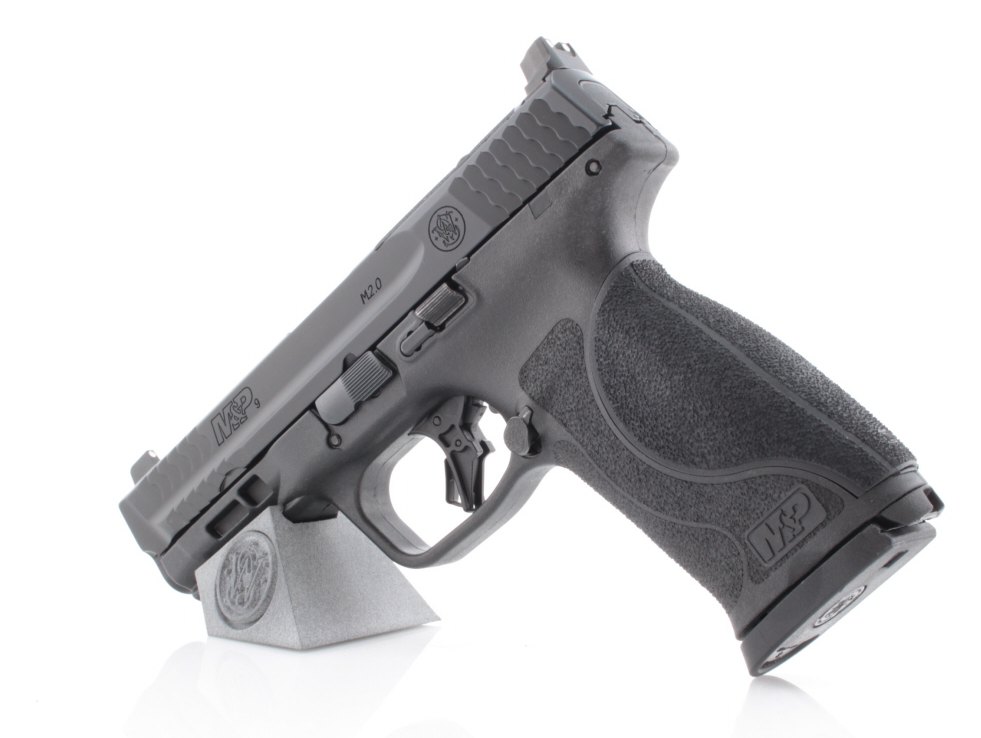
Smith & Wesson M&P, Glock 34, Walther PDP: the gaps
- Against a Glock 34: same striker-fired family, 79 g apart. The Glock 34, with its 135 mm barrel, is out of Production and TAR; the M&P Competitor, at 127 mm, stays in Production71011.
- Against a Walther PDP: 745 g and 2,500 g listed for the 5-inch Full Size, also allowed in Production712. The M&P Competitor comes with its magazines and plates.
- Against a CZ Shadow 2: 508 g more for the CZ, and a first double-action shot at 46 N, or 4,691 g13. The M&P breaks at the same weight on every shot.
Our comparison of competition 9mm pistols sets these pistols side by side.
Budget for an M&P pistol: €624 of ammunition a year
| Item | Amount |
|---|---|
| M&P9 M2.0 4.25" new | €890 to €1,086151617 |
| M&P9 M2.0 Competitor new | €1,790 to €1,7961618 |
| M&P22 Compact new | €377 to €6791517 |
| 17-round M&P9 magazine | €68 to €801617 |
| Handgun safe | €115 to €2892021 |
| 9mm ammunition, at 200 rounds a month | €624 a year19 |
Leaving out the license and club fees, the first year comes to about €1,630 to €2,000 with a polymer M2.0, €2,530 to €2,710 with a Competitor. In the following years, ammunition remains the main item: €624 a year in 9mm at €0.26 a round, €312 a year in .22 LR at €0.13 a round bought by the case19.
The Competitor comes with four magazines1; for the polymer, two more magazines add €136 to €160, detailed in our magazine guide.
In France, the M&P is a Category B firearm, like every pistol, .22 LR included: buying one requires a prefectural authorization, and storing it a gun safe, a strong cabinet or a strongroom2223. The license, the club and the Category B authorization are costed in our first-year budget.
Buying an M&P pistol: who it suits, and who less
What it brings, by objective
For IPSC Production, the Competitor brings a 127 mm barrel, a break measured at 1,809 g and four magazines from day one. In return, it costs twice as much as the polymer and must run without its magwell.
For TAR and IPSC with a single pistol, the polymer M2.0 with a 4.25-inch barrel fits event 830 and Production. In return, its break, measured at 2,637 g on a new Compact, is the heaviest value in this guide.
For a first pistol, the polymer M2.0 costs €890 to €1,086 and covers several disciplines; our criteria for choosing a first pistol take the question event by event.
For .22 LR practice, the M&P22 Compact halves the ammunition budget. In return, it opens neither IPSC nor TAR pistol.
Three misconceptions about the Smith & Wesson M&P
- "The Competitor is an Open gun." The IPSC Production list approves it, without its magwell7.
- "A lightened trigger takes you out of Production." For a pistol that breaks at the same weight on every shot, the threshold is 1,360 g8; the Competitor was measured at 1,809 g4.
- "Every M&P passes in TAR." Event 830 excludes fibre optics and lightening cuts, two factory features of the Competitor110.
Sources 24 references
Specifications come from the sheets of Smith & Wesson and the other manufacturers; the M&P trigger weights, which Smith & Wesson does not publish, from measurements in the specialist press; the rules, from the IPSC and French federation rulebooks in the edition stated; prices, from dated readings at several French gunsmiths, marked ⚠️ as commercial data. Click a reference number in the text to highlight the matching source.
- Smith & Wesson — Performance Center M&P9 M2.0 Competitor 17 Rounds (SKU 13199), manufacturer specification sheet, re-read 24 September 2026: 9 mm, weight 29 oz, width 1.3 in, height 5.5 in, capacity 17; "Metal frame design with 5" barrel", "Slide lightening cuts on top and sides", "Optimal 18-degree grip angle", four backstraps S, M, ML and L, "Flared mag well", "Fiber-optic front sight and blacked-out rear sight", reversible oversized magazine release, "Slide cut for optics", "Enhanced sear for lighter, crisper trigger let-off", "Comes with four 17-round magazines", 10 + 1 or 17 + 1 versions; the cuts "reduce the amount of weight in front of the chamber and, in return, help improve the recoil balance point"; list price $1,049.
- Smith & Wesson — M&P9 M2.0 Optics Ready Full Size Series (SKU 13564), manufacturer specification sheet, re-read 24 September 2026: 9 mm, weight 29 oz, width 1.16 in, height 5.7 in, capacity 17, "Slide cut for optics", "M2.0 flat face trigger", "Four interchangeable palmswell grip inserts […] S, M, ML, L"; list price $699.
- Smith & Wesson — M&P22 Compact, manufacturer specification sheet, re-read 24 September 2026: .22 LR, weight 15.3 oz, width 1.48 in, height 5.03 in, capacity 10.
- NRA Shooting Sports USA — M&P9 M2.0 Competitor review, Jake Martens, 10 May 2023, re-read 24 September 2026: "The average of five pulls of the trigger on the Wheeler Digital Scale measured three pounds, 15.8 ounces"; 5-inch barrel with a 1:10 twist; four 17-round magazines; "The gun ships with a removeable flared magazine well"; "The kit includes seven different mounting plates and five different sets of screws"; list price $999. ⚠️ Specialist press; the trigger value is a measurement on one pistol.
- NRA Shooting Sports USA — M&P9 M2.0 Competitor preview, John Parker, 10 March 2023, re-read 24 September 2026: "Trigger pull weight is about 4¾ pounds set from the factory with a clean break"; "All the necessary mounting plates are included". ⚠️ Specialist press; approximate value, not published by Smith & Wesson.
- American Rifleman (NRA) — M&P9 M2.0 Compact review, Joe Kurtenbach, 16 July 2018, re-read 24 September 2026: 4-inch barrel, 15 rounds; break measured at 5 lb 13 oz out of the box and 5 lb 4 oz after 1,000 rounds; "an articulated trigger" with "a safety tab that engages the frame"; more than 2,000 rounds without "a single malfunction, stoppage, hiccup". ⚠️ Specialist press; measurements on one pistol of the Compact version.
- IPSC — Production Division List, "Updated: 2026-03-09", re-read 24 September 2026: SMITH & WESSON "M&P M2.0 (but not the M&P M2.0 Competitor) […] Also approved: […] M&P9 M2.0 METAL, M&P9 M2.0 METAL with threaded barrel, PC M&P9 M2.0 COMPETITOR, Tungsten Finish (without Jet-Funnel), PC M&P9 M2.0 COMPETITOR 2-TONE (without Jet-Funnel)"; GLOCK 17, 19 and variants "provided the barrel length does not exceed 127mm", without the 34; WALTHER "PDP (all variants Full Size and Compact, all barrel lengths up to 5 inch […])".
- IPSC — IPSC Handgun Competition Rules, Jan 2026 Edition, Final 29 Dec 2025, link published by the official IPSC Rule Books page, re-read 24 September 2026: minimum calibre 9 mm in all divisions; appendices D4 and D4a (Production, Production Optics) — "Maximum barrel length 127 mm", "2.27kg (5lbs.) for the first shot fired and no restriction for subsequent shots fired, or 1.36kg (3lbs.) for every shot fired", 15 rounds at most at the start signal, "flared, enlarged and/or add-on magwells" prohibited, optic prohibited in Production and required in Production Optics; appendix D2 (Standard) — 225 × 150 × 45 mm box, Major reserved for calibres of 10 mm and above, no optic; appendix D3 (Classic) — "classic 1911-genre design […] single-stack"; appendix D6 (Optics) — one optic, magazine of 141.25 mm at most; appendix D1 (Open) — magazine of 170 mm at most.
- Fédération française de tir — Règlement administratif du tir sportif de vitesse, saison 2019-2020 (PDF, in French), article I: discipline « régie au niveau international par l'IPSC » [governed internationally by IPSC].
- Fédération française de tir — Règlement TAR, saison 2025-2026 (PDF, in French, issued 12 January 2026), re-read 24 September 2026: handguns, « La longueur du canon des pistolets automatiques ne peut dépasser 13cm » [the barrel of semi-automatic pistols may not exceed 13 cm], fixed open sights, trigger pull « ne peut être inférieur à 1,360 kg » [may not be under 1.360 kg]; event 830, calibres from 7.62 to 11.60, 5 rounds per magazine; appendix A, discipline 830 — not allowed: « Tout allègement de l'arme d'origine ou non » [any lightening, factory or not], « Tous systèmes de visée de type laser et fibre optique » [all laser and fibre-optic sighting systems], « Puits de chargeur proéminents » [protruding magwells], pistols with a barrel over 13 cm « (Ex : GLOCK 34 et 35 […]) ».
- GLOCK — G34 Gen5 MOS, manufacturer specification sheet, re-read 24 September 2026: barrel 135 mm, trigger pull 24 N, weight 665 g without magazine and 743 g with an empty magazine, 17 rounds.
- Carl Walther — PDP Full Size 5" (ref. 2851776), manufacturer specification sheet, re-read 24 September 2026: 18 rounds, weight 745 g, trigger pull 2,500 g, barrel 127 mm. ⚠️ The sheet does not say whether the weight includes the magazine.
- CZ — CZ Shadow 2, manufacturer specification sheet, re-read 24 September 2026: trigger pull 15 N in single action and 46 N in double action; consulted 20 August 2026 for the 1,330 g weight with an empty magazine and the listed capacity of 19 + 1.
- Staccato — Staccato P, manufacturer specification sheet, consulted 20 August 2026: 17 + 1 or 20 + 1, weight 33 oz (936 g) in the steel version, 4140 steel frame.
- Armurerie Douillet — prices recorded 24 September 2026: pistolet Smith & Wesson M&P9 M2.0 canon 4,25″ €890.00; pistolet Smith & Wesson M&P 22 Compact .22 LR €679.00. ⚠️ Commercial data.
- Armurerie Lavaux — prices recorded 24 September 2026: pistolet Smith & Wesson MP9 M2.0 4.25" €1,085.95; pistolet Smith & Wesson MP9 M2.0 Competitor 5" €1,795.95; chargeur Smith & Wesson M&P9 17 coups €79.95. ⚠️ Commercial data.
- Armurerie Auxerre — prices recorded 24 September 2026: pistolet S&W M&P9 2.0 9x19, 4.25-inch barrel, fixed rear and front sights, 17 + 1 rounds, €1,006.50; pistolet S&W M&P22 Compact .22 LR, « À partir de 376,60 € » [from €376.60], regular price €569.90; chargeur Smith & Wesson 17 coups pour M&P9 €68.00. ⚠️ Commercial data, promotional price displayed for the M&P22.
- Armurerie de la Bourse — pistolet Smith & Wesson MP9 M2.0 Competitor 5", price recorded 24 September 2026: €1,790.00. ⚠️ Commercial data; shown as out of stock that day.
- Armurerie Centrale — 1 000 cartouches STV Scorpio 9 mm Luger 124 gr FMJ, price recorded 24 September 2026: €259.00 including VAT, or €0.26 a round; at 200 rounds a month, 2,400 rounds and €624 a year. .22 LR comes to €0.13 a round in cases of 400 to 500, or €312 a year at the same volume (reading of 30 July 2026, taken from our first-pistol guide). ⚠️ Commercial data.
- Armurerie Loisir — prices recorded 24 September 2026: coffre-fort Fortify Delta 1 pour arme de poing €115.00; coffre-fort Infac C3A €259.00. ⚠️ Commercial data.
- Safepro24 France — handgun safes, prices recorded 24 September 2026: Rottner GunBox €68.90, Profirst NY 2 €289.00 instead of €374.95. ⚠️ Commercial data.
- Légifrance — article R311-2 du code de la sécurité intérieure (in French), version in force on 7 September 2025: category B, II, 1° « armes à feu de poing et armes converties en armes de poing non comprises dans les autres catégories » [handguns and weapons converted into handguns not included in the other categories].
- Légifrance — article R314-3 du code de la sécurité intérieure (in French), in force since 11 May 2017: Category A and B firearms stored « soit dans des coffres-forts ou des armoires fortes adaptés au type et au nombre de matériels détenus » [either in safes or strong cabinets suited to the type and number of items held], or in a strongroom. See also Service-public.gouv.fr, fiche F2250 (in French), checked 20 March 2025.
- Images — manufacturer renders and photographs, reproduced without retouching, cropped to their content: Smith & Wesson, M&P9 M2.0 Optics Ready.
The M&P range is broad, and spec sheets conflate easily. Generations, barrel lengths, Performance Center versions, manual-safety models and reduced-capacity variants coexist under the same name; division eligibility depends on the exact version. When in doubt, the club's range officer settles it before the gunsmith does.
Frequently asked questions
What is the difference between the M&P9 M2.0 and the Competitor?
The M&P9 M2.0 is the polymer pistol of the range: 17 rounds and an optic-ready slide. The Competitor, from the Performance Center custom shop, gets a metal frame, a 5-inch barrel, a lightened slide, a fibre-optic front sight, a removable flared magwell and four 17-round magazines. Smith & Wesson lists the same 29 ounces, or 822 grams, for both. In France the Competitor costs about twice as much: €1,790 to €1,796, against €890 to €1,086 for an M2.0 with a 4.25-inch barrel.
What is the trigger pull of a Smith & Wesson M&P?
Smith & Wesson publishes no figure. The press measured 1,809 grams, averaged over five pulls, on an M&P9 M2.0 Competitor, and 2,637 grams on a new M&P9 M2.0 Compact, down to 2,381 grams after 1,000 rounds. The trigger is hinged: a safety tab bears on the frame until the finger presses the whole trigger.
Is the M&P Competitor allowed in Production division?
Yes, without its magwell. The IPSC Production list, updated on 9 March 2026, approves the Performance Center M&P9 M2.0 Competitor "without Jet-Funnel", and the rules forbid any flared or add-on magwell in Production. Its 5-inch barrel, 127 mm, is the maximum allowed, and a striker-fired pistol must break at 1,360 grams or more on every shot.
Is there an M&P in .22 LR?
Yes, the M&P22 Compact: 10 rounds, 434 grams, sold new for €377 to €679 depending on the gunsmith and the version. It takes the look of the M&P in a compact format, but runs neither in IPSC, where the minimum caliber is 9 mm, nor in TAR pistol, reserved for calibers from 7.62 to 11.60 mm. In France it remains a category B firearm.
Do you need an authorization to buy a Smith & Wesson M&P in France?
Yes. Like every pistol, .22 LR included, the M&P is a category B firearm under French law: a sport shooter can only buy one with an authorization from the prefect, applied for online after three supervised shooting sessions. Four to seven months usually pass between the license and the purchase, and the pistol must then be stored in a gun safe, a strong cabinet or a strongroom.