Pistol magazines for sport shooting: how many, which, what price
Published on · Updated on · 7 min read · Anthony Baillon
Three magazines cover a club session, four to five for action shooting. A factory magazine costs €30 to €80. In France, it is bought on presentation of the pistol's authorization, ten at most per firearm; above 20 rounds it moves into category A, except with a federation certificate for action shooting.
At a glance
| Practice | Magazines | Capacity allowed |
|---|---|---|
| Club, precision | 3 | 5 rounds at ISSF 25 m and in TAR |
| TSV Production | 4 to 5 | 15 rounds at the start |
| TSV Standard, Open | 4 to 5 | Magazine length limited |
- Price: €30 to €80 factory depending on the pistol, €86 to €144 for a 2011; €23 to €32 for an aftermarket Magpul magazine for Glock.
- Buying: on presentation of the pistol's authorization, ten magazines at most per firearm.
- Above 20 rounds: category A, on a federation certificate for action shooting.
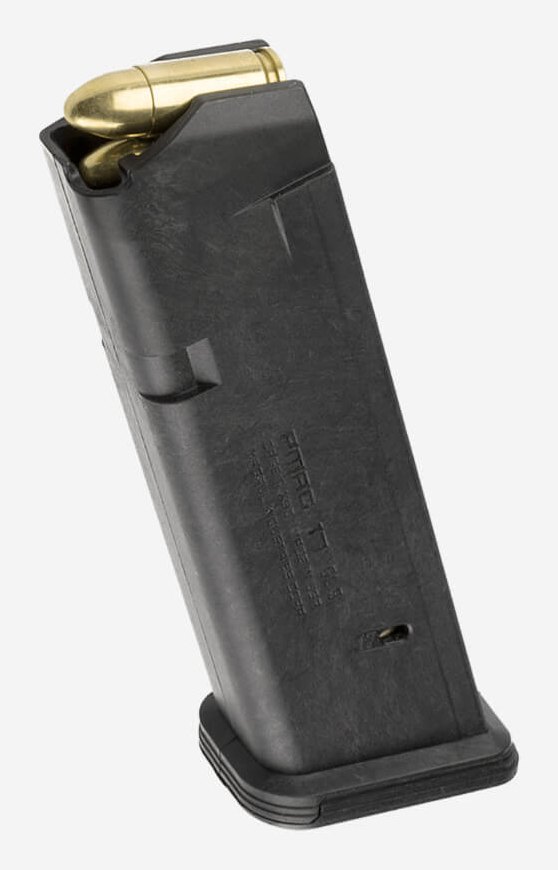
Pistol magazines: 3 at the club, 4 to 5 for action shooting
The number depends on how you shoot, not on the pistol's capacity.
| Practice | Magazines | Why |
|---|---|---|
| Club sessions, slow fire | 3 | Load them ahead of time, keep a spare |
| Action shooting, drills with reloads | 4 to 5 | Run drills back to back without reloading magazines |
| Regular competition | 5 and more | With matching base pads |
French law caps the number of magazines at ten per category B firearm9. The Smith & Wesson M&P in its Competitor version ships with four magazines5, which covers most of the need from day one.
Pistol magazine prices: €30 to €80 from the maker
| Factory magazine, 9 mm | Capacity | Price found |
|---|---|---|
| Beretta 92 FS | 15 to 17 rounds | €30 to €381822 |
| Glock 17 and 34 | 17 rounds | €32 to €43181921 |
| Walther PDP Full Size | 18 rounds | €531821 |
| CZ Shadow 2 and SP-01 | 18 or 19 rounds | €65 to €70201819 |
| Smith & Wesson M&P9 | 17 rounds | €68 to €801822 |
| 2011 pistol | 17 to 20 rounds | €86 to €14424 |
New prices found on 24 September 2026 at French gun shops. The same Glock 17 magazine ranges from €32 to €43 depending on the shop1821.
The budget reads per year:
- First year: €60 to €160 for two extra factory magazines, 2011 excluded.
- Following years: €6 to €10 per magazine spring, replaced as it wears24.
Buying a magazine in France: the authorization, 10 at most
A handgun magazine of 20 rounds or fewer follows the category of the firearm: category B, 11°, for a pistol8. The French internal security code governs the purchase9:
- You must own the firearm: nobody may acquire a magazine without the ownership title for the matching firearm.
- The firearm's authorization is shown at purchase, at the gun shop as online.
- Ten magazines at most per firearm. Beyond that, the fine can reach €75011.
The details of the authorization are in our guide to the French category B authorization.
Magazines over 20 rounds: category A, except for TSV
A handgun magazine of more than 20 rounds is classed in category A1, 8°, and the firearm that takes it moves into category A itself as soon as it is inserted8. One exception covers shooters whose discipline requires these magazines: they may acquire and own them on a certificate from the French shooting federation attesting that they practice action shooting (TSV, the French name for IPSC shooting), and these magazines do not count towards the ten-per-firearm ceiling9. The federation issues this certificate to shooters who can show a level 3 match in the division requested13.
Magazine capacity: 15 rounds in Production, 5 at 25 m
Factory capacity of sport shooting 9mm pistols
Rounds in the magazine as shipped, without an extended base pad and excluding the chambered round
Capacities: manufacturer spec sheets and reviews1234567. In IPSC Production division, a magazine holds no more than 15 rounds at the start signal10; above 20 rounds, a handgun magazine moves into French category A8.
View the data
| Pistol | Factory capacity |
|---|---|
| Staccato P | 17 + 1 or 20 + 1 |
| Dan Wesson DWX | 19 + 1 |
| Walther PDP Full Size | 18 |
| CZ Shadow 2 | 18 + 1 or 19 + 1 |
| Glock 34 Gen5 | 17 + 1 |
| S&W M&P9 Competitor | 17 + 1 |
| Beretta 92X Performance | 15 |
Factory capacity often exceeds what the rules allow at the start.
| Discipline | What the rules set |
|---|---|
| ISSF 25 m pistol | 5 rounds at most, only one magazine loaded at a time12 |
| ISSF 50 m pistol | One round12 |
| TAR, pistol at 25 m | 5 rounds per magazine14 |
| IPSC Production and Production Optics | 15 rounds at most at the start signal10 |
| IPSC Classic | 8 rounds at Major power factor, 10 at Minor10 |
| IPSC Standard | Magazine fits in a 225 × 150 × 45 mm box with the pistol10 |
| IPSC Open | Magazine 170 mm long at most10 |
French action shooting (TSV) follows the IPSC rulebook13. The divisions are covered in detail in our article on IPSC and TSV in France.
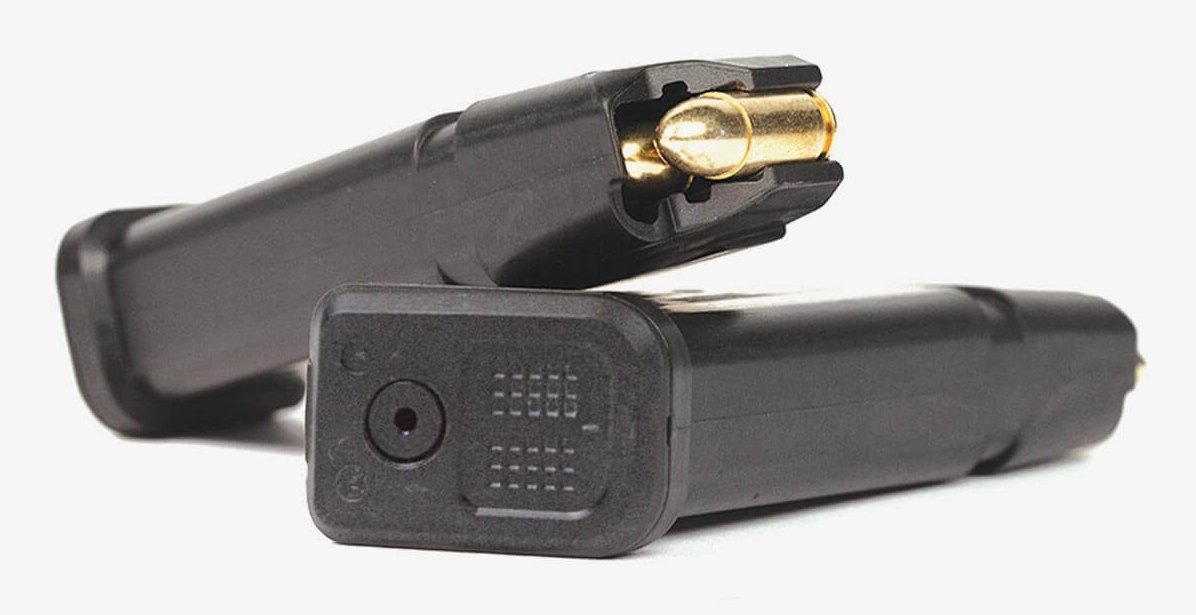
Factory or aftermarket magazine: pros and cons
The factory magazine
Pros
- Designed for the pistol: dimensions, spring and follower are the manufacturer's own.
- The reference point after a stoppage: a fault that persists with the factory magazine points to another cause.
The aftermarket magazine
Pros
Cons
- A range limited to the most common pistols, Glock first.
- To be proven on the range over several dozen rounds before relying on it in a match.
Base pads and magwells: allowed depending on division
Extended base pads
Pros
- A few more rounds in the same magazine.
- A larger grip surface for drawing the magazine from its pouch.
The add-on magwell
Pros
- It guides the magazine and forgives an imperfect insertion during a reload.
Magazine care: wiped dry, feed lips and spring
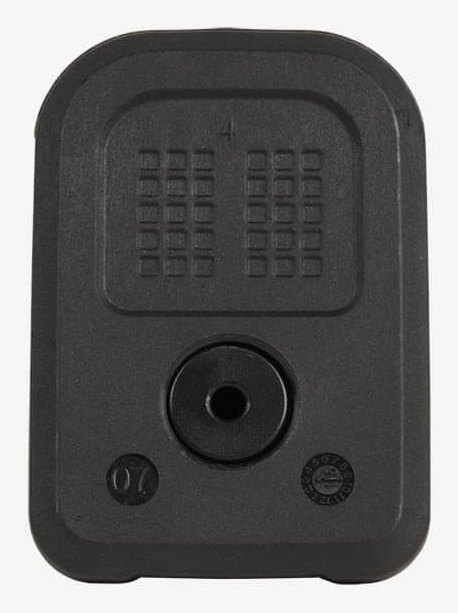
A magazine comes apart through the base pad, released by a catch or a hole depending on the model; the spring comes out under tension, and the thumb holds it back during the operation15. Glock asks for it to be wiped dry, inside and out, before reassembly: oil left in a magazine can contaminate primers16. Its preventive maintenance booklet has magazines taken apart "perhaps every 3-4 months"17.
Each time it is taken apart, three checks:
- The feed lips: neither spread nor chipped.
- The follower: it slides without catching.
- The spring: it lifts the last rounds firmly; sluggish feeding at the end of the magazine signals a tired spring.
Numbering your magazines then tells you which one causes the stoppages: see pistol reliability and malfunction tracking. Care of the pistol itself is in our pistol maintenance guide.
Magazines by discipline: accessories outside Production
What you gain, what you give up
For precision and TAR, at 25 meters, five rounds per magazine are enough1214: three factory magazines cover the session, with no base pad or magwell.
For TSV in Production, four to five factory magazines are enough, with no accessories: base pads and magwells add nothing under the 15-round cap, and the magwell is prohibited there10. In return, reloads are done without help.
For TSV Standard or Open, extended base pads and a magwell bring extra rounds and a surer reload. In return, each magazine costs more, and the gauge box or the maximum length sets the limit10.
Three misconceptions about pistol magazines
- "A magazine can be bought freely." In France you must own the firearm and show its authorization, up to ten magazines per firearm9.
- "More rounds is always better." Production caps the start at 15 rounds, ISSF 25 meters at 51012, and above 20 rounds a magazine changes category8.
- "A magazine is oiled like the pistol." Glock asks for it to be wiped dry, inside and out16.
Sources 25 references
Capacities come from manufacturer spec sheets and specialist press reviews; rules from Légifrance and the ISSF, IPSC and FFTir rulebooks in the edition stated; prices from dated surveys at several French gun shops, flagged ⚠️ as commercial data. Click a note marker in the text to highlight the matching source.
- CZ — CZ Shadow 2, manufacturer spec sheet, reread on 24 September 2026: capacity "18+1" or "19+1" depending on the version, three magazines supplied with the full-size versions.
- Glock — G34 Gen5 MOS, official page: 17 + 1 rounds.
- Walther — PDP Standard Full Size 5", official page: 10- or 18-round magazines.
- NRA Shooting Sports USA — Beretta 92X Performance review: 15-round capacity.
- NRA Shooting Sports USA — M&P9 M2.0 Competitor presentation: four magazines supplied, oversized reversible magazine release.
- Outdoor Life — Staccato P review: 17 + 1 or 20 + 1 rounds depending on the magazine.
- Outdoor Life — Dan Wesson DWX review: 19 + 1 rounds in full size.
- Légifrance — article R311-2 du code de la sécurité intérieure (in French), version in force since 7 September 2025 (decree no. 2025-894 of 5 September 2025), reread on 24 September 2026: category A1, 8° — « Système d'alimentation d'arme de poing contenant plus de 20 munitions » [handgun feeding device holding more than 20 rounds]; A1, 2° — a firearm firing more than twenty-one rounds without reloading when a feeding device of more than twenty rounds « y a été inséré » [has been inserted]; category B, 11° — « Système d'alimentation des armes mentionnées au II » [feeding device for the firearms listed in II].
- Légifrance — articles R312-45 et R312-45-1 du code de la sécurité intérieure (in French), reread on 24 September 2026. R312-45 (in force since 10 February 2022): « L'acquisition des systèmes d'alimentation de la catégorie B est soumise à la présentation de l'autorisation de l'arme » [buying category B feeding devices requires showing the firearm's authorisation]; « Nul ne peut acquérir et détenir un système d'alimentation sans avoir le titre de détention de l'arme correspondante » [nobody may acquire or own a feeding device without the ownership title for the matching firearm]; « Nul ne peut acquérir et détenir plus de dix systèmes d'alimentation par arme. » [nobody may acquire or own more than ten feeding devices per firearm]. R312-45-1 (in force since 1 August 2018): persons « pratiquant une discipline de tir nécessitant l'utilisation de tels systèmes d'alimentation et en possession du certificat fédéral » [practising a shooting discipline that requires such feeding devices and holding the federation certificate] may acquire and own handgun magazines of more than twenty rounds, « pas pris en compte dans les quotas prévus à l'article R. 312-45 » [not counted in the quotas of article R. 312-45]. The certificate is the one in article R312-5, 10°: « justification de la pratique du tir sportif de vitesse apportée par la fourniture d'un certificat de la Fédération française de tir » [proof of practising action shooting by a certificate from the French shooting federation].
- IPSC — IPSC Handgun Competition Rules, Jan 2026 Edition, Final 29 Dec 2025, link published by the official IPSC Rule Books page, reread on 24 September 2026: appendices D4 and D4a (Production, Production Optics) — magazine "must not contain more than 15 rounds at the Start Signal", "flared, enlarged and/or add-on magwells" prohibited; D3 (Classic) — 8 rounds at Major, 10 at Minor, magwells limited to 35 mm wide; D2 (Standard) — box "225 mm x 150 mm x 45 mm", telescopic magazines and compressible base pads "expressly prohibited"; D1 (Open) — magazine length "170 mm". ⚠️ The interpretations published in February and May 2026 were not reread.
- Service-Public (DILA) — armes de catégorie B pour un tireur sportif (in French), fact sheet F2250 checked on 20 March 2025: « au maximum 10 systèmes d'alimentation par arme » [at most 10 feeding devices per firearm], fine of up to €750 if exceeded. ⚠️ For action shooting, the fact sheet also applies this ceiling, which article R312-45-1 sets aside for magazines of more than twenty rounds: the decree prevails.
- Fédération française de tir — Règles Pistolet ISSF, mise à jour 08/2026 (PDF, in French; translation of the 2025 edition, second printing in force on 1 July 2026), reread on 24 September 2026: rule 8.7.6.2 c — « un seul chargeur ou pistolet sera chargé avec 5 cartouches au maximum » [only one magazine or pistol may be loaded, with 5 rounds at most] in 25 m events; table 8.12 — 50 m pistol loaded with a single round.
- Fédération française de tir — Règlement administratif du tir sportif de vitesse, saison 2019-2020 (PDF, in French): article I, discipline « régie au niveau international par l'IPSC » [governed internationally by IPSC]; article XVI, federation certificate for « chargeurs longs » [long magazines] issued to shooters showing « d'une compétition de niveau 3 pour la division sollicitée » [a level 3 match in the division requested].
- Fédération française de tir — Règlement TAR, saison 2025-2026 (PDF, in French, issued 12 January 2026), reread on 24 September 2026: 25 m pistol events 830, 831 and 832, five rounds per magazine; event 830, « Puits de chargeur proéminents » [protruding magwells] prohibited.
- CZ — CZ Shadow user manual (PDF, edition 02/2025), "Magazine Disassembly" section: base pad released through the hole or the floorplate catch, spring held back by the thumb, "the spring could fly out".
- Glock — Instructions for use, models G17 to G48 (PDF, edition 06/2026): "Make sure that the magazine (inside and out) and breech face are wiped dry before reassembling your GLOCK pistol. Leaving lubricant in these areas could cause contamination of primers".
- Glock — Preventive Maintenance of the GLOCK Semi-Automatic Safe Action Pistol (PDF, 7 pages): magazines taken apart "perhaps every 3-4 months".
- Armurerie Auxerre — prices found on 24 September 2026: 17-round Glock 17 Gen4 magazine €32.00; Glock 17 Gen5 €35.20; CZ SP-01 Shadow 18 rounds €69.90; Walther PDP FS 18 rounds €52.90; Beretta 92 FS 15 rounds €29.90; Smith & Wesson M&P9 17 rounds €68.00; Magpul PMAG 17 GL9 €22.95. ⚠️ Commercial data.
- Armurerie de la Bourse — prices found on 24 September 2026: Glock 17 magazine, 17 rounds €37.00; CZ Shadow SP-01 / Shadow 2 magazine €70.00; Toni System +2 base pad for Glock €34.00; Glock Gen5 magwell €28.00; Toni System magwell for Glock 17/34/45 Gen5 €92.00. ⚠️ Commercial data.
- Le Pistolier — prices found on 24 September 2026: CZ Shadow 2 9x19 magazine €64.99; Toni System base pad for Glock €44.99. ⚠️ Commercial data.
- Armurerie Douillet — prices found on 24 September 2026: Glock 17 Gen5 magazine, 17 rounds €43.00; Walther PDP Full Size magazine, 18 rounds €53.00; +3 base pad for CZ 75, SP-01, Shadow 2 €25.00; Glock Gen5 magwell €34.00; aluminium magwell for CZ Shadow 2 €90.00. ⚠️ Commercial data.
- Armurerie Lavaux — prices found on 24 September 2026: Beretta 92 FS magazine, 17 rounds €37.95; Smith & Wesson M&P9 magazine, 17 rounds €79.95. ⚠️ Commercial data.
- Gunmarket — Magpul PMAG 17 rounds for Glock, price found on 24 September 2026: €32.00. ⚠️ Commercial data.
- Deville Armory — prices found on 24 September 2026: Mec-Gar magazine for 2011 pistol, 9x19, 18 rounds €86.21; Watchtower 20-round magazine for 2011, 140 mm €144.00; factory Glock magazine spring €6.42; Glock 33510 spring for Gen5 17-round magazine €10.00; Eemann Tech spring for CZ Shadow 18-round magazine €6.00; M-Arms +2 base pad for CZ Shadow €25.00; Eemann Tech magwell for CZ Shadow 2 €73.15. ⚠️ Commercial data; the only mainland France dealer found for 2011 magazines (no Staccato-branded magazine on sale) and for magazine springs.
- Visuals — manufacturer renders and photographs, reproduced without retouching, cropped to their content: Magpul, PMAG 17 GL9.
The division rules prevail. The capacities allowed change with the rulebook edition and the division. An add-on base pad or magwell is best confirmed with the club's range officer before buying.
Frequently asked questions
How many magazines do you need for sport shooting?
Three cover a club session: two in use, one spare. Action shooting often calls for four to five, to run drills back to back without reloading magazines in between. French law sets a ceiling: ten magazines at most per category B firearm.
Do you need paperwork to buy a pistol magazine in France?
Yes. A pistol magazine of 20 rounds or fewer is classed in category B, like the pistol itself. It is bought on presentation of the authorization for the matching firearm, up to ten magazines per firearm.
Can you own a magazine of more than 20 rounds?
In France, a handgun magazine of more than 20 rounds is in category A. The internal security code allows shooters whose discipline requires them to buy these magazines on a certificate from the French shooting federation for action shooting (TSV); they do not count towards the ten-per-firearm ceiling.
How many rounds go in the magazine in competition?
Five at most in ISSF 25-meter events and in TAR, a single round at 50 meters. In action shooting, Production division limits the magazine to 15 rounds at the start signal; Standard and Open set no capacity limit but a magazine length limit.
How do you maintain a pistol magazine?
It comes apart through the base pad, holding back the spring, which comes out under tension. Glock asks for it to be wiped dry, inside and out: oil left in a magazine can contaminate primers. The feed lips, follower and spring are checked each time it is taken apart.