IPSC in France (TSV): divisions, Minor/Major and how to start
Published on · Updated on · 11 min read · Anthony Baillon
Tir sportif de vitesse is the FFTir's IPSC: you draw, move and shoot timed courses, under the 2026 IPSC rules. In pistol, seven divisions set the firearm admitted, and the power factor separates Minor from Major. The 9mm pistol, in Category B, is bought four to seven months after the license.
At a glance
| Division | What it imposes | Major |
|---|---|---|
| Production | Firearm from the IPSC list, 15 rounds, no optic | No |
| Production Optics | The same, red dot compulsory | No |
| Standard | Box of 225 × 150 × 45 mm, no optic | 170, in 10 mm |
| Classic | 1911 profile, 8 or 10 rounds | 170, in 10 mm |
| Open | Optic, compensator, 170 mm magazine | 160, from 9mm |
- The firearm: a Category B 9mm pistol, four to seven months after the license, in a TSV-approved club.
- First year: €1,110 to €1,437 excluding the pistol, of which €624 to €662 of ammunition at 200 rounds a month; afterwards, €819 to €962 a year.
- Magazines of more than 20 rounds: Category A1, accessible in TSV on a federal certificate.
IPSC in France: TSV, recognized by the FFTir since 1978
Tir sportif de vitesse (TSV) is the French name for IPSC: « reconnue depuis 1978 par la FFTir » [recognized by the FFTir since 1978], the discipline is « régie au niveau international par l'IPSC » [governed internationally by the IPSC]5. It is practiced in four disciplines: Handgun, Rifle, Shotgun and Pistol Caliber Carbine6.
The sporting rules are the IPSC's. The federation publishes a translation, dated 2012, but « seul le règlement officiel de l'IPSC en anglais est valable sur les compétitions de Niveau III et plus » [only the official English IPSC rules are valid at Level III competitions and above]57: the edition in force is January 20261.
Three French rules frame the practice:
- An approved club: shooting from the holster is prohibited outside a TSV-approved association, or without a TSV instructor present58.
- Competition: the practice « débouche obligatoirement sur la compétition » [necessarily leads to competition]5.
- Six pistol divisions in national competition: Open, Standard, Classic, Production, Production Optic and PCC; Revolver and Optics are not among them8.
The IPSC motto sums up the event: Diligentia, Vis, Celeritas, accuracy, power, speed, in equal parts1.
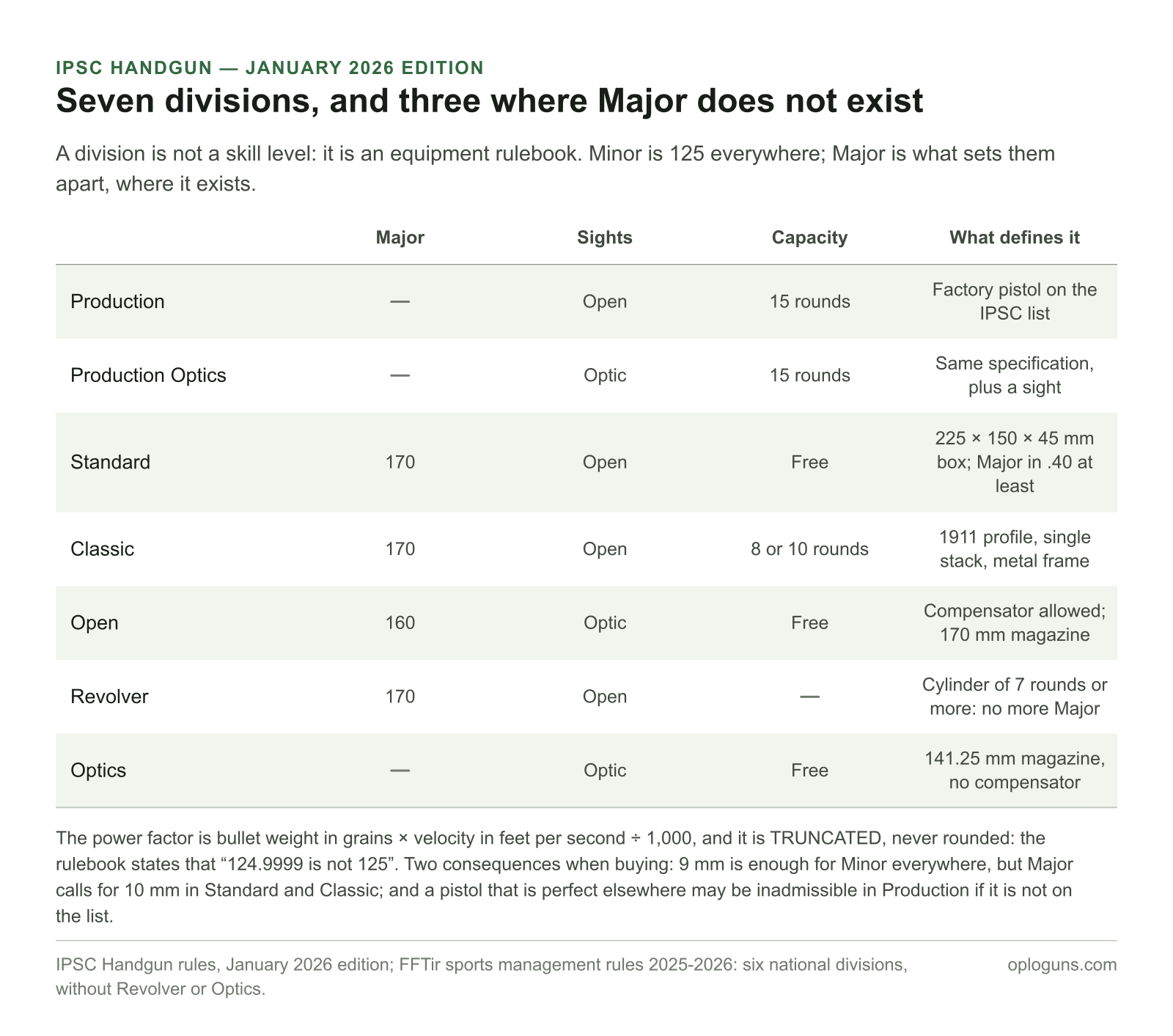
IPSC divisions 2026: what each one admits
A division sets what the firearm is allowed to be: caliber, sights, capacity, trigger. All of them require at least a 9 mm caliber, with a 19 mm case1.
Production
Pros
Production Optics
Pros
Standard
Pros
Classic
Pros
Open
Pros
The two divisions absent from the French championship complete the list: Optics, red dot on an unrestricted firearm, no compensator, Minor only, and Revolver, whose Major at 170 excludes cylinders of 7 rounds or more18.
Minor or Major: factor 125, then 160 or 170
The power factor is measured by chronograph, on three of the shooter's rounds1:
124 grains × 1,020 feet/s ÷ 1,000 = 126.48
At 1,000 feet per second, the same 124-grain bullet gives only 124: Minor is not reached. The result is truncated, never rounded1. The choice of loads is detailed in our guide to 9mm ammunition for sport shooting.
The power factor thresholds, Minor and Major
Power factor = bullet weight (grains) × velocity (feet per second) ÷ 1,000; IPSC Handgun rules, January 2026 edition
The result is truncated, never rounded: "124.9999 is not 125"1. Production, Production Optics and Optics are shot in Minor only1.
View the data
| Division | Minor | Major |
|---|---|---|
| Open | 125 | 160 |
| Standard | 125 | 170 |
| Classic | 125 | 170 |
| Revolver | 125 | 170, cylinder of 6 rounds at most |
| Production | 125 | — |
| Production Optics | 125 | — |
| Optics | 125 | — |
Major changes the value of the peripheral zones: C is worth 4 points instead of 3, D is worth 2 instead of 1, and A is worth 5 in both cases1. It therefore pays mainly on off-center hits.
What the same target scores in Minor and in Major
Example: 32 hits (20 A, 8 C, 4 D) on an IPSC target, scoring table of Appendix B2 of the 2026 rules
The A zone is worth 5 in Minor as in Major; only the C and D zones change value1.
View the data
| Zone hit | Hits | Minor points | Major points |
|---|---|---|---|
| A (center) | 20 | 100 | 100 |
| C | 8 | 24 | 32 |
| D (periphery) | 4 | 4 | 8 |
| Total | 32 | 128 | 140 |
IPSC stage: 12, 24 or 32 rounds, ranked by hit factor
A match strings together stages, courses shot only once. A short course requires 12 rounds at most, a medium one 24, a long one 32, never more than 9 scoring hits from any one position; a sanctioned match counts three short courses for two medium and one long1.
Time runs from the start signal, given 1 to 4 seconds after the range officer's "Standby", to the last shot1. On a cardboard target, the two best hits count1.
| Hit or fault | Minor | Major |
|---|---|---|
| Zone A | 5 | 5 |
| Zone C | 3 | 4 |
| Zone D | 1 | 2 |
| Miss | −10 | −10 |
| No-shoot hit, per hit (two at most) | −10 | −10 |
| Procedural penalty | −10 | −10 |
The points, penalties deducted, are then divided by the time: that is the hit factor. The best on the stage receives all the points at stake, the others are ranked pro rata1.
At constant points, time drives the hit factor
Hit factor = points, penalties deducted ÷ time in seconds; example of a stage finished with 115 points
The best hit factor on the stage receives the stage's maximum points; the other shooters are ranked pro rata1.
View the data
| Time | Points | Hit factor |
|---|---|---|
| 15.00 s | 115 | 7.67 |
| 20.00 s | 115 | 5.75 |
| 25.00 s | 115 | 4.60 |
| 30.00 s | 115 | 3.83 |
| 35.00 s | 115 | 3.29 |
| 40.00 s | 115 | 2.88 |
A shooter who scores 108 points in 24 seconds, so 4.50, beats one who scores 120 in 30 seconds, so 4.00.
IPSC safety: seven faults that disqualify
In IPSC, a safety fault does not cost points: it ends the match1. The firearm is handled only in a safety area, or on the firing line at the range officer's command1. Grounds for disqualification include1:
- The muzzle outside the permitted angle: 90 degrees in every direction by default, unless a different angle is announced at the briefing.
- A dropped firearm, loaded or not, during the course.
- The muzzle pointed at yourself, or at another person.
- The finger inside the trigger guard while moving, or while clearing a malfunction.
- A shot into the ground less than 3 meters from the shooter, except at a closer cardboard target.
- Ammunition handled in the safety area, even dummy rounds.
- A loaded firearm outside the range officer's authorization.
TSV pistol in France: Category B, 4–7 months after license
Every handgun is Category B12. The authorization requires three controlled sessions at least two months apart within the last twelve months, then an answer from the prefect within three months, whose silence amounts to refusal144. The pistol is then kept in a safe or strong cabinet15. The file is detailed in our guide to the Category B firearm authorization.
Most TSV long guns are also Category B: semi-automatic rifle with a detachable magazine, up to 11 rounds in centerfire or 31 in rimfire, semi-automatic shotgun of more than 3 rounds, smooth-bore pump-action shotgun1216.
Beyond 20 rounds, a handgun magazine moves to Category A112. A TSV shooter may acquire them on a federation certificate, outside the ceiling of ten magazines per firearm13; the FFTir issues it only to shooters who compete regularly5. The detail is in our article on pistol magazines, and the choice of firearm in pistol eligibility by discipline.
TSV budget: €1,110 to €1,437 the first year
Assumption: 200 rounds of 9mm a month, so 2,400 a year, and the pistol bought in the first year.
| Item | First year | Following years |
|---|---|---|
| License and club subscription | €165 to €3201718 | €165 to €270 |
| Medical certificate | €3019 | €30 |
| 2,400 rounds of 9mm, by the case of 1,000 | €624 to €66223 | €624 to €662 |
| Passive ear defenders and shooting glasses | €40 to €792021 | — |
| Belt, holster, three magazine pouches | €251 to €346222324 | — |
| Total, excluding the pistol | €1,110 to €1,437 | €819 to €962 |
| New pistol, from Glock 17 to CZ Shadow 2 | €715 to €1,8702526 | — |
| Handgun safe | €115 to €2892728 | — |
| Total, with the pistol | €1,940 to €3,596 | €819 to €962 |
Ammunition weighs the most, and every year: €0.26 to €0.28 a round by the case of 1,000, against €0.26 to €0.32 by the box of 5023. The belt costs €63 to €84, the holster €83 to €89, a magazine pouch €35 to €58 each222324.
What 9mm rounds cost each year, by rate of fire
Yearly cost at €0.26 a round, price of a case of 1,000 FMJ rounds surveyed on 24 September 2026; excluding firearm, license and equipment
Case of 1,000 rounds at €259.00, so €0.26 a round2; €0.28 at €275.953. Purchases are capped at 3,000 rounds per firearm per 12-month period4.
View the data
| Rate | Rounds a year | Cost at €0.26 | Cost at €0.28 |
|---|---|---|---|
| 100 a month | 1,200 | €312 | €331 |
| 200 a month | 2,400 | €624 | €662 |
| 300 a month | 3,600 | €936 | €993 |
| 400 a month | 4,800 | €1,248 | €1,325 |
The rate of fire runs into two ceilings: 3,000 rounds bought per firearm per twelve-month period, and 1,000 held per firearm429. Beyond 250 rounds a month, a second Category B firearm is needed, or reloading: ammunition components can be bought without limit30. The framework is detailed in our guides to firearm and ammunition quotas and to keeping a reloading log.
Starting TSV: approved club, license, then authorization
- A TSV-approved club, where an instructor in the discipline supervises shooting531. The federal training guidelines provide for no compulsory qualification for the shooter, only instructor diplomas32.
- The FFTir license: €165 to €320 the first year depending on the club, then €165 to €2701718, with a medical certificate less than a year old8.
- Three controlled sessions, at least two months apart, then the authorization application144.
- The first competitions: the French championship is open subject to validation by the club's TSV instructor and president8.
The choice between 9mm and .22 LR and that of the first pistol are detailed in our guides.
Three misconceptions about IPSC and TSV
- "A heavy bullet makes Major in Production." Production is shot in Minor only, like Production Optics and Optics1.
- "A factor of 124.99 makes Minor." The result is truncated: 124.9999 is not 1251.
- "TSV can be practiced at any club." Only approved clubs organize it, with a TSV instructor present58.
IPSC division by goal: what each one brings
What you gain, what you give up
To start with a production firearm, Production accepts a Glock 17 or a CZ Shadow 2 unmodified, in 9mm. In return, 15 rounds, a regulated trigger and no Major.
To shoot with a red dot, Production Optics keeps the production firearm and adds the optic, for €309 to €320 more. Open also opens the compensator and Major in 9mm, but its magazines of more than 20 rounds go through a certificate reserved for regular competitors.
To shoot Major with iron sights, Standard and Classic require a caliber of at least 10 mm; Classic limits the magazine to 8 rounds in Major.
Sources 32 references
Divisions, scoring and safety come from the IPSC Handgun rules of January 2026, the French organization from the FFTir's rulebooks, firearm categories from the code de la sécurité intérieure in force, budgets from the fees published by clubs and from dated price surveys at French dealers. Click a note call in the text to highlight the corresponding source.
- IPSC — IPSC Handgun Competition Rules, January 2026 Edition (PDF, final version of 29 December 2025, linked from the IPSC "Rule Books" page), consulted on 24 September 2026: 1.1.3, accuracy, power and speed, "Diligentia, Vis, Celeritas"; 1.2.1.1 to 1.2.1.4, short, medium and long courses of 12, 24 and 32 rounds at most, at most 9 scoring hits from any one position, ratio of 3 short to 2 medium and 1 long; 2.1.2, default safe angle of "90 degrees in all directions", modifiable by stage (2.1.2.1); 5.4, eye and ear protection; 5.6.3.5, power factor = bullet weight in grains × average velocity of 3 rounds in feet per second ÷ 1,000, "a result of 124.9999 is not 125"; 8.3.1 to 8.3.8, range commands, "Standby" followed by the start signal "within 1 to 4 seconds"; 9.2.1.1, hit factor = points of the best hits, penalties deducted, divided by the time, the best hit factor on the stage receiving the maximum points; 9.4.2 to 9.4.4, −10 points per no-shoot hit (two at most per no-shoot) and per miss; 10.1.2, procedural penalty of −10 points; glossary, "Firing a shot at, but missing, a target is not a "failure to engage""; 10.4.2, shot into the ground less than 3 m from the shooter; 10.5.1 to 10.5.16, disqualifications for unsafe gun handling, including the angle (10.5.2), the dropped firearm (10.5.3), the muzzle pointed at oneself (10.5.5), the finger in the trigger guard while moving (10.5.11) and ammunition handled in the safety area (10.5.13); Appendix B2, A, C and D zones at 5, 4 and 2 points in Major, 5, 3 and 1 in Minor; Appendix D1, Open, Major 160 with a bullet of at least 120 grains, Minor 125, magazine of 170 mm at most, optic and compensator allowed; D2, Standard, Major 170 in 10 mm (.40) at least, .357 SIG allowed until 31 December 2029, box of 225 × 150 × 45 mm, neither optic nor compensator; D3, Classic, single-stack 1911 profile, box of 225 × 150 × 45 mm, 8 rounds in Major or 10 in Minor at the start signal; D4 and D4a, Production and Production Optics, Minor only, pistols on the Production Division List, trigger of "2.27kg (5lbs.) for first shot or 1.36kg (3lbs.) for every shot", barrel of 127 mm at most, 15 rounds at most at the start signal, magazine wells prohibited ("flared, enlarged and/or add-on magwells"), red dot compulsory in Production Optics; D5, Revolver, Major 170, except cylinders of 7 rounds or more; D6, Optics, Minor only, red dot compulsory, magazine of 141.25 mm (170 mm single stack), no compensator; Appendix F1, calls "Alpha", "Charlie", "Delta", "Miss".
- Armurerie Centrale — munitions 9x19 (in French), prices surveyed on 24 September 2026: 1,000 rounds of STV Scorpio 9 mm Luger 124 gr FMJ at €259.00; boxes of 50 FMJ from €12.90 (Fiocchi 123 grains) to €15.95 (Aguila 124 grains). ⚠️ Commercial data.
- Armurerie Lavaux — MFS cal. 9x19 Para FMJ, lot de 1 000 (in French), price surveyed on 24 September 2026: €275.95 for 20 boxes of 50, in stock, 124-grain FMJ bullet; same day, Norma 9 mm Para FMJ by 1,000 at €294.95. ⚠️ Commercial data.
- Service-public.gouv.fr — armes de catégorie B pour un tireur sportif (soumises à autorisation) (in French), factsheet F2250 checked on 20 March 2025: 15 firearms, 6 for a first-time applicant, 3,000 rounds per firearm per 12 consecutive months, storage in a safe, strong cabinet or strongroom, authorization valid 5 years, and the prefecture's response time — « en l'absence de réponse dans un délai de 3 mois à partir de la date de réception de votre demande, cela signifie que votre demande est refusée » [without an answer within 3 months of receipt, the application is refused].
- FFTir — Règlement administratif du Tir Sportif de Vitesse, saison 2019/2020 (4-page PDF, in French, hosted by the federation), consulted on 24 September 2026: preamble, « La pratique du Tir Sportif de Vitesse est exclusivement sportive et débouche obligatoirement sur la compétition » [TSV is exclusively a sport and necessarily leads to competition]; article I, discipline « reconnue depuis 1978 par la FFTir et […] régie au niveau international par l'IPSC » [recognized since 1978 by the FFTir and governed internationally by the IPSC]; article IV, shooting from the holster prohibited outside an approved association or « sans la présence d'un moniteur TSV » [without a TSV instructor present]; article VII, sporting rules available in French, « seul le règlement officiel de l'IPSC en anglais est valable sur les compétitions de Niveau III et plus » [only the official English IPSC rules are valid at Level III competitions and above]; article XVI, "chargeurs longs" [long magazines] certificate issued « qu'aux seuls tireurs pratiquant régulièrement la compétition » [only to shooters who compete regularly]. ⚠️ 2019-2020 edition, the latest published by the federation.
- Fédération française de tir — Tir sportif de vitesse — Organisation (in French), consulted on 30 July 2026: « Le Tir Sportif de Vitesse (TSV) est la déclinaison Française de l'IPSC » [TSV is the French version of IPSC], four disciplines (Handgun, Rifle, Shotgun, PCC), ministerial delegation, national specialist TSV commission.
- FFTir — page « Règlements sportifs » (in French), consulted on 24 September 2026: under Tir sportif de vitesse, "Règlement Tir sportif de vitesse Armes de poing (MàJ 2012)", French translation of the January 2012 IPSC edition.
- FFTir — Règlement de Gestion Sportive 2025-2026, Vie Nationale (PDF, in French, update of 23 March 2026), consulted on 24 September 2026: B.10.1, participation in TSV « réservée aux tireurs licenciés dans les clubs habilités pour cette discipline » [reserved for shooters licensed at clubs approved for this discipline]; B.10.1.1, events "HANDGUN : Open, Standard, Classic, Production, Production Optic, PCC", "RIFLE : Open Semi Auto – Standard Semi Auto", "SHOTGUN : Open, Standard Semi-auto, Standard manual, PCC, 3 Gun", IPSC rules applied for categories at internationally ranked competitions; B.10.2.1, French championship « open sous réserve de validation par le moniteur TSV du club, le président du club et le service OCC » [open subject to validation by the club's TSV instructor, the club president and the OCC department]; A.1.1, licence for the season and one-year medical certificate checked on the EDEN portal.
- IPSC — Production Division List, update of 9 March 2026, consulted on 24 September 2026: only pistols on the list, compliant with Appendix D4, are admitted in Production, and the IPSC "reserves the right to modify this list at any time"; the list includes the Glock 17 and its Gen 5 versions, and the CZ Shadow 2 and Shadow 2 OR.
- Armurerie de la Bourse — surveys of 24 September 2026 (in French): Holosun Elite 407C X3 €309.00; Trijicon RMR RM05 9 MOA €860.00; Aimpoint ACRO P-2 3.5 MOA FDE without interface €799.00; Trijicon RMR adapter for Glock MOS €44.00. ⚠️ Commercial data.
- Armurerie Auxerre — surveys of 24 September 2026 (in French): Holosun 407C X3 2 MOA €319.95; Aimpoint ACRO mount for Glock MOS €76.20. ⚠️ Commercial data.
- Légifrance — article R311-2 du code de la sécurité intérieure (in French), version in force since 7 September 2025 (decree no. 2025-894 of 5 September 2025), consulted on 24 September 2026: Category A1, 8°, « Système d'alimentation d'arme de poing contenant plus de 20 munitions » [handgun feeding device holding more than 20 rounds]; Category B, 1°, handguns; Category B, 2°, long guns « a) A répétition semi-automatique, à percussion centrale, dont le projectile a un diamètre inférieur à 20 mm, d'une capacité supérieure à 3 coups ou équipées d'un système d'alimentation amovible et n'excédant pas 11 coups » [semi-automatic, centerfire, projectile under 20 mm, capacity over 3 rounds or with a detachable feeding device, not exceeding 11 rounds] and « a bis) A répétition semi-automatique à percussion annulaire, dont le projectile a un diamètre inférieur à 20 mm, d'une capacité supérieure à 3 coups ou équipées d'un système d'alimentation amovible et n'excédant pas 31 coups » [the same in rimfire, not exceeding 31 rounds]; Category C, 1°, long guns « a) A répétition semi-automatique dont le projectile a un diamètre inférieur à 20 mm équipées de systèmes d'alimentation inamovibles permettant le tir de 3 munitions au plus » [semi-automatic with fixed feeding devices of 3 rounds at most], « b) A répétition manuelle dont le projectile a un diamètre inférieur à 20 mm équipées de systèmes d'alimentation permettant le tir de 11 munitions au plus » [manual repeating, 11 rounds at most], « c) A un coup par canon » [single shot per barrel]; Category D, h), muzzle energy of 2 to 20 joules; Category D, « e) Armes historiques et de collection dont le modèle est antérieur au 1er janvier 1900 » [historic and collectors' firearms of a model predating 1 January 1900], unless specially classified by arrêté, and « f) Reproductions d'arme dont le modèle est antérieur au 1er janvier 1900 ne pouvant tirer que des munitions sans étui métallique, sauf celles dont la technique de fabrication améliore la précision et la durabilité de l'arme » [reproductions of pre-1900 models firing only ammunition without a metal case, except those whose manufacture improves accuracy and durability].
- Légifrance — articles R312-45 et R312-45-1 du code de la sécurité intérieure (in French), consulted on 24 September 2026: feeding devices bought on production of the firearm's authorization, « Nul ne peut acquérir et détenir plus de dix systèmes d'alimentation par arme » [no one may acquire and hold more than ten feeding devices per firearm]; R312-45-1, magazines of more than 20 rounds for the disciplines that require them, on a certificate issued by the federation (R312-5, 10°, tir sportif de vitesse), outside the quota of ten.
- Légifrance — arrêté du 28 avril 2020 relatif aux avis favorables et aux attestations délivrés par les fédérations (in French; JORF of 29 April 2020, art. R.312-5 CSI), article 3: « la participation du tireur, au cours des douze mois précédant sa demande, à trois séances contrôlées de pratique du tir, espacées d'au moins deux mois » [the shooter's participation, during the twelve months before the application, in three controlled shooting sessions at least two months apart].
- Légifrance — article R.314-3 du code de la sécurité intérieure (in French), version in force since 11 May 2017: storage of Category A and B firearms, parts and ammunition in a suitable safe or strong cabinet, or in a strongroom with an armored door and barred openings.
- Légifrance — article R311-2 du code de la sécurité intérieure (in French), version in force since 7 September 2025 (decree no. 2025-894 of 5 September 2025), consulted on 23 September 2026: Category C, 1°, long guns « a) A répétition semi-automatique dont le projectile a un diamètre inférieur à 20 mm équipées de systèmes d'alimentation inamovibles permettant le tir de 3 munitions au plus sans qu'intervienne le réapprovisionnement » [semi-automatic with fixed feeding devices allowing 3 rounds at most without reloading] and « c) A un coup par canon » [single shot per barrel]; Category B, 2°, f), manual repeating long guns « munies d'un dispositif de rechargement à pompe » [fitted with a pump-action reloading device], including « armes à canon lisse » [smooth-bore firearms].
- USO Tir, FFTir-affiliated club — tarifs, saison 2026-2027 (in French), in force from 1 September 2026: adult men €165, women €155, young shooters €130 and €120; « les tarifs comprennent le coût de la licence fédérale, l'assurance et la cotisation à l'USO Tir » [fees include the federal licence, insurance and the USO Tir subscription]; membership gives the right to « utilisation des armes du club » [use of the club's firearms] and access to gloves, jackets and trousers.
- Tir Club Alpin — inscription et tarifs (in French), 2026-2027 season, consulted on 23 September 2026: €318 for a new member, €268 on renewal.
- Assurance maladie — tarifs conventionnels des médecins généralistes et spécialistes (in French), page updated 17 March 2026: GP consultation (G), €30.00 in mainland France, fee in force at 1 January 2026.
- Armurerie Loisir — protections auditives (in French), prices surveyed on 24 September 2026: passive ear defenders from €14.90 (Real Hunter Passive) to €49.90 (3M Optime III), plugs from €1.50 to €5.99, electronic ear defenders from €79.90 to €299.00. ⚠️ Commercial data.
- Armurerie Gilles — lunettes de tir On-Point, Browning (in French), price surveyed on 23 September 2026: €25.00 in yellow, €29.00 in orange; same day, Meyson, lunette de tir On-Point Browning at €27.90, « Certifié EN166 » [EN166 certified], and Chassez Discount, On-Point orange at €29.00. ⚠️ Commercial data.
- Armurerie de la Bourse — IPSC / TSV and ceinture et sous-ceinture IPSC DAA Premium Belt (in French), prices surveyed on 24 September 2026: DAA Racer Gen 2 magazine pouch €36.00 (Racer €35.00), Ghost Thunder Elite holster €89.00, Ghost One Evo €139.00, DAA Premium belt and inner belt €63.00. ⚠️ Commercial data.
- Deville Armory — équipement TSV (in French), prices surveyed on 24 September 2026: DAA Competition Ratchet belt €83.95, DAA Premium Belt €62.95, DAA X-Ray magazine pouch €57.51. ⚠️ Commercial data.
- Armurerie Douillet — holster Ghost Thunder Elite droitier pour CZ Shadow 1/2/TS et Tanfoglio Stock 1/3 (in French), price surveyed on 24 September 2026: €83.00, in stock. ⚠️ Commercial data.
- Armurerie Auxerre — pistolet Glock 17 Gen 5 Front Serrations, 9x19 and pistolet CZ Shadow 2 Black, 9x19 (in French), prices surveyed on 24 September 2026: €715.00 on promotion instead of €729.95, and €1,866.75, 19-round magazine. ⚠️ Commercial data.
- Gunmarket — pistolet Glock 17 Gen5, 9x19 (in French), price surveyed on 24 September 2026: €739.00 instead of €850.00, to order; same day, Deville Armory, pistolet CZ Shadow 2, 9x19: €1,870.00 incl. VAT, Category B, two in stock. ⚠️ Commercial data.
- Armurerie Loisir — coffres-forts et armoires fortes (in French), survey of 23 September 2026: handguns, Fortify Delta 1 €115.00, Fortify SC6 €249.00 instead of €279.00, Infac €259.00; long guns, from €397.00 to €865.00. ⚠️ Commercial data.
- Safepro24 France — coffres-forts pour armes de poing (in French), prices surveyed on 30 July 2026: Rottner GunBox €68.90, Profirst Patrol 2 guns €168.00, Profirst NY 2 €289.00, Profirst Teos 40 S1 €317.80, Rottner Gunmaster XL €392.80, Profirst Pistol EN0 EL €520.80, Profirst Hurrican EN 0 €873.70. ⚠️ Commercial data.
- Légifrance — article R.312-49 du code de la sécurité intérieure (in French): « Nul ne peut détenir plus de 1 000 munitions par arme. » [No one may hold more than 1,000 rounds per firearm.] A stock ceiling, independent of the purchase ceiling and applicable whatever the origin of the rounds.
- Légifrance — article R.312-48 du code de la sécurité intérieure (in French), in force since 1 August 2018: « Les personnes mentionnées à l'article R. 312-40 sont autorisées à acquérir et détenir, sans limitation, des éléments de munitions, pour les calibres des armes qu'elles détiennent. » [The persons mentioned in article R. 312-40 may acquire and hold, without limit, ammunition components for the calibers of the firearms they hold.] It is this article that takes reloading out of the acquisition quota.
- Fédération française de tir — Moniteur Tir sportif de vitesse (TSV) (in French), consulted on 30 July 2026: TSV instructor (teaching) and national TSV referee (official).
- Fédération française de tir — Directives de formation 2025-2028 (in French, version 09/2024, PDF): list of instructor diplomas (including "Moniteur Tir sportif de vitesse (TSV)"); no compulsory TSV shooter qualification appears in it.
The rules in force prevail. This article describes the IPSC Handgun rules of January 2026 and the French texts at 24 September 2026, with prices surveyed the same day. The Production Division List changes during the season: a pistol's admission is confirmed on the IPSC website before buying.
Frequently asked questions
Are IPSC and TSV the same thing?
Yes. Tir sportif de vitesse is the French name for IPSC, recognized by the FFTir since 1978 and governed internationally by the IPSC. It follows the IPSC rules; the English version alone prevails at Level III competitions and above. It is practiced only in an approved club, with a TSV instructor present.
What is the difference between Minor and Major?
The ammunition's power factor. Minor requires at least 125, in every division. Major requires 160 in Open, 170 in Standard, Classic and Revolver, and does not exist in Production, Production Optics or Optics. On the target, the A zone is worth 5 points in both cases; the C and D zones score more in Major.
How is the power factor calculated?
Bullet weight in grains multiplied by the average velocity of three rounds in feet per second, divided by 1,000. A 124-grain bullet at 1,020 feet per second gives 126.48: Minor is reached. The result is truncated, never rounded: 124.9999 is not 125.
What is the hit factor?
A stage's score: the points of the best hits, penalties deducted, divided by the time in seconds. 115 points in 25 seconds give a hit factor of 4.60. The best hit factor on the stage receives all the points at stake; the other shooters are ranked pro rata.
Which pistols are admitted in the Production division?
Those on the IPSC Production Division List, which the international federation may change at any time; the Glock 17 and the CZ Shadow 2 are on it. The rules of Appendix D4 apply on top: barrel of 127 mm at most, trigger of 2.27 kg on the first shot or 1.36 kg on every shot, 15 rounds at most at the start signal, no magazine well.
Do you need an authorization to shoot TSV with your own firearm?
Yes. A 9mm pistol is Category B: three controlled sessions at least two months apart, then the prefect's authorization, with three months to answer, so four to seven months after the license. TSV semi-automatic rifles and pump-action shotguns are also Category B. Magazines of more than 20 rounds additionally require a federal certificate.
How much does a first year of TSV cost?
€1,110 to €1,437 excluding the pistol, for 2,400 rounds of 9mm, the license, the medical certificate, protection, a belt, a holster and three magazine pouches. With a new Glock 17 or CZ Shadow 2 and a safe, €1,940 to €3,596. The following years come to €819 to €962, mostly ammunition, at prices surveyed on 24 September 2026.
What leads to a disqualification in IPSC?
A safety fault, which ends the whole match: muzzle outside the permitted angle, 90 degrees by default, finger inside the trigger guard while moving, a dropped firearm, muzzle pointed at yourself or someone else, a shot into the ground less than 3 meters away, or ammunition handled in the safety area.