9mm or .22 LR: which caliber to start sport shooting with?
Published on · Updated on · 6 min read · Anthony Baillon
For the same packaging, .22 LR costs half as much per round as 9mm and recoils about ten times less. 9mm, for its part, opens practical shooting, service-firearm shooting and 25 meter centerfire. The choice therefore comes down to the discipline you are aiming at and how much you shoot.
At a glance
| Caliber | Price per round | Strength and limit |
|---|---|---|
| .22 LR | €0.13 by the case €0.16 by the box of 50 |
✓ Precision at 25 and 50 m, low recoil ✗ Neither TSV nor TAR |
| 9mm FMJ | €0.26 by the case €0.30 by the box of 50 |
✓ TSV, TAR, 25 m centerfire ✗ Ammunition ×2, recoil ×10 |
Median prices surveyed on 24 September 2026.
- Per year, at 200 rounds a month: €312 in .22 LR by the case, €624 in 9mm.
- In between: the .22 LR version of a 9mm pistol, or a conversion kit at €422 to €845.
Ammunition budget: 9mm costs twice as much as .22 LR
Price per round, by caliber and packaging
Practice ammunition, median price surveyed on 24 September 2026 at three French gun shops; the surveyed range is in brackets
.22 LR: cases of 400 to 500 and boxes of 5012. 9mm FMJ: cases of 1,000 and boxes of 5034. Match ammunition in .22 LR rises to €0.50 a round.
View the data
| Ammunition | Packaging | Surveyed price | Price per round |
|---|---|---|---|
| .22 LR | Case of 400 to 500 | €45 to €89 | €0.13 (€0.11 to €0.18) |
| .22 LR | Box of 50 | €5.50 to €10 | €0.16 (€0.11 to €0.20) |
| 9mm FMJ | Case of 1,000 | €259 to €280 | €0.26 (€0.26 to €0.28) |
| 9mm FMJ | Box of 50 | €12.90 to €16 | €0.30 (€0.26 to €0.32) |
Packaging counts as much as caliber. By the case of 400 to 500, .22 LR drops to €0.13 a round12; by the box of 50, it comes to €0.16 at the median, from €0.11 for Aguila to €0.20 for RWS Pistol Match2. 9mm FMJ costs €0.26 by the case of 1,000 and €0.30 by the box of 5034.
Comparing a box of .22 LR with a case of 9mm narrows the gap on paper; for the same packaging, the ratio stays one to two.
Yearly budget: €312 in .22 LR, €624 in 9mm
What ammunition costs each year, by rate of fire
Yearly ammunition cost by the number of rounds fired each month: €0.13 a round in .22 LR bought by the case, €0.26 in 9mm FMJ. Prices surveyed on 24 September 2026, excluding firearm and license.
Price per round: .22 LR by the case of 400 to 50012, 9mm FMJ by the case of 1,000 or by the entry-level box of 5034. By the box of 50, at €0.16 a round, .22 LR comes to €384 a year at 200 rounds a month.
View the data
| Rate | Rounds a year | .22 LR by the case | 9mm |
|---|---|---|---|
| 100 a month | 1,200 | €156 | €312 |
| 200 a month | 2,400 | €312 | €624 |
| 300 a month | 3,600 | €468 | €936 |
| 400 a month | 4,800 | €624 | €1,248 |
At 200 rounds a month, 9mm costs €312 more every year than .22 LR bought by the case. The full budget, license, firearm and safe included, is detailed in our article on the cost of the first year.
The quota does not weigh the same way. 9mm, a Category B round, is bought within a limit of 3,000 rounds per firearm per twelve-month period8. .22 LR, in Category C, escapes that quota; without the corresponding firearm, holding it is limited to 500 rounds9. See Category B quotas.
Recoil: about ten times less in .22 LR caliber
Free recoil energy
A 1,000 g firearm in both cases, to isolate the effect of the cartridge; momentum of the bullet alone
Calculated from manufacturer weights and velocities: 40-grain .22 LR at 326 m/s5, 115-grain 9mm at 360 m/s6. Powder gases add a few tenths of a joule to the 9mm. The ratio obtained, nine to ten, falls within the range of 8 to 14 published by an American retailer7.
View the data
| Caliber | Bullet | Velocity | Free recoil |
|---|---|---|---|
| .22 LR | 40 grains (2.59 g) | 326 m/s (1,070 fps) | 0.36 J |
| 9mm | 115 grains (7.45 g) | 360 m/s (1,181 fps) | 3.6 J |
For the same firearm weight, 9mm produces about ten times more recoil energy than .22 LR567. Faced with noticeable recoil, a beginner often learns to anticipate the shot: the hand tightens and the muzzle dips just before the break. .22 LR lets you work on sight picture and trigger release without that variable.
Both calibers call for the same hearing protection. The detail of the trigger, which counts as much as recoil, is in our guide double action, single action or striker-fired.
Events: each caliber opens its own disciplines
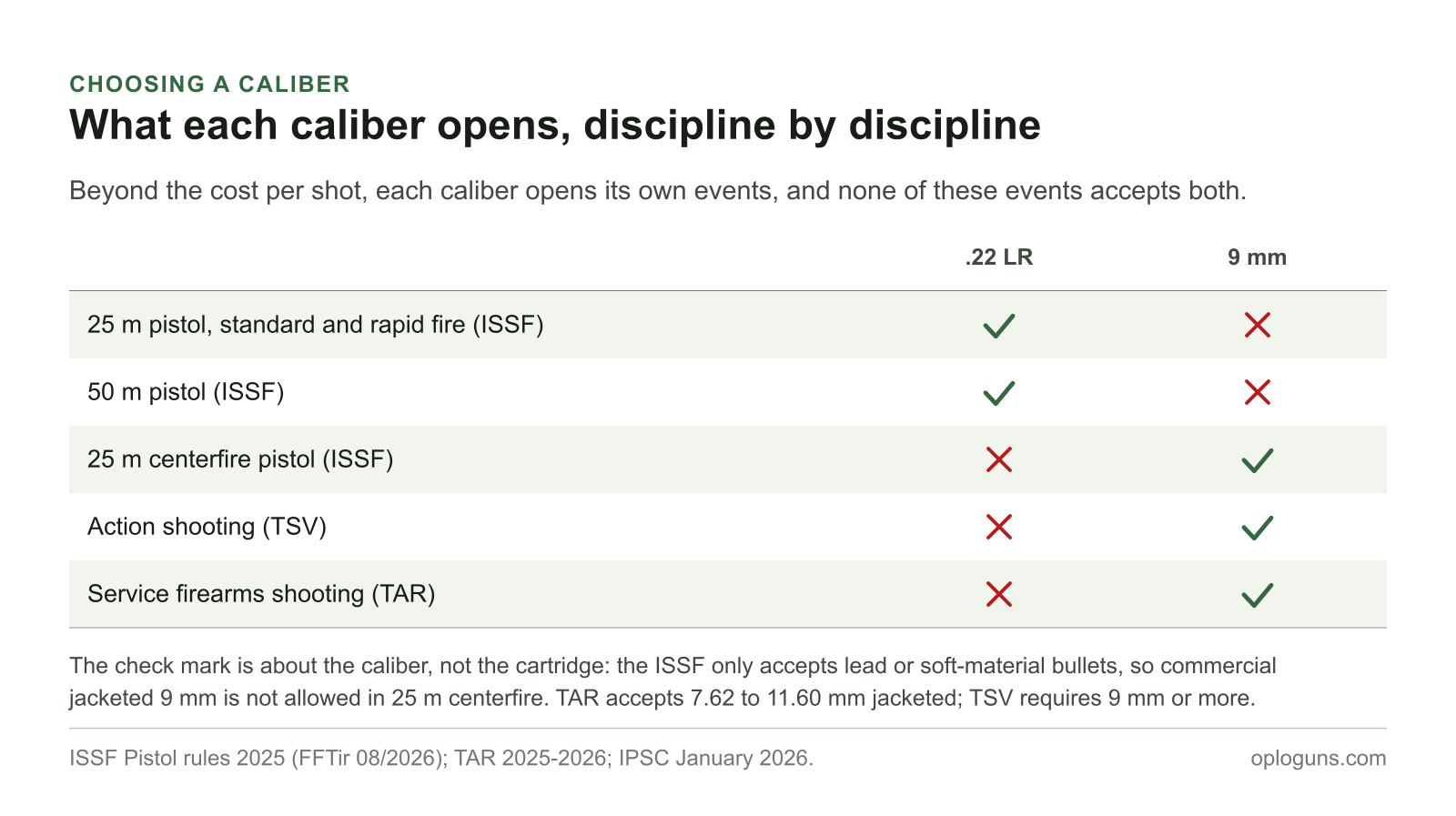
| Event | .22 LR | 9mm |
|---|---|---|
| 25 m pistol, standard, rapid fire (ISSF) | ✓ | — |
| 50 m pistol (ISSF) | ✓ | — |
| 25 m centerfire pistol (ISSF) | — | ✓ with lead bullets |
| Practical shooting (TSV) | — | ✓ |
| Service-firearm shooting (TAR) | — | ✓ |
The ISSF reserves 25 m centerfire for calibers of 7.62 to 9.65 mm, and admits only lead or soft-material projectiles: commercial jacketed 9mm is not allowed there10. TAR admits 7.62 to 11.60 mm, with jacketed projectiles11. Practical shooting, which follows the IPSC rules, requires a caliber of at least 9 mm12. Eligibility firearm by firearm is in our article on pistols admitted by discipline.
Starting in .22 LR: three families of pistols
| Family | Examples | Surveyed new price |
|---|---|---|
| .22 LR target pistol | Browning Buck Mark Standard URX | €599 to €6101314 |
| .22 LR version of a 9mm pistol | Glock 44, Beretta 92 FS .22 LR, CZ P-07 Kadet | €595 to €6501314 |
| Conversion kit on a 9mm | Tactical Solutions for Glock, Kadet for CZ Shadow 2, Beretta 92 FS kit | €422 to €8451314 |
A reference 9mm pistol, the Glock 17 Gen5, costs €739 to €7451315. Every handgun is in Category B, .22 LR included16.
The conversion kit replaces the slide and barrel and keeps the frame, trigger and grip. These parts stay outside the firearm quota, which only the frame and the lower receiver count against8. The detailed comparison of models is in our guide to the first sport shooting pistol.
.22 LR or 9mm caliber: pros and cons
.22 LR
Pros
9mm
Pros
- One firearm for large caliber: TSV, TAR, 25 m centerfire with lead bullets.
- Reloadable, which lowers the price per round for an equipped shooter; see keeping a reloading log.
Cons
- €312 more ammunition a year at 200 rounds a month.
- About ten times more recoil, longer for a beginner to master.
- Ammunition capped at 3,000 per firearm per year8.
Which caliber to start with, depending on your goal
What you gain, what you give up
For precision at 25 and 50 meters, .22 LR opens every ISSF pistol event except centerfire, for €312 of ammunition a year. In return, moving up to a large caliber takes a second firearm.
For practical shooting or TAR, 9mm is the discipline's caliber from day one. In return, ammunition costs twice as much, and recoil has to be worked on from the start.
To learn on .22 LR before a 9mm, the .22 LR version of a 9mm pistol or a conversion kit keeps the same controls. In return, the trigger remains a service-pistol trigger, and the kit costs almost the price of a firearm.
Three misconceptions about the caliber to start with
- "A .22 LR pistol is declared in Category C." No: it is the .22 LR round that is in C. Every handgun is in Category B, with an authorization and a safe16. See firearm categories.
- ".22 LR only costs 30% less." That figure compares a box of .22 LR with a case of 9mm. For the same packaging, .22 LR costs half as much1234.
- "9mm is allowed in every ISSF 25 meter event." Only in 25 m centerfire, and with lead projectiles: jacketed ones are prohibited there10.
Sources 16 references
Event rules come from the ISSF, TAR and IPSC rulebooks in the edition stated; classifications and quotas from Légifrance and service-public.gouv.fr; prices from dated surveys at several French gun shops, flagged ⚠️ as commercial data. Click a note call in the text to highlight the corresponding source.
- Armurerie Loisir — balles .22 LR (in French), survey of 24 September 2026: cases — Magtech 500 €54.90, Winchester M22 500 €59.90, Remington Thunderbolt 500 €59.90, CCI Blazer 500 €74.90, CCI Standard Velocity 500 €75.90; boxes of 50 — Fiocchi TT Soft €5.65, Geco €6.99, CCI Blazer €7.99, Winchester T22 €7.99, CCI Standard Velocity €8.99, ELEY Club €9.90; ELEY Tenex Pistol €24.90. ⚠️ Commercial data.
- Armurerie de la Bourse — munitions de catégorie C (in French), survey of 24 September 2026: boxes of 50 — Aguila Standard SP €5.50, Sellier & Bellot Club €6.00, Geco €7.00, CCI Standard €8.00, CCI Blazer €8.00, RWS Pistol Match €10.00, ELEY Club €12.00; Winchester M22 €45.00 per 400, SK Magazine €89.00 per 500. ⚠️ Commercial data.
- Armurerie Centrale — munitions 9x19 (in French), survey of 24 September 2026 from the product pages: Fiocchi FMJ 124 grains €12.90 per 50, STV Scorpio FMJ 124 grains €13.90, Geco FMJ €14.49, Norma Range & Training €14.90, Winchester Target & Practice €15.90, Aguila FMJ €15.95; STV Scorpio FMJ €259.00 per 1,000. ⚠️ Commercial data.
- Armurerie de la Bourse — munitions de catégorie B (in French), survey of 24 September 2026: 9x19 FMJ — Norma, Winchester and MFS €15.00 per 50, Fiocchi, Magtech and Sellier & Bellot €16.00; STV Scorpio €280.00 for a case of 1,000. ⚠️ Commercial data.
- Armurerie Loisir — 500 cartouches CCI Standard Velocity 22 LR (in French): 40-grain bullet, velocity 326 m/s. Free recoil energy calculated for a 1,000 g firearm, bullet alone.
- Federal Ammunition — American Eagle 9mm Luger 115 grain, official page: muzzle velocity 1,180 feet per second, so 360 m/s. Free recoil energy calculated for a 1,000 g firearm, bullet alone.
- Target Sports USA — .22 LR vs 9mm, ballistics compared: free recoil ratio of 8 to 14 between 9mm and .22 LR. ⚠️ American retailer's blog, cited to cross-check the calculation.
- Service-public.gouv.fr — armes de catégorie B pour un tireur sportif (in French), factsheet F2250 checked on 20 March 2025: « Vous pouvez acheter au maximum 3 000 cartouches par arme autorisée pour le tir sportif, par période de 12 mois consécutifs » [you may buy at most 3,000 rounds per firearm authorized for sport shooting, per 12 consecutive months]; frames and lower receivers « prises en compte dans le quota d'armes depuis le 1er septembre 2023 » [counted in the firearm quota since 1 September 2023]; « Les autres éléments d'arme restent exclus du quota d'acquisition et de détention des armes » [other firearm parts remain excluded from the acquisition and holding quota].
- Légifrance — articles R312-60 à R312-63 du code de la sécurité intérieure (in French): « Nul ne peut détenir plus de 500 munitions classées dans les 6°, 7° et 8° de la catégorie C sans détenir l'arme correspondante » [no one may hold more than 500 rounds classified in 6°, 7° and 8° of Category C without holding the corresponding firearm] (R312-63).
- Fédération française de tir — Règles Pistolet ISSF, mise à jour 08/2026 (PDF, in French; translation of the 2025 edition, second print in force at 1 July 2026), reread on 24 September 2026: 8.4.3.2, 25 m rimfire pistol "de calibre 5,6 mm (.22'') […] chambré pour les cartouches Long Rifle" [5.6 mm (.22") caliber chambered for Long Rifle cartridges]; 8.4.3.3, centerfire « de calibre compris entre 7,62mm et 9,65mm » [caliber between 7.62 mm and 9.65 mm]; 8.4.3.4, 50 m pistol in .22 Long Rifle; 8.4.4, projectiles « uniquement en plomb ou matériau tendre similaire » [only of lead or similar soft material], « Les projectiles chemisés ne sont pas autorisés » [jacketed projectiles are not permitted], "magnum" ammunition prohibited.
- Fédération française de tir — Règlement TAR, saison 2025-2026 (PDF, in French, circulated 12 January 2026): centerfire handguns « d'un calibre compris entre 7,62 mm et 11,60 mm » [of a caliber between 7.62 mm and 11.60 mm]; jacketed projectiles, lead and wadcutter prohibited.
- IPSC — IPSC Handgun Competition Rules, Jan 2026 Edition, Final 29 Dec 2025, link published by the official IPSC Rule Books page: minimum caliber 9 mm (appendix D); TSV follows these rules (FFTir, Règlement administratif du TSV 2019-2020, in French, article I).
- Armurerie de la Bourse — surveys of 24 September 2026 (in French): armes de poing de catégorie B, new prices — Glock 44 Gen5 FS €595.00, Browning Buck Mark Standard URX SE MS €599.00, CZ P-07 Kadet €639.00, Beretta 92 FS .22 LR €650.00, Glock 17 Gen5 FS €745.00; Tactical Solutions .22 LR conversion for Glock 17 €430.00, for Glock 19 €450.00; CZ Shadow 2 Kadet conversion €845.00. ⚠️ Commercial data.
- Armurerie Auxerre — surveys of 24 September 2026 (in French): Browning Buck Mark Standard URX .22 LR €609.90; Beretta 92 FS - 22 €629.00; Beretta 92 FS .22 LR conversion kit €421.64; Kadet conversion for CZ Shadow 2 €819.40. ⚠️ Commercial data.
- GunMarket — pistolet Glock 17 Gen5 cal. 9x19 (in French), survey of 24 September 2026: €739.00. ⚠️ Commercial data.
- Légifrance — article R311-2 du code de la sécurité intérieure (in French), version in force since 7 September 2025: Category B, handguns and their parts (5°); at 10°, « Munitions à percussion centrale et leurs éléments conçus pour les armes de poing » [centerfire ammunition and its components designed for handguns]: rimfire .22 LR is not among them.
The discipline's rulebook prevails. Permitted calibers and projectiles change with the edition of the rules: the club's range officer confirms the rule in force before a purchase.
Frequently asked questions
Which caliber should you start sport shooting with?
It depends on the discipline you are aiming at. .22 LR costs half as much per round for the same packaging, recoils about ten times less and opens the precision events at 25 and 50 meters. 9mm opens practical shooting, service-firearm shooting and 25 meter centerfire.
Is .22 LR really cheaper than 9mm?
Yes, half the price for the same packaging. By the case, .22 LR works out at €0.13 a round and 9mm FMJ at €0.26; by the box of 50, €0.16 against €0.30. At 200 rounds a month, the gap reaches €312 a year when buying by the case.
Can you shoot every discipline with a .22 LR?
No. In pistol, .22 LR opens ISSF 25 m, standard, rapid fire and 50 m. 25 m centerfire requires a caliber of 7.62 to 9.65 mm, service-firearm shooting (TAR) a caliber of 7.62 to 11.60 mm, and practical shooting a caliber of at least 9 mm.
Does a .22 LR conversion kit replace a second firearm?
It turns a 9mm pistol into a .22 LR by changing the slide and barrel, for €422 to €845 depending on the model. In France, these parts do not count towards the firearm quota, unlike the frame. The kit keeps the trigger and grip of the original pistol.
Does .22 LR count towards the 3,000-round quota?
No. In France, the quota of 3,000 rounds per firearm per year covers centerfire ammunition classified in Category B, such as 9mm. Rimfire .22 LR falls in Category C: without the corresponding firearm, holding it is limited to 500 rounds.