Back to news

9mm, .38 Special, .357 Magnum or .45 ACP: which caliber for which event

Published on · 27 min read · Anthony Baillon

In sport shooting, a handgun caliber is chosen on the event and the cost per round, not on energy: from .22 LR at €0.15 to .45 ACP at €0.56, the price per cartridge varies fourfold. Here are the four centerfire calibers, in numbers and sourced.

€0.28 a round in 9mm, the cheapest centerfire
7.62–9.65 mm the ISSF Centre Fire window, .45 and .357 excluded
×2.5 the .357 Magnum's energy against the .38 Special
Handgun caliber eligibility by event: 9mm and .38 Special are admitted in TAR as in ISSF 25 m Centre Fire, .357 Magnum and .45 ACP are excluded from the ISSF, and .22 LR shoots neither TAR nor IPSC but holds three 25 m events and the 50 m.
9mm is the only caliber to appear in all three families of events — subject, at the ISSF, to firing a lead projectile. © Oplo

Five handgun calibers in sport shooting

Which caliber should you choose for a handgun in sport shooting? The question almost always comes down to five cartridges: 9mm Parabellum, .38 Special, .357 Magnum, .45 ACP and .22 Long Rifle. The first four are centerfire; the last, rimfire, plays in another regulatory category.

The classification of ammunition separates them immediately. The 9mm, .38 Special, .357 Magnum and .45 ACP are Category B ammunition, under 10° of article R.311-2: centerfire ammunition designed for handguns1. The .22 LR, being rimfire, falls under Category C and escapes the annual quota of 3,000 cartridges per firearm that weighs on Category B2.

The common mistake is to compare these calibers by their energy, as if this were about defense. In sport shooting, two criteria dominate: the event — each discipline sets its own caliber window — and the cost per round, since you shoot by the hundred. Energy decides almost nothing: no ISSF or TAR target scores better because the bullet hits harder.

One sentence per caliber:

  • 9mm Parabellum — the cheapest centerfire, admitted in the greatest number of events.
  • .38 Special — the soft cartridge of the match revolver, queen of 25 m Centre Fire.
  • .357 Magnum — the most powerful of the four, most often loaded with .38 in competition.
  • .45 ACP — the big caliber of TAR and dynamic shooting, excluded from the ISSF.
  • .22 LR — outside Category B, king of practice and the ISSF speed events.

The master table: energy, price, event

Here, gathered in a single table, are the six pieces of data that really decide a caliber. No French page brings them together: comparison sites give energy without the barrel or the source, list firearm prices rather than ammunition prices, and pass over the disciplines in silence24.

Caliber Muzzle energy Cost per round Recoil Category Events admitted Power factor
9mm Parabellum ≈ 518 J (150 mm) ≈ €0.28 Moderate, sharp B 10° TAR, IPSC; ISSF Centre Fire with lead projectiles only ≈ 146 · Minor
.38 Special ≈ 300 J (4″ revolver) ≈ €0.44 Soft B 10° TAR, ISSF Centre Fire ≈ 140 · Minor
.357 Magnum ≈ 760 J (150 mm) ≈ €0.50 Strong, brisk B 10° TAR (loaded with .38), IPSC Revolver ≈ 200 · Major
.45 ACP ≈ 504 J (127 mm) ≈ €0.56 Strong, slow B 10° TAR, IPSC Standard/Classic ≈ 196 · Major
.22 LR ≈ 110 J (pistol) ≈ €0.15 Negligible C ISSF 25 m Pistol, Standard and Rapid Fire; 50 m Pistol n/a

Every column is set out and sourced further down: energy from cross-checked manufacturer data sheets121415, price from dealer surveys of 30 July 2026201821, events from the TAR7, ISSF8 and IPSC9 rulebooks. Two findings structure the whole article.

The first: 9mm is at once the cheapest per round and the most versatile — the only caliber to appear in all three families of events, subject, for the ISSF, to firing a lead projectile. The second: energy tracks neither price nor eligibility. The .357 Magnum, the most powerful, is the one you throttle down to .38 to shoot; the .45 ACP, level on energy with 9mm, costs twice as much and finds the ISSF closed to it.

Muzzle energy: what the data sheets say

Muzzle energy is calculated from the bullet's mass and its velocity. It varies most of all with barrel length: the same .38 Special gives about 300 J in a 4-inch revolver and 376 J on one manufacturer's 190 mm test barrel2611. An energy figure without its barrel and bullet mass means nothing.

Muzzle energy, centerfire caliber by centerfire caliber

Standard FMJ loadings; barrel length stated per caliber, because energy depends heavily on it

.357 Magnum (158 gr)9mm Para (124 gr).45 ACP (230 gr).38 Special (158 gr).357 Magnum 158 gr — about 760 J from a 150 mm barrel9mm Parabellum 124 gr — about 518 J from a 150 mm barrel.45 ACP 230 gr — about 504 J from a 127 mm barrel.38 Special 158 gr — about 300 J from a 4-inch revolver760 J518 J504 J300 J0 J200 J400 J600 J800 J

Cross-checked manufacturer figures: 9mm 124 gr ≈ 518 J (150 mm barrel)1214, .357 Magnum 158 gr ≈ 760 J (150 mm)1215, .45 ACP 230 gr ≈ 504 J (127 mm)1216. The .38 Special is given here at ~300 J, the figure for a 4-inch revolver26; the same cartridge reaches 376 J on a 190 mm test barrel11. The ranking survives differences in barrel length, the absolute values do not: take them at ± 10%.

Voir les données
CaliberBulletEnergy ≈Test barrel
.357 Magnum158 gr760 J150 mm
9mm Parabellum124 gr518 J150 mm
.45 ACP230 gr504 J127 mm
.38 Special158 gr300 J4 in revolver (102 mm)

The ranking, though, is stable. The .357 Magnum dominates at about 760 J, more than twice the .38 Special1215. It owes that power to its pressure: 3,000 bar in the Commission internationale permanente (CIP) catalog, against 1,500 bar for the .38 Special — double, for the same case base54.

Then comes a nearly inseparable pair: 9mm (≈ 518 J) and .45 ACP (≈ 504 J) deliver the same energy by opposite routes1216. The 9mm bets on speed (124 grains at 360 m/s), the .45 on mass (230 grains at 260 m/s). Two independent manufacturers confirm this neighborhood around 500 to 520 J1416.

"9mm hits harder than .45": false. The two calibers are level on muzzle energy, around 500 to 520 J121416. The 9mm gets there through speed, the .45 ACP through the mass of its bullet. What separates them is the nature of the recoil — brief and sharp for 9mm, a slower, broader push for the .45 — not the amount of energy.

The .38 Special is the most scattered: about 300 J from a 4-inch revolver, but 444 J with a brisk JHP load measured on a 150 mm barrel17. Always give the bullet mass, the barrel length and the projectile type, never a bare figure.

The .22 LR plays an octave below: about 138 J measured on a 700 mm rifle barrel, and more like 90 to 120 J in a match pistol13. Since its bar is not directly comparable to those of the handgun calibers, we left it out of the chart.

The cost per round, caliber by caliber (2026)

Price is the criterion that really decides, because it is paid at every session. At 30 July 2026, taking the cheapest box of 50 at three French dealers, the gap between calibers is clear20191821.

Cost per round, from .22 LR to .45 ACP

Standard FMJ, cheapest box of 50, surveyed 30 July 2026 at French dealers — indicative commercial prices

.22 LR (40 gr)9mm Para.38 Special.357 Magnum.45 ACP.22 LR — about €0.15 a round (Category C, outside the Category B quota)9mm — about €0.28 a round, the cheapest centerfire.38 Special — about €0.44 a round.357 Magnum — about €0.50 a round.45 ACP — about €0.56 a round0.15 €0.28 €0.44 €0.5 €0.56 €0 €0.15 €0.3 €0.45 €0.6 €

Price of the cheapest box of 50, divided by 50, surveyed 30 July 20262019182122. Ranges observed for the box of 50: 9mm €12.90-25.90, .38 Special €21.90-37.00, .357 Magnum €24.90-36.90, .45 ACP €27.90-39.90, .22 LR €8.30-8.902023. Indicative prices, to be re-dated on the day you buy.

Voir les données
CaliberCost per roundBox of 501,000 in bulk
.22 LR€0.15€8.30–8.90≈ €150
9mm Parabellum€0.28€12.90–25.90≈ €280
.38 Special€0.44€21.90–37.00≈ €519
.357 Magnum€0.50€24.90–36.90≈ €580
.45 ACP€0.56€27.90–39.90≈ €589

The 9mm is by far the cheapest centerfire caliber: about €0.28 a round, roughly half the .45 ACP (€0.56)2021. The .38 Special (€0.44) and the .357 Magnum (€0.50) occupy the middle ground1918. Only .22 LR goes lower, around €0.15 — but it falls under Category C, outside the Category B quota22.

These figures are dated ranges, not carved prices. From one retailer to another, a box of 50 .38 Special goes from €21.90 to €37.001923; bulk of 1,000 cartridges runs from ~€280 in 9mm to ~€589 in .45 ACP2021. A single price presented as the price of a caliber would be misleading: redo the survey on the day you buy.

Multiplied by a season's volume, the gap becomes concrete. The Category B quota caps acquisition at 3,000 cartridges per firearm per year2 — a ceiling rarely reached, but useful as an upper marker.

The cost of ammunition to fill one firearm's quota

Category B quota = 3,000 cartridges per firearm per 12 months; cumulative cost at the cheapest 2026 FMJ price

9mm (€0.28/round) .38 Special (€0.44/round) .45 ACP (€0.56/round)
1,800 €1,200 €600 €0 €9mm — €840 for 3,000 cartridges.38 Special — €1,320 for 3,000 cartridges.45 ACP — €1,680 for 3,000 cartridges840 €1,320 €1,680 €07501,5002,2503,000 cartridges

At €0.28, €0.44 and €0.56 a round201921, the caliber makes the cost of the same quantity fired vary twofold. The 3,000 quota is a ceiling per firearm2, rarely reached: at two sessions a month of 50 rounds, you fire about 1,200 cartridges a year. Read the bill at your real volume, not at the ceiling.

Voir les données
Cartridges fired9mm.38 Special.45 ACP
500€140€220€280
1,200 (≈ one season)€336€528€672
3,000 (quota per firearm)€840€1,320€1,680

At two sessions a month of 50 rounds, you fire about 1,200 cartridges a year: €336 in 9mm, €672 in .45 ACP. The caliber, not the quota, is the real budget constraint. And that bill stops being an estimate as soon as you tie it to your actual sessions — which is the whole point of a shooting logbook kept session by session.

Power factor: the Minor and Major thresholds in TSV

In dynamic shooting — IPSC, run in France under the name TSV — power counts, but not in joules. It is measured by power factor: bullet mass in grains, multiplied by its velocity in feet per second, divided by 1,000930. The result classifies the shooter as Minor or Major, and Major earns more points on peripheral hits.

Calculated power factor and the Minor / Major thresholds

Power factor = mass (grains) × velocity (feet/s) ÷ 1,000; velocities from manufacturer data sheets, indicative values

.357 Magnum (158 gr).45 ACP (230 gr)9mm (124 gr).38 Special (158 gr).357 Magnum — power factor ≈ 200 (Major).45 ACP — power factor ≈ 196 (Major)9mm — power factor ≈ 146 (Minor).38 Special — power factor ≈ 140 (Minor)200196146140060120180240

IPSC thresholds of the January 2026 edition: Minor 125 in every division, Major 160 in Open and 170 in Standard, Classic and Revolver9. Values calculated from test-barrel velocities12; at a match, power factor is chronographed at 3 m in the shooter's own firearm, and the same loading can tip either way. The USPSA sets Major at 165: not to be confused with the IPSC30.

Voir les données
CaliberLoadingPower factor ≈Classification
.357 Magnum158 gr at 395 m/s200Major
.45 ACP230 gr at 260 m/s196Major
9mm Parabellum124 gr at 360 m/s146Minor
.38 Special158 gr at 271 m/s140Minor

The thresholds in the January 2026 edition of the IPSC rulebook are clear: Minor at 125 in every division, Major at 160 in Open and 170 in Standard, Classic and Revolver9. Take care not to carry over the American thresholds: the USPSA puts Major at 16530. French TSV falls under the IPSC, so 160 or 170.

The caliber comes into play twice. First a minimum: at least 9mm to compete9. Then for Major: in Standard and Classic, the bullet must measure at least 10 mm (.40)928. The direct consequence: 9mm makes Major only in Open, the .45 ACP is the "natural" Major in Standard and Classic, and the .357 Magnum makes Major in Revolver.

These power factors are orders of magnitude. They are calculated from manufacturer data-sheet velocities, measured on test barrels12. At a match, the check is done at 3 meters, in the shooter's own firearm9. A .38 fired in a short revolver can fall below 125; a "hot" 9mm can reach Major in Open. The chart's Minor/Major classification holds, the value to the point does not.

The detail of the divisions, the targets and the scoring is in our guide to IPSC and TSV in France.

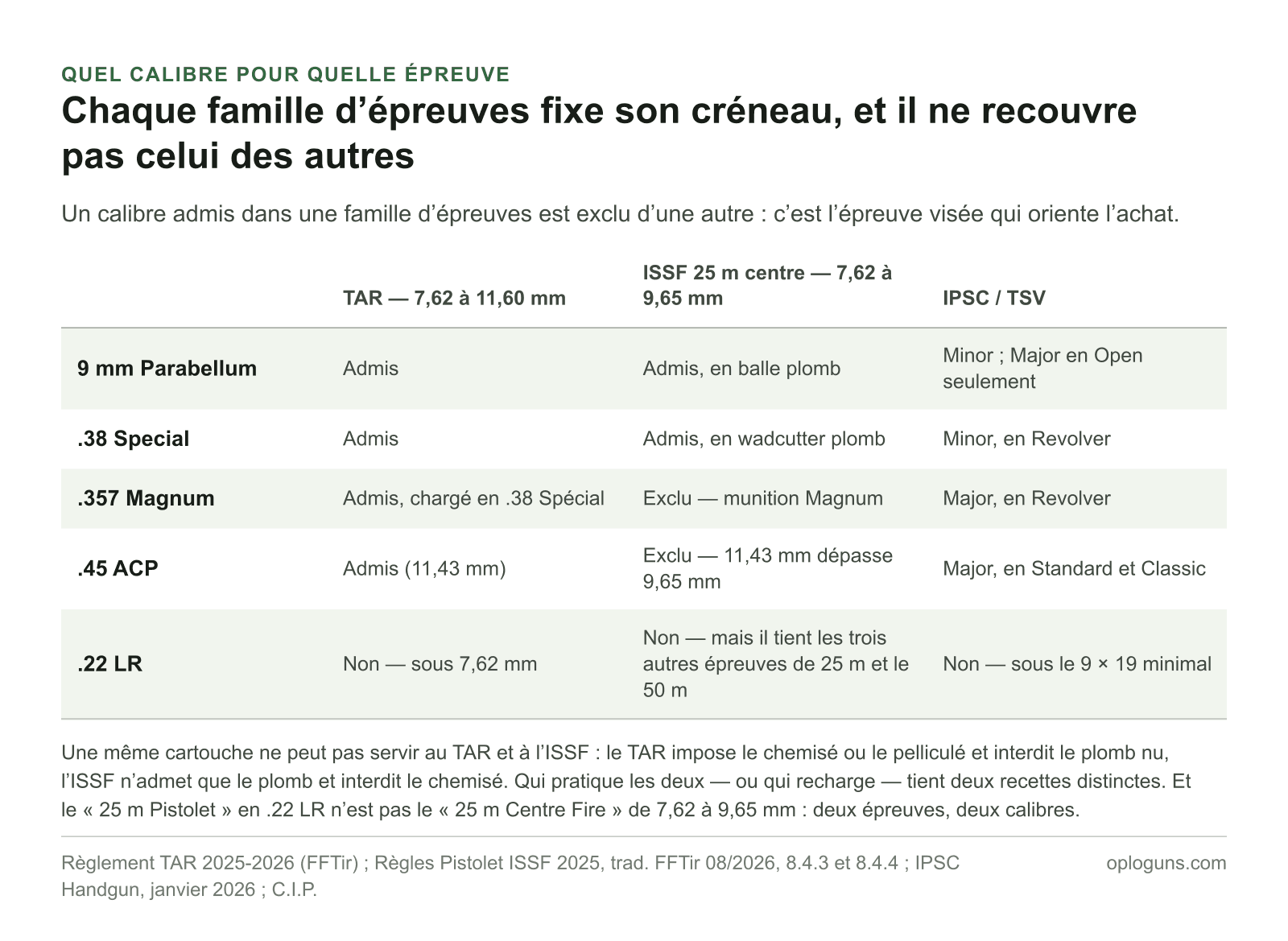
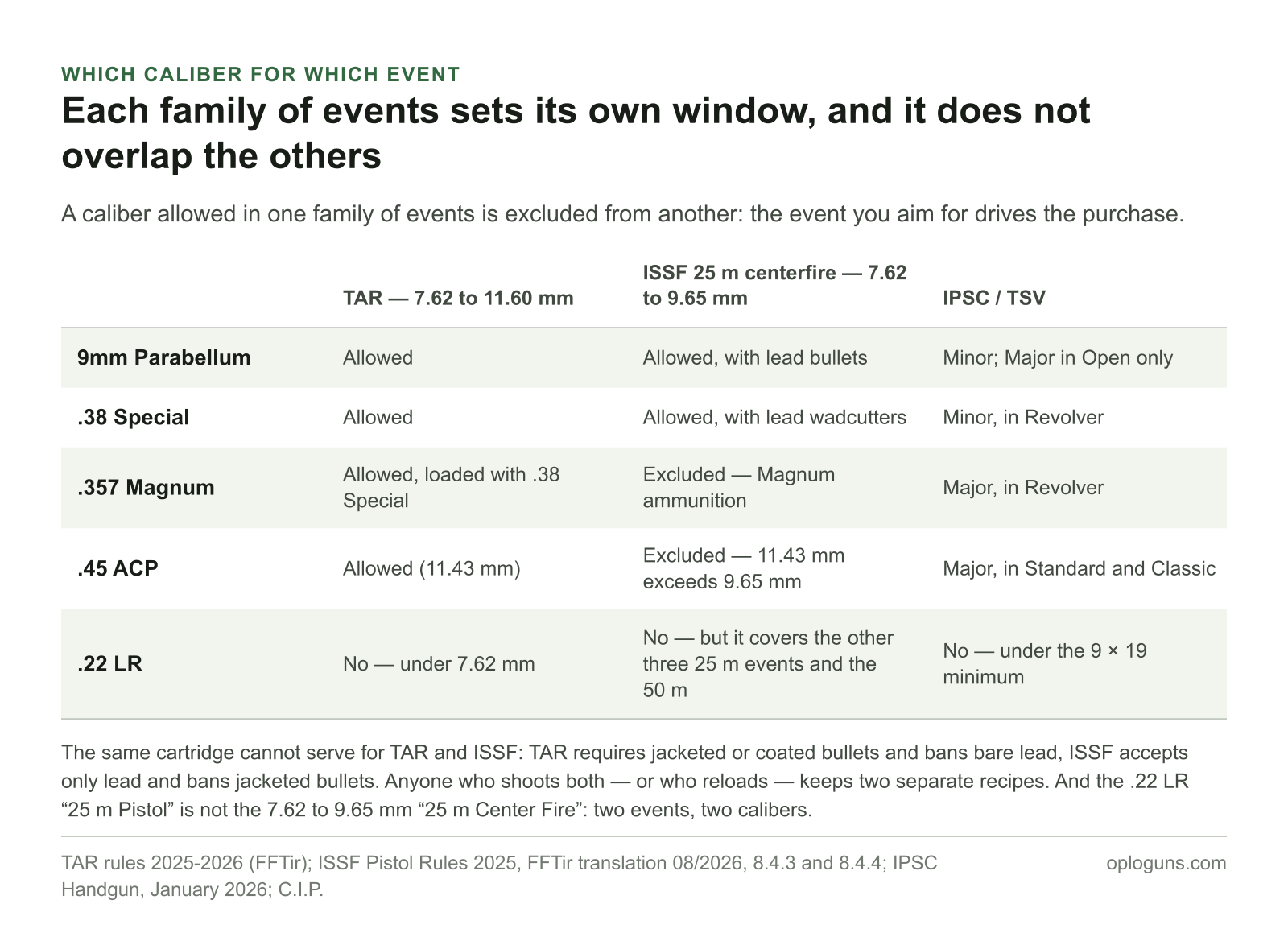
Which caliber for which event: TAR, ISSF, IPSC

This is the section that really settles matters, and the one the French web neglects. Each family of events sets its own caliber window, and a caliber admitted somewhere is excluded elsewhere.

Caliber TAR (7.62–11.60 mm) ISSF 25 m Centre Fire (7.62–9.65 mm) IPSC / TSV
9mm Admitted Admitted by dimension (Ø 9.03 mm) Minor; Major in Open only
.38 Special Admitted Admitted (the classic loading) Minor (Revolver)
.357 Magnum Admitted only when loaded with .38 Special Excluded (Magnum ammunition) Major (Revolver)
.45 ACP Admitted (11.43 mm) Excluded (11.43 mm > 9.65 mm) Major (Standard/Classic)
.22 LR No (< 7.62 mm) No — but the three other 25 m events (Pistol, Standard, Rapid Fire) and 50 m Pistol are in .22 LR No (rimfire)

TARtir aux armes réglementaires, service-firearm shooting — admits centerfire handguns "of a caliber between 7.62 mm and 11.60 mm"7. The .45 ACP (11.43 mm) therefore fits, alongside 7.65 Browning, .38 Special and 9mm. The 2025-2026 rulebook requires jacketed projectiles and bans lead and wadcutter7.

The ISSF is tighter on its 25 m Centre Fire event: "any centre fire pistol or revolver of calibre 7.62 mm to 9.65 mm", and "High-power or Magnum ammunition is not allowed"8. Two exclusions follow, decisive and absent from the French web: the .45 ACP (11.43 mm caliber) is too big, and the .357 Magnum is ruled out as Magnum ammunition828.

The other ISSF pistol events — 25 m Pistol, 25 m Standard, 25 m Rapid Fire (Olympic) and 50 m Pistol — are shot with .22 LR829. Hence a frequent confusion: "25 m Pistol" (.22 LR) is not "25 m Centre Fire" (7.62–9.65 mm). Two events, two calibers. In IPSC/TSV, finally, any caliber of at least 9mm competes; the choice turns on the power factor seen above.

One and the same cartridge cannot serve TAR and the ISSF. The two rulebooks contradict each other on the projectile: TAR requires jacketed and bans lead7; the ISSF requires lead ("made only of lead or similar soft material") and bans jacketed8. A shooter who practices both disciplines — or who reloads — must keep two separate recipes, one per rulebook.

The 9mm Parabellum, the default caliber

If a single caliber were to serve as the default choice, it would be 9mm, for a simple reason: it combines the two advantages nothing else brings together. It is the cheapest of the centerfire calibers (€0.28 a round20) and the most versatile — the only one present in TAR, in IPSC and, subject to the ammunition, in ISSF Centre Fire.

Technically it is a high-pressure cartridge (2,350 bar CIP3) but with moderate recoil, sharp and brief. Its energy, about 518 to 521 J1012, equals that of the .45 ACP for a bullet half as heavy and ammunition half as expensive.

One decisive reservation for ISSF Centre Fire: 9mm is admitted there by its dimension (9.03 mm bullet3), but rule 8.4.4 requires lead or soft-material projectiles and expressly bans jacketed ones8, whereas commercial 9mm is jacketed. This is therefore not a matter of comfort: with FMJ cartridges, you are turned away at equipment control. In practice, the .38 Special remains the choice for this event; 9mm only passes with a lead projectile. For a beginner, the real question is mostly against the .22 LR, which we costed separately in our comparison of 9mm and .22 LR.

9mm or .38 Special: the match revolver

The .38 Special is not a direct rival to 9mm: it is the other world, that of the revolver. Where 9mm equips semi-automatic pistols, the .38 Special is the cartridge of the precision revolver, soft and consistent.

At 1,500 bar of CIP pressure4 and about 300 J from a 4-inch revolver26, it is the weakest of the four centerfire calibers. That is precisely what makes it a match cartridge: little recoil, little muzzle rise, and a wadcutter bullet that cuts the target cleanly. It costs more than 9mm (€0.44 against €0.281920), a gap owing mostly to the market: 9mm is mass-produced.

The .38 Special in a revolver comes into its own above all:

  • in ISSF 25 m Centre Fire, where its lead wadcutter bullet is the standard8;
  • in TAR, where it appears by name in the list of admitted calibers7;
  • for anyone seeking the softest recoil of any Category B caliber.

The choice between a 9mm pistol and a .38 revolver is first a choice of platform and discipline, which we set out in our comparison of pistol and revolver.

9mm or .357 Magnum: power and price

The .357 Magnum is the most powerful of the four — and the most common trap. Many buy it for its reputation, imagining they will shoot magnum in competition. That is rarely the case.

At about 760 J and 3,000 bar of CIP pressure512, it exceeds the energy of 9mm by about half and its pressure by a quarter. The recoil is strong and brisk, the noise considerable, and the price follows: €0.50 a round18, nearly double the 9mm. Against it, the 9mm offers a more sober cartridge, faster to realign, and far cheaper.

Above all, a .357 Magnum revolver also chambers .38 Special — and that is what is shot at a match. The next section returns to this, because it turns the buying logic on its head.

.357 Magnum: you buy it to shoot .38

Here is the most useful fact on the subject, and the one the French pages leading on ".357 Magnum" leave out25: a revolver chambered in .357 Magnum also fires the .38 Special cartridge, shorter, softer and cheaper.

The two cartridges share the same bullet diameter (.357 inch, or 9.07 mm) and the same case base (11.18 mm in the CIP catalog)54. Only the length differs: the .357 case is about 3 mm longer27. A .357 therefore chambers the .38; the reverse is impossible, because the .357 case is too long to fit a .38 cylinder.

And the TAR rulebook is explicit: "Firearms chambered in 357 Magnum are permitted if they use 38 Special ammunition"7. In other words, at a match, you buy a .357 to shoot .38: you gain the firearm's robustness and versatility, and you shoot the soft, cheap cartridge.

Do not confuse "same diameter" with "same caliber". The .38 Special and the .357 Magnum share the bullet and the base, but the .357's pressure is double (3,000 against 1,500 bar CIP54) and its case is longer. They are two distinct cartridges: the .357 revolver accepts both, a .38 revolver accepts only the .38.

9mm or .45 ACP: the big-caliber event

The .45 ACP is the historic big caliber, that of American-style dynamic shooting and of TAR. Its 11.43 mm caliber bullet — 11.5 mm at actual diameter28 — weighs 230 grains and delivers about 504 J, the same energy as 9mm1216, at low pressure (1,300 bar CIP6).

The recoil is strong but slow, a broad push rather than a snap. The price is the highest of the four: €0.56 a round21, double the 9mm. Its advantage lies elsewhere than in energy or budget.

In IPSC, its bullet of more than 10 mm makes it the "natural" Major in Standard and Classic928. On the other hand — and this is a point the whole French web misses — the .45 ACP is not an ISSF caliber: its 11.43 mm caliber exceeds the 9.65 mm ceiling of 25 m Centre Fire8. It is a TAR and IPSC caliber, not an Olympic one.

".45 ACP, the Olympic caliber": no. No ISSF pistol event is shot in .45 ACP. The 25 m Centre Fire caps at 9.65 mm in diameter8, and the Olympic speed and precision events are shot with .22 LR829. The .45 ACP shines in TAR and dynamic shooting, two disciplines absent from the Olympic program.

The .22 LR, practice caliber and match caliber

Outside the four centerfire calibers, the .22 LR earns its place — it is the most-fired caliber of all. At about €0.15 a round22, with negligible recoil and moderate noise, it is the practice caliber par excellence.

Being rimfire, it falls under Category C1: no annual quota of 3,000 cartridges, since that covers Category B alone2. You can therefore practice a great deal without eating into the quota of a Category B caliber held elsewhere.

It is not merely a training caliber. The most prestigious ISSF pistol events — 25 m Pistol, 25 m Rapid Fire (Olympic) and 50 m Pistol — are shot with .22 LR829. A .22 pistol therefore opens both cheap practice and precision competition. For a beginner hesitating between starting with .22 or 9mm, we set out the numbers in 9mm or .22 LR for beginners.

Availability and reloading, caliber by caliber

That leaves a practical criterion: can you find the caliber, and can you reload it? On availability, 9mm dominates — it is the most-produced caliber in the world, therefore the easiest to find and the cheapest20. The .38, .357 and .45 are common at dealers, but dearer and more prone to shortages.

All can be reloaded. The .38 Special and the .45 ACP, at low pressure, have a reputation for being easy and forgiving for a beginning reloader; the .357 Magnum, at 3,000 bar5, demands more rigor. The 9mm can be reloaded too, but its low commercial price reduces the economic point of the exercise.

To weigh availability against cost:

  • 9mm — the most available, the cheapest; little point in reloading.
  • .38 and .45 — low pressure, easy to reload; this is where it pays off.
  • .357 Magnum — demanding to reload; at a match, you mostly reload .38.
  • .22 LR — not reloadable (rimfire priming), but already very cheap.

A reminder for the reloader: TAR wants jacketed, the ISSF wants lead78. One press, two recipes depending on the discipline.

Anthony Baillon Oplo co-founder

I bought my first revolver in .357 Magnum believing I would shoot .357 in competition. I built up a case of magnum ammunition, paid the recoil and the noise at every session, and then read the TAR rulebook: at a match, my .357 had to shoot .38 Special. I had been using the wrong cartridge for months.

In hindsight, the mistake was a happy one. The .38 costs less, recoils less, wears the firearm less — and the .357 cylinder swallows both. Today I shoot .38 at matches and keep a few .357 for the pleasure of the range. But I would have liked to read one clear line about that before buying: that line is what I wanted to write here.

Which caliber for which shooter: the verdict

A caliber is chosen on the event you are aiming at and the cost per session, never on energy alone. Before settling, one last warning from review about the figures in circulation.

Julien Mercier Technical reviewer

On this article I sent back every energy figure that did not come with its barrel length and its bullet mass. A .38 Special "at 444 joules" and a .38 Special "at 300 joules" are the same cartridges, measured one with a JHP bullet on a 150 mm barrel, the other in a 4-inch revolver. The number without the barrel is not data, it is a sales pitch.

9mm by default, .45 for TAR, .357 to shoot .38

9mm is the default choice: the cheapest per round (€0.28) and the only caliber admitted at once in TAR, in IPSC and — provided you shoot a lead projectile — in ISSF Centre Fire. To start out, or to do everything with a single firearm, it is the one.

The .45 ACP is a TAR and dynamic-shooting caliber, not an ISSF caliber: its 11.43 mm excludes it from 25 m Centre Fire, capped at 9.65 mm. Do not buy it with the Olympics in mind.

The .357 Magnum is bought to shoot .38 Special: same diameter, half the pressure, and the TAR rulebook requires it at a match. The magnum is for the pleasure of the range, not for the target.

And if you shoot only for precision at the lowest cost, the .22 LR remains unbeatable — outside Category B, at €0.15 a round.

Sources 30 references

The regulatory classifications were reread on Légifrance, the event scopes in the dated official TAR, ISSF and IPSC rulebooks, and the pressures and diameters in the CIP tables. Energies come from cross-checked manufacturer data sheets; prices from dealer surveys dated 30 July 2026. Technical and commercial data, being non-regulatory, are flagged with ⚠️. Click a note marker in the text to find the matching source.

  1. Légifrance — article R.311-2 of the code de la sécurité intérieure, version in force at 7 September 2025: centerfire ammunition designed for handguns falls under Category B 10° "with the exception of that classified in Category C by a joint order of the interior minister and the minister responsible for customs"; the .22 LR, being rimfire, is in Category C.
  2. Légifrance — article R.312-47 of the code de la sécurité intérieure, version in force at 1 January 2024: "3,000 cartridges per firearm under 2° of article R. 312-40" — annual quota of Category B ammunition, per firearm and per twelve-month period.
  3. C.I.P. — TDCC table Tab IV, 9 mm Luger (established 14 June 1984, revised 23 September 2008): maximum pressure 2,350 bar, bullet diameter 9.03 mm.
  4. C.I.P. — TDCC table Tab IV, .38 Special (revised 7 June 2000): maximum pressure 1,500 bar, case base of 11.18 mm — identical to that of the .357 Magnum.
  5. C.I.P. — TDCC table Tab IV, .357 Magnum (revised 14 June 2006): maximum pressure 3,000 bar — double the .38 Special — same case base, longer cartridge.
  6. C.I.P. — TDCC table Tab IV, .45 Auto (.45 ACP) (revised 21 April 2020): maximum pressure 1,300 bar, case base of 12.19 mm.
  7. FFTir, CNS TAR — tir aux armes réglementaires rulebook 2025-2026 (issued 12 January 2026): centerfire handguns "of a caliber between 7.62 mm and 11.60 mm"; "Firearms chambered in 357 Magnum are permitted if they use 38 Special ammunition"; jacketed projectiles compulsory, lead and wadcutter banned; list of admitted calibers by name.
  8. ISSF — ISSF Pistol Rules, 2025 edition (in force 1 January 2026), articles 8.4.3.3 and 8.4.4: 25 m Centre Fire "of calibre 7.62 mm to 9.65 mm", "High-power or Magnum ammunition is not allowed", projectiles "made only of lead or similar soft material" (jacketed banned). ⚠️ Official document consulted on a club mirror, the official host having returned an error on 30 July 2026; official reference: issf-sports.org.
  9. IPSC — IPSC Handgun Competition Rules, January 2026 edition (final version of 29 December 2025): power factor = mass (grains) × velocity (feet/s) ÷ 1,000 (art. 5.6.3.5); Minor 125 in every division, Major 160 (Open) and 170 (Standard, Classic, Revolver); minimum caliber 9mm, and 10 mm (.40) for Major in Standard and Classic (Appendix D). ⚠️ Official document consulted on a league mirror; official reference: ipsc.org.
  10. Sellier & Bellot — 9 mm Luger FMJ 124 gr data sheet (SB9B) (consulted 30 July 2026): 124 gr / 8.00 g, v0 360 m/s, E0 ≈ 521 J, test barrel 152 mm. ⚠️ Manufacturer technical data, non-regulatory.
  11. Sellier & Bellot — .38 Special FMJ 158 gr data sheet (SB38P) (consulted 30 July 2026): 158 gr / 10.25 g, v0 271 m/s, E0 376 J, test barrel 190 mm — a high figure, to be read against the barrel length. ⚠️ Manufacturer technical data.
  12. Sellier & Bellot — metric ballistic table of the pistol/revolver catalog (consulted 30 July 2026): 9mm 124 gr 518 J (150 mm barrel), .357 Magnum 158 gr 760 J (150 mm), .45 Auto 230 gr 504 J (127 mm). ⚠️ Manufacturer technical data.
  13. Sellier & Bellot — .22 Long Rifle Club 40 gr data sheet (SB22A) (consulted 30 July 2026): 40 gr / 2.60 g, v0 326 m/s, E0 ≈ 138 J, 700 mm rifle test barrel — to be reduced sharply for a pistol (~90 to 120 J). ⚠️ Manufacturer technical data.
  14. GECO (RUAG/Beretta) — Full Metal Jacket 9 mm Luger 8.0 g data sheet (consulted 30 July 2026): 124 gr, v0 360 m/s, E0 518 J, 125 mm barrel — a second manufacturer confirming ~518 J. ⚠️ Manufacturer technical data.
  15. GECO (RUAG/Beretta) — FMJ Flat Nose .357 Magnum 10.2 g data sheet (consulted 30 July 2026): 158 gr, v0 395 m/s, E0 796 J, 150 mm barrel — confirms ~760 to 800 J. ⚠️ Manufacturer technical data.
  16. GECO (RUAG/Beretta) — Lead Round Nose copper-plated .45 Auto 14.9 g data sheet (consulted 30 July 2026): 230 gr, v0 261 m/s, E0 508 J, 150 mm barrel — confirms ~505 J, almost level with 9mm. ⚠️ Manufacturer technical data.
  17. GECO (RUAG/Beretta) — Jacketed Hollow Point .38 Special 10.2 g data sheet (consulted 30 July 2026): 158 gr, v0 295 m/s, E0 444 J, 150 mm barrel — illustrates the spread of .38 energy by loading. ⚠️ Manufacturer technical data.
  18. Armurerie Centrale — .357 Magnum ammunition, online prices (surveyed 30 July 2026): box of 50 from €24.90 (Fiocchi 158 SJSP) to €36.90, so about €0.50 a round at the cheapest. ⚠️ Commercial price, non-regulatory.
  19. Armurerie Centrale — .38 Special ammunition, online prices (surveyed 30 July 2026): box of 50 from €21.90 (Geco 158 FMJ) to €45.90, so about €0.44 a round at the cheapest; bulk 1,000 STV FMJ at €519. ⚠️ Commercial price.
  20. Armurerie Centrale — 9x19 ammunition (Category B), online prices (surveyed 30 July 2026): box of 50 from €12.90 (Fiocchi 123 FMJ) to €19.90, so about €0.28 a round — the cheapest of the centerfire calibers; bulk 1,000 at ~€280. ⚠️ Commercial price.
  21. Armurerie Centrale — .45 ACP ammunition, online prices (surveyed 30 July 2026): box of 50 from €27.90 (Fiocchi 230 FMJ) to €39.90, so about €0.56 a round at the cheapest; bulk 1,000 STV at €589. ⚠️ Commercial price.
  22. Armurerie Centrale — .22 LR ammunition, online prices (surveyed 30 July 2026): CCI Blazer .22 LR per 500 at €74.90 (€0.15 a round); Eley Club and Force per 50 at €8.30-8.90 — the cheapest caliber, outside the Category B quota. ⚠️ Commercial price.
  23. Armurerie Auxerre — Category B ammunition, online prices (surveyed 30 July 2026): Norma R&T .357 at €27.60, Fiocchi .38 FMJ 158 at €25.90, Aguila 9mm JHP at €30.00 — a second retailer confirming the ranges and the spread between brands. ⚠️ Commercial price.
  24. Tir Sportif Chabris — tableau des calibres d'armes de poing (consulted 30 July 2026): competing page on "handgun caliber table", unsourced energies (9mm "500 J", .38 "250 J"), with no barrel length and no discipline. ⚠️ Dealer blog, cited as a point of comparison, never as proof.
  25. Tir Sportif Chabris — "Que veut dire .357 Magnum" (consulted 30 July 2026): competing page leading on ".357 Magnum" which does not explain that a .357 revolver fires .38 Special. ⚠️ Dealer blog, cited as comparison.
  26. RifleConfigurator — 9mm vs .38 Special: Ballistics, Recoil & Capacity (consulted 30 July 2026): .38 Special energy on a realistic 4-inch barrel (200-230 ft-lb ≈ 271-312 J) and 9mm (~364 ft-lb ≈ 493 J). ⚠️ English-language guide oriented toward defense, secondary corroboration.
  27. Wikipedia (EN) — .357 Magnum (consulted 30 July 2026): a .357 revolver also chambers and fires .38 Special; CIP pressure 300 MPa (= 3,000 bar); case about 3 mm longer than the .38. ⚠️ Secondary source, corroboration.
  28. Wikipedia (EN) — .45 ACP (consulted 30 July 2026): bullet diameter 11.5 mm (above the ISSF ceiling of 9.65 mm), CIP pressure ≈ 131 MPa (~1,300 bar), energy 230 gr FMJ ≈ 483 J. ⚠️ Secondary source, corroboration.
  29. Wikipedia (EN) — ISSF 25 meter rapid fire pistol (consulted 30 July 2026): the 25 m rapid fire event is shot with .22 LR. ⚠️ Secondary source, corroboration.
  30. NRA — SSUSA — Understanding the Power Factor (consulted 30 July 2026): confirms the formula (mass × velocity ÷ 1,000) and notes that the USPSA uses 125 Minor and 165 Major, not to be confused with the IPSC thresholds. ⚠️ Secondary source, unofficial.

The regulation in force governs. This article cites the texts applicable at 30 July 2026: the code de la sécurité intérieure, the TAR rulebook 2025-2026, the ISSF Pistol Rules 2025 and IPSC Handgun January 2026. Caliber windows and power factor thresholds change from one edition to the next, and prices change every season. Check the version in force on Légifrance and with the FFTir, the ISSF and the IPSC, then the balance of your quotas in the SIA before buying.

Frequently asked questions

Which caliber should you choose for a handgun in sport shooting?

It depends on the event you are aiming at and on your budget, not on energy. The 9mm Parabellum is the default choice: the cheapest per round, about €0.28, and admitted in TAR and IPSC. It also falls inside the ISSF 25 m Centre Fire caliber window, but the event accepts only lead or soft-material projectiles and bans jacketed ones: commercial 9mm, being jacketed, does not pass as it comes. The .38 Special suits the precision revolver, the .45 ACP suits TAR and dynamic shooting, and the .22 LR suits practice and the ISSF speed events.

Is 9mm really the cheapest caliber?

Among centerfire calibers, yes, and by a wide margin. At 30 July 2026, 9mm works out at about €0.28 a round, against €0.44 for .38 Special, €0.50 for .357 Magnum and €0.56 for .45 ACP. Only .22 LR goes lower, around €0.15, but it falls under Category C, outside the Category B quota.

Can you shoot .45 ACP in ISSF 25 m Centre Fire?

No. The ISSF 25 m Centre Fire event admits only calibers from 7.62 to 9.65 mm in diameter. The .45 ACP measures 11.43 mm: it exceeds the ceiling and is excluded. The .357 Magnum is too, as Magnum ammunition, expressly banned. The .45 ACP is a TAR and dynamic-shooting caliber, not an Olympic one.

Can a .357 Magnum revolver fire .38 Special?

Yes, and that is in fact what is done in competition. The two cartridges share bullet diameter and case base; only the .357 case is longer, by about 3 mm. A .357 revolver therefore chambers .38 Special, softer and cheaper. The reverse is impossible: the .357 case is too long to fit a .38 revolver.

Does 9mm have more energy than .45 ACP?

No, they are almost level, around 500 to 520 joules at the muzzle according to manufacturer data sheets. The 9mm gets there through the speed of a light 124-grain bullet, the .45 ACP through the mass of a heavy 230-grain one. What separates them is the nature of the recoil, not the amount of energy: sharp and brief for 9mm, a broad push for the .45.

What is power factor and what are its thresholds?

In IPSC and TSV, power factor measures the power of a loading: bullet mass in grains, multiplied by its velocity in feet per second, divided by 1,000. The thresholds in the January 2026 edition are 125 for Minor, in every division, and 160 in Open or 170 in Standard, Classic and Revolver for Major. The American USPSA uses 165, which should not be confused with it.

Which calibers are admitted in service-firearm shooting?

TAR admits centerfire handguns of a caliber between 7.62 and 11.60 mm: 7.65 Browning, .38 Special, 9mm Parabellum and .45 ACP, among others. The .357 Magnum is allowed only when loaded with .38 Special. Projectiles must be jacketed; lead and wadcutter are banned — the exact opposite of the ISSF, which requires lead.

Does .22 LR count toward the Category B quota?

No. The .22 LR is rimfire ammunition, classified in Category C, whereas the quota of 3,000 cartridges per firearm per year covers only Category B, which is centerfire. You can therefore acquire it without eating into that quota. Other holding ceilings, specific to Category C, nonetheless apply depending on whether or not you hold the matching firearm.

Should you choose a pistol or a revolver?

That is first a choice of discipline. The semi-automatic pistol, often in 9mm, dominates dynamic shooting and ISSF Centre Fire. The revolver, in .38 Special or .357 Magnum, prevails at 25 m Centre Fire and in several precision events. Many shooters end up with both; a first firearm is chosen according to the event you want to shoot first.