First sport shooting pistol: which one to choose, and when to buy it
Published on · Updated on · 10 min read · Anthony Baillon
There is no single right first pistol, but four routes: the .22 LR target pistol, the .22 LR version of a 9mm pistol, the 9mm and the air pistol. Each opens different events, at a different cost. Only the air pistol can be bought straight away; the others take four to seven months of license.
At a glance
| Route | Budget | Strength and limit |
|---|---|---|
| .22 LR target pistol | €529 to €1,125 + €312/year |
✓ Every precision event ✗ Nothing in common with a 9mm |
| .22 LR version of a 9mm | €415 to €679 + €312/year |
✓ Same controls as the 9mm ✗ Service-pistol trigger |
| 9mm | €700 to €739 + €624/year |
✓ Speed, service pistol, centerfire ✗ Ammunition ×2, recoil ×10 |
| 10 m air pistol | €212 to €400 + €34/year |
✓ Immediate purchase, no safe ✗ 10 meters only |
Budget: new price, plus one year of ammunition at 200 rounds a month, at the price surveyed on 30 July 2026.
- When to buy: straight away for an air pistol; after four to seven months of license for a firearm.
- First year: €520 to €1,790 all in, depending on the route.
- Used: 17 to 28% less than new, for an identical model.
Four ways to start pistol shooting
The .22 LR target pistol
Pistols designed for target shooting, in .22 LR from the outset.
| Model | Trigger | Barrel | Weight | Surveyed price |
|---|---|---|---|---|
| Browning Buck Mark Standard URX | Single action | 140 mm | 980 g | €529 to €61012 |
| Smith & Wesson SW22 Victory | Striker-fired | 140 mm | 1,021 g | €715 to €74934 |
| Ruger Mark IV Target | Single action | 140 mm | 1,009 g | €1,120 to €1,12553 |
Pros
- An identical break on every shot on the single-action models, which is what precision shooting asks for. See single action, double action, striker-fired.
- A 140 mm barrel, under the 153 mm ceiling of the 25 meter events6: no precision event is closed to it.
- Ammunition half the price of 9mm, and almost no recoil.
Cons
- It resembles no 9mm pistol. When moving up to a larger caliber, the grip and the trigger have to be learned again.
- It only serves in .22 LR: no practical shooting, no service-pistol events, no 25 meter centerfire.
Between the Buck Mark and the Mark IV Target, the price gap reaches €550. The Mark IV adds a receiver drilled for an optic5; otherwise, same caliber, same barrel, 29 g apart71.
The .22 LR version of a 9mm pistol
Several pistols designed in 9mm, or in .45 for the 1911, also exist in .22 LR, with the same shape and the same controls.
| Model | Original pistol | Surveyed price |
|---|---|---|
| Mauser 1911-22 | Colt 1911 | €4153 |
| Glock 44 | Glock 19 | €539, €629 threaded barrel8 |
| Beretta 92 FS .22 LR | Beretta 92 FS | €6393 |
| Smith & Wesson M&P 22 Compact | M&P 9 Compact | €6793 |
Pros
- What you learn carries over. Same grip, same controls: moving to 9mm does not start from scratch.
- A contained price, from €415 to €679.
- .22 LR ammunition, at €0.13 a round.
Cons
- A service-pistol trigger: striker-fired on the Glock, double action on the first shot on the Beretta 929. The break is longer and less crisp than a pure single action.
- The same shape, not the same weight: 415 g for the Glock 44 against 610 g for the Glock 191011, 740 g against 945 g for the Beretta 92 FS912. The controls can be learned, but handling 9mm recoil still has to be acquired.
- A short sight radius on compact models: the Glock 44 is 178 mm long, against 245 mm for a Buck Mark101. At 25 meters, the slightest misalignment of the sights pushes the bullet further off.
- Two firearms in the end: moving to 9mm takes a second purchase, which uses a second place out of the six allowed to a first-time holder for five years1314.
A .22 LR conversion kit, fitted to a 9mm pistol, avoids buying a second firearm. It is covered in our comparison 9mm or .22 LR for sport shooting.
The 9mm pistol
Pros
Cons
- Ammunition twice as expensive: €0.26 a round against €0.131718. At 200 rounds a month, €312 more every year.
- About ten times more recoil than .22 LR, for the same firearm weight (the calculation is in our comparison 9mm or .22 LR). In a beginner, it often sets up flinching at the shot, a fault that takes long to correct.
- No .22 LR, so neither 25 meter precision nor 50 meters.
What ammunition costs each year, by rate of fire
Yearly ammunition cost by the number of rounds fired each month, at the practice price surveyed on 30 July 2026: €0.26 a round in 9mm FMJ, €0.13 in .22 LR bought by the case, €0.014 a 4.5 mm pellet. Excluding firearm, license and equipment.
Price per round: .22 LR by the case of 400 to 500 rounds4317, 9mm FMJ by the box of 5018, leisure-grade pellets23.
View the data
| Rate | Rounds a year | Air pistol | .22 LR | 9mm |
|---|---|---|---|---|
| 100 a month | 1,200 | €17 | €156 | €312 |
| 200 a month | 2,400 | €34 | €312 | €624 |
| 300 a month | 3,600 | €50 | €468 | €936 |
| 400 a month | 4,800 | €67 | €624 | €1,248 |
The 10 m air pistol
Pros
What each pistol brings, depending on your goal
What you gain, what you give up
For precision (25 and 50 meters), the .22 LR target pistol is the only route that opens all these events from day one. In return, moving to 9mm takes a second firearm and a different grip.
For practical shooting or service-pistol events, two routes lead there. The .22 LR version of the pistol you have in mind lets you learn with the same controls, for €312 of ammunition a year instead of €624, but means a second purchase later. The 9mm avoids that second purchase, at the price of double the ammunition and more demanding recoil at the start.
To shoot without waiting, or before 18, the air pistol is the only route open straight away. It does not replace a firearm, but it usefully fills the months of waiting for Category B.
When the goal is not yet set, .22 LR is the route that closes the fewest events for the lowest spend. Trying the club's firearms, once licensed, provides the rest of the answer.
The detail of the events open to each firearm is in our article on pistol eligibility by discipline.
Three misconceptions about a first pistol
- "A .22 LR pistol is in Category C." No: it is the .22 LR cartridge that is in C. Every handgun, whatever its caliber, is in Category B, with a prefectural authorization and a safe1926. The detail is in our guide to firearm Categories A, B, C and D.
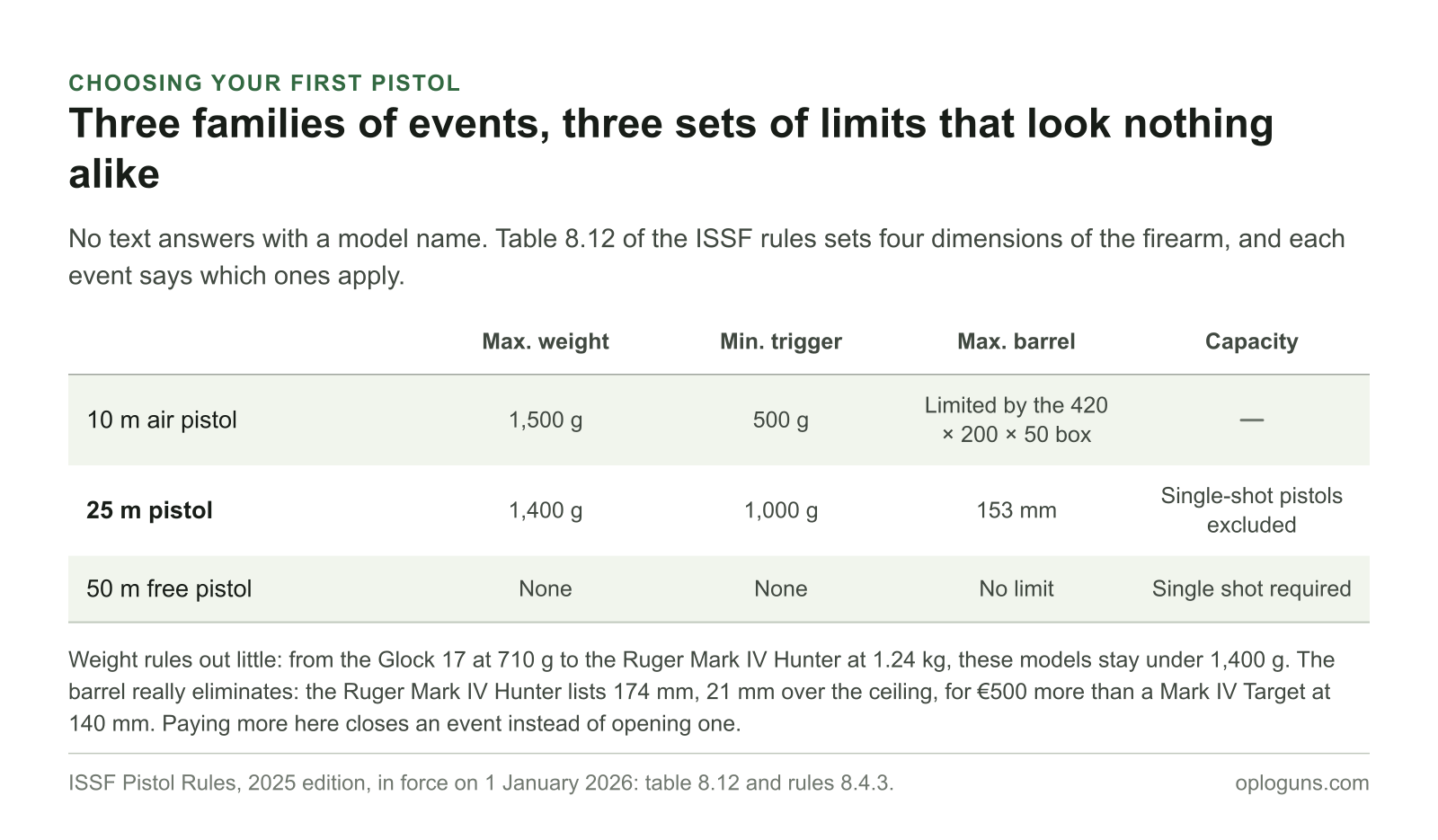
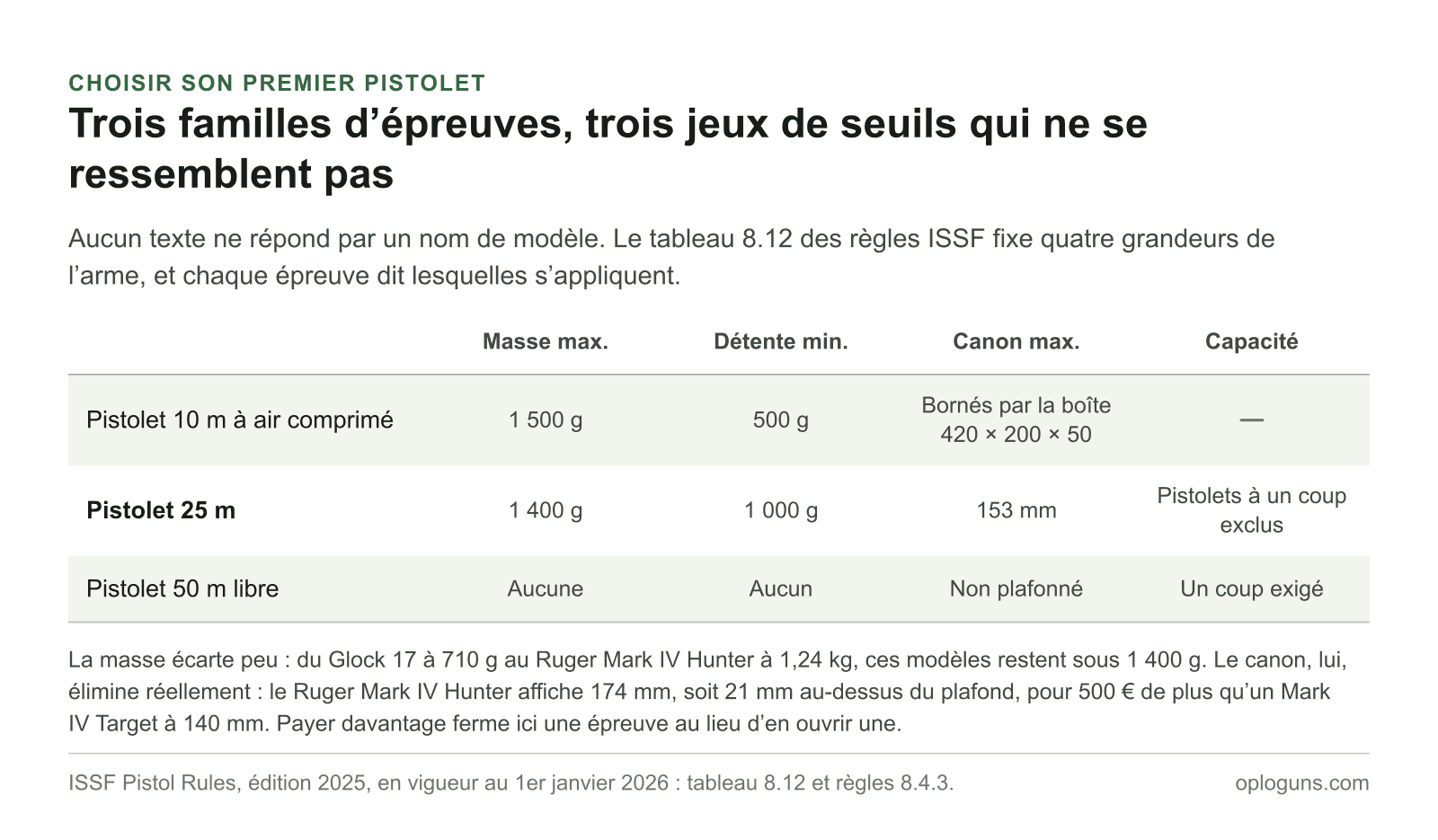
- "A longer barrel is better." Not in competition: the 25 meter events cap the barrel at 153 mm627. The Ruger Mark IV Hunter, at 174 mm, costs €500 more than the Target and is excluded from them2829.
- "The shooting logbook proves my sessions." Not since 2020: the club's register and the federation's opinion are what count1330. See the three controlled sessions rule.
A first handgun: 4 to 7 months after the license
Every handgun, .22 LR included, requires a prefectural authorization19. It is obtained in three steps:
- Take out a license at a club affiliated to the FFTir31.
- Complete three controlled sessions, at least two months apart, within the last twelve months32. That is four months at minimum.
- File the authorization application. The prefecture has three months to answer; without an answer, it is a refusal14. The file is detailed in our guide to the Category B firearm authorization.
| Type of pistol | Category | Formality | Purchase possible |
|---|---|---|---|
| 10 m air pistol, 2 to 20 joules | D | None | Immediately1920 |
| Air pistol of 20 joules and over | C | Declaration | On declaration20 |
| Firearm (.22 LR, 9mm…) | B | Authorization | After 4 to 7 months3214 |
A first-time holder is limited to six firearms for five years, against fifteen afterwards1314 — see firearm quotas. Before 18, a young license holder over nine may hold an air pistol with a parent's consent, the parent buying it for them3334.
First year: €520 to €1,790 depending on the pistol
About €1,320 in .22 LR, €1,790 in 9mm, €520 with an air pistol. The firearm is not even half of the bill.
The cost of the first year, by route in
Assumptions: license and club subscription €205, medical certificate €30, hearing protection €30, 200 rounds a month so 2,400 across the year, ammunition at the surveyed practice price (€0.014 a pellet, €0.13 a .22 LR round by the case, €0.26 a 9mm round by the case), firearm at the median surveyed price for a reference model (€220 a Weihrauch HW40 PCA, €570 a Buck Mark Standard URX, €722 a Glock 17 Gen5), safe €175 in Category B only. Prices surveyed 30 July 2026.
The Category B route is not reachable in the first months of a license: three controlled sessions two months apart, then prefectural processing of up to three months, push it back by four to seven months321430. The safe disappears in Category D, which article R.314-3 does not cover26. The €205 retained for license and club is the median first-year cost of three affiliated clubs for the 2026-2027 season, joining fee included: €165, €205 and €250353637.
View the data
| Item | Air pistol (cat. D) | .22 LR (cat. B) | 9mm (cat. B) |
|---|---|---|---|
| License and club subscription | €205 | €205 | €205 |
| Medical certificate | €30 | €30 | €30 |
| Hearing protection | €30 | €30 | €30 |
| Firearm, median price of the segment | €220 | €570 | €722 |
| Safe | not applicable | €175 | €175 |
| 2,400 rounds across the year | €34 | €312 | €624 |
| First-year total | €519 | €1,322 | €1,786 |
What this budget contains:
- License and club: €165 to €320 depending on the club, federal license and insurance included35363749.
- Medical certificate: about €3038, not reimbursed by French health insurance39. See the FFTir medical certificate.
- Safe: €115 to €289 for most models4041. Compulsory in Category B, with no certification required26. Unnecessary for an air pistol.
- Ear defenders: €15 to €50 for an adequate passive model42.
- Ammunition: €0.13 a round in .22 LR, by the case of 5004317. The case works out 16% cheaper than the box of 5044.
- The same pistol changes price from one shop to the next: €529 or €610 for the same Buck Mark, on the same day12.
The item-by-item detail is in our article on the cost of the first year of sport shooting.
Used pistols: 17 to 28% cheaper than new
On identical references, surveyed the same day:
| Model | Used | New | Difference |
|---|---|---|---|
| Glock 44 .22 LR threaded barrel | €45545 | €6298 | −28% |
| Glock 19 Gen5 9mm | €54946 | €7228 | −24% |
| Ruger Mark IV Hunter .22 LR | €1,35046 | €1,639 to €1,669329 | −18% |
| Glock 26 Gen5 FS 9mm | €59945 | €7228 | −17% |
The comparison only makes sense for an identical model, generation and version included: a used Glock 17 Gen3 does not compare with a new Gen545, and a new CZ Shadow 2 runs from €1,869 to €3,199 depending on the version at the same dealer47.
Trying a pistol: two sessions a year without a license
Without a license, introductory sessions are limited to two per twelve-month period. They take place with the association's firearms, never your own, under the supervision of an instructor2448. The air pistol is exempt from that cap24. Trying is also where a trigger is judged, since its weight rarely appears on spec sheets.
One possible progression, which costs almost nothing:
- Try the air pistol, as many times as needed, to confirm the interest.
- Use the two firearm introductory sessions, asking for two different models.
- Take out the license and shoot for several months with the club's firearms before buying35. Some clubs sell practice by the half-day, €1037.
If the air pistol is enough, a new entry-level pistol costs €212 to €4002122. And if the choice of mechanism is still open, our comparison of double action, single action and striker-fired sets out the differences.
Sources 49 references
Regulatory texts were reread on Légifrance and service-public.gouv.fr in their version in force; equipment thresholds come from the ISSF rules, cross-checked between the French edition circulated by the FFTir and the edition in force at 1 January 2026. All prices come from surveys carried out on 30 July 2026 at several dealers and are flagged ⚠️ as commercial, not regulatory, data. Click a note call in the text to highlight the corresponding source.
- Armurerie Auxerre — Browning Buck Mark Standard URX calibre 22 LR (in French), price surveyed on 30 July 2026: €609.90, Category B-1, 10-round magazine, 140 mm barrel, overall length 245 mm, weight 980 g, single action only, adjustable rear sight and fixed front sight. ⚠️ Commercial data, not regulatory.
- L'Armurerie Française — pistolets Browning catégorie B (in French), prices surveyed on 30 July 2026: Buck Mark Standard URX €529.00, Plus Rosewood UDX €549.00, Standard Stainless URX €555.00, Contour URX €619.00, Contour Stainless URX €699.00, Black Label threaded €699.00. ⚠️ Commercial data.
- Armurerie Douillet — pistolets et revolvers .22 LR de catégorie B (in French), prices surveyed on 30 July 2026: Mauser HSR PP7 €399.00, Mauser 1911-22 €415.00, GSG 1911 two-tone €429.00, Taurus TX 22 threaded €589.00, Beretta 92 FS .22 LR €639.00, S&W M&P 22 Compact €679.00, S&W 22 Victory €715.00, CZ P07 Kadet €725.00, Ruger Mark IV 22/45 €819.00, Ruger Mark IV Target blued €1,125.00, Walther CSP Classic €1,386.00, Mark IV Hunter €1,639.00, Pardini SP High Tech €2,895.00. ⚠️ Commercial data.
- Le Pistolier — pistolet Smith & Wesson SW22 Victory 22 LR (in French), price surveyed on 30 July 2026: €749.00 incl. VAT, Category B, 10-round magazine, 5.5" barrel so 14 cm, weight 1,021 g, striker-fired mechanism. ⚠️ Commercial data.
- Armurerie Auxerre — pistolet Ruger Mark IV Target .22 LR (in French), price surveyed on 30 July 2026: €1,119.95, Category B-1, 10-round magazine, 140 mm barrel, overall length 240 mm, weight 1 kg blued and 1.2 kg stainless, single action only, receiver drilled for an optic. ⚠️ Commercial data.
- ISSF — ISSF Pistol Rules, edition 2025 (first print 12/2025), effective 1 January 2026 (PDF): table 8.12 — 10 m air "1 500 g max. / 500 g min.", box 420 × 200 × 50; 25 m rimfire and centerfire "1 400 g max. / 1 000 g min.", box 300 × 150 × 50, barrel 153 mm, sight radius 220 mm; 50 m "No Restriction"; 8.4.4 lead or similar soft material projectiles only, jacketed prohibited; 8.4.3.2 and 8.4.3.3 permitted calibers and exclusion of single-shot pistols. ⚠️ PDF hosted by a Spanish club rather than on the ISSF site: version to be reconfirmed before any equipment control.
- Ruger — Mark IV Target specifications, model 40101, consulted on 30 July 2026: .22 LR, capacity 10+1, barrel 5.50" (13.9 cm), overall length 9.75", weight 35.6 oz so 1,009 g, MSRP $689.00. The sight radius is not given by the manufacturer.
- L'Armurerie Française — pistolets Glock catégorie B (in French), prices surveyed on 30 July 2026: Glock 44 Gen5 .22 LR €539.00, Glock 44 Gen5 threaded €629.00, Glock 43 Gen3 €579.00, Glock 43x €660.00, Glock 26 Gen5 €699.00, Glock 26 Gen5 FS €722.00, Glock 17 Gen5 FS €722.00, Glock 19 Gen5 FS €722.00, Glock 19X Coyote €768.00, Glock 41 Gen4 .45 ACP €790.00, Glock 17 Gen5 FS MOS €829.00, Glock 34 MOS Gen5 €920.00. ⚠️ Commercial data.
- Deville Armory — pistolet Beretta 92FS 22 LR 15 coups (in French), sheet consulted on 20 August 2026: Category B, single and double action, 5.3" barrel (135 mm in the Référentiel général des armes, reference BN597), overall length 217 mm, weight 0.74 kg, 15 rounds. ⚠️ Commercial data.
- Armurerie Pascal — Glock 44 22 LR (in French), sheet consulted on 20 August 2026: barrel 102 mm, overall length 178 mm, height 128 mm, weight 415 g. ⚠️ Commercial data.
- Armurerie Pascal — Glock 19 Gen 5 MOS FS 9x19 (in French), sheet consulted on 20 August 2026: capacity 15+1, barrel 102 mm, overall length 185 mm, weight 610 g. ⚠️ Commercial data.
- Deville Armory — pistolet Beretta 92FS 9x19 (in French), sheet consulted on 20 August 2026: single and double action, 4.9" barrel (125 mm in the Référentiel général des armes, reference BE714), overall length 217 mm, weight 0.945 kg, 15 rounds. ⚠️ Commercial data.
- Légifrance — sous-paragraphe « Tir sportif », articles R312-40 à R312-43-1 du code de la sécurité intérieure (in French): « dans la limite de quinze armes » [within the limit of fifteen firearms] (R312-40, in force since 1 January 2024), « qu'un maximum de six armes » [a maximum of six firearms] for five years (R312-41-1, from which adults taking part in national or international competitions are excluded), and R312-43 — the « carnet de tir indiquant la date de chaque séance contrôlée » [shooting logbook indicating the date of each controlled session] — repealed, last version at 1 July 2020 (decree no. 2020-486).
- Service-public.gouv.fr — armes de catégorie B pour un tireur sportif (soumises à autorisation) (in French), factsheet F2250 checked on 20 March 2025: 15 firearms, 6 for a first-time applicant, 3,000 rounds per firearm per 12 consecutive months, storage in a safe, strong cabinet or strongroom, authorization valid 5 years, and the prefecture's response time — « en l'absence de réponse dans un délai de 3 mois à partir de la date de réception de votre demande, cela signifie que votre demande est refusée » [without an answer within 3 months of receipt, the application is refused].
- GunMarket — pistolet Glock 17 Gen5 cal. 9x19, catégorie B (in French), price surveyed on 30 July 2026: €739.00 (instead of €850.00), capacity 17 rounds, barrel 114 mm, overall length 202 mm, weight 708 g. ⚠️ Commercial data.
- Armurerie Laudier — pistolet Glock 17 génération 5 cal. 9 Para, catégorie B1 (in French), price surveyed on 30 July 2026: €699.95 (recommended price €745.00), capacity 17 rounds, barrel 114 mm, weight 710 g. ⚠️ Commercial data.
- Armurerie de la Bourse — munitions de catégorie C, 49 .22 LR references (in French), prices surveyed on 30 July 2026: Aguila Standard SP €5.50 per 50, Sellier & Bellot Club €6.00, Geco €7.00, CCI Standard €8.00, RWS Pistol Match €10.00, ELEY Club €12.00, ELEY Match €18.00, ELEY Tenex Pistol €18.00; SK Magazine €57.00 per 500, Winchester M22 €45.00 per 400. Cheapest dealer in the survey. ⚠️ Commercial data.
- Armurerie Centrale — munitions 9x19 / 9 mm Luger (in French), prices surveyed on 30 July 2026: Fiocchi FMJ 123gr €12.90 per 50, STV Scorpio FMJ €13.90, Fiocchi FMJ 115gr €13.90, Geco FMJ 124gr €14.49, Norma Range & Training €14.90, Winchester Target & Practice €15.90, Aguila FMJ €15.95; STV Scorpio €259.00 per 1,000. ⚠️ Commercial data, and the only dealer to return a complete FMJ listing: range to be cross-checked.
- Légifrance — article R311-2 du code de la sécurité intérieure (in French), version in force at 7 September 2025 (decree no. 2025-894 of 5 September 2025): Category B, II, 1° « armes à feu de poing et armes converties en armes de poing non comprises dans les autres catégories » [handguns and firearms converted into handguns not included in the other categories]; Category C, 4° from 20 joules; Category D, h from 2 to 20 joules. No paragraph still covers single-shot rimfire handguns.
- Service-public.gouv.fr — armes : à quoi correspondent les différentes catégories ? (in French), factsheet F31877: Category D free to acquire and hold, including air guns with an « énergie à la bouche comprise entre 2 et 20 joules » [muzzle energy between 2 and 20 joules]; Category B on authorization, Category C on declaration.
- Frankonia — armes de poing, tir sportif 10 m (in French), prices surveyed on 30 July 2026: Weihrauch HW 40 PCA €211.99, Weihrauch HW 45 "Black Star" €399.99, Hämmerli AP20 ambidextrous €848.99, AP20 Pro €1,165.00, Steyr LP 2 €1,618.99, Steyr LP EVO 10 €2,195.99, Feinwerkbau P8X MeshPro €2,449.00, Steyr LP 50 €2,589.00, Steyr EVO 10 E €2,607.99. ⚠️ Commercial data: the gaps with reference 25 on identical models justify publishing ranges only.
- Armurerie Auxerre — pistolet à plombs Weihrauch HW40 PCA (in French), price surveyed on 30 July 2026: €229.90, « vente libre aux majeurs » [free sale to adults], 4.5 mm diabolo caliber, energy 3.5 joules, weight 788 g, overall length 242 mm, rifled steel barrel, adjustable rear sight. ⚠️ Commercial data; the age wording rests on no cited text.
- Armurerie Loisir — plombs 4,5 mm (in French), prices surveyed on 30 July 2026: boxes of 500 from €5.50 (Swiss Arms pointed) to €8.90 (H&N Sport) for leisure; RWS Meisterkugeln €10.99, Norma S-Target Match €11.10, RWS R10 Match €14.90 and €15.50 for match; ELEY Tenex Air €21.90 per 450. ⚠️ Commercial data surveyed at a single dealer: an order of magnitude, not a figure to rely on.
- Légifrance — article R312-43-1 du code de la sécurité intérieure (in French), in force since 10 February 2022 (decree no. 2022-144 of 8 February 2022): « Elles ne peuvent participer à plus de deux séances de tir d'initiation par période de douze mois » [they may not take part in more than two introductory shooting sessions per twelve-month period], and III excluding sessions « de tir d'initiation au moyen d'armes à air comprimé » [of introductory shooting with air guns].
- ABC Shootings — pistolets à air 10 m, compétition ISSF (in French), prices surveyed on 30 July 2026: Walther LP500 €1,529.00, Hämmerli AP20 Laser/Hybrid €1,595.00, Steyr LP2 €1,689.00, Pardini K12 €1,989.00, Steyr EVO 10 Silver €2,059.00, Feinwerkbau P8 X €2,189.00, Morini 162MI €2,350.00, Steyr LP50 €2,469.00, Morini 162EI €2,580.00, Steyr EVO 10E €2,669.00, Steyr LP2 Hybrid Pack €2,854.00. ⚠️ Commercial data.
- Légifrance — article R314-3 du code de la sécurité intérieure (in French), in force since 11 May 2017: storage of Category A and B firearms « soit dans des coffres-forts ou des armoires fortes adaptés au type et au nombre de matériels détenus » [either in safes or strong cabinets suited to the type and number of items held], or in a strongroom with an armored door and barred openings. Categories C and D are not covered.
- Fédération française de tir — Règles Pistolet ISSF, édition 2025, 2e impression en vigueur au 1er juillet 2026, mise à jour par la CNS Arbitrage le 04/07/2026 (PDF, in French), read on 25 September 2026: table 8.12 « Caractéristiques des pistolets » [pistol specifications] — 10 m air "1500g max.", "500g min.", box "420 x 200 x 50"; 50 m « Pas de limitation » [no restriction], « Chargé avec une seule cartouche » [loaded with a single cartridge]; 25 m "1400g max.", "1000g min.", box "300 x 150 x 50", barrel "max. 153 mm", sight radius "max. 220 mm"; 8.4.4 « Les projectiles chemisés ne sont pas autorisés » [jacketed bullets are not permitted]. Official French version of the table in reference 6.
- Ruger — Mark IV Hunter specifications, model 40118, consulted on 30 July 2026: barrel 6.88" so 174 mm, overall length 11.12", weight 44 oz so 1.24 kg, capacity 10+1, MSRP $1,019.00. The barrel exceeds the ISSF ceiling of 153 mm at 25 meters by 21 mm.
- Armurerie Auxerre — pistolet Ruger Mark IV inox Hunter flûté .22 LR (in French), price surveyed on 30 July 2026: €1,669.00, barrel 175 mm, overall length 285 mm, weight 1.24 kg, interchangeable fiber-optic front sight, adjustable rear sight. Confirms the manufacturer's sheet to the millimeter. ⚠️ Commercial data.
- Fédération française de tir — 2020, nouveau régime de la délivrance des avis préalables (in French), article of 7 May 2020 (arrêté of 28 April 2020, NOR INTA1933589A, in force since 30 April 2020; federal regime announced as applicable at 1 July 2020): « maintien de l'obligation de trois tirs espacés d'au moins deux mois au cours des douze mois précédant la demande » [the obligation of three shoots at least two months apart during the twelve months before the application is maintained], the federation's role as trusted third party, and the paper logbook replaced by the association's register.
- Fédération française de tir — s'inscrire à la FFTir (in French), fees announced for the 2025/2026 and 2026/2027 seasons: licence « valable du 1er septembre au 31 août de l'année suivante » [valid from 1 September to 31 August of the following year], issued by one of the 1,650 affiliated clubs; adult €69, young shooter €49, club €85.
- Légifrance — arrêté du 28 avril 2020 relatif aux avis favorables et aux attestations délivrés par les fédérations (in French; JORF of 29 April 2020, art. R.312-5 CSI), article 3: « la participation du tireur, au cours des douze mois précédant sa demande, à trois séances contrôlées de pratique du tir, espacées d'au moins deux mois » [the shooter's participation, during the twelve months before the application, in three controlled shooting sessions at least two months apart].
- Légifrance — article R312-52 du code de la sécurité intérieure (in French), version in force since 6 July 2023 (decree no. 2023-557 of 3 July 2023), not repealed at 30 July 2026: holding of firearms of h and h bis of Category D by minors « de plus de neuf ans » [over nine], on a licence from a delegated federation for shooting, clay shooting or biathlon and with the authorization of a person with parental authority not entered in the FINIADA; Category C over twelve with a shooting licence, over sixteen with a validated hunting permit.
- Légifrance — article R312-1 du code de la sécurité intérieure (in French), version in force since 10 February 2022: « La vente aux mineurs des matériels de guerres, armes, munitions et de leurs éléments est interdite » [the sale to minors of war materiel, firearms, ammunition and their components is prohibited]; acquisition is made by a person with parental authority not entered in the FINIADA, on production of a current licence in the minor's name.
- USO Tir, FFTir-affiliated club — tarifs, saison 2026-2027 (in French), in force from 1 September 2026: adult men €165, women €155, young shooters €130 and €120; « les tarifs comprennent le coût de la licence fédérale, l'assurance et la cotisation à l'USO Tir » [fees include the federal licence, insurance and the USO Tir subscription]; membership gives the right to « utilisation des armes du club » [use of the club's firearms] and access to gloves, jackets and trousers.
- Les Tireurs du Loch, FFTir-affiliated club — horaires, adhésion et tarifs, saison 2026-2027 (in French), registration open on 1 September 2026: adults €200, young shooters aged 9 to 20 €110, second club €110, joining fee "50 € par famille" [€50 per family]; licence requiring a medical certificate, an identity document, a photo and proof of address.
- AS Monts-Tir, FFTir-affiliated club — licence, tarifs saison 2026-2027 (in French), from 1 September 2026 to 31 August 2027: adult €205 for a new membership and €175 on renewal, young shooter €155 and €120, half-day practice card €10; the fee « inclut la licence fédérale (FFTir), l'assurance, la quote-part Ligue, la quote-part Comité départemental et la cotisation au club » [includes the federal licence, insurance, league and departmental committee shares and the club subscription].
- Assurance maladie — tarifs conventionnels des médecins généralistes et spécialistes (in French), fee in force at 1 January 2026 (page updated 17 March 2026): « G : consultation pour le médecin généraliste ou spécialiste de médecine générale | 30,00 » [GP consultation, €30.00].
- Sénat — question écrite n° 02063 de Mme Dominique Vérien (in French), published in the JO Sénat of 31 October 2024 p. 4245, answer from the ministry of sport, youth and community life published in the JO Sénat of 5 December 2024 p. 4746: « le certificat médical de non contre-indication à la pratique sportive est un acte de prévention qui ne fait pas partie du panier de soins établi par l'assurance maladie et de ce fait ne doit pas être pris en charge par la sécurité sociale » [the sports medical certificate is a prevention act outside the health insurance basket of care and is therefore not covered by social security]. A consistent position since the answer in the JO Sénat of 27 July 2006 (question no. 16016): « la rédaction de certificats médicaux [...] ne constitue pas un acte de soins et ne constitue donc pas en tant que telle une prestation remboursable par l'assurance maladie » [writing medical certificates is not a treatment act and so not a reimbursable service].
- Armurerie Loisir — coffres-forts et armoires fortes pour armes (in French), prices surveyed on 30 July 2026: handguns Fortify Delta 1 €115.00, Fortify SC6 €249.00, Infac C3A €259.00; long guns Buffalo 7 guns €397.00, Buffalo River €510.90, Buffalo Digital Premium €715.00. ⚠️ Commercial data.
- Safepro24 France — coffres-forts pour armes de poing (in French), prices surveyed on 30 July 2026: Rottner GunBox €68.90, Profirst Patrol 2 guns €168.00, Profirst NY 2 €289.00, Profirst Teos 40 S1 €317.80, Rottner Gunmaster XL €392.80, Profirst Pistol EN0 EL €520.80, Profirst Hurrican EN 0 €873.70. ⚠️ Commercial data.
- Armurerie Loisir — protections auditives (in French), prices surveyed on 30 July 2026: foam plugs €3.00, elastomer plugs €5.99, Real Hunter passive ear defenders €14.90 to €29.90, Browning Compact €29.99, 3M Peltor €39.90 to €49.90, electronic ear defenders €49.90 to €299.00, Sordin Supreme Pro €215.00 to €299.00, MSA Supreme Pro-X €349.99. ⚠️ Commercial data surveyed at a single dealer.
- Armurerie Loisir — balles et cartouches .22 LR, 43 references (in French), prices surveyed on 30 July 2026: boxes of 50 from €6.99 (Geco, Aguila) to €25.50 (CCI Pistol Match), including RWS Pistol Match €9.50, ELEY Match €19.90, ELEY Tenex Pistol €24.90; cases of 500 from €59.90 (Remington Thunderbolt) to €78.90 (Winchester T22). ⚠️ Commercial data.
- Armurerie Loisir — 500 cartouches CCI Standard Velocity 22 LR (in French), price surveyed on 30 July 2026: €75.90 incl. VAT (instead of €79.90), 10 boxes of 50, 40-grain bullet, velocity 326 m/s, so €7.59 per 50 against €8.99 by the box at the same dealer. ⚠️ Commercial data.
- Armurerie Douillet — armes d'occasion de catégorie B (in French), prices surveyed on 30 July 2026: Glock 17 Gen 3 RTF2 €525, Glock 26 Gen5 FS €599, Glock 44 .22 LR threaded barrel €455, CZ P09 .22 LR €629, SIG Sauer P220 .22 LR €590, Walther P38 €890, Anschütz mod. 1451 P .22 LR €275. ⚠️ Commercial data.
- Le Pistolier — armes de poing de catégorie B d'occasion (in French), 24 listings surveyed on 30 July 2026: Unique MOD/D2 .22 LR €349, Smith & Wesson mod. 48 .22 LR €649, Ruger Mark IV Hunter .22 LR €1,350, Glock 19 Gen 5 9mm €549, Tanfoglio Stock III €799, CZ TS 2 €1,699 and €1,999, Manurhin MR 73 .357 Magnum €2,199, CZ Shadow 2 €2,699, SIG Sauer P226 X-Five €3,199. ⚠️ Commercial data. The version of the CZ Shadow 2 was not recorded: lacking an identical reference, it does not enter the new/used comparison.
- Le Pistolier — CZ 75 Shadow II and CZ Shadow 2 Orange OR (in French), new prices surveyed on 23 September 2026 in the dealer's catalog: Shadow II €1,869.00, Shadow 2 Compact OR and Compact Carry €1,869.00, Black Wood €1,879.00, Urban Grey €1,959.00, Optic Ready €2,149.00, Target 5" and 6" €2,239.00, Compact Industrial €2,345.00 to €2,349.00, Orange OR €3,199.00. ⚠️ Commercial data.
- Fédération française de tir — tirs d'initiation (in French), update of 28 June 2022 (decree no. 2022-144): "2 séances maximum sur une période de 12 mois" [2 sessions maximum over a 12-month period], Category B or C firearms provided by the association, personal firearms prohibited ("pas d'apport personnel"), handling under the « surveillance directe d'un encadrant qualifié » [direct supervision of a qualified instructor] designated by the president, FINIADA check « impérativement depuis l'intranet fédéral ITAC » [strictly through the federal intranet ITAC].
- Tir Club Alpin — inscription et tarifs (in French), 2026-2027 season, consulted on 23 September 2026: €318 for a new member, €268 on renewal.
The rules in force prevail. Texts and prices are those of 30 July 2026. The version in force is on Légifrance, the edition of the rules is available from your club, and the day's price from the dealer before any purchase.
Frequently asked questions
Which pistol should you choose to start sport shooting?
It depends on the goal. Four routes exist: the .22 LR target pistol (€529 to €1,125), which opens every 25 and 50 meter event; the .22 LR version of a 9mm pistol (€415 to €679), which keeps its controls; the 9mm (€700 to €739 for a Glock 17), which opens practical shooting and service-pistol events but doubles the cost of ammunition; the air pistol (€212 to €400), the only one you can buy without an authorization.
Can you buy a pistol as soon as you have the license?
No. First come three controlled sessions at least two months apart, so four months at minimum, then prefectural processing, which can take three months. Four to seven months of license therefore pass before a first Category B purchase. Only the Category D air pistol can be bought straight away.
Is a .22 LR pistol in Category C?
No, in Category B. The .22 LR cartridge is classified C, but it is the firearm that counts: every modern handgun is in Category B, whatever its caliber. It therefore requires a prefectural authorization and a safe.
Do you need a safe for a first pistol?
Yes for a firearm (Category B), no for an air pistol (Category D). A handgun safe usually costs €115 to €289, and no certification is required: it only has to suit the number of firearms held.
Does buying used really save money on a pistol?
Yes: 17 to 28% less than new on identical models surveyed on 30 July 2026, for example a Glock 19 Gen5 at €549 used against €722 new. The comparison only holds for the same version: a new CZ Shadow 2, for example, runs from €1,869 to €3,199 depending on the version.
Can you try a pistol before buying it?
Yes, but with the club's firearm, never your own, and at most two introductory sessions a year without a license. The air pistol is exempt from that cap. Once licensed, you have access to the club's firearms.