The shooting logbook and the 3 controlled sessions: the rule and its calendar
Published on · Updated on · 10 min read · Anthony Baillon
For a first Category B firearm, the federation's opinion requires three controlled sessions, at least two months apart, within the twelve months before the application. The shooting logbook has not existed since 1 July 2020: the club register is what counts. At renewal, one shoot a year is enough under the text.
At a glance
| Situation | What the text requires | Who checks it |
|---|---|---|
| First application | 3 sessions, 2 months apart, over 12 months | The club president |
| Renewal | No 12-month break | The club president |
| Shooting logbook | Abolished on 1 July 2020 | Replaced by the club register |
- Four months at the very least between the first and third session; the oldest must not be more than twelve months old on the day of the application.
- 40 cartridges, caliber, internal logbook: league or club rules, not the code's.
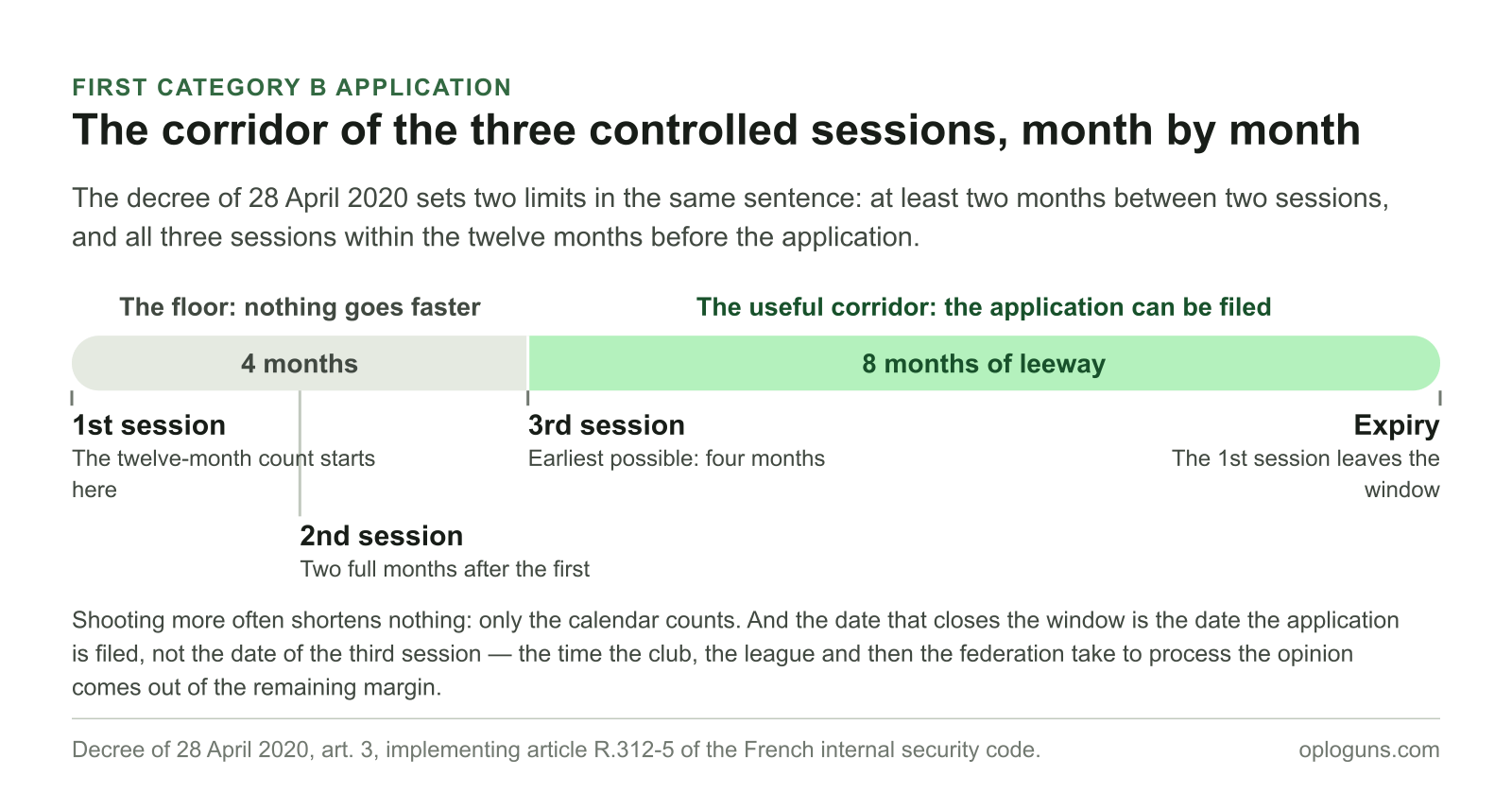
Three controlled sessions, 2 months apart, within 12 months
The rule sits in article 3 of the arrêté of 28 April 2020, made to apply article R312-5 of the code de la sécurité intérieure1:
« Pour une première demande d'acquisition d'armes mentionnées à l'article 1er du présent arrêté, l'attestation porte sur la participation du tireur, au cours des douze mois précédant sa demande, à trois séances contrôlées de pratique du tir, espacées d'au moins deux mois. »
[For a first application to acquire the firearms mentioned in article 1 of this arrêté, the attestation covers the shooter's participation, during the twelve months preceding their application, in three controlled shooting sessions at least two months apart.]
Three points can be read in that sentence:
- Participation, not a score: the result on the target does not count.
- Twelve rolling months before the application, not the calendar year.
- At least two months between two sessions, which turns a number into a calendar.
The sessions take place « au sein d'une association sportive agréée membre de la Fédération française de tir » [within an approved sports association that is a member of the French shooting federation]. The association's president, or someone they appoint, checks them and keeps the list of participants by name up to date, available to the federation and to state officials1. The interior ministry confirmed in November 2020 that the three sessions were kept, with attendance checks passing to club presidents4.
Controlled sessions: 4 to 12 months from the 1st to the 3rd
The two bounds come from the same sentence and pull in opposite directions: one prevents going too fast, the other prevents dawdling.
The controlled-session corridor: between 4 and 12 months
Time elapsed between the 1st and 3rd session, for the same gap between the 1st and 2nd, then between the 2nd and 3rd
Two bounds at once: at least two months between two sessions, and all three sessions within the twelve months before the application1. In green, the gaps that leave three sessions counted; in orange, those that leave only two.
View the data
| Gap between two sessions | 1st → 3rd session | Three sessions counted? |
|---|---|---|
| 1.5 months | 3 months | No: gap under two months |
| 2 months | 4 months | Yes: the shortest route |
| 4 months | 8 months | Yes |
| 7 months | 14 months | No: the 1st session is over twelve months old |
- The floor: four months. Two months between the first and second session, two between the second and third. Shooting more often shortens nothing.
- The ceiling: twelve months before the application. A session shot thirteen months ago has left the window. With seven months between sessions, the first is fourteen months old on the day of the third: only two remain valid.
The date that counts is that of the application, not that of the third session. Between the two come the president's signature of the opinion, its certification by the league and the federation in ITAC3, then filing in the SIA account. One club announces about a week for the signature alone11.
Two months or 60 days: the club counts the sessions
The text says "deux mois" [two months], without converting them into days1. Clubs do not all count the same way:
| Reading | The club's wording | From 1 January to 1 March |
|---|---|---|
| Date to date | Shoots « espacés d'au moins 2 mois » [at least 2 months apart]10 | Session counted |
| In days | « 3 tirs au sein du club, espacés de 60 jours minimum » [3 shoots at the club, 60 days apart minimum]9 | Session refused: 59 days |
Between 1 January and 1 March of a non-leap year, 59 days pass. It is the president who checks and signs1: the club's reading applies. Two months and a week apart passes everywhere.
The shooting logbook is gone; the club register counts
Article R312-43 of the code de la sécurité intérieure, which imposed the shooting logbook, has been repealed since 1 July 2020 by decree no. 2020-48625. So has the arrêté of 16 December 1998 on the minimum number of controlled sessions, the shooting logbook and the daily register1. Article R312-40, often cited, now deals only with firearm quotas6.
The federation drew the consequences: « le Carnet de tir et sa vérification par l'Administration seront purement et simplement supprimés » [the shooting logbook and its checking by the authorities will simply be abolished], and « un registre de ces séances de tir contrôlées devra continuer à être tenu à cet effet par l'association sportive » [the sports association must go on keeping a register of these controlled sessions]3. It advises clubs to keep a record of visits by the means of their choice (attendance book, entry badge, visit log and so on), and states that it imposes nothing beyond what the arrêté provides3.
| Level | What is binding | The logbook |
|---|---|---|
| Code and arrêté | 3 sessions, list by name kept by the president1 | Abolished2 |
| Federation | Nothing beyond the arrêté3 | Any format |
| League or club | Its own rules | Sometimes kept10912 |
A club in the Gironde writes that the logbook is "no longer legally compulsory" but that the Aquitaine league keeps it10; ASAL Tir sportif in Lorient has its Category B holders validate theirs three times a year12. On the prefecture's side, the documents to supply no longer include a logbook, but the FFTir's prior opinion as an original78.
What the controlled sessions rule does not require
Several common requirements do not appear in the arrêté1. They remain legitimate when a club sets them, but they are its rules:
- A number of cartridges: some clubs ask for at least 40 cartridges per session1012.
- A caliber: one club has members shoot with the largest-caliber firearm they hold, or a club firearm otherwise10.
- A minimum length of membership: one club waits six months before signing a first opinion11.
Introductory sessions, for their part, are not controlled sessions: they concern non-members, two at most per twelve-month period13. See shooting without a club.
Your own logbook of sessions or the club register
Only the club register, certified by the president, proves attendance: « l'Administration ne prévoit aucun autre mode de preuve » [the authorities provide for no other means of proof]3. A personal record, in a paper logbook or a spreadsheet, remains possible alongside it.
Keeping your own record of sessions
Pros
- The dates close at hand, to work out the gap before each session.
- A history that follows the shooter if they change club.
Cons
- No value as proof: only the president's certification counts3.
- It has to be kept up on the day, or the dates end up rebuilt from memory.
Relying on the club register
Cons
- A free format: book, badge or logbook depending on the club3, not always open to the shooter.
- Working out the gap is left to the shooter before each session.
What each record offers
As proof, the club register is the only document that counts. In return, it does not tell the shooter when to come back.
To keep to the calendar, a personal record gives the date of the next possible session and the age of the oldest. In return, it proves nothing on its own.
Renewal: one shoot a year, not three controlled sessions
Article 4 of the arrêté replaced a count with a notion1: at renewal, the attestation covers « la pratique régulière du tir » [regular shooting practice] during the previous authorization, and « l'absence de pratique du tir pendant douze mois consécutifs au moins » [an absence of practice for at least twelve consecutive months] bars it.
Renewal: what the text has required since 2020
Minimum number of sessions over a five-year authorization, before and after 1 July 2020
The arrêté sets no number: an absence of practice for at least twelve consecutive months bars the opinion1. The federation concludes: « Un tir par an, au moins, demeure donc nécessaire » [at least one shoot a year therefore remains necessary], and recalls that the obligation of three controlled shoots a year has been removed3. Five sessions over five years avoid any twelve-month gap; four are not enough.
View the data
| Regime | Per year | Over five years |
|---|---|---|
| Since 1 July 2020 | No 12-month break | 5 sessions at least |
| Before 1 July 2020 | 3 controlled shoots | 15 sessions |
The federation places under this regime a new acquisition application by a holder who is already authorized: renewal « et par extension […] une nouvelle demande d'acquisition » [and by extension a new acquisition application]3. Since the SIA, the Category B authorization is global, valid for five years for a quota of fifteen firearms, six for a first-time holder148; it must be renewed at least three months before it expires15. See the Category B authorization and firearm quotas.
Clubs read this rule in their own way: the Société de Tir de Nancy asks for one shoot in the last twelve months9, ASAL Tir sportif in Lorient for three validations a year from its Category B holders12.
Badly spaced controlled sessions: three ways to catch up
- Redo a session. A session that does not count does not cancel the others: adding one at least two months from its neighbor is enough, then checking that the oldest of the three counted is under twelve months old.
- Move the application. The window is counted from the application: waiting can bring a session into the required gap, provided the oldest does not drop out at the other end.
- Shoot at another approved association. The arrêté does not require the shooter's own club1, but it is that club's president who signs the opinion.
Once the opinion is signed, the clock runs again: one prefecture asks for an opinion bearing the club's stamp « de moins de trois mois » [less than three months old]7, and one club points out that « cet imprimé n'est valable que 3 mois » [this form is valid for 3 months only]11.
Three misconceptions about the logbook and the sessions
- "You need a stamped shooting logbook." The logbook has been abolished since 1 July 2020; the club register replaces it23. A club may keep one for internal use10.
- "Three sessions within twelve months are enough." They must also be at least two months apart: three sessions in three weeks do not count1.
- "You need three controlled sessions a year to keep your authorization." Not since 2020: only a break of twelve consecutive months bars renewal13.
Sources 15 references
Texts reread on Légifrance in their version in force, federal rules reread on fftir.org, prefecture and club pages cited for their practices and flagged ⚠️ where they are dated. All documents are in French. Click a note marker in the text to highlight the matching source.
- Légifrance — arrêté du 28 avril 2020 relatif aux avis favorables et aux attestations délivrés par les fédérations, version in force since 30 April 2020, consulted on 24 September 2026: article 3 — « Pour une première demande d'acquisition d'armes mentionnées à l'article 1er du présent arrêté, l'attestation porte sur la participation du tireur, au cours des douze mois précédant sa demande, à trois séances contrôlées de pratique du tir, espacées d'au moins deux mois. Ces séances contrôlées de pratique du tir sont effectuées au sein d'une association sportive agréée membre de la Fédération française de tir. Le président de l'association […], ou une personne désignée par lui, est chargé de contrôler les séances de pratique du tir. Il tient à jour la liste nominative des personnes ayant participé à ces séances » [three controlled sessions at least two months apart in the twelve months before a first application, within an approved FFTir association; the president or their appointee checks the sessions and keeps the list of participants]; article 4 — for a renewal, « la pratique régulière du tir » during the previous authorization, « L'absence de pratique du tir pendant douze mois consécutifs au moins » barring the attestation and the opinion; article 7 — repeal of the arrêté of 16 December 1998 « relatif au nombre minimum de séances contrôlées de pratique du tir, au carnet de tir et au registre journalier ».
- Légifrance — décret n° 2020-486 du 28 avril 2020: repeal of article R312-43 of the code de la sécurité intérieure (shooting logbook and daily register), in force on 1 July 2020.
- Fédération française de tir — 2020, nouveau régime de la délivrance des avis préalables, 7 May 2020, consulted on 24 September 2026: « le Carnet de tir et sa vérification par l'Administration seront purement et simplement supprimés »; first application: « trois tirs espacés d'au moins deux mois au cours des douze mois précédant la demande », « un registre de ces séances de tir contrôlées devra continuer à être tenu à cet effet par l'association sportive »; « pour un renouvellement d'autorisation de détention d'armes (et par extension pour une nouvelle demande d'acquisition) », regular practice, « Un tir par an, au moins, demeure donc nécessaire » [at least one shoot a year remains necessary]; removal of « l'obligation de pratiquer trois tirs contrôlés par an »; « L'Administration ne prévoit aucun autre mode de preuve de l'assiduité du demandeur que la certification de l'avis préalable par le président signataire dudit avis et la certification par la ligue régionale et par la Fédération Française de Tir (ces deux opérations sont effectuées via ITAC) » [no other proof of attendance than certification by the president, the league and the federation, via ITAC]; record of visits « par le moyen de leur choix (cahier de présence, badge d'entrée, carnet de passage etc.) »; « La Fédération Française de Tir n'impose rien de plus que ce qui est prévu dans l'arrêté »; in force on 1 July 2020.
- Assemblée nationale — question écrite n° 29746, answer from the interior ministry published on 17 November 2020, consulted on 24 September 2026: for a first application, the shooter shows « trois séances de tir contrôlées, espacées d'au moins deux mois »; attendance checks entrusted to club presidents, who engage their responsibility.
- Légifrance — code de la sécurité intérieure, sous-paragraphe « Tir sportif », consulted on 24 September 2026: R312-43 repealed on 1 July 2020.
- Légifrance — article R312-40 du code de la sécurité intérieure, version in force since 1 January 2024 (decree no. 2023-557 of 3 July 2023): sport shooters' firearm quotas; no mention of controlled sessions or a shooting logbook.
- Préfecture de Meurthe-et-Moselle — pièces à fournir, catégorie B tir sportif (PDF, updated on 4 September 2020): « avis préalable de la Fédération Française de Tir en cours de validité (feuille verte originale) avec cachet-signature de la société de tir de moins de trois mois » [current FFTir prior opinion, original green form, with the shooting club's stamp and signature less than three months old]; no shooting logbook in the list. ⚠️ List predates the opening of the SIA to sport shooters.
- Préfecture des Deux-Sèvres — demande et renouvellement pour les tireurs sportifs, updated on 4 October 2024: single global five-year authorization, quota of 15 firearms, 6 for first-time holders; FFTir favorable opinion as an original; no shooting logbook among the documents.
- Société de Tir de Nancy — tirs contrôlés, consulted on 24 September 2026: first application, « 3 tirs au sein du club, espacés de 60 jours minimum »; renewal, one shoot in the last 12 months; logbook stamped by the duty officer on Saturday and Sunday. ⚠️ Club rule.
- CTC Castelnau-de-Médoc (Gironde) — carnet de tir et contrôle de connaissances, consulted on 24 September 2026: logbook « plus légalement obligatoire » [no longer legally compulsory] but kept by the Aquitaine league; shoots at least 2 months apart; at least 40 cartridges, with the largest-caliber firearm held or a club firearm. ⚠️ League and club rule.
- Tir Sportif Vercellois (Doubs) — délivrance des avis préalables, consulted on 24 September 2026: « ATTENTION, cet imprimé n'est valable que 3 mois »; six months' minimum membership for new shooters; about a week for the president's signature. ⚠️ Club rule.
- ASAL Tir sportif (Lorient) — règlement intérieur, amended by the general meeting of 13 October 2024, consulted on 24 September 2026: article 32, logbook of Category B holders validated at least three times a year, at least two months apart, by a 40-shot session under the supervision of a range officer or a qualified instructor. ⚠️ Club rule.
- Légifrance — article R312-43-1 du code de la sécurité intérieure, version in force since 10 February 2022: non-members « ne peuvent participer à plus de deux séances de tir d'initiation par période de douze mois » [may not take part in more than two introductory sessions per twelve-month period].
- Préfecture du Gard — tireurs sportifs: « depuis le 27/02/2024 et l'ouverture du SIA aux tireurs sportifs » [since 27/02/2024 and the opening of the SIA to sport shooters], single global five-year authorization, 15 firearms, 6 for first-time holders.
- Légifrance — sous-section « Armes soumises à autorisation » du code de la sécurité intérieure, consulted on 24 September 2026: R312-13, authorization « accordée pour une durée de cinq ans » [granted for five years]; R312-14, renewal applied for at least three months before expiry.
The regulations in force prevail. Texts reread on 24 September 2026. The arrangements for checking sessions (time slots, cartridges, internal logbook, counting the two months) are set by each club and each league: their rules apply on top of the text.
Frequently asked questions
How long does it take to complete the 3 controlled sessions?
Four months at the very least: two months between the first and second session, two months between the second and third. And all three must fit within the twelve months before the application. The useful gap between the first and third session therefore runs from four to just under twelve months.
Is the shooting logbook still compulsory?
No. Article R312-43 of the code de la sécurité intérieure, which imposed it, has been repealed since 1 July 2020. The club president, or the person they appoint, checks the sessions and keeps the list of participants by name. Some clubs and leagues keep an internal logbook: that is then their rule, not the code's.
Do you need 3 controlled sessions a year to renew your authorization?
No. Since 1 July 2020, renewal rests on regular shooting practice during the previous authorization, and only an absence of practice for twelve consecutive months bars it. The federation concludes that at least one shoot a year remains necessary. A club may ask for more.
Is a two-month gap the same as 60 days?
The text says two months, with no conversion into days. Some clubs count from date to date, others announce 60 days minimum. Between 1 January and 1 March there are 59 days: the same session passes in one club and not in the other. The president does the checking, so the club's reading applies.
Can a controlled session be done at another club?
The arrêté requires the sessions to take place within an approved sports association that is a member of the Fédération française de tir, without requiring it to be the shooter's own club. Yet it is the president of the shooter's own club who signs the prior opinion: their position counts.
Do introductory sessions count as controlled sessions?
No. Introductory sessions are those of a non-member, limited to two per twelve-month period. Controlled sessions are those of a licensed shooter, entered in their club's register.