French firearm categories A, B, C and D: the classification and the C1b notation
Published on · Updated on · 10 min read · Anthony Baillon
Verified by a gunsmithFour categories, four regimes: A prohibited, B subject to authorization, C to declaration, D unrestricted. Every pistol that fires a cartridge is in B, a bolt-action rifle of 11 rounds at most in C, air guns from 2 to 20 joules in D. "C1b" reads Category C, heading 1°, sub-point b).
At a glance
| Category | Regime | In sport shooting |
|---|---|---|
| A | Prohibited, save derogation | Centerfire semi-auto beyond 11 rounds |
| B | Prefect's authorization | Every pistol, .22 LR included |
| C | Declaration in the SIA | Bolt-action rifle of 11 rounds at most, over-and-under shotgun |
| D | Unrestricted | Air guns from 2 to 20 joules |
- Category B: a global authorization, four to seven months after the license, safe compulsory (€115 to €289 in the first year).
- Category C: declared by the dealer in the SIA, with a shooting, ball-trap or biathlon license, or a hunting permit.
- The magazine counts: the same rifle changes category depending on the magazine inserted.
Firearm categories: banned, authorized, declared, free
Article R311-2 of the code de la sécurité intérieure places every firearm, round of ammunition and component in one of four categories, and each letter carries a regime of acquisition and holding1.
| Category | Regime | Common examples |
|---|---|---|
| A | « Interdits à l'acquisition et à la détention » [prohibited from acquisition and holding] | Automatic firearms, handgun magazines of more than 20 rounds |
| B | « Soumises à autorisation » [subject to authorization] | Pistols and revolvers, semi-automatic rifles with a detachable magazine |
| C | « Soumises à déclaration » [subject to declaration] | Bolt-action rifles, single-shot-per-barrel shotguns, deactivated firearms, alarm firearms |
| D | « Libres » [unrestricted] | Air guns from 2 to 20 joules, firearms made before 1900 |
Category D1, "subject to registration", disappeared on 1 August 2018: decree no. 2018-542 abolished it and kept a single Category D9.
For a licensed minor, the category also sets an age: a Category D firearm may be held from over 9, a Category C firearm from over 12, always with a parent's permission5, and it is the parent who makes the purchase16.
Reading "C1b": Category C, heading 1°, sub-point b)
Article R311-2 never writes "C1b", "C3" or "C12". It writes « III. - Armes de catégorie C » [III. Category C firearms], then numbered headings 1°, 2°, 3°…, and for the first of them sub-points a), b), c), d)1. The short notation strings these three elements together:
- The capital letter: the category, here C.
- The number: the heading, here 1°, long guns.
- The lower-case letter: the sub-point, here b), manual repeaters.
The F2246 factsheet on service-public.gouv.fr and the SIA use this contracted form, from C1- a) to C122.
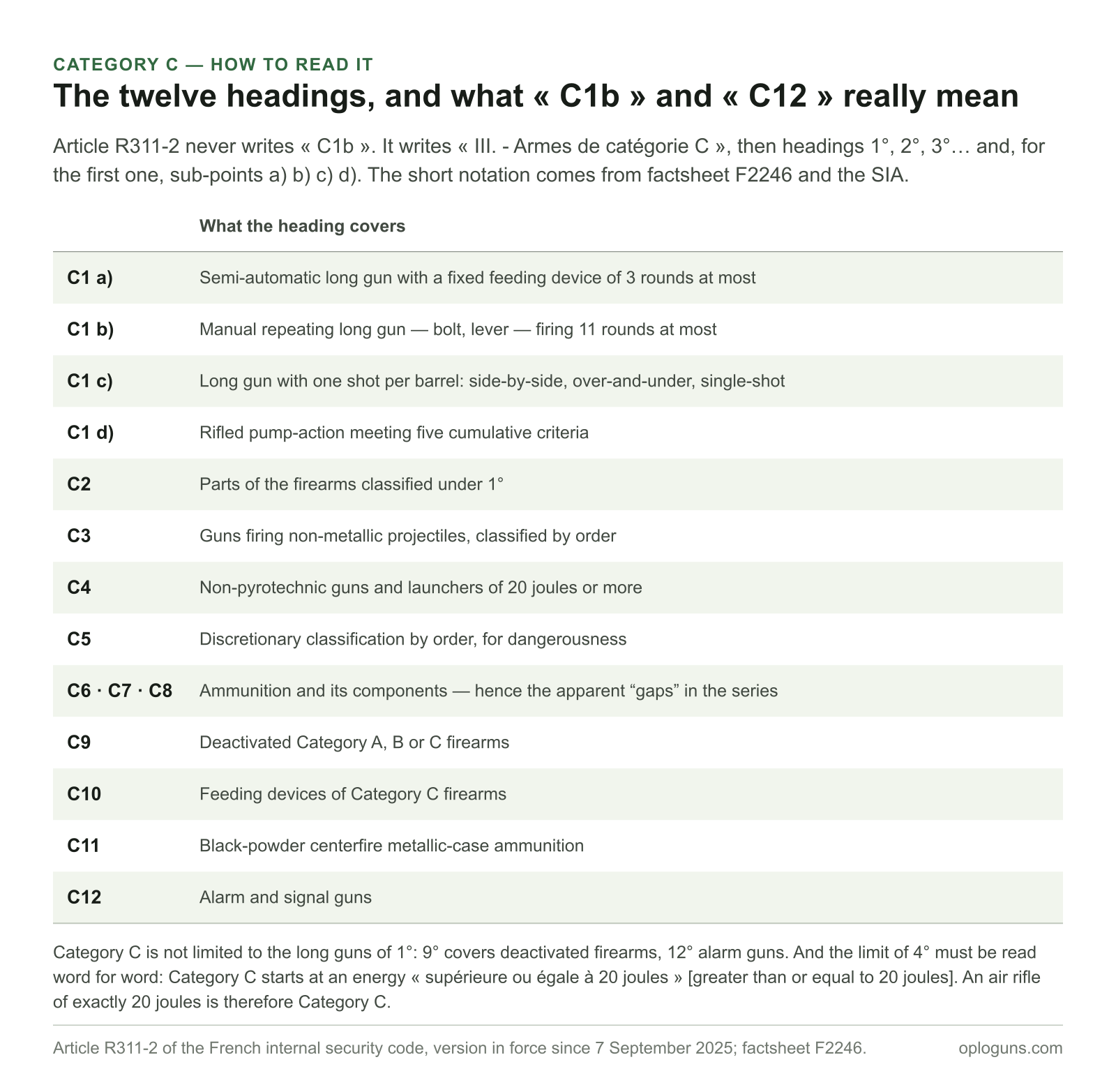
Category C in twelve headings, four of them ammunition
| Heading | What it covers |
|---|---|
| C1 a) | Semi-automatic long gun with a fixed feeding system of 3 rounds at most |
| C1 b) | Manually operated long gun of 11 rounds at most |
| C1 c) | Long gun single-shot per barrel: side-by-side, over-and-under, single-shot |
| C1 d) | Rifled pump-action meeting five cumulative conditions |
| C2 | Components of the firearms of 1° |
| C3 | Firearms firing non-metallic projectiles, classified by order |
| C4 | Non-pyrotechnic guns and launchers of 20 joules or more |
| C5 | Firearms classified by order for their dangerousness |
| C6, C7, C8 | Ammunition and ammunition components |
| C9 | Category A, B or C firearms that have been deactivated |
| C10 | Feeding systems for Category C firearms |
| C11 | Metallic-case black-powder centerfire ammunition |
| C12 | Alarm and signalling firearms |
Consumer-facing lists often skip 6°, 7°, 8° and 11°: those headings designate ammunition, not firearms1.
The 20-joule boundary is read to the letter. Category C starts at an energy « supérieure ou égale à 20 joules » [greater than or equal to 20 joules], Category D stops at « entre 2 et 20 joules » [between 2 and 20 joules]1: an air rifle of exactly 20 joules is in Category C.
A rifled pump-action shotgun is in C1 d) only if all five conditions are met: gauge 8, 10, 12, 14, 16, 20, 24, 28, 32, 36 or 410, capacity of 5 rounds at most, overall length over 80 cm, barrel over 60 cm and a fixed stock1. Otherwise it is in Category B 2° f), like every smooth-bore pump-action since 1 August 20189.
A firearm changes category at 3, 11, 21 or 31 rounds
Firing capacity without reloading, chamber included, moves a firearm from one category to another. The threshold depends on the type of firearm and, for semi-automatic long guns, on the ignition system1.
The round count that moves a firearm into another category
Firing capacity without reloading, chamber included, under article R311-2 of the code de la sécurité intérieure in force since 7 September 2025
A semi-automatic long gun with a detachable magazine is in Category B whatever its capacity, up to the Category A threshold1. The Ministry of the Interior's guidance note explains where two of the thresholds come from: « La limite de 31 coups pour les armes d'épaule est celle d'une norme industrielle de nombreux chargeurs (30 coups + 1 munition dans la chambre) » [the 31-round limit for long guns is an industry standard for many magazines: 30 rounds + 1 in the chamber] and « Une limite à 21 coups pour les armes de poing est instaurée sur la même base » [a 21-round limit for handguns is set on the same basis]3. Since 2018, the 31-round threshold applies only to rimfire1.
View the data
| Threshold | Type of firearm | Up to the threshold | Beyond |
|---|---|---|---|
| 3 rounds | Semi-automatic long gun, fixed feeding system | C 1° a) | B 2° a) or a bis) |
| 11 rounds | Manually operated long gun | C 1° b) | B 2° b) |
| 11 rounds | Centerfire semi-automatic long gun | B 2° a) | A1 3° bis |
| 21 rounds | Handgun | B 1° | A1 2° |
| 31 rounds | Rimfire semi-automatic long gun | B 2° a bis) | A1 3° |
| 31 rounds | Manually operated long gun | B 2° b) | A1 3° quater |
The Ministry of the Interior's guidance note uses three classification criteria: repeatability of fire, firing capacity without reloading, and concealability, long gun against handgun3. Caliber is added, with the 20 mm boundary, and dimensions: a long gun of 80 cm or less overall, or with a barrel of 45 cm or less, is in Category B 2° c)1.
The inserted magazine changes the firearm's category
For firearms with a detachable magazine, the category depends on the magazine that is in it. Article R311-2 classifies a handgun in A1 2° once a feeding system of more than 20 rounds « y a été inséré » [has been inserted into it], and a centerfire semi-automatic long gun in A1 3° bis once a magazine of more than 10 rounds is inserted1.
| Firearm | Magazine inserted | Resulting category |
|---|---|---|
| Manually operated long gun | 10 rounds at most | C 1° b) |
| Manually operated long gun | 11 to 30 rounds | B 2° b) |
| Semi-auto long gun, centerfire | more than 10 rounds | A1 3° bis |
| Semi-auto long gun, rimfire | more than 30 rounds | A1 3° |
| Handgun | more than 20 rounds | A1 2° |
The code counts total capacity, chamber included; the magazine counts on its own. A 10-round magazine in a chambered bolt-action rifle gives 11 rounds: the firearm stays in C1 b)14. The Service central des armes specifies that inserting a Category A magazine « n'est réalisée que sur le pas de tir » [takes place only on the firing line], otherwise transport becomes that of a Category A firearm4.
Magazines themselves are limited to ten per firearm; those of more than 20 rounds for a handgun or more than 30 for a long gun are bought on a federation certificate, for the disciplines that require them, outside that quota17. The detail is in our guide to pistol magazines.
Category C: a license or a certificate, by heading
Depending on the heading, the documents required for a Category C firearm are the reverse of each other.
| Headings | Title required | Medical certificate |
|---|---|---|
| C1, C4 | Validated hunting permit, shooting, ball-trap or biathlon license, or collector's card | No: the title stands in for it |
| C3, C9, C12 | None | Yes, less than a month old |
Showing the title « supplée à la production du certificat médical datant de moins d'un mois » [stands in for a medical certificate less than a month old] (article R312-53), and article R312-54 waives the title for 3°, 9° and 12°5. Without a title, the buyer provides a medical certificate less than a month old attesting a condition compatible with holding the firearm2.
The declaration no longer goes through the prefecture: the dealer or broker registers the sale, the firearm arrives in the SIA digital gun rack, and the purchase is confirmed online, validated automatically after five days2. The account itself is covered in the SIA account and digital gun rack.
A safe in Category B, three options in Category C
| Category | Storage required | Cost |
|---|---|---|
| A and B | Suitable safe or strong cabinet, or strongroom with a reinforced door | €115 to €289 for a handgun safe |
| C | Safe, or a part removed and stored separately, or a device preventing removal | No purchase imposed |
| D | No specific rule | — |
Category A and B firearms, components and ammunition are kept in a safe or strong cabinet « adaptés au type et au nombre de matériels détenus » [suited to the type and number of items held], or in a strongroom12. In Category C, ammunition is stored separately, in conditions that prevent free access12.
For a handgun, the safe costs €115 to €289 depending on the model1314. Budget:
- First year: €115 to €289 for a handgun safe, from the first Category B firearm.
- Following years: no cost as long as the safe stays suited to the number of firearms.
Fifteen firearms in Category B, no quota in Category C
The firearm quota covers only firearms authorized for sport shooting, in Categories A1 and B: fifteen at most, six for five years for a first-time holder1011. The sub-section of the code devoted to firearms subject to declaration never caps the number of firearms: it caps ammunition5.
Category C ammunition: two holding ceilings
Articles R312-61 and R312-63 of the code de la sécurité intérieure
Category C ammunition of 8°, including .22 LR, is not covered by the 1,000 ceiling of article R312-61, which concerns only 6° and 7°. It still counts towards the 500 ceiling that applies to anyone who does not hold the matching firearm (R312-63)5.
View the data
| Situation | Ceiling | Article |
|---|---|---|
| Without holding the firearm | 500 rounds of 6°, 7° and 8° | R312-63 |
| Ammunition of 6° and 7°, with the firearm | 1,000 per firearm | R312-61 |
| Ammunition of 8° (.22 LR…), with the firearm | No ceiling | Not covered by R312-61 |
The detail of firearm and ammunition ceilings in Category B is in French firearm and ammunition quotas.
Six dates that change a firearm's category
Two identical firearms can fall under different regimes depending on their date of acquisition.
| Date | What changes |
|---|---|
| 1 Dec. 2011 | Smooth-bore shotguns acquired before stay exempt from declaration, until the first change of hands15 |
| 8 Apr. 2016 | European deactivation standard: a certificate for any later deactivation18 |
| 1 Aug. 2018 | End of Category D1; smooth-bore single-shot-per-barrel shotgun to C1 c); deactivated firearms to C9; smooth-bore pump-action to B 2° f)9 |
| 1 Aug. 2019 | End of the regularisation period for rifled pump-actions moved up to B19 |
| 1 Jul. 2024 | Alarm and signalling firearms moved from Category D i) to Category C 12°67 |
| 7 Sep. 2025 | Serrated-blade knives and knuckledusters made after 1900 classified in A11 |
Alarm firearms acquired up to 30 June 2024 may be kept without declaration, and their ammunition stays in Category D6. The 2011 exemption, for its part, ends on sale or inheritance: an inherited Category C firearm is declared « sans délai » [without delay] from the SIA account515.
Four misconceptions about French firearm categories
- "A .22 LR pistol is in Category C." No: it is the .22 LR cartridge that is in C. Every pistol that fires a cartridge is in B 1°, whatever its caliber1, with an authorization and a safe. See choosing a first sport pistol.
- "A semi-automatic .22 LR with a ten-round magazine is in Category C." No: Category C 1° a) requires a fixed feeding system of 3 rounds at most. With a detachable magazine, the rifle is in B 2° a bis)1.
- "A hunter is limited to three Category C firearms." No: that figure comes from article R316-11, which lets a European Union resident holding the European Firearms Pass travel in France with « trois armes de chasse de la catégorie C » [three Category C hunting firearms] and « cent cartouches par arme » [one hundred cartridges per firearm]8. It does not limit what a hunter keeps at home.
- "Air guns are always unrestricted." Only from 2 to 20 joules. At 20 joules and above, the gun is in Category C 4° and is declared with a title12.
A firearm's category is checked in the RGA
Four questions classify most firearms:
- Is the barrel smooth or rifled?
- Is the action single-shot, manual repeater, semi-automatic or pump?
- Is the feeding system detachable, and of what capacity?
- What are the overall and barrel lengths?
The official classification, model by model, is in the Référentiel général des armes: each model carries an identifier of two letters and three digits and its administrative classification. The RGA can be consulted in the SIA and is published as open data on data.gouv.fr20. It prevails over a dealer's product sheet.
Sources 20 references
The articles of the code de la sécurité intérieure were reread on Légifrance in their version in force on 24 September 2026, and the service-public.gouv.fr factsheets the same day. French documents keep their French titles and quotations, with a short translation in brackets. Click a note marker in the text to highlight the matching source.
- Légifrance — article R311-2 du code de la sécurité intérieure (in French), version in force since 7 September 2025 (decree no. 2025-894 of 5 September 2025), consulted on 24 September 2026: Category A « interdits à l'acquisition et à la détention » [prohibited from acquisition and holding], A1 2° (handgun of more than 21 rounds, « dès lors qu'un système d'alimentation d'une capacité supérieure à vingt cartouches […] y a été inséré » [once a feeding system of more than twenty rounds has been inserted]), A1 3° (rimfire semi-automatic long gun, more than 31 rounds), A1 3° bis (centerfire, more than 11 rounds, magazine of more than ten rounds), A1 3° quater (manual repeater, more than 31 rounds), A1 13° and 14° (knives and knuckledusters); Category B « soumises à autorisation » [subject to authorisation], 1° « Armes à feu de poing » [handguns], 2° a) and a bis) centerfire (up to 11 rounds) and rimfire (up to 31 rounds) semi-automatic long guns « d'une capacité supérieure à 3 coups ou équipées d'un système d'alimentation amovible » [of more than 3 rounds or fitted with a detachable feeding system], 2° b) manual repeaters of more than 11 up to 31 rounds, 2° c) 80 cm overall or 45 cm of barrel at most, 2° f) pump-action; Category C « soumises à déclaration » [subject to declaration], 1° a) « systèmes d'alimentation inamovibles permettant le tir de 3 munitions au plus » [fixed feeding systems allowing 3 rounds at most], 1° b) « 11 munitions au plus » [11 rounds at most], 1° c) « À un coup par canon » [single shot per barrel], 1° d) rifled pump-action under the five conditions, 4° « supérieure ou égale à 20 joules » [20 joules or more], 6° to 8° and 11° ammunition, 9° deactivated firearms, 10° feeding systems, 12° « Armes d'alarme et de signalisation » [alarm and signalling firearms]; Category D « libres » [unrestricted], h) « entre 2 et 20 joules » [between 2 and 20 joules].
- Service-Public (DILA) — Armes de catégorie C (soumise à déclaration), fiche F2246 (in French), checked on 20 March 2025, consulted on 24 September 2026: C1- a) to C12 notation; titles required (validated hunting permit, shooting, ball-trap or biathlon licence, collector's card); for C3, C9 and C12 without a title, « certificat médical datant de moins d'un mois » [medical certificate less than a month old]; purchase from a dealer, an approved broker or between private individuals in the presence of a dealer; « L'arme achetée est transférée automatiquement dans votre râtelier numérique » [the firearm bought is transferred automatically to your digital gun rack]; « l'achat est validé automatiquement au bout de 5 jours » [the purchase is validated automatically after 5 days].
- Ministère de l'Intérieur, DLPAJ/CAB/BPA — « Les critères de classement dans la nomenclature des armes » (in French, 2013): three dangerousness criteria (repeatability of fire, capacity without reloading, concealability); « La limite de 31 coups pour les armes d'épaule est celle d'une norme industrielle de nombreux chargeurs (30 coups + 1 munition dans la chambre) » [the 31-round limit for long guns is an industry standard for many magazines: 30 rounds + 1 in the chamber]; « Une limite à 21 coups pour les armes de poing est instaurée sur la même base » [a 21-round limit for handguns is set on the same basis]. ⚠️ A 2013 document, earlier than the 2018 distinction between rimfire and centerfire; cited for the logic of the thresholds, not for their current value.
- Service central des armes — « Régime applicable aux chargeurs amovibles issu du décret n° 2018-542 » (in French), September 2018: table classifying the firearm according to the magazine inserted; « l'insertion du chargeur n'est réalisée que sur le pas de tir, dans un club de tir affilié à la FFTir ou lors de concours internationaux » [the magazine is inserted only on the firing line, in a club affiliated to the FFTir or at international competitions].
- Légifrance — articles R312-52 à R312-63 du code de la sécurité intérieure (in French), consulted on 24 September 2026: R312-52 (version of 6 July 2023) — minors over twelve in Category C and over nine in Category D h) and h bis) with a licence and a parent's permission; R312-53 (version of 10 February 2022) — titles required, « La présentation de l'un des titres prévus à cet article supplée à la production du certificat médical datant de moins d'un mois » [showing one of the titles listed in this article stands in for a medical certificate less than a month old]; R312-54 (version of 1 July 2024) — acquisition of firearms of 3°, 9° and 12° of Category C; R312-55 (version of 29 June 2024) — found or inherited firearm declared without delay through the individual account; R312-61 — « 1 000 munitions » [1,000 rounds] of 6° or 7° per firearm held; R312-63 — 500 rounds of 6°, 7° and 8° without holding the matching firearm.
- Préfecture des Deux-Sèvres — principales évolutions réglementaires du décret n° 2024-615 (PDF, in French), consulted on 24 September 2026: « Le décret surclasse, à compter du 1er juillet 2024, les armes d'alarme et de signalisation au 12° de la catégorie C jusqu'à cette date classées au i) de la catégorie D » [from 1 July 2024 the decree moves alarm and signalling firearms, until then in Category D i), up to Category C 12°]; those « acquises jusqu'au 30 juin 2024 pourront être conservées par leurs détenteurs sans déclaration » [acquired up to 30 June 2024 may be kept by their holders without declaration]; their ammunition stays in Category D i).
- Légifrance — décret n° 2024-615 du 27 juin 2024 portant diverses mesures dans le domaine des armes (in French), consulted on 24 September 2026: 12° « Armes d'alarme et de signalisation » [alarm and signalling firearms] added to Category C.
- Légifrance — article R316-11 du code de la sécurité intérieure (in French), version in force since 29 June 2024, consulted on 24 September 2026: under the European Firearms Pass, hunters may hold « trois armes de chasse de la catégorie C » [three Category C hunting firearms] and « cent cartouches par arme » [one hundred cartridges per firearm], sport shooters « jusqu'à six armes des catégories A, B, et C » [up to six firearms of Categories A, B and C], for a trip to France or a transit.
- Préfecture du Cher — modifications du classement des armes (in French), consulted on 24 September 2026: on 1 August 2018, « Le décret supprime la catégorie D1° » [the decree abolishes Category D1°]; « Les fusils de chasse à un coup par canon lisse sont désormais classés en catégorie C1°c » [smooth-bore single-shot-per-barrel hunting shotguns are now in Category C1°c]; deactivated firearms in « catégorie C9° »; « Les fusils munis d'un dispositif de rechargement à pompe à canon lisse sont désormais classés en catégorie B2°f » [smooth-bore pump-action shotguns are now in Category B2°f].
- Légifrance — articles R312-40 à R312-43-1 du code de la sécurité intérieure (in French), consulted on 24 September 2026: R312-40 (version of 1 January 2024, decree no. 2023-557) — firearms « des 3° bis et 7° de la rubrique 1 du I et des 1°, 2°, 4°, 5°, 9° et 10° du II » [of 3° bis and 7° of heading 1 of I and of 1°, 2°, 4°, 5°, 9° and 10° of II], « dans la limite de quinze armes » [up to fifteen firearms]; R312-41-1 — « un maximum de six armes » [a maximum of six firearms] for « une durée de cinq ans à compter de la délivrance de leur première autorisation » [five years from the issue of their first authorisation].
- Service-Public (DILA) — Armes de catégorie B pour un tireur sportif, fiche F2250 (in French), checked on 20 March 2025, consulted on 24 September 2026: 15 firearms at most, 6 for 5 years for a first-time applicant; storage in a safe, strong cabinet or strongroom.
- Légifrance — articles R314-2 à R314-4 du code de la sécurité intérieure (in French), consulted on 24 September 2026: R314-3 (version of 11 May 2017) — Category A and B firearms, components and ammunition kept « dans des coffres-forts ou des armoires fortes adaptés au type et au nombre de matériels détenus » [in safes or strong cabinets suited to the type and number of items held] or in strongrooms; R314-4 (version of 1 August 2018) — Category C: safe or strong cabinet, « démontage d'un élément d'arme la rendant immédiatement inutilisable, lequel est conservé à part » [removal of a part making the firearm immediately unusable, stored separately], or « tout autre dispositif empêchant l'enlèvement de l'arme » [any other device preventing the firearm from being taken away]; « Les munitions doivent être conservées séparément dans des conditions interdisant l'accès libre. » [ammunition must be stored separately in conditions preventing free access].
- Armurerie Loisir — coffres-forts et armoires fortes, prices read on 24 September 2026: Fortify Delta 1 for a handgun €115.00, Fortify SC6 2 shelves €249.00, Infac C3A €259.00; long guns Buffalo 7 guns €397.00, Buffalo River 7 guns €510.90, Buffalo Digital Premium 10 guns €715.00. ⚠️ Commercial data.
- Safepro24 France — coffres-forts pour armes de poing, prices read on 24 September 2026: Rottner GunBox €68.90, Profirst Patrol €166.40, Profirst NY 2 €289.00, Rottner Gunmaster XL €392.80, Profirst Pistol EN0 EL €520.80. ⚠️ Commercial data.
- UFA — « Faut-il déclarer les fusils à canon lisse ? » (in French): smooth-bore shotguns acquired before 1 December 2011 exempt from declaration (article 18 of the decree of 7 October 2011), exemption lost on change of holder. ⚠️ Association source.
- Légifrance — article R312-1 du code de la sécurité intérieure (in French), version in force since 10 February 2022: « La vente aux mineurs des matériels de guerres, armes, munitions et de leurs éléments est interdite » [selling war materiel, firearms, ammunition and their components to minors is prohibited]; the purchase is made by a person with parental authority not listed in the FINIADA, on presentation of a licence in the minor's name.
- Légifrance — articles R312-45 et R312-45-1 du code de la sécurité intérieure (in French), consulted on 24 September 2026: « Nul ne peut acquérir et détenir plus de dix systèmes d'alimentation par arme » [nobody may acquire and hold more than ten feeding systems per firearm] (R312-45, version of 10 February 2022); feeding systems of more than 20 rounds for handguns and more than 30 for long guns, on a federation certificate, for the disciplines that require them, not counted in the ten (R312-45-1, version of 1 August 2018).
- EUR-Lex — règlement d'exécution (UE) 2015/2403 du 15 décembre 2015 (in French) laying down deactivation standards, applicable since 8 April 2016.
- Préfecture de l'Eure — communiqué sur le surclassement des fusils à pompe (in French, 12 March 2019): deadline of 1 August 2019 to apply for authorisation or have the firearm converted to Category C by a dealer.
- data.gouv.fr — Référentiel général des armes (RGA), open dataset of the Ministry of the Interior: identifier and administrative classification of each model.
The text in force prevails. This article describes the code de la sécurité intérieure as of 24 September 2026, including article R311-2 last amended by decree no. 2025-894 of 5 September 2025. For a specific firearm, the reference classification is the one in the RGA.
Frequently asked questions
What does C1b mean?
Category C, heading 1°, sub-point b) of article R311-2 of the code de la sécurité intérieure: manually operated long guns, bolt or lever action, whose feeding system allows 11 rounds at most. The legal text never writes "C1b": the contracted form comes from the service-public F2246 factsheet and from the SIA.
Is a .22 LR pistol in Category C?
No. Every pistol that fires a cartridge is in Category B, whatever its caliber, .22 LR included: article R311-2 classifies « armes à feu de poing » [handguns] in B 1°. It is the .22 LR cartridge that is in Category C. The pistol therefore requires an authorization and a safe.
Is a semi-automatic .22 LR rifle in Category C?
Only if its feeding system is fixed and limited to 3 rounds. With a detachable magazine it is in Category B, under 2° a bis) of article R311-2, up to 31 rounds; beyond that, Category A. A bolt-action .22 LR rifle of 11 rounds at most, on the other hand, is in Category C.
Can anyone buy an air rifle in France?
Between 2 and 20 joules at the muzzle, yes: it is in Category D, free to acquire and hold for an adult. At 20 joules and above it moves to Category C, heading 4°, and is declared with a hunting permit, a shooting, ball-trap or biathlon license, or a collector's card.
How many Category C firearms may you hold?
No text caps the number of Category C firearms: the code caps the ammunition, 1,000 per firearm for 6° and 7°. The fifteen-firearm quota covers only firearms authorized for sport shooting, in Categories A1 and B, with six for a first-time holder for five years. The figure of "three Category C firearms" comes from article R316-11, which concerns only travel within the European Union.
Does a Category C firearm require a safe?
Not necessarily. Article R314-4 leaves the choice between a safe or a strong cabinet, removing a part that is stored separately, or any device preventing the firearm from being taken away, such as a cable through the trigger guard. Ammunition is stored separately. A safe, strong cabinet or strongroom is compulsory only in Categories A and B (article R314-3).