9mm ammo: what 115, 124 and 147 grain actually change
Published on · Updated on · 6 min read · Anthony Baillon
Verified by a gunsmithThree bullet weights share the 9mm: 115, 124 and 147 grains. The 115 is the fastest; the 147 is the only subsonic one and shows the highest power factor, even though it carries the least energy. The right weight depends above all on your pistol: each one runs best within a range of loads.
At a glance
| Bullet weight | Velocity and factor | Strength and limit |
|---|---|---|
| 115 grains (7.45 g) | 360 m/s, factor 136 | ✓ The fastest, short recoil ✗ Lowest factor, sharper recoil |
| 124 grains (8.03 g) | 351 m/s, factor 143 | ✓ The most energy, NATO standard ✗ A compromise, with no standout strength |
| 147 grains (9.53 g) | 305 m/s, factor 147 | ✓ Highest factor, spread-out push ✗ Subsonic: to be tested in your own pistol |
Manufacturer values from one range, measured in the same test barrel.
- Malfunctions: changing the box of ammunition before stripping the pistol.
- Competition: match ammunition is tested in practice, and the factor threshold comes from the range officer.
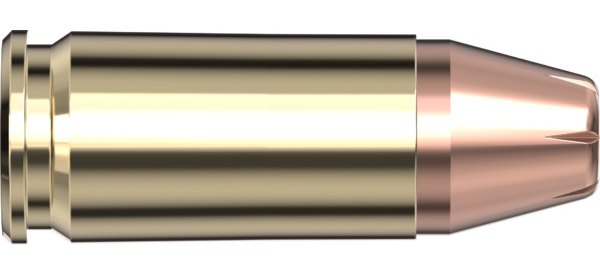
115, 124 or 147 grain: pros and cons
Three bullet weights, three velocities
Same brand, same range, same test barrel: only the weight changes
The invisible line on this chart sits at about 343 m/s, the speed of sound in air. The 147 grain falls below it: that is what is called a subsonic load, and it is the only one of the three. Manufacturer velocities123, converted to meters per second4.
View the data
| Bullet weight | Mass | Muzzle velocity | Energy | Regime |
|---|---|---|---|---|
| 115 grains | 7.45 g | ≈ 360 m/s (1,180 ft/s) | ≈ 482 J | Supersonic |
| 124 grains | 8.03 g | ≈ 351 m/s (1,150 ft/s) | ≈ 493 J | Supersonic |
| 147 grains | 9.53 g | ≈ 305 m/s (1,000 ft/s) | ≈ 443 J | Subsonic |
Between the lightest and the heaviest bullet, a 2.1-gram difference is enough to shift muzzle velocity by 55 meters per second, and to take the 147 grain below the speed of sound4.
The 115 grain
Pros
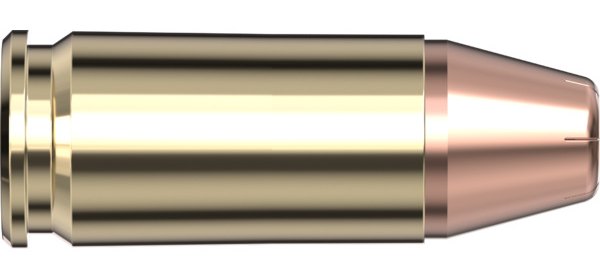
The 124 grain
Pros
Cons
- A compromise: neither the fastest nor the highest power factor (143)4.
The 147 grain
Pros
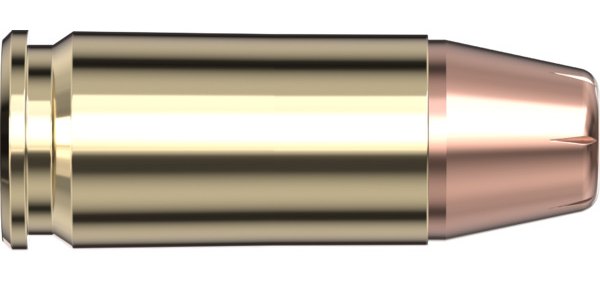
147 grain: the least energy, the highest power factor
Power factor flips the ranking
Bullet weight in grains × velocity in ft/s ÷ 1,000 — the calculation used in competition
The 147 grain develops the least energy of the three, and yet shows the highest factor4. Energy depends on the square of velocity; power factor and recoil impulse depend first on mass. Felt recoil, for its part, comes down to how the push is spread over time: the bullet that pushes hardest is not the one that feels harshest.
View the data
| Bullet weight | Power factor | Energy | What you feel |
|---|---|---|---|
| 147 grains | ≈ 147 | ≈ 443 J | Long push |
| 124 grains | ≈ 143 | ≈ 493 J | In between |
| 115 grains | ≈ 136 | ≈ 482 J | Sharp snap |
The 147 grain develops less energy than the other two, about 443 joules against 493 for the 124 grain, and yet shows the highest power factor4. Energy depends on the square of velocity; power factor and recoil impulse depend first on mass. A heavy, slow bullet pushes for longer than a light, fast one snaps hard.
The same reasoning is what makes the 9mm preferred to the .45 on the 1911 platform: less recoil, hence faster shooting. The weight of the pistol also enters the equation, as our comparison of competition 9mm pistols shows.
Power factor is calculated as follows:
147 grains × 1,000 ft/s ÷ 1,000 = 147
The minimums to reach vary by federation, discipline and rulebook edition: the threshold comes from your club's range officer. An out-of-date value, or one from another federation, would put you out of the rankings.
Malfunctions: changing ammo before stripping the pistol
Before blaming the pistol, the ammunition is the cheapest lead to test. Glock lists improper ammunition among the causes of most malfunctions, alongside a poor grip, faulty cleaning or lubrication and a damaged magazine; after a malfunction with a new brand, type or lot of ammunition, its manual advises trying another load8.
Not every bullet suits every feed ramp either: some pistols simply will not feed certain loads7. The pairing of pistol and ammunition is real.
The cheapest test. Changing the box and firing fifty rounds: if the malfunction disappears, the answer has cost one box. Beyond that, our guide to pistol malfunctions reviews the other causes, starting with the magazines.
The recoil spring decides which ammo cycles
A semi-automatic pistol only runs with ammunition loaded within the pressure range that operates its action7. Too weak for the spring, a load does not drive the slide back far enough: the case is not ejected and ends up pinched crosswise7.
CZ gives an example: the .22 LR adapter for the Shadow 2 ships with two recoil springs, one for less powerful ammunition such as subsonics, the other for more powerful loads9. Hence the practical consequence: a new pistol is not neutral, it is set up around a range of loads.
Competition ammo: loaded just above the threshold
Many competitors reload their ammunition and load it light to reduce recoil7, aiming for a power factor barely above the required minimum, with a five-point margin to absorb temperature and chronograph variations5. Less charge means less recoil; but it eats into the pistol's functioning margin: too light for the factory spring, the load leaves cases caught crosswise7.
Hence a classic case: a pistol that is reliable in practice and jams with the light ammunition kept for matches. The pistol has not deteriorated: what is missing is the match between the load and the spring.
Beyond the ammunition, follow-up shots depend on the trigger: our guide to double action, single action or striker-fired explains why the second break does not always feel like the first.
Testing match ammo: 200 rounds without a malfunction
- Shooting the match ammunition in practice, not only the range ammunition.
- Recording the exact reference, brand and weight: "9mm" is not enough.
- Counting at least two hundred rounds without a malfunction before trusting it in a match.
- Not changing lot the day before: two boxes of the same reference can differ.
A new pistol, or one back from the gunsmith, adds the break-in period: our guides to maintenance and the trigger explain what moves during the first few hundred rounds.
Buying 9mm ammo: quota and availability
In France, Category B ammunition cannot be bought freely: it follows the firearm, and holding it is capped. The details are in our guide to French firearm and ammunition quotas.
Two consequences for choosing a bullet weight. Testing three weights uses up quota: it is better done in an organized way than at the mercy of deliveries. And a load that cannot be found twice in a row is of no use in competition, however good it is.
Sources 10 references
Velocities come from the manufacturer sheets of a single range; masses, energies and power factors are calculated from them. Click a reference number in the text to highlight the matching source.
- Federal Ammunition — American Eagle 9 mm Luger 115 grains, official page: full metal jacket bullet, muzzle velocity 1,180 feet per second.
- Federal Ammunition — American Eagle 9 mm Luger 124 grains, official page: full metal jacket bullet, muzzle velocity 1,150 feet per second.
- Federal Ammunition — American Eagle 9 mm Luger 147 grains, official page: full metal jacket bullet, muzzle velocity 1,000 feet per second.
- Conversions and calculations derived from the three sheets above: masses in grams (1 grain = 0.064 799 g), velocities in metres per second, muzzle energies by the standard formula, power factors by the calculation used in competition. ⚠️ Energies do not appear on the manufacturer sheets: they are calculated, and rounded to the joule.
- Chris Christian, NRA Shooting Sports USA — How To Reload 9mm For Competitive Shooting, 19 March 2020, reread on 25 September 2026: bullets of 115 to 125 grains "produce a snappy recoil, which some shooters find helps them get back on target quickly. Other shooters prefer the softer push recoil of the heavier bullets"; "Savvy shooters load 5 PF above requirements for a safety margin to account for temperature and chronograph variances".
- Magtech — 9x19mm NATO Ball 124gr, official page reread on 25 September 2026: 124-grain bullet, muzzle velocity 1,296 feet per second.
- Chris Christian, NRA Shooting Illustrated — 4 Handgun Malfunction Causes & Clearance Drills, 30 May 2018, reread on 25 September 2026: reliable operation requires ammunition "loaded within the range of pressure levels required to operate the action"; "Not every bullet profile will properly fit every barrel's feed ramp. Some guns just will not feed certain loads"; on stovepipes: "Many competitive shooters ‘load light’ to reduce recoil, and if they go too light and don't install a lighter recoil spring, stovepipes can occur".
- Glock — Instructions for use, models G17 to G48 (PDF, edition 06/2026), reread on 25 September 2026: "Most malfunctions are caused by improper ammunition, an improper grip on the pistol when shooting (limp wristing), improper cleaning or lubrication, or damaged magazine"; "If you experience a malfunction (jam) while using a new brand, type, or lot of ammunition, try firing another type of ammunition to determine whether the ammunition was the source of the malfunction (jam)".
- CZ — Instruction manual CZ Shadow (PDF, edition 02/2025), reread on 25 September 2026, .22 LR adapter: "Two color-coded recoil springs are supplied with the firearm. The one with blue marking is suitable for weaker versions of .22LR ammunition (e.g. subsonic). The one with red marking is suitable for more powerful ammunition (e.g. high velocity)."
- Images — manufacturer renders and photographs, reproduced without retouching, cropped to their content: Hornady, 9 mm Luger 115 grains XTP; Hornady, 9 mm Luger 124 grains XTP; Hornady, 9 mm Luger 147 grains XTP.
None of these values is a rule. The velocities quoted are measured in a manufacturer's test barrel: your pistol, with its own barrel length, will give something else. Power factor minimums, permitted ammunition and range restrictions come under the rules of your discipline and the range officer.
Frequently asked questions
What is the difference between 115, 124 and 147 grain?
The weight of the bullet, and everything that follows from it. Within one manufacturer's range, the 115 grain weighs 7.45 g and leaves the muzzle at about 360 m/s, the 124 grain 8.03 g at 351 m/s, the 147 grain 9.53 g at 305 m/s. The 115 is the fastest, the 147 the slowest and the only subsonic one of the three. The recoil does not feel the same: short and sharp with the light bullet, longer and more of a push with the heavy one.
Which bullet weight for sport shooting?
It depends on your discipline and your pistol, not on a general ranking. The 115 grain gives a sharp recoil, which helps some shooters get back on target quickly; others prefer the softer push of heavy bullets such as the 147 grain; the 124 grain, the weight of NATO ammunition, sits between the two. The only useful judge remains your pistol: some will not feed every load.
What is power factor?
It is the calculation used in competition to rank loads: bullet weight in grains multiplied by velocity in feet per second, divided by a thousand. A 147-grain bullet at 1,000 ft/s gives a factor of 147. The minimums vary by federation, discipline and rulebook edition: the value in force comes from your club's range officer, more reliably than from a figure found online.
Can my malfunctions come from the ammunition?
Yes. Glock lists improper ammunition among the causes of most malfunctions, alongside a poor grip, faulty cleaning or lubrication and a damaged magazine; after a malfunction with a new brand, type or lot of ammunition, its manual advises trying another load. Some pistols also will not feed certain bullet profiles. Changing the box remains the cheapest test before stripping the pistol.
Is subsonic ammunition less reliable?
It is less powerful. A load too weak for the pistol's spring does not drive the slide back far enough, and the case can end up caught crosswise. CZ, for instance, supplies the .22 LR adapter of its Shadow 2 with two springs, one of them for less powerful ammunition such as subsonics. That does not rule out the 147 grain, which is widely used: it means trying it in your own pistol before relying on it.
How much ammunition can you hold for a category B firearm in France?
Under French law, holding ammunition for a category B firearm is capped per authorized firearm, and storage follows the same security obligations as the firearm itself. The quotas and conditions are detailed in our dedicated guide to firearm and ammunition quotas.