Pistol malfunctions: recognize the symptom, then find the cause
Published on · 5 min read · Anthony Baillon
Verified by a gunsmithA pistol malfunction is handled in two steps: first the safety drill, always the same — muzzle towards the target, finger outside the trigger guard — then the cause. A round that does not fire is the only dangerous case. For repeated stoppages, the magazine is the first suspect, well before the pistol.
At a glance
| What you see | What it is | Where to look |
|---|---|---|
| The round does not fire | Misfire or hangfire | The barrel, once the pistol is unloaded |
| Two cartridges jam together | Double feed | The magazine |
| A case stays crosswise | Ejection too weak | Ammunition, extractor, recoil spring |
| The slide stops short of closing | Incomplete closing | Chamber, ammunition, deformed case |
| The slide stays open, magazine not empty | Slide stop pressed | The thumb on the slide stop |
- First, always: muzzle towards the target, finger outside the trigger guard, face away from the ejection port.
- Round that does not fire: touch nothing for 10 to 60 seconds depending on the manufacturer, then unload and check the barrel.
- Two cartridges jammed: the magazine comes out before anything else.
- Repeated malfunctions: the magazine first, then the ammunition, maintenance and break-in; the pistol last.
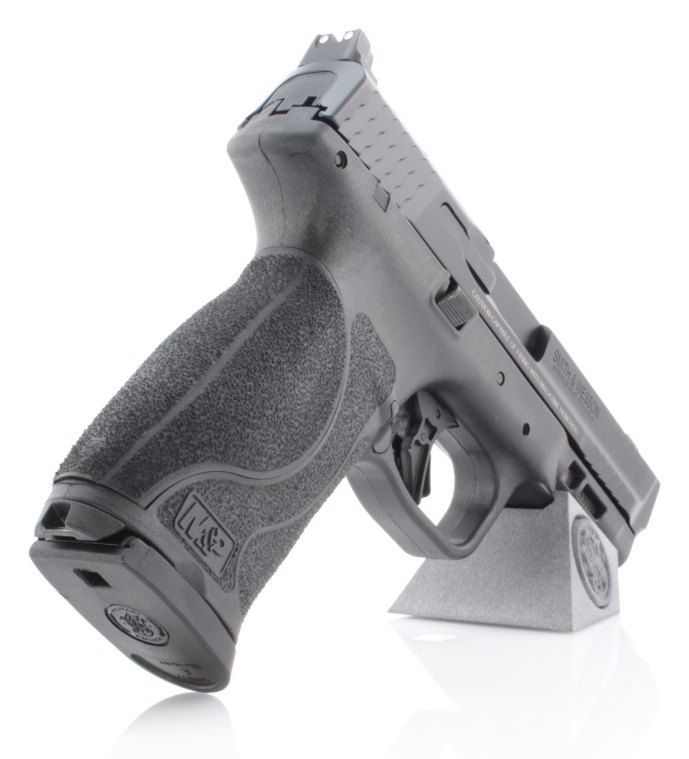
First drill: muzzle on target, finger outside the guard
Whatever the malfunction, safety comes before diagnosis:
- The pistol stays pointed at the target. A malfunction is no reason to turn the muzzle towards yourself to look1.
- The finger comes out of the trigger guard. A round that has not gone off can still go off at the next movement.
- The face stays away from the ejection port. A cartridge that ignites during handling throws the case outwards: Smith & Wesson spells this out in its manual5.
Only then comes the diagnosis, and the symptom almost always points to the right family of causes.
The round does not fire: wait, pistol on target
The other malfunctions immobilise the pistol; this one can still make it fire. A failure to fire can be an outright misfire — the primer did not ignite — or a hangfire: the primer ignited, but ignition is delayed. Nothing tells them apart at the time, hence the rule: handle nothing, and wait.
How long to wait depends on the manufacturer, from ten to sixty seconds.
Hangfire: how long to wait, according to the manufacturers
Wait prescribed by the official manuals, pistol kept pointed at the target, before any handling
Values taken from the manufacturers' manuals2345. All of them prescribe keeping the pistol pointed at the target without handling it; they differ on the duration, by a factor of six.
View the data
| Manufacturer | Prescribed wait | What the manual says |
|---|---|---|
| Walther, PDP | 10 seconds | wait ten seconds, muzzle in a safe direction |
| CZ, Shadow | 30 seconds | a hangfire goes off within 30 seconds |
| Beretta, 92X Performance | 1 full minute | wait a full minute before unloading |
| Smith & Wesson, M&P M2.0 | 60 seconds | wait 60 seconds, then remove the magazine |
Walther prescribes ten seconds2, CZ thirty, because "the cartridge will fire within 30 seconds"3, Beretta "one (1) full minute"4 and Smith & Wesson sixty seconds5.
All the manuals agree on what follows: unload, then check the barrel. If the round went off too weakly, the bullet may have stayed inside; Beretta warns that this case produces a dangerous barrel obstruction4. Firing behind a lodged bullet can destroy the pistol and injure the shooter.
Sixty seconds cover all four manuals. Waiting a minute rather than ten seconds costs nothing on the range. For another pistol, its own manual prevails.
Double feed malfunction: the magazine comes out first
One cartridge is already in the chamber, a second rises behind it, and the two jam together: the slide no longer closes.
As long as the magazine is in place, it keeps pushing, and working the slide achieves nothing. The magazine comes out first, and only then can the chamber be cleared. It is also the malfunction that points most directly to its culprit: the magazine, most often through worn feed lips, sometimes through a tired spring6 or a rough or bent follower7.
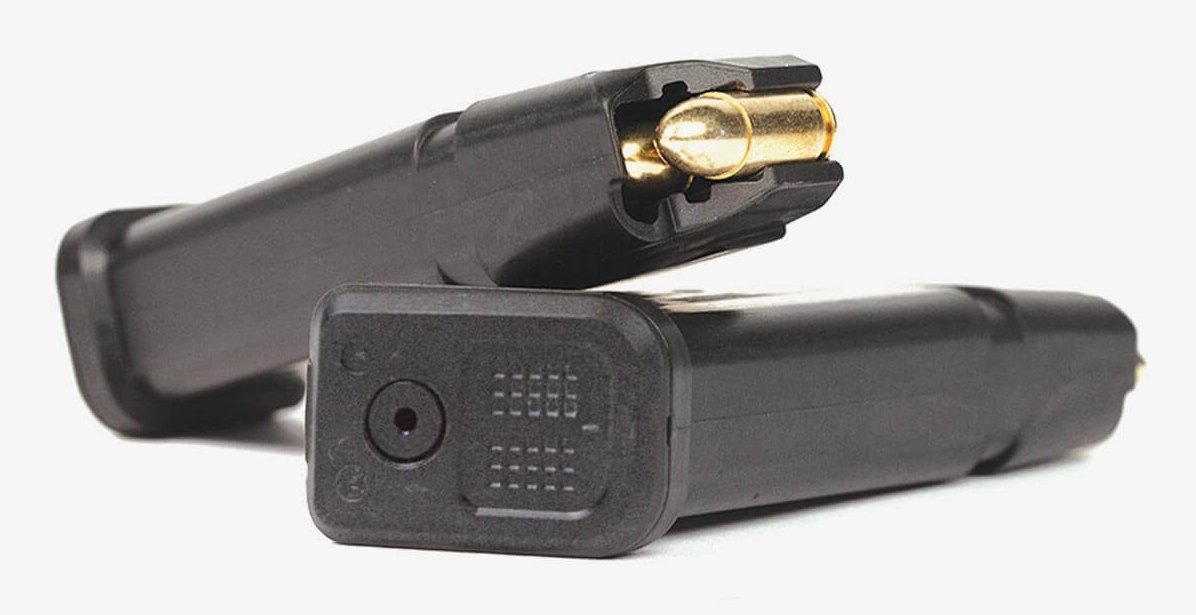
Stovepipe: a minor malfunction, weak ejection
The case was extracted, but without enough energy to clear the pistol: the slide closes on it and pinches it, upright or at an angle. Spectacular, but minor. Three leads, in this order:
- an underpowered round;
- a fouled extractor or ejection port;
- a recoil spring at the end of its life.
Replacing wear parts is judged on this kind of sign rather than on a round counter.
Slide will not close: three cases, three causes
Three situations that are often confused, although they have neither the same cause nor the same seriousness.
| What you see | What it is | Where to look |
|---|---|---|
| The slide stops a few millimeters short | Incomplete closing | fouled chamber, out-of-spec round, deformed case |
| The slide is completely locked up | Foreign body or double feed | remove the magazine before anything else |
| The slide stays open, magazine not empty | Slide stop pressed by mistake | thumb riding up on the slide stop, or the magazine at fault |
The third case often passes for a breakdown: it is the shooter's thumb touching the slide stop while firing. The pistol is sound; it is the position of the hand that changes.
Repeated stoppages: the magazine before the pistol
The reflex is to suspect the pistol; it is often the wrong order. Shooting Sports USA calls the magazine "the weak link in any semi-automatic design"7, and savvy competitors number their magazines to spot the one causing double feeds6. Causes are therefore ruled out in this order:
| Order | Cause | How to confirm it |
|---|---|---|
| 1 | The magazine | number the magazines, note which one was in use |
| 2 | The ammunition | change lot, not just box |
| 3 | Maintenance | pistol dry or over-lubricated, fouled extractor |
| 4 | Break-in | new pistol, malfunctions becoming rarer on their own |
| 5 | The pistol | only after ruling out the other four |
Our magazine checks — feed lips, follower, spring — take two minutes and rule out the most likely cause before anyone touches the pistol.
A single malfunction proves nothing: it is the trend that decides. On a new pistol, a falling rate is break-in, a rate that stays steady is a fault. To measure it, three columns of a malfunction log are enough: pistol, ammunition lot, magazine number.
Sources 8 references
Waiting times and unloading instructions come from the manufacturers' manuals, in the edition stated for each. Click a note marker in the text to highlight the matching source.
- Fédération française de tir — Les règles de sécurité (in French), consulted on 7 August 2026: « Une arme doit TOUJOURS être considérée comme CHARGÉE et à ce titre ne doit JAMAIS être dirigée vers soi-même ou vers quelqu'un. » [A firearm must ALWAYS be treated as LOADED and must therefore NEVER be pointed at yourself or anyone else.] ⚠️ This page covers neither failures to fire, nor hangfires, nor what to do in a stoppage — checked on 7 August 2026. That is why the waiting times in this article are taken from the manufacturers.
- Walther — PDP Safety & Instruction manual (PDF), section 3.6 "Clearing Misfires": "If a cartridge fails to fire, wait ten seconds while keeping the muzzle pointed in a safe direction", then unloading and a visual check of the chamber and barrel.
- CZ — Instruction manual CZ Shadow (PDF, edition 02/2025), safety rule no. 19: "In case it fails to fire, hold the firearm keeping it pointed in a safe direction and wait 30 seconds. If a hangfire (slow ignition) has occurred, the cartridge will fire within 30 seconds."
- Beretta — Pistol user manual 92X Performance (PDF): "With the pistol pointed in a SAFE direction, wait one (1) full minute", then complete unloading. The manual also describes the "squib load", a round that goes off with insufficient force to drive the bullet out of the barrel, and warns that it can produce a dangerous barrel obstruction.
- Smith & Wesson — Safety & Instruction Manual, M&P M2.0 pistols (PDF), "Hangfires and misfires" section: "Wait 60 seconds, then press the magazine catch and remove the magazine from the pistol." The manual defines a hangfire as a perceptible delay between the firing pin striking the primer and the round firing, and warns to keep the face away from the ejection port when clearing a cartridge.
- Chris Christian, NRA Shooting Sports USA — How To Clear 4 Common Semi-Automatic Malfunctions, 27 September 2021, reread on 25 September 2026: on double feeds, "Normally, this is not a gun or ammunition issue. The most common cause is worn magazine feed lips that allow a round to jump free during normal cycling. A weak magazine spring that allows rounds to bounce around in the magazine under recoil can also contribute"; "savvy competitors number their magazines for easy identification".
- Stanton L. Wormley Jr., NRA Shooting Sports USA — A Failure to Feed: Semi-Autos, 27 February 2017, reread on 25 September 2026: "The magazine is the weak link in any semi-automatic design"; defects cited include deformed feed lips and "a rough, bent or poorly-designed follower".
- Visuals — manufacturer renders and photographs, reproduced without retouching, cropped to their content: Smith & Wesson, M&P9 M2.0 Optics Ready; Magpul, PMAG 17 GL9.
Your pistol's manual prevails. At the slightest doubt after a malfunction — obstruction, noise or unusual behavior — shooting stops and the pistol goes to a gunsmith for inspection.
Frequently asked questions
What should you do when a pistol round does not fire?
Handle nothing straight away. The pistol stays pointed at the target, finger outside the trigger guard, and unloading waits: the round can still go off. This is the hangfire, a delayed ignition of the primer. The manufacturers' manuals prescribe very different waits — ten seconds at Walther, thirty at CZ, sixty at Beretta and Smith & Wesson. Waiting a minute covers all four. Once the pistol is unloaded, the barrel is checked: a bullet may have stayed in it.
Why does my pistol keep jamming?
The first suspect is the magazine, not the pistol. The shooting press describes it as the weak link of any semi-automatic pistol: worn or bent feed lips, a tired spring, a follower that catches. Before blaming the pistol, numbering the magazines and noting which one was in use at each malfunction settles the question. A faulty magazine gives itself away in two sessions, where doubt about the pistol lasts for months.
What is a double feed on a pistol?
Two cartridges present themselves to the chamber at the same time and block each other: one is already engaged, the other rises behind it. The slide does not close and the pistol is locked up. It is the malfunction that takes longest to clear, because the magazine has to come out before the chamber can be freed — unlike the other malfunctions, working the slide alone is not enough.
Is a case stuck crosswise serious?
No, and it is the simplest malfunction to clear. The case was not fully ejected and ends up pinched by the closing slide, upright or at an angle. The pistol remains safe as long as it is pointed at the target. The cause is most often weak ejection: an underpowered round, a fouled extractor, or a recoil spring at the end of its life.
Should malfunctions on a new pistol be a worry?
Not necessarily, but they are worth writing down. A new pistol needs a break-in: a single malfunction therefore does not carry the same weight as on a broken-in pistol. What counts is the trend — a falling rate is break-in, a rate that stays steady is a fault.