Glock 19: the complete guide before you buy
Published on · Updated on · 8 min read · Anthony Baillon
The Glock 19 is the compact 9mm every other manufacturer measures itself against, and the one most often recommended without reservation. Here is what it genuinely does well, where it gives ground, and how it compares with the range pistols in this series.
At a glance
| Glock 19 Gen5 | |
|---|---|
| Weight | 670 g with empty magazine, 855 g loaded |
| Barrel | 102 mm, or 4.02 inches |
| Capacity | 15 + 1 rounds of 9 × 19 |
| Trigger | 26 N listed, about 2,650 g |
| French category | B: authorization required |
| Price | €722 new, €549 used |
- Its argument: nothing disqualifies it, whatever the use.
- Its weakness: the factory trigger, the heaviest of the 9mm pistols compared here.
- For an optic: the MOS version, cut at the factory, almost always costs less than a conversion.
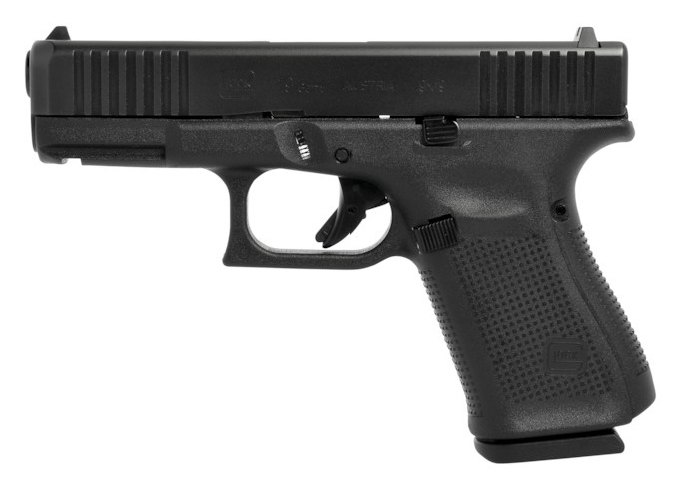
Glock 19: pros and cons
Pros
Glock 19: rarely the best, never ruled out
The Glock 19 is rarely the best pistol for any given task. It is also rarely a poor choice, whatever the task, and that is the whole argument.
At 670 grams with an empty magazine, a 102 mm (4.02-inch) barrel and 15 rounds1, it sits at the point where nothing disqualifies it: small enough to transport without organizing your day around it, large enough to shoot well with a full firing grip.
The clearest evidence is not in any review but in the market. Enough manufacturers have built pistols to these dimensions that "Glock 19 size" now describes a category rather than a brand.
Glock 19 size: 670 g, half a range pistol
The Glock 19 against full-size range 9mm pistols
Unloaded weight without magazine; the Glock 19 is a compact, and the comparison shows what that format brings and what it costs
Every figure is the manufacturer's own, magazine empty. This chart does not rank the Glock 19 among range pistols — it is not competing with them. It shows the price of compactness: roughly half the mass of a steel competition pistol, and everything that follows from it.
View the data
| Pistol | Unloaded weight | Barrel | Capacity | Use |
|---|---|---|---|---|
| CZ Shadow 2 | 1,330 g (46.9 oz) | 4.7" | 19 + 1 | Range |
| Walther PDP Steel Frame Match 5" | 1,195 g | 5" | 18 or 20 | Range |
| Staccato P | 936 g (33 oz) | 4.4" | 17 + 1 or 20 + 1 | Range and duty |
| Glock 34 Gen5 MOS | 743 g (26.21 oz) | 5.31" | 17 + 1 | Competition |
| Glock 19 Gen5 MOS | 670 g (23.63 oz) | 4.02" | 15 + 1 | General purpose |
Set against the range pistols in this series, the Glock 19 weighs roughly half what a steel competition pistol does — 670 grams1 against the 1,330 CZ lists for a Shadow 26. That is not a criticism — they are not competing for the same use — but it deserves to be seen clearly, because everything else follows from it.
What you gain: a light pistol, easy to take to the range, that needs no planning.
What you give up: the mass that steadies a pistol between shots, and 33 millimeters of barrel against a Glock 34 — which Glock's own sheets turn into 38 millimeters of sight radius, 153 against 19112. On deliberate shots at distance, it shows.
The Glock 19 is a general-purpose pistol that shoots well, not a range pistol that happens to be easy to transport. Bought for the first of those two descriptions, it will not disappoint.
Glock 19 trigger: 26 N, its weakest point
Trigger pull, in grams
Manufacturers' figures; the table view also gives newtons and a press measurement of the Glock 19
The Glock 19 trigger is not a competition trigger, and does not claim to be. The comparison sets expectations: a shooter moving from this pistol to a range pistol will find a very different break, and the reverse holds too.
View the data
| Pistol | Grams | Newtons | Nature of the figure |
|---|---|---|---|
| Staccato XC | 1,134 g | 11.1 N | manufacturer, 2.5 lb |
| CZ Shadow 2, single action | 1,530 g | 15 N | manufacturer |
| Glock 34 Gen5 | 2,447 g | 24 N | manufacturer |
| Walther PDP | 2,500 g | 24.5 N | manufacturer |
| Glock 19 Gen5 | 2,651 g | 26 N | manufacturer |
| Glock 19 Gen5 | 2,637 g | 25.8 N | review measurement, 5 lb 13 oz |
This is where the platform gives the most ground.
Glock publishes the figure in newtons, as European manufacturers do: 26 newtons1, about 2,651 grams. An independent measurement of a Gen5 MOS put the break at 5 pounds 13 ounces12, or 2,637 grams: within an ounce of the listed figure, which is rarer than it sounds. That is heavier than the 24 newtons listed for the Glock 342 and the 2,500 grams listed for a Walther PDP8, and well above what a range pistol offers: CZ lists 15 newtons, or 1,530 grams, for a Shadow 2 in single action6, Staccato 1,134 grams for an XC1014.
No rulebook makes you live with it. USPSA states that "there is no restriction on the trigger pull weight of a firearm" outside the divisions that set a threshold4; IPSC Production is one of the few that does, at 2,270 g on the first shot or 1,360 g on every shot5.
In return, the break is identical from the first shot to the last, with no double-action first pull to learn — the trade-off our trigger guide sets out in full.
A technical warning before having yours lightened: it is gunsmith work, to be validated on the ammunition you actually shoot — Glock's own manual treats a firing-pin indent that is too light or off-center as a reason to stop and consult a gunsmith3.
Glock 19 reliability: four causes of malfunction, per Glock
Glock's instructions are blunt about where malfunctions come from, and the list does not point at the pistol: an incorrect grip, unsuitable cleaning or lubrication, a damaged magazine, or ammunition outside SAAMI, CIP or NATO standards3. The 9mm Luger those standards define is a 35,000 psi cartridge, with a 9.030 mm (.3555-inch) bullet11.
For a buyer, the question is therefore mostly about grip angle and trigger — two points settled in the hand, not on a spec sheet.
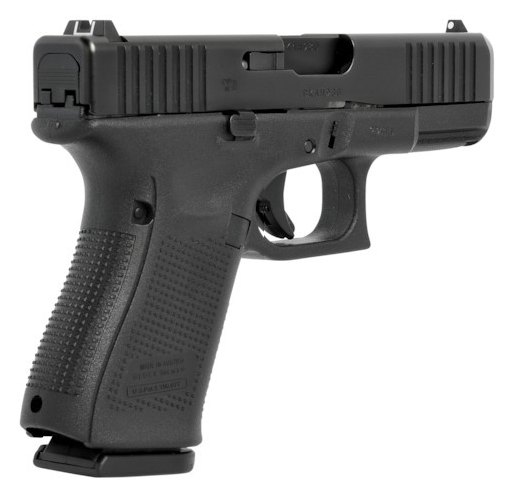
Glock 19 optics: the MOS version over a conversion
MOS versions are cut at the factory for a red dot1 and accept most optics on the market through a set of adapter plates. Non-MOS versions need slide milling at a specialist.
The division comes before the optic. In USPSA, Carry Optics and Limited Optics both require the optic to be attached directly to the slide, never to the frame; USPSA Production and IPSC Production both forbid optical sights outright45.
If an optic is part of the plan, buying the MOS version from the start almost always costs less than converting a standard slide later, and it avoids weeks with the pistol out of service. Our red dot guide covers footprints, plates and the full cost.
Glock parts: a huge market, and one trap
The Glock parts market has no equivalent: triggers, barrels, sights, flared magwells, magazine base pads, compensators.
That breadth is a real advantage: you can adapt the pistol to your hand and your discipline over time, spreading the cost. It is also a trap, because some of those parts close a division: USPSA Production and Carry Optics forbid compensators and ported barrels, and IPSC Production bans every non-factory part except magazines, open sights, grip panels, springs, hammers and trigger assemblies45.
One modification at a time, at a gunsmith, making sure the pistol runs before moving on to the next.
Glock 19, Glock 34, Walther PDP: what sets them apart
- Against a Glock 34: same platform, different use. The 34 adds sight radius, two rounds and competition details; the 19, ease of transport.
- Against a Walther PDP: same striker-fired family. Walther lists a 2,500-gram break across the whole range, slightly under the Glock 19's 26 N, and its 5-inch polymer Full Size, at 745 grams8, competes more with the Glock 34 than with the 19.
- Against a CZ Shadow 2 or a Staccato: the comparison is not a fair one. These are dedicated range pistols: 1,330 grams of steel for the CZ6, 936 for a Staccato P913, against a steel-framed Walther Match at 1,1957. The Glock 19 is not trying to be one.
Our comparison of eleven competition 9mm pistols covers the range pistols proper.
Glock 19 budget: €624 of ammunition a year
| Item | Amount |
|---|---|
| Glock 19 Gen5, new | €72216 |
| Glock 19 Gen5, used | €54917 |
| Gun safe, for a first category B firearm | €115 to €2891920 |
| 9mm ammunition, at 200 rounds a month | €624 a year18 |
With a new Glock 19, the first year comes to about €1,460 to €1,640, before license and club fees; in the following years, ammunition remains the main item, at €624 a year. For the identical version, the used pistol found on the same day costs 24% less than new1617.
Depending on use, the list grows with spare magazines — Glock offers 15, 17, 24, 31 and 33 rounds for this frame1, covered in our magazine guide —, an optic plate on a MOS version, more visible sights, and sometimes the trigger.
In France, the Glock 19 is a Category B firearm, like every centerfire pistol: a sport shooter needs a prefectural authorization to buy one, and must store it in a gun safe, a strong cabinet or a strongroom2122. The route from license to purchase is set out in our guide to the French Category B authorization.
Buying a Glock 19: who it suits, and who less
What it brings, and what it asks
It suits a shooter who wants a single pistol for almost everything: range practice, a first competition season, a light pistol to transport. Its reliability removes a whole category of worries, and its parts market lets it evolve.
It suits less a range shooter chasing scores: the sight radius and mass of a dedicated competition pistol make themselves felt. Less, too, anyone the brand's grip angle has never convinced — a criterion settled in the hand.
Sources 22 references
Every dimension, weight and trigger figure below was read on the manufacturer's specification sheet or in the rulebook that sets it, in the edition in force, and cross-checked against a second independent reference. Press and commercial sources corroborate, or supply a measurement no manufacturer publishes; they never stand alone, and they carry a ⚠️. Click a reference number in the text to highlight the matching source.
- GLOCK — G19 Gen5, manufacturer specification sheet, consulted 20 August 2026: barrel 102 mm (4.02 in), overall length 185 mm, slide length 174 mm, overall width 34 mm, height with magazine 128 mm, sight radius 153 mm with polymer sights, trigger distance 70 mm, trigger pull 26 N, weight 610 g without magazine, 670 g with an empty magazine and 855 g loaded, standard capacity 15 rounds with 15-, 17-, 24-, 31- and 33-round options, GLOCK Marksman Barrel, nDLC finish, front serrations and an ambidextrous slide stop lever.
- GLOCK — G34 Gen5 MOS, manufacturer specification sheet, consulted 20 August 2026: 9x19 mm, barrel 135 mm (5.31 in), overall length 222 mm, slide length 207 mm, overall width 34 mm, height with magazine 139 mm, sight radius 191 mm with polymer sights, trigger distance 70 mm, trigger pull 24 N (2,447 g), weight 665 g without magazine, 743 g with an empty magazine and 980 g loaded, standard capacity 17 rounds with 10- and 24-round options.
- GLOCK — Safe Action Pistols, Instructions for Use (PDF, ref. 54575, English edition 09-23), consulted 20 August 2026: malfunctions attributed to an improper grip, improper cleaning or lubrication and a damaged magazine; warning against reloaded, remanufactured or handloaded ammunition "because it may not be applicable SAAMI, CIP or NATO standards"; a light or off-centre firing-pin indent sends the pistol to a competent gunsmith; the pistol is cleaned and lubricated when new before first firing, after each firing, as conditions of use require, and at least once a year; lubrication limited to the outside of the barrel with its hood and lugs, the inside top of the slide where the hood rubs, one drop where the trigger bar meets the connector, and one drop spread along each slide rail cut; "GLOCK pistols are designed to operate properly with only small amounts of lubrication".
- USPSA — USPSA Competition Rules, March 2026 edition (PDF), consulted 20 August 2026: rule 5.1.2 (minimum case dimension 9x19 mm, minimum bullet diameter 9 mm / .354 in), rule 5.1.4 ("there is no restriction on the trigger pull weight of a firearm" outside the divisions that set a threshold), Appendix C2 §36 (power factor = bullet weight in grains × average velocity in feet per second / 1,000, all decimals ignored, "a result of 124.9999 is not 125"), Appendix D1 Open (Major 165, Minor 125, minimum bullet weight 112 grains for Major, magazines up to 171.25 mm, compensators and ports allowed), Appendix D2 Limited (Major 165 but only from .40 / 10 mm / .357 SIG, magazines of 141.25 mm, or 171.25 mm on single-stack guns, no optics, no compensators), Appendix D3 Limited-10 (10 rounds loaded after the start signal), Appendix D4 Production (Minor only, 15 rounds after the start signal, 59 ounces, box of 227.01 × 152.40 × 41.28 mm, approved handgun list, notch and post sights only), Appendix D5 Single-Stack (same box, 8 rounds in Major and 10 in Minor), Appendix D6 Revolver (6 rounds before reloading in Major, 8 in Minor), Appendix D7 Carry Optics (Minor only, optic required and "attached directly to slide between rear of slide and ejection port", never to the frame, magazines of 141.25 mm, 59 ounces with optic and empty magazine), Appendix D9 Limited Optics, Appendix E1 (magazines measured on the EGW gauge).
- IPSC — IPSC Handgun Competition Rules, January 2026 Edition (PDF, final version of 29 December 2025), consulted 20 August 2026: Appendix D4 Production — maximum barrel length 127 mm, minimum trigger pull 2,270 g on the first shot or 1,360 g on every shot, 15 rounds at the start signal, no optical sights, no compensators or ports, models restricted to the IPSC Production Division List, external hammers fully decocked at the start signal and first shot fired in double action, non-factory parts prohibited except magazines, open sights, grip panels, springs, hammers and trigger assemblies; Appendix D4a Production Optics requires an optical sight, under the same trigger and first-shot conditions. ⚠️ Consulted on the Polish region's mirror, each page carrying the IPSC header and edition, IPSC publishing no stable direct link to the PDF on its own site; the division pages and the Production Division List on ipsc.org were read alongside it and agree.
- CZ — CZ Shadow 2, manufacturer specification sheet, consulted 20 August 2026: 9x19 mm, weight with empty magazine 1,330 g (46.9 oz), length 217 mm, height 157 mm, width 34 mm, barrel 120 mm (4.7 in), SA/DA trigger, steel frame, duralumin grips, trigger pull SA 15 N and DA 46 N (3.4 and 10.4 lb, or 1,530 and 4,691 g), single-action travel and reset of 3 to 4 mm against 12 mm in double action, capacity listed as 19+1 — full-size magazines take a base plate that adds two rounds to the 17 they hold as standard, and three magazines ship with the pistol.
- Carl Walther — PDP Steel Frame Match FS 5" (ref. 2872218), manufacturer specification sheet, re-read 24 September 2026: 18 or 20 rounds, Dynamic Performance Trigger, trigger pull 2,500 g, weight 1,195 g, barrel 127 mm, 213 × 150 × 40 mm.
- Carl Walther — PDP Full Size 5" (ref. 2851776), manufacturer specification sheet, re-read 24 September 2026: 9 mm Luger, 18 rounds, weight 745 g, Performance Duty Trigger, trigger pull 2,500 g, the same figure as on the sheets of the other PDPs (Match Polymer, F-Series, Steel Frame), barrel 127 mm. ⚠️ The sheet does not say whether the weight includes the magazine.
- Staccato — Staccato P, manufacturer specification sheet, consulted 20 August 2026: 9x19 mm, 17+1 or 20+1, single-action trigger listed at 4 to 4.5 lb, 4.4-inch bull barrel, weight 33 oz (936 g) in the steel version, 4140 steel frame, 8.1 × 1.5 × 5.9 in with a grip width of 1.3 in, tool-less recoil system, two 17-round magazines supplied, list price $2,499.
- Staccato — Staccato XC, manufacturer specification sheet, consulted 20 August 2026: 5.0-inch barrel with integral island compensator, "Balanced 2.5lb Trigger", or 1,134 g, weight 37.56 oz without optic or magazine, billet-machined 4140 steel frame, 8.7 × 1.5 × 5.9 in, two 17-round magazines.
- SAAMI — ANSI/SAAMI Z299.3-2022, Centerfire Pistol & Revolver (PDF, approved 13 December 2022), consulted 20 August 2026: 9 mm Luger, maximum average pressure 35,000 psi by transducer and 38,500 psi for +P, bullet diameter .3555 in (9.030 mm), case length .754 in (19.15 mm), cartridge overall length from 1.000 in (25.40 mm) to 1.169 in (29.69 mm), six grooves and a 10-inch right-hand twist, cartridge and chamber drawing issued 29 May 1979 and revised 23 June 2021; for comparison, 40 S&W at 35,000 psi, 45 Auto at 21,000 psi, 38 Super Auto +P at 36,500 psi and 357 SIG at 40,000 psi.
- American Rifleman (NRA) — Glock 19 Gen5 MOS FS tested, 20 June 2019, consulted 20 August 2026: 24 ounces with an empty magazine, 4.02-inch barrel, overall length 7.28 in, height 5.04 in, width 1.34 in, 15-round magazine, white-dot front and square-notch rear sights, trigger measured at 5 lb 13 oz, list price $745. ⚠️ Specialist press; the trigger figure is a measurement, and it lands within an ounce of the 26 N Glock lists.
- Outdoor Life — Staccato P review, 22 February 2023, consulted 20 August 2026: 37 ounces measured with an empty 17-round magazine, frame and slide machined from 4140 steel billet, aluminium models also existing, trigger measured at 4 lb 2 oz, about 1,350 rounds fired without malfunction, ten five-shot groups averaging 1.15 in at 50 feet. ⚠️ Specialist press; corroborates the Staccato sheet, the four-ounce difference being the magazine.
- Small Arms Review — Staccato XC review, consulted 20 August 2026: single-action pull of 2.5 pounds, corroborating the figure Staccato publishes. ⚠️ Specialist press.
- Images — manufacturer renders and photographs, reproduced without retouching, cropped to their content: GLOCK, G19 Gen5.
- L'Armurerie Française — pistolets Glock catégorie B (in French), prices recorded 30 July 2026: Glock 44 Gen5 .22 LR €539.00, Glock 44 Gen5 threaded €629.00, Glock 43 Gen3 €579.00, Glock 43x €660.00, Glock 26 Gen5 €699.00, Glock 26 Gen5 FS €722.00, Glock 17 Gen5 FS €722.00, Glock 19 Gen5 FS €722.00, Glock 19X Coyote €768.00, Glock 41 Gen4 .45 ACP €790.00, Glock 17 Gen5 FS MOS €829.00, Glock 34 MOS Gen5 €920.00. ⚠️ Commercial data.
- Le Pistolier — used category B handguns (in French), 24 listings recorded 30 July 2026: Unique MOD/D2 .22 LR €349, Smith & Wesson model 48 .22 LR €649, Ruger Mark IV Hunter .22 LR €1,350, Glock 19 Gen 5 9 mm €549, Tanfoglio Stock III €799, CZ TS 2 €1,699 and €1,999, Manurhin MR 73 .357 Magnum €2,199, CZ Shadow 2 €2,699, SIG Sauer P226 X-Five €3,199. ⚠️ Commercial data.
- Armurerie Centrale — munitions 9x19 / 9 mm Luger (in French), prices recorded 30 July 2026: Fiocchi FMJ 123gr €12.90 per 50, STV Scorpio FMJ €13.90, Fiocchi FMJ 115gr €13.90, Geco FMJ 124gr €14.49, Norma Range & Training €14.90, Winchester Target & Practice €15.90, Aguila FMJ €15.95; STV Scorpio €259.00 per 1,000. That is €0.26 a round at the cheapest box. ⚠️ Commercial data, recorded at a single retailer.
- Armurerie Loisir — coffres-forts et armoires fortes pour armes (in French), prices recorded 30 July 2026: handgun safes Fortify Delta 1 €115.00, Fortify SC6 €249.00, Infac C3A €259.00. ⚠️ Commercial data.
- Safepro24 France — coffres-forts pour armes de poing (in French), prices recorded 30 July 2026: Rottner GunBox €68.90, Profirst Patrol 2 armes €168.00, Profirst NY 2 €289.00, Profirst Teos 40 S1 €317.80, Rottner Gunmaster XL €392.80. ⚠️ Commercial data.
- Service-public.gouv.fr — armes de catégorie B pour un tireur sportif (soumises à autorisation) (in French), fact sheet F2250 checked 20 March 2025: 15 firearms, 6 for a first-time applicant, 3,000 cartridges per firearm per 12 consecutive months, storage in a gun safe, strong cabinet or strongroom, authorisation valid 5 years, and the prefecture's response time — « en l'absence de réponse dans un délai de 3 mois à partir de la date de réception de votre demande, cela signifie que votre demande est refusée » [no answer within 3 months of receipt means the application is refused].
- Légifrance — article R314-3 du code de la sécurité intérieure (in French), in force since 11 May 2017: category A and B firearms stored « soit dans des coffres-forts ou des armoires fortes adaptés au type et au nombre de matériels détenus » [either in safes or strong cabinets suited to the type and number of items held], or in a strongroom with an armoured door and barred openings. Categories C and D are not covered.
Generation and version change the spec sheet. Glock 19s come in several generations whose grips, textures and optic provisions differ, and MOS and non-MOS slides are not interchangeable in this respect. Any work on the trigger is a gunsmith's job, as Glock's manual points out for any abnormal firing-pin indent.
Frequently asked questions
Why is the Glock 19 so often recommended?
Because it sits at the point where nothing disqualifies it. At 670 grams with an empty magazine, with a 102 mm (4.02-inch) barrel and 15 rounds, it is small enough to transport without fuss and large enough to shoot well. It is rarely the best pistol for any given task, and rarely a poor choice, whatever the task.
Glock 19 or Glock 34?
Two different uses. The 34 adds a longer barrel and 38 millimeters of sight radius, 17 rounds and competition-oriented details, for 73 grams more and a size that no longer goes unnoticed. The 19 gives up sight radius and two rounds for a pistol you transport without organizing anything around it. For scoring at the range, the 34 is the better-suited tool; for a lighter, shorter pistol, it is the 19.
What is the Glock 19 trigger worth?
It is the platform's weakest point. Glock lists 26 newtons, about 2,651 grams or 5.85 pounds, and an independent measurement of a Gen5 MOS gave 5 pounds 13 ounces — the two figures agree within an ounce, and both sit above the 24 newtons Glock lists for the 34, as well as the 2,500 grams Walther lists for the PDP. The parts market is considerable; any work on the trigger is a gunsmith's job.
Does the Glock 19 take a red dot?
MOS versions leave the factory with the optic cut and accept most optics through a set of adapter plates, with no slide milling. Non-MOS versions need milling at a specialist. If an optic is part of the plan, buying the MOS version from the start almost always costs less than a later conversion.
Is the Glock 19 reliable?
Glock ties malfunctions to causes outside the pistol: an incorrect grip, unsuitable cleaning or lubrication, a damaged magazine, or ammunition outside SAAMI, CIP or NATO standards. A firing-pin indent that is too light or off-center, on the other hand, sends the pistol to a gunsmith.
Do you need an authorization to buy a Glock 19 in France?
Yes. Like every centerfire pistol, the Glock 19 is a category B firearm under French law: a sport shooter can only buy one with an authorization from the prefect, applied for online after three supervised shooting sessions. Four to seven months usually pass between the license and the purchase, and the pistol must then be stored in a gun safe, a strong cabinet or a strongroom.