Walther PDP: the complete guide before you buy
Published on · Updated on · 9 min read · Anthony Baillon
Verified by a gunsmithThe Walther PDP is a striker-fired 9mm pistol that comes in two families: polymer, from 680 to 763 g, and steel frame, from 1,145 to 1,195 g. Walther lists the same 2,500 g break across the whole range. Up to a 5-inch barrel, it is allowed in IPSC Production.
At a glance
| Polymer PDP | Steel-frame PDP | |
|---|---|---|
| Weight | 680 to 763 g | 1,145 to 1,195 g |
| Trigger | 2,500 g | 2,500 g |
| Barrel | 102 to 127 mm | 102 to 127 mm |
| New price | €839 to €1,299 | €1,879 to €2,242 |
- The main choice: polymer or steel, 450 g and about €1,000 apart.
- In IPSC: allowed in Production up to a 5-inch barrel, without a compensator.
- For .22 LR practice: no PDP, but a hammer-fired P22Q, around €465.
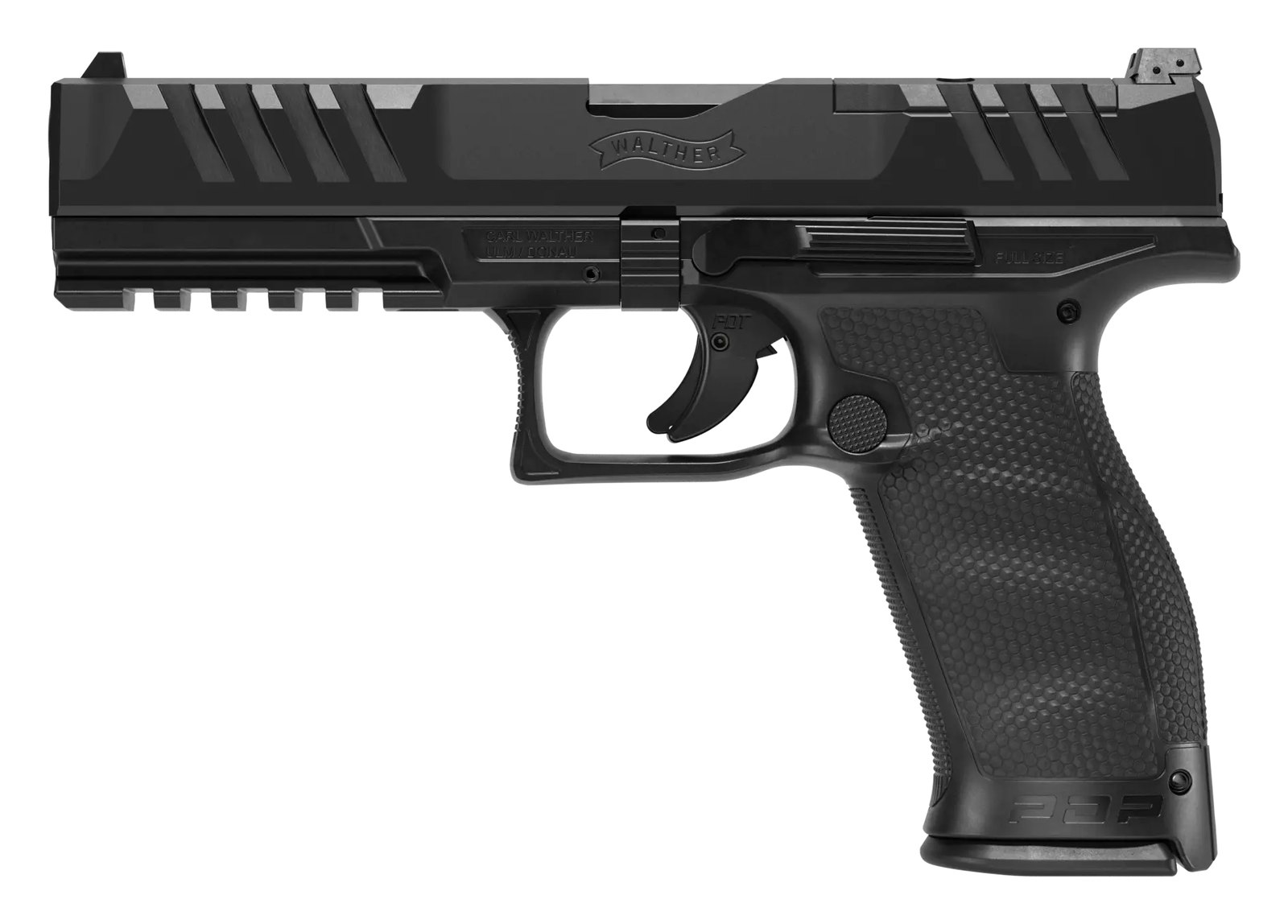
Walther PDP: pros and cons
Polymer PDP
Pros
Steel-frame PDP
Pros
Walther PDP range: four formats, two frames
The same name covers pistols that differ in frame, barrel length and grip. Walther describes them as follows1234:
| Version | Barrel | Weight | Capacity |
|---|---|---|---|
| F-Series 4" | 102 mm | 680 g | 15 |
| Full Size 4" | 102 mm | 695 g | 18 |
| Full Size 5" | 127 mm | 745 g | 18 |
| Match Polymer 5" | 127 mm | 763 g | 18 or 20 |
| Steel Frame 4.5" | 114 mm | 1,145 g | 18 |
| Steel Frame Match 5" | 127 mm | 1,195 g | 18 or 20 |
The F-Series is not a cut-down pistol: it keeps a 102 mm barrel and 15 rounds, but its grip, its trigger reach and the effort needed to rack the slide are reduced, for smaller hands3. The Match versions get the Dynamic Performance Trigger; the others the Performance Duty Trigger, listed at the same weight12.
Walther PDP polymer or steel: 450 g apart
The Walther PDP range, from polymer to steel
Weight listed by Walther, in grams, compared with two range neighbors
Two families stand out: the polymer PDPs, between 680 and 763 g, and the steel-framed PDPs, above 1,100 g. Sources123478.
View the data
| Pistol | Weight | Barrel | Capacity |
|---|---|---|---|
| CZ Shadow 2 | 1,330 g | 120 mm | 19 + 1 |
| PDP Steel Frame Match 5" | 1,195 g | 127 mm | 18 or 20 |
| PDP Steel Frame 4.5" | 1,145 g | 114 mm | 18 |
| PDP Match Polymer 5" | 763 g | 127 mm | 18 or 20 |
| PDP Full Size 5" | 745 g | 127 mm | 18 |
| Glock 34 Gen5 | 743 g | 135 mm | 17 |
| PDP F-Series 4" | 680 g | 102 mm | 15 |
With the same 127 mm barrel, the Steel Frame Match weighs 1,195 g, the polymer Full Size 745 g14. The 450 g of steel sit in the frame, under the hand: they slow muzzle rise between shots, and tire the arm more at the end of a long session.
The polymer sits at the weight of a Glock 34, 743 g with an empty magazine7; the steel approaches that of a CZ Shadow 2, 1,330 g8.
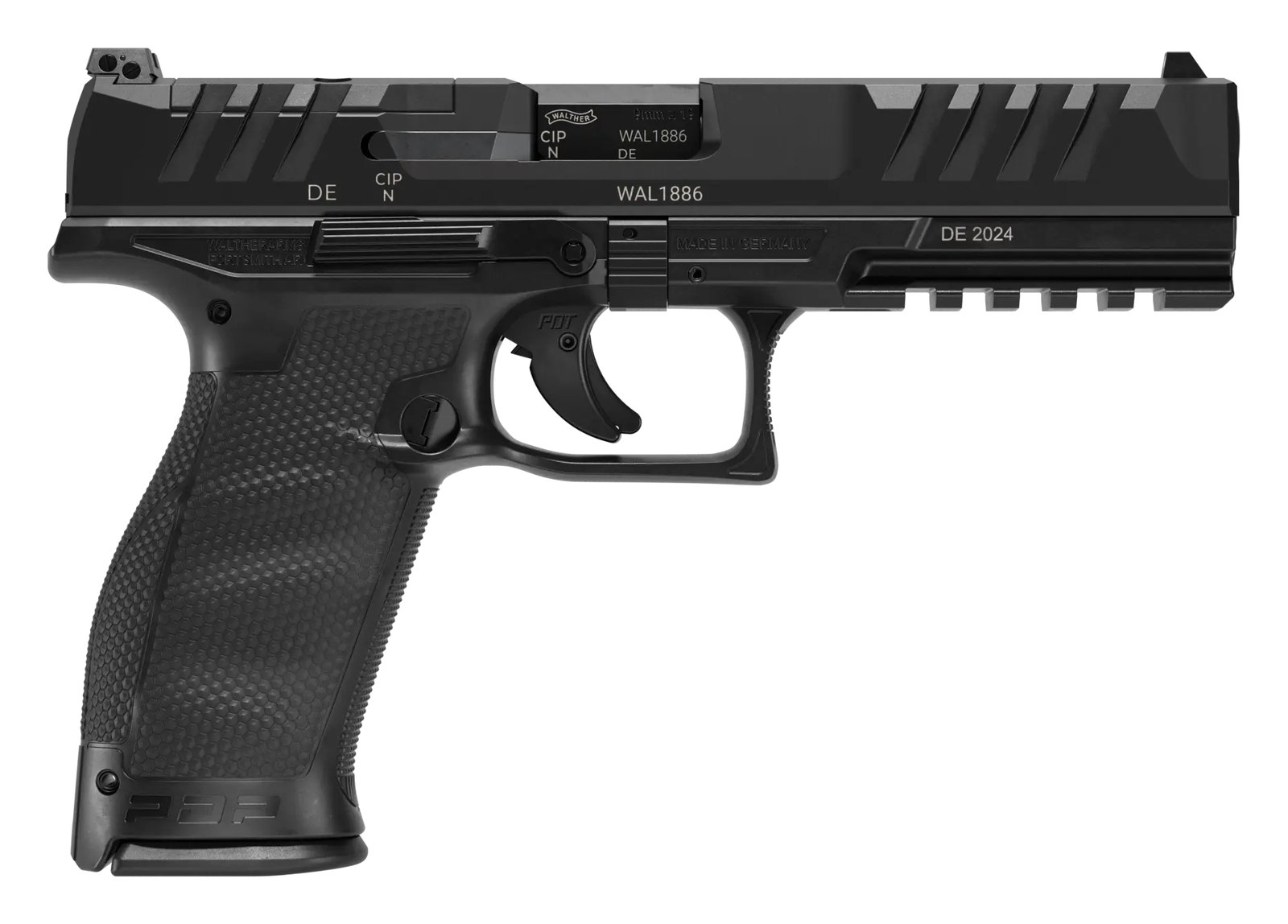
Walther PDP trigger: 2,500 g across the range
Trigger pull of the Walther PDP and its neighbors
Figures listed by the manufacturers, in grams (1 N = 102 g)
The whole PDP range is listed at the same trigger pull, polymer and steel alike. On the CZ Shadow 2, only the first shot, in double action, breaks heavier: 4,691 g. Sources14678.
View the data
| Pistol | Grams | Listed figure |
|---|---|---|
| CZ Shadow 2, single action | 1,530 g | 15 N |
| Glock 34 Gen5 | 2,447 g | 24 N |
| Walther PDP Full Size 5" | 2,500 g | 2,500 g |
| Walther PDP Steel Frame Match 5" | 2,500 g | 2,500 g |
| Walther Q5 Match SF | 2,549 g | 25 N |
| CZ Shadow 2, first shot in double action | 4,691 g | 46 N |
Walther lists a 2,500 g break for the polymer PDPs as for the Steel Frame Match124. The break is identical on every shot, with no double-action first shot.
That is the level of a Glock 34, listed at 24 N, or 2,447 g7. The Walther Q5 Match SF, the PDP's predecessor in competition, was listed at 25 N, or 2,549 g6. A range single action breaks lighter: 15 N, about 1,530 g, on a CZ Shadow 2 with the hammer cocked8.
The rulebooks leave room: 2,500 g is above the 2,270 g required on the first shot in IPSC Production and the 1,000 g of ISSF 25 m1113. Lightening the trigger remains gunsmith work, covered in our trigger guide.
Walther PDP in IPSC: Production-legal up to 5 inches
IPSC shooting, called TSV in France, follows the IPSC rulebook12. The IPSC Production list, updated on 9 March 2026, approves the PDP in "all variants Full Size and Compact, all barrel lengths up to 5 inch including Steel Frame models without detachable Mag Funnel"10.
| IPSC division | PDP up to 5 inches | Condition |
|---|---|---|
| Production | Allowed | 15 rounds at the start, no optic |
| Production Optics | Allowed | One red dot |
| Standard | Allowed | 225 × 150 × 45 mm box, no optic |
| Optics | Allowed | One red dot, magazine of 141.25 mm at most |
| Open | Allowed | Magazine of 170 mm at most |
Two versions fall outside Production: the Pro SD, with a 5.1-inch threaded barrel17, and the Success & Comfort, supplied with a compensator, which Production forbids51011. In Standard, the Steel Frame Match, 150 mm tall, reaches the height of the gauge box411. The divisions are covered in detail in our article on IPSC in France.
Walther PDP in TAR and ISSF 25 m
In TAR, the French federation's service-pistol discipline, event 830 excludes pistols with a barrel longer than 13 cm, fibre-optic sights and protruding magwells14. PDPs with a 102 to 127 mm barrel stay under the length limit; a protruding magwell takes them out.
In ISSF 25 m centerfire pistol, the 5-inch PDP Full Size meets the specification table113:
- Weight: 745 g, for 1,400 g at most, empty magazine included.
- Barrel: 127 mm, for 153 mm at most.
- Dimensions: 210 × 143 × 34 mm, for a 300 × 150 × 50 mm box.
- Trigger: 2,500 g, for 1,000 g at least.
Fibre-optic sights are forbidden there, and the magazine takes only five rounds13. The other events are covered in our article on pistol eligibility by discipline.
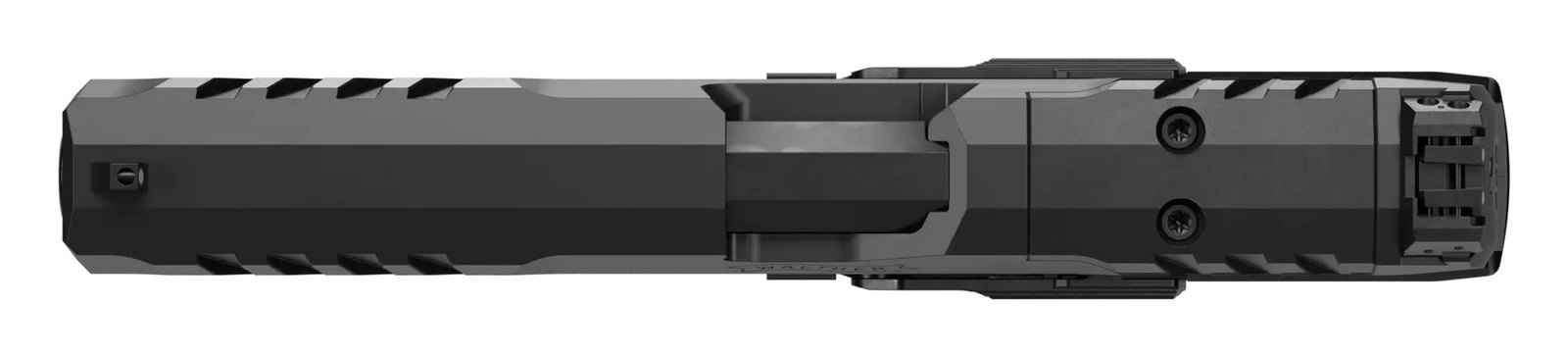
Optics: the Walther PDP slide is factory-ready
The whole PDP range leaves the factory with an optic cut closed by a plate, and sights designed to stay visible through the optic1. The plate that adapts the cut to the red dot's footprint is not supplied9.
A red dot changes the division: Production Optics or Optics instead of Production or Standard, with the optic fixed on the upper rear of the slide11. Footprints and the full cost are in our red dot guide.
Walther PDP, Glock 34, CZ Shadow 2: what sets them apart
- Against a Glock 34: same weight, same striker-fired family, a similar break. The 5-inch PDP stays in Production; the Glock 34, with its 135 mm barrel, does not710.
- Against a CZ Shadow 2: the PDP Steel Frame approaches its weight without its 4,691 g double-action first shot, but also without its 1,530 g single action48.
- Against a Glock 19: the 4-inch PDP F-Series targets the same size, 680 g for 15 rounds, with a smaller grip3.
Our comparison of competition 9mm pistols places the PDP among the other range pistols.
Walther PDP in .22 LR: no such version, but the P22Q
Walther's pistol range has no PDP in .22 LR15. The brand's .22 LR sold by French gunsmiths is the P22Q, at €459 and €469 new1619. It is not a replica of the PDP: it is a hammer-fired pistol, in double then single action, listed at about 4,990 g in double action and 1,814 g in single (11 and 4 pounds)16.
For learning striker-fired controls in .22 LR, the brand therefore offers no equivalent; the choice between the two calibers is set out in our comparison 9mm or .22 LR. Under French law, a .22 LR pistol is still a category B firearm24.
Walther PDP budget: €624 of ammunition a year
| Item | Amount |
|---|---|
| PDP F-Series 4", new | €839 to €8691718 |
| PDP Full Size 4.5", new | €879 to €9491718 |
| PDP Match Polymer 5", new | €1,269 to €1,2991718 |
| PDP Steel Frame 4.5", new | €1,920 to €1,9491720 |
| PDP Steel Frame Match 5", new | €2,199 to €2,2421719 |
| Handgun safe | €115 to €2892223 |
| 9mm ammunition, at 200 rounds a month | €624 a year21 |
With a 4.5-inch PDP Full Size, the first year comes to about €1,620 to €1,860, before license and club fees; with a Steel Frame Match, to about €2,940 to €3,160. In the following years, ammunition remains the main item, €624 a year at €0.26 a round21.
Depending on use, an optic plate and spare magazines come on top.
In France, the PDP is a Category B firearm, like every centerfire pistol: buying one requires a prefectural authorization, and storing it a gun safe, a strong cabinet or a strongroom2425. The license, the club and the Category B authorization are costed in our first-year budget.
Buying a Walther PDP: who it suits, and who less
What it brings, by objective
For IPSC in Production, the 5-inch PDP brings a barrel at the maximum allowed, a slide ready to move over to Production Optics and a break above the minimum. In return, its 2,500 g trigger stays heavier than a range single action.
For stability at the range, the Steel Frame adds 450 g without changing the controls. In return, it costs more than double and weighs 1,195 g in the Match version.
For smaller hands, the F-Series reduces the grip and the trigger reach while keeping 15 rounds. In return, its 102 mm barrel shortens the sight radius.
For a first pistol, a polymer PDP covers IPSC, TAR and 25 m; our criteria for a first sport pistol approach the question by discipline.
Three misconceptions about the Walther PDP
- "The Match versions break lighter." Walther lists 2,500 g for the Match versions' Dynamic Performance Trigger as for the Performance Duty Trigger12.
- "Every PDP is allowed in Production." The IPSC list stops at a 5-inch barrel, and Production forbids compensators: the 5.1-inch Pro SD and the Success & Comfort fall outside it1011.
- "The F-Series is a shortened PDP." It keeps the 102 mm barrel of the 4-inch Full Size; what changes is the grip, the trigger reach and the effort on the slide13.
Sources 26 references
Dimensions, weights and trigger pulls come from the manufacturers' sheets; eligibility, from the IPSC, TAR and ISSF rulebooks in the edition stated; prices, from dated readings at French gunsmiths. Click a reference number in the text to highlight the matching source.
- Carl Walther — PDP Full Size 5" (ref. 2851776), manufacturer specification sheet, re-read 24 September 2026: 9 mm Luger, 18 rounds, weight 745 g, adjustable polymer sights "optics ready, co-witness ready", Performance Duty Trigger, trigger pull 2,500 g, barrel 127 mm, dimensions 210 × 143 × 34 mm; 4" and 4.5" variants. Same page for the Full Size 4" (ref. 2851822): weight 695 g, 18 rounds, 2,500 g, barrel 102 mm, 184 × 143 × 34 mm. ⚠️ The sheet does not say whether the weight includes the magazine.
- Carl Walther — PDP 5" Match Polymer (ref. 2878241), manufacturer specification sheet, re-read 24 September 2026: 9 mm × 19, 18 or 20 rounds, Dynamic Performance Trigger, trigger pull 2,500 g, weight 763 g, barrel 127 mm, dimensions 216 × 145 × 40 mm.
- Carl Walther — PDP F-Series 4" (ref. 2842694), manufacturer specification sheet, re-read 24 September 2026: weight 680 g, 15 rounds, Performance Duty Trigger, trigger pull 2,500 g, barrel 102 mm, dimensions 184 × 136 × 34 mm; "reduced trigger reach, reduced grip circumference, and reduced force necessary to operate the slide".
- Carl Walther — PDP Steel Frame Match FS 5" (ref. 2872218) and PDP Steel Frame FS 4.5" (ref. 2872293), manufacturer specification sheets, re-read 24 September 2026: Match 5" — 18 or 20 rounds, Dynamic Performance Trigger, 2,500 g, weight 1,195 g, barrel 127 mm, 213 × 150 × 40 mm; 4.5" — 18 rounds, Performance Duty Trigger, 2,500 g, weight 1,145 g, barrel 114 mm, 201 × 145 × 35 mm.
- Carl Walther — PDP Full Size 5.1" Success & Comfort (ref. 2912490), manufacturer specification sheet, re-read 24 September 2026: weight 700 g, 18 or 20 rounds, 2,500 g, barrel listed as "127 (5,1")", "Thread with compensator and extended bolt travel".
- Walther — official Q-Series brochure (PDF), Q5 Match SF table (ref. 283 01 41): 1,160 grams with an empty magazine, 127 mm barrel, 15-round magazines, trigger documented at 25 N.
- GLOCK — G34 Gen5 MOS, manufacturer specification sheet, re-read 24 September 2026: barrel 135 mm, trigger pull 24 N, weight 743 g with an empty magazine, 17 rounds.
- CZ — CZ Shadow 2, manufacturer specification sheet, re-read 24 September 2026: trigger pull 15 N in single action and 46 N in double action; consulted 20 August 2026 for the 1,330 g weight with an empty magazine, the 120 mm barrel and the 19 + 1 capacity.
- Walther Arms — PDP Standard Full Size 5" and PDP Steel Frame Match Full Size 5", US importer's sheets, re-read 24 September 2026: "Plate cut (optic plate and optic not included)"; "optic plate not included".
- IPSC — Production Division List, "Updated: 2026-03-09", re-read 24 September 2026: WALTHER "PDP (all variants Full Size and Compact, all barrel lengths up to 5 inch including Steel Frame models without detachable Mag Funnel)", as well as the PPQ Q5 Match and Q5 Match SF "without detachable magwell"; GLOCK: 17, 19 and variants "provided the barrel length does not exceed 127mm", without the 34.
- IPSC — IPSC Handgun Competition Rules, Jan 2026 Edition, Final 29 Dec 2025, link published by the official IPSC Rule Books page, re-read 24 September 2026: appendices D4 and D4a (Production, Production Optics) — barrel of 127 mm at most, 15 rounds at most at the start signal, "2.27kg (5lbs.) for the first shot fired […] or 1.36kg (3lbs.) for every shot fired", compensators forbidden, optic forbidden in Production and required in Production Optics; appendix D2 (Standard) — 225 × 150 × 45 mm box (tolerance +1 mm), no optic; appendix D6 (Optics) — one optic "on the upper rear of the slide", magazine of 141.25 mm at most; appendix D1 (Open) — magazine of 170 mm at most.
- Fédération française de tir — Règlement administratif du tir sportif de vitesse, saison 2019-2020 (PDF, in French), article I: discipline « régie au niveau international par l'IPSC » [governed internationally by IPSC]; article VII: « seul le règlement officiel de l'IPSC en anglais est valable sur les compétitions de Niveau III et plus » [only the official English IPSC rulebook applies at Level III competitions and above].
- Fédération française de tir — Règles Pistolet ISSF, mise à jour 08/2026 (PDF, French translation of the 2025 edition, second print in force from 1 July 2026), re-read 24 September 2026: 8.4.1.2 a — fibre-optic sights forbidden; table 8.12, 25 m centrefire pistol — 1,400 g at most including the empty magazine, trigger of at least 1,000 g, 300 × 150 × 50 mm box, barrel of 153 mm at most; 8.7.6.2 c — five rounds at most in a single magazine.
- Fédération française de tir — Règlement TAR, saison 2025-2026 (PDF, in French, issued 12 January 2026), re-read 24 September 2026: appendix A, event 830 — not allowed: pistols with a barrel over 13 cm, « Tous systèmes de visée de type laser et fibre optique » [all laser and fibre-optic sighting systems], « Puits de chargeur proéminents » [protruding magwells], recoil compensation systems.
- Carl Walther — pistol range, re-read 24 September 2026: PDP Full Size, Compact, F-Series, Pro SD, Pro NT, Professional ACRO, Match Polymer, Steel Frame, Success & Comfort, all in 9 mm Luger; no PDP in .22 LR.
- Walther Arms — P22Q, US importer's sheet, re-read 24 September 2026: .22 LR, 10 rounds, "Double | Single Action", "11 lb double action pull" and "4 lb single action". Price recorded 24 September 2026 at Le Pistolier, Walther P22Q: €459.00. ⚠️ Commercial data for the price.
- Le Pistolier — prices recorded 24 September 2026: PDP F-Series €869.00; PDP Full Size, 4.5-inch barrel, 18 rounds €879.00; PDP Full Size 4.5" €949.00; PDP Match Polymer Full Size 5" €1,269.00; PDP SF Full Size €1,949.00; PDP SF Compact €1,879.00; PDP SF Match Full Size 5" €2,199.00; PDP Full Size Pro SD €1,199.00, « canon fileté de 5.1 pouces » [5.1-inch threaded barrel]. ⚠️ Commercial data.
- Armurerie Douillet — prices recorded 24 September 2026: PDP F-Series OR 4" €839.00 instead of €959.00; PDP Full Size 4.5" OD Green €879.00 instead of €1,009.00; PDP Match Polymer FS 5" €1,299.00. ⚠️ Commercial data, promotional prices displayed.
- Deville Armory — prices recorded 24 September 2026: PDP Match Steel Frame 5" €2,242.00; Walther P22Q STD 3.42" .22 LR €469.00. ⚠️ Commercial data.
- Armurerie Auxerre and Armurerie de la Bourse — prices recorded 24 September 2026: PDP SF Full Size 4.5" €1,920.00; PDP SF Full Size 4.5 OR Steel Frame €1,925.00. ⚠️ Commercial data.
- Armurerie Centrale — 1 000 cartouches STV Scorpio 9 mm Luger 124 gr FMJ (in French), price recorded 24 September 2026: €259.00 including VAT, or €0.26 a round; at 200 rounds a month, 2,400 rounds and €624 a year. ⚠️ Commercial data.
- Armurerie Loisir — prices recorded 24 September 2026: coffre-fort Fortify Delta 1 pour arme de poing €115.00; coffre-fort Infac C3A €259.00. ⚠️ Commercial data.
- Safepro24 France — coffres-forts pour armes de poing (in French), prices recorded 24 September 2026: Rottner GunBox €68.90, Profirst NY 2 €289.00 instead of €374.95. ⚠️ Commercial data.
- Légifrance — article R311-2 du code de la sécurité intérieure (in French), version in force on 7 September 2025: category B, II, 1° « armes à feu de poing et armes converties en armes de poing non comprises dans les autres catégories » [handguns and firearms converted into handguns not included in the other categories].
- Légifrance — article R314-3 du code de la sécurité intérieure (in French), in force since 11 May 2017: category A and B firearms stored « soit dans des coffres-forts ou des armoires fortes adaptés au type et au nombre de matériels détenus » [either in safes or strong cabinets suited to the type and number of items held], or in a strongroom. See also Service-public.gouv.fr, fact sheet F2250 (in French), checked 20 March 2025.
- Images — manufacturer renders and photographs, reproduced without retouching, cropped to their content: Walther, PDP Full Size 5-inch.
The version changes the spec sheet and the division. The PDP range covers different barrel lengths, frames, triggers and grips, and published weights vary from one market to another. Eligibility depends on the exact version and the edition of the rules: when in doubt, the club's range officer decides before the gunsmith does.
Frequently asked questions
What is the difference between a polymer Walther PDP and a steel-framed PDP?
About 450 grams, and more than double the price. Walther lists 745 grams for the 5-inch polymer PDP Full Size and 1,195 grams for the 5-inch Steel Frame Match. Both keep the same 127 mm barrel and the same listed 2,500-gram break; the mass of the steel slows muzzle rise between shots, at the cost of a heavier pistol to carry around.
What is the trigger pull of a Walther PDP?
Walther lists 2,500 grams for the polymer PDPs, whether they have the Performance Duty Trigger or the Dynamic Performance Trigger of the Match versions, and for the Steel Frame Match. That is the level of a Glock 34, listed at 2,447 grams, and slightly less than the 25 newtons, about 2,549 grams, of the Walther Q5 Match SF.
Is the Walther PDP allowed in Production division?
Yes, up to a 5-inch barrel. The IPSC Production list approves every PDP Full Size and Compact of 5 inches or less, steel frame included, without a detachable magazine funnel. The Pro SD with its 5.1-inch threaded barrel falls outside it, as does the Success & Comfort, supplied with a compensator.
Is there a Walther PDP in .22 LR?
No, Walther's pistol range has no PDP in .22 LR. The brand's .22 LR sold by French gunsmiths is the P22Q, at around 460 to 470 euros new, but it is a hammer-fired pistol in double then single action, without a PDP's controls.
Do you need an authorization to buy a Walther PDP in France?
Yes. Like every centerfire pistol, the Walther PDP is a category B firearm under French law: a sport shooter can only buy one with an authorization from the prefect, applied for online after three supervised shooting sessions. Four to seven months usually pass between the license and the purchase, and the pistol must then be stored in a gun safe, a strong cabinet or a strongroom.