Red dot sight on a pistol: benefits, price, zeroing and rules
Published on · Updated on · 10 min read · Anthony Baillon
Verified by a gunsmithA red dot keeps the target sharp and does away with lining up the front and rear sights: a real gain beyond fifteen meters and for presbyopic eyes. It costs €309 to €1,099, plus a mounting plate, and needs a battery and some learning. It is prohibited in ISSF pistol.
At a glance
| Sighting | Budget | Strength and limit |
|---|---|---|
| Iron sights | Supplied with the pistol | ✓ Allowed everywhere, no battery ✗ Three planes of focus |
| Open red dot | €309 to €1,099 | ✓ One sharp target, little parallax ✗ Diode exposed to rain |
| Enclosed red dot | €678 to €799 | ✓ Sealed, works in rain ✗ Taller, heavier, dearer |
- Rules: prohibited in ISSF pistol; allowed in Production Optics, Optics and Open in action shooting.
- Buying: the plate available for the pistol decides the footprint, and therefore the optic.
- Zeroing: 1 MOA per click, i.e. 7.3 mm at 25 meters.
Red dot or iron sights: a sharp target
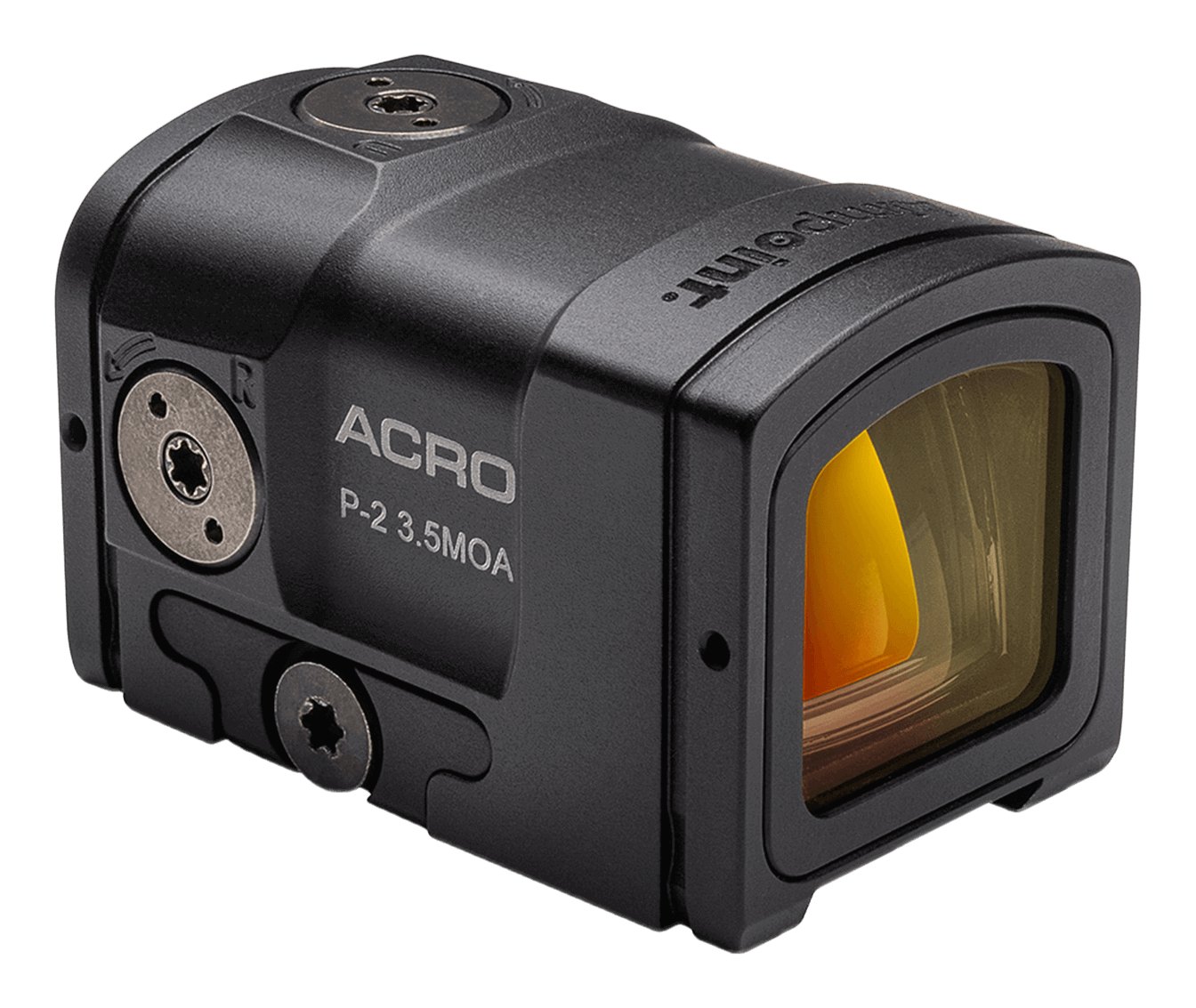
With a rear sight and a front sight, the eye juggles three planes, front sight, rear sight and target, and can keep only one sharp: the classic rule favors the front sight, so a blurred target. The red dot projects its reticle at optical infinity: the target stays sharp and the dot sits on it.
Eye alignment also matters much less. A badly placed head shifts the front sight within the rear notch; with a red dot, as long as the dot is visible in the window, it shows where the bullet goes. This explains why presbyopic shooters adopt it.
Iron sights
Pros
- Allowed in every discipline, ISSF included1.
- No battery, no failure: nothing fogs up or switches off.
- Supplied with the pistol, at no extra cost.
Cons
- Three planes of focus: the target is blurred when the front sight is sharp.
- A badly placed head moves the impact.
- Hard to reconcile for a presbyopic eye.
The red dot
Pros
- A single plane of focus: the target.
- Head position is forgiven as long as the dot stays in the window.
- A clear gain on distant targets and in slow fire.
In fast shooting at short range, the gap with well-mastered iron sights narrows: the shooter's training then weighs more than the optic.
Red dot banned in ISSF pistol, allowed in IPSC
| Discipline | Rule | Red dot |
|---|---|---|
| ISSF pistol 10, 25 and 50 m | 8.4.1.2 a) | Prohibited1 |
| ISSF rifle | 7.4.1.6 a) | Prohibited1 |
| ISSF shotgun | 9.4.2.8 | Prohibited1 |
| ISSF 50 m running target | 10.4.3.1 | Allowed, any type of sight1 |
| ISSF 10 m running target | 10.4.3.2 | Non-variable optic of 4× at most1 |
| IPSC Production Optics, Optics, Open | Appendices D | Allowed2 |
In pistol, rule 8.4.1.2 allows only open sights and expressly prohibits projected-dot sights, as it does fibre optics and reflective surfaces1. The red dot's home in pistol shooting is therefore action shooting, where the IPSC rulebook opens three divisions to optics2. Fitting an optic to a pistol entered in Production moves it into Production Optics: same pistol, different classification. The divisions are covered in our article on IPSC and TSV in France, the ISSF events in our guide to which pistol suits which discipline.
Pistol red dot price: €309 to €1,099
| Optic | Emitter | Price found |
|---|---|---|
| Holosun 407C X3 | Open | €309 to €3201415 |
| Holosun 507K X2 | Open | €314 to €390161719 |
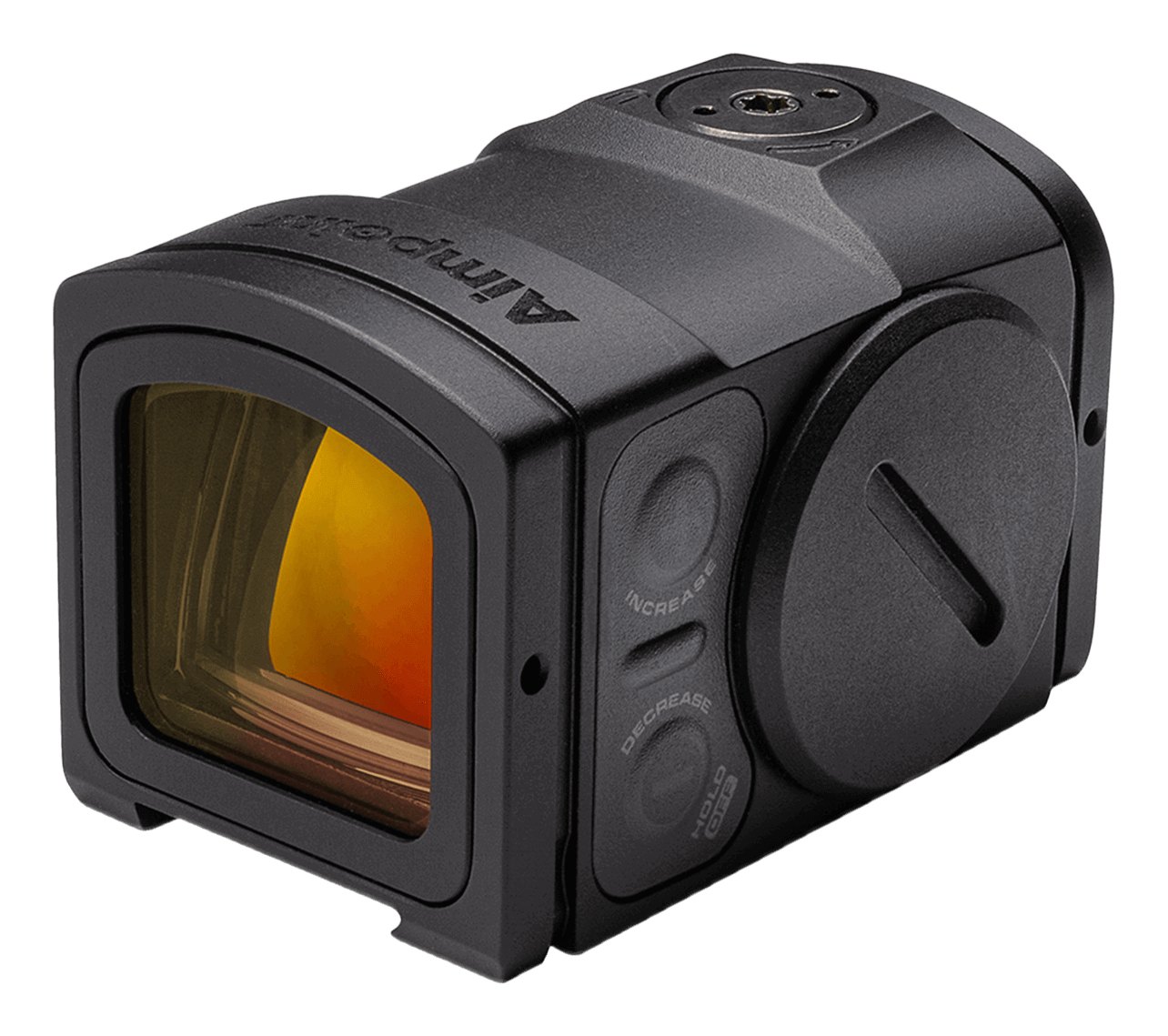
| Aimpoint ACRO P-2 | Enclosed | €678 to €7992014 |
| Trijicon RMR Type 2 | Open | €800 to €8601814 |
| Trijicon RMR HD | Open | €1,060 to €1,0991819 |
| Mounting plate (Glock MOS, CZ Shadow 2 OR) | — | €43 to €8914192115 |
New prices found on 24 September 2026 at several French gun shops. For the same Holosun 507K X2, the gap reaches €76 from one shop to another1617.
The budget reads per year:
- First year: €352 to €1,188, optic and plate included. The red dot is sold freely; only the plate depends on the pistol.
- Following years: one battery a year, CR2032 or CR1632 depending on the model34.
Price follows neither adjustment nor battery life: a click is worth 1 MOA on a Holosun 507K X2 as on a Trijicon RMR HD, and the Holosun claims 50,000 hours of battery against about three years for the RMR HD45.
Red dot footprint: the pistol's plate decides
An optic does not screw straight onto a slide. It has a footprint, the layout of its screws and lugs, and the slide must carry the matching cut or take an adapter plate8.
| Footprint | Optics | What it fits |
|---|---|---|
| Trijicon RMR | RMR Type 2, RMR HD, SRO; Holosun 407C, 507C, 508T | The most widespread, full-size slides6 |
| Shield RMSc, known as "K" or J-Point | Shield RMSc, Holosun 407K and 507K, EPS Carry | Slim slides46 |
| Aimpoint ACRO | ACRO P-1 and P-2, Steiner MPS | Enclosed emitter, often via a plate36 |
| Leupold DeltaPoint Pro | DeltaPoint Pro | Optic-ready M&P slides6 |
| Holosun EPS | EPS, EPS Carry | Enclosed emitter, pattern close to the K6 |
| Holosun 509T | 509T | Its own pattern, via a plate6 |
- RMSc, "K" and J-Point are one pattern: a listing that names all three describes compatibility, not a choice6.
- The RMRcc is not the RMR: despite the name, the pattern differs6.
- Plates change from one slide generation to the next, for the same model7.
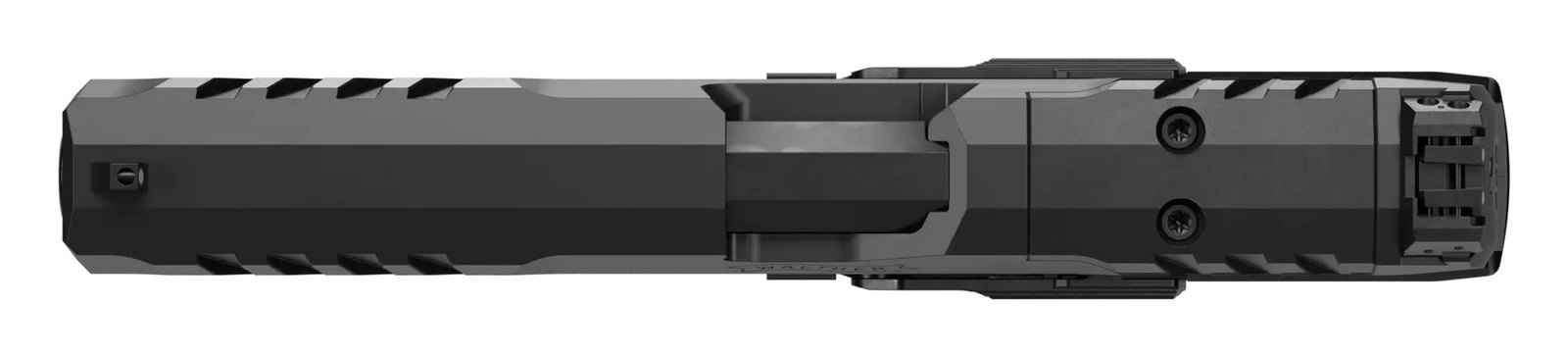
The order that avoids hunting for a plate that does not exist: first the plates available for the pistol and its slide generation, then the optic among the footprints they accept.
| Pistol | Optic-ready from the factory | To plan for |
|---|---|---|
| Glock 34 MOS | Yes | A plate for the footprint10 |
| Walther PDP | Yes, the whole range | A plate11 |
| CZ Shadow 2 OR | Yes | A plate12 |
| Smith & Wesson M&P Competitor | Yes | A plate13 |
| Beretta 92X Performance | No | An optic-ready workshop version |
| Dan Wesson DWX | No | An optic-ready workshop version |
Open or enclosed red dot sight: pros and cons
The open emitter
Pros
- The flattest and lightest: 1 ounce, i.e. 28 g, for a Holosun 507K X24.
- The most common format, so the most plates.
Cons
- Diode and lens in the open air: rain, dust and mud can blur the dot.
The enclosed emitter
Pros
- A sealed optical channel: the Aimpoint ACRO P-2 is rated waterproof down to 35 meters of immersion3.
On an indoor range, an open emitter is enough. The enclosed one comes into its own outdoors, in the rain, or on a pistol that goes out often.
Zeroing a red dot: 1 MOA per click, 7.3 mm at 25 m
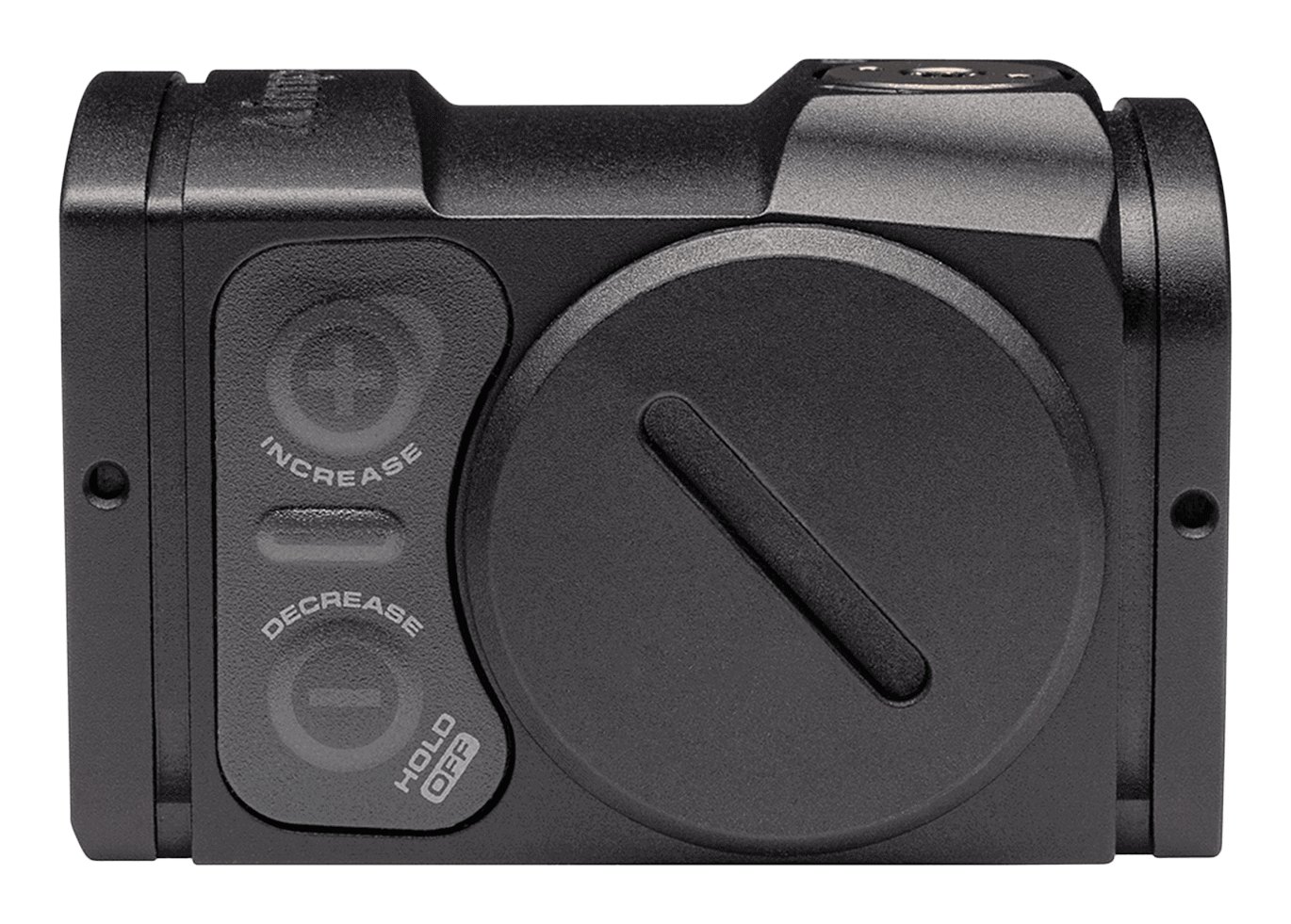
A red dot adjusts for windage and elevation, in clicks. The usual value is 1 MOA per click, that of the Trijicon RMR HD5 as of the Holosun 507K X2, whose travel reaches ±30 MOA4. One minute of angle covers 2.909 cm at 100 meters; the rest is proportion.
| Distance | One 1 MOA click | To correct 3.5 cm |
|---|---|---|
| 10 m | 2.9 mm | 12 clicks |
| 15 m | 4.4 mm | 8 clicks |
| 25 m | 7.3 mm | 5 clicks |
| 50 m | 14.5 mm | 2 clicks |
A dot zeroed for two distances is zeroed for neither: 15 meters is a common compromise, 25 meters suits those who mostly shoot precision at that distance. The steps:
- Tighten the optic before zeroing: medium-strength threadlocker, screws tightened alternately9.
- Shoot from a rest, on a bag or a bench: a scattered offhand group has no readable center.
- Fire five rounds at least, then correct on the center of the group, never on a single shot.
Dot size is also given in MOA. At 25 meters, a 2 MOA dot covers about 15 mm of target, a 6 MOA dot close to 44 mm: the small dot is more precise, the large one is found faster. The Trijicon RMR HD comes in 1 and 3.25 MOA5, the ACRO P-2 in 2.5 and 3.5 MOA3, and the Holosun 507K X2 combines a 2 MOA dot with a 32 MOA circle4.
Finding the dot: suppressor-height sights and dry fire
The pistol comes up, and the window is empty: the wrist does not arrive at the same angle as on the previous presentation. Iron sights used to hide this flaw; the red dot makes it visible. Four remedies, from the most effective to the most minor:
- Suppressor-height iron sights, visible in the window: line up the rear sight and the dot appears. They also serve as a backup if the battery dies or the lens fogs up, provided the division allows them.
- Dry presentation, pistol checked empty, repeated until the dot lands in the window without being searched for.
- Starting at three meters, then moving back: the closer the target, the more forgiving the error.
- Turning the brightness down: a dot that is too bright blooms and grows9.
A dot that looks like a starburst often comes from the eye: astigmatism distorts the reticle. A phone photo of the dot shows it sharp if the fault lies in the eye9, and the bloom shrinks with the brightness.
Red dot sight battery: 50,000 hours at a set brightness
- Format and access: CR2032 for the ACRO P-23, CR1632 for the 507K X24. A side tray (Holosun) or top loading (RMR HD) changes the battery without removing the optic, so without redoing the zero45.
- Claimed battery life: 50,000 hours, over five years, on the ACRO P-2 at setting 6 of 103 and on the 507K X24; about three years on the RMR HD5. At full brightness, battery life drops.
- Motion wake switches the optic off at rest and back on at the first movement4.
A battery gives no warning: replacing it on a fixed date, once a year, avoids a failure mid-session.
Sights by discipline: irons in ISSF, red dot in TSV
What you gain, what you give up
For ISSF precision shooting, the question does not arise: only open sights are allowed in pistol1.
For action shooting, the red dot saves time on distant targets and forgives head position. In return, the pistol changes division, and the presentation takes some learning.
For recreational range shooting, the open red dot brings the comfort of a sharp target, especially to presbyopic eyes, for €352 at least, plate included. Iron sights remain allowed everywhere and never fail.
For shooting outdoors, in the rain, the enclosed emitter protects the diode, at the cost of a few dozen grams and euros more.
Three misconceptions about the pistol red dot
- "A red dot corrects a poor grip." It reveals it: a wrist that does not arrive at the same angle leaves the window empty.
- "RMSc, K and J-Point are three footprints." It is one pattern under three names6.
- "A starburst dot is a fault in the optic." It is often astigmatism in the eye; a photo of the dot shows it sharp9.
Sources 22 references
Sighting rules come from the ISSF and IPSC rulebooks in the edition stated; optic specifications from the makers' spec sheets; prices from dated surveys at several French gun shops, flagged ⚠️ as commercial data. Click a note marker in the text to highlight the matching source.
- ISSF — ISSF Rule Book, Edition 2025 (Second Print 07/2026), in force since 1 July 2026 (PDF), consulted on 19 August 2026. Rule 8.4.1.2 a), pistol: "Only open sights are allowed. Sights using fibre optic, light enhancing or reflecting colour surfaces are prohibited. Optical, mirror, telescope, laser beam, electronically projected dot sights etc. are prohibited". Rule 7.4.1.6 a), rifle: "No Light enhancing system, optical sight, optical system or telescope may be attached to the rifle". Rule 9.4.2.8, shotgun: any device "magnifying, light emitting […] are prohibited". Rules 10.4.3.1 and 10.4.3.2, running target: "50m Rifles. Any types of sights are permitted" and "10m Rifles. Any type of sights are permitted except that optical sights must be non-variable with a maximum of four power (4X) magnification". Text identical to the first printing of December 2025.
- IPSC — IPSC Handgun Competition Rules, January 2026 edition (PDF): seven divisions, of which Production Optics, Optics and Open allow an optical sight.
- Aimpoint — official Acro P-2 spec sheet, 3.5 MOA (ref. 200691), consulted on 19 August 2026: 3.5 MOA dot, CR2032 battery, "50,000 hours (over 5 years) of constant operation" at setting 6, ten brightness levels of which four are night-vision compatible, 60 g, immersion to 35 metres, sealed optical channel. A 2.5 MOA version exists in the same catalogue.
- Holosun — official HS507K-X2 spec sheet, consulted on 19 August 2026: 2 MOA dot and 32 MOA circle, adjustment of 1 MOA per click over ±30 MOA of travel, CR1632 battery in a side tray, 50,000 hours of battery life, twelve brightness levels (ten daylight, two night vision), "K" footprint, 1 oz, IP67, motion wake.
- Primary Arms — Trijicon RMR HD spec sheet, 3.25 MOA circle-dot reticle, consulted on 19 August 2026: central dot of 1 MOA or 3.25 MOA with a 55 MOA segmented circle, adjustment of 1 MOA per click, CR2032 battery loaded from the top — so without removing the optic —, claimed battery life of up to three years, RMR footprint. ⚠️ Specialist commercial source: the manufacturer's site blocks automated access.
- 3CR Tactical — Pistol Red Dot Footprints: RMR, RMSc, ACRO, DPP, EPS, consulted on 19 August 2026: footprint-by-footprint correspondence and the optics concerned; "The RMR footprint is the most common cut on the market"; "When a slide listing says "RMSc / J-Point / Holosun K," it's all one footprint"; the RMRcc follows a pattern distinct from the RMR despite its name. ⚠️ Specialist commercial source.
- Boss Components — red dot footprint compatibility: proprietary cuts and adapter plates for the Trijicon RMR, Shield RMSc, Docter/Noblex, C-More RTS and Vortex Venom footprints, varying with slide generation. ⚠️ Specialist commercial source.
- Optics Trade — mounting a red dot on a pistol: principle of the plate fitted in place of the rear sight. ⚠️ Commercial source.
- Primary Arms — Common Red Dot Sight Issues and How to Correct Them, consulted on 19 August 2026: bloom and starburst worsen when the reticle is too bright; method for diagnosing astigmatism by photographing the reticle; medium-strength threadlocker and alternate tightening of the mounting screws, then a zero check. ⚠️ Specialist commercial source.
- Glock — G34 Gen5 MOS, official page: optic-ready slide.
- Walther — PDP Standard Full Size 5", official page: optic-ready slide across the range.
- CZ — CZ Shadow 2 range, official page: an optic-ready version exists.
- Smith & Wesson — Performance Center M&P9 M2.0 Competitor, official page: optic mounting plate.
- Armurerie de la Bourse — prices found on 24 September 2026: Holosun Elite 407C X3 €309.00; Trijicon RMR RM05 9 MOA €860.00; Aimpoint ACRO P-2 3.5 MOA FDE without interface €799.00; Trijicon RMR adapter for Glock MOS €44.00. ⚠️ Commercial data.
- Armurerie Auxerre — prices found on 24 September 2026: Holosun 407C X3 2 MOA €319.95; Aimpoint ACRO mount for Glock MOS €76.20. ⚠️ Commercial data.
- Armurerie-Chasseur — Holosun HS507K-X2 red dot for handguns, price found on 24 September 2026: €313.95 on promotion until 21 October, €347.95 outside the promotion. ⚠️ Commercial data.
- Armurerie FMR — Holosun HS507K X2, price found on 24 September 2026: €390.00, fitting included. ⚠️ Commercial data.
- Conditions Extrêmes — prices found on 24 September 2026: Trijicon RMR HD 3.25 MOA €1,059.90 (instead of €1,099.90); Trijicon RMR RM06 Type 2 3.25 MOA €799.90 (instead of €859.90). ⚠️ Commercial data.
- Deville Armory — prices found on 24 September 2026: Trijicon RMR HD 3.25 MOA €1,099.00 (pre-order); Holosun 507K X2 €379.00; Eemann Tech CZ Shadow 2 OR plate for ACRO €43.36. ⚠️ Commercial data.
- Terräng Armurerie — Aimpoint ACRO P-2 3.5 MOA, price found on 24 September 2026: €678.00. ⚠️ Commercial data; unavailable online on that date, available in store.
- Gunmarket — prices found on 24 September 2026: Aimpoint ACRO plate for Glock MOS €89.00; Aimpoint ACRO plate for CZ Shadow 2 €89.00. ⚠️ Commercial data.
- Visuals — manufacturer renders and photographs, reproduced without retouching, cropped to their content: Aimpoint, Acro P-2 3.5 MOA; Walther, PDP Full Size 5 inch.
The division rules prevail. This article cites the ISSF rulebook in its 2025 edition, second printing in force on 1 July 2026, and the IPSC Handgun rulebook of January 2026. Whether a configuration is allowed is best confirmed with the club's range officer before spending the money.
Frequently asked questions
Does a red dot really make you more accurate?
Above all, it removes a difficulty. With iron sights, the eye juggles three planes, front sight, rear sight and target, and can keep only one sharp. With a red dot, the target stays sharp and the dot sits on it. The gain is clear on distant targets and slow fire; in fast shooting at short range, training weighs more than the optic.
At what distance should a pistol red dot be zeroed?
At a single distance, the one you shoot at most: 15 meters is a common compromise, 25 meters suits precision events. A 1 MOA click moves the point of impact by about 4.4 mm at 15 meters and 7.3 mm at 25 meters: correcting 3.5 cm at 25 meters takes five clicks.
Which red dot footprint fits my pistol?
The one used by the mounting plates that exist for the pistol and its slide generation. The Trijicon RMR footprint is the most widespread on full-size slides; slim slides take the Shield RMSc footprint, which Holosun calls "K" and which is also sold as J-Point: three names for a single pattern.
Is a red dot allowed in ISSF?
Not in pistol: ISSF rule 8.4.1.2 allows only open sights and prohibits projected-dot sights, as it does fibre optics. Rifle and shotgun prohibit them too. Only running target allows an optic. In action shooting (IPSC), three divisions accept one: Production Optics, Optics and Open.
Why does the red dot not appear in the window?
Because the wrist does not arrive at the same angle as on the previous presentation. Suppressor-height iron sights, visible in the window, guide the eye to the dot; the presentation can also be practiced dry, pistol checked empty, starting close to the target.
How much does a pistol red dot cost?
From €309 to €1,099 depending on the model, prices found on 24 September 2026: about €310 to €320 for a Holosun 407C X3, €314 to €390 for a 507K X2, €678 to €799 for an enclosed Aimpoint ACRO P-2, €800 to €1,099 for a Trijicon RMR. A mounting plate adds €43 to €89.