The IPSC rulebook in French: where to read it, which edition prevails in 2026
Published on · 13 min read · Anthony Baillon
The IPSC handgun rulebook is read in its January 2026 edition, in English, on the IPSC website. In French, the FFTir, France's shooting federation, circulates only a translation of the 2012 edition, labeled « non-officielle » [unofficial]; a private translation stops at 2019. Where they differ, the English version prevails: rule 12.2.
At a glance
| Text | Edition | Status |
|---|---|---|
| IPSC Handgun rulebook | January 2026 | The only official text, in English |
| Translation circulated by the FFTir | January 2012 | « Traduction non-officielle » [unofficial translation], five divisions |
| Translation on ipsc-france.fr | January 2019 | « Non-officielle », non-federation site |
| TSV administrative regulations | 2019/2020 season | Federation text: organization, not shooting |
- Where they differ: English prevails (rule 12.2); at Level III and above, it alone is valid according to the FFTir.
- The outline: twelve chapters and Appendices A to F; chapters 5, 8 and 10 carry what a beginner needs to know.
IPSC rulebook: the January 2026 edition, in English
The text is titled IPSC Handgun Competition Rules, January 2026 Edition. Its final version is dated 29 December 2025; it runs to 81 pages1. It is downloaded from the "Rule Books" page of the IPSC website.
Three rules say how to read it1:
- Every match follows the latest edition: the line is mandatory from Level I to Level V (Appendix A1).
- The appendices are part of the rulebook (12.1), divisions and targets included.
- The metric system prevails: the values in parentheses, pounds and inches, are given only as a guide (12.6).
The text is not frozen between two editions. The interpretations IPSC publishes on its website count as precedents, and apply to matches starting seven days or more after their publication (11.8.3)1.
This rulebook governs handguns only. Rifle, shotgun and pistol caliber carbine are also shot « selon les règles internationales » [under the international rules], writes the FFTir5; the last of these is presented in our article on the PCC.
IPSC rulebook in French: two dated translations
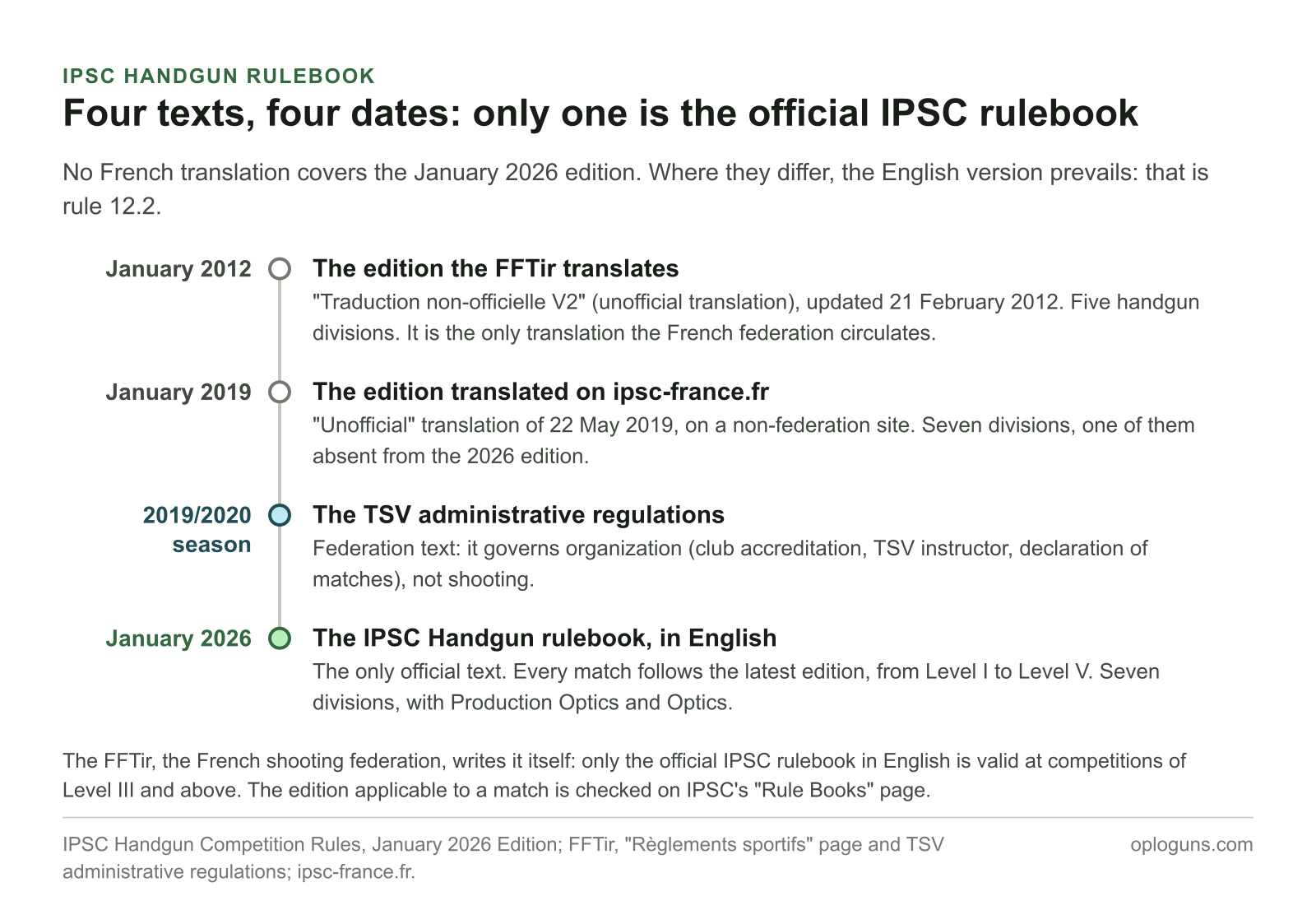
Two French translations are in circulation. Neither covers the 2026 edition.
| Translation circulated by the FFTir | Translation on ipsc-france.fr | |
|---|---|---|
| Edition translated | January 2012 | January 2019 |
| Date of the document | Updated 21 February 2012 | 22 May 2019 |
| What it says of itself | « Traduction non-officielle V2 » [unofficial translation V2] | « Traduction "non-officielle" » [unofficial translation] |
| Form | 137 pages, bilingual | 151 pages, bilingual |
| Divisions | Five | Seven, one of them absent from the 2026 edition |
| Who publishes it | The federation, « Règlements sportifs » page | A non-federation site |
The first is on the FFTir's « Règlements sportifs » [sporting rulebooks] page, under the heading « Épreuves IPSC », with the title « Règlement Tir sportif de vitesse Armes de poing (MàJ 2012) » [TSV handgun rulebook, updated 2012]23. The second is a file hosted by ipsc-france.fr, which is not a federation site4.
Both carry the same translator's note: some terms stay in English, « dans un souci de pertinence par rapport à leur utilisation au stand » [for the sake of relevance to how they are used at the range]34. The Range Officer's commands are among them: the 2012 translation writes "Load And Make Ready", followed by « chargez et tenez-vous prêt » in parentheses3.
The translated 2012 edition: what has changed since
Fourteen years separate the federation's translation from the 2026 text. The twelve-chapter structure has not moved, and neither have the limits of 12, 24 and 32 rounds per course of fire31. The divisions, however, have changed:
| Point | 2012 edition, translated | 2026 edition |
|---|---|---|
| Handgun divisions | Five: Open, Standard, Classic, Production, Revolver | Seven: Production Optics and Optics are added |
| Trigger pull in Production | 2.27 kg for the first shot | 2.27 kg for the first shot, or 1.36 kg for every shot |
| Color and finish in Production | Changing them is prohibited | Changing them is permitted |
| Distance of gun and equipment | 50 mm from the torso | 50 mm from the belt |
| .357 SIG for Major, Classic division | Accepted until 31 December 2014 | Accepted until 31 December 2029 |
The 2019 translation has aged too. It describes a « Production Optique Légère » [Production Optics Light] division, absent from the 2026 edition, and has no Optics division41.
An old translation remains useful for understanding how the text is built. It no longer says what a gun is allowed to be. Today's divisions each have their own article: Production, Production Optics and Optics, Standard and Open.
Which version prevails: English, rule 12.2
The rulebook settles it itself: "English is the official language of the IPSC Rules." If the English version and a version in another language differ, the English version prevails1.
The FFTir writes the same thing in its own way: « Un règlement sportif en français est disponible sur le site www.fftir.org, cependant seul le règlement officiel de l'IPSC en anglais est valable sur les compétitions de Niveau III et plus » [a sporting rulebook in French is available on www.fftir.org, but only the official IPSC rulebook in English is valid at competitions of Level III and above]5.
The federation's sentence covers only Level III and beyond. For Level I and II matches, IPSC requires the latest edition, as everywhere1; the federation's translation, for its part, is the 2012 one3. The levels are described in our article on the first IPSC match.
The rulebook does, however, give way to the law. An organizer may enforce a local rule only to comply with the country's law (3.3.1), and each shooter answers for the legality of their equipment where the match is shot (12.3)1. The FFTir repeats it: firearms must be « en conformité avec la législation Française en vigueur » [in compliance with the French legislation in force]5.
The clearest example is the magazine. IPSC allows 170 mm in Open division1; in France, a handgun magazine holding more than 20 rounds is category A18. The detail is in our article on pistol magazines.
The federation's TSV regulations: what they add in France
Three FFTir texts deal with tir sportif de vitesse (TSV), the French name for IPSC shooting. None rewrites the shooting rules.
| Federation text | What it governs | What it leaves to IPSC |
|---|---|---|
| TSV administrative regulations, 2019/2020 season | Club accreditation, TSV instructor, declaration of matches, license, extended-magazine certificate | Safety, firearms, targets |
| Sporting management regulations 2026-2027, chapter B.10 | Participation, events and teams at the French championship | Categories at competitions with an international ranking |
| "RGSI TSV 2026", dated 6 February 2026 | Selection for the French national team | Everything else |
The first refers to IPSC three times: the safety rules are « conformes […] au règlement sportif de l'I.P.S.C. » [in line with the IPSC sporting rulebook], and so are the firearms and the targets5. What it adds is described in our article on getting started in TSV.
The second sets the events of the French championship: for handgun, Open, Standard, Classic, Production, Optic and Production Optic, plus the two PCC events6. Revolver is not among them.
The third has a misleading name. It is not a set of rules for the sport: in it the national technical directorate sets out « les modalités de sélection des épreuves de TSV » [the selection arrangements for TSV events]7.
Outline of the IPSC rulebook: 12 chapters, Appendices A–F
The order of the chapters follows the life of a match: the stage is designed, it is equipped, the shooter is equipped, shooting takes place, scores are counted, penalties are applied1.
| Chapter | What it contains | Rules to know |
|---|---|---|
| 1. Course Design | Principles of stage design: safety, the balance of accuracy, power and speed, freestyle; types of courses | 1.1.5, freestyle; 1.2.1.1 to 1.2.1.3, 12, 24 and 32 rounds at most |
| 2. Range and Course Construction | Angles of fire, distances, fault lines, obstacles, safety areas | 2.1.2, 90-degree angle; 2.1.3, 7 m from metal targets; 2.4, safety areas |
| 3. Course Information | Written briefing, walkthrough, local rules | 3.2.2, briefing read word for word; 3.2.4, walkthrough |
| 4. Range Equipment | Paper and metal targets, equipment failures | 4.6.1, change nothing on the stage; 4.7.2, failure: reshoot |
| 5. Competitor Equipment | Firearms, holster, dress, protection, ammunition, chronograph, malfunctions | 5.1.2, 9x19 caliber at least; 5.2.2, handling the gun; 5.6.3.5, power factor |
| 6. Match Structure | Definitions, divisions, categories, teams, schedule | 6.1.3, three stages at least; 6.2.3, one declared division; 6.6.1, being present on schedule |
| 7. Match Management | Role of each official | 7.1.1, Range Officer; 7.1.5, Range Master |
| 8. The Course of Fire | Ready condition of the gun, shooter's start position, commands, movement | 8.2.2, start position; 8.3.1 to 8.3.8, commands; 8.5.1, finger outside the trigger guard |
| 9. Scoring | Scoring method, value of hits, challenges, score sheet, official time | 9.2.1.1, hit factor; 9.5.1, best two hits; 9.6.4, scoring challenge |
| 10. Penalties and Disqualifications | Procedural penalties, disqualifications | 10.1.2, 10 points; 10.4, accidental discharge; 10.5, unsafe gun handling |
| 11. Arbitration and Interpretation of Rules | Appeals, Arbitration Committee, interpretations | 11.3.1, one hour to appeal; 11.8.3, interpretations |
| 12. Miscellaneous Matters | Language, glossary, measurements | 12.2, English prevails; 12.5, glossary |
The appendices carry the figures1:
- A: match levels (A1), recognized divisions and categories (A2), shoot-offs (A3), stage balance (A4).
- B: target presentation, the IPSC target (B2) and the mini target (B3), with the value of each zone.
- C: popper calibration (C1), poppers (C2), metal plates (C3), chronograph record (C4).
- D: the seven divisions, from D1 (Open) to D6 (Optics), D4a being Production Optics.
- E: magazine measurement (E1), equipment position (E2), grip tape and beavertail (E3), trigger pull test and barrel measurement (E4), equipment check sheet (E5).
- F: hand signals for calling the scores (F1).
Appendices B and C are detailed in our article on the IPSC target, Appendix E2 in the one on IPSC gear.
IPSC rules to know before a first match
Twelve numbers are enough to avoid being caught out1:
- 5.2.2: the gun is handled only in a safety area, or under the direct command of a Range Officer.
- 2.4.4: no ammunition, not even dummy rounds, is handled in a safety area.
- 2.1.2: the muzzle stays within 90 degrees of the range's centerline, in all directions.
- 8.5.1: the finger is outside the trigger guard during any movement.
- 8.3.1 to 8.3.8: eight steps of range commands, from "Load And Make Ready" to "Range Is Clear".
- 8.7.1: no sight picture and no dry firing before the start signal.
- 9.5.1: on a paper target, the best two hits count; a metal target must fall.
- 9.4.2 to 9.4.4 and 10.1.2: 10 points off per miss, per hit on a no-shoot, per procedural penalty.
- 5.6.3.5: the power factor is calculated without rounding; 124.9999 is not 125.
- 6.2.5.1: equipment outside the rules of its division gets the shooter moved to Open, when Open is offered at the match (after a warning for holster and magazine position).
- 10.3.1: a disqualification bars the shooter from all remaining stages.
- 12.2: in case of doubt about a translation, English prevails.
Scoring and the hit factor are developed in our guide to IPSC in France, and the official time of the course of fire (9.10.1) in our article on the shot timer.
English-French glossary of the IPSC rulebook
The rulebook's glossary (12.5) defines its terms in English1. The French equivalents below are reading aids: at a French range, it is the English word that is used.
| English term | In French, and what it means | Where to read it |
|---|---|---|
| Course of fire (COF) | Parcours de tir: timed and scored separately | 6.1.1 |
| Stage | Parcours: one course of fire and its facilities | 6.1.2 |
| Match | At least three stages | 6.1.3 |
| Range Officer (RO) | Arbitre de parcours | 7.1.1 |
| Chief Range Officer (CRO) | Arbitre en chef, for one area | 7.1.2 |
| Range Master (RM) | Authority over the whole range and over the application of the rules | 7.1.5 |
| Match Director (MD) | Directeur de match, for the organization | 7.1.6 |
| Regional Director | Representative of an IPSC region, a country or territory | Glossary |
| Safety Area | Zone de sécurité | 2.4 |
| Written stage briefing | Briefing écrit du parcours | 3.2 |
| Walkthrough | Reconnaissance du parcours: inspecting the stage | 3.2.4 |
| Downrange, uprange | Toward the targets; toward the rear, where the muzzle does not point | Glossary |
| Fault Line | Ligne de faute: the boundary of the shooting area | 2.2.1 |
| Hard cover | Couvert dur: deemed impenetrable | 9.1.6 |
| No-shoot | Cible à ne pas tirer: a target that carries a penalty | Glossary |
| Popper | Metal target that must fall | Appendices C1, C2 |
| Miss | Manqué | 9.4.4 |
| Procedural penalty | Pénalité de procédure | 10.1 |
| Reshoot | Parcours à retirer: stage shot again, by decision of a Range Officer or the Arbitration Committee | Glossary |
| Power factor | Facteur de puissance: Minor or Major | 5.6 |
| Hit factor | Points divided by time | 9.2.1.1 |
| Comstock | Scoring against time, stopped at the last shot, unlimited number of rounds | 9.2.1 |
| Squib | Bullet lodged in the barrel, or leaving it at very low velocity | Glossary |
| Sweeping | Balayage: the muzzle passes over part of the shooter's own body | Glossary, 10.5.5 |
| Strong hand, weak hand | Main forte, the one that grips the gun at the holster; main faible, the other | Glossary |
| Dry firing | Tir à sec: gun with no ammunition at all | Glossary |
| Sight picture | Prise de visée: aiming without firing | Glossary |
| Allied equipment | Magazines, speed loaders and their carriers, magnets included | Glossary |
| OFM, aftermarket | Original firearm manufacturer; part of another origin | Glossary |
| Must, should, may | Mandatory; optional but highly recommended; entirely optional | Glossary |
The last three words carry weight. The rulebook distinguishes what is imposed from what is only recommended, and a "should" is not read as a "must"1.
Three misconceptions about the IPSC rulebook in French
- "The FFTir translation is the official rulebook in France." It presents itself as « non-officielle », covers the 2012 edition, and the federation itself writes that only English is valid at Level III and above35.
- "The RGSI TSV 2026 is the TSV rulebook." It sets selection for the French national team, not the practice of the sport7.
- "What IPSC allows is allowed in France." Firearms must also comply with French law; a magazine holding more than 20 rounds is category A1 there58.
Which edition to read, depending on the match
What you gain, what you give up
To understand the discipline, a French translation gives the outline and the logic of the text, which have not changed. The trade-off: its divisions and its equipment figures are those of 2012 or 2019.
For a Level I or II, IPSC requires the latest edition (Appendix A1); the FFTir reserves English only for Level III and above. Ask the organizer which text is followed. The trade-off: the 2026 edition is read in English only; the glossary above covers the terms that keep coming up.
For a Level III and above, only the English text is valid. The trade-off: the translation no longer has any role there.
Sources 8 references
The rules cited come from the IPSC Handgun rulebook of January 2026; the status of the translations, from the documents themselves; the French framework, from the FFTir's regulations. Click a reference number in the text to highlight the matching source.
- IPSC — IPSC Handgun Competition Rules, January 2026 Edition (81-page PDF, internal title "Jan 2026 Edition - Final 29 Dec 2025", linked from IPSC's "Rule Books" page), consulted on 15 November 2026: table of contents, chapters 1 to 12 and Appendices A1 to F1, including D1 Open, D2 Standard, D3 Classic, D4 Production, D4a Production Optics, D5 Revolver, D6 Optics; Appendix A1, line 1, "Must follow latest edition IPSC rules", mandatory from I to V; 1.1.5, "Freestyle"; 1.2.1.1 to 1.2.1.3, courses of 12, 24 and 32 rounds at most; 2.1.2, 2.1.3, 2.2.1, 2.4.4; 3.2.2, 3.2.4; 3.3.1, "Host organizations may not enforce local rules except to comply with legislation or legal precedent in the applicable jurisdiction"; 4.6.1, 4.7.2; 5.1.2, 5.2.2, 5.6.3.5 ("a result of 124.9999 is not 125"); 6.1.1 to 6.1.3, 6.2.3, 6.2.5.1, 6.6.1; 7.1.1 to 7.1.6; 8.2.2, 8.3.1 to 8.3.8, 8.5.1, 8.7.1; 9.1.6, 9.2.1 and 9.2.1.1, 9.4.2 to 9.4.4, 9.5.1, 9.6.4, 9.10.1; 10.1.2, 10.3.1, 10.4, 10.5; 11.3.1; 11.8.3, "All rule interpretations published on the IPSC website will be deemed to be precedents and will be applied to all IPSC sanctioned matches commencing on or after 7 days from the date of publication"; 12.1, "All Appendices included herein are an integral part of these rules"; 12.2, "English is the official language of the IPSC Rules. Should there be discrepancies between the English language version of these rules and versions presented in other languages, the English language version will prevail."; 12.3, the shooter's responsibility for the legality of their equipment; 12.5, glossary, including "Must – Mandatory", "Should – Optional but highly recommended", "May – Entirely optional"; 12.6, "where measurements are expressed, those in brackets are only provided as a guide"; Appendix D1, magazine of 170 mm at most, distance of 50 mm "from belt"; D2 and D3, .357 SIG accepted for Major "until 31 December 2029"; D4, trigger pull of "2.27kg (5lbs.) for first shot or 1.36kg (3lbs.) for every shot", "Changing the original color and/or finish of a handgun […] is permitted". ⚠️ The IPSC website refused automated reading on 15 November 2026: whether this edition is still the latest, and the interpretations published since, are to be checked on its "Rule Books" page.
- FFTir — « Règlements sportifs » page [sporting rulebooks] (in French), consulted on 15 November 2026: heading « Épreuves IPSC », a single document, « Règlement Tir sportif de vitesse Armes de poing (MàJ 2012) ».
- FFTir — Règles des compétitions « Arme de poing », édition janvier 2012 [Handgun competition rules, January 2012 edition] (137-page PDF, bilingual English-French), consulted on 15 November 2026: title page, « Traduction non-officielle V2, I@n, 2011 », « MàJ : 21/02/2012 », « Avertissement du traducteur: Compte-tenu de la règle 12.2 et dans un souci de pertinence par rapport à leur utilisation au stand, certains termes restent utilisés dans la présente traduction sous leur forme originale en anglais » [translator's note: given rule 12.2 and for the sake of relevance to how they are used at the range, some terms are kept in this translation in their original English form]; contents, Appendices D1 to D5 only (Open, Standard, Classic, Production, Revolver); 1.2.1.1 to 1.2.1.3, 12, 24 and 32 rounds; 8.3.1, "Load And Make Ready" (« chargez et tenez-vous prêt »); Appendix D4, "Minimum trigger pull […] 2.27 kg (5lbs) for first shot", "Max. distance of handgun and allied equipment from torso 50mm", prohibited modifications including "changing the original color and/or finish of a handgun"; Appendix D3, .357 SIG, "This concession expires 31 December 2014".
- ipsc-france.fr — Règles des compétitions Handgun, édition janvier 2019 [Handgun competition rules, January 2019 edition] (151-page PDF, bilingual English-French), consulted on 15 November 2026: title page, « Traduction "non-officielle" i@n - © 2019 », « 22/05/2019 », same translator's note; 12.2 reproduced in English and in French; contents, Appendices D1 to D5, with D4a « Division Production Optique » and D4b « Division Production Optique Légère », with no Optics division. ⚠️ Non-federation site, run by a shooter; the document binds neither IPSC nor the FFTir.
- FFTir — Règlement administratif du Tir Sportif de Vitesse, saison 2019/2020 [TSV administrative regulations, 2019/2020 season] (4-page PDF, in French), consulted on 15 November 2026: article VII, « L'observation du règlement sportif est obligatoire. Un règlement sportif en français est disponible sur le site www.fftir.org, cependant seul le règlement officiel de l'IPSC en anglais est valable sur les compétitions de Niveau III et plus. » [compliance with the sporting rulebook is mandatory; a sporting rulebook in French is available on www.fftir.org, but only the official IPSC rulebook in English is valid at competitions of Level III and above]; article XI, safety rules « conformes aux règles de sécurité de la F.F.Tir et au règlement sportif de l'I.P.S.C. » [in line with the FFTir's safety rules and the IPSC sporting rulebook]; article XII, Handgun, Rifle, Shotgun and PCC disciplines « pratiquées selon les règles internationales » [practiced under the international rules]; article XIII, firearms « conformes à la réglementation FFTir et aux règlements sportifs de l'I.P.S.C. » [in line with FFTir regulations and the IPSC sporting rulebooks], and « en conformité avec la législation Française en vigueur » [in compliance with the French legislation in force]; article XIV, targets « conformes aux règlements sportifs de l'I.P.S.C. » [in line with the IPSC sporting rulebooks]. ⚠️ 2019/2020 vintage: it is the only TSV administrative regulation linked from the federation's site at that date.
- FFTir — Règlement de Gestion Sportive 2026-2027, Vie Nationale [sporting management regulations 2026-2027] (PDF, in French, V1, « Version du 29/09/2026 »), consulted on 15 November 2026: B.10.1.1, events "HANDGUN : Open, Standard, Classic, Production, Optic, Production Optic, PCC Optic, PCC Iron" and "SHOTGUN : Open, Modified, Standard Manual"; « Lors de compétitions comportant un classement international, le règlement IPSC sera appliqué pour la détermination des catégories. » [at competitions with an international ranking, the IPSC rulebook will be applied to determine the categories].
- FFTir — RGSI TSV 2026 (4-page PDF, in French, header "RGSI TSV 2026 – 06.02.2026"), consulted on 15 November 2026: « A travers ce document, la Direction Technique Nationale propose d'exposer les modalités de sélection des épreuves de TSV. » [in this document, the national technical directorate sets out the selection arrangements for TSV events].
- Légifrance — article R311-2 du code de la sécurité intérieure (in French), version in force since 7 September 2025 (decree no. 2025-894 of 5 September 2025): category A1, 8°, « Système d'alimentation d'arme de poing contenant plus de 20 munitions » [handgun feeding device holding more than 20 rounds].
The rulebook in force prevails. This article describes the January 2026 edition of the IPSC Handgun rulebook and the FFTir's texts as they read on 15 November 2026. The edition applicable to a match, and the interpretations published since, are to be checked on the IPSC website; the rule numbers cited are those of this edition.
Frequently asked questions
Is there an IPSC rulebook in French for 2026?
Not at the FFTir, the French shooting federation. The federation circulates only a translation of the January 2012 edition, which presents itself as « non-officielle » [unofficial]. Another translation, a private one, covers the January 2019 edition. The IPSC Handgun rulebook of January 2026 is read in English, and its rule 12.2 makes the English version prevail over any translation.
What is the latest edition of the IPSC Handgun rulebook?
The January 2026 Edition, whose final version is dated 29 December 2025: 81 pages, twelve chapters and Appendices A to F. Every match, from Level I to Level V, must follow the latest edition; check it on the "Rule Books" page of the IPSC website.
Where can you download the IPSC rulebook?
On the "Rule Books" page of the IPSC website, which links to the PDF for each discipline. The French translation of the 2012 edition is on the FFTir's « Règlements sportifs » [sporting rulebooks] page, under the heading « Épreuves IPSC », with the title « Règlement Tir sportif de vitesse Armes de poing (MàJ 2012) ».
Are the rules of tir sportif de vitesse those of IPSC?
Yes for the shooting rules. The FFTir's administrative regulations for tir sportif de vitesse (TSV), the French name for IPSC shooting, refer to the IPSC sporting rulebook for safety, firearms and targets. The federation adds its own organizational rules: club accreditation, presence of a TSV instructor, declaration of competitions, license.
What does rule 12.2 of the IPSC rulebook say?
That English is the official language of the IPSC Rules, and that where the English version and a version in another language differ, the English version prevails. The FFTir draws the consequence: only the official rulebook in English is valid at competitions of Level III and above.
How many handgun divisions does the 2026 IPSC rulebook have?
Seven, described in Appendices D1 to D6: Open, Standard, Classic, Production, Production Optics, Revolver and Optics. The 2012 translation circulated by the FFTir knows only five: it has neither Production Optics nor Optics.
Spotted an error, or a rule that has changed since we checked? Report an error