IPSC and TSV gear: holster, belt and magazine pouches, what the rules require
Published on · 10 min read · Anthony Baillon
In IPSC, holster and magazine pouches are worn on a belt at waist level, within 50 mm of the belt, in all divisions. Outside Open and Revolver, nothing goes forward of the hip bone at the start. No number of magazine pouches is required. In France, drawing from the holster remains reserved for TSV-accredited clubs.
At a glance
| IPSC rule | What it requires | Divisions |
|---|---|---|
| Belt | At waist level, sewn on or three belt loops | All |
| 50 mm | From the belt to the grip and the magazines | All |
| Behind the hip bone | Gun, holster and magazines at the start | All, except Open and Revolver |
| Holster | Trigger covered, muzzle within 1 m of the feet | All |
- Magazine pouches: no number required, retention devices designed for the purpose or the rear pockets.
- Budget recorded: €227 to €539 for the belt, the holster and three magazine pouches, the first year.
IPSC belt: at waist level, held by three belt loops
The whole rig hangs on a single belt. Unless the written stage briefing says otherwise, it is worn at waist level; the belt, the inner belt or both are sewn on at the waist, or held by at least three belt loops of the trousers or shorts1.
Female competitors have an exception, in all divisions: the belt may be worn at hip level. If another belt is worn at waist level, the holster and the magazine pouches go on the lower one1.
Hence the two-part competition belt. An inner belt goes through the belt loops; the outer belt, which carries the gear, sticks to it with hook-and-loop. Ghost lists about 20 cm of overlap and a width of 3.8 cm for its own5. The belts recorded cost €55 to €84567.
Once set, the position stays fixed. The holster and the magazine pouches stay in the same place from one stage to the next, unless a briefing says otherwise or an official asks1.
IPSC holster: a single holster, and four prohibitions
The rules impose neither a brand nor a type of holster1. They do forbid starting a stage with1:
- More than one holster, a shoulder holster or a holster tied to the thigh.
- A butt that sits below the top of the belt, measured at the heel of the grip.
- A holster that lets the muzzle point more than one meter from the feet, competitor standing relaxed.
- A holster that gives access to the trigger, or that is unlocked with the index finger.
A retention strap or flap is fastened before the "Standby" command. The Range Master, the match's chief official, may deem a holster unsafe and require it to be improved, failing which it is withdrawn from the match1. Two exceptions exist: the duty holster of serving police and military personnel, and the accommodations granted to competitors with a permanent disability1.
Outside a stage, the holstered gun is unloaded, magazine well empty, hammer or striker decocked1. It is drawn, holstered, and the holster with the gun in it taken off the belt, only in a safety area, or on an official's command1.
Holster position by division: hip bone and 50 mm
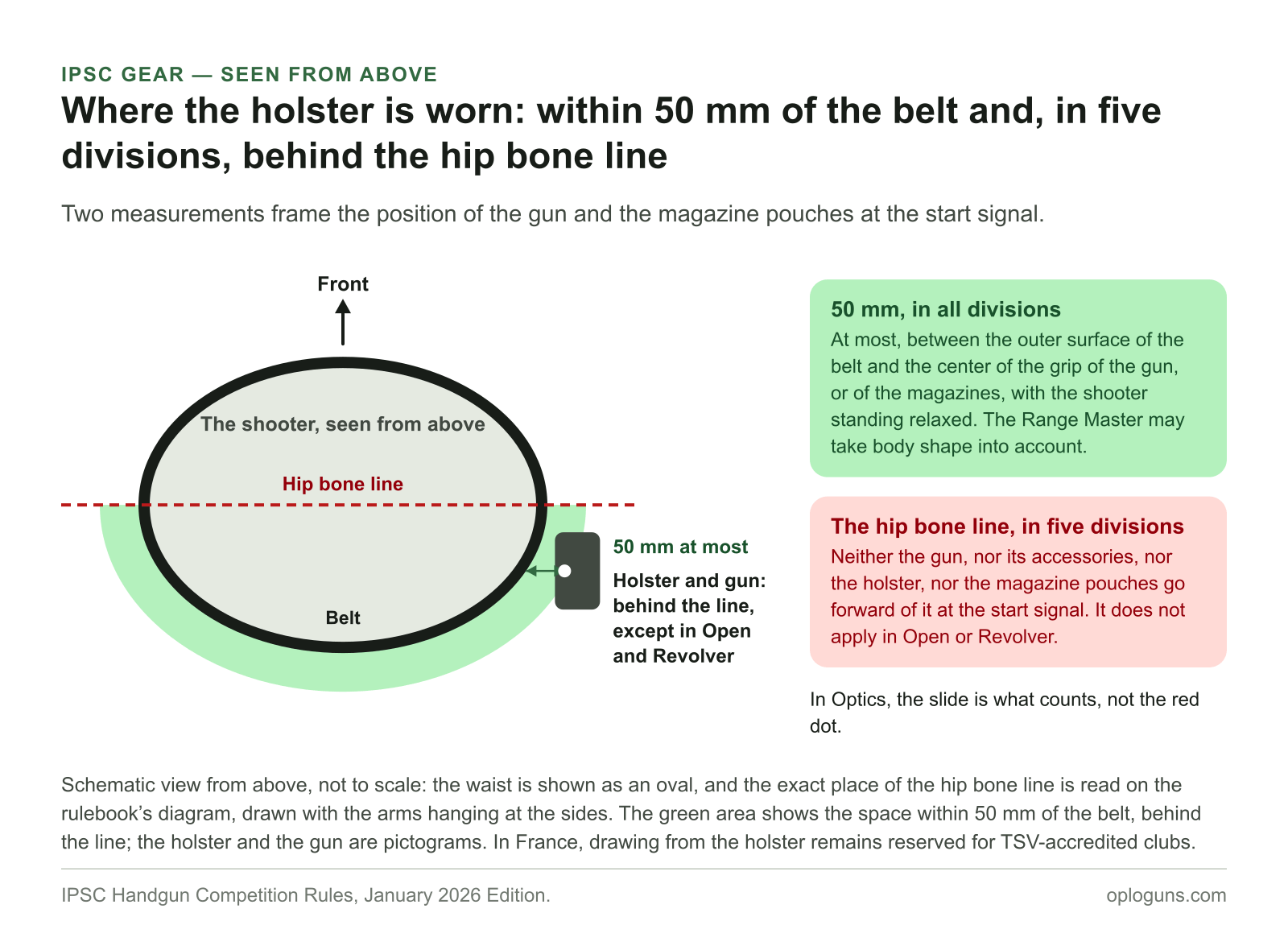
Two measurements frame the position. The first applies to all divisions: 50 mm at most between the outer surface of the belt and the center of the grip of the gun, or of the magazines, competitor standing relaxed1. Roughly the short side of a bank card8.
The second is the hip bone line. In five divisions, neither the gun, nor its accessories, nor the holster, nor the magazine pouches go forward of the line of the hip bone at the start signal. The rulebook's diagram draws it with the arms hanging at the sides1.
| Division | 50 mm from the belt | Behind the hip bone |
|---|---|---|
| Open | Yes | No |
| Standard | Yes | Yes |
| Classic | Yes | Yes |
| Production | Yes | Yes |
| Production Optics | Yes | Yes |
| Optics | Yes | Yes, the slide counts, not the red dot |
| Revolver | Yes | No |
The gap is sorted out before the start: the competitor who fails the measurement adjusts their gear, and the Range Master may take body shape into account1. After the start, the first offense earns a warning; the next sends the competitor to Open, or to shooting for no score if they are already there1. What each division allows on the gun side is detailed in our guide to IPSC in France.
IPSC magazine pouches: no number required
The rules set neither a minimum nor a maximum. Spare cartridges, magazines and speed loaders are carried in retention devices designed for the purpose; the rear pockets of the trousers or shorts are also approved1. When the start is made with magazines placed on a table, the competitor stows them wherever they like after the signal1.
Magazine pouches follow the holster's rules. The rulebook counts them as allied equipment, magnets included: 50 mm from the belt everywhere, behind the hip bone in the five divisions concerned1.
The number follows from the course of fire. A Long Course requires 32 rounds at most1: in Production, limited to 15 rounds per magazine, it takes three magazines at the minimum, one in the gun and two on the belt, with no spare for a malfunction8. The number of magazines to plan for, and their prices, are in our guide to pistol magazines.
Three families of magazine pouches share the belts:
- The clamp-type pouch, in polymer: €31 to €36 for a DAA Racer5.
- The open-frame pouch, in polymer: €49 to €58 for a DAA X-Ray56.
- The magnetic pouch, which holds up to two magazines by magnets: €61 at Ghost7.
IPSC holster types: polymer, Kydex, adjustable hanger
The thermoformed polymer holster
Ghost describes its Thunder Elite as an adjustable polymer holster, thermoformed for each pistol model, on a rigid belt attachment5.
Pros
Cons
- One holster per gun model: another pistol calls for another holster5; the models pistol by pistol are in which IPSC holster for which pistol.
The closed-body Kydex holster
The DAA PDR PRO-II is presented as a closed-body Kydex holster, on an aluminum rail, with continuously adjustable height6.
Cons
- One version per gun family: CZ, Glock and Canik each have their own6.
The competition holster with an insert or a hanger
The most expensive holsters multiply the adjustments. The Ghost One Evo adjusts in height and in rotation, with an adjustable barrel support and a ball lock5; the DAA Alpha-X takes an insert block specific to the pistol6; the CR Speed Ultra 2 hangs from an adjustable hanger6.
Pros
TSV in France: drawing reserved for accredited clubs
The FFTir, the French shooting federation, does not rewrite the equipment rules: the sporting rules of TSV (tir sportif de vitesse, its name for IPSC action shooting) are those of IPSC, of which only the English version is authoritative at Level III competitions and above2. Guns must also comply with federal regulations and with French law2.
The federation does add a rule about place. Drawing from the holster, shooting on the move or shooting at IPSC targets is « formellement interdite » [strictly forbidden] outside TSV-accredited clubs, or at an accredited club without a TSV instructor present2. The penalty is a matter for the disciplinary committee, for the shooter as for the club president2.
At the 2026-2027 French championship, six handgun divisions are open: Open, Standard, Classic, Production, Optic and Production Optic3. Revolver is not among them.
Away from the range, the holster stays empty. Carrying a Category B firearm is prohibited; the shooting license counts as a legitimate reason for transport, and a firearm travels in such a way that it cannot be used immediately4. The pistol therefore makes the trip in a case, as our guide to transporting your gun explains.
IPSC gear budget: €227 to €539 the first year
Prices recorded on 4 November 2026 at three French gun shops567:
| Item | First year | Following years |
|---|---|---|
| Belt and inner belt | €55 to €84 | — |
| Holster | €79 to €272 | — |
| Three magazine pouches | €93 to €183 | — |
| Total | €227 to €539 | — |
The same item changes price from one gun shop to another: €83 or €89 for a Ghost Thunder Elite, €205 or €234 for the same left-handed DAA Alpha-X without insert567. In the following years, nothing is bought again as long as the gun does not change8.
The IPSC rules also recommend eye and ear protection "at all times", which the organizer may make compulsory1: see our guides to shooting glasses and hearing protection. The full budget of the discipline, license and ammunition included, is in our guide to IPSC in France.
Three misconceptions about IPSC gear
- "You need a holster from a competition brand." The rules impose neither a brand nor a type of holster, only prohibitions1.
- "In Open, gear goes wherever you like." The 50 mm limit applies in Open too; only the hip bone line is not required there1.
- "The number of magazine pouches is capped." No rule sets it: the course of fire decides1.
Which IPSC gear for your division
Production, Production Optics, Standard, Classic, Optics
A holster and magazine pouches that stay behind the hip bone and within 50 mm of the belt: an adjustable polymer holster, €79 to €90, is enough. In return, one holster per gun model, and a position to have checked before the first match.
Open
The hip bone line does not apply: the holster can sit farther forward, and adjustable-hanger holsters offer the most adjustments, for €139 to €272. In return, the 50 mm limit remains, and some holsters require their own belt. The chronograph that settles Major is presented in our guide to the shooting chronograph.
Starting out at an accredited club
A two-part belt, a holster for the shooter's gun and two or three magazine pouches cover the first stages, for €227 at the lowest price recorded. In return, drawing from the holster is practiced only with a TSV instructor present.
Sources 8 references
Equipment rules taken from the IPSC Handgun rules in force; French rules taken from the FFTir's regulations and the code de la sécurité intérieure; descriptions and prices recorded on 4 November 2026 at three French gun shops. Click a reference number in the text to highlight the matching source.
- IPSC — IPSC Handgun Competition Rules, January 2026 Edition (PDF, final version of 29 December 2025, linked from IPSC's "Rule Books" page), reread 4 November 2026: 1.2.1.3, "Long Courses – Must not require more than 32 rounds"; 5.2.1.2, holstered gun with "an empty magazine well", hammer or striker decocked; 5.2.2, handling, holstering and removal of the holster with the gun in it only in a safety area or on an official's command; 5.2.3, belt "worn at waist level", "permanently sewn at the waist, or secured with a minimum of three belt loops"; 5.2.3.1, "Female competitors in all Divisions": belt "at hip level", gear on the lower belt; 5.2.4, spares carried "in retention devices specifically designed for that purpose", rear pockets "also approved"; 5.2.4.1, magazines placed on a table stowed anywhere after the start; 5.2.4.2, position unchanged from one stage to the next; 5.2.5, measurement between "the outer surface of the competitor's belt and the center of the longest dimension of the handgun grip and/or any reloading devices", competitor "standing relaxed", Range Master's allowance for body shape; 5.2.6, no brand or type of holster imposed, holster deemed unsafe improved or withdrawn, retention fastened before "Standby"; 5.2.7, a single holster, no shoulder holster or "tie-down", heel of the butt above the top of the belt, muzzle within 1 m of the feet, trigger inaccessible and unlocking without the index finger; 5.2.8 and 5.2.9, exceptions for serving police and military personnel and for competitors with disabilities; 5.2.10 and Appendix E2, "Foremost limit for gun, holster and allied equipment behind the hip bone at the Start Signal"; 5.4.1 and 5.4.2, eye and ear protection recommended "at all times", may be required by the organizer; 6.2.5.1, warning for the first offense, then Open or no score; Appendices D1 to D6, line 10 "Max. distance of handgun and allied equipment from belt 50 mm" in all divisions, line 11 "Rule 5.2.10 / Appendix E2 applies": Yes in Standard, Classic, Production, Production Optics and Optics, No in Open and Revolver; D4, magazines of 15 rounds at most in Production; D6, "Appendix E2 will consider the slide, not the optical sight"; glossary, "Allied Equipment": magazines, speed loaders and their pouches, "(including magnets)". ⚠️ IPSC also publishes interpretations during the year on its Rule Books page: to be checked before a match.
- FFTir — Règlement administratif du Tir Sportif de Vitesse, saison 2019/2020 [administrative rules for TSV, 2019/2020 season, in French] (4-page PDF hosted by the federation), reread 4 November 2026: article IV, the practice of « tout exercice de tir comportant l'usage d'une arme portée à l'étui (dégainé) » [any shooting exercise involving a gun carried in a holster (drawing)] or of shooting on the move and at IPSC targets « en dehors des Associations habilitées ou pour celles qui le sont « sans la présence d'un moniteur TSV » est formellement interdite » [outside accredited associations, or at those that are accredited "without a TSV instructor present", is strictly forbidden], with referral to the disciplinary committee for the shooters and the association's president; article VII, « seul le règlement officiel de l'IPSC en anglais est valable sur les compétitions de Niveau III et plus » [only the official IPSC rulebook in English is valid at Level III competitions and above]; article XIII, guns compliant with FFTir regulations, IPSC rules and French legislation. ⚠️ 2019-2020 edition, the latest version published by the federation.
- FFTir — Règlement de Gestion Sportive 2026-2027, Vie Nationale [sports management rules 2026-2027, in French] (PDF, version of 29 September 2026), reread 4 November 2026: B.10.1.1, events "HANDGUN : Open, Standard, Classic, Production, Optic, Production Optic, PCC Optic, PCC Iron".
- Légifrance — articles R315-1, R315-2 et R315-4 du code de la sécurité intérieure (in French), versions in force since 1 August 2018 (decree no. 2018-542 of 29 June 2018), reread 4 November 2026: R315-1, carrying of Category A and B firearms prohibited, transport without a legitimate reason prohibited; R315-2, 3°, a current shooting license counts as a legitimate reason for transporting the guns used in practicing the sport; R315-4, firearms transported « de manière à ne pas être immédiatement utilisables » [in such a way that they cannot be used immediately].
- Armurerie de la Bourse (in French) — recorded 4 November 2026: Ghost IPSC belt and inner belt €55.00, « Ceinture + sous ceinture velcro » [belt + hook-and-loop inner belt], « environ 20cm de recouvrement velcro » [about 20 cm of hook-and-loop overlap], « Largeur de 3,8cm » [width of 3.8 cm]; DAA Pro Belt belt and inner belt €60.00; Ghost Thunder Elite holster €89.00, « Holster réglable avec fixation sur ceinture solide et rigide » [adjustable holster with a solid, rigid belt attachment], « techno polymère incassable, thermoformé pour chaque modèle de pistolet » [unbreakable techno-polymer, thermoformed for each pistol model]; Ghost One Evo holster €139.00, « réglable en hauteur et en rotation » [adjustable in height and in rotation], « Support de canon réglable » [adjustable barrel support], « Système de verrouillage avec sphère en polymère » [locking system with a polymer ball]; Ghost One S holster €160.00; left-handed DAA Alpha-X holster without insert €205.00; DAA Racer magazine pouch €31.00 (€36.00 for the Racer Gen 2); DAA X-Ray polymer magazine pouch €49.00. ⚠️ Commercial data.
- Deville Armory (in French) — recorded 4 November 2026: DAA Premium belt €62.95; DAA Competition belt €83.95; DAA PDR PRO-II holster €98.91, presented as closed-body Kydex, on an aluminum rail, continuously adjustable height, in CZ, Glock and Canik versions; left-handed DAA Alpha-X holster without insert €233.91, compatible with Race Master inserts; Alpha-X / Race Master insert block for Glock €82.71, presented as intended for shooters who often change pistols; CR Speed Ultra 2 holster for CZ Shadow 2 €272.02, "suspension C-BAX Versa-Hanger", compatible only with CR Speed belts; DAA X-Ray polymer magazine pouch €57.51. ⚠️ Commercial data.
- Armurerie Douillet (in French) — recorded 4 November 2026: Ghost IPSC belt €55.00; Ghost Stinger holster €79.00; Ghost Thunder Elite holster for Glock €83.00; Ghost Thunder G3 Stinger holster €90.00; Ghost double-magnet magazine pouch €61.00, which lets you « ajouter rapidement jusque 2 chargeurs » [quickly add up to 2 magazines]. ⚠️ Commercial data.
- Calculations: a bank card measures 85.60 × 53.98 mm (ISO/IEC 7810 ID-1 format); Long Course of 32 rounds with 15-round magazines: 32 ÷ 15 = 2.13, so three magazines; budget: 55 + 79 + 3 × 31 = €227 at the lowest, 83.95 + 272.02 + 3 × 61 = €538.97 at the highest; three magazine pouches: 3 × 31 = €93 to 3 × 61 = €183.
The rules in force prevail. This article describes the IPSC Handgun rules of January 2026 and the French federation's administrative rules for TSV; the prices are those of 4 November 2026. Whether a piece of gear complies is checked with the club's TSV instructor and with the official before the first match.
Frequently asked questions
Where is the holster worn in IPSC?
On a belt worn at waist level, sewn on or held by at least three belt loops; female competitors may wear it at hip level. In all divisions, the grip of the gun and the magazines stay within 50 mm of the belt. In Standard, Classic, Production, Production Optics and Optics, neither the gun, nor the holster, nor the magazine pouches go forward of the hip bone at the start signal.
How many magazine pouches do you need in IPSC?
The rules set no number: they only ask that spare magazines be carried in retention devices designed for that purpose, or in the rear pockets. The course of fire decides: a Long Course requires 32 rounds at most, so three 15-round magazines at the minimum in Production, not counting a spare for a malfunction.
Which holster to start TSV with?
The IPSC rules impose neither a brand nor a type of holster. They ban the shoulder or thigh holster, the butt below the top of the belt, the muzzle pointing more than one meter from the feet, and any access to the trigger while the gun is holstered. The adjustable polymer holsters recorded cost €79 to €90, the competition holsters with an insert or an adjustable hanger €139 to €272.
Can you practice drawing from the holster at any club in France?
No. The French federation's administrative rules for TSV, its name for IPSC action shooting, forbid any shooting exercise with a holstered gun outside accredited clubs, or at an accredited club without a TSV instructor present. Away from the range, the pistol travels in its case, in such a way that it cannot be used immediately.
How much does basic IPSC gear cost?
At the prices recorded on 4 November 2026 at three French gun shops: €55 to €84 for the belt and its inner belt, €79 to €272 for the holster, €31 to €61 per magazine pouch. With three magazine pouches, the set comes to €227 to €539 the first year, then nothing more as long as nothing breaks.
Spotted an error, or a rule that has changed since we checked? Report an error