IPSC Open Division: optic, compensator, long magazines and Major in 9mm
Published on · 11 min read · Anthony Baillon
Open is the least restricted IPSC division: optic and compensator allowed, no box, no minimum trigger pull, no imposed capacity, magazines of 170 mm at most. Major is reached from 9 mm up, at 160, with a bullet of at least 120 grains. In France, beyond 20 rounds, a magazine requires a federation certificate.
At a glance
| Appendix D1 item | What the rulebook sets | No. |
|---|---|---|
| Sights | Optical or electronic allowed | 12 |
| Compensator | Allowed, as are ports | 13 |
| Magazine | 170 mm at most, capacity unrestricted | 8 and 9 |
| Major | Factor 160, bullet of at least 120 grains | 1 and 3 |
| Minor | Factor 125 | 2 |
- Major in 9 mm, with a semi-automatic pistol, exists only in this division: a power factor of at least 160, measured on the match chronograph with your own cartridges.
- In France, a handgun magazine of more than 20 rounds is in Category A1: it takes a certificate from the FFTir, the French shooting federation, granted after a Level 3 match in the division.
- The entry cost: €3,226 to €10,088 for the pistol, the red dot and the equipment, at the prices of 15 November 2026.
IPSC Open: Appendix D1, line by line
Appendix D1 of the January 2026 IPSC rulebook is the shortest of the division appendices: fourteen lines, a single special condition1. The edition that prevails, and the translations of it in circulation, are reviewed in our article on the IPSC rulebook in French.
| Line | What Appendix D1 governs | Open |
|---|---|---|
| 1 | Minimum power factor, Major | 160 |
| 2 | Minimum power factor, Minor | 125 |
| 3 | Minimum bullet weight | 120 grains for Major |
| 4 | Minimum caliber and case length | 9 mm and 19 mm |
| 5 | Minimum caliber for Major | None |
| 6 | Minimum trigger pull | None |
| 7 | Maximum handgun size | None |
| 8 | Maximum magazine length | 170 mm |
| 9 | Maximum capacity | None |
| 10 | Distance of handgun and equipment from the belt | 50 mm at most |
| 11 | Equipment behind the hip bone | Not required |
| 12 | Optical or electronic sights | Yes |
| 13 | Compensator, ports, sound suppressor, flash suppressor | Yes |
| 14 | Weight attached to the barrel, extending beyond the muzzle | Yes |
Three "yes" answers that no other division brings together: the optic without the compensator is found in Production Optics and Optics, but lines 13 and 14 open only here1. The overall table is in our guide to IPSC in France.
In France, Open is one of the six handgun divisions of the 2026-2027 French championship3.
The federation's rules add a condition that weighs more here than elsewhere. Firearms must comply with the IPSC rules, and be « en conformité avec la législation Française en vigueur » [in compliance with the French legislation in force]2. What Appendix D1 allows must therefore also be permitted by law. The case of the sound suppressor is covered in our article on suppressors under French law.
Optic and compensator: what Open alone allows
The rulebook defines the two parts that make an Open pistol1:
- Optical or electronic sights: any aiming device that uses electronic circuitry or lenses, flashlights included. Its location is unrestricted: no line of Appendix D1 requires it on the slide.
- The compensator: a part fitted to the muzzle end of the barrel, which diverts the gases to counter muzzle rise.
The belt enjoys the same freedom. The hip bone line does not apply: the holster can be worn further forward than in the other divisions, 50 mm from the belt at most1. The holsters that take advantage of it are described in our guide to IPSC gear.
Open nonetheless keeps the prohibitions common to all divisions1:
- The laser sight, which projects a dot onto the target.
- The shoulder stock and the fore-grip, of any shape.
- Burst fire, and the trigger that fires on release.
- More than one barrel.
- A trigger wider than the trigger guard.
- Metal-piercing, incendiary or tracer ammunition.
170 mm magazines: the measurement, and French law
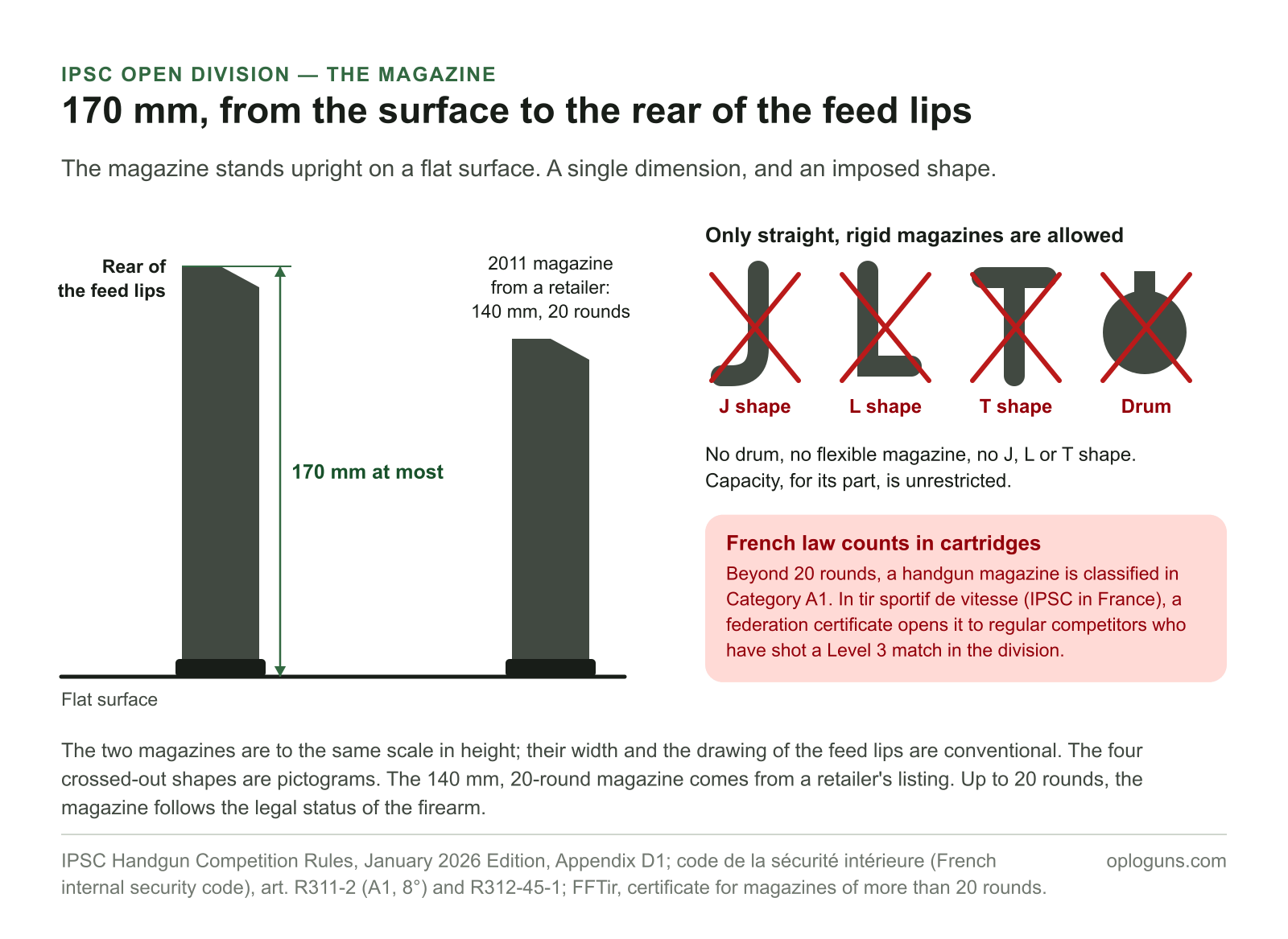
A single dimension: 170 mm, or 6.7 inches110. The magazine is stood upright on a flat surface, and the measurement is taken from that surface to the rear of the feed lips. Only straight, rigid magazines are allowed: no drum, no flexible magazine, no J, L or T shape1. Capacity, for its part, is unrestricted.
French law sets another bound, counted in cartridges. Beyond 20 rounds, a handgun magazine is classified in Category A14. The code de la sécurité intérieure (the French internal security code) provides an exception for the disciplines that require these magazines: a certificate from the federation, for tir sportif de vitesse (TSV, the French name for IPSC), outside the ceiling of ten magazines per firearm4.
The FFTir sets the terms of this certificate2:
- It is reserved for regular competitors, who can show a Level 3 competition « pour la division sollicitée » [for the division requested].
- The club president applies for it.
- The chair of the national TSV commission gives an opinion.
- The president of the FFTir and the national technical director sign it.
Up to 20 rounds, the magazine follows the legal status of the firearm4. Match levels are explained in our article on the first IPSC match, buying magazines in our guide to pistol magazines.
On price, a 2011 magazine in 9 mm costs €86 in 18 rounds, €144 in 20 rounds and 140 mm; a 140 mm 2011 magazine in .38 Super, €1108.
Major in 9mm: 160, with a 120-grain bullet
In Standard and Classic, Major requires 170 and a 10 mm bullet; in Revolver, 170, with a cylinder of six rounds at most. In Open, 160 is enough, with no minimum caliber beyond 9 mm1. The trade-off fits in one line: the bullet weighs at least 120 grains, or 7.78 g10.
The calculation is the same in every division: bullet weight in grains, multiplied by the average velocity of three cartridges in feet per second, divided by 1,000, decimals ignored1. The officials draw eight of the shooter's cartridges, weigh one bullet and fire three over the match chronograph1. The rulebook sets the threshold, the powder manufacturer's table sets the charge, the match chronograph checks.
A factory 9 mm cartridge falls well short. Sellier & Bellot lists 360 m/s for its 124-grain jacketed bullet: factor 146, which is Minor510. With that cartridge, an Open shooter is scored in Minor. Two of the three Open pistols recorded below are in fact also offered in .38 Super Auto, and one in 9x2167.
Two rules protect the 120-grain floor1:
- A bullet that is too light and reaches 160 is deemed unsafe: the ammunition is withdrawn from the match.
- The scale decides: if the first bullet weighed is under 120 grains, a second is weighed, and its weight is final.
The shooter alone remains responsible for the safety of the ammunition they bring1. The legal framework for handloading is in our guide to ammunition reloading under French law; how the chronograph check unfolds, in our article on Standard Division.
Open as the fallback division: automatic reclassification
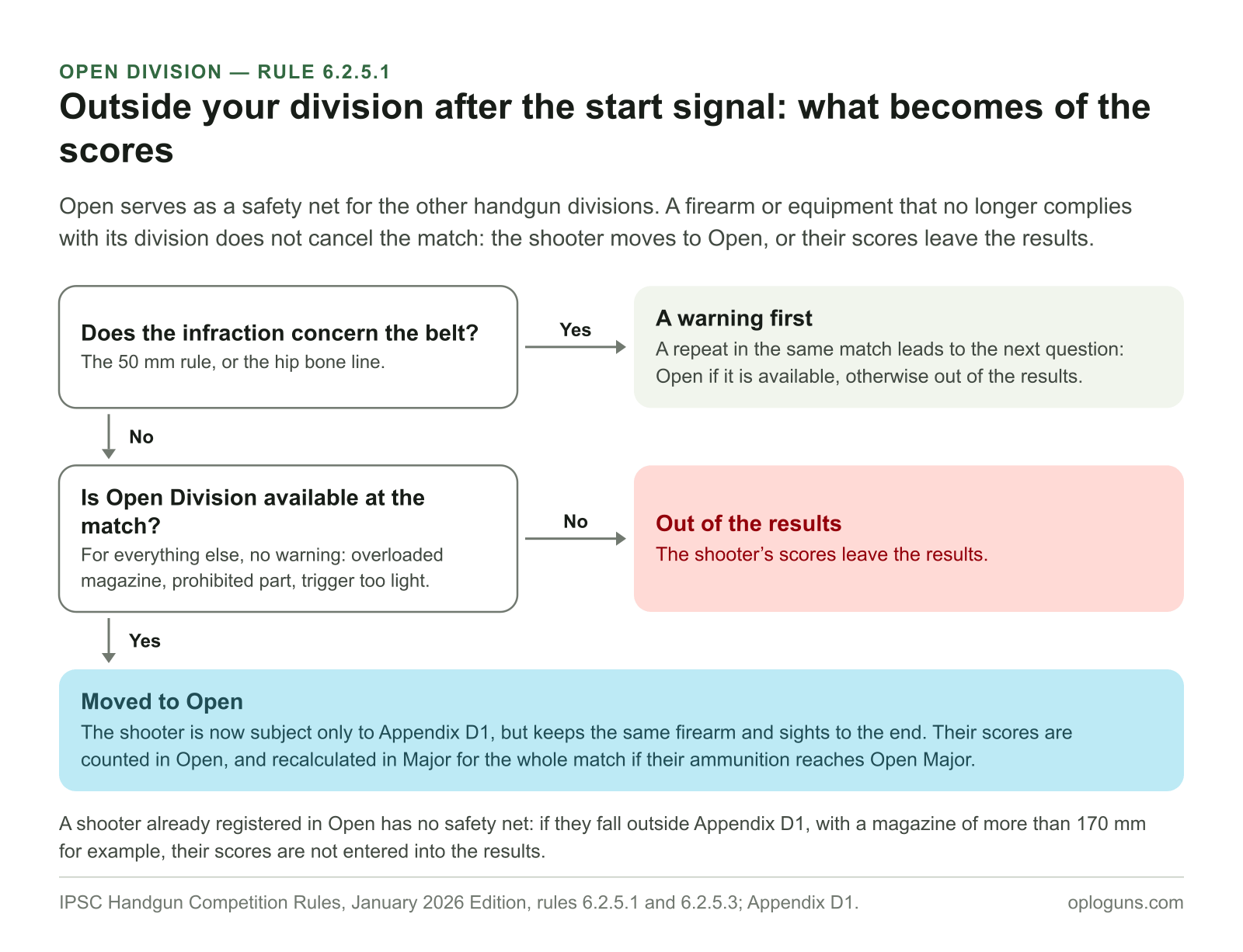
Open also serves as a safety net for the other divisions. A shooter whose firearm or equipment no longer complies with their division after the start signal is placed there, if it is available at the match; otherwise, their scores leave the results1.
Reclassification follows three rules1:
- For the belt, a warning first. A breach of the 50 mm rule or of the hip line earns a warning; a repeat in the same match sends the shooter to Open.
- For everything else, Open straight away: an overloaded magazine, a prohibited part, a trigger that is too light.
- The same firearm to the end. The reclassified shooter is now subject only to Appendix D1, but keeps their firearm and their sights.
Their scores are not lost: they are counted in Open. And if their ammunition reaches Open Major, the scores are recalculated in Major for the whole match1.
An Open shooter, on the other hand, has no safety net. If they fall outside Appendix D1, with a magazine of more than 170 mm for example, their scores are not entered into the results1.
Open pistols: what the freedom brings and costs
No list, no box: an Open pistol is recognized by what it carries. Three models on sale at French gun shops are compensated, or intended for the division by their maker67:
- The Tanfoglio Domina: an all-steel single action of 1,343 g, 265 mm long, with a 132 mm barrel, in 9x19, 9x21 or .38 Super Auto.
- The STP Max Open 5.0 T2: a 2011 with a 5-inch barrel, sold with its compensator, optics-ready, in 9x19 or .38 Super Auto.
- The Staccato XC: a 9 mm 2011 with a compensated 5-inch barrel, 17 rounds.
The models are compared in our guide to which pistol for TSV, division by division, the platform in our guide to Staccato and the 2011.
Pros
Entry budget for Open: €3,226 to €10,088
Assumption: a new Open pistol, a red dot, a belt, a holster and three magazine pouches. Prices recorded on 15 November 2026.
| Item | First year | Following years |
|---|---|---|
| New pistol, from the Domina to the Staccato XC | €2,690 to €8,4507 | — |
| Red dot | €309 to €1,0999 | — |
| Belt, holster, three magazine pouches | €227 to €5399 | — |
| Total specific to the division | €3,226 to €10,088 | — |
| 2,400 factory 9 mm cartridges, in Minor | €624 to €6628 | €624 to €662 |
| 2,400 factory .38 Super Auto cartridges | €1,344 to €1,7768 | €1,344 to €1,776 |
Between the Domina, at €2,690, and the Staccato XC, at €7,990 or €8,450 depending on the gun shop, the STP Max Open sells for €5,8907. The Domina ships with three magazines, with no mount and no optic, and the plate for the STP is sold separately7: mounting the sight comes on top of these totals.
Spare magazines are added according to the pistol: €74 for a 17-round Tanfoglio magazine in .38 Super, €86 to €144 for a 2011 magazine8. Choosing a sight is detailed in our red dot guide; the license, the medical certificate and the gun safe, in our guide to IPSC in France.
Four common mistakes in Open Division
- "In Open, anything goes." The magazine does not exceed 170 mm, the equipment stays within 50 mm of the belt, and the laser, the shoulder stock and burst fire remain prohibited1.
- "A very fast light bullet makes Major." Under 120 grains, ammunition that reaches 160 is withdrawn from the match1.
- "A 170 mm magazine is bought like any other." In France, beyond 20 rounds, it falls under Category A1 and a federation certificate42.
- "Being moved to Open cancels the match." The scores are counted in Open, and recalculated in Major if the ammunition reaches 1601.
Open Division by goal
What you gain, what you give up
To shoot Major with a 9 mm, Open is the only route with a semi-automatic pistol. In return, a bullet of at least 120 grains, a power factor of 160 that the factory 9 mm cartridges recorded do not reach, and a chronograph check.
To combine optic and compensator, Open is again the only division. In return, a pistol at €2,690 at least, and magazines subject to a certificate beyond 20 rounds.
For a red dot without a compensator, Optics and Production Optics are enough, in Minor. In return, shorter magazines, or magazines limited to 15 cartridges.
To get started, Open prohibits nothing: a factory pistol can be declared there. In return, it is ranked alongside compensated pistols shot in Major.
Sources 10 references
The rules come from the IPSC Handgun rulebook in its January 2026 edition, the French framework from the FFTir's rules and the code de la sécurité intérieure, specifications and velocities from manufacturers' sheets, prices from surveys dated 15 November 2026 at French gun shops. Click a note marker in the text to highlight the matching source.
- IPSC — IPSC Handgun Competition Rules, January 2026 Edition (PDF, final version of 29 December 2025, linked from the IPSC "Rule Books" page), reread on 15 November 2026: Appendix D1, Open Division, p. 55 — lines 1 to 14, including "Minimum power factor for Major : 160", "Minimum power factor for Minor : 125", "Minimum bullet weight : 120 grain for Major", "Minimum bullet caliber for Major : No", "Minimum trigger pull : No", "Maximum handgun size : No", "Maximum magazine length : 170 mm (see Appendix E1)", "Maximum ammunition capacity : No", "Rule 5.2.10 / Appendix E2 applies : No", "Optical/electronic sights : Yes", "Compensators, ports, sound and/or flash suppressors : Yes", "Weight(s) attached to barrel that extend beyond the muzzle : Yes"; 15, "Ammunition which fails to meet the minimum bullet weight above, but which chronographs at Major power factor, will be treated as unsafe and must be withdrawn (see Rule 5.5.6)", second weighing "as a final and definitive bullet weight test". Appendix E1, magazine "placed vertically upright on a flat surface, with the measurement taken from the flat surface upwards to the rear of the feed-lips", "Only straight, rigid magazines are permitted (i.e. flexible, drum, 'J', 'L', 'T' or similar shape magazines are prohibited)". Appendices D2 to D6, Major at 170 with a 10 mm bullet in Standard and Classic, at 170 with no minimum caliber in Revolver, except with a cylinder of 7 rounds or more, "Not applicable" in Production, Production Optics and Optics; lines 13 and 14 at "No" outside Open. Rules 5.1.2, minimum caliber 9x19; 5.1.3.2, "'Optical/electronic sights' are aiming devices (including flashlights) fitted to a firearm which use electronic circuitry and/or lenses"; 5.1.3.3, laser sights "not permitted in IPSC matches"; 5.1.5, trigger wider than the trigger guard prohibited; 5.1.10 to 5.1.12, shoulder stock, fore-grip, burst fire, trigger firing on release and multiple barrels prohibited; 5.2.5, 50 mm from the belt; 5.5.1, shooter "solely and personally responsible for the safety of all and any ammunition"; 5.5.4, "Metal piercing, incendiary and/or tracer" ammunition prohibited; 5.6.3.5, power factor formula, "The final result will ignore all decimal places"; 6.2.5.1, warning then Open for the belt, Open at once for the other requirements, "Competitors already registered in Open Division who fail to comply […] will not have their scores entered into match results"; 6.2.5.3, reclassified shooter subject "only to the provisions of Appendix D1 but […] required to continue using the same firearm and sights", "If the competitor's ammunition satisfies the requirements for Open Major power factor, his scores for the entire match will be adjusted accordingly"; glossary, "Compensator : A device fitted to the muzzle end of a barrel to counter muzzle rise by diverting away escaping gasses", "1 grain = 0.0648 grams". ⚠️ The IPSC also publishes interpretations during the year on its Rule Books page: to be checked before a match. Rules 5.6.3.2, 5.6.3.3 and 5.6.3.5, p. 14: eight cartridges "drawn from each competitor", one bullet weighed, three cartridges fired over the chronograph, factor calculated on their "average velocity", "The final result will ignore all decimal places".
- FFTir — Règlement administratif du Tir Sportif de Vitesse, saison 2019/2020 [administrative rules for TSV, 2019/2020 season] (4-page PDF hosted by the federation, in French), reread on 15 November 2026: article XIII, firearms « conformes à la réglementation FFTir et aux règlements sportifs de l'I.P.S.C. Elles doivent également se trouver en conformité avec la législation Française en vigueur » [compliant with FFTir regulations and the IPSC sporting rules; they must also be in compliance with the French legislation in force]; article XVI, certificate for long magazines: « Ce certificat ne sera délivré qu'aux seuls tireurs pratiquant régulièrement la compétition, en justifiant de leur participation à une compétition de niveau 3 pour la division sollicitée. Ce certificat est demandé par le président de l'association, il est soumis au président de la CNS TSV pour avis, puis il est signé par le président de la FFTir et le Directeur Technique National FFTir. » [this certificate will be issued only to shooters who compete regularly and can show participation in a Level 3 competition for the division requested; it is applied for by the club president, submitted to the chair of the national TSV commission for an opinion, then signed by the president of the FFTir and the FFTir national technical director]. ⚠️ 2019-2020 edition, the latest version published by the federation.
- FFTir — Règlement de Gestion Sportive 2026-2027, Vie Nationale [sports management rules 2026-2027, national competitions] (PDF, V1, « Version du 29/09/2026 », in French), reread on 15 November 2026: B.10.1.1, events "HANDGUN : Open, Standard, Classic, Production, Optic, Production Optic, PCC Optic, PCC Iron".
- Légifrance — article R311-2 du code de la sécurité intérieure (in French), version in force since 7 September 2025 (decree no. 2025-894 of 5 September 2025), consulted on 24 September 2026: Category A1, 8°, « Système d'alimentation d'arme de poing contenant plus de 20 munitions » [handgun feeding device holding more than 20 rounds]; 20 rounds or fewer for a pistol, Category B, 11°. Articles R312-45 and R312-45-1, consulted on 24 September 2026: « Nul ne peut acquérir et détenir plus de dix systèmes d'alimentation par arme » [no one may acquire and hold more than ten feeding devices per firearm]; magazines of more than 20 rounds for the disciplines that require them, on a certificate issued by the federation (R312-5, 10°, tir sportif de vitesse), outside the quota of ten.
- Sellier & Bellot — 9 mm Luger, manufacturer's sheets, reread on 15 November 2026: FMJ 124 grains, V0 360 m/s; FMJ 115 grains, V0 390 m/s. ⚠️ Velocities listed by the manufacturer, with no indication of the test barrel length on this page; the velocity the match chronograph measures depends on the firearm.
- Tanfoglio — Domina, manufacturer's sheet (in Italian), reread on 15 November 2026: pistol presented for the "Divisione Open IPSC", overall length 265 mm, 132 mm barrel, 1,343 g, steel frame and slide, "S.A." action, calibers 9x19, 9x21 and .38 SA.
- New pistols, prices recorded on 15 November 2026 (pages in French). Armurerie de la Bourse, Tanfoglio Domina cal. .38 Super Auto, €2,690.00 instead of €3,590.00, « Livré en mallette avec trois chargeurs sans montage et sans optique » [delivered in a case with three magazines, with no mount and no optic]. Deville Armory, STP Max Open 5.0 T2 in 9x19 and in .38 SA, €5,890.00 each, « Plateforme : 2011 », « Canon : 5 pouces » [barrel: 5 inches], « Configuration : Open T2 (avec compensateur et red dot) » [with compensator and red dot], optic « Platine à acheter séparément » [plate to be bought separately]. Le Pistolier, Staccato XC 9x19, €7,990.00, « Canon : 5" Island Comp compensé intégré » [barrel: 5-inch integral Island Comp], « Capacité : 17+1 coups » [capacity: 17+1 rounds]; Falc Armurerie, Staccato XC 9x19, €8,450.00 instead of €8,990.00. ⚠️ Commercial data; discounted prices shown for the Domina and at Falc, STP on pre-order.
- Magazines and ammunition, prices recorded on 15 November 2026 (pages in French). Deville Armory: Mec-Gar magazine for 2011 9x19, 18 rounds, €86.21; 20-round magazine for 2011, 140 mm, €144.00; 50 Geco .38 Super Auto FMJ 124 gr cartridges, €35.00. Armurerie de la Bourse: STI 2011 magazine cal. .38 Super, 140 mm, €110.00; Tanfoglio large-frame magazine cal. .38 Super, « Capacité 17 coups » [capacity 17 rounds], €74.00; 50 Fiocchi .38 Super Auto 129 gr cartridges, €28.00; 50 Geco .38 Super Auto 124 gr cartridges, €37.00. 9 mm by the case of 1,000: Armurerie Centrale, STV Scorpio 124 gr FMJ, €259.00; Armurerie Lavaux, MFS 9x19 Para FMJ, €275.95. ⚠️ Commercial data; the STV case was shown as out of stock that day.
- Red dot and equipment, prices recorded on 15 November 2026 (pages in French). Red dots: Armurerie de la Bourse, Holosun Elite 407C X3, €309.00; Armurerie Auxerre, Holosun 407C X3, €319.95; Conditions Extrêmes, Trijicon RMR HD 3.25 MOA, €1,059.90; Deville Armory, Trijicon RMR HD 3.25 MOA, €1,099.00. Equipment: Armurerie de la Bourse, Ghost IPSC belt and inner belt, €55.00, and DAA Racer magazine pouch, €31.00; Armurerie Douillet, Ghost Stinger holster, €79.00, and Ghost double-magnet magazine pouch, €61.00; Deville Armory, DAA Competition belt, €83.95, and CR Speed Ultra 2 holster, €272.02. ⚠️ Commercial data; slide-mounted sights, frame-mounted sights were not surveyed.
- Calculations and conversions: 170 mm ÷ 25.4 = 6.69 inches; 1 grain = 0.0648 g, so 120 grains = 7.78 g; 1 foot per second = 0.3048 m/s; 124 grains at 360 m/s (1,181.1 ft/s) = 146.5, so 146; cost per round: €259.00 and €275.95 per 1,000 in 9 mm, or €0.26 and €0.28; €28.00 and €37.00 per 50 in .38 Super Auto, or €0.56 and €0.74; 2,400 cartridges a year: €624 to €662 in 9 mm, 48 boxes at €28.00 and €37.00 in .38 Super Auto, or €1,344 to €1,776; equipment: 55 + 79 + 3 × 31 = €227 to 83.95 + 272.02 + 3 × 61 = €538.97; total: 2,690 + 309 + 227 = €3,226 to 8,450 + 1,099 + 538.97 = €10,087.97.
The rules and the law in force prevail. This article describes the IPSC Handgun rulebook of January 2026, the FFTir's administrative rules for TSV and the code de la sécurité intérieure in the versions cited; the prices are those of 15 November 2026. This article gives neither a charge nor a velocity to reach: the charge is read in the powder manufacturer's table, the safety of a cartridge is the shooter's responsibility, and the power factor is the match chronograph's. The legal status of a magazine of more than 20 rounds is to be checked with the club and the federation before any purchase.
Frequently asked questions
What is Open Division in IPSC?
The least restricted handgun division in the IPSC rulebook, described in Appendix D1. It allows optical sights, compensators and weights attached to the barrel, with no limit on size, trigger pull or capacity. Three dimensions remain: a magazine of 170 mm at most, 50 mm between the belt and the equipment, and a bullet of at least 120 grains for Major.
Can you shoot Major with a 9mm in Open Division?
Yes: it is the only semi-automatic pistol division that allows it. Major there requires a power factor of 160, with a bullet of at least 120 grains, and no minimum caliber beyond 9 mm. That factor is measured on the match chronograph, on cartridges drawn from the shooter's own; a 124-grain factory cartridge listed at 360 m/s gives 146, which is Minor.
How long can a magazine be in Open Division?
170 mm at most, measured with the magazine standing upright on a flat surface, from that surface to the rear of the feed lips. Only straight, rigid magazines are allowed. The rulebook sets no capacity.
Do you need a certificate for magazines of more than 20 rounds?
Yes, in France. A handgun magazine holding more than 20 rounds is classified in Category A1. A TSV shooter (tir sportif de vitesse, the French name for IPSC) can acquire some on a certificate from the FFTir, the French shooting federation, which issues it only to shooters who can show a Level 3 competition in the division requested. Up to 20 rounds, the magazine follows the legal status of the firearm.
Can a Production pistol shoot in Open?
Yes: Open has neither a list of approved firearms nor an imposed configuration, and a shooter can declare a factory pistol there. It is also the fallback division: a shooter whose equipment no longer complies with their division after the start signal is moved into it, with the same firearm, and their scores are counted there.
How much does an Open pistol cost?
At the prices recorded on 15 November 2026 at four French gun shops: €2,690 for a Tanfoglio Domina in .38 Super Auto, €5,890 for an STP Max Open, €7,990 to €8,450 for a Staccato XC. Add the red dot, €309 to €1,099, and the equipment, €227 to €539.
Spotted an error, or a rule that has changed since we checked? Report an error