Suppressors in France: what the law says, word for word
Published on · 12 min read · Anthony Baillon
In France, a suppressor is not a weapon: since 1 August 2018, article R311-1 of the code de la sécurité intérieure excludes it, provided it does not alter the way the gun works. Hunting has allowed it since 24 January 2018. It takes about 20 decibels off the shot: shooting remains loud.
At a glance
| Question | What the text says | Where |
|---|---|---|
| A weapon? | No, if it does not alter the way the gun works | R311-1, IV, 2° |
| Category, declaration? | None: the classification does not cite it | R311-2 |
| For hunting? | Ban removed on 24 January 2018 | Arrêté of 2 January 2018 |
| Transported on its own? | Outside the list of the ban | R315-1 |
| At the range? | Depends on the discipline: allowed in PR22 and TAR 821 | Rulebooks |
- The gun keeps its category: a bolt-action .22 LR rifle stays in C 1° b), with its purchase document.
- Noise drops by about twenty decibels, according to the ministry: hearing protection keeps its place.
Suppressors: not a weapon since 1 August 2018
One line settles the suppressor's fate. Article R311-1 of the code de la sécurité intérieure, the French internal security code, opens its IV with « Ne sont pas des armes au sens du présent titre » [The following are not weapons within the meaning of this title]. Point 2° files there « Les réducteurs de son constituant des pièces additionnelles ne modifiant pas le fonctionnement de l'arme » [Sound reducers that are add-on parts not altering the way the firearm works]1.
The code says « réducteur de son » [sound reducer]. The ministry in charge of hunting says « modérateur de son » [sound moderator]7, everyday speech « silencieux » [silencer]. All three words mean the part screwed onto the muzzle, the suppressor: a large-volume chamber, lined with baffles, where the gases expand before leaving13.
The "present title" is Title I of Book III, « Armes et munitions » [Weapons and ammunition]. It runs from article R311-1 to article R317-149: the classification of firearms, their acquisition, their transport. None of it covers the sound reducer.
The rule changed in 2018. Until 1 August, the same article called "accessories" the « dispositifs destinés à atténuer le bruit causé par le tir de l'arme » [devices intended to reduce the noise caused by firing the gun]. And it specified: « Les accessoires suivent le régime juridique des éléments d'arme » [Accessories follow the legal regime of firearm components]2. Decree no. 2018-542 of 29 June 2018 replaced that sentence with the current exclusion2.
Sound reducer: no category, the gun keeps its own
Article R311-2 classifies weapons in four categories, from A to D. It cites the sound reducer in none of them3. With no category, there is no authorization, no declaration and no document to present for it.
Nor is it a firearm component. The code reserves that term for a « partie d'une arme essentielle à son fonctionnement » [part of a firearm essential to its operation], and it names them1:
- the barrel and the frame;
- the receiver and the bolt or slide;
- the cylinder and the locking systems;
- the conversion kit.
The suppressor does not appear there. As for age, the eighteen-year rule of article L312-1 covers « des matériels de guerre, armes, munitions et leurs éléments de toute catégorie » [war materiel, weapons, ammunition and their components of any category]4. Within the meaning of R311-1, the sound reducer is neither a weapon nor a firearm component.
What counts is the gun it screws onto. A manual repeating rifle whose magazines allow « le tir de 11 munitions au plus » [11 rounds at most to be fired] is in Category C, 1°, b)3. That is the case of bolt-action .22 LR rifles, compared in getting started with a bolt-action .22 LR rifle. They are bought with a shooting license or a validated hunting license (permis de chasser), then declared: the procedure is in declaring a Category C firearm. Semi-automatics have their own classification, detailed in the semi-automatic .22 LR rifle.
Short barrel: the suppressor does not count in its length
A rifle whose barrel measures 45 centimeters or less moves into Category B, whatever its mechanism. That is c) of 2° of Category B: a long gun « dont la longueur du canon est inférieure ou égale à 45 centimètres » [whose barrel length is 45 centimeters or less]3.
A suppressor screwed on the end does not bring it back up into C. The measurement is written in the definitions: the barrel length of a long gun « se mesure de l'extrémité arrière de la chambre jusqu'à l'autre extrémité du canon, les parties démontables non comprises » [is measured from the rear end of the chamber to the other end of the barrel, removable parts not included]1. A suppressor unscrews. A 40-centimeter barrel remains a 40-centimeter barrel, with or without it.
The figure to read on the spec sheet
The barrel length, without suppressor. At 45 centimeters or less, the rifle is in Category B, on authorization; beyond that, a bolt-action .22 LR rifle of 11 shots at most stays in C. Any doubt about a specific gun is cleared up at the gunsmith's, before buying.
Suppressors for hunting: the ban removed in 2018
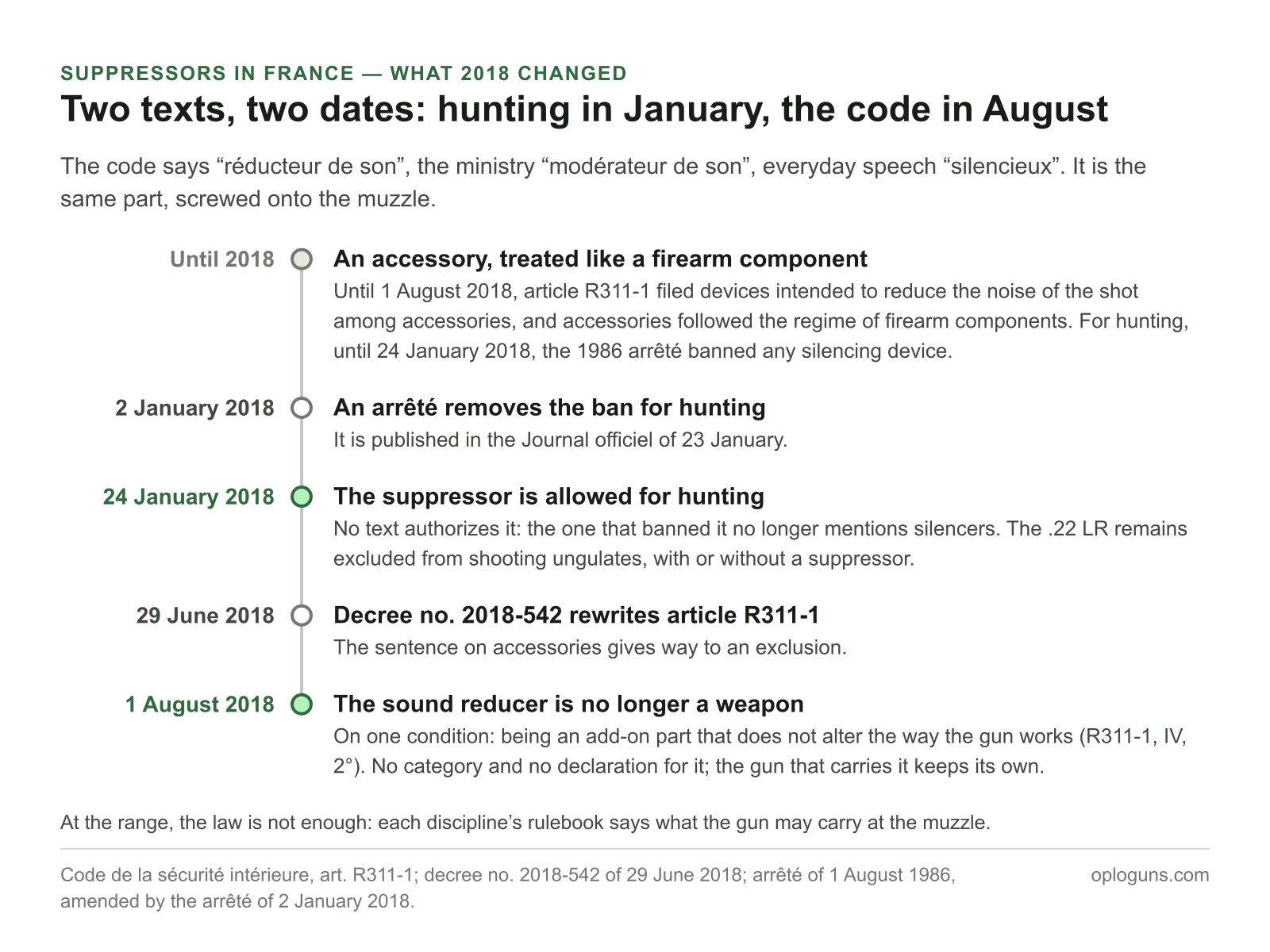
No text authorizes the suppressor for hunting. A text removed its ban. Until 24 January 2018, article 2 of the arrêté (ministerial order) of 1 August 1986 banned, « pour la chasse de tout gibier et pour la destruction des animaux nuisibles » [for hunting any game and for destroying pests], « l'emploi sur les armes à feu de tout dispositif silencieux destiné à atténuer le bruit au départ du coup » [the use on firearms of any silencing device intended to reduce the noise of the shot]5.
The arrêté of 2 January 2018, published in the Journal officiel (the official gazette) of 23 January, comes down to one useful article: those words « sont supprimés » [are deleted]6. Article 2 as amended has applied since 24 January 2018. The version in force of the 1986 arrêté no longer speaks of silencers5.
The ministry explained it in answer to written questions from senators and members of the National Assembly. The arrêté « permet l'utilisation de modérateurs de sons sur les armes à feu de chasse » [allows the use of sound moderators on hunting firearms]. These are not, it writes, « de silencieux mais de dispositifs qui atténuent la puissance acoustique du coup de feu d'une vingtaine de décibels en moyenne » [silencers but devices that reduce the acoustic power of the gunshot by about twenty decibels on average]78. The stated aim: « protéger l'ouïe des tireurs » [to protect shooters' hearing]. The choice by caliber is detailed in choosing a suppressor for a hunting rifle.
For .22 LR, another rule of the same arrêté weighs more. Its article 3 bans « pour le tir des ongulés » [for shooting ungulates] any rimfire firearm5. Roe deer, red deer and wild boar are therefore closed to it, suppressor or not. The hunting license remains the only document that opens hunting: see shooting license or hunting license.
Transporting a suppressor: alone, or fitted to the gun
On its own, in a bag, the suppressor escapes the ban on transport without a legitimate reason. Article R315-1 sets that ban for « des armes, éléments d'arme et munitions des catégories C et D » [weapons, firearm components and ammunition of Categories C and D]9. The sound reducer is neither, within the meaning of R311-11.
Fitted to the rifle, it travels with it, and the gun sets the rule9:
- The document: the shooting license counts as a transport permit for the guns of its sport, Categories A to D; the hunting license, for Category C firearms intended for hunting.
- The manner: a firearm travels « de manière à ne pas être immédiatement utilisable » [in such a way that it is not immediately usable], by a technical device or by removing one of its components.
Case, trigger lock or dismantling: the options are compared in transporting your firearm to the range.
Suppressors at the range: it depends on the discipline
At the range, the law is not enough. Each discipline's rulebook says what the gun may carry at the muzzle.
| Discipline | Suppressor | Text |
|---|---|---|
| Precision Rifle .22 LR, Factory division | Allowed | IPRF, 4.2.811 |
| Precision Rifle .22 LR, Open division | No additional equipment rule | IPRF, 4.2, Open division11 |
| TAR, .22 LR semi-automatic rifle (821) | Allowed | TAR rulebook, annex A10 |
| ISSF rifle, including 50 m | Not named; any device in the barrel or a tube banned | ISSF, 7.4.1.512 |
| ISSF 25 m pistol | Compensators, muzzle brakes and similar devices banned | ISSF, 8.4.1.612 |
Precision Rifle writes it in so many words: in the rimfire Factory division, « un réducteur de son, un frein de bouche ou un tuner peut être monté » [a sound reducer, a muzzle brake or a tuner may be fitted], and the barrel « peut être chanfreiné et / ou fileté » [may be crowned and/or threaded]11. The FFTir's rulebook for TAR (tir aux armes réglementaires, service-firearm shooting), for its .22 LR semi-automatic rifle: « Tous les types de visée sont autorisés, avec ou sans réducteur de son » [All types of sights are allowed, with or without a sound reducer]10. The match formats are in Precision Rifle in France and service-firearm shooting.
The ISSF rulebook, for its part, does not name the suppressor. On the rifle, it bans compensators and muzzle brakes, then "any construction or device inside the barrel or tube, other than rifling and chambering"12. A suppressor's baffles are housed in a tube13, and extension tubes go through equipment control12. The 50 m three-position event is presented in getting started in 50 m rifle.
How many decibels a suppressor takes off
About twenty on average, according to the ministry7. Published measurements give the same order:
- The NIOSH team, the American institute for occupational health (2018): 17 to 24 dB less peak at the shooter's ear, 20 to 28 dB at the position of an instructor, one meter behind, across four firearms and three suppressors14.
- Lobarinas and colleagues (2016): 7 to 32 dB depending on conditions, across nine AR-15 rifles and fourteen suppressors. Near the right ear, the peak most often stayed above 140 dB15.
Twenty decibels less is a sound pressure divided by ten16. Yet the ministry compares the suppressed shot to the noise of a running jackhammer7.
The .22 LR starts from lower down. At the shooter's ear, a .17 or .22 caliber rifle peaks at around 140 to 144 dB unsuppressed, against 159 to 174 dB for larger calibers13. The models for this caliber are compared in choosing a .22 LR suppressor. The World Health Organization recommends not exceeding 140 dB peak for adults, 120 dB for children13. NIOSH concludes that shooters keep their hearing protection on, suppressor or not14: protectors and their ratings are compared in hearing protection for shooting. The case of air guns is covered separately in the quiet pellet rifle.
Subsonic bullets and suppressors: the gains add up
A subsonic round leaves the muzzle below 341 m/s. It burns less powder and no longer produces the crack of supersonic flight. On its own, it lowers the peak by 10 or 15 dB13.
With a suppressor, the two effects combine. On .223 and .308 rifles, at three microphone positions, the peaks recorded were as follows13:
| Ammunition | Unsuppressed | Suppressed |
|---|---|---|
| Subsonic | 127 to 149 dB | 100 to 132 dB |
| Supersonic | 148 to 161 dB | 120 to 137 dB |
The ministry draws the limit for hunting from this: big-game bullets, held to a minimum power, « restent supersoniques, avec ou sans modérateur de son » [remain supersonic, with or without a sound moderator]7. In .22 LR, the sound barrier and the effect of cold are detailed in .22 LR subsonic, standard or high velocity. A suppressor that is too tight can also shift the group: the check is in zeroing your riflescope.
Four misconceptions about silencers and the law
- "Silencers are banned in France." No. The code has not counted it as a weapon since 1 August 201812, and hunting has allowed it since 24 January 201856.
- "It follows the gun's category." That was the "accessories" regime until 20182. The current text takes it out of weapons1.
- "With one, shooting becomes silent." The ministry compares it to a jackhammer7. Near the right ear, the peak of a suppressed AR-15 most often stayed above 140 dB15.
- "A suppressor means no ear protection." NIOSH recommends hearing protection for every shot, suppressor included14.
Suppressors: what the law changes depending on use
For hunting
The suppressor has been allowed since 24 January 2018, with no document of its own. In return, the .22 LR remains excluded from shooting ungulates, and a validated hunting license is still required to hunt.
For shooting at the range
The suppressor is allowed in Precision Rifle .22 LR and on the TAR semi-automatic rifle. In return, the ISSF rulebook bans any device in the barrel or a tube, and each discipline has its own rulebook.
To protect your hearing
The suppressor takes 17 to 24 dB off the peak at the shooter's ear, more with a subsonic round. In return, the peak can stay above 140 dB: earmuffs or plugs keep their place.
This article summarizes the texts in force on 4 November 2026, cited with their version. The text in force prevails: a decree can change a definition. A discipline's rulebook is checked with the club or the referee, the category of a specific gun with the gunsmith or the prefecture.
Sources 16 references
The texts cited come from Légifrance, the Sénat, the Assemblée nationale and INERIS, in the version stated for each; the sporting rulebooks, from the federations that publish them; the noise measurements, from peer-reviewed scientific journals. Everything was reread on 4 November 2026. Unless noted, the documents are in French. Click a note marker in the text to highlight the matching source.
- Légifrance — article R311-1 du code de la sécurité intérieure, version in force since 7 September 2025 (decree no. 2025-894 of 5 September 2025, art. 1), consulted on 4 November 2026: I, 12°, « La longueur de référence du canon d'une arme d'épaule se mesure de l'extrémité arrière de la chambre jusqu'à l'autre extrémité du canon, les parties démontables non comprises » [the reference barrel length of a long gun is measured from the rear end of the chamber to the other end of the barrel, removable parts not included]; 19°, « Elément d'arme : partie d'une arme essentielle à son fonctionnement : le canon, la carcasse, la boîte de culasse, y compris le cas échéant ses parties supérieures et inférieures, la culasse, y compris le cas échéant son ensemble mobile additionnel, le barillet, les systèmes de fermetures et la conversion » [firearm component: part of a firearm essential to its operation: the barrel, the frame, the receiver, including where applicable its upper and lower parts, the bolt or slide, including where applicable its additional moving assembly, the cylinder, the locking systems and the conversion kit]; « IV.-Ne sont pas des armes au sens du présent titre : […] 2° Les réducteurs de son constituant des pièces additionnelles ne modifiant pas le fonctionnement de l'arme » [IV. The following are not weapons within the meaning of this title: … 2° sound reducers that are add-on parts not altering the way the firearm works]. The words « modérateur » and « silencieux » do not appear in it.
- Légifrance — article R311-1 du code de la sécurité intérieure, earlier versions, consulted on 4 November 2026: version in force from 11 May 2017 to 1 August 2018, I, 1°, « Accessoires : pièces additionnelles ne modifiant pas le fonctionnement intrinsèque de l'arme, constituées par tous dispositifs destinés à atténuer le bruit causé par le tir de l'arme. Les accessoires suivent le régime juridique des éléments d'arme » [accessories: add-on parts not altering the intrinsic operation of the firearm, consisting of any devices intended to reduce the noise caused by firing it. Accessories follow the legal regime of firearm components]; version in force from 1 August 2018, amended by decree no. 2018-542 of 29 June 2018, art. 2: IV, 2°, « Les réducteurs de son constituant des pièces additionnelles ne modifiant pas le fonctionnement de l'arme » [sound reducers that are add-on parts not altering the way the firearm works].
- Légifrance — article R311-2 du code de la sécurité intérieure, version in force since 7 September 2025 (decree no. 2025-894), consulted on 4 November 2026: Category C, 1°, b), « A répétition manuelle dont le projectile a un diamètre inférieur à 20 mm équipées de systèmes d'alimentation permettant le tir de 11 munitions au plus, sans qu'intervienne le réapprovisionnement » [manual repeating, projectile under 20 mm in diameter, fitted with feed systems allowing 11 rounds at most to be fired without reloading]; Category B, 2°, c), « Dont la longueur totale minimale est inférieure ou égale à 80 centimètres ou dont la longueur du canon est inférieure ou égale à 45 centimètres » [whose minimum overall length is 80 centimeters or less or whose barrel length is 45 centimeters or less]. The words « réducteur », « modérateur », « silencieux » and « accessoire » do not appear in it.
- Légifrance — article L312-1 du code de la sécurité intérieure, version in force since 21 June 2019, consulted on 4 November 2026: « Nul ne peut acquérir et détenir légalement des matériels de guerre, armes, munitions et leurs éléments de toute catégorie s'il n'est pas âgé de dix-huit ans révolus, sous réserve des exceptions définies par décret en Conseil d'Etat pour la chasse et les activités encadrées par la fédération sportive ayant reçu, au titre de l'article L. 131-14 du code du sport, délégation du ministre chargé des sports pour la pratique du tir » [no one may lawfully acquire and hold war materiel, weapons, ammunition and their components of any category unless they are at least eighteen, subject to the exceptions defined by decree for hunting and for the activities supervised by the sports federation holding the sports minister's delegation for the practice of shooting].
- Légifrance — arrêté du 1er août 1986 relatif à divers procédés de chasse, de destruction des animaux nuisibles et à la reprise du gibier vivant dans un but de repeuplement [order on various methods of hunting, pest destruction and the capture of live game for restocking], consulted on 4 November 2026: article 2 in force from 30 May 2015 to 24 January 2018, « Sont interdits pour la chasse de tout gibier et pour la destruction des animaux nuisibles : » [are banned for hunting any game and for destroying pests:] […] « l'emploi sur les armes à feu de tout dispositif silencieux destiné à atténuer le bruit au départ du coup » [the use on firearms of any silencing device intended to reduce the noise of the shot]; article 2 in force from 24 January 2018 to 31 December 2023, amended by the arrêté of 2 January 2018, art. 1, without that mention; version in force, no article mentions silencer, moderator or reducer; article 3, in force since 7 August 2004: « Est interdit l'emploi pour le tir des ongulés de toute arme à percussion annulaire » [the use of any rimfire firearm for shooting ungulates is banned].
- INERIS, AIDA database — arrêté du 2 janvier 2018 modifiant l'arrêté du 1er août 1986 relatif à divers procédés de chasse, JO no. 18 of 23 January 2018, NOR: TREL1736224A, consulted on 4 November 2026: article 1, « L'article 2 de l'arrêté du 1er août 1986 susvisé est ainsi modifié : Au troisième alinéa, les mots : « - l'emploi sur les armes à feu de tout dispositif silencieux destiné à atténuer le bruit au départ du coup ; » sont supprimés » [article 2 of the arrêté of 1 August 1986 is amended as follows: in the third paragraph, the words on the use on firearms of any silencing device intended to reduce the noise of the shot are deleted].
- Sénat — question écrite n° 03048 de M. Arnaud Bazin, JO Sénat of 1 February 2018, p. 404, answer from the ministry for the ecological and inclusive transition, JO Sénat of 22 February 2018, p. 862, consulted on 4 November 2026: « L'arrêté ministériel du 2 janvier 2018 permet l'utilisation de modérateurs de sons sur les armes à feu de chasse. Il ne s'agit pas de silencieux mais de dispositifs qui atténuent la puissance acoustique du coup de feu d'une vingtaine de décibels en moyenne » [the ministerial arrêté of 2 January 2018 allows the use of sound moderators on hunting firearms. These are not silencers but devices that reduce the acoustic power of the gunshot by about twenty decibels on average]; « Il s'agit bien de protéger l'ouïe des tireurs, non pas de rendre le tir silencieux » [the aim is indeed to protect shooters' hearing, not to make the shot silent]; the minimum power test « exigé pour le tir des grands gibiers à balles, qui restent supersoniques, avec ou sans modérateur de son » [required for shooting big game with bullets, which remain supersonic, with or without a sound moderator]; « Le niveau sonore atteint est similaire à la puissance sonore émise par un marteau piqueur en fonctionnement » [the sound level reached is similar to the sound power emitted by a running jackhammer]; the shot is still heard « à plusieurs dizaines de mètres de distance » [several dozen meters away].
- Assemblée nationale — question écrite n° 5052 de Mme Typhanie Degois, answer published in the JO of 27 February 2018, p. 1771, and question écrite n° 7187 de Mme Laurence Vanceunebrock-Mialon, answer published in the JO of 28 May 2019, p. 5006, consulted on 4 November 2026: same answer from the ministry for the ecological and inclusive transition; in 2019, « L'arrêté ministériel modifié du 1er août 1986 […] permet l'utilisation de modérateurs de sons sur les armes à feu de chasse » [the amended ministerial arrêté of 1 August 1986 allows the use of sound moderators on hunting firearms].
- Légifrance — articles R315-1, R315-2 et R315-4 du code de la sécurité intérieure, Title I « Armes et munitions » (articles R311-1 to R317-14), versions in force since 1 August 2018, consulted on 4 November 2026: R315-1, 3°, « Le port et le transport sans motif légitime des armes, éléments d'arme et munitions des catégories C et D » [the carrying and transport without a legitimate reason of weapons, firearm components and ammunition of Categories C and D]; R315-2, 2°, the hunting license « vaut titre de transport légitime des armes, éléments d'arme et munitions de catégorie C ainsi que des armes du a de la catégorie D, destinés à être utilisés en action de chasse » [counts as a legitimate transport permit for Category C firearms, components and ammunition and for the weapons of a of Category D, intended to be used while hunting]; 3°, the shooting license of a delegated federation « vaut titre de transport légitime des armes, éléments d'arme, systèmes d'alimentation et munitions des catégories A, B et C ainsi que des armes, éléments d'arme et munitions de la catégorie D utilisés dans la pratique du sport relevant de ladite fédération » [counts as a legitimate transport permit for weapons, components, feed systems and ammunition of Categories A, B and C and for weapons, components and ammunition of Category D used in the practice of the sport governed by that federation]; R315-4, firearms « sont transportées de manière à ne pas être immédiatement utilisables, soit en recourant à un dispositif technique répondant à cet objectif, soit par démontage d'un de leurs éléments » [are transported in such a way that they are not immediately usable, either by using a technical device that meets that aim, or by removing one of their components].
- Fédération française de tir — Règlement TAR, saison 2025-2026 (PDF, distributed on 12 January 2026, validated by the board on 6 December 2025), reread on 4 November 2026: annex A, discipline 821, « Carabines semi-automatiques cal. .22 LR (catégorie B) » [semi-automatic rifles, .22 LR caliber (Category B)]: « Tous les types de visée sont autorisés, avec ou sans réducteur de son » [all types of sights are allowed, with or without a sound reducer].
- FRPRA — Règlement Precision Rifle IPRF, version française v1.3 (PDF, updated on 9 September 2026), reread on 4 November 2026: 4.2, rimfire divisions; Open division, « Il n'y a pas de règles supplémentaires en matière d'équipement » [there are no additional equipment rules]; Factory division, 4.2.7.2, « Le canon peut être chanfreiné et / ou fileté » [the barrel may be crowned and/or threaded]; 4.2.8, « Un réducteur de son, un frein de bouche ou un tuner peut être monté » [a sound reducer, a muzzle brake or a tuner may be fitted].
- ISSF — Rule Book, Edition 2025, Third Print 10/2026 (PDF, in English), in force since 19 October 2026, reread on 4 November 2026: 7.4.1.5, rifle, "Barrels and extension tubes must not be perforated in any way. Compensators and muzzle breaks on the rifle are prohibited. Any construction or device inside the barrel or tube, other than rifling and chambering for the cartridge or pellet, is prohibited. Extension tubes must be inspected by Equipment Control"; 8.4.1.6 b), 25 m pistol, "Compensators, muzzle brakes, perforated barrels or any device(s) functioning in a similar manner are not allowed". The words "silencer", "suppressor" and "moderator" do not appear in it.
- Meinke D. K., Finan D. S., Flamme G. A., Murphy W. J., Stewart M., Lankford J. E., Tasko S. — "Prevention of Noise-Induced Hearing Loss from Recreational Firearms", Seminars in Hearing, 2017, vol. 38, no. 4, pp. 267-281 (in English), reread on 4 November 2026: a suppressor couples "a large-volume chamber to the muzzle"; "Baffles within the chamber act to diffuse the energy of the blast wave"; table 1, peaks at the left ear of a right-handed shooter, "Rifles (0.17 and 0.22 caliber) ∼140–144", "Rifles (higher caliber than 0.22) ∼159–174"; "The World Health Organization recommends peak SPLs not exceed 140 dB for adults and 120 dB for youth"; ammunition below 341 m/s: "can lower peak SPL measurements by 10 or 15 dB"; measurements by Murphy et al. on .223 and .308 rifles, three microphone positions: subsonic rounds from 100 to 132 dB suppressed, from 127 to 149 dB unsuppressed; supersonic rounds from 120 to 137 dB suppressed, from 148 to 161 dB unsuppressed.
- Murphy W. J., Flamme G. A., Campbell A. R., Zechmann E. L., Tasko S. M., Lankford J. E., Meinke D. K., Finan D. S., Stewart M. — "The reduction of gunshot noise and auditory risk through the use of firearm suppressors and low-velocity ammunition", International Journal of Audiology, 2018, vol. 57, suppl. 1, pp. S28-S41 (in English), abstract reread on 4 November 2026: three suppressors on four firearms; "The suppressors reduced exposures at the ear between 17 and 24 dB peak sound pressure level"; at the instructor's position, about one meter behind the shooter, "between 20 and 28 dB peak"; "firearm users should always wear hearing protection whenever target shooting or hunting".
- Lobarinas E., Scott R., Spankovich C., Le Prell C. G. — "Differential effects of suppressors on hazardous sound pressure levels generated by AR-15 rifles", International Journal of Audiology, 2016, vol. 55, suppl. 1, pp. S59-S71 (in English), abstract reread on 4 November 2026: nine AR-15 rifles and fourteen suppressors; "under most rifle/ammunition conditions, levels remained above 140 dB peak SPL near a user's right ear"; "Overall suppression ranged from 7-32 dB across conditions".
- Calculation: the sound pressure level equals 20 × log10 of the pressure ratio; a drop of 20 dB therefore corresponds to a pressure divided by 10 (20 × log10 10 = 20).
Frequently asked questions
Is a silencer legal in France?
Yes. Since 1 August 2018, article R311-1 of the code de la sécurité intérieure files among the things that are not weapons sound reducers that are add-on parts not altering the way the firearm works. No category covers it. For hunting, its ban was removed by an arrêté of 2 January 2018, applied since 24 January 2018.
Do you need a license to buy a suppressor?
The code attaches no category, authorization or declaration to it: it is neither a weapon within the meaning of article R311-1 nor a firearm component. The gun it is fitted to keeps its own rules. A bolt-action .22 LR rifle, in Category C, is bought on presentation of a shooting license or a validated hunting license, then declared.
Can you hunt with a suppressor?
Yes, since 24 January 2018. The arrêté of 2 January 2018 removed from the arrêté of 1 August 1986 the ban on any silencing device intended to reduce the noise of the shot. In .22 LR, another limit remains: article 3 of the same arrêté bans rimfire firearms for shooting ungulates.
How many decibels does a suppressor take off?
About twenty decibels on average, according to the ministry in charge of hunting. A NIOSH team measured 17 to 24 dB less peak at the shooter's ear; a 2016 study on AR-15 rifles, 7 to 32 dB depending on conditions. The shot remains loud: the ministry compares it to the noise of a jackhammer.
Is a suppressor allowed in shooting competition?
It depends on the discipline. The IPRF Precision Rifle rulebook allows it in the .22 LR Factory division, the FFTir's TAR rulebook on the .22 LR semi-automatic rifle of event 821. The ISSF rulebook does not name it, but bans on the rifle compensators, muzzle brakes and any device placed inside the barrel or an extension tube.
Spotted an error, or a rule that has changed since we checked? Report an error