Suppressor for a hunting rifle: .243, .308, .30-06, .300 Win Mag — which one to choose
Published on · Updated on · 9 min read · Anthony Baillon
A hunting suppressor, or sound moderator, is chosen by caliber, then by thread, magnum rating, length and weight. A .308, a .30-06 and a .300 Win Mag take a .30 suppressor, rated magnum for the last. One .30 model seen at two gun shops: €316; others go over €800.
At a glance
| Criterion | What decides | Benchmark |
|---|---|---|
| Caliber | A bore at least equal to the bullet | Groups .224 to .375 at A-Tec |
| Magnum | The manufacturer's rating | .300 Win Mag: model declared magnum |
| Mount | Over the barrel or forward of the muzzle | 67 to 150 mm added |
| Weight | Diameter and material | 260 to 490 g at A-Tec |
- French hunting has allowed it since 24 January 2018; the big-game bullet remains faster than sound.
- The muzzle brake does the opposite for the ear: it sends the noise back toward the shooter.
Suppressors for hunting: what French law says
The arrêté (ministerial order) of 1 August 1986, which sets the prohibited hunting methods, banned « tout dispositif silencieux destiné à atténuer le bruit au départ du coup » [any silencing device intended to reduce the noise of the shot]. The order of 2 January 2018 removed those words, from 24 January 201812. In its version in force, the 1986 order no longer mentions silencer, moderator or sound suppressor1.
The ministry responsible for hunting gave the purpose of the measure: « protéger l'ouïe des tireurs, non pas de rendre le tir silencieux » [to protect shooters' hearing, not to make the shot silent]3. The code de la sécurité intérieure, France's internal security code, does not count among firearms « les réducteurs de son constituant des pièces additionnelles ne modifiant pas le fonctionnement de l'arme » [sound suppressors that are add-on parts not altering the operation of the firearm]4. The rifle keeps its category and its purchase requirements.
The exact texts, transport included, are in suppressors: what French law says. Electronic optics, for their part, remain on a closed list: see thermal scopes and night vision. That leaves choosing the model, and caliber decides before everything else.
Suppressor caliber: .243, .308, .30-06, .300 Win Mag
A suppressor is bored for a group of calibers. Hausken offers internals with different clearance bores for different caliber groups, and sets a rule: the bore must have at least the diameter of the caliber fired5. A-Tec builds its Optima in modules: by changing the two front modules, it goes from one caliber to another between .224 and .3756.
| Cartridge | Caliber group | What remains to be checked |
|---|---|---|
| .243 Win | To be checked | The manufacturer's listing for the .243 |
| .308 Win | .30 | The barrel's thread pitch |
| .30-06 | .30 | The barrel's thread pitch |
| .300 Win Mag | .30, magnum | The stated magnum rating |
Groups on the Optima 45 sheet: .224, .264 (6.5), .30, .338 and .3757.
A suppressor that is too wide remains usable, at a loss. Hausken writes it: a caliber smaller than the suppressor's works, with a loss of performance, because gas leaks around the bullet5. A single .30 suppressor for a .243 and a .308 is therefore a compromise, not an equivalence.
Suppressor for a .300 Win Mag: the magnum rating
A .300 Win Mag fires a .30-caliber bullet, with more powder. Manufacturers set apart the models that accept it. A-Tec asks you to confirm a model's compatibility for magnum use8. Hausken lists for magnums a titanium-core version of its JAKT range and its WHISPER MEGA XTRM59.
The barrel changes too. On a Tikka T3x, the manual gives an M15 × 1 thread for magnum calibers, against M14 × 1 in general10. At Tikka, the suppressor from a .308 therefore does not necessarily screw onto the .300 Win Mag. Thread pitch and the unthreaded barrel are covered in suppressor thread pitch.
Over-barrel or muzzle-forward: the added length
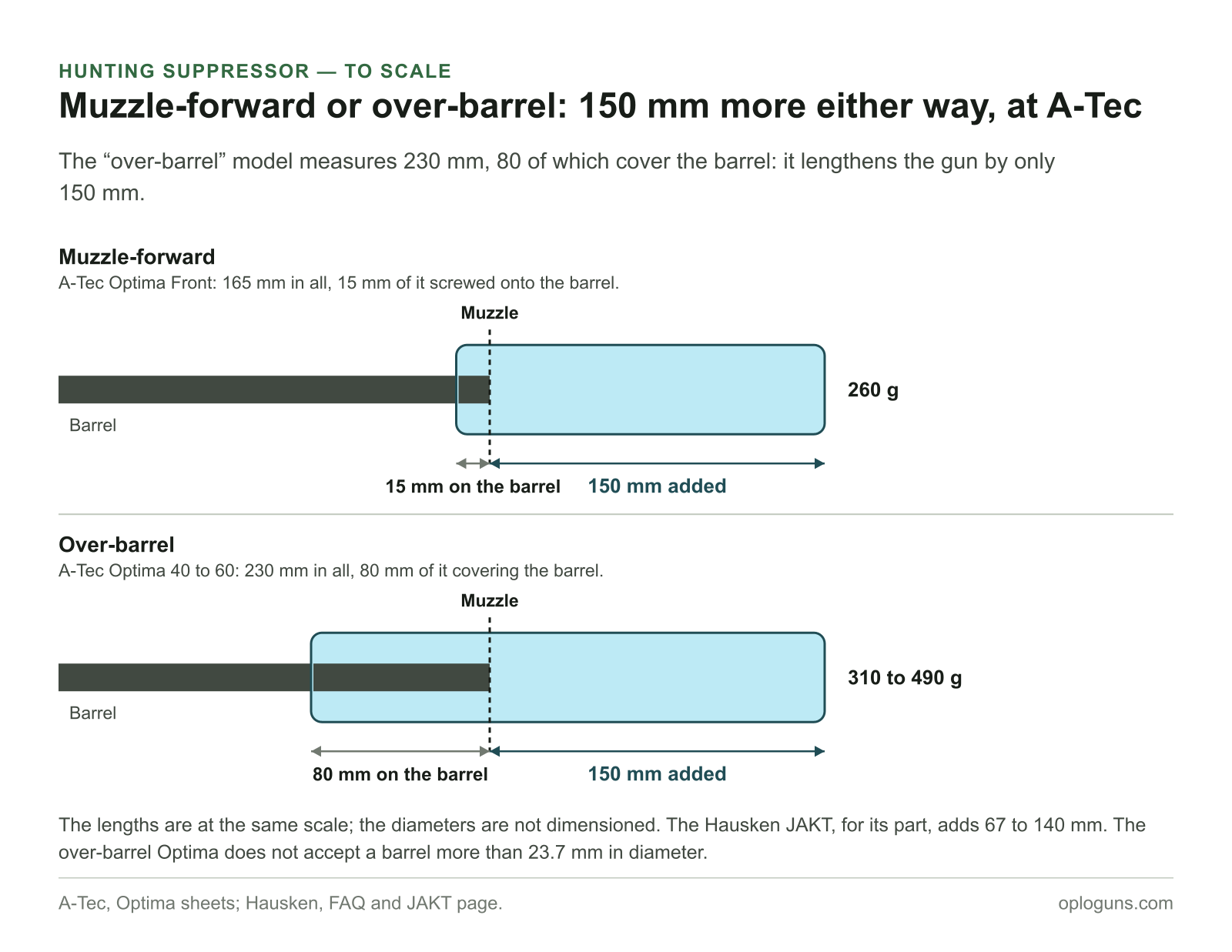
A "muzzle-forward" suppressor covers little of the barrel: A-Tec's Optima Front, 165 mm long in all, covers 15 mm of it and lengthens it by 150 mm6. An "over-barrel" suppressor, the kind that sleeves back over the barrel, covers part of it and lengthens it only by a fraction5. Hausken sees the first mostly on guns with a red dot or open sights5.
| Model | Mount | Added length | Weight | Listed |
|---|---|---|---|---|
| A-Tec Optima Front | Muzzle-forward | 150 mm | 260 g | 28 dB(C) |
| A-Tec Optima 40 | Over-barrel, 80 mm | 150 mm | 310 g | 26 dB(C) |
| A-Tec Optima 45 | Over-barrel, 80 mm | 150 mm | 335 g | 29 dB(C) |
| A-Tec Optima 50 | Over-barrel, 80 mm | 150 mm | 395 g | 31 dB(C) |
| A-Tec Optima 60 | Over-barrel, 80 mm | 150 mm | 490 g | 35 dB(C) |
| Hausken JAKT, Ø 50 mm | Over-barrel | 67 to 140 mm | — | — |
A-Tec sheets, measurements in .308 Winchester under MIL-STD-1474D67; Hausken JAKT page9.
The table shows the trade-off. At A-Tec, for the same length, each gain in diameter adds listed decibels and weight: from 310 to 490 grams, or 180 grams more, the weight of an apple, at the end of the barrel. The over-barrel model has one more limit: the Optima does not accept a barrel more than 23.7 mm in diameter6.
Spec-sheet decibels: measured beside the muzzle
Manufacturers measure under the military standard MIL-STD-1474D, microphone one meter to the left of the muzzle57. Hausken lists about 31 dB for its standard models and 34 dB on average for the XTRM models, with a stainless-steel mesh5. Those figures compare with one another.
At the shooter's ear, NIOSH, the US occupational safety and health institute, measured something else: 17 to 24 dB less at peak, on other guns and other suppressors11. Those figures cannot be subtracted from the ones on spec sheets. Without a suppressor, a rifle in a caliber above .22 peaks at around 159 to 174 dB at the ear12, well above the recommended limit of 140 dB.
Part of the noise escapes the suppressor. The ministry writes it: big-game bullets, held to a minimum power, « restent supersoniques, avec ou sans modérateur de son » [remain supersonic, with or without a sound moderator]3. The crack of the bullet in flight remains. So does hearing protection: earmuffs are compared in hearing protection for shooting.
Suppressor or muzzle brake: recoil versus the ear
The muzzle brake sends the gases out to the sides, through slots or holes at the end of the barrel, to counter recoil. A review by audiologists published in 2017 recommends avoiding it: it ejects the gases closer to the ear and sends more sound pressure back toward the shooter12. It puts no figure on the difference.
The suppressor reduces recoil too, Hausken writes, by slowing the gases in its chambers5. A-Tec even offers a brake screwed onto the end of the Optima, for significantly reduced recoil7.
Muzzle brake
Pros
- Made for recoil: the gases go out to the sides.
Cons
- More noise toward you: the 2017 review recommends avoiding it.
Suppressor
Pros
- Less noise at the ear: 17 to 24 dB less at peak.
- Less recoil too, according to Hausken.
Cons
- Longer and heavier: 150 mm and up to 490 g at A-Tec.
- Maintenance: removed after shooting, dried, oiled.
Suppressor maintenance: steel or aluminum
A-Tec distinguishes between materials. Steel stands up better to heat and sustained fire; aluminum requires letting it cool, for example after five rounds without a pause8. The Optima combines an aluminum body and a stainless-steel core6.
After shooting, A-Tec and Tikka say the same thing: the suppressor comes off the gun, dries, then gets a little oil. The residue contains ammonia, and trapped moisture rusts the barrel810.
The point of impact moves too. Hausken speaks of a few centimeters after fitting and recommends a check at the range5. The method is in zeroing a riflescope.
Price of a .30 suppressor: from €316 to over €800
Only one .30 model was seen at two gun shops on 15 November 2026: the Tikka Optisup Hunt M18 × 1, at €3161415. Above €800, two gun shops each listed a .30 suppressor in stock, a Hausken in both cases, one of them at a reduced price1316. The other models recorded were seen at one seller only, several of them out of stock.
An adapter is added if the barrel's pitch differs from the suppressor's: the case is covered in suppressor thread pitch.
Three misconceptions about the hunting suppressor
- "With a suppressor, the shot can no longer be heard." The ministry compares the level reached to that of a jackhammer, and the bullet remains supersonic3.
- "A .30 suppressor suits every caliber." The bore must be at least equal to the bullet, and a smaller caliber loses performance5.
- "The muzzle brake protects the ear too." The 2017 review recommends avoiding it: it sends the noise back toward the shooter12.
Hunting suppressor: the choice by rifle
For a .308 or a .30-06
A .30 suppressor in the barrel's pitch, muzzle-forward or over-barrel. In return, it adds about 150 mm and 260 to 490 grams at A-Tec, and the point of impact is checked again after fitting.
For a .300 Win Mag
A model rated for magnums by its manufacturer, in the magnum barrel's pitch. In return, the choice is narrower, and the pitch may differ from that of the brand's other rifles.
For a .243
A suppressor whose manufacturer lists the .243. In return, a .30 suppressor shared with another rifle works, but with a loss of performance.
The decibels cited are the manufacturers', measured under their standard, and those of NIOSH, measured at the ear. The text in force prevails: order of 1 August 1986 and code de la sécurité intérieure in their version of 15 November 2026. Check the thread pitch and the magnum rating in the manuals of the gun and the suppressor, or with a gunsmith.
Sources 16 references
The legal texts come from Légifrance, the French Senate and INERIS, in the version indicated; the specifications, from the manufacturers' sheets and manuals; the noise measurements, from peer-reviewed scientific journals; the prices, from the sellers' pages. Everything was reread on 15 November 2026, unless stated otherwise. Click a reference number in the text to highlight the matching source.
- Légifrance — arrêté du 1er août 1986 relatif à divers procédés de chasse, de destruction des animaux nuisibles et à la reprise du gibier vivant dans un but de repeuplement [order of 1 August 1986 on various methods of hunting, of destroying pest animals and of recapturing live game for restocking] (in French), consulted on 15 November 2026: the version in force contains neither « silencieux », nor « modérateur », nor « réducteur de son »; article 2 in force until 24 January 2018, « Sont interdits pour la chasse de tout gibier et pour la destruction des animaux nuisibles » […] « l'emploi sur les armes à feu de tout dispositif silencieux destiné à atténuer le bruit au départ du coup » [prohibited for hunting any game and for destroying pest animals: the use on firearms of any silencing device intended to reduce the noise of the shot] (earlier version reread on 4 November 2026 for the article on suppressor law).
- INERIS, AIDA database — arrêté du 2 janvier 2018 modifiant l'arrêté du 1er août 1986 [order of 2 January 2018 amending the order of 1 August 1986] (in French), Journal officiel no. 18 of 23 January 2018, NOR: TREL1736224A: article 1, the words « l'emploi sur les armes à feu de tout dispositif silencieux destiné à atténuer le bruit au départ du coup » « sont supprimés » [are removed]. Reread on 4 November 2026.
- Sénat — question écrite n° 03048 de M. Arnaud Bazin [written question no. 03048] (in French), answer from the ministry for the ecological and inclusive transition, Journal officiel of the Senate of 22 February 2018, p. 862: « Il s'agit bien de protéger l'ouïe des tireurs, non pas de rendre le tir silencieux » [the aim is indeed to protect shooters' hearing, not to make the shot silent]; big game shot with bullets, « qui restent supersoniques, avec ou sans modérateur de son » [which remain supersonic, with or without a sound moderator]; « Le niveau sonore atteint est similaire à la puissance sonore émise par un marteau piqueur en fonctionnement » [the sound level reached is similar to the sound power of a jackhammer in operation]. Reread on 4 November 2026.
- Légifrance — article R311-1 du code de la sécurité intérieure (in French), version in force since 7 September 2025 (decree no. 2025-894), consulted on 15 November 2026: IV, 2°, « Les réducteurs de son constituant des pièces additionnelles ne modifiant pas le fonctionnement de l'arme » [sound suppressors that are add-on parts not altering the operation of the firearm].
- Hausken — FAQ, read on 15 November 2026: "Internal workings with different clearance bores are offered for different calibre groups. It must be ensured that the passage bore has at least the diameter of the calibre used"; smaller caliber: "Yes, but with a loss of performance in terms of silencing. The silencer achieves the optimal silencing performance when the bullet calibre matches the inner diameter as best as possible"; "the HAUSKEN WHISPER MEGA XTRM […] is also suitable for MAGNUM calibres"; "Over-barrel silencers only lengthen the barrel by a small percentage, while on-barrel silencers lengthen the barrel by their full size. On-barrel silencers are mainly used for guns with a red dot or open sights"; measurement under MIL-STD-1474D, "100 cm to the left of the silencer's exit"; "The standard variants of HAUSKEN silencers mean a reduction of approx. 31 dB. For the XTRM models, the average is around 34 dB"; "The silencing performance of a silencer also leads to a reduction in the recoil of the weapon"; "the point of impact is shifted by a few centimetres"; "we recommend checking the shot pattern at a shooting range". ⚠️ Manufacturer's presentation.
- A-Tec — Optima rifle system silencers, read on 15 and then 16 November 2026: "possible to change the two front modules to make it fit another calibre within the .224 - .375 range"; Optima 40, 26 dB(C), 310 g; 45, 29 dB(C), 335 g; 50, 31 dB(C), 395 g; 60, 35 dB(C), 490 g; all "over barrel length" 80 mm, "added length" 150 mm, total 230 mm, "max barrel diameter" Ø 23.7 mm; Optima Front, 28 dB(C), 260 g, "over barrel length" 15 mm, "added length" 150 mm, "total length" 165 mm; "a hardened aluminum alloy […] and a stainless steel core". ⚠️ Manufacturer's data.
- A-Tec — Optima 45 sheet (PDF), read on 15 November 2026: "All recorded data is in compliance with MIL-STD-1474 D standards"; "DbC measure cartridge": ".308 Winchester"; "Available calibres": ".224 | .264 (6,5) | .30 | .338 | .375"; "Possible to add end cap brake (ECB) for significant reduced recoil". ⚠️ Manufacturer's data.
- A-Tec — Maintenance and instructions, read on 15 November 2026: "For magnum or full-auto use, confirm model compatibility"; "Steel models offer higher heat tolerance and sustained fire capability. Aluminium models require stricter heat control"; "(e.g., 5 rounds max without pause for aluminium models)"; "Always remove the silencer from the rifle before transport or storage"; "Apply a light coat of oil inside and on the threads once dry"; "Residue from firing contains corrosive compounds like ammonia". ⚠️ Manufacturer's instructions.
- Hausken — JAKT and JAKT, variants, read on 15 November 2026: "as on- and over-barrel designs"; "a Magnum-ready titanium core variant"; JD151, JD184 and JD224, Ø 50 mm, "a very small weapon extension of 67/100/140 mm". ⚠️ Manufacturer's presentation.
- Sako — Tikka T1x and T3x manual, version 5.3 (PDF, French text included), read on 15 November 2026: "Muzzle thread": "M14x1", "Except: 8x57IS, 9.3x62, Magnum Calibers... M15x1", "Varmint, Super Varmint, Sporter, TAC... M18x1"; « N'oubliez pas de démonter le modérateur de son du canon après avoir tiré. L'humidité émanant du modérateur de son peut entraîner la corrosion de l'âme du canon » [remember to remove the sound moderator from the barrel after shooting; moisture from the moderator can corrode the bore]; « Pour monter un frein de bouche sur le modèle Tikka/Sako (filetage M14/M15) » [to fit a muzzle brake on the Tikka/Sako model (M14/M15 thread)], « Pour monter un frein de bouche sur le modèle Tikka/Sako TACT (filetage à pas métrique M18x1) » [to fit a muzzle brake on the Tikka/Sako TACT model (M18x1 metric thread)].
- Murphy W. J., Flamme G. A., Campbell A. R. et al. — "The reduction of gunshot noise and auditory risk through the use of firearm suppressors and low-velocity ammunition", International Journal of Audiology, 2018, vol. 57, suppl. 1, pp. S28-S41: "The suppressors reduced exposures at the ear between 17 and 24 dB peak sound pressure level".
- Meinke D. K., Finan D. S., Flamme G. A. et al. — "Prevention of Noise-Induced Hearing Loss from Recreational Firearms", Seminars in Hearing, 2017, vol. 38, no. 4, pp. 267-281, reread on 15 November 2026: table 1, "Rifles (higher caliber than 0.22) ∼159–174" dB peak at the ear; 140 dB recommended at most for adults; "Muzzle brakes (ports) are utilized to counter the physical effects of recoil (kickback) when a gun is discharged by redirecting the propellant gases perpendicularly relative to the barrel through slots, vents, holes, or baffles positioned at the end of the muzzle. The use of muzzle brakes should be avoided because they increase the noise hazard. Escaping gases are ejected closer to the ear and radiate more sound pressure backward toward the shooter, which increases the exposure measured at the shooter's ear" (no figure in dB).
- Armurerie Auxerre — silencieux et modérateurs de son [silencers and sound moderators] (in French), recorded on 15 November 2026: Hausken HX-Ti3 cal. .30 M18x1 €829.90, in stock; other .30 models seen at this seller only, several of them out of stock. ⚠️ Commercial data.
- Armurerie Centrale — silencieux [silencers] (in French), recorded on 15 November 2026: Tikka Optisup Hunt silencer M18X1 - .30, €315.90. ⚠️ Commercial data.
- Armurerie Loisir — silencieux [silencers] (in French), recorded on 15 November 2026: Tikka Optisup Hunt sound moderator M18X1 .30 €315.90. ⚠️ Commercial data.
- Armurerie Lavaux — silencieux et modérateurs de son [silencers and sound moderators] (in French), recorded on 15 November 2026: Hausken WHISPER WX456 MEGA XTRM MKII cal. .30 €835.50 (struck-through price €975.00). ⚠️ Commercial data.
Frequently asked questions
Which suppressor for a .308?
A .30-caliber suppressor, in the barrel's thread pitch: M14 × 1 on most Tikka T3x rifles, M18 × 1 on their Varmint, Sporter and TAC versions, according to the manual. At A-Tec, the Optima 45, measured in .308 Winchester, lists 29 dB(C) for 335 grams. The only .30 model seen at two French gun shops, the Tikka Optisup Hunt, cost €316; others went over €800.
Which suppressor for a .30-06?
The .30-06 fires a .30-caliber bullet, like the .308: the same .30 suppressors take it, if they are listed for it. On a Tikka T3x, the manual gives an M14 × 1 thread apart from magnum calibers and particular versions. The suppressor's bore must be at least equal to the diameter of the bullet, Hausken points out.
Suppressor or muzzle brake?
Both reduce recoil, by opposite means. The muzzle brake sends the gases out to the sides; a 2017 review by audiologists recommends avoiding it, because it sends more noise back toward the shooter's ear. The suppressor holds the gases in its chambers: NIOSH measures 17 to 24 dB less at peak at the ear.
Is a suppressor allowed for hunting in France?
Yes. The ministerial order of 2 January 2018 removed the ban on the « dispositif silencieux » [silencing device] from the order of 1 August 1986, from 24 January 2018. The version of that order now in force no longer mentions either silencer or moderator. The ministry presented the measure as intended to « protéger l'ouïe des tireurs » [protect shooters' hearing].
How do you choose a suppressor?
In order: the caliber, which the suppressor must accept; the barrel's thread pitch; the magnum rating if needed; then the added length, the weight, and whether it mounts over the barrel or forward of the muzzle. The decibels on spec sheets compare with one another, not with what the ear perceives.
Spotted an error, or a rule that has changed since we checked? Report an error