Thermal scopes and night vision: what French law allows, and how to choose
Published on · 10 min read · Anthony Baillon
In France, the thermal riflescope is excluded from hunting. The arrêté of 1 August 1986 lists only thermal or light-intensifying monoculars and binoculars, hands-free devices excepted; yet the ministry writes that it reserves their use for public officers. Some night vision devices are war materiel.
At a glance
| Device | For hunting | Text |
|---|---|---|
| Thermal or intensifying monocular, binoculars | Listed, hands-free use excepted; ministry's reservation | Art. 7; answer of 23 June 2026 |
| Thermal clip-on on the scope | Excluded | 1986 arrêté, art. 7 |
| Thermal riflescope | Excluded | L424-4; answer of 23 June 2026 |
| Hands-free device | Excluded; war materiel if it falls under 14° | Art. 7; R311-2, A2 |
- Before any purchase for hunting, the departmental hunters' federation or the prefecture answers.
- Free sale is not free use, the ministry writes.
Thermal scopes: excluded from permitted hunting aids
The French environment code sets the principle: « Tous les moyens d'assistance électronique à l'exercice de la chasse, autres que ceux autorisés par arrêté ministériel sont prohibés » [All electronic aids to hunting, other than those authorized by ministerial arrêté, are prohibited]1. Whatever is not on the list is banned.
The list is in article 7 of the arrêté (ministerial order) of 1 August 1986, in its version in force since 10 July 2026: « sont seuls autorisés pour la chasse […] les moyens d'assistance électronique suivants » [only the following electronic aids are authorized for hunting]2. No thermal riflescope appears in it.
The ministry in charge of hunting confirmed it in an answer published in the Journal officiel, the official gazette, on 23 June 2026. The arrêté, it writes, changed in the summer of 2025 « pour rappeler l'interdiction » [to restate the ban] on devices usable hands-free or fixed to a gun by an adapter. And it concludes: « L'interdiction couvre donc bien le cas des lunettes de tir dites « thermiques » » [The ban therefore does cover so-called "thermal" riflescopes]3.
A thermal riflescope is fixed to the gun: that is the case the ban targets. If it records video, article 2 bans it on a hunting gun as well (see below). No hunting use is open to it.
Night vision and thermal: what article 7 lists
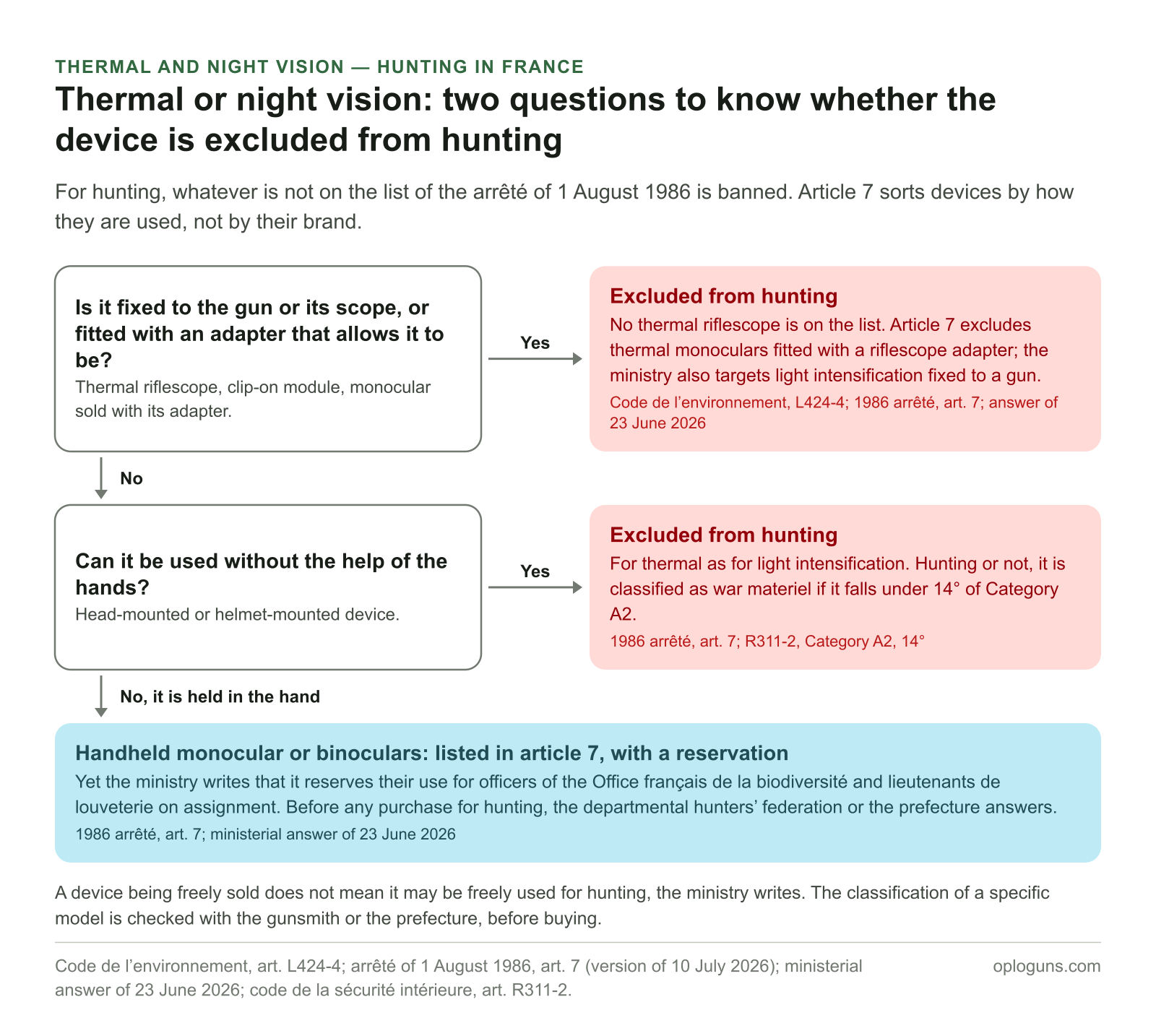
Article 7 names two families of observation devices, each with its limit2:
- Light intensification: « les appareils monoculaires ou binoculaires à intensification ou amplification de lumière, à l'exclusion des appareils qui peuvent être mis en oeuvre sans l'aide des mains » [monocular or binocular light-intensifying or light-amplifying devices, excluding devices that can be operated without the help of the hands].
- Thermal: « les appareils monoculaires ou binoculaires thermiques, à l'exclusion des appareils qui peuvent être mis en œuvre sans l'aide des mains dont les monoculaires équipés d'un adaptateur leur permettant d'être fixé sur une lunette de tir » [thermal monocular or binocular devices, excluding devices that can be operated without the help of the hands, including monoculars fitted with an adapter allowing them to be fixed to a riflescope].
The ministerial answer of 23 June 2026 adds a sentence that article 7 does not contain. It writes that « la réglementation réserve strictement l'usage de ces dispositifs aux agents de l'Office français de la biodiversité et aux lieutenants de louveterie, formés à cette technologie et uniquement lorsqu'ils interviennent dans le cadre d'une mission ordonnée par le préfet » [the regulations strictly reserve the use of these devices for officers of the Office français de la biodiversité (the state biodiversity agency) and lieutenants de louveterie (volunteer wildlife-control officers), trained in this technology and only when acting on an assignment ordered by the prefect]3.
Two texts, two readings
For a hunter, the two texts do not read the same way. Article 7 lists monoculars and binoculars. The ministry's answer reserves their use for public officers. Before any purchase or use for hunting, the departmental hunters' federation (fédération départementale des chasseurs) or the prefecture answers.
On the aiming side, the same list keeps only optics without imaging2:
- Scopes « à réticule lumineux fixées sur les armes à feu » [with an illuminated reticle, fixed to firearms].
- Red dot sights « sans convertisseur ou amplificateur d'image, et sans rayon laser » [with no image converter or intensifier, and no laser beam].
- Rangefinders, which may be built into scopes with no « système de correction automatique de la visée » [automatic aim-correction system].
These optics are compared in the hunting scope and the red dot for driven hunts.
No device changes hunting hours. The hunting license gives « le droit de chasser de jour » [the right to hunt by day], and « Le jour s'entend du temps qui commence une heure avant le lever du soleil au chef-lieu du département et finit une heure après son coucher » [Day means the time that begins one hour before sunrise at the department's administrative seat and ends one hour after sunset]1. The license itself is presented in shooting license or hunting license.
Device classification: Category A2 for some
"Thermal" does not appear in the firearms classification4. The code targets technologies and a mode of use. Article R311-2 of the code de la sécurité intérieure, the French internal security code, files in Category A2, among war materiel, at 14°4:
- « Matériels d'observation ou de prise de vues conçus pour l'usage militaire » [observation or imaging equipment designed for military use];
- « matériels de visée ou de vision nocturne ou par conditions de visibilité réduite utilisant l'intensification de lumière ou l'infrarouge passif destinés exclusivement à l'usage militaire » [aiming or night vision equipment, or equipment for reduced visibility, using light intensification or passive infrared, intended exclusively for military use];
- and « matériels utilisant les mêmes technologies qui peuvent être mis en œuvre sans l'aide des mains » [equipment using the same technologies that can be operated without the help of the hands].
The ministry, asked about thermal devices, writes that « certains font l'objet d'un classement » [some are classified] by that 14°. Those « sont par principe interdits d'acquisition et de détention » [are in principle banned from acquisition and holding], except those intended for the military, law enforcement or certain administrations. « A côté de cette catégorie, d'autres matériels moins performants sont sous un régime d'acquisition et de détention libres » [Alongside this category, other, less capable equipment is under a regime of free acquisition and holding]3.
The text sets no numerical performance threshold4. The classification of a specific device therefore cannot be deduced from its spec sheet: it is checked with the gunsmith or the prefecture, before buying. Categories A to D are presented in firearm categories.
Free sale, regulated use
The ministry says it in one sentence: free sale « ne signifie pas que leur usage n'est pas encadré pour certaines activités, notamment la chasse » [does not mean that their use is not regulated for certain activities, hunting in particular]3. A device sold in a gun shop can still be banned for hunting.
Clip-on, headset, camera: three cases the text settles
Three setups raise questions. The text settles them one by one:
- The clip-on, a thermal or night vision module sold to be fixed to a riflescope7. For thermal, article 7 excludes by name monoculars « équipés d'un adaptateur leur permettant d'être fixé sur une lunette de tir » [fitted with an adapter allowing them to be fixed to a riflescope]2. For intensification, the ministerial answer also targets devices « fixés sur une arme par l'intermédiaire d'un adaptateur » [fixed to a gun by means of an adapter]3.
- The head-mounted or helmet-mounted device, usable hands-free. Excluded from hunting by article 7, for both families2. Hunting or not, it is classified under 14° of Category A2 if it falls within its terms4.
- The video function on the gun. Article 2 bans, for hunting any game, « l'emploi sur les armes à feu et les arcs d'appareils disposant de fonctions de capture photographiques ou vidéos » [the use on firearms and bows of devices with photo or video capture functions]. Article 7 departs from it only for a camera of 15 centimeters at most, placed under the barrel and triggered by the shot25.
Thermal monocular: sensor, lens, sensitivity
For the observation device that article 7 lists, and once its use for hunting has been checked with the federation, the manufacturer's spec sheet gives four useful figures. Three models from the same Pulsar range show them6:
| Pulsar Axion Compact | XQ19 | XQ30 Pro | XG35 |
|---|---|---|---|
| Sensor | 384 × 288, 17 µm | 384 × 288, 17 µm | 640 × 480, 12 µm |
| Lens | 19 mm | 30 mm | 35 mm |
| Magnification | 1.5 to 6 | 2 to 8 | 2.5 to 20 |
| Field of view at 100 m | 34.7 m | 23.3 m | 21.9 m |
| System sensitivity | < 18 mK | < 20 mK | < 20 mK |
| Battery life, weight | 8 h, 250 g | — | 7 h, 300 g |
Weights without battery, battery life at 22 °C, according to the manufacturer6.
- The sensor sets the number of pixels in the image. A 640 × 480 has 307,200, which is 2.8 times more than a 384 × 2888.
- The lens sets the trade-off. On these three models, the longer it is, the higher the magnification and the narrower the field: from 34.7 m to 21.9 m wide, at 100 m, between the XQ19 and the XG35.
- Sensitivity, in millikelvins, is what Pulsar highlights for observation in bad weather on its XQ30 Pro6.
- Battery life and weight decide comfort: 250 grams, the weight of a block of butter, and 8 hours for the smallest.
384 × 288 sensor
Pros
- Wide field: 34.7 m at 100 m on the XQ19.
- Light and long-lasting: 250 grams, 8 hours.
Cons
- Fewer pixels: 110,592, against 307,200 in 640 × 480.
- Limited magnification: 6 times at most on the XQ19.
640 × 480 sensor
Pros
- More pixels: 2.8 times more, 307,200 in all.
- Extended magnification: up to 20 times on the XG35.
Cons
- Narrower field: 21.9 m at 100 m on the XG35.
- Heavier, shorter battery life: 300 grams, 7 hours.
Three misconceptions about thermal scopes
- "Sold in a gun shop, so allowed for hunting." The ministry distinguishes free sale from use, which is regulated « notamment » [in particular] for hunting3.
- "A clip-on is not a scope." For thermal, article 7 excludes by name monoculars fitted with a riflescope adapter2.
- "A hands-free device is just an accessory." Point 14° of Category A2 files some of them among war materiel34.
Thermal scope or monocular: choosing by use
To observe
Monoculars and binoculars that need the hands appear in article 7. In return, the ministerial answer of 23 June 2026 reserves their use for public officers: before buying for hunting, the departmental hunters' federation or the prefecture answers.
To aim
A conventional scope, with or without an illuminated reticle, or a red dot with no image converter or intensifier: choosing one is covered in choosing a riflescope. In return, no thermal or night imaging on the rifle when hunting.
For a hands-free device
No route for hunting: article 7 excludes it. Hunting or not, it is classified under 14° of Category A2 if it falls within its terms; the ministry writes that only some equipment is. The classification of a specific model is checked before buying.
This article cites the texts in force on 15 November 2026: code de la sécurité intérieure, environment code and arrêté of 1 August 1986 in its version of 10 July 2026. The text in force prevails. The classification of a specific device is checked with the gunsmith or the prefecture; its use for hunting, with the departmental hunters' federation or the prefecture.
Sources 8 references
The texts come from Légifrance and the Assemblée nationale, in the version stated; the specifications, from the manufacturers' sheets. Everything was reread on 15 November 2026. Unless noted, the documents are in French. Click a note marker in the text to highlight the matching source.
- Légifrance — article L424-4 du code de l'environnement, in force since 9 March 2012 (law no. 2012-325 of 7 March 2012), consulted on 15 November 2026: « Dans le temps où la chasse est ouverte, le permis donne à celui qui l'a obtenu le droit de chasser de jour » [while hunting is open, the license gives its holder the right to hunt by day]; « Le jour s'entend du temps qui commence une heure avant le lever du soleil au chef-lieu du département et finit une heure après son coucher » [day means the time that begins one hour before sunrise at the department's administrative seat and ends one hour after sunset]; « Tous les moyens d'assistance électronique à l'exercice de la chasse, autres que ceux autorisés par arrêté ministériel sont prohibés » [all electronic aids to hunting, other than those authorized by ministerial arrêté, are prohibited].
- Légifrance — arrêté du 1er août 1986 relatif à divers procédés de chasse, article 7 [order on various hunting methods], amended by the arrêté of 25 June 2026, in force since 10 July 2026, consulted on 15 November 2026: « En application de l'article L. 424-4 du code de l'environnement, sont seuls autorisés pour la chasse et la destruction des espèces d'animaux classées susceptibles d'occasionner des dégâts les moyens d'assistance électronique suivants : » [under article L. 424-4 of the environment code, only the following electronic aids are authorized for hunting and for destroying animal species listed as liable to cause damage:]; « les viseurs à point rouge, sans convertisseur ou amplificateur d'image, et sans rayon laser » [red dot sights, with no image converter or intensifier, and no laser beam]; « les lunettes à réticule lumineux fixées sur les armes à feu » [illuminated-reticle scopes fixed to firearms]; « les télémètres, qui peuvent être intégrés dans les lunettes de visée fixées sur les armes à feu à la condition que ces dernières ne soient pas équipées d'un système de correction automatique de la visée » [rangefinders, which may be built into scopes fixed to firearms provided the scopes are not fitted with an automatic aim-correction system]; « les appareils monoculaires ou binoculaires à intensification ou amplification de lumière, à l'exclusion des appareils qui peuvent être mis en oeuvre sans l'aide des mains » [monocular or binocular light-intensifying or light-amplifying devices, excluding devices that can be operated without the help of the hands]; « les appareils monoculaires ou binoculaires thermiques, à l'exclusion des appareils qui peuvent être mis en œuvre sans l'aide des mains dont les monoculaires équipés d'un adaptateur leur permettant d'être fixé sur une lunette de tir » [thermal monocular or binocular devices, excluding devices that can be operated without the help of the hands, including monoculars fitted with an adapter allowing them to be fixed to a riflescope]; « par dérogation aux dispositions de l'article 2 du présent arrêté, les appareils disposant de fonctions de vidéos à déclenchement automatique par la détonation d'une longueur maximum de 15 centimètres et placés sous le canon des armes à feu » [by way of exception to article 2 of this arrêté, devices with video functions triggered automatically by the shot, of a maximum length of 15 centimeters and placed under the barrel of firearms]. Text of the article cross-checked against the consolidated version distributed by the Aude hunters' federation (data of 10 July 2026). The arrêté of 25 June 2026 itself could not be read.
- Assemblée nationale — question écrite n° 2443 de M. Matthias Renault, « Utilisation des appareils de vision thermique pour la chasse au gibier d'eau » [use of thermal vision devices for waterfowl hunting], published in the JO on 3 December 2024, p. 6418, answer from the ministry for the ecological transition published in the JO on 23 June 2026, p. 5770, read on 15 November 2026: « Parmi ces matériels, certains font l'objet d'un classement par l'article R. 311-2 (14° de la rubrique 2) du code de la sécurité intérieure » [among this equipment, some is classified by article R. 311-2 (14° of heading 2) of the internal security code]; « Ces matériels classés sont par principe interdits d'acquisition et de détention, sauf ceux destinés aux militaires, aux forces de l'ordre ou de sécurité intérieure voire à certaines administrations pour accomplir certaines missions déterminées. A côté de cette catégorie, d'autres matériels moins performants sont sous un régime d'acquisition et de détention libres, ce qui signifie qu'ils sont en vente libre. En revanche, cela ne signifie pas que leur usage n'est pas encadré pour certaines activités, notamment la chasse » [this classified equipment is in principle banned from acquisition and holding, except that intended for the military, law enforcement or internal security forces, or certain administrations for specific assignments. Alongside this category, other, less capable equipment is under a regime of free acquisition and holding, which means it is sold freely. That does not mean, however, that its use is not regulated for certain activities, hunting in particular]; « la réglementation réserve strictement l'usage de ces dispositifs aux agents de l'Office français de la biodiversité et aux lieutenants de louveterie, formés à cette technologie et uniquement lorsqu'ils interviennent dans le cadre d'une mission ordonnée par le préfet » [the regulations strictly reserve the use of these devices for officers of the Office français de la biodiversité and lieutenants de louveterie, trained in this technology and only when acting on an assignment ordered by the prefect]; « Cet arrêté a d'ailleurs évolué à l'été 2025 pour rappeler l'interdiction d'utiliser des appareils monoculaires ou binoculaires à intensification, amplification de lumière ou thermique, pouvant être mis en œuvre sans l'aide des mains ou étant fixés sur une arme par l'intermédiaire d'un adaptateur. L'interdiction couvre donc bien le cas des lunettes de tir dites « thermiques » » [this arrêté moreover changed in the summer of 2025 to restate the ban on using light-intensifying, light-amplifying or thermal monocular or binocular devices that can be operated without the help of the hands or are fixed to a gun by means of an adapter. The ban therefore does cover so-called thermal riflescopes].
- Légifrance — article R311-2 du code de la sécurité intérieure, version in force since 7 September 2025 (decree no. 2025-894, art. 2), consulted on 15 November 2026: Category A2, « Les armes relevant des matériels de guerre, les matériels destinés à porter ou à utiliser au combat les armes à feu […] » [weapons that are war materiel, equipment intended to carry or use firearms in combat…]; 14°, « Matériels d'observation ou de prise de vues conçus pour l'usage militaire ; matériels de visée ou de vision nocturne ou par conditions de visibilité réduite utilisant l'intensification de lumière ou l'infrarouge passif destinés exclusivement à l'usage militaire et matériels utilisant les mêmes technologies qui peuvent être mis en œuvre sans l'aide des mains » [observation or imaging equipment designed for military use; aiming or night vision equipment, or equipment for reduced visibility, using light intensification or passive infrared, intended exclusively for military use, and equipment using the same technologies that can be operated without the help of the hands]. The words « thermique », « imagerie » and « lunette » do not appear in it.
- Légifrance — arrêté du 1er août 1986, article 2, in force since 31 December 2023 (arrêté of 28 December 2023), consulted on 15 November 2026: banned for hunting any game is « l'emploi sur les armes à feu et les arcs d'appareils disposant de fonctions de capture photographiques ou vidéos » [the use on firearms and bows of devices with photo or video capture functions].
- Pulsar — Axion Compact (page in English), read on 15 November 2026: XQ19, sensor "384x288", "17" µm, F19 lens, "1.5 - 6", field of view "34.7 x 21.5" m at 100 m, "System NETD, mK < 18", "8" h "at t=22°С", "0.25 (without battery)" kg; XQ30 Pro, 384x288, 17 µm, F30, "2 – 8", "23.3 x 17.5" m, System NETD < 20; "higher thermal sensitivity for close-range observation in poor weather conditions"; XG35, "640x480", "12" µm, F35, "2.5 – 20", "21.9 x 13.7" m, System NETD < 20, "7" h, "0.3 (without battery)" kg. ⚠️ Manufacturer's data.
- Armurerie Auxerre — vision nocturne, recorded on 15 November 2026: « Clip-on thermique Pard Predator 35 mm », « Adaptateur thermique frontal avec télémètre intégré » [front-mounted thermal adapter with built-in rangefinder]; « Clip-on avant vision nocturne PARD FD1 ». ⚠️ Seller's text.
- Calculation: 640 × 480 = 307,200 points; 384 × 288 = 110,592 points; 307,200 ÷ 110,592 = 2.78.
Frequently asked questions
Is a thermal riflescope allowed for hunting in France?
No. The environment code prohibits any electronic aid that an arrêté does not authorize, and article 7 of the arrêté of 1 August 1986 lists, among thermal devices, only monoculars and binoculars, excluding those that can be operated without the help of the hands. The ministry wrote as much in an answer published in the Journal officiel on 23 June 2026: the ban does indeed cover so-called thermal riflescopes.
Can you buy a thermal riflescope in France?
The ministry distinguishes two regimes. Equipment classified under 14° of Category A2 of the code de la sécurité intérieure is in principle banned from acquisition and holding, except for the military, law enforcement and certain administrations. Other, less capable equipment is sold freely. Free sale says nothing about use: for hunting, the thermal riflescope remains excluded.
Is a thermal monocular allowed for hunting?
Two texts do not read the same way. Article 7 of the arrêté of 1 August 1986, in force since 10 July 2026, lists thermal monocular or binocular devices, excluding those usable without the help of the hands and monoculars that can be fixed to a riflescope. The ministerial answer published on 23 June 2026 writes that the regulations strictly reserve the use of these devices for officers of the Office français de la biodiversité and lieutenants de louveterie, on an assignment ordered by the prefect. Before any purchase or use for hunting, the departmental hunters' federation or the prefecture answers.
Is a thermal clip-on allowed?
Not for hunting. A clip-on is a module that attaches to a riflescope. For thermal devices, article 7 of the arrêté of 1 August 1986 excludes by name monoculars fitted with an adapter that lets them be fixed to a riflescope. For light intensification, the ministerial answer of 23 June 2026 also targets devices fixed to a gun by means of an adapter.
Digital or night riflescope: is it allowed for hunting?
As far as optics fixed to the gun go, article 7 of the arrêté of 1 August 1986 lists only illuminated-reticle scopes, red dot sights with no image converter or intensifier, and built-in rangefinders with no automatic aim correction. The environment code prohibits any other electronic aid. Article 2 also bans, on guns, devices that film or take photographs.
Spotted an error, or a rule that has changed since we checked? Report an error