Choosing a riflescope: first or second focal plane, reticle, tube and price
Published on · 11 min read · Anthony Baillon
In the first focal plane, a reticle's marks stay true at every magnification; in the second, at one only. Choosing a riflescope also means choosing the reticle's unit, the tube and the parallax. The prices recorded run from €76 to €4,350. And in ISSF, no scope goes on the gun.
At a glance
| Choice | What it changes | Worth knowing |
|---|---|---|
| First focal plane | Marks true at every magnification | Fine reticle at low magnification |
| Second focal plane | Reticle of constant size | Marks true at one magnification only |
| MOA or MRAD | 2.9 cm or 10 cm at 100 m | Reticle and turrets in the same unit |
| 25.4, 30 or 34 mm tube | The rings, the weight | Elevation adjustment is read on the spec sheet |
| Adjustable parallax | Sharp image from 9 to 14 m | Otherwise set at 91 m |
- Prices recorded: from €76 for an entry-level scope to €4,350 for a high-end long-range scope, mount not included.
- In competition: banned on the gun in ISSF, free in PRS, reserved for modified rifles in French service arms shooting (TAR).
First or second focal plane: where the reticle sits
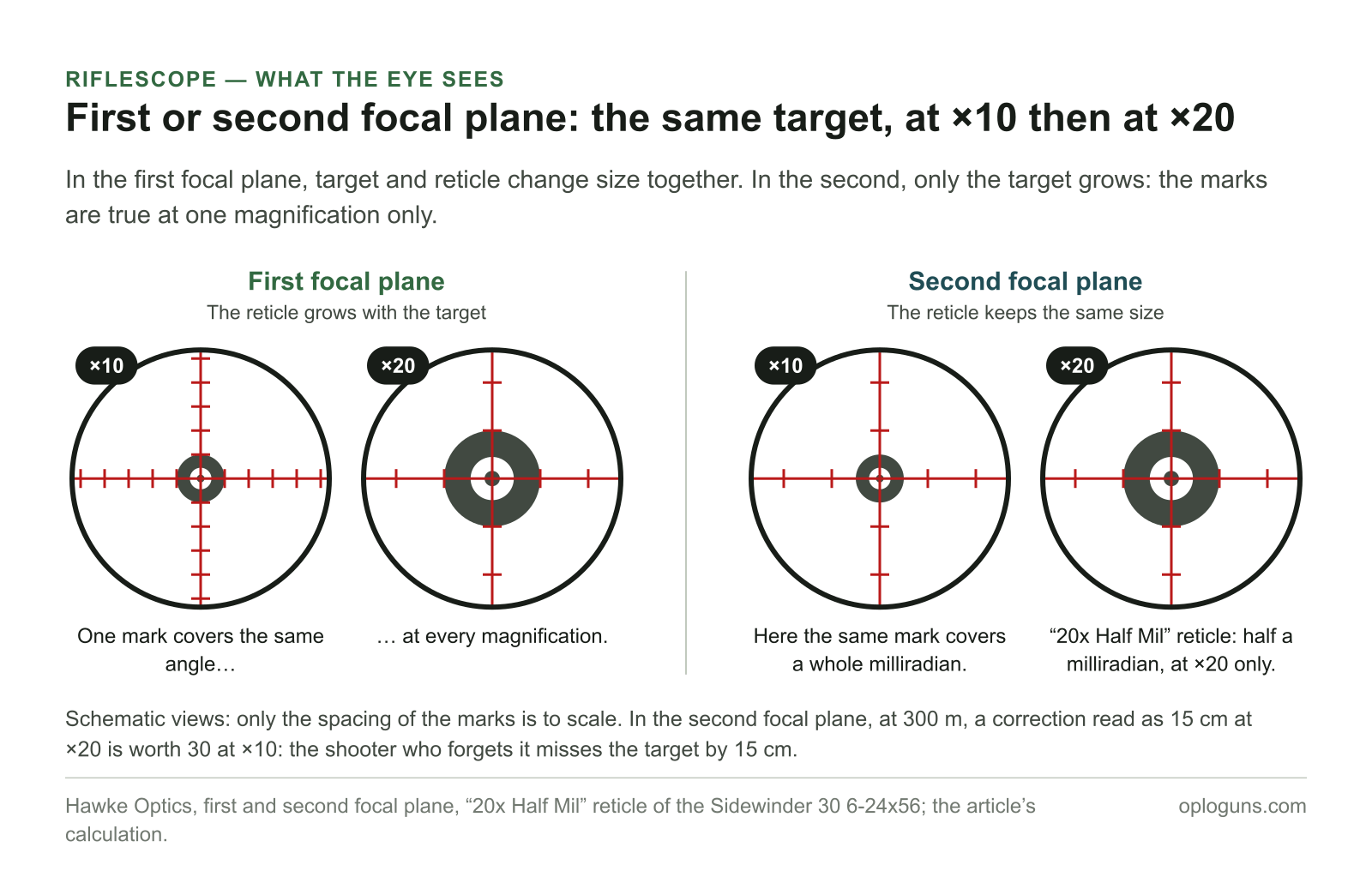
A scope forms two intermediate images of the target. The reticle is etched in one of those two planes. In the first focal plane, known as FFP, it sits on the turret side, in front of the system that changes the magnification; in the second, known as SFP, on the eyepiece side14.
The consequence shows when you turn the magnification ring. In the first focal plane, the reticle grows and shrinks at the same rate as the target: one mark covers the same angle at ×4 as at ×162. In the second, the reticle stays the same size, and its aiming points are calibrated on a single magnification34.
That magnification often appears in the reticle's name. The Hawke Sidewinder 30 6-24x56 carries a "20x Half Mil" reticle: its half-milliradian marks are worth half a milliradian only at ×205. At ×10, the same interval covers a whole milliradian17. At 300 m, a correction read as 15 cm is then worth 30. The shooter who forgets it misses the target by 15 cm.
The first focal plane
Pros
The second focal plane
Pros
MOA or MRAD reticle: the same unit as the clicks
Two units of angle share reticles and turrets between them. One minute of angle, or MOA, covers 2.9 cm at 100 m; one milliradian, or MRAD, 10 cm, a little more than the width of a bank card17. Clicks are most often worth ¼ MOA, about 7 mm at 100 m, or 0.1 mrad, 1 cm4. The click calculation, distance by distance, is in our guide to zeroing a riflescope.
The unit counts less than its consistency. The Hawke FFP scopes cited here carry a reticle in milliradians and 0.1 mrad clicks78. The Vantage 3-9x40 Mil Dot, for its part, mixes a reticle in milliradians and ¼ MOA clicks6. On that scope, a one-milliradian gap read on the reticle equals 3.44 MOA: nearly 14 clicks to count, and a conversion to redo at every correction17.
Illuminated reticle or not
Illumination lights all or part of the reticle. Its first job is to offset the drawback of the first focal plane: a reticle that has become fine at low magnification1. The Vantage 30 FFP offers five levels, in red and in green; the Frontier 34, eleven levels, with an off position between each78. The Vantage 3-9x40 has none6. For hunting in low light, Leupold favors the second focal plane instead, whose reticle does not thin out3. Thermal and night-vision devices are dealt with separately in thermal scopes and night vision.
Riflescope tube: 25.4, 30 or 34 mm, and adjustment
The tube diameter decides the rings first. Hawke points it out before any mounting: the tube and the rings must have the same diameter4. The three common diameters are one inch, or 25.4 mm, 30 mm and 34 mm678.
It also decides the weight, in part. The Vantage 3-9x40 weighs 402 g, the Frontier 34 3-18x50, 790 g68: almost 400 g of difference, one more full can on the gun.
Elevation adjustment: the tube diameter does not tell you
Maximum elevation adjustment listed by Hawke for four of its scopes, in milliradians (100 MOA = 29.1 mrad)
Hawke manufacturer sheets5678. The Vantage 3-9x40 lists 100 MOA, converted to milliradians17. With the scope delivered centered, only half of this adjustment remains available above the zero9.
View the data
| Scope | Tube | Listed adjustment | In milliradians |
|---|---|---|---|
| Hawke Vantage 3-9x40 Mil Dot | 25.4 mm | 100 MOA | 29.1 mrad |
| Hawke Vantage 30 WA FFP 4-16x50 | 30 mm | 26 mrad | 26 mrad |
| Hawke Sidewinder 30 SF 6-24x56 | 30 mm | 20 mrad | 20 mrad |
| Hawke Frontier 34 FFP 3-18x50 | 34 mm | 46 mrad | 46 mrad |
Elevation adjustment, for its part, cannot be deduced from the tube. On the Hawke sheets, the one-inch scope lists more adjustment than two 30 mm scopes567. And that figure is a total, from bottom to top. Vortex spells it out: a scope delivered centered offers only half its adjustment to compensate for bullet drop, that is 35 MOA on a scope that lists 709. Beyond that, a canted base recovers adjustment, as our guide to mounting a riflescope explains.
Riflescope parallax: fixed at 91 m or adjustable
Parallax shows when you move your head. If the reticle seems to slide across the target when the eye moves behind the eyepiece, the image of the target and the reticle are not in the same plane49. A scope without adjustment is free of it at one distance only: 100 yards, or 91 m, at Hawke46.
The adjustment is made in two ways:
- On the objective, known as AO: the front ring of the Airmax 3-9x40 goes down to 9 m10.
- Through a side knob, known as side focus: from 9 m to infinity on the Vantage 30 FFP, from 14 m on the Frontier 3478.
Vortex describes the same operation in both cases: turn the knob until the image of the target is sharp, which removes the parallax error9. For an air rifle at 10 or 20 m, or a .22 LR at 50 m, the adjustment makes the difference: those distances are far from the factory's 91 m. In PRS, the rules even provide for dry aiming, before the start, to check « parallaxe, mise au point » [parallax, focus]14.
Riflescope objective and magnification by distance
The magnification you need can be calculated. With 20/20 vision, ×5.2 is enough to see a .22 LR hole at 100 m17; the full calculation, distance by distance, is in our guide what magnification to see your hits.
That leaves the range. A 3-9x covers a ratio of 3, a 3-18x a ratio of 6. That ratio decides the field of view at the lowest magnification: 12.5 m at 100 m at ×3 on the Frontier 34, reduced to 2.1 m at ×188. The objective diameter, for its part, sets the exit pupil, and so the brightness at high magnification: 16.7 mm at ×3 on the Frontier 34 3-18x50, 2.8 mm at ×188. A larger objective also calls for higher rings.
Riflescope price: from €76 to over €4,000
Prices recorded on 4 November 2026 at two French gun shops, scope alone1112:
| Range | Models recorded | Price |
|---|---|---|
| 25.4 mm tube, second focal plane, fixed parallax | Hawke Vantage 4x32 and 3-9x40 | €76 to €169 |
| 30 mm tube, illuminated, side parallax | Hawke Vantage 30 WA 4-16x50 | €399 to €400 |
| First focal plane, 34 mm tube, MRAD | Vortex Strike Eagle 5-25x56 | €845 to €935 |
| High-end long range | Zeiss LRP S3 6-36x56, Kahles K540i 5-40x56 | €2,565 to €4,350 |
The same model changes price from one gun shop to another: €845 or €935 for the same Strike Eagle, on the same day, a gap of €901112. The scope never arrives alone: rings, rail and torque wrench come on top. What an entry-level scope gives up is detailed in the budget riflescope.
Riflescope and rules: banned in ISSF, free in PRS
Before the purchase, the discipline decides:
- ISSF, rifle: no optical system or telescope may be attached to the rifle (rule 7.4.1.6 a)13. The spotting scope, not attached to the gun, remains allowed at 50 and 300 m.
- ISSF, pistol: only open sights are allowed, and any optical or projected-dot sight is prohibited (rule 8.4.1.2 a)13. In IPSC action pistol, the optic allowed is a red dot, with no magnification.
- Precision Rifle: « Il n'y a aucune restriction concernant les optiques » [there is no restriction on optics] (rule 4.3 of the French FRPRA rules). To estimate distances, on the other hand, only binoculars, a monocular, a rangefinder or a spotting scope are used: the riflescope is not allowed for that (rule 2.1.2)14. The discipline is presented in our guide to Precision Rifle in France.
- Service arms shooting (TAR, tir aux armes réglementaires): a scope is allowed only in the modified arms category, of a service pattern and on its original mount; standard bolt-action rifles (810) and standard semi-automatic rifles allow « ni dioptre, ni lunette » [neither aperture sight nor scope]15. The detail is in our guide to TAR.
- Metallic silhouettes: field pistol has its optical-sight event, the 40916.
For all French federal events, the shooter undertakes to use optics that comply with the rules of the event16. The rules in force prevail.
Three misconceptions about choosing a riflescope
- "A bigger tube gives more adjustment." Not always: the one-inch Hawke Vantage lists 29.1 mrad, the Vantage 30 FFP 26 mrad67.
- "The second focal plane is made for beginners." Hawke recommends it for benchrest, because its reticle covers less of the target at high magnification1.
- "More magnification is always better." On the Frontier 34, going from ×3 to ×18 makes the field of view fall from 12.5 to 2.1 m at 100 m, and the exit pupil from 16.7 to 2.8 mm8.
Which riflescope for your shooting
Air rifle or .22 LR, up to 50 m
Adjustable parallax counts more than the focal plane: without it, the image is set only at 91 m. A Hawke with an adjustable objective goes down to 9 m. In return, none of these scopes goes on a rifle in ISSF competition: they serve recreation, benchrest or PR22. Zeroing an air rifle at 20 m is detailed in our guide to zeroing a scope, and what its 11 mm rail and its recoil require in the air rifle scope.
Varying distances and Precision Rifle
The first focal plane, in milliradians on the turrets as on the reticle, lets you correct with the reticle at any magnification. The Strike Eagle 5-25x56 recorded costs €845 to €935. In return, a heavier scope, and an elevation adjustment to check on the spec sheet: the 1,000 m distance uses it up quickly. The elevation adjustment of long-range scopes is compared in the long-range riflescope.
Shooting at a known distance, hunting
The second focal plane keeps a reticle readable at every magnification, and Leupold considers it suited to hunting in low light. In return, its marks hold only at the stated magnification: any correction with the reticle assumes that setting. In driven hunts, where the shot is short, the 1-6x driven-hunt scope competes with the red dot.
Sources 17 references
Definitions and specifications taken from the optics manufacturers' pages and manuals; rules taken from the rulebooks in force of the ISSF, the FRPRA and the FFTir, the French shooting federation; prices recorded on 4 November 2026 at two French gun shops; conversions calculated. Click a reference number in the text to highlight the matching source.
- Hawke Optics — First Focal Plane (FFP) & Second Focal Plane Riflescopes, 9 May 2020, reread 4 November 2026: in the first focal plane, reticle "positioned toward the turrets", whose visible size changes with magnification, aiming points identical at every magnification; in the second, reticle "positioned toward the eyepiece", of constant size, "Most SFP reticles are designed with their aimpoints calibrated on a specific magnification", example of the "10x Mil-Dot" reticle true at ×10; all the brand's FFP scopes illuminated so that the aiming points stay visible at the lowest magnification; thickness of the FFP reticle having to stay visible at the lowest magnification; SFP reticle covering less of the target, "more useful for target applications like benchrest shooting".
- Leupold — First Focal Plane (FFP) Riflescopes, reread 4 November 2026: "In first focal plane riflescopes, the reticle grows and shrinks at the same rate as the target"; "This allows you to accurately use the reticle feature at any magnification setting".
- Leupold — Second Focal Plane Rifle Scopes, reread 4 November 2026: "In second focal plane riflescopes, the reticle stays the same size"; reticles "ideal for low-light hunting situations".
- Hawke Optics — Endurance riflescope instructions (PDF, French text included), reread 4 November 2026: « Vérifiez toujours que le diamètre du tube de la lunette correspond au diamètre des bagues » [always check that the scope's tube diameter matches the ring diameter]; « Les lunettes de carabine sans réglage de parallaxe sont réglées sur 100 yards (91 mètres) » [riflescopes without parallax adjustment are set at 100 yards (91 meters)]; second focal plane, reticle « positionné vers l'oculaire » [positioned toward the eyepiece], « Chaque réticule est conçu avec des points de visée calibrés sur un grossissement spécifique » [each reticle is designed with aiming points calibrated on a specific magnification]; ¼ MOA click "7mm at 100m", 0.1 mrad click "10mm at 100m". ⚠️ Manufacturer's document hosted by a reseller.
- Hawke Optics — Sidewinder 30 SF 6-24x56, 20x Half Mil reticle, sheet reread 4 November 2026: 30 mm tube, second focal plane, side parallax from 9 m to infinity, 0.1 mrad clicks, elevation adjustment of 20 mrad, 775 g. ⚠️ Manufacturer's technical data.
- Hawke Optics — Vantage 3-9x40 Mil Dot, sheet reread 4 November 2026: 1-inch tube, second focal plane, parallax fixed at 100 yards (91 m), no illumination, Mil Dot reticle, ¼ MOA clicks, elevation adjustment of 100 MOA, field of view from 13 to 4.2 m at 100 m, 402 g. ⚠️ Manufacturer's technical data.
- Hawke Optics — Vantage 30 WA FFP 4-16x50 Half Mil Dot IR, sheet reread 4 November 2026: 30 mm tube, first focal plane, illumination "5 Levels (Red & Green)", side parallax from 9 m to infinity, 0.1 mrad clicks, elevation adjustment of 26 mrad, 745 g. ⚠️ Manufacturer's technical data.
- Hawke Optics — Frontier 34 FFP 3-18x50 Mil Pro Ext, sheet reread 4 November 2026: 34 mm tube, first focal plane, illumination "11 Levels (Red)" with intermediate off positions, side parallax from 14 m to infinity, 0.1 mrad clicks, elevation adjustment of 46 mrad, field of view from 12.5 to 2.1 m at 100 m, exit pupil from 16.7 to 2.8 mm, 790 g. ⚠️ Manufacturer's technical data.
- Vortex Optics — FAQs, reread 4 November 2026: the listed adjustment is "the total range of adjustment available from the absolute bottom to absolute top"; scope delivered "optically centered in the middle", half of the adjustment remaining available; example of a Diamondback Tactical 4-12x40 with "70 MOA of total elevation adjustment", that is 35 MOA available; 20 MOA canted bases; parallax check "by moving your head back and forth"; "When the image is sharply focused, parallax error will also be eliminated".
- Hawke Optics — Airmax 3-9x40 AO AMX, sheet reread 4 November 2026: "Parallax: Adjustable Objective", focus from 9 m to infinity. ⚠️ Manufacturer's technical data.
- Armurerie Auxerre (in French) — prices recorded 4 November 2026: Hawke Vantage 4x32 30/30 €75.65; Hawke Vantage 3-9x40 30/30 €101.15; Hawke Vantage 30 WA FFP 4-16x50 Half Mil Dot €399.90; Vortex Strike Eagle 5-25x56 EBR-7C MRAD €845.00; Zeiss LRP S3 6-36x56 ZF-MRi FFP €2,565.00. ⚠️ Commercial data.
- Armurerie Douillet (in French) — prices recorded 4 November 2026: Hawke Vantage 3-9x40 30/30 €119.50; Hawke Vantage IR 3-9x40 Mil-Dot €169.00; Hawke Vantage 30 WA SF IR 4-16x50 €399.00; Vortex Strike Eagle 5-25x56 EBR-7C IL FFP MRAD €935.00; Kahles K540i DLR 5-40x56 €4,350.00. ⚠️ Commercial data.
- ISSF — Rule Book, Edition 2025, Third Print 10/2026, in force since 19 October 2026, reread 4 November 2026: 7.4.1.6 a), "No Light enhancing system, optical sight, optical system or telescope may be attached to the rifle"; 8.4.1.2 a), "Only open sights are allowed", "Optical, mirror, telescope, laser beam, electronically projected dot sights etc. are prohibited"; 7.5.8.1, spotting scope not attached to the gun allowed in the 50 and 300 m events.
- FRPRA — Règlement Precision Rifle IPRF, version française v1.3 [IPRF Precision Rifle rules, French version v1.3] (PDF, « Mis à jour : 9 septembre 2026 » [updated 9 September 2026]), reread 4 November 2026: 4.3, « Il n'y a aucune restriction concernant les optiques dans les divisions de l'IPRF » [there is no restriction on optics in the IPRF divisions]; 2.1.1.2, dry aiming allowed to check that the optics « (parallaxe, mise au point, etc.) sont réglées correctement » [(parallax, focus, etc.) are set correctly]; 2.1.2, distances assessed with « une paire de jumelles, un monoculaire, un télémètre ou une lunette d'observation » [a pair of binoculars, a monocular, a rangefinder or a spotting scope], « Les lunettes de visée ne peuvent pas être utilisées » [riflescopes may not be used].
- FFTir, CNS TAR — Règlement TAR, saison 2025-2026 [TAR rules, 2025-2026 season, in French] (PDF, circulated 12 January 2026), reread 4 November 2026: long guns, general provisions (p. 16), « Seuls les appareils de visée d'origine ouverts ou fermés sont autorisés » [only original open or closed sights are allowed] and « Les lunettes de visée ou dispositifs optiques d'un modèle réglementaire avec leur montage d'origine sont autorisés dans la catégorie « Armes modifiées » » [scopes or optical devices of a service pattern with their original mount are allowed in the "modified arms" category]; annex A 811-812, « une lunette réglementaire (ou sa réplique conforme, y compris le montage) dont le grossissement est indiqué » [a service scope (or its faithful replica, mount included) whose magnification is stated]; annexes 810 and 815-816, standard version « Ni dioptre, ni lunette » [neither aperture sight nor scope].
- FFTir — Règlement de Gestion Sportive 2026-2027, Vie Nationale [sports management rules 2026-2027, in French] (PDF, version of 29 September 2026), reread 4 November 2026: metallic silhouettes, « Pistolet field : visée ouverte et visée optique » [field pistol: open sights and optical sights], event 409 « Production visée optique » [Production, optical sights]; participants' undertaking to use equipment « (armes, munitions, optiques, accessoires, substances) » [(guns, ammunition, optics, accessories, substances)] that complies with the rules of the event.
- Calculations: one minute of angle covers 29.09 mm at 100 m, one milliradian 100 mm; 1 mrad = 3.438 MOA, or 13.75 clicks of ¼ MOA; 100 MOA = 29.09 mrad; in the second focal plane, the angle covered by a mark varies as the inverse of the magnification (×2 at ×10 for a reticle calibrated at ×20); 0.5 mrad at 300 m = 15 cm, 1 mrad = 30 cm; minimum magnification to see a 5.6 mm hole at 100 m with 20/20 vision: 29.09 ÷ 5.6 = ×5.2; magnification ratio of a 3-18x: 18 ÷ 3 = 6. A bank card is 85.6 mm wide.
The rules in force prevail. The rules cited are those of the ISSF in force since 19 October 2026, of the FRPRA rules of 9 September 2026 and of the 2025-2026 TAR rules; the specifications are those of the manufacturers' sheets, and the prices those of 4 November 2026. An optic is checked against the rules of the event before the purchase.
Frequently asked questions
First or second focal plane: which riflescope should you choose?
It all depends on how you use the reticle marks. In the first focal plane, the reticle grows with the target: its marks cover the same angle at every magnification, which helps when you correct with the reticle at varying distances, in PRS for example. In the second focal plane, the reticle stays the same size and its marks are true only at the magnification the manufacturer states, often ×10 or ×20; it covers less of the target at high magnification.
Do you need a reticle in MOA or in MRAD?
Both units measure an angle: one minute of angle covers 2.9 cm at 100 m, one milliradian 10 cm. What counts is that the reticle and the turrets speak the same unit. Some entry-level scopes mix them: the Hawke Vantage 3-9x40 Mil Dot has a reticle in milliradians and ¼ MOA clicks, and a gap of one milliradian read on the reticle takes nearly 14 clicks.
Is a scope without parallax adjustment suitable at 50 m?
Without adjustment, Hawke sets the parallax at 100 yards, or 91 m. At another distance, the reticle seems to slide across the target when the eye moves behind the eyepiece. For an air rifle or a .22 LR at short distance, scopes with adjustable parallax go down to 9 m at Hawke, on the objective or through a side knob.
How much does a riflescope cost?
At the prices recorded on 4 November 2026 at two French gun shops: €76 to €120 for a Hawke Vantage with a 25.4 mm tube, about €400 for a 30 mm scope with an illuminated reticle and side parallax, €845 to €935 for a first focal plane Vortex Strike Eagle 5-25x56, €2,565 to €4,350 for a high-end long-range scope. The mount comes on top.
Is a riflescope allowed in sport shooting competition?
Not in ISSF: no telescope or optical system may be attached to the rifle, and the pistol allows only open sights. In Precision Rifle, the French FRPRA rules set no restriction on optics. In French service arms shooting (TAR), a scope is allowed only in the modified rifles category, of a service pattern and on its original mount. The rules of each discipline prevail.
Spotted an error, or a rule that has changed since we checked? Report an error