Service-arms shooting (TAR): events, permitted firearms and how to start
Published on · 11 min read · Anthony Baillon
Tir aux armes réglementaires (TAR), service-arms shooting, is shot with service firearms adopted since 1886. The FFTir, the French shooting federation, makes twelve events of it: pistol at 25 m, .22 LR rifle at 50 m, service rifle at 200 m. A Category C .22 LR rifle, which is simply declared, is enough to start.
At a glance
| Family | Permitted gun | Distance |
|---|---|---|
| Pistol | Service handgun, 7.62 to 11.60 mm, Category B | 25 m |
| .22 LR rifle | Military training or match rifle; semi-auto in 821 | 50 m |
| Service rifle | Service rifle, bolt-action or semi-automatic | 200 m |
- To begin: the .22 LR training rifle, in Category C, often the club's; €507 to €662 the first year.
- 2027 French championship: Vitrolles, from 25 to 27 June; regionals before 23 May.
Service-arms shooting: pros and cons
Pros
- Service firearms, old or recent: any model adopted since 1886, except specialist weapons1.
- A way in with .22 LR: the training rifle at 50 m falls under Category C, subject to simple declaration311.
- Three distances in one discipline: pistol at 25 m, rifle at 50 m, service rifle at 200 m6.
- Wide quotas at the French championship: 224 places in 830, 250 in 821 in 20279.
Cons
- Few adjustments allowed: original grips and stock, fixed sights on pistols, trigger pull of at least 1,360 g24.
- The pistol means an authorization: Category B, at least four months after the license, and a safe131416.
- A 200 m range for the service rifle: failing that, 100 m at a reduced target, with the league's agreement8.
- Jacketed ammunition: no lead bullets and no wadcutters, apart from .22 LR24.
TAR: service firearms, from 1886 to today
The rulebook defines TAR in one line: « un tir d'inspiration militaire pratiqué avec un armement réglementaire » [military-inspired shooting practiced with service weapons]1. The guns come from the armed forces and law enforcement, historical or contemporary6. They are standard-issue troop weapons, adopted from 1886 onward, firing smokeless-powder ammunition. Specialist weapons are excluded1.
The federation organizes these competitions with the Union nationale des officiers de réserve (UNOR), the reserve officers' union, and the Fédération nationale des associations de sous-officiers de réserve (FNASOR), its counterpart for reserve non-commissioned officers7. The shooting remains civilian. It is « ouvert à tous et sans distinction d'âge et de sexe » [open to all, regardless of age or sex]1.
One rule surprises newcomers. « Aucune arme détenue à titre administratif ne peut être utilisée » [No firearm held in an official capacity may be used] in competition1. The firearms of Category A1, 11°, converted automatic weapons, are refused when a club holds them411.
TAR events: twelve matches from 25 to 200 meters
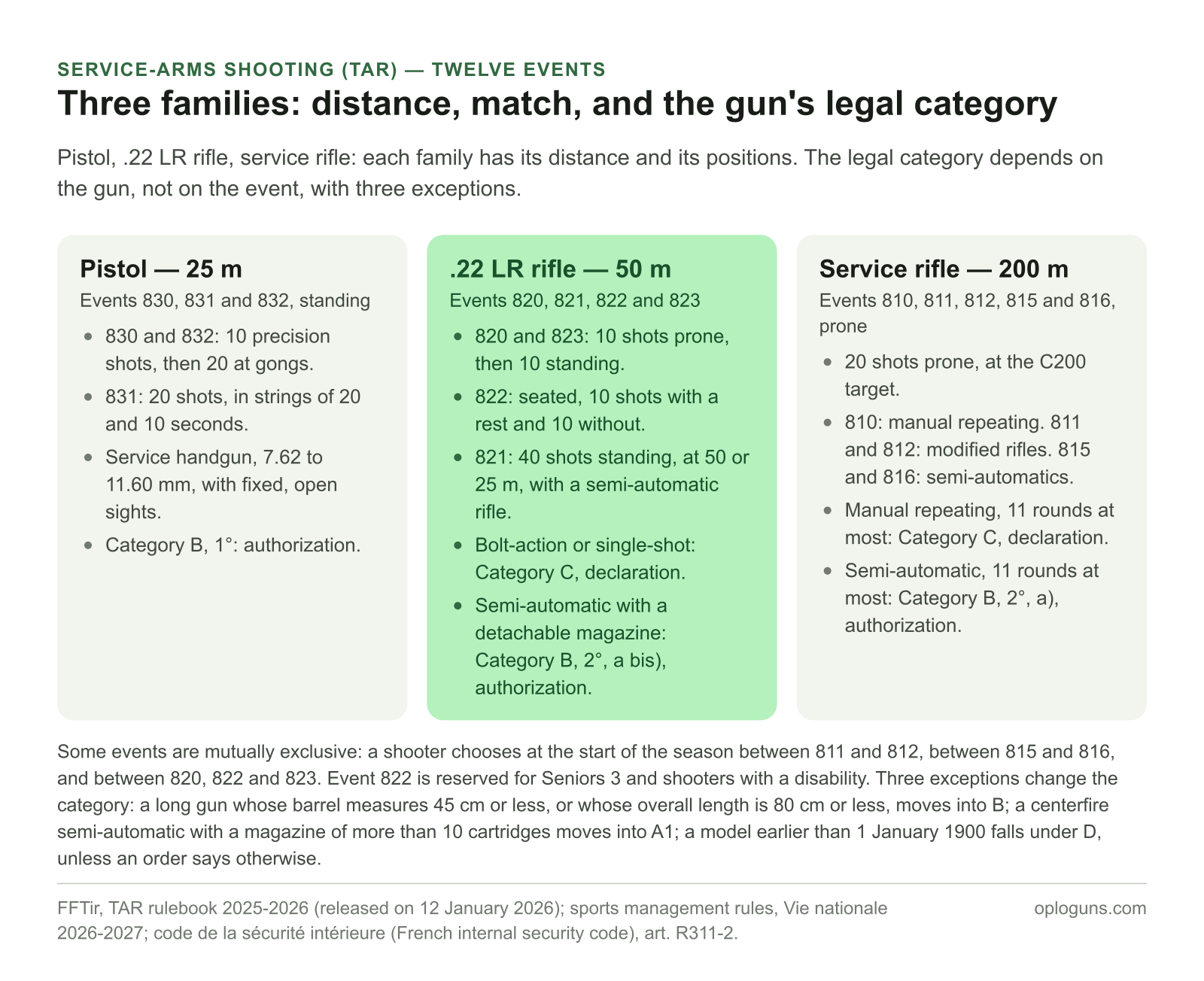
The French championship has twelve events, divided into three families8:
| No. | Event | Distance | Match shots |
|---|---|---|---|
| 830 | Pistol/revolver, recent guns | 25 m | 10 precision, 20 at gongs |
| 831 | Service rapid fire | 25 m | 20, in strings of 20 and 10 s |
| 832 | Pistol/revolver, authentic guns | 25 m | 10 precision, 20 at gongs |
| 820 | .22 LR military training rifle | 50 m | 10 prone, 10 standing |
| 821 | Semi-automatic .22 LR rifle | 50 or 25 m | 40 standing |
| 822 | .22 LR training rifle, seated | 50 m | 10 with a rest, 10 without |
| 823 | .22 LR military match rifle | 50 m | 10 prone, 10 standing |
| 810 | Manually operated repeating rifle | 200 m | 20 prone |
| 811, 812 | Modified rifle, large or small caliber | 200 m | 20 prone |
| 815, 816 | Semi-automatic rifle, large or small caliber | 200 m | 20 prone |
Most matches are shot in two stages: a precision series, then a rapid-fire series234. Events 821 and 831 shoot timed strings only. With the semi-automatic rifle, the ten rapid-fire shots fit into one minute4. The targets and their zones are detailed in our article on sport shooting target dimensions.
Some events are mutually exclusive. A shooter chooses at the start of the season between 811 and 812, between 815 and 816, and between 820, 822 and 8238. Event 822, in the seated position, is reserved for Seniors 3 and shooters with a disability8.
TAR pistol: barrel of 13 cm at most, fixed sights
The three pistol events are shot standing, at 25 meters2. Precision is shot one-handed, arm unsupported. Rapid fire, with one or two hands2. The program changed on 12 January 2026, and the 2026-2027 season carries it over. In 830 and 832, ten precision shots, then twenty shots at gongs. Each gong is worth 5 points58. The 2027 French championship has no final in 8308.
The gun is a centerfire handgun, of caliber 7.62 to 11.60 mm, with fixed, open sights2. The rulebook forbids:
- Long barrels: over 13 cm for a pistol, over 15.5 cm for a revolver, outside the list of authentic guns.
- Add-ons: counterweights, compensator, Picatinny rail above the barrel, laser or fiber-optic sights.
- Modified grips: adjustable, anatomical, in soft material or with a palm rest.
- A light trigger: under 1,360 g, a little less than the weight of a one-and-a-half-liter bottle of water.
These rules appear in the 2025-2026 TAR rulebook2. They rule out the Glock 34 and 35, cited by name2. A Glock 17, with its 114 mm barrel, fits into 83017. Barrel length is explained in our Glock 34 guide. Three hammer-fired service pistols are put through the 830 filter in Beretta 92, CZ 75 or SIG P226, and three revolvers in 686, GP100 or Python.
Event 832 is reserved for "authentic" guns. They were on issue in an army at war up to 1970, designed after 1886, and remain in their original condition and caliber2. The rulebook draws up the list, from the Colt 1911 to the MAS 50 and the Walther P382. Event 831 accepts the guns of both lists2.
.22 LR rifle in TAR: the cheapest way in
Event 820 is shot at 50 meters, with a .22 LR military training rifle and a blade front sight. Ten shots prone in 7 minutes, then ten shots standing in 5 minutes3. The rulebook lists the permitted models: old training rifles such as the Mauser KKW or the Lee-Enfield .22, sleeved service rifles, and one new gun, the CZ 457 Training Rifle3.
Event 823 repeats that match. The gun there is a military match rifle, with a period aperture sight3. Event 821 is of a different nature. Forty shots standing, at 50 or 25 meters, at a biathlon-type target, in strings of 30 then 20 seconds3. The rifle there is semi-automatic, military in appearance. Any sight is allowed. The sling is not3.
The .22 LR escapes the jacketed-bullet requirement, which applies to all the other TAR guns4. That caliber is compared with the others in our article on .22 LR, .22 Magnum and .17 HMR.
Service rifle in TAR: 200 m, in the prone position
The service rifle is shot prone, at 200 meters. The target is the C2004. A département with no 200 m facility may shoot at 100 m at a target reduced by half, with its league's agreement8.
The caliber runs from 5.45 to 8.3 mm, original or obtained by rebarreling4. Small caliber means 5.45, .222 and .223 Remington; large caliber, everything above4. The three families are distinguished as follows:
- 810, manual repeating: standard gun, no aperture sight and no scope, magazine loaded with 5 cartridges at most.
- 811 and 812, modified rifles: military match aperture sights or issue scope, original mount included.
- 815 and 816, semi-automatics: original semi-automatic version, trigger pull of at least 2,000 g.
These three families and their lists of guns are in the TAR rulebook4. The category of a service rifle, for its part, is checked version by version in the référentiel général des armes, the state's reference list of firearm models: the M1 Garand (in French), for example, is recorded there under each of its manufacturers. The case of the most common semi-automatics, from category to magazines, is covered in AR-15 or AK in sport shooting, and the choice of a gun for 816 in choosing an AR-15.
Category of TAR firearms: B for pistols, C for bolt actions
The discipline's guns fall mainly under two legal regimes. Article R311-2 of the code de la sécurité intérieure (France's internal security code) classifies them as follows1112:
| TAR gun | Category | Regime |
|---|---|---|
| Pistol, revolver (830 to 832) | B 1° | Authorization |
| Semi-auto .22 LR rifle, detachable magazine (821) | B 2° a bis) | Authorization |
| Semi-automatic rifle, 11 rounds at most (815, 816, and 811, 812 if semi-auto) | B 2° a) | Authorization |
| Bolt-action or single-shot .22 LR rifle (820, 822, 823) | C 1° b) or c) | Declaration |
| Manually operated repeating rifle, 11 rounds at most (810, and 811, 812 if bolt-action) | C 1° b) | Declaration |
Three exceptions matter. A long gun whose barrel measures 45 cm or less, or whose overall length is 80 cm or less, moves into Category B11. A centerfire semi-automatic into which a magazine of more than 10 cartridges is inserted moves into A111. A gun whose model is earlier than 1 January 1900 falls under Category D, unless an arrêté (ministerial order) classifies it elsewhere11.
The case of the semi-automatic .22 LR is detailed in our article on the category of a .22 LR rifle. The Category B authorization presupposes three controlled sessions, at least two months apart14. The application is then processed within three months at most, and the prefecture's silence amounts to a refusal15. The route is in our article on the Category B authorization.
TAR budget: €507 to €662 the first year
With the club's rifle, the first year comes down to the license, the certificate and the cartridges24252622. A purchased gun changes the order of magnitude:
| Profile, 200 shots a month | First year | Following years |
|---|---|---|
| Club's .22 LR rifle (820) | €507 to €662 | €507 to €612 |
| CZ 457 Training Rifle purchased | €1,337 to €1,492 | €507 to €612 |
| 9 mm pistol purchased, Glock 17 (830) | €1,599 to €1,779 | €819 to €924 |
The calculation assumes 200 shots a month. The license and club dues cost €165 to €320 the first year, €165 to €270 afterward2425. The medical certificate comes to €3026. The .22 LR is counted at €0.13 a shot, within the €0.12 to €0.16 range found for boxes of 50022; 9 mm, at €0.2623. The CZ 457 Training Rifle costs about €830 new2021, the Glock 17 Gen5 MOS €780 to €8051819.
The pistol also requires a safe, a gun cabinet or a strong room, absent from the table16. The other items of a season are in our article on the budget for the first year of sport shooting.
Starting TAR: club, license, then competition
- An affiliated club: the federation's « Où pratiquer » [where to shoot] page lists them by league27; our criteria for choosing a shooting club help to compare.
- The license and the medical certificate: €165 to €320 the first year depending on the club2425.
- The .22 LR rifle: the club's when it lends one24, or a Category C rifle declared with the license1228.
- The pistol afterward: after the Category B authorization, at least four months after the license1314.
In competition, the departmental and then the regional are compulsory; only the regional score counts toward the quota8. All ages are ranked together, as Seniors 189. Cadets have access only to 820, 821 and 8238. In 2026-2027, the regionals are shot before 23 May, for a French championship in Vitrolles from 25 to 27 June10. The full ladder is in our article on qualifying for the French championship.
Three misconceptions about service-arms shooting
- "You need a collector's gun." Event 830 allows recent military pistols, such as a Glock 17217.
- "TAR is IPSC-style speed shooting." You shoot standing, on the spot, precision then rapid fire at gongs, with no stage to run2; TSV is described in our article on IPSC in France.
- "The .22 LR has no place in it." Four events out of twelve are shot in .22 LR, with a rifle8.
Where to enter TAR, depending on your goal
To try it at the lowest cost, the club's .22 LR training rifle, in 820: €507 to €662 the first year, with no formality other than the license.
To shoot a pistol, 830 accepts a recent service pistol. In return, you need the Category B authorization, at least four months after the license, and a safe.
For the service rifle, 810 is shot with a Category C bolt-action rifle. It needs a 200 m range, or the league's agreement for 100 m at a reduced target.
Sources 28 references
The events and the permitted guns come from the FFTir's TAR rulebook and its 2026-2027 sports management rules, the categories from the code de la sécurité intérieure, the prices from dated readings at French retailers. All documents are in French, except the manufacturer's sheet. Click a note marker in the text to highlight the matching source.
- FFTir, CNS TAR — Règlement Tir aux armes réglementaires, diffusion du 12 janvier 2026, saison 2025-2026, chapitres I et II [service-arms shooting rulebook, released on 12 January 2026] (PDF, validated by the executive committee on 6 December 2025), consulted on 1 November 2026: « Un tir d'inspiration militaire pratiqué avec un armement réglementaire »; « populaire ouvert à tous et sans distinction d'âge et de sexe » [popular, open to all, regardless of age or sex]; guns « de base de corps de troupe à l'exception des armes de spécialiste, adoptées à partir de 1886 et utilisant une munition à poudre sans fumée » [standard-issue troop weapons, except specialist weapons, adopted from 1886 onward and using smokeless-powder ammunition]; « Aucune arme détenue à titre administratif ne peut être utilisée dans le cadre du Tir aux Armes Réglementaires en compétition » [no firearm held in an official capacity may be used in service-arms shooting in competition].
- FFTir, CNS TAR — Règlement TAR 2025-2026, armes de poing : généralités, épreuves 830, 831, 832 et annexes A [handguns: general provisions, events and appendices A] (PDF), consulted on 1 November 2026: caliber « compris entre 7,62mm et 11,60mm » [between 7.62 mm and 11.60 mm]; pistol barrel of 13 cm at most; « Seuls les appareils de visée fixes et ouverts » [only fixed, open sights]; adjustable, anatomical or soft grips forbidden; trigger pull « ne peut être inférieur à 1,360 kg » [may not be less than 1.360 kg]; lead bullets and wadcutters forbidden, jacketed or coated projectiles; 830: precision « 2 x 5 coups à 1 main bras franc » [2 × 5 shots one-handed, arm unsupported] in 7 min, then 2 × 5 shots at gongs in 20 s and 2 × 5 in 10 s, standing position; exclusions of appendix A-830: barrels over 13 cm « (Ex : GLOCK 34 et 35 […]) », revolvers with a barrel over 15.5 cm, counterweights, recoil compensation, laser and fiber-optic sights, Picatinny rail; 831: guns of appendices 830 and 832; 832: « armes ayant été en dotation dans une armée en conflit jusqu'en 1970 et ayant été conçue après 1886, dans leur état et dans leur calibre d'origine » [guns that were on issue in an army at war up to 1970 and designed after 1886, in their original condition and caliber], list by name (Colt 1911, MAS-MAC 50, Walther P38…).
- FFTir, CNS TAR — Règlement TAR 2025-2026, épreuves 820, 821, 822, 823 et annexes A (PDF), consulted on 1 November 2026: 820, .22 LR military training rifle, blade front sight, 5 sighters, 10 shots prone in 7 min, 10 shots standing in 5 min, C 50 target, 50 m; appendix 820-822 (Mauser KKW, Lee Enfield .22 Short Rifle Mk IV, CZ 457 Training Rifle, sleeved service rifles…); 821, « Carabine semi-automatique 22LR (Catégorie B) » [semi-automatic .22 LR rifle (Category B)], « Tous les types de visée » [all types of sight], sling forbidden, 2 × 10 shots standing in 30 s and 2 × 10 in 20 s, biathlon-type target, 50 m or 25 m; 822, same guns as 820, seated positions with and without a rest; 823, military match rifle, aperture sight of a model in use at the time.
- FFTir, CNS TAR — Règlement TAR 2025-2026, armes d'épaule : généralités, épreuves 810 à 816 et annexes A [long guns: general provisions, events and appendices A] (PDF), consulted on 1 November 2026: caliber « compris toujours entre 5,45 et 8,3mm » [always between 5.45 and 8.3 mm], original or by rebarreling or rechambering; lead bullets « hors 22LR » [apart from .22 LR] and wadcutters forbidden, jacketed or semi-jacketed projectiles « À l'exception du calibre .22LR » [except in .22 LR]; magazine « approvisionné à 5 cartouches au maximum » [loaded with 5 cartridges at most]; trigger pull of at least 1.360 kg, 2 kg for semi-automatic rifles; 810, prone, C 200 Mod. 75 target, 200 m, no aperture sight and no scope, « Les armes classées en A1-11 détenues par les clubs ne seront admises dans aucune rencontre » [guns classified in A1-11 held by clubs will not be admitted to any match]; 811-812, military match aperture sights or issue scope; 812 and 816 in 5.45, .222 or .223; 815-816, original semi-automatic versions, 10 rapid-fire shots in 1 min.
- FFTir, CNS TAR — Note d'accompagnement du règlement TAR 2025-2026 [explanatory note to the TAR rulebook] (PDF, 12 January 2026), consulted on 1 November 2026: « valeur d'un gong ramenée à 5 points pour les armes de poing » [value of a gong reduced to 5 points for handguns]; preparation time standardized at 5 minutes; rulebook in force « à compter du 12 Janvier 2026 » [from 12 January 2026].
- FFTir, CNS TAR — Fascicule de présentation du TAR, saison 2025-2026 [TAR presentation booklet] (PDF, 12 January 2026), consulted on 1 November 2026: a discipline that « met en valeur les armes utilisées par les forces armées et les forces de l'ordre, qu'elles soient historiques ou contemporaines » [showcases the guns used by the armed forces and law enforcement, whether historical or contemporary]; « Le TAR permet de pratiquer le tir à 25 m, 50 m et 200 m selon les épreuves » [TAR lets you shoot at 25 m, 50 m and 200 m depending on the event]; « Ouvert à toutes et tous » [open to everyone].
- FFTir — discipline « Tir aux armes réglementaires », consulted on 1 November 2026: competitions organized « en coopération avec l'Union Nationale des Officiers de Réserve (UNOR) et avec la Fédération Nationale des Associations de Sous-Officiers de Réserve (FNASOR) » [in cooperation with the UNOR and the FNASOR]; « il n'utilise que des équipements et du matériel militaire standard » [it uses only standard military equipment].
- FFTir — Règlement de gestion sportive Vie nationale 2026-2027, version du 29/09/2026, §B.9 — tir aux armes réglementaires [sports management rules, national level] (PDF), consulted on 1 November 2026: events 810, 811, 812, 815, 816, 820, 821, 822 (S3, HP), 823, 830, 831, 832; 830 and 832 on the « programme de tir modifié avec 10 coups en précision et 20 coups sur gongs » [modified shooting program with 10 precision shots and 20 shots at gongs], « gongs maintenant comptés 5 points au lieu de 10 » [gongs now counted 5 points instead of 10], « Pas de finale au programme du CDF 2027 » [no final on the program of the 2027 French championship] in 830; exclusive choice between 811 and 812, 815 and 816, 820, 822 and 823; compulsory participation in the departmental and regional tiers, « C'est uniquement lors de l'échelon régional que les points sont pris en compte pour le calcul des quotas » [only at the regional tier are the scores counted for the quotas]; ranking up « Imposé S1 » [S1 imposed]; cadets limited to 820, 821 and 823; shooting at 100 m at « la réduction à 50% de la C200 » [the C200 reduced to 50%] with the league's agreement; seated challenge 813.
- FFTir — RGS Vie nationale 2026-2027, §D — quotas du championnat de France TAR, mise à jour du 29/09/2026 (PDF), consulted on 1 November 2026: a single S1 ranking grouping the categories, quotas of 170 places (810), 85 (811, 812, 815, 816), 162 (820), 250 (821), 20 (822), 81 (823), 224 (830), 243 (831) and 192 (832).
- FFTir — Calendrier sportif prévisionnel saison 2026/2027, mise à jour du 15/10/2026 [provisional sporting calendar] (PDF), consulted on 1 November 2026: « TIR ARMES REGLEMENTAIRES », regional deadline 23/05/2027, French championship in Vitrolles « du 25 au 27 juin » [from 25 to 27 June]; « Ces dates sont susceptibles de modifications » [these dates are subject to change].
- Légifrance — article R311-2 du code de la sécurité intérieure, version in force since 7 September 2025, consulted on 1 November 2026: B 1° « Armes à feu de poing et armes converties en armes de poing non comprises dans les autres catégories » [handguns and firearms converted into handguns not included in the other categories]; B 2° a) and a bis), semi-automatic long guns, centerfire (11 rounds at most) and rimfire (31 rounds at most), above 3 rounds or with a detachable feeding system; B 2° c), overall length of 80 cm or less or barrel of 45 cm or less; C 1° b), manually repeating, 11 rounds at most; C 1° c), « A un coup par canon » [one shot per barrel]; A1 3° bis, centerfire semi-automatic with a magazine of more than 10 cartridges; A1 11°, « Armes à feu à répétition automatique transformées en armes à feu à répétition semi-automatique » [automatic firearms converted into semi-automatic firearms]; D e), firearms whose model is earlier than 1 January 1900, except those classified in another category by order.
- Service-public.gouv.fr — armes : à quoi correspondent les différentes catégories ? [firearms: what do the different categories mean?], fact sheet F31877: Category B on authorization, Category C on declaration, Category D with free acquisition and holding.
- Service-Public (DILA) — Armes de catégorie B pour un tireur sportif (soumises à autorisation), fiche F2250 [Category B firearms for a sport shooter (subject to authorization)], verified on 20 March 2025: online application on the SIA, with the « Avis favorable de la Fédération française de tir […] lié à la pratique régulière du tir » [favorable opinion of the Fédération française de tir, tied to regular shooting practice].
- Légifrance — arrêté du 28 avril 2020 relatif aux avis favorables et aux attestations délivrés par les fédérations, article 3: « trois séances contrôlées de pratique du tir, espacées d'au moins deux mois » [three controlled shooting sessions, at least two months apart], during the twelve months before the application.
- Légifrance — sous-section « Armes soumises à autorisation » du code de la sécurité intérieure, R312-10-1 (version of 29 June 2024): « Le silence gardé pendant trois mois par l'autorité compétente vaut décision de rejet » [silence kept for three months by the competent authority amounts to a decision to refuse].
- Légifrance — article R314-3 du code de la sécurité intérieure, version in force since 11 May 2017: Category A and B firearms kept « dans des coffres-forts ou des armoires fortes » [in safes or gun cabinets], or « à l'intérieur de pièces fortes comportant une porte blindée » [inside strong rooms with an armored door].
- GLOCK — G17 Gen5 MOS, manufacturer specification sheet, in English, reread on 24 September 2026: 114 mm barrel, 17 rounds.
- Armurerie Douillet — Glock 17 Gen5 MOS, price read on 24 September 2026: €805.00. ⚠️ Commercial data.
- Armurerie Lavaux — Glock 17 Gen5 MOS FS, price read on 24 September 2026: €779.95. ⚠️ Commercial data.
- Armurerie Auxerre — carabine CZ 457 Training Rifle filetée .22 LR, price read on 24 September 2026: €829.95, Category C, 5-round magazine. ⚠️ Commercial data.
- Armurerie Beau Repaire — carabine CZ 457 Training Rifle .22 LR, canon fileté 63 cm, price read on 24 September 2026: €831.00, bolt-action rifle, Category C. ⚠️ Commercial data.
- Armurerie Loisir — cartouches .22 LR, prices read on 24 September 2026: boxes of 500 from €61.90 to €78.90, or €0.12 to €0.16 a shot. ⚠️ Commercial data.
- Armurerie Centrale — munitions 9x19 / 9 mm Luger, prices read on 30 July 2026: STV Scorpio €259.00 per 1,000; Fiocchi FMJ €12.90 per 50. ⚠️ Commercial data.
- USO Tir, FFTir-affiliated club — tarifs, saison 2026-2027, in force from 1 September 2026: adult men €165, federal license, insurance and club dues included; membership giving the right to « utilisation des armes du club » [use of the club's firearms].
- Tir Club Alpin — inscription et tarifs, 2026-2027 season, consulted on 23 September 2026: €318 for a new member, €268 on renewal.
- Assurance maladie — tarifs conventionnels des médecins généralistes et spécialistes [agreed fees of general practitioners and specialists], page updated on 17 March 2026: general practitioner consultation, €30.00 in mainland France.
- FFTir — « Où pratiquer », consulted on 23 September 2026: search for affiliated clubs by club number or by league.
- Service-Public (DILA) — Armes de catégorie C (soumise à déclaration), fiche F2246 [Category C firearms (subject to declaration)], verified on 20 March 2025, consulted on 24 September 2026: « Il est obligatoire d'avoir créé un compte SIA pour acheter une arme en tant que licencié tireur sportif » [you must have created an SIA account to buy a firearm as a licensed sport shooter]; « L'arme achetée est transférée automatiquement dans votre râtelier numérique » [the firearm purchased is transferred automatically to your digital gun rack]; purchase from « un armurier, un courtier agréé, ou à un particulier en présence d'un armurier » [a gun dealer, an approved broker, or a private individual in the presence of a gun dealer].
Frequently asked questions
What is service-arms shooting (TAR)?
Tir aux armes réglementaires, TAR, is a discipline of the Fédération française de tir shot with service firearms, those of the armed forces and law enforcement, adopted from 1886 onward. It has twelve events at the French championship: three with a pistol or revolver at 25 m, four with a .22 LR rifle at 50 m, five with a service rifle at 200 m. The competitions are organized with the UNOR and the FNASOR, two federations of reservists.
Which gun should you start TAR with?
The .22 LR military training rifle, shot at 50 m in event 820. Bolt-action or single-shot, it falls under Category C and is declared, with no authorization. The rulebook lists the permitted models, from old training rifles to the CZ 457 Training Rifle, sold new for around 830 euros. A club may also lend its own.
Can you shoot TAR with a Glock 17?
Yes, in event 830, open to recent military pistols with a barrel of 13 cm at most, with fixed, open sights. The Glock 17 has a 114 mm barrel. The rulebook, on the other hand, excludes by name the Glock 34 and 35, whose barrel is longer. Like any pistol, the Glock 17 falls under Category B and requires an authorization.
Where is the French TAR championship held in 2027?
In Vitrolles, from 25 to 27 June 2027, according to the FFTir's provisional calendar updated on 15 October 2026. The regional championships must be shot before 23 May 2027, after a departmental championship: both tiers are compulsory.
Do you need an authorization to shoot TAR?
Not for every event. The .22 LR training or match rifle, bolt-action or single-shot, and the manually operated repeating rifle holding 11 rounds at most fall under Category C, subject to declaration. The pistol, the revolver, the semi-automatic .22 LR rifle and the semi-automatic service rifle fall under Category B, subject to authorization.
Spotted an error, or a rule that has changed since we checked? Report an error