Para shooting and handi-tir in France: classification, events and how to start
Published on · 9 min read · Anthony Baillon
Para shooting (para-tir) is competitive sport shooting for people with disabilities; handi-tir is its recreational practice. Both come under the FFTir, the French shooting federation, with its license alone. To compete, you need a classification, SH1, SH2 or vision impaired, established on file and then at a physical examination.
At a glance
| Class | Situation | What changes |
|---|---|---|
| SH1 | Lower limbs; in pistol, also a limb amputation | Pistol or rifle, adapted events |
| SH2 | Upper limbs, in rifle | Spring-mounted stand, loading assistant |
| VI | Vision impairment | Adapted aiming system, assistant |
- To begin: an FFTir license is enough, with no handisport license; the club can borrow a stand from the federation.
- French championship 2027: 10 m in Châlons-en-Champagne from 8 to 13 February, 25 and 50 m in Moulins from 21 to 28 July.
Handi-tir or para shooting: recreation and competition
The FFTir distinguishes two practices: handi-tir, recreation, and para-tir, competition12. It develops them for motor, sensory or visual disabilities1. The ministry of sports delegated para shooting to it by an order of 31 December 20162, a delegation taken up again by an order of 28 March 20223.
That delegation changes one thing. A shooter with a disability no longer needs a license from the Fédération française handisport, the French disability sports federation, to compete: the FFTir license is enough, at every level34. The FFTir even reimburses the FFHandisport license of its license holders who also practice in that federation, on supporting documents2.
The federation is affiliated to World Shooting Para Sport, the international federation, and to the French Paralympic and Sports Committee1. Adult events follow the WSPS rules; those it does not provide for follow the federal rules5.
Para shooting classification: a file, then an exam
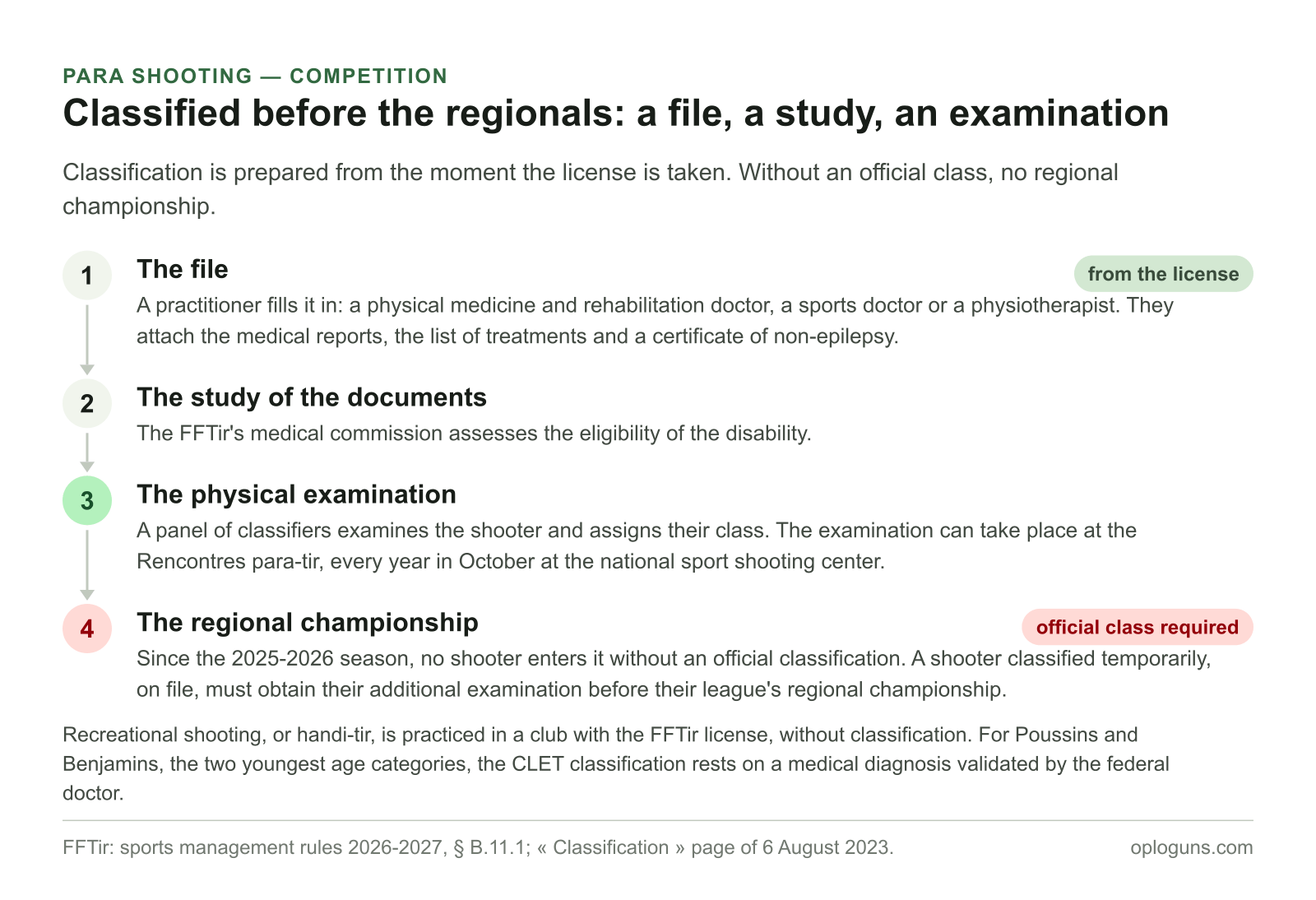
No official classification, no regional championship. The rule has applied since the 2025-2026 season4. It is therefore prepared from the moment the license is taken, in three stages410:
- The file: a practitioner fills it in, a physical medicine and rehabilitation doctor, a sports doctor or a physiotherapist; they attach the medical reports, the list of treatments and a certificate of non-epilepsy.
- The study of the documents: the FFTir's medical commission assesses the eligibility of the disability.
- The physical examination: a panel of classifiers examines the shooter and assigns their class.
The list of treatments has a reason: some medicines are on the list of doping products10. The physical examination can take place at the « Rencontres para-tir » [para shooting gatherings], held every year in October at the CNTS, the national sport shooting center in Déols, with panels of national classifiers1011. A shooter classified temporarily, on file, must obtain their additional examination before their league's regional championship4.
Para shooting classes: SH1, SH2, VI and the French class
The classes group shooters « ayant une capacité sportive similaire » [with a similar sporting ability]4. What is at stake is fairness. The 2026-2027 sports management rules (règlement de gestion sportive) recognize six families4:
| Class | Who | Events |
|---|---|---|
| SH1 pistol | Lower-limb disability, or a limb amputation | P1 to P5, F5, F10 |
| SH1 rifle | Lower-limb disability | R1 to R3, R6 to R8 |
| SH2 rifle | Upper-limb impairment, spring-mounted stand | R4, R5, R9, F12 |
| VI | Vision impairment, after an eye examination | 10 m rifle standing and prone |
| SG-S, SG-L, SG-U | Clay target: seated, or standing depending on the limbs affected | Trap PT1, PT2, PT3 |
| CLF | Neither an official class nor the able-bodied events | F6, F7, F13, in the French cup |
The French class, CLF, answers a precise situation: a file or an examination that does not lead to an official class, for a shooter who cannot compete with able-bodied shooters either4. Its events are shot at the same time as the others, but remain unofficial4.
Para shooting events at 10, 25 and 50 m
All para shooting events are mixed: men and women are ranked together5. At 10 meters, the program is as follows5:
| 10 m event | Class | Shots, time on electronic targets |
|---|---|---|
| R1/R2, rifle standing | SH1 | 60 shots, 1 h 15 min |
| R3, rifle prone | SH1 | 60 shots, 50 min |
| R4, rifle standing | SH2 | 60 shots, 1 h 15 min |
| R5, rifle prone | SH2 | 60 shots, 1 h |
| P1/P2, pistol | SH1 | 60 shots, 1 h 15 min |
| P5 standard, F5 rapid fire | SH1 | 40 shots |
At 25 and 50 meters, rifle is shot prone in R6 and R9, in three positions in R7/R8 and F12; pistol is shot in P3 at 25 m and in P4 at 50 m5. Finals are held at the French championship in R1/R2, R3, R4, R5, P1/P2, R6 and R95. The run of an able-bodied 10 m match is described in our articles on 10 m air pistol and 10 m air rifle.
Stand, assistant, adapted sights: the gear allowed
Three adaptations set para shooting apart from able-bodied shooting.
- The spring-mounted stand: it carries the rifle of SH2 shooters, and young para shooters use it in competition47.
- The loading assistant: for SH2 and VI shooters, they place the rifle, load it and make it safe; an FFTir license holder or an identified person, they receive a bib number at equipment control34.
- The adapted aiming system: vision impaired shooters shoot with the VIASS or VIS500 systems from Ecoaims5.
A club that is starting to welcome such shooters does not necessarily have this gear. The FFTir lends A and B stands for a season, with an option to buy, and the VIASS system for three to six months2. Beyond the loan, a call for projects from the Agence nationale du sport, the national sports agency, helps to fund a club's para sports equipment. The assistant follows the same dress code as the shooter, since they stay on the firing line for the whole event12.
Junior para shooting: a shooting-school classification
Poussins, Benjamins and Minimes, the three youngest age categories, have their own para shooting circuit, organized with the shooting school7. For Poussins and Benjamins, the CLET classification rests on a medical diagnosis validated by the federal doctor4. Minimes can aim for the official SH1 or SH2 classes4.
Each match has 40 shots, in 50 minutes on electronic targets, with a rifle prone or a pistol, always as a mixed event7. The stand is the rule there for the youngest, spring-mounted or adjustable depending on the event7. The regional championships are shot before 4 April 2027, for a French para shooting schools championship at the CNTS from 6 to 9 May9. Entry ages are in our article on the minimum age for a shooting license.
French para shooting championship: 2027 quotas and minimums
The route follows that of able-bodied shooters. The departmental then the regional championship are compulsory. Only the regional score counts for the quota5. The French championships are shot at the same time as the able-bodied ones, but a shooter cannot shoot the same event in both rankings4. The quota often comes with a minimum score, all age categories combined8:
| Event, Seniors | Places at the French championship | Minimum |
|---|---|---|
| P1/P2, 10 m pistol | 40 | 460 |
| R3, 10 m rifle prone, SH1 | 22 | 553.2 |
| R5, 10 m rifle prone, SH2 | 35 | 578.4 |
| P3, 25 m pistol | 14 | 400 |
| R6, 50 m rifle prone, SH1 | 18 | 500 |
| R9, 50 m rifle prone, SH2 | 23 | 510 |
Juniors have 5 places at 10 m and 12 at 50 m, with minimums that are equal or lower8. In para trap, access to the French championship is open, provided you have shot the regional championship5. In 2026-2027, the 10 m regionals are shot before 10 January, the 25 and 50 m ones before 13 June9. The full ladder is in our article on qualifying for the French championship.
Competing without a para shooting class: the HP mark
Not every discipline has a para shooting event. In the others, a shooter with a disability appears in the results at their rank, with the mark HP, without changing the ranking of the others6. They can go through to finals if there is room, and the federation may qualify them outside the quota or the minimum, if they have shot the qualifying stages6.
Service-arms shooting (tir aux armes réglementaires) gives an example. A shooter who is autonomous competes there under the HP ranking in all events; one who needs outside help, in the seated events13. The discipline is described in our article on service-arms shooting.
Starting to shoot with a disability: a welcoming club
The first obstacle is often the range itself. The ministry of sports publishes the Handiguide des sports, which lists the organizations that welcome people with disabilities, with a filter by place, by type of disability and by discipline1415. The FFTir encourages its clubs to register on it2.
Two federal courses prepare supervisors: the Handi-tir specialty certificate for welcoming and introducing shooters, the Para-tir specialty certificate for competition211. The Cibles Couleurs progression, the federation's colored-target skill levels, stays the same as for an able-bodied shooter, at an adapted pace and with adapted tools2. The license requires a medical certificate less than a year old, as for any shooter16; what it must say is in our article on the FFTir medical certificate.
Three misconceptions about sport shooting and disability
- "You need a handisport license." The FFTir license is enough to compete at every level3.
- "Para shooting is shot from a wheelchair." The classes also cover upper-limb impairment and vision impairment4.
- "No official class, no competition." The HP mark and the CLF French cup open other routes46.
Where to start, depending on your plan
To shoot for recreation, handi-tir is practiced in a club with the FFTir license, without classification; the Handiguide des sports helps to find an equipped club.
To compete, the classification file is started as soon as you hold the license, to be classified before the regional championship: before 10 January 2027 at 10 m.
For a child, the shooting school's para shooting circuit starts with a diagnosis validated by the federal doctor, with a French championship in May.
Sources 16 references
The classes, the events and the quotas come from the FFTir's 2026-2027 sports management rules; the classification and the loaned gear, from its para shooting pages. All documents are in French. Click a note marker in the text to highlight the matching source.
- FFTir — discipline « Para-tir », consulted on 1 November 2026: « Depuis décembre 2016, le ministère des sports a délégué à la FFTir l'organisation de l'activité Para-tir » [since December 2016, the ministry of sports has delegated the organization of para shooting to the FFTir]; activities « Handi-tir (loisir) et Para-tir (compétition) » developed « autour de plusieurs disciplines répondant à des pathologies motrices, sensorielles ou visuelles » [around several disciplines suited to motor, sensory or visual conditions]; FFTir affiliated to World Shooting Para Sport and to the Comité paralympique et sportif français.
- FFTir — « Stratégie et équipements » [strategy and equipment], page of 27 April 2023, consulted on 1 November 2026: delegation « par arrêté du 31 décembre 2016 » [by order of 31 December 2016]; loan of « Potences a et b » (« prêt sur une saison avec option d'achat ») [stands A and B, loaned for a season with an option to buy] and of the « Système VIASS, pour la pratique des déficients visuels » (« prêt de 3 à 6 mois ») [VIASS system, for vision impaired shooters, loaned for 3 to 6 months]; reimbursement of the FFHandisport license to FFTir license holders, on supporting documents; Handi-tir and Para-tir specialty certificates; « Cibles Couleurs® » open to people with disabilities; registration of clubs on the Handiguide des sports.
- FFTir — Règlement de gestion sportive Vie nationale 2026-2027, version du 29/09/2026, §A.1.7.2 — tireurs en situation de handicap [sports management rules 2026-2027, shooters with disabilities] (PDF), consulted on 1 November 2026: delegation « par arrêté du 28 mars 2022 » [by order of 28 March 2022]; « les tireurs en situation de handicap n'ont plus besoin de prendre une licence à la FFH pour participer aux compétitions de tir organisées par la FFTir » [shooters with disabilities no longer need to take an FFH license to take part in the shooting competitions organized by the FFTir]; loading assistant for SH2 or VI shooters, an FFTir license holder or an identified person, with a specific bib number.
- FFTir — RGS Vie nationale 2026-2027, §B.11 et B.11.1 — para-tir, classification (PDF), consulted on 1 November 2026: FFTir license sufficient; French championships at 10, 25, 50 m and clay target « concomitamment avec ceux des tireurs valides » [concurrently with those of able-bodied shooters], « Tout tireur s'engageant dans une épreuve valide ne pourra pas concourir dans la même épreuve Para-tir » [any shooter entering an able-bodied event may not compete in the same para shooting event]; classes SH1 pistol (« handicap aux membres inférieurs et/ou amputés d'un membre supérieur ou inférieur » [lower-limb disability and/or amputation of an upper or lower limb]), SH1 rifle, SH2 rifle (« potence à ressort » [spring-mounted stand], loading assistant), SG-S, SG-L, SG-U, VI (« examen ophtalmologique » [eye examination]), CLF, CLET; medical file from the moment the license is taken, classification « confirmée lors d'un examen physique par le panel » [confirmed at a physical examination by the panel]; « A compter de la saison 25/26, aucun tireur ne pourra se présenter à l'échelon régional sans avoir obtenu une classification officielle » [from the 25/26 season, no shooter may enter the regional stage without having obtained an official classification]; CLF events F7 and F13 of the para shooting French cup.
- FFTir — RGS Vie nationale 2026-2027, §B.11.2 — championnat de France adultes para-tir [adult French para shooting championship] (PDF), consulted on 1 November 2026: WSPS rules for adult events, FFTir rules for the others; « les systèmes VIASS et VIS500 d'Ecoaims sont autorisés » [the VIASS and VIS500 systems from Ecoaims are authorized]; compulsory participation in the departmental and regional stages, regional scores alone counted for the quotas; para trap with open access « sous réserve de participation au championnat régional » [subject to taking part in the regional championship]; 10 m events (R1/R2 60 shots 1:15, R3 0:50, R4 1:15, R5 1:00, P1/P2 1:15, P5 and F5 40 shots), 25/50 m (R6, R7/R8, R9, F12, F13, P3, P4, F10), all mixed; finals in R1/R2, R3, R4, R5, P1/P2, R6 and R9.
- FFTir — RGS Vie nationale 2026-2027, §B.11.2.5 — autres disciplines [other disciplines] (PDF), consulted on 1 November 2026: results in the rankings « au rang qui leur revient avec la mention HP sans que le classement des autres tireurs n'en soit affecté » [at the rank that is theirs with the mark HP, without the ranking of the other shooters being affected]; finals depending on places; « qualification hors quota ou hors point de qualification » [qualification outside the quota or the qualifying score] possible, « sous réserve de participation aux échelons qualificatifs » [subject to taking part in the qualifying stages].
- FFTir — RGS Vie nationale 2026-2027, §B.11.3 — championnat de France jeunes para-tir [junior French para shooting championship] (PDF), consulted on 1 November 2026: stages « organisés en même temps que les échelons Écoles de tir » [organized at the same time as the shooting schools stages]; stands « A ressort Écoles de Tir », « A ressort (A ou B) », « Modulable » [spring-mounted for shooting schools, spring-mounted (A or B), adjustable]; events of 40 shots, 0:50 on electronic targets; « Toutes les épreuves sont mixtes » [all events are mixed].
- FFTir — RGS Vie nationale 2026-2027, §D — quotas et points du championnat de France para-tir, mise à jour du 29/09/2026 [quotas and scores for the French para shooting championship] (PDF), consulted on 1 November 2026: « toutes catégories confondues » [all categories combined]; 10 m: P1/P2 juniors 5 places and 440, seniors 40 and 460; R3 juniors 5 and 520, seniors 22 and 553.2; R5 juniors 5 and 525, seniors 35 and 578.4; 25/50 m: P3 14 and 400; R6 juniors 12 and 500, seniors 18 and 500; R9 juniors 12 and 500, seniors 23 and 510.
- FFTir — Calendrier sportif prévisionnel saison 2026/2027, mise à jour du 15/10/2026 [provisional sporting calendar, 2026/2027 season] (PDF), consulted on 1 November 2026: 10 m para shooting, regional deadline 10/01/2027, French championship in Châlons-en-Champagne from 8 to 13 February; para shooting schools, deadline 04/04/2027, CNTS from 6 to 9 May; 25/50 m para shooting, deadline 13/06/2027, Moulins from 21 to 28 July.
- FFTir — « Classification », page of 6 August 2023, consulted on 1 November 2026: file filled in by « un praticien (médecin spécialiste en rééducation fonctionnelle, médecin du sport, kinésithérapeute) » [a practitioner (specialist in functional rehabilitation, sports doctor, physiotherapist)], medical information, list of treatments (« certains peuvent être considérés comme dopants » [some may be considered doping agents]), certificate of non-epilepsy; « Une Classe Sportive ne peut être attribuée qu'après examen physique de l'athlète par un panel de classificateurs fédéraux » [a sport class can be assigned only after a physical examination of the athlete by a panel of federal classifiers]; « Rencontres Para-tir » which « ont lieu tous les ans en octobre sur le CNTS » [take place every year in October at the CNTS].
- FFTir — « Rencontres Para-tir », consulted on 1 November 2026: held at the CNTS since 2022, edition announced for 17 to 19 October 2025; « 2 panels de classificateurs nationaux » [2 panels of national classifiers]; CS Handi-tir and CS Para-tir courses.
- FFTir — RGS Vie nationale 2026-2027, §A.1.2 — code vestimentaire [dress code] (PDF), consulted on 1 November 2026: dress rules applicable « également aux « assistants paratir » ou « loaders » qui sont amenés à rester sur le pas de tir sur toute la durée de la compétition » [also to para shooting assistants or loaders who have to stay on the firing line for the whole competition].
- FFTir — RGS Vie nationale 2026-2027, §B.9 — tir aux armes réglementaires [service-arms shooting] (PDF), consulted on 1 November 2026: « Les tireurs en situation de handicap mais autonomes peuvent accéder en classement HP à toutes les épreuves. Les personnes en situation de handicap mais ayant besoin d'une aide extérieure ne pourront accéder qu'aux épreuves en tir assis. » [shooters with disabilities who are autonomous may enter all events under the HP ranking; those who need outside help may enter only the seated events].
- Ministère des Sports — « Le Handiguide des sports », consulted on 1 November 2026: platform offered by the ministry and run by the Centre d'expertise sport handicaps; database that can be filtered « en fonction de votre lieu de résidence, de votre type de handicap et de votre discipline sportive » [by your place of residence, your type of disability and your sport].
- FFTir — « Handiguide des Sports », page of 24 June 2019, consulted on 1 November 2026: ministry site « référençant les structures garantissant un accueil et une offre permettant aux personnes en situation de handicap d'accéder à une pratique sportive adaptée » [listing the organizations that guarantee a welcome and an offer allowing people with disabilities to access an adapted sport], search by place, type of disability and discipline.
- Légifrance — article L231-2-3 du code du sport, version in force since 4 March 2022: for disciplines with particular constraints, license and competitions subject to a « certificat médical datant de moins d'un an » [medical certificate less than a year old].
Frequently asked questions
What is the difference between handi-tir and para-tir?
The FFTir, the French shooting federation, calls handi-tir the recreational shooting of people with disabilities, and para-tir (para shooting) the competition. Handi-tir is practiced in a club with an FFTir license, without classification. Para shooting requires an official classification, SH1, SH2 or vision impaired, to compete in the reserved events up to the French championship.
Do you need a handisport license to do sport shooting?
No. Since the ministry of sports delegated para shooting to the Fédération française de tir, an FFTir license is enough to take part in the shooting competitions it organizes, at every level. The federation even reimburses the FFHandisport license of license holders who also practice in that second federation, on supporting documents.
How do you get a para shooting classification?
A practitioner, a physical medicine and rehabilitation doctor, a sports doctor or a physiotherapist, fills in the FFTir's classification file, together with the medical reports, the list of treatments and a certificate of non-epilepsy. The medical commission studies it, then a panel of classifiers examines the shooter physically. Since the 2025-2026 season, no shooter may shoot a regional championship without an official classification.
What are the para shooting classes?
SH1 groups shooters whose disability affects the lower limbs and, in pistol, those with a limb amputation. SH2 groups, in rifle, those whose upper-limb impairment requires a spring-mounted stand. VI designates vision impaired shooters. A French class, CLF, takes those who fall under no official class without being able to shoot with able-bodied shooters.
Where is the French para shooting championship held in 2027?
At the same time as the able-bodied one. 10 m is shot in Châlons-en-Champagne from 8 to 13 February 2027, 25 and 50 m in Moulins from 21 to 28 July 2027, and the para shooting schools at the federation's national sport shooting center in Déols from 6 to 9 May 2027, according to the FFTir's provisional calendar.
Spotted an error, or a rule that has changed since we checked? Report an error