Grants for a French sport shooting club: who pays what, and when to apply
Published on · 12 min read · Anthony Baillon
A grant for a French sport shooting club comes from six funding desks. The projet sportif fédéral of the Agence nationale du sport, assessed by the FFTir, is the first; job aid, the FDVA, local authorities, the Pass'Sport and donations complete the list. The 2026 federal campaign shared out €333,000. It closed on 15 May.
At a glance
| Scheme | Who pays, for what | When |
|---|---|---|
| Projet sportif fédéral | ANS through the FFTir: development projects | 31 March to 15 May 2026 |
| Job aid | ANS through the DRAJES: €12,000 a year at most | Regional calendar |
| FDVA | State: running costs, new projects | First half of the year |
| Local authorities | Commune, département, region | Set by each |
| Pass'Sport | State: €50 per young member, refunded to the club | 1 September to 31 December 2026 |
| Donations | Donors: 66% or 60% as a tax reduction | All year |
- Equipment: the projet sportif fédéral caps purchases at €500 excluding VAT per unit, new firearms and electronic targets excluded.
- Common condition: affiliation to the FFTir and the contrat d'engagement républicain, then a financial report.
Shooting club grants: approval opens the door
A club that is not approved is entitled to no state aid. The code du sport, the French sports code, says so: « Les associations sportives ne peuvent bénéficier de l'aide de l'Etat qu'à la condition d'avoir été agréées » [sports associations may receive state aid only on condition that they have been approved]1. Affiliation to an approved federation, together with signing the contrat d'engagement républicain (the "republican commitment contract" every subsidized French association subscribes to), counts as approval1. The route to affiliation with the FFTir, the French shooting federation, is described in starting a shooting club.
The contrat d'engagement républicain then comes back with every application. The FFTir's framework note requires it for every projet sportif fédéral application, and the FDVA for every grant412. The association must also be registered in the Sirene business register to apply for a public grant13.
Projet sportif fédéral: €333,000 for shooting in 2026
The Agence nationale du sport (ANS, France's national sports agency) devotes €70 million to the projets sportifs fédéraux, the federal sports projects, in 20263. Each federation receives its envelope and entrusts the assessment to its own teams23. For shooting, the 2026 envelope is €333,000, of which €27,600 for the overseas territories: the same amounts as in 20255.
Half goes to the clubs, at least. The FFTir commits to this in its framework note4. In 2026, 97 applications were started and 72 validated5. The agency validated the distribution proposed by the federation on 10 July 20266.
The 2026 calendar, set by the FFTir's framework note4:
- 31 March: the campaign opens.
- 15 May at midnight: closing, applications validated on Le Compte Asso, the state's online portal for associations.
- Late May and June: assessment by the federal committee, then validation by the governing board.
- July to September: the agency's decision and payment.
- June 2027 at the latest: end of the project and financial report.
What the projet sportif fédéral funds at a club
The 2026 framework note sorts eligible projects into three families4:
- Developing participation: young people outside school hours, women, people with disabilities, hard-to-reach groups, volunteer training, overseas clubs.
- Sport and health: fighting sedentary lifestyles, the sport-health network, preventing lead exposure.
- Ethics and citizenship: fighting violence, adapting to climate change, the Cibles Couleurs program.
At least 20% of the funds go to women's participation and 15% to disability4. A project for people with disabilities has two conditions. The club joins the Club inclusif program and appears in the Handiguide des sports, the national directory of accessible clubs, before 31 December 20264. The lead strand ties in with what lead exposure at the range describes, the disability strand with what para shooting and handi-tir presents.
Pros
The €500 cap rules out a club's two heaviest items: its firearms and its electronic targets. The federation writes it: « Cela exclut donc l'achat d'armes neuves ou de cibles électroniques complètes » [this therefore excludes the purchase of new firearms or complete electronic targets]4. What that equipment costs is detailed in equipping a shooting club.
Jobs at the club: up to €12,000 a year in ANS funding
A job, not a project. Job aid goes through another of the agency's schemes, the projets sportifs territoriaux (regional sports projects), assessed in each region by the DRAJES, the state's regional office for youth and sport7. Job funding amounts to €49.86 million in 2026, of which €9.58 million for the year's new posts8.
The rules of the 2026 service note8:
- €12,000 a year at most per full-time job, over two or three years, with aid that may taper.
- A permanent contract, for a sports instructor, a development officer or a general-purpose employee. One-off aid, capped at €12,000, can go to a fixed-term contract.
- A professional card for the instructor, the sports collective agreement, and a good-character check on officers and instructors.
- No combining with the state's other hiring aids, such as the Fonjep or the PEC.
Pros
The qualifications that open the professional card, and those that are enough for a volunteer, are in federal shooting qualifications.
Club equipment and para sport funding: the ANS calls
The agency also opens calls for equipment projects, filed on the InfraSport platform9. Two of them, open to sports associations, may concern a shooting club:
- Support for para sport: accessible facilities and specific equipment intended for federal practice, up to 80% of expenditure, for an application of at least €10,000. Envelope of €2.5 million, campaign from late March to 30 June 202610.
- Energy renovation of major facilities in underserved areas: 20% at most, for a gain of at least 40% in consumption. Envelope of €8.8 million, closing on 30 June 202611.
A trap common to both: no quotation or purchase order may be signed before the application is filed1011. For para sport, a club must also appear in the Handiguide des sports, or have applied to before the call ends10.
FDVA grants: the club's running costs, not training
The fonds pour le développement de la vie associative (FDVA), the state fund for the development of associations, has two strands. A shooting club is entitled to only one. Sports associations are excluded from the volunteer-training strand, since the state supports them elsewhere. They are eligible for the running-costs and innovative-projects strand12.
In 2025, that strand supported 22,063 associations, for an average grant of €2,23012. The calendar is set area by area, in the first half of the year. Guidance notes come out at the start of the year, and applications are filed on Le Compte Asso12.
Pros
Local authority grants: commune, département, region
Local authorities award their own grants, for a public-interest purpose13. The application may cover a project, an investment, the development of activities or the association's overall running costs13. Each authority sets its calendar and its criteria.
The application goes through Le Compte Asso when the authority is connected to it. Otherwise, it is made on the cerfa form no. 12156*06, the standard form shared by the state and local authorities1314.
Pros
A commune can also lend something other than money. Land or a building, under an agreement, is one of the routes to setting up a range described in starting a shooting club.
Pass'Sport: €50 per young member, refunded to the club
The 2026-2027 Pass'Sport is worth €50 off the registration fee. It targets young people aged 6 to 17 whose quotient familial (the means-test index used by French family benefit funds) does not exceed €699, young people with disabilities who receive the AEEH or AAH disability allowances, and students on grants aged under 2816. The campaign runs from 1 September to 31 December 202616.
The club deducts the €50 from the registration price, then claims a refund on Le Compte Asso1615. If registration costs less than €50, the difference must benefit the young person, in equipment or clothing for example16. The license and its fees are in the FFTir license.
Pros
- A cheaper registration for eligible families, simply by showing a code to the club16.
Cons
- The club advances the discount until it is refunded16.
Donations to the club: a 66% or 60% tax reduction
A donation to your club costs the donor less than it brings you. The tax system pays the difference; French law calls this mécénat, giving with nothing in return. An individual deducts 66% of the donation, within the limit of 20% of taxable income. The excess carries forward over five years1718. A €200 donation costs them €6817.
A company deducts 60% of its donation up to €2 million, 40% beyond. The cap is €20,000 or 5 per thousand of turnover, whichever is higher1920. The club issues it a receipt on form 2041-MEC-SD20.
Pros
Grant calendar for a shooting club
| Deadline | Scheme | What happens |
|---|---|---|
| Start of the year | FDVA | Guidance notes by département12 |
| 31 March to 15 May 2026 | Projet sportif fédéral | Filing on Le Compte Asso4 |
| Late March to 30 June 2026 | Para sport equipment | Filing on InfraSport10 |
| 30 June 2026 | Projet sportif fédéral 2025 | Financial report34 |
| July to September 2026 | Projet sportif fédéral | Decision and payment4 |
| 1 September to 31 December 2026 | Pass'Sport | Deduction at registration16 |
| June 2027 at the latest | Projet sportif fédéral 2026 | End of the project, review4 |
If your club was funded the previous year, its financial report is entered with the new application4. Financial records are kept for ten years, and a grant for one year does not carry over to the next4.
Three misconceptions about shooting club grants
- "The projet sportif fédéral funds the club's firearms and targets." The 2026 framework note caps equipment at €500 excluding VAT per unit and excludes new firearms and complete electronic targets4.
- "The FDVA pays for training the club's volunteers." That strand excludes sports associations; only the running-costs and innovative-projects strand is open to them12.
- "An unspent grant can be used the following year." Carrying over from one financial year to the next is not allowed, and the agency asks for unused aid to be repaid4.
Funding your shooting club, project by project
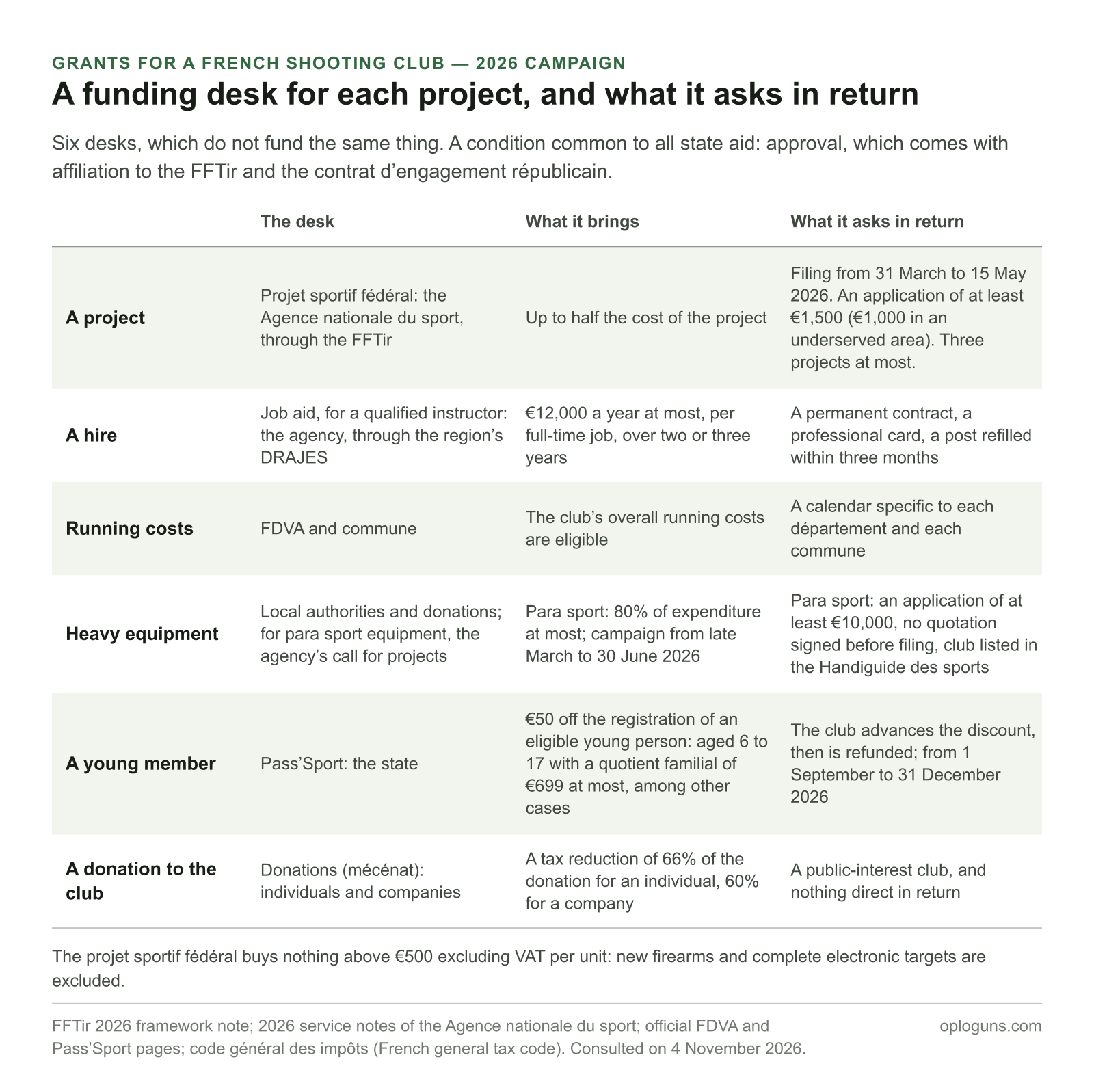
What you gain, what you give up
For a development project — shooting school, women's time slot, para shooting, lead prevention — the projet sportif fédéral brings up to half the cost. The trade-off: the application is prepared in spring and exceeds €1,500.
To hire a qualified instructor, the agency's job aid goes up to €12,000 a year over two or three years. The trade-off: it requires a permanent contract, a professional card and a post refilled within three months.
For day-to-day running costs, the FDVA and the commune are the open desks. The catch: every département and every commune has its own calendar.
For heavy equipment, firearms, cabinets or electronic targets, the projet sportif fédéral funds nothing. That leaves local authorities, donations, and for para sport equipment the agency's call for projects, at 80% at most.
Sources 20 references
The schemes come from the 2026 service notes of the Agence nationale du sport, the FFTir's framework note and campaign review, the official FDVA, Pass'Sport and service-public pages, and the code général des impôts read on Légifrance, all consulted on 4 November 2026. All documents are in French. Click a note marker in the text to highlight the matching source.
- Légifrance — article L121-4 du code du sport, in force since 26 August 2021, consulted on 4 November 2026: « Les associations sportives ne peuvent bénéficier de l'aide de l'Etat qu'à la condition d'avoir été agréées » [sports associations may receive state aid only on condition that they have been approved]; affiliation to a sports federation approved by the state and signing the contrat d'engagement républicain « valent agrément » [count as approval].
- Agence nationale du sport — les projets sportifs fédéraux (PSF) [the federal sports projects], page updated on 21 April 2026, consulted on 4 November 2026: scheme deployed by the approved federations and the CNOSF with their regional bodies and their affiliated associations; annual framework note from each federation; contact with the PSF officer of the federation of affiliation.
- Agence nationale du sport — note de service n° 2026-DFT-02, projets sportifs fédéraux 2026 [service note, 2026 federal sports projects] (PDF, 10 pages, 25 March 2026), consulted on 4 November 2026: « l'accompagnement financier 2026 s'élève à 70 M€ » [financial support for 2026 amounts to €70 million]; minimum of €750 per project, €500 in an underserved area (outside QPV priority districts and cités éducatives); minimum of €1,500 per beneficiary, €1,000 in an underserved area; the same project cannot be filed under both the PSF and the PST; 2025 beneficiaries required to send their financial report by 30 June 2026, on Le Compte Asso.
- Fédération française de tir — Note de cadrage projet sportif fédéral 2026 [framework note for the 2026 federal sports project] (PDF, 10 pages, 26 March 2026), consulted on 4 November 2026: calendar (launch on 31 March 2026, closing on 15 May 2026 at midnight, assessment in late May, validation in June, decisions and payment from July to September, end of project in June 2027 at the latest); at least 50% to clubs, 20% to women's participation, 15% to disability; three projects at most per club; thresholds of €1,500 and €1,000; « le prix maximum éligible par unité est fixé à 500 € HT. Cela exclut donc l'achat d'armes neuves ou de cibles électroniques complètes. Une action ne peut pas porter uniquement sur de l'achat de matériel » [the maximum eligible price per unit is set at €500 excluding VAT. This therefore excludes the purchase of new firearms or complete electronic targets. A project cannot consist solely of equipment purchases]; grant capped at 50% of the project; contrat d'engagement républicain; Club inclusif and Handiguide before 31 December 2026; eligible projects by family; Compte Asso code 2019; records kept for 10 years; « le report de subvention d'un exercice à l'autre n'est pas autorisé » [carrying a grant over from one financial year to the next is not allowed].
- Fédération française de tir — Bilan campagne PSF 2026 [review of the 2026 PSF campaign] (PDF, 20 pages, 2 July 2026), consulted on 4 November 2026: « MONTANT DE L'ENVELOPPE 2026 = 333 000 € » [amount of the 2026 envelope], « DONT OUTRE-MER = 27 600 € » [of which overseas], amounts carried over from 2025; 97 applications started, 72 validated, 3 ineligible; five assessors in charge of support.
- Fédération française de tir — projet sportif fédéral, page consulted on 4 November 2026: announcement of 10 July 2026, « L'ANS a validé la répartition 2026 proposée par l'équipe fédérale ! » [the ANS has validated the 2026 distribution proposed by the federal team]; documents from the 2022 to 2026 campaigns.
- Agence nationale du sport — les projets sportifs territoriaux (PST) [the regional sports projects], page updated on 19 May 2026, consulted on 4 November 2026: jobs and public policies; applications assessed by the DRAJES with the support of the SDJES; 2026: about €49.86 million for jobs; €69.72 million devoted to the PST in 2025.
- Agence nationale du sport — note de service n° 2026-DFT-03, projets sportifs territoriaux 2026 [service note, 2026 regional sports projects] (PDF, 10 pages, 10 April 2026), consulted on 4 November 2026: job funding of €49.86 million, of which €9.58 million for 2026 creations; agency jobs over 2 or 3 years, « le plafond de l'aide est de 12 K€ par an et par emploi » [the aid is capped at €12,000 per year and per job], tapering aid possible, priority recruitment in underserved areas; one-off aid of €12,000 at most; permanent contract for a sports instructor, development officer or general-purpose employee, fixed-term contract for one-off aid; good-character check, sports collective agreement, professional card; cannot be combined with Fonjep and PEC; three months to replace an employee who leaves, otherwise repayment; training in the prevention of violence and discrimination for renewal.
- Agence nationale du sport — dispositifs pour le financement des équipements sportifs en 2026 [schemes for funding sports facilities in 2026], page updated on 2 April 2026, consulted on 4 November 2026: five schemes (swimming pools, energy renovation, para sport, legacy of the Alps 2030 Games, overseas territories), applications on InfraSport.
- Agence nationale du sport — soutien à la pratique parasportive 2026 [support for para sport 2026] (PDF, 1 page), consulted on 4 November 2026: sports associations eligible; « Matériels spécifiques (y compris fauteuils) destinés à la pratique sportive fédérale » [specific equipment, wheelchairs included, intended for federal sports practice]; budget €2.5 million; « Taux de subvention maximal : 80 % des dépenses éligibles » [maximum grant rate: 80% of eligible expenditure]; minimum application threshold €10,000; campaign from late March to 30 June 2026, review in the fall; listing in the Handiguide des sports; « Aucun début d'exécution autorisé avant le dépôt du dossier sur Infrasport » [no start of work allowed before the application is filed on Infrasport].
- Agence nationale du sport — soutien à la rénovation énergétique des équipements structurants en territoires carencés 2026 [support for the energy renovation of major facilities in underserved areas 2026] (PDF, 1 page), consulted on 4 November 2026: sports associations eligible; budget €8.8 million; maximum rate of 20%; « Réduction d'au moins 40 % de la consommation énergétique » [reduction of at least 40% in energy consumption]; QPV, ZRR/FRR, rural CRTE or overseas territories; end of campaign on 30 June 2026; quotations not signed before the application is filed on InfraSport.
- Ministère chargé de la vie associative — fonds pour le développement de la vie associative (FDVA), page consulted on 4 November 2026: « Les associations sportives qui peuvent bénéficier du soutien de l'État pour la formation de leurs bénévoles ne bénéficient pas du FDVA formation des bénévoles » [sports associations that can receive state support for training their volunteers do not benefit from the FDVA volunteer-training strand]; running-costs and innovative-projects strand: « Les associations sportives sont éligibles à cette partie du FDVA » [sports associations are eligible for this part of the FDVA]; in 2025, 22,063 associations and 23,026 projects supported « pour une subvention moyenne basse de 2 230 euros » [for a low average grant of 2,230 euros], 83% very small associations; calendar « fixé au cours du premier semestre » [set during the first half of the year]; guidance notes published at the start of the year; campaigns on Le Compte Asso; contrat d'engagement républicain.
- Service-public — subventions versées aux associations [grants paid to associations], fact sheet verified on 1 January 2026, consulted on 4 November 2026: association declared and registered in the Sirene register; grant awarded for a public-interest purpose by the state, local authorities and public bodies; project or investment, development of activities or overall funding; application on Le Compte Asso or by form; agreement above €23,000; financial report within 6 months of the end of the financial year; law no. 2000-321 of 12 April 2000, articles 9-1 and 10.
- Service-public — Association : demande de subvention [association: grant application], cerfa no. 12156*06, page verified on 26 December 2022, consulted on 4 November 2026: application to the state, a local authority or another public body, for a project or overall running costs; financial report on cerfa no. 15059.
- Ministère chargé de la vie associative — Le Compte Asso, page consulted on 4 November 2026: online procedure for grant applications, entry of financial reports, SIREN or SIRET number; access through lecompteasso.associations.gouv.fr.
- Ministère des sports — le dispositif Pass'Sport de retour pour la rentrée 2026 [the Pass'Sport scheme returns for the 2026 season], press release of 29 August 2026, consulted on 4 November 2026: €50; young people aged 6 to 17 with a CAF or MSA quotient familial of €699 at most, AEEH from 6 to 19, AAH from 16 to 30, students on grants aged under 28; campaign from 1 September to 31 December 2026; deduction at registration and refund to the club through Le Compte Asso; « le club s'engage à ce que la différence bénéficie tout de même au jeune » [the club undertakes that the difference still benefits the young person].
- Service-public — impôt sur le revenu, dons aux associations et organismes d'intérêt général [income tax, donations to associations and public-interest bodies], fact sheet verified on 15 April 2026, consulted on 4 November 2026: 66% reduction within the limit of 20% of taxable income, example of a €200 donation giving a €132 reduction; carried forward over 5 years; non-profit body, with disinterested management, not operating for the benefit of a restricted circle of people; sporting character accepted.
- Légifrance — code général des impôts, article 200, version in force since 21 February 2026, consulted on 4 November 2026: tax reduction « égale à 66 % de leur montant » [equal to 66% of their amount], « dans la limite de 20 % du revenu imposable » [within the limit of 20% of taxable income], in favor of public-interest works or bodies « ayant un caractère philanthropique, éducatif, scientifique, social, humanitaire, sportif, familial, culturel » [of a philanthropic, educational, scientific, social, humanitarian, sporting, family or cultural character]; supporting documents on the model set by the tax authorities.
- Légifrance — code général des impôts, article 238 bis, version in force since 10 July 2026 (law no. 2026-602 of 8 July 2026), consulted on 4 November 2026: « la fraction inférieure ou égale à 2 millions d'euros ouvre droit à une réduction d'impôt au taux de 60 % » [the portion up to 2 million euros gives entitlement to a tax reduction at the rate of 60%], 40% beyond; « dans la limite de 20 000 € ou de 5 pour mille du chiffre d'affaires » [within the limit of €20,000 or 5 per thousand of turnover]; carried forward over the five following financial years; public-interest bodies of a sporting character; declaration of donations above €10,000 a year.
- Entreprendre service-public — mécénat d'entreprise : dons en faveur d'organismes sans but lucratif [corporate giving: donations to non-profit bodies], fact sheet verified on 20 July 2026, consulted on 4 November 2026: 60% up to €2,000,000, 40% beyond; cap of €20,000 or 5 per thousand of turnover excluding VAT, the higher amount being used; tax receipt issued by the body on form 2041-MEC-SD; sponsorship, which gives rise to something direct in return, is not mécénat.
The text in force prevails. Schemes, thresholds and dates are those published on 4 November 2026 for the 2026 campaign. Every year, the FFTir's framework note, the agency's service notes and the FDVA's guidance notes set the rules. The league, the DRAJES and the local authority say which ones apply on the day of filing.
Frequently asked questions
What grants can a sport shooting club apply for in France?
Six funding desks are open to it: the projet sportif fédéral of the Agence nationale du sport, the national sports agency, assessed by the FFTir, the French shooting federation; the agency's job aid, assessed by the DRAJES, the state's regional sports office; the running-costs and innovative-projects strand of the FDVA; grants from the commune, the département or the region; the Pass'Sport, refunded to the club; and donations, which French tax law makes deductible for the donor.
When do you file a projet sportif fédéral application with the FFTir?
In 2026, the campaign opened on 31 March and closed on 15 May at midnight, on Le Compte Asso, with code 2019. Grants were decided and paid from July to September. Every year the FFTir publishes a framework note that sets the calendar; the 2026 one is dated 26 March.
Can the projet sportif fédéral fund electronic targets?
No. The FFTir's 2026 framework note caps the eligible price at €500 excluding VAT per unit of equipment, which excludes new firearms and complete electronic targets. Nor can a project consist of equipment alone.
Is a donation to a French shooting club tax-deductible?
Yes, if the club is a public-interest body: disinterested management, non-profit purpose, an activity that does not benefit a restricted circle of people. An individual deducts 66% of the donation within the limit of 20% of taxable income (article 200 of the code général des impôts, the French general tax code), a company 60% within the limit of €20,000 or 5 per thousand of its turnover (article 238 bis).
What is the minimum amount for a grant application to the ANS?
For the 2026 projet sportif fédéral: €1,500 per application, or €1,000 in an underserved area, and €750 per project, or €500. The agency's call for projects for para sport equipment required at least €10,000.
Spotted an error, or a rule that has changed since we checked? Report an error