Lead at the shooting range: what the studies measure, what the French federation recommends
Published on · 12 min read · Anthony Baillon
At the shooting range, lead escapes from the primer and the bullet, then settles everywhere. In two clubs in the Doubs, in eastern France, 60 of the 133 adult shooters screened exceeded the adult overexposure threshold. The French federation recommends dedicated clothing, hands washed before eating, and an FFP3 mask for cleaning.
At a glance
| What was measured | Result | Where |
|---|---|---|
| Shooters above 70 µg/L | 60 out of 133 | Two clubs in the Doubs |
| Cleaning the range | Blood lead level doubled on average | Club A in the Doubs |
| Half the lead eliminated | About a year without exposure | Doubs shooters |
- Lead comes home on shoe soles and laundry: the French federation asks for clothes and shoes kept for shooting.
- To clean the range: FFP3 half-mask, coverall, gloves, and never any dry sweeping.
- The medical certificate does not measure lead: a blood lead test is something to discuss with your doctor.
Lead exposure: 60 shooters out of 133 overexposed
In early 2019, two recreational clubs near Besançon discovered abnormal blood lead levels among their members. Twenty-two known results, a mean of 256 µg/L, six above 400 µg/L1. Both clubs closed their ranges of their own accord. The regional health agency (ARS) called in Santé publique France, the national public health agency, which invited every member to be tested.
By February 2020, 133 adult shooters had sent in at least one blood lead result1:
- Club A: 24 shooters out of 41 above 70 µg/L, or 58%.
- Club B: 36 out of 92, or 39%.
- Both clubs: a median of 81 µg/L.
The 70 µg/L threshold defines overexposure for an adult. The Haut Conseil de la santé publique (HCSP), France's High Council for Public Health, set it in 2020 at the 98th percentile of blood lead levels in the French population1. Only one French person in fifty exceeds it. In these two clubs, more than two screened shooters in five did.
One caveat matters: screening was voluntary, and the most assiduous shooters took part the most1. These rates describe the shooters screened, not all the members.
The Doubs is not an isolated case. In 2020, at a competition shooting hall followed by the Lyon poison control center, 8 of the 18 children tested exceeded 50 µg/L, up to 129 µg/L2. Between 2010 and 2018, the occupational disease centers recorded 37 poisonings among recreational shooters, with a median blood lead level of 300 µg/L2.
Lead comes from the primer, the bullet and the floor
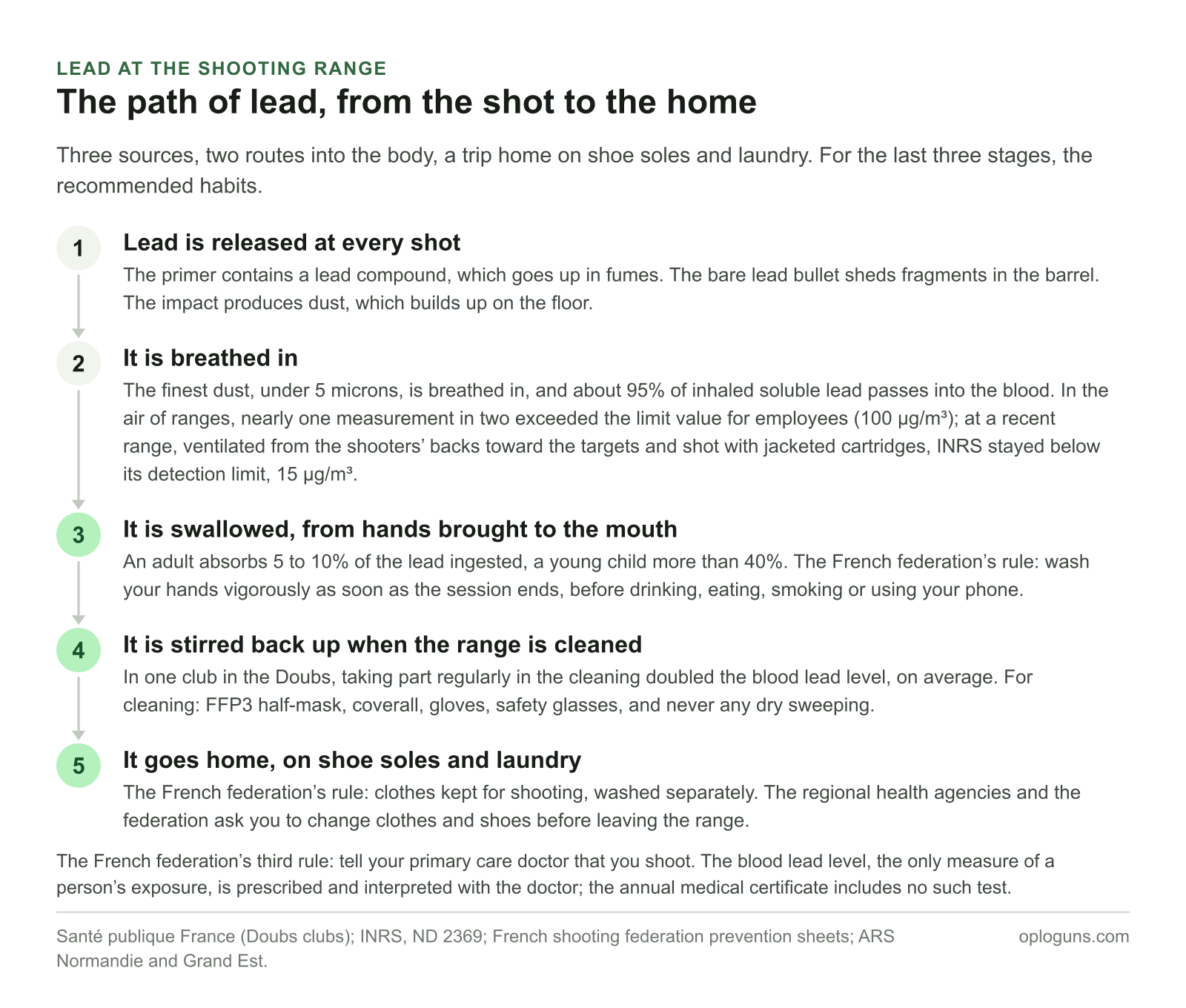
Three sources add up at every session23:
- The primer contains a lead compound, which goes up in fumes at every shot.
- The bare lead bullet sheds fine fragments in the barrel, which are blown out with the gases.
- The impact on the target or the backstop produces dust, which builds up on the floor.
The body absorbs this lead by two routes. The finest dust, under 5 microns, is breathed in, and about 95% of inhaled soluble lead passes into the blood1. The rest is swallowed, from hands brought to the mouth. An adult absorbs 5 to 10% of the lead ingested; a young child, more than 40%14.
In the air of ranges, the laboratories of France's regional occupational insurance funds have gathered 65 measurements. Nearly one in two exceeded the limit value set for employees, 100 µg/m³ on average over eight hours3. At an old range, during three hours of 9 mm shooting, two instructors breathed 397 and 358 µg/m³3.
The question that remains is whether a range can do much better. It can.
Ventilated range: lead below the detection limit
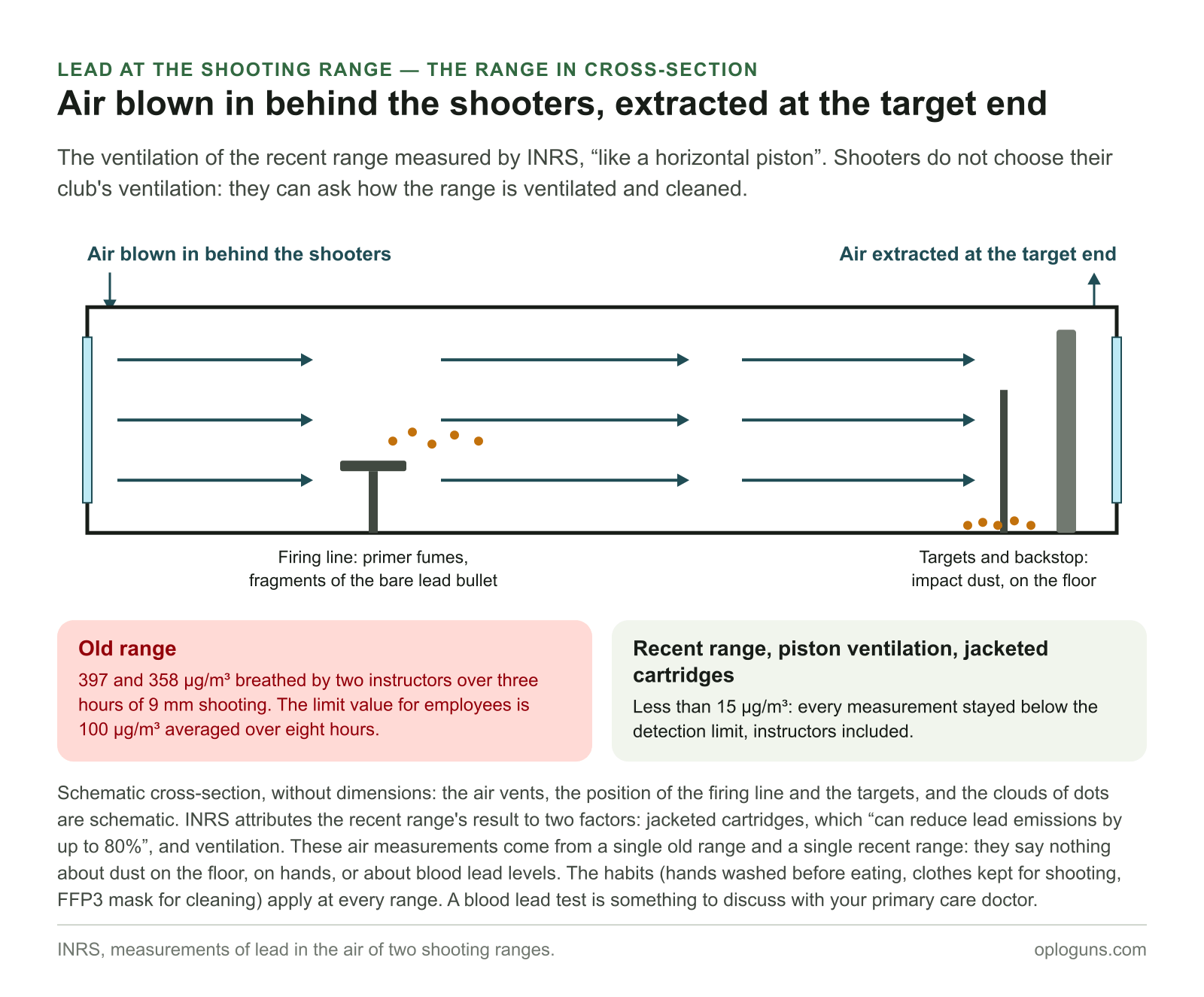
INRS, the French occupational safety institute, measured a second, more recent range. There the air is blown in behind the shooters' backs and extracted at the target end, like a horizontal piston. The shooters there were using jacketed cartridges. Every measurement stayed below the detection limit, 15 µg/m³, instructors included3.
The institute attributes this result to two factors. Jacketed cartridges « peuvent réduire jusqu'à 80 % les émissions en plomb » [can reduce lead emissions by up to 80%]. Ventilation, for its part, carries away the rest3.
Shooters do not choose their club's ventilation. They can ask how the range is ventilated and cleaned. The French shooting federation plans to add new criteria to range approval, in its prevention plan adopted on 15 March 20255. A club's prevention project can be funded in part by the lead strand of the federation's sports project grants.
Cleaning the range, eating on site: two risky habits
In club A in the Doubs, a statistical model isolated the effect of each practice on its own. Taking part regularly in cleaning the ranges doubles the blood lead level, on average. Eating on site after shooting raises it by 50%1. In club B, cleaning stands out in the same way1.
The mechanism is simple. Cleaning stirs back up the dust built up on the floor and near the targets. The meal brings to the mouth what the hands have picked up2. The case of the pellet trap being emptied is covered in target holder and pellet trap.
The "openers", the members who open and close the sessions, often combined the two: they clean the firing line and eat at the club1. Their blood lead levels were higher on average than those of the other members1.
What the French federation recommends: clothes, hands, FFP3
The federation has adopted a plan to prevent lead exposure for the 2025-2028 Olympic cycle5. Its messages to license holders, drawn up with Santé publique France, come down to three rules6:
- Do not ingest dust: wash your hands vigorously as soon as the session ends, before drinking, eating, smoking or using your phone.
- Do not take dust home: wear clothes kept for shooting, wash them separately, clean your position with a microfiber cloth stored in an airtight bag.
- Tell your primary care doctor that you shoot.
On the firing line, the same sheet rules out dry sweeping and blowers6. Santé publique France's poster « 3 gestes simples » [3 simple habits] adds drinking from a water bottle in competition and cleaning your gun on site, in the area provided7. A rifle shooting jacket is not washed like a T-shirt. In the absence of guidance from manufacturers, the federation advises storing it separately, at home or in a club locker room6.
For cleaning the range, the federation's sheet on protective equipment against lead details the gear8:
| Part of the body | Equipment specified by the French federation |
|---|---|
| Airways | FFP3 half-mask with exhalation valve, or full-face mask with filter cartridges |
| Body and feet | Disposable coverall, overshoes |
| Eyes | Safety glasses |
| Hands | Long-cuffed household gloves, tougher than latex or vinyl |
Surgical masks and DIY dust masks are excluded: their protection against lead is judged « très insuffisante » [very inadequate]8. A beard « diminue de beaucoup l'efficacité du masque » [greatly reduces the mask's effectiveness]8. These rules apply « à l'identique » [identically] to volunteers and to employees8. The floor is cleaned with a vacuum cleaner fitted with an H13 filter or wet, with a flat mop9. The marking on the glasses is read as explained in the EN 166 standard for safety glasses.
Lead comes home from the range on your shoe soles
In July 2022, Santé publique France wiped the soles of a visitor who had walked through the range of one of the two clubs, even though it had been cleaned up. The result: 90 and 170 milligrams of lead per square meter, against less than 80 micrograms for the control soles1. More than a thousand times as much. For dust, the risk threshold used for children is 70 micrograms per square meter14.
This lead travels in the car, the hallway, the laundry. Before going home and once home, the regional health agencies and the French federation describe the same routine61011:
- change clothes and shoes before leaving the range, and put them in a dedicated bag;
- wash your shooting clothes separately from the family laundry; a quick cycle is enough, according to the federation;
- clean the shoes with a damp cloth, without brushing or vacuuming them;
- take a full shower, hair and beard included;
- clean your guns outside the living areas, when the family is away, then wet-clean the area.
For gun maintenance, the regional health agencies advise gloves and a mask, outdoors or in a ventilated room1011. The disassembly steps are set out in maintaining a sport shooting pistol. Reloading, and above all casting lead, have their own instructions: a ventilated room, no children, a mask with a filter cartridge, wet cleaning and never the household vacuum cleaner210. The legal framework for the reloading bench is in reloading ammunition.
Children at the range: 18 of 29 screened above 50 µg/L
Between 2015 and 2018, 29 children had a first test in connection with visits to a range. Eighteen exceeded 50 µg/L, the threshold at which childhood lead poisoning must be reported in France12. More than four in five were over 712.
A child absorbs more of it, and a developing brain is more sensitive to it1. According to the HCSP, the decline in cognitive performance follows the blood lead level with no known threshold: one IQ point is lost at levels as low as 12 µg/L4.
At the range, the sheets ask that a child not be left to sit or play on the floor, or to put a dropped object in their mouth610. A minor's blood lead test is reimbursed by French national health insurance410. The HCSP recommends screening 6- to 17-year-olds exposed to a source of lead12. The pediatrician or the primary care doctor decides. The ages for taking up shooting are in the minimum age to start shooting.
Lead in the blood: a test the medical certificate ignores
The only measure of a person's exposure is the blood lead level1. The annual medical certificate includes no such test, as the French federation's medical certificate points out. Santé publique France recommends talking to your primary care doctor about your shooting, « pour envisager le cas échéant, une plombémie » [to consider a blood lead test where appropriate]12. The federation makes it its third rule6.
Ordering the test and reading it are the doctor's job. The doctor can call on a poison control center to interpret the result1. The benchmarks below are action thresholds, not thresholds of safety: there is no blood lead level "without effect"2.
| Benchmark | Blood lead level | Source |
|---|---|---|
| Vigilance in children | 25 µg/L | HCSP |
| Mandatory reporting, minor | 50 µg/L | HCSP, Santé publique France |
| Overexposure, adult pregnant woman | 50 µg/L | HCSP |
| Overexposure, adult | 70 µg/L | HCSP |
These thresholds come from the HCSP, as cited by Santé publique France1210. Once exposure has stopped, the decline is slow. In the Doubs, it took about a year to halve the shooters' lead burden1. The half-life of lead in the blood is 30 to 40 days at first, then exceeds ten years: the lead bound in bone, more than 90% of the total in an adult, is released very slowly14.
Three misconceptions about lead at the shooting range
- "Jacketed bullets solve the problem." They reduce emissions, by up to 80% according to INRS3. Yet in the Doubs, the shooters who used them did not have lower blood lead levels: their means were even higher, with no significant difference1. The lead already deposited on the firing line stays there.
- "Lead is a children's issue." Sixty adults out of 133 were overexposed in the Doubs1. Even below 100 µg/L, effects on blood pressure and on the kidney are described in adults14.
- "No symptoms, no poisoning." Poisoning most often goes unnoticed without a blood test10. Of 13 adults from one club, between 172 and 565 µg/L, only five described symptoms, and nonspecific ones2.
Airgun firing lines, at 10 m, are reputed to emit less: no primer, no burning powder1. Their pellets also escape the European lead ban, which targets shot. The events for each type of gun are introduced in the French federation's disciplines.
Lead at the range: what each person does on leaving
Depending on your place in the club
The regular shooter. The federation's three rules come down to three habits: hands washed before any contact with the mouth, clothes kept for shooting, and your shooting mentioned to your primary care doctor. The rest depends on the range, about which a shooter can ask questions.
The volunteer who cleans. In one of the Doubs clubs, cleaning doubled the blood lead level. The federation's sheet specifies the full set of equipment for them, FFP3 mask included, with no exception for a volunteer.
The parent who comes with a child. No playing on the floor, hands washed, and a blood lead test to discuss with the pediatrician if the child shoots or is often at the range.
Pregnant, or planning a pregnancy. Lead stored in bone passes back into the blood during pregnancy14. Two regional health agencies ask women to stop shooting1011, and the decision is made with the doctor or the midwife: see sport shooting and pregnancy.
Sources 12 references
Documents from French health agencies and from the Fédération française de tir (FFTir), read on 1 November 2026. All are in French. Click a note marker in the text to highlight the matching source.
- Santé publique France — Exposition au plomb en lien avec la pratique du tir sportif dans deux sociétés de tir du Doubs (25) [lead exposure linked to sport shooting in two shooting clubs in the Doubs], Clinard F. et al., legal deposit December 2024, 38 pp. (PDF read in the copy circulated by the ARS Normandie), consulted on 1 November 2026: 22 known initial blood lead levels, mean 256 µg/L, six above 400 µg/L; « 24 (58 %) adultes sur 41 » [24 (58%) adults out of 41] (club A) and « 36 (39 %) adultes sur 92 » [36 (39%) adults out of 92] (club B) above 70 µg/L; median 81 µg/L; HCSP thresholds of 2020 (70 µg/L adult, 50 µg/L pregnant woman over 17); 90% of lead bound in bone, released during pregnancy; children sensitive to its toxicity for neurodevelopment; bioavailability « de l'ordre de 95 % » [on the order of 95%] by inhalation, digestive absorption of 5 to 10% in adults, 40 to 50% in children; blood lead levels « 100 % plus élevées » [100% higher] for cleaning the ranges and « 50 % plus élevées » [50% higher] for eating on site (club A, multivariate model); jacketed bullets: no significant difference; soles: 89,256 to 171,838 µg/m² against 39 to 79 µg/m² for the controls (July 2022); « de l'ordre d'une année sans exposition » [on the order of a year without exposure] to halve the lead burden. ⚠️ Voluntary screening: these rates describe the shooters screened, not all the members.
- Anses — « Intoxication par le plomb dans les stands de tir : un risque connu mais qui persiste », Vigil'Anses n° 12 [lead poisoning at shooting ranges: a known risk that persists], November 2020 (copy circulated by the ARS Normandie), consulted on 1 November 2026: lead from the primer, bullet fragments blown out of the barrel, impact dust; 13 adults from one club between 172 and 565 µg/L, five of them with nonspecific symptoms; shooting hall followed by the Lyon poison control center in 2020: 8 of the 18 children tested above 50 µg/L, up to 129 µg/L; 37 non-occupational cases between 2010 and 2018, median 300 µg/L; the 50 µg/L threshold is « un seuil d'intervention et non de toxicité » [an intervention threshold, not a toxicity threshold]; HCSP recommendation to screen exposed 6- to 17-year-olds; casting lead: ventilation, mask with filter cartridge.
- INRS — Mesures de prévention de l'exposition au plomb des salariés de stand de tir, note documentaire ND 2369 [measures to prevent lead exposure among shooting range employees], Hygiène et sécurité du travail no. 229, 4th quarter 2012, consulted on 1 November 2026: 65 measurements from the COLCHIC database at shooting ranges, median 0.099 mg/m³, « 49,23 % des résultats supérieurs à la VLEP/8 h » [49.23% of results above the 8-hour occupational exposure limit] (0.1 mg/m³); range A, primer with lead styphnate, instructors at 397 and 358 µg/m³ over a three-hour session; range B, piston-flow ventilation and jacketed cartridges, concentrations « systématiquement inférieures à la limite de détection » [systematically below the detection limit] (15 µg/m³); jacketed cartridges « qui peuvent réduire jusqu'à 80 % les émissions en plomb » [which can reduce lead emissions by up to 80%].
- Haut Conseil de la santé publique — Guide pratique de dépistage et de prise en charge des expositions au plomb chez l'enfant mineur et la femme enceinte [practical guide to screening and managing lead exposure in minors and pregnant women], validated on 19 October 2017, sheets A and B, consulted on 1 November 2026: digestive absorption of 5 to 10% in adults, 40 to 55% in young children; more than 90% of the internal dose in bone; half-life of 30-40 days, then over 10 years; loss of one IQ point from 12 µg/L; rise in blood pressure in adults between 50 and 100 µg/L; « Chasse, tir sportif » [hunting, sport shooting] among the leisure activities that expose; collective screening above 70 µg/m² of household dust; « la réserve de plomb biologiquement actif augmente pendant la grossesse et l'allaitement » [the reserve of biologically active lead increases during pregnancy and breastfeeding]; sheet R: blood lead test and screening consultation covered at 100% for minors and pregnant women (arrêté of 18 January 2005).
- Fédération française de tir — « La Fédération Française de Tir se dote d'un plan de prévention de l'exposition au plomb » [the French shooting federation adopts a plan to prevent lead exposure] (copy circulated by the ARS Normandie), consulted on 1 November 2026: plan adopted on 15 March 2025 by the executive committee, rolled out over the 2025-2028 Olympic cycle; « nouveaux critères dans l'homologation des stands » [new criteria in range approval]; priority groups, including pregnant women.
- Fédération française de tir — « Messages de prévention et exemples de conseils à donner aux licenciés » [prevention messages and examples of advice to give license holders], resource sheet of the prevention plan, PDF of 22 October 2025 (copy circulated by the Ligue régionale de tir de Lorraine), consulted on 1 November 2026: messages « élaborés en partenariat avec Santé Publique France » [drawn up in partnership with Santé publique France]; rules 1 to 3; « Evitez de balayer à sec ou d'utiliser un soufflant » [avoid dry sweeping or using a blower]; wash your clothes separately, « un cycle rapide est suffisant » [a quick cycle is enough]; rifle shooting jackets to be stored separately; clean your guns « en l'absence des membres de sa famille et dans une pièce différente des pièces de vie » [when family members are away and in a room other than the living areas].
- Santé publique France — affiche « 3 gestes simples lorsque je pratique le tir » [poster: 3 simple habits when I shoot], ref. W-3207-001-2504, May 2025 (copy circulated by the Ligue régionale de tir de Lorraine), consulted on 1 November 2026: water bottle in competition, hands washed on leaving the firing line, specific clothing, « Je nettoie mon arme sur place dans l'espace réservé à cet effet » [I clean my gun on site in the area set aside for it].
- Fédération française de tir — fiche ressource « EPI plomb » [resource sheet on protective equipment against lead], version of 21 October 2025 (copy circulated by the Ligue régionale de tir de Lorraine), consulted on 1 November 2026: protective equipment for cleaning, collecting and casting lead; « Le demi-masque FFP3, avec valve expiratoire, ou le masque complet avec cartouches » [the FFP3 half-mask with exhalation valve, or the full-face mask with cartridges]; « de bricolage » [DIY] and surgical masks excluded, protection « très Insuffisant[e] » [very inadequate]; « le port de la barbe diminue de beaucoup l'efficacité du masque » [wearing a beard greatly reduces the mask's effectiveness]; measures « à reproduire à l'identique pour les bénévoles » [to be applied identically for volunteers]. ⚠️ A version 2, dated May 2026, is published by the FFTir; it has not been reread.
- Fédération française de tir — « Mesures d'entretien et de nettoyage en vue de protéger de la contamination par le plomb » [maintenance and cleaning measures to protect against lead contamination], version of 21 October 2025 (copy circulated by the Ligue régionale de tir de Lorraine), consulted on 1 November 2026: « Tous les stands de tir en activité en France doivent être considérés comme contaminés par le plomb » [every shooting range in operation in France must be considered contaminated with lead]; vacuum cleaner with H13 filter or wet cleaning with a flat mop; FFP3 mask on the firing line during cleaning.
- ARS Normandie, DRDJSCS and Ligue de tir de Normandie — « Tir sportif, attention au plomb ! » [sport shooting: watch out for lead!], September 2020, based on the sheet from the ARS Grand Est and the Ligue de tir d'Alsace, consulted on 1 November 2026: poisoning that « passe le plus souvent inaperçue sauf à exercer une surveillance biologique » [most often goes unnoticed unless biological monitoring is carried out]; vigilance threshold of 25 µg/L and mandatory reporting above 50 µg/L in minors; test « remboursé par l'Assurance Maladie pour les patients mineurs » [reimbursed by national health insurance for patients who are minors]; dedicated clothing, shoes cleaned « en humidifiant (ne pas brosser ni aspirer) » [by dampening them; do not brush or vacuum]; FFP3 mask for cleaning the premises; reloading in a ventilated room, without children, « Ne pas utiliser d'aspirateur » [do not use a vacuum cleaner]; « Il est vivement recommandé d'interrompre la pratique du tir pendant la grossesse » [it is strongly recommended to stop shooting during pregnancy].
- ARS Grand Est — « Pratique du tir sportif : fiche d'information sur les mesures de prévention du risque d'intoxication au plomb » [sport shooting: information sheet on measures to prevent the risk of lead poisoning], consulted on 1 November 2026: dedicated clothes and shoes, change before going home and carry the clothes in a bag, wet cleaning of shoes and gun cases, full shower on returning home, gloves and mask for cleaning the gun; « Si vous êtes une femme enceinte, ne pratiquez pas le tir et évitez de fréquenter le stand de tir au cours de votre grossesse. » [if you are pregnant, do not shoot, and avoid going to the shooting range during your pregnancy].
- Santé publique France — « Intoxications par le plomb chez les enfants de moins de 18 ans en lien avec la fréquentation de stands de tir entre 2015 et 2018 » [lead poisoning in children under 18 linked to visits to shooting ranges between 2015 and 2018], published on 1 June 2021, consulted on 1 November 2026: 29 children screened for the first time, « 18 présentaient une plombémie supérieure ou égale à 50μg/L » [18 had a blood lead level of 50 µg/L or more]; 82% over 7 years old; « il est recommandé de parler de sa pratique de tir à son médecin traitant, pour envisager le cas échéant, une plombémie » [it is recommended to talk to your primary care doctor about your shooting, to consider a blood lead test where appropriate]. ⚠️ Blood lead tests prescribed because of an identified risk factor: sample not representative.
This article informs; it does not replace medical advice. A blood lead test is prescribed and interpreted with a doctor, who can call on a poison control center. The recommendations cited are those published as of 1 November 2026.
Frequently asked questions
Does sport shooting expose you to lead?
Yes, especially at an indoor range. The fumes and dust come from the primer and the bullet, then settle on the floor, the benches, hands and clothes. In two clubs in the Doubs, in eastern France, 60 of the 133 adult shooters screened exceeded 70 µg/L, the overexposure threshold for an adult (Santé publique France, December 2024).
Which mask for cleaning a shooting range?
An FFP3 half-mask with an exhalation valve, or a full-face mask with filter cartridges, according to the French shooting federation's sheet on protective equipment against lead (version of 21 October 2025). It adds a disposable coverall, overshoes, safety glasses and long-cuffed household gloves, and rules out surgical masks and DIY dust masks.
How do you know if you have too much lead in your blood?
Through a blood lead test, a blood sample prescribed by a doctor. The medical certificate for the French shooting license does not include one. Santé publique France and the French federation recommend telling your primary care doctor that you shoot; the doctor judges whether the test is useful and interprets the result.
How long does it take to eliminate lead?
A long time. In the Doubs study, it took on the order of a year without exposure to halve the shooters' lead burden. According to the Haut Conseil de la santé publique, France's High Council for Public Health, more than 90% of the lead in an adult's body is bound in bone, where its half-life exceeds ten years.
Do jacketed bullets remove the risk?
No. INRS, the French occupational safety institute, states that they can reduce lead emissions by up to 80%. But in the two Doubs clubs, the shooters who used them did not have lower blood lead levels than the others: the lead already deposited in the range goes on exposing people.
Spotted an error, or a rule that has changed since we checked? Report an error