Clay shooting cartridges: the load and shot size each discipline requires
Published on · Updated on · 8 min read · Anthony Baillon
In Olympic trap and skeet, the ISSF rules limit the cartridge to 24 grams of shot, in pellets of 2.6 mm at most; the FITASC disciplines and DTL allow 28 grams. Manufacturers load their trap cartridges in 2.4 mm and their skeet cartridges in 2.0 mm. A cartridge costs 34 to 50 euro cents.
At a glance
| Discipline | Maximum load | Shot diameter |
|---|---|---|
| Olympic trap and skeet | 24 g, + 0.5 g | 2.6 mm at most |
| Universal Trench, Trap1 | 28 g | 2.5 mm at most |
| Sporting, Compak Sporting | 28 g, + 2% | 2 to 2.5 mm |
| DTL | 28 g | 2.6 mm at most |
- Price: €9.40 to €11.50 for a box of 25 in 24 g, €8.40 to €12.40 in 28 g, on 4 November 2026.
- Near a wetland, lead shot has been banned since 15 February 2023: steel takes over.
Olympic trap and skeet cartridge: 24 grams
The ISSF rules, in force since 19 October 2026, define the cartridge allowed in Olympic trap and skeet1:
- A load of 24.0 g at most, with a 0.5 g tolerance, checked on the average of sampled cartridges.
- Spherical pellets, of lead, lead alloy or another ISSF-approved material, of 2.6 mm at most, plated or not.
- A translucent or transparent wad, and shot with no color added.
- No black powder, no tracer or incendiary cartridge, and no loading that spreads the shot pattern.
The check has consequences. Too heavy a load can mean disqualification, the red card; other deviations, a warning or a penalty1. Cartridges sold on the site of an ISSF competition are tested and their results posted before official training1.
In France, these two events come under the Fédération française de tir, the French shooting federation. How they run and what they cost are detailed in Olympic trap and in Olympic skeet.
FFBT and FITASC clay cartridges: 28 grams
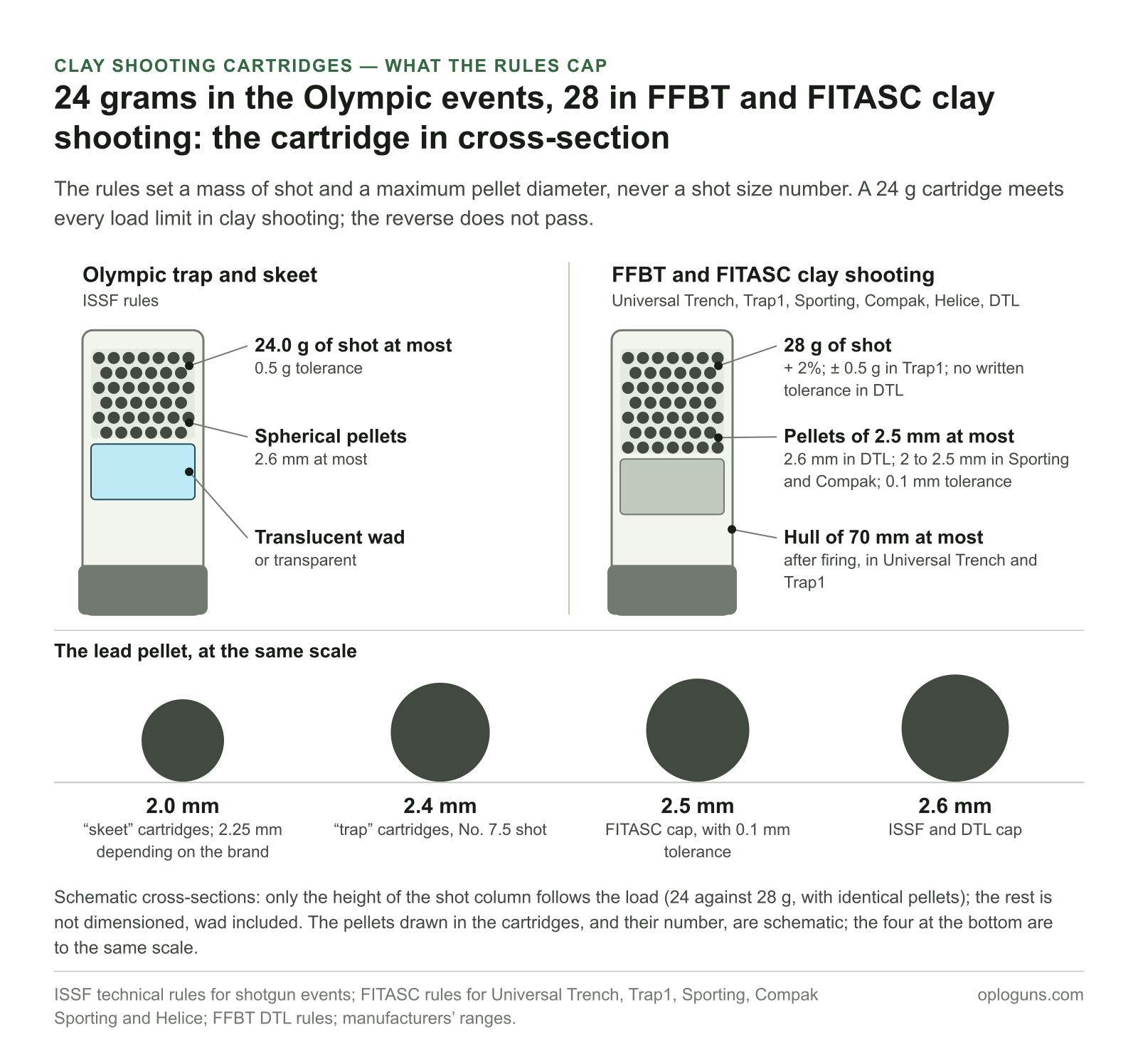
The FITASC disciplines, from Universal Trench to Compak Sporting, and the DTL (Down-The-Line) of the Fédération française de ball-trap (FFBT), the French clay shooting federation, allow 28 grams. The maximum diameter changes from one event to the next.
| Discipline | Load | Shot | Other rules |
|---|---|---|---|
| Universal Trench | 28 g, + 2%2 | 2.5 mm, + 0.1 mm | case of 70 mm at most after firing |
| Trap1 | 28 g, ± 0.5 g3 | 2.5 mm, + 0.1 mm | case of 70 mm at most after firing |
| Sporting (parcours de chasse) | 28 g, + 2%4 | 2 to 2.5 mm, ± 0.1 mm | shot sizes not mixed |
| Compak Sporting | 28 g, + 2%5 | 2 to 2.5 mm, ± 0.1 mm | shot sizes not mixed |
| Helice | 28 g, + 2%6 | 2.5 mm, ± 0.1 mm | shot sizes not mixed |
| DTL (FFBT) | 28 g7 | 2.6 mm | unmixed shot, plating allowed |
Reloaded cartridges are banned in Sporting, Compak Sporting and DTL, and in international Universal Trench and Trap1 competitions23457. Black powder and tracer cartridges are banned everywhere. Reloading metallic ammunition, its equipment and its steps are described in getting started with reloading. Reloading shotshells is covered in reloading 12-gauge cartridges.
A Sporting shooter's stock of 28 g cartridges therefore does not pass the check at an ISSF event. The reverse does: a 24 g cartridge meets every load limit in this table.
Shot size: 2.4 mm for trap, 2.0 mm for skeet
The rules set a maximum diameter, never a size number. So the choice comes from the manufacturers' ranges, which name their cartridges by discipline8:
- Trap cartridges: 2.4 mm, in 24 g as in 28 g; shot size no. 7.5 corresponds to 2.4 mm.
- Skeet cartridges: 2.0 mm, or 2.25 mm depending on the brand.
The two layouts are nothing alike. In trap, the shooter stands 15 meters behind the edge of the trap pit, and the target flies away from them over a distance of 76 meters1. The second shot is therefore fired at a target farther away than the first. In skeet, the target crosses above the center stake, at the center of a circle of 19.20 meters radius that carries stations 1 to 7, and must be broken before a limit of 40.30 meters1.
Young shooters can shoot lighter loads. The French federation's shooting schools load their benjamin and minime age groups, the young categories, with shot size no. 7.5 or 9, with 21 or 24 grams, in 12 or 20 gauge9.
Clay cartridge velocity: 400 to 415 m/s advertised
None of the rulebooks cited sets a velocity127. Manufacturers print it on the box: 400 to 415 m/s for the lead cartridges recorded, in 24 g as in 28 g10.
| Cartridge | Load, shot | Advertised velocity |
|---|---|---|
| Clever T2 Compétition | 24 g, no. 7.5 | 415 m/s10 |
| Fiocchi Official | 24 g, no. 7.5 | 415 m/s10 |
| Baschieri & Pellagri Competition One | 24 g, no. 7.5 | 405 m/s10 |
| Baschieri & Pellagri Competition One | 28 g, no. 7.5 | 410 m/s10 |
| Tunet Universelle | 28 g, no. 7.5 | 400 m/s10 |
These velocities come from the manufacturers, with no common measuring point from one brand to another.
Steel shot: the clay cartridge for wetlands
Since 15 February 2023, EU regulation 2021/57 has banned firing shot containing 1% lead or more in a wetland or within 100 meters of one11. It covers « tout tir pratiqué avec un fusil de chasse » [any shooting done with a shotgun]: a clay ground on the edge of a pond is concerned11.
Steel clay cartridges exist, in 24 grams and in 2.5 mm shot8:
- Topshot Competition Trap Steel, 24 g, 2.5 mm: €10.90 for a box of 25.
- Sellier & Bellot Steel Trap, 24 g, 2.5 mm, 400 m/s advertised: €12.30 for a box of 25.
The shotgun must accept steel. The steel shot proof mark and the gun's manual say so, just as they tell you about the shotgun's chamber and chokes. The timetable of the European restriction, which keeps lead shot of 1.9 to 2.6 mm on ranges that meet the standards, is detailed in lead-free ammunition.
Price per clay: €0.58 to €1.24 with the cartridge
A box of 25 cartridges, recorded on 4 November 2026 at three French gun shops81012:
| Cartridge | Box of 25 | Per shot |
|---|---|---|
| Lead, 24 g | €9.40 to €11.50 | €0.38 to €0.46 |
| Lead, 28 g | €8.40 to €12.40 | €0.34 to €0.50 |
| Steel, 24 g | €10.90 to €12.30 | €0.44 to €0.49 |
| Lead, 24 g, in quantity | €8.17 to €9.00 | €0.33 to €0.36 |
The round of 25 clays costs from €5, in Olympic trap at the member rate of the Ball-trap club de Gonesse13, to €7.90, in trap or skeet for a license holder at Paris Chasse Tir14, two clubs compared in Olympic trap: €0.20 to €0.32 per clay depending on the club. Hence, 24 g cartridge included:
- In skeet, one cartridge per clay1: €0.58 to €0.78 per clay, €14.40 to €19.40 per round.
- In trap, one or two cartridges depending on the first shot1: €0.58 to €1.24 per clay, €14.40 to €30.90 per round.
Every clay broken with the first shot in trap saves a cartridge. And every box is bought on presentation of a qualifying document.
Buying clay cartridges in France: license or permit
In France, clay shooting cartridges are bought on presentation of a current shooting, clay shooting or biathlon license, or of a validated hunting license (permis de chasser)15. Without a shotgun of your own, you cannot hold more than 500 of them15. What each document opens up is compared in shooting license or hunting license.
Three misconceptions about clay shooting cartridges
- "A 28 g cartridge is accepted everywhere." In ISSF competition, the average load checked does not exceed 24.5 g, and the excess can mean the red card1.
- "The rules cap the velocity." Neither the ISSF, nor FITASC, nor DTL sets a velocity: they limit the load and the diameter127.
- "A reloaded cartridge is as good as a new one in a match." Sporting, Compak Sporting and DTL ban it; in Universal Trench, the FITASC ban applies in international competitions (article 2.07)2457.
Which clay shooting cartridge, by discipline
Olympic trap
A 24 g load in 2.4 mm, the no. 7.5 shot of trap cartridges, meets the ISSF rules. In return, every second shot costs one more cartridge: €0.38 to €0.46 by the box.
Olympic skeet
A 24 g load in 2.0 or 2.25 mm follows the same ISSF limit, for targets that cross some twenty meters from stations 1 to 7. In return, the box costs as much as for trap: €10.60 to €11.50 at the same gun shop.
Sporting, Compak Sporting and Universal Trench
Twenty-eight grams are allowed, in 2 to 2.5 mm in Sporting and Compak Sporting, 2.5 mm at most in Universal Trench. In return, that stock does not pass at an ISSF event.
On the edge of a wetland
Lead-free shot has been required since 2023, in steel for €0.44 to €0.49 per shot in 24 g. In return, the shotgun must carry the proof mark that allows it, or its manual must accept it.
Sources 15 references
ISSF, FITASC and FFBT rulebooks in their edition in force; EU regulation reread in its official version; prices recorded on 4 November 2026 at several French gun shops, flagged ⚠️ as commercial data. Click a reference number in the text to highlight the matching source.
- ISSF — Rule Book, Edition 2025, Third Print 10/2026, in force since 19 October 2026, reread 4 November 2026: 9.4.3.1, "Shot charge must not exceed 24.0g (+0.5g tolerance)", average checked "(24.5g)", "Pellets must be spherical in shape", "made of lead, lead alloy or of any other ISSF approved material", "must not exceed 2.6mm in diameter", "may be plated", wad "translucent or transparent", "The shot must not have any colour added", "Black powder, tracer, incendiary, or other special types of cartridges are prohibited", no loading "which will give an extra or special dispersion effect"; 9.4.3.2, check of cartridges sold on site before official training, red card possible for the load, warning or penalty for the rest; 6.4.18 d), trap stations "at a distance of 15m ± 0.05m to the rear of the front edge of the trap pit"; 9.8.2.3 c), "Distance -- 76.0m +/- 1.0m"; 6.4.19.1, skeet stations 1 to 7 on an arc of a circle of 19.20 m radius whose center "marks the base of the target crossing point"; 6.4.19.2 e), shooting boundaries 40.30 m from each house; trap, 9.8.1.1 d), "Two (2) shots may be fired at each target", except in the final; skeet, 9.9.2.2, "Only one (1) shot may be fired at each target". No velocity is set in it.
- FITASC — règlement international Fosse Universelle [international Universal Trench rules, in French] (PDF, 1 January 2025), reread 4 November 2026: 2.07, « la longueur de l'étui de la cartouche ne devra pas dépasser 70 mm » [the length of the cartridge case must not exceed 70 mm], « La charge des cartouches est limitée à 28 grammes de plomb, avec une tolérance de + 2% » [the cartridge load is limited to 28 grams of shot, with a tolerance of + 2%], spherical pellets « n'excédant pas 2,5 mm, avec une tolérance de plus 0,1 mm » [not exceeding 2.5 mm, with a tolerance of plus 0.1 mm]; black powder, tracer or reloaded cartridges banned « dans les compétitions internationales » [in international competitions]; text reread 15 November 2026: « L'emploi de la poudre noire est interdit, ainsi que l'emploi de cartouches traçantes ou rechargées dans les compétitions internationales » [the use of black powder is prohibited, as is the use of tracer or reloaded cartridges in international competitions].
- FITASC — règlement international Trap1 [international Trap1 rules, in French] (PDF, 1 January 2025), reread 4 November 2026: 9.1, case of 70 mm at most after firing, load « limitée à 28 grammes de plomb, avec une tolérance de +/-0.5g » [limited to 28 grams of shot, with a tolerance of +/- 0.5 g], pellets of 2.5 mm at most, « avec une tolérance de plus 0,1 mm » [with a tolerance of plus 0.1 mm]; tracer, spreader or reloaded cartridges banned in international competition.
- FITASC — règlement international Parcours de chasse - Sporting [international Sporting rules, in French] (PDF, version of 1 January 2025), reread 4 November 2026: 7.8, « La charge des cartouches est limitée à 28 grammes de plomb, avec une tolérance de + 2% » [the cartridge load is limited to 28 grams of shot, with a tolerance of + 2%], spherical pellets « compris entre 2 et 2,5 mm (avec une tolérance de plus ou moins 0,1mm) » [between 2 and 2.5 mm, with a tolerance of plus or minus 0.1 mm]; « L'emploi de disperseurs ou de tous autres artifices de chargement est strictement interdit, de même que l'emploi de cartouches rechargées » [the use of spreaders or any other loading device is strictly prohibited, as is the use of reloaded cartridges]; mixing sizes banned; black powder and tracer cartridges banned.
- FITASC — règlement international Compak Sporting [international Compak Sporting rules, in French] (PDF, 1 January 2025), reread 4 November 2026: 18.3, load « limitée à 28 grammes de plomb, avec une tolérance de + 2% » [limited to 28 grams of shot, with a tolerance of + 2%], spherical pellets « compris entre 2 et 2,5 mm, avec une tolérance de plus ou moins 0,1mm » [between 2 and 2.5 mm, with a tolerance of plus or minus 0.1 mm], « Interdiction d'utilisation des munitions rechargées » [reloaded ammunition prohibited], mixing sizes banned, black powder and tracer cartridges banned.
- FITASC — règlement international Tir aux hélices ZZ [international Helice ZZ rules, in French] (PDF, 2026), reread 4 November 2026: 4.3.1, load that « ne doit pas dépasser 28 grammes de plomb avec une tolérance maximum de + 2 % » [must not exceed 28 grams of shot with a maximum tolerance of + 2%], spherical pellets « de 2,5 mm maximum avec une tolérance de plus ou moins 0,1 mm » [of 2.5 mm maximum with a tolerance of plus or minus 0.1 mm]; reloaded cartridges, spreaders, mixed shot, black powder and tracer cartridges banned.
- Fédération française de ball-trap — règlement DTL [DTL rules, in French] (PDF, updated 5 January 2018), reread 4 November 2026: « Grenaille sphérique de 2,6 mm maximum de diamètre sans mélange » [spherical shot of 2.6 mm maximum diameter, unmixed]; « Chargement : 28 grammes de grenaille maximum » [load: 28 grams of shot maximum]; « La grenaille peut être recouverte d'un autre métal » [the shot may be coated with another metal]; « Les cartouches rechargées, la poudre noire, les cartouches incendiaires ou traçantes sont interdites » [reloaded cartridges, black powder, incendiary or tracer cartridges are prohibited].
- Frankonia (in French) — prices recorded 4 November 2026, box of 25 bought singly (then by 10, 40 or 200 boxes): Topshot Competition 12/70 Trap 24 g no. 7.5 (2.4 mm), €11.50 (€9.00 by 200); Baschieri & Pellagri Competition One Trap 2.4 mm 24 g, €10.60 (€9.00 by 40); Competition One Skeet 2.25 mm 24 g, €10.60; Baschieri & Pellagri 12/70 Skeet 2.0 mm 24 g, €10.60; Topshot Competition Skeet 24 g 2 mm, €11.50; Topshot Competition Trap 28 g 2.4 mm, €12.40; Topshot Competition Trap Steel 24 g 2.5 mm, €10.90; Sellier & Bellot 12/67,5 Steel Trap 24 g 2.5 mm, €12.30, « Vitesse de projectile V2 (m/s) 400,0 » [projectile velocity V2 (m/s) 400.0]. ⚠️ Commercial data; the two steel cartridges were recorded at this one gun shop.
- FFTir — Règlement Écoles de tir Plateaux 2026 [shooting schools rules for clay target events 2026, in French] (PDF, 13 February 2026), reread 4 November 2026: « Fusil à canon lisse classique Calibre 12 ou Calibre 20 » [conventional smoothbore shotgun, 12 or 20 gauge]; « Munitions : Cartouches calibre 12 ou 20 chargées de 21 ou 24 gr de plombs N° 7½ ou 9. » [ammunition: 12- or 20-gauge cartridges loaded with 21 or 24 g of no. 7½ or 9 shot]
- Meyson (in French) — prices recorded 4 November 2026, box of 25 bought singly, and specifications displayed: Baschieri & Pellagri Competition One 24 g, no. 7.5 shot, 405 m/s, €9.40 (€8.89 by 10, €8.69 by 100); Clever T2 Compétition 24 g, no. 7½ shot, 415 m/s, €9.79; Fiocchi Official 24 g, no. 7.5 shot, 415 m/s, €10.50; Baschieri & Pellagri Competition One 28 g, no. 7.5 or 8 shot, 410 m/s, €9.40; Tunet Universelle 28 g, no. 7.5 shot, 400 m/s, €8.40; Fiocchi Official 28 g, no. 7.5 shot, 415 m/s, €10.50. ⚠️ Commercial data; distance at which the velocities are measured not stated.
- EUR-Lex — règlement (UE) 2021/57 de la Commission du 25 janvier 2021 [Commission Regulation (EU) 2021/57 of 25 January 2021, French version], OJ L 24 of 26 January 2021, reread 4 November 2026: « Après le 15 février 2023, il est interdit » [after 15 February 2023, it is prohibited] to discharge, « à l'intérieur ou à moins de 100 mètres de zones humides » [in or within 100 meters of wetlands], shot containing a concentration of lead « égale ou supérieure à 1 % en poids » [equal to or greater than 1% by weight]; « tir » [shooting]: « tout tir pratiqué avec un fusil de chasse » [any shooting done with a shotgun].
- Terres & Eaux (in French) — cartouches Cyrano Sport 12/24 g, plomb n° 7,5, price recorded 4 November 2026: €10.89 for a box of 25, €8.71 by 10, €8.17 by 40. ⚠️ Commercial data.
- Ball-trap club de Gonesse (Val-d'Oise) — tarifs de la fosse olympique [Olympic trap rates, in French], recorded 4 November 2026: « FOSSE OLYMPIQUE 25 plateaux 5,00€ » [Olympic trap, 25 clays, €5.00] for a club member, cadet or junior. ⚠️ Commercial data.
- Paris Chasse Tir (Charmentray, Seine-et-Marne) — ball-trap et tir au plateau (in French), rate recorded 23 September 2026 and cited in Olympic trap: "FU / FO / Skeet" round at €7.90 for a license holder of the club. ⚠️ Commercial data.
- Légifrance — articles R312-60 et R312-63 du code de la sécurité intérieure (in French), as quoted word for word in Olympic skeet (consulted 23 September 2026): R312-60, acquisition of the ammunition of heading 8° of Category C « sur présentation du permis de chasser » [on presentation of the hunting license] accompanied by a validation document, or « de la licence de tir, de ball-trap ou de biathlon en cours de validité » [of a current shooting, clay shooting or biathlon license]; R312-63, « Nul ne peut détenir plus de 500 munitions classées dans les 6°, 7° et 8° de la catégorie C sans détenir l'arme correspondante » [no one may hold more than 500 rounds classified under 6°, 7° and 8° of Category C without holding the corresponding gun].
The rules in force prevail. Rules and prices are those of 4 November 2026. The rules of the competition, available from the club or the organizer, take precedence over this summary; the day's price is on the seller's site, and whether a steel cartridge is compatible is marked on the shotgun and stated in its manual.
Frequently asked questions
Which cartridge for Olympic trap?
A 12-gauge cartridge loaded with 24 grams of shot at most, with a 0.5 g tolerance, in spherical pellets of 2.6 mm at most and with a translucent or transparent wad: that is ISSF rule 9.4.3.1. Manufacturers sell their trap cartridges in 2.4 mm, shot size no. 7.5. The box of 25 cost €9.40 to €11.50 in France on 4 November 2026.
Which cartridge for skeet?
In Olympic skeet, the same ISSF limit as trap: 24 grams at most, pellets of 2.6 mm at most. The manufacturers' skeet cartridges are loaded in 2.0 or 2.25 mm. In skeet, the target crosses above the center stake, 19.20 m from stations 1 to 7.
Can you shoot 28 g cartridges in Olympic trap?
Not in ISSF competition: the average load checked must not exceed 24.5 g, and going over can mean disqualification, the red card. Twenty-eight grams is the rule in the FITASC disciplines and in the French federation's DTL: Universal Trench, Trap1, Sporting, Compak Sporting.
What shot size for clay shooting?
The rules set a maximum diameter, not a size number: 2.6 mm for the ISSF and in DTL, 2.5 mm in Universal Trench and Trap1, 2 to 2.5 mm in Sporting and Compak Sporting. Manufacturers load their trap cartridges in 2.4 mm, which is shot size no. 7.5, and their skeet cartridges in 2.0 mm.
How much does a clay shooting cartridge cost?
From €0.38 to €0.46 in 24 g and from €0.34 to €0.50 in 28 g by the box of 25, as recorded in France on 4 November 2026; €8.17 to €9.00 a box when bought in quantity. With a round of clays at €5 to €7.90 for 25, one clay comes to €0.58 to €0.78 in skeet and up to €1.24 in trap if the second shot is fired.
Spotted an error, or a rule that has changed since we checked? Report an error