Hearing protection for shooting: SNR, impulse noise and the EN 352 standard
Published on · Updated on · 9 min read · Anthony Baillon
A gunshot reaches 140 to 175 dB peak at the shooter's ear. The SNR of earmuffs or earplugs was measured for continuous noise, not for that peak. The EN 352 standard certifies the protector; against the blast, measurements by the US institute NIOSH argue for double protection.
At a glance
| Benchmark | Value | Source |
|---|---|---|
| Peak of a firearm | 140 to 175 dB | 2017 study |
| Maximum recommended peak | 140 dB | NIOSH, French labor code |
| Earmuffs and foam earplug | Up to 50 dB less peak | NIOSH |
- The SNR describes a "typical" industrial noise: real attenuation is 5 to 15 dB lower, according to INRS, the French occupational safety institute.
- EN 352 has ten parts, but no harmonized standard covers protectors designed for impulse noise alone.
- A temple of your glasses under the cushion costs part of the attenuation.
Gunshot noise: 140 to 175 dB peak
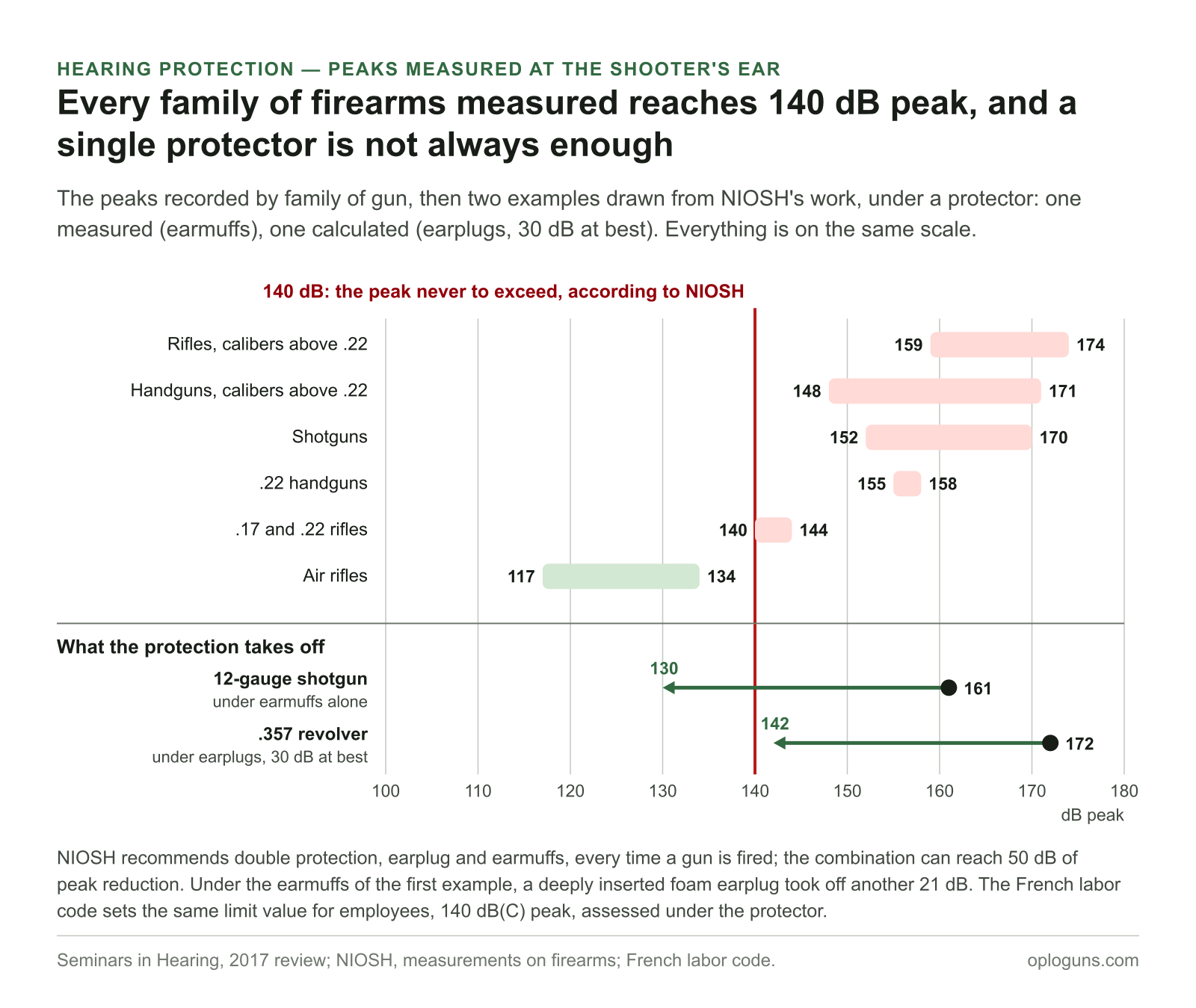
A review published in 2017 in Seminars in Hearing brought together the measurements made at shooters' ears. The maximum peaks of firearms range from about 140 to 175 dB1:
| Gun | Measured peak |
|---|---|
| Rifles, calibers larger than .22 | 159 to 174 dB |
| Pistols, calibers larger than .22 | 148 to 171 dB |
| Shotguns | 152 to 170 dB |
| .22 pistols | 155 to 158 dB |
| .17 and .22 rifles | 140 to 144 dB |
| Air rifles | 117 to 134 dB |
Measurements by NIOSH, the US National Institute for Occupational Safety and Health, give the same order of magnitude: from 144 dB for a .22 rifle to 172 dB for a .357 revolver2. At an indoor police range, the service weapons measured from 159 to 169 dB2. On a .22, what a suppressor takes off is covered in choosing a .22 LR suppressor. Where an air rifle's noise comes from, mechanism by mechanism, is set out in the quiet air rifle.
The benchmark is 140 dB. NIOSH recommends never exceeding that peak: a single impulse at 140 dB uses up, on its own, the noise dose allowed for the day2. The French labor code sets a limit value for employees of 140 dB(C) peak, assessed under the protector34.
At an indoor range, the sound reflected by the walls adds to the direct wave12. The same question then arises for lead exposure, set out in lead at the shooting range. What remains is to know what the number printed on the box measures.
SNR, H, M, L: ratings measured in continuous noise
The SNR, or single number rating, sums up attenuation in one figure. INRS defines it as the attenuation assumed for a "typical" industrial noise. The H, M and L values do the same for noises that are mainly high-, medium- or low-frequency3. These values are supposed to be reached by 84% of wearers3. They come from tests in continuous noise1.
Three limits follow for the shooter:
- Real attenuation is lower. Many studies put it 5 to 15 dB below the stated value, depending on the type of protector3.
- Fitting counts as much as the product. INRS takes 10 dB off foam earplugs worn without training, 5 dB off earmuffs3.
- A gunshot is not an industrial noise. For impulse noise, standard EN 458 offers a separate method, based on the peak level measured without a protector and on the frequency content of the noise3.
The stated orders of magnitude remain useful for comparing two products. According to INRS, earmuffs or formable earplugs show an SNR of 20 to 35 dB, premolded earplugs 15 to 25 dB4. On firearms, NIOSH measured 20 to 38 dB of peak reduction for earmuffs, 10 to 30 dB for earplugs2.
A gap of a few decibels weighs heavily. The formula NIOSH proposes for the number of shots allowed per day divides that number by ten for every additional 10 dB of peak under the protector2.
EN 352 standard: ten parts, from earplug to earmuff
A hearing protector is personal protective equipment subject to European Regulation 2016/425. A notified body checks its conformity4. The EN 352 standards give the presumption of conformity, in their versions published in the Official Journal on 16 June 20265:
| Part | Protector covered |
|---|---|
| EN 352-1 | Earmuffs |
| EN 352-2 | Earplugs |
| EN 352-3 | Earmuffs mounted on a safety helmet |
| EN 352-4 | Level-dependent earmuffs |
| EN 352-5 | Active noise reduction earmuffs |
| EN 352-6 | Earmuffs with audio input |
| EN 352-7 | Level-dependent earplugs |
| EN 352-8 | Earmuffs with entertainment audio input |
| EN 352-9 | Earplugs with electrical audio input |
| EN 352-10 | Earplugs with entertainment audio input |
To be certified, a protector must reach at least H = 12 dB, M = 11 dB and L = 9 dB4. Its attenuation values appear in the instructions3. The documentation must cite the certification standard: failing that, according to INRS, the product is on the face of it not a hearing protector4.
There is a gap. For protectors designed against impulse noise alone, « utilisées par exemple pour le tir » [used for example for shooting], no requirements standard gives a presumption of conformity4.
Electronic earmuffs: restoring sound costs no peak reduction
Level-dependent earmuffs, known as "sound restoration" earmuffs, pick up ambient noise through a microphone and play it back through a small speaker. Faint sounds are amplified; the restoration cuts out when the noise approaches 80 dB(A)4. On firearms, NIOSH tested these earmuffs with the volume at maximum, at unity gain and switched off. Their amplifiers reacted fast enough to give the same peak reduction as when switched off2.
Three other families behave differently:
- Active noise reduction earmuffs (EN 352-5) act on low frequencies, up to about 1,000 Hz. Against impulse noise, they generally add nothing more4.
- The "hunting" filter attenuates only above a certain peak, for example 110 dB(C). It generally does not comply with the regulation, because it fails to reach the minimum attenuations4.
- The electronic sound-restoration earplug: no effectiveness data existed on firearms in 2007, according to NIOSH2.
Double protection: earplugs and earmuffs against the blast
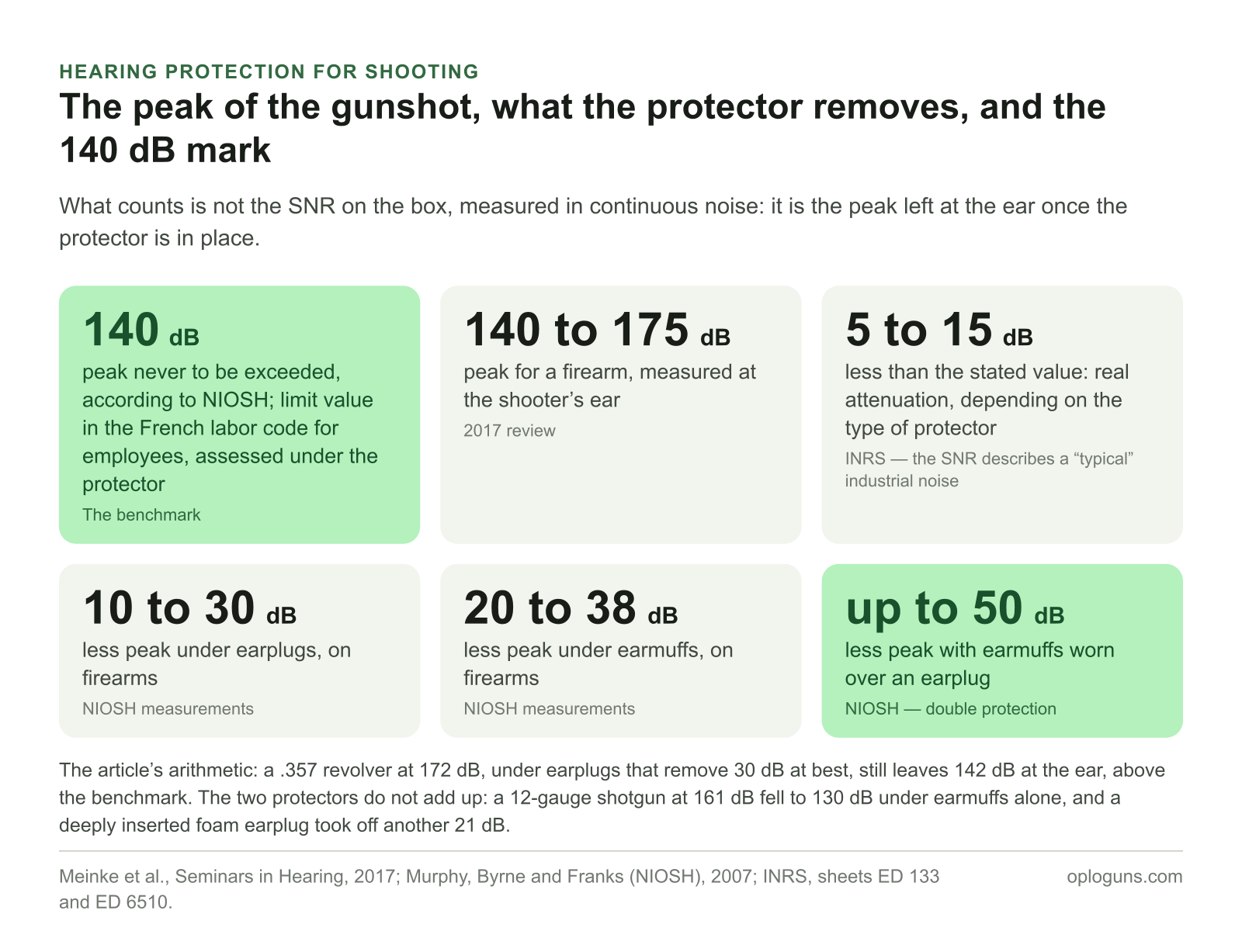
NIOSH recommends double protection to shooters and hunters every time a gun is fired2. The 2017 review concludes likewise: earplug and earmuff together provide the greatest protection1.
The two protectors do not add up. In continuous noise, INRS generally counts 6 to 10 dB more than the better of the two4. On firearms, NIOSH measured more. A 12-gauge shotgun at 161 dB fell to 130 dB under earmuffs alone. A deeply inserted foam earplug took off another 21 dB2. According to the same team, the combination can reach 50 dB of peak reduction2.
The arithmetic shows the limit of a single protector. A .357 revolver at 172 dB, under earplugs that remove 30 dB at best, still leaves 142 dB at the ear2. Above the 140 mark.
Passive double protection makes it hard to hear range commands. NIOSH describes a compromise: sound-restoration earmuffs worn over a foam earplug, the earmuffs making up for part of the earplug's attenuation2.
Glasses, hair, wear: hearing protection's lost decibels
INRS lists what degrades real attenuation3:
- incorrect fitting, especially for earplugs;
- temples of glasses or hair between the cushion and the head;
- a protector unsuited to the wearer's anatomy;
- aging, wear and poor maintenance.
A foam earplug reaches its values only when inserted deeply enough into the ear canal4. NIOSH recommends making sure the earmuffs seal when safety glasses are worn2. The marking on those glasses is decoded in the EN 166 standard.
Children at the range: the same noise as the shooter
A child present at the range is exposed to the same noise as the shooter. The ARS Normandie, a French regional health agency, asks that children be protected from the noise6. The ages for taking up shooting are in the minimum age to start shooting.
For pregnancy, the health advice is brought together in sport shooting and pregnancy.
Three misconceptions about hearing protection for shooting
- "The higher the SNR, the better I am protected from the gunshot." The SNR assumes a "typical" industrial noise and degrades by 5 to 15 dB in real conditions3. Against a peak, the calculation method is a different one3.
- "Electronic earmuffs protect less than passive ones." In NIOSH's tests on firearms, they gave the same peak reduction, whatever the volume2.
- "Foam earplugs are enough." They remove 10 to 30 dB of peak according to NIOSH2, which leaves more than 140 dB at the ear under the loudest guns.
The price of a first pair of passive earmuffs appears in the first-year budget. Passive, electronic and Bluetooth earmuffs are compared in shooting earmuffs compared.
Hearing protection for shooting: by gun and by range
What the measurements indicate
Airguns at 10 m. The measured peaks, 117 to 134 dB, stay under the 140 dB mark1. The noise to take into account is also that of the neighboring positions, if they are firing live rounds.
Small calibers, .22 included. The measured peaks, 140 to 158 dB, reach or exceed the mark1. Under earmuffs, which remove 20 to 38 dB of peak according to NIOSH, they drop back under it2; double protection widens the margin.
Large calibers and indoor ranges. With peaks up to 175 dB and reverberation, NIOSH recommends double protection at every shot12. Sound-restoration earmuffs over a foam earplug keep range commands audible. A suppressor lowers the peak at the muzzle, without doing away with hearing protection.
Sources 6 references
Documents from INRS, NIOSH and the European Commission, and one scientific review, read on 1 November 2026. The INRS, European Commission and ARS documents were read in French; the two others are in English. Click a note marker in the text to highlight the matching source.
- Meinke D. K., Finan D. S., Flamme G. A., Murphy W. J., Stewart M., Lankford J. E., Tasko S. — "Prevention of Noise-Induced Hearing Loss from Recreational Firearms", Seminars in Hearing, 2017, vol. 38, no. 4, pp. 267-281, DOI 10.1055/s-0037-1606323, consulted on 1 November 2026: "The maximum peak sound pressure levels (SPLs) from firearms range from ∼140 to 175 dB"; peaks at the shooter's ear: rifles in calibers larger than .22, 159 to 174 dB; pistols in calibers larger than .22, 148 to 171 dB; shotguns, 152 to 170 dB; .22 pistols, 155 to 158 dB; .17 and .22 rifles, 140 to 144 dB; air rifles, 117 to 134 dB; "Dual hearing protection (earplug worn in combination with an earmuff) provides the greatest protection"; attenuation values of protectors obtained in continuous noise; increased risk in enclosed, reverberant spaces.
- Murphy W. J., Byrne D. C., Franks J. R. (NIOSH) — "Firearms and Hearing Protection", The Hearing Review, March 2007, archived by the CDC, consulted on 1 November 2026: "NIOSH recommends that exposure to peak impulsive noises not exceed 140 dB SPL"; one impulse at 140 dB "would constitute 100% of a person's daily allowable noise exposure"; peaks from 144 dB (.22 rifle) to 172 dB (.357 revolver); 159 to 169 dB at an indoor police range; peak reduction of 10 to 30 dB for earplugs, 20 to 38 dB for earmuffs; level-dependent earmuffs: same protection as when switched off, effect of the volume "minimal"; 12-gauge shotgun: 161 dB reduced to 130 dB by earmuffs (31 dB), deeply inserted foam earplug "adds another 21 dB"; "as much as 50 dB of peak reduction"; double protection "every time a weapon is fired"; formula N = 10^((140 – PI)/10); no data on electronic sound-restoration earplugs; seal of the earmuffs with safety glasses.
- INRS — « Valeurs limites d'exposition au bruit et port de protecteurs individuels », fiche ED 133 [noise exposure limit values and the wearing of personal protectors], 3rd edition, November 2021, consulted on 1 November 2026: exposure limit values of 87 dB(A) and 140 dB(C) « pour les bruits à caractère impulsionnel » [for noises of an impulsive nature] (articles R. 4431-2 to R. 4431-4 of the French labor code), assessed taking the protector into account; stated attenuation overestimated, « L'écart varie de 5 à 15 dB selon le type de protecteur » [the gap varies from 5 to 15 dB depending on the type of protector]; SNR and H, M, L « supposés pour un bruit industriel “type” » [assumed for a "typical" industrial noise] (ISO 4869-2), reached or exceeded by 84% of users; derating for untrained employees: 5 dB for earmuffs, 10 dB for foam earplugs; causes of lost attenuation, including « branches de lunettes, cheveux » [temples of glasses, hair]; impulse noise: method in annex B of standard NF EN 458, based on the peak level without a protector and the frequency characteristics.
- INRS — « Les protections auditives », brochure ED 6510 [hearing protectors], 2023, consulted on 1 November 2026: thresholds of 80 dB(A)/135 dB(C), 85 dB(A)/137 dB(C) and 87 dB(A)/140 dB(C), the last « apprécié en tenant compte de l'atténuation » [assessed taking the attenuation into account]; SNR of 15 to 25 dB (premolded earplugs), 20 to 35 dB (formable ones, provided they are « suffisamment profondément insérés » [inserted deeply enough], and earmuffs); conformity with Regulation 2016/425 checked by notified bodies; certification minimums « H ≥ 12 dB, M ≥ 11 dB, L ≥ 9 dB »; restoration that « s'annule généralement » [generally cuts out] at around 80 dB(A); active control effective « au mieux jusqu'à environ 1 000 Hz » [at best up to about 1,000 Hz], generally with no additional attenuation for impulse noises; devices with a filter triggered at around 110 dB(C), « très répandu chez les chasseurs » [very widespread among hunters], « généralement pas conformes au règlement EPI 2016/425 » [generally not compliant with PPE Regulation 2016/425]; double protection: « un complément de 6 dB à 10 dB à l'atténuation du plus efficace des deux PICB » [an extra 6 dB to 10 dB on top of the attenuation of the more effective of the two protectors]; annex 1: no requirements standard for « les protections auditives contre les bruits impulsionnels (utilisées par exemple pour le tir) » [hearing protectors against impulse noises, used for example for shooting].
- European Commission — décision d'exécution (UE) 2026/1279 du 12 juin 2026 relative aux normes harmonisées concernant les équipements de protection individuelle [Implementing Decision (EU) 2026/1279 of 12 June 2026 on harmonized standards for personal protective equipment], OJ L of 16 June 2026 (text read in the copy circulated by Eurogip), consulted on 1 November 2026: annex I, lines 19 to 28, EN 352-1:2020, EN 352-2:2020+A1:2024, EN 352-3:2020, EN 352-4:2020, EN 352-5:2020, EN 352-6:2020+A1:2024, EN 352-7:2020, EN 352-8:2020+A1:2024, EN 352-9:2020+A1:2024, EN 352-10:2020+A1:2024, with their titles; annex II, withdrawal of EN 352-2:2020 on 16 November 2026.
- ARS Normandie, DRDJSCS and Ligue de tir de Normandie — « Tir sportif, attention au plomb ! » [sport shooting: watch out for lead!], September 2020, consulted on 1 November 2026: « Si vos enfants sont présents lors de votre activité de tir […] Veillez, par ailleurs, à les protéger des nuisances sonores. » [if your children are present while you shoot, also take care to protect them from the noise].
This article informs; it does not replace medical advice. Tinnitus that persists or a drop in hearing after shooting should be discussed with a doctor. The standards cited are those published in the Official Journal of the European Union as of 1 November 2026.
Frequently asked questions
What SNR for sport shooting?
The SNR does not answer the question well. According to INRS, the French occupational safety institute, it expresses the attenuation assumed for a typical industrial noise, not for a gunshot, and real attenuation is 5 to 15 dB below the stated value. For impulse noise, standard EN 458 provides another method, based on the peak level. NIOSH measurements on firearms give 20 to 38 dB of peak reduction for earmuffs, 10 to 30 dB for earplugs.
What does the EN 352 standard mean?
It is the series of European standards for hearing protectors, published in the Official Journal of the European Union. It has ten parts: earmuffs (EN 352-1), earplugs (EN 352-2), earmuffs mounted on a safety helmet (EN 352-3), level-dependent models (EN 352-4 and 352-7), active noise reduction models (EN 352-5) and models with audio input (EN 352-6, 8, 9 and 10).
Should you wear earplugs and earmuffs at the same time?
NIOSH, the US occupational safety and health institute, recommends double protection every time a gun is fired. On a 12-gauge shotgun, earmuffs alone reduced the peak by 31 dB; a deeply inserted foam earplug added 21 dB. INRS, in continuous noise, generally counts 6 to 10 dB more than the better of the two protectors.
Do electronic earmuffs protect as well as passive earmuffs?
In NIOSH's tests on firearms, level-dependent earmuffs reacted fast enough to give the same peak reduction as when switched off, whatever the volume setting. Active noise reduction earmuffs, for their part, generally add nothing more against impulse noise, according to INRS.
Do glasses reduce the effectiveness of earmuffs?
Yes. INRS lists the temples of glasses and hair among the things that come between the earmuff and the head and reduce real attenuation. NIOSH stresses the seal of the cushion when safety glasses are worn.
Spotted an error, or a rule that has changed since we checked? Report an error