Safety glasses for shooting: reading the EN 166 standard, and what replaces it
Published on · Updated on · 7 min read · Anthony Baillon
On safety glasses marked EN 166, the letter F, B or A gives the impact resistance: a steel ball fired at 45, 120 or 190 m/s. The number 1, 2 or 3 gives the optical class. As of 11 November 2025, EN 166 is no longer the reference standard: EN ISO 16321-1 replaces it.
At a glance
| Symbol | Meaning | Test |
|---|---|---|
| F | Low-energy impact | 6 mm ball at 45 m/s |
| B | Medium-energy impact | Same ball at 120 m/s |
| A | High-energy impact | Same ball at 190 m/s |
- Optical class 1: recommended for continuous wear or precision work.
- An added T (FT, BT, AT): impact withstood from −5 °C to +55 °C.
- EN ISO 16321-1 now gives the presumption of conformity; the marking on new pairs changes.
Impact rating on safety glasses: F, B or A, 45 to 190 m/s
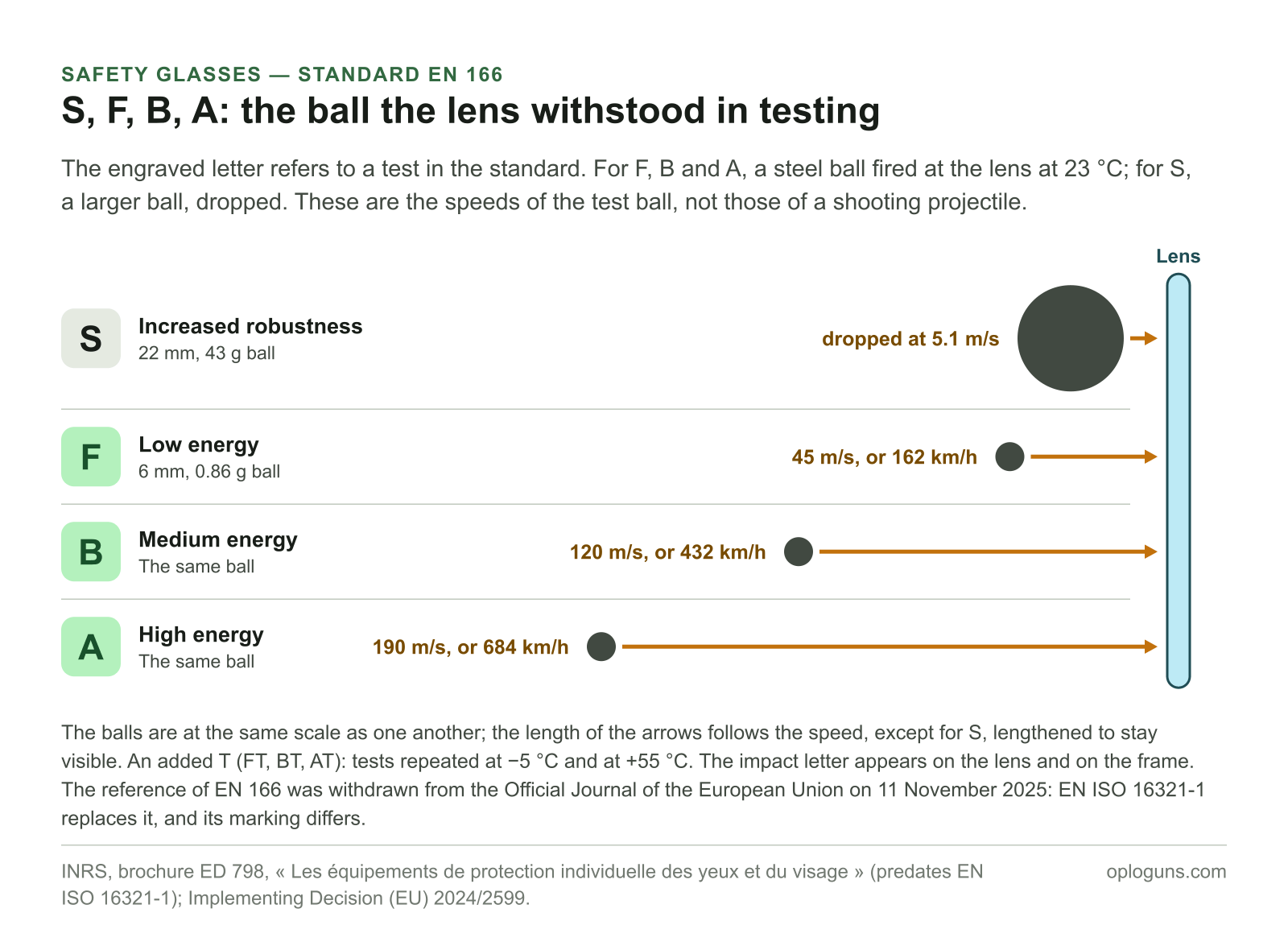
Standard EN 166 describes three levels of resistance to particle impact. Each one fires a steel ball 6 mm in diameter and weighing 0.86 g at the lens, at 23 °C1:
- F, low energy: 45 m/s, or 162 km/h.
- B, medium energy: 120 m/s, or 432 km/h.
- A, high energy: 190 m/s, or 684 km/h.
A basic level exists below these. "Increased robustness", marked S, is checked with a 22 mm, 43 g ball dropped at 5.1 m/s1. It is mandatory for lenses without a filter and for every frame1.
For use at "extreme" temperatures, the tests are run at −5 °C and at +55 °C. The symbol then becomes FT, BT or AT12. The impact symbol appears both on the lens and on the frame1.
Resistance says nothing about sharpness. Another value takes care of that.
Optical class: 1 for glasses worn for long periods
EN 166 defines three optical classes, which measure the quality of vision through the lens1:
| Class | Intended use |
|---|---|
| 1 | Continuous wear or precision work |
| 2 | Intermittent wear |
| 3 | Very short time only |
The MSA, the French agricultural social insurance fund, sums up class 1 in one phrase: « qualité optique parfaite, pas de distorsion » [perfect optical quality, no distortion]2. The class number is read on the lens, not on the frame1.
Reading the marking: lens on one side, frame on the other
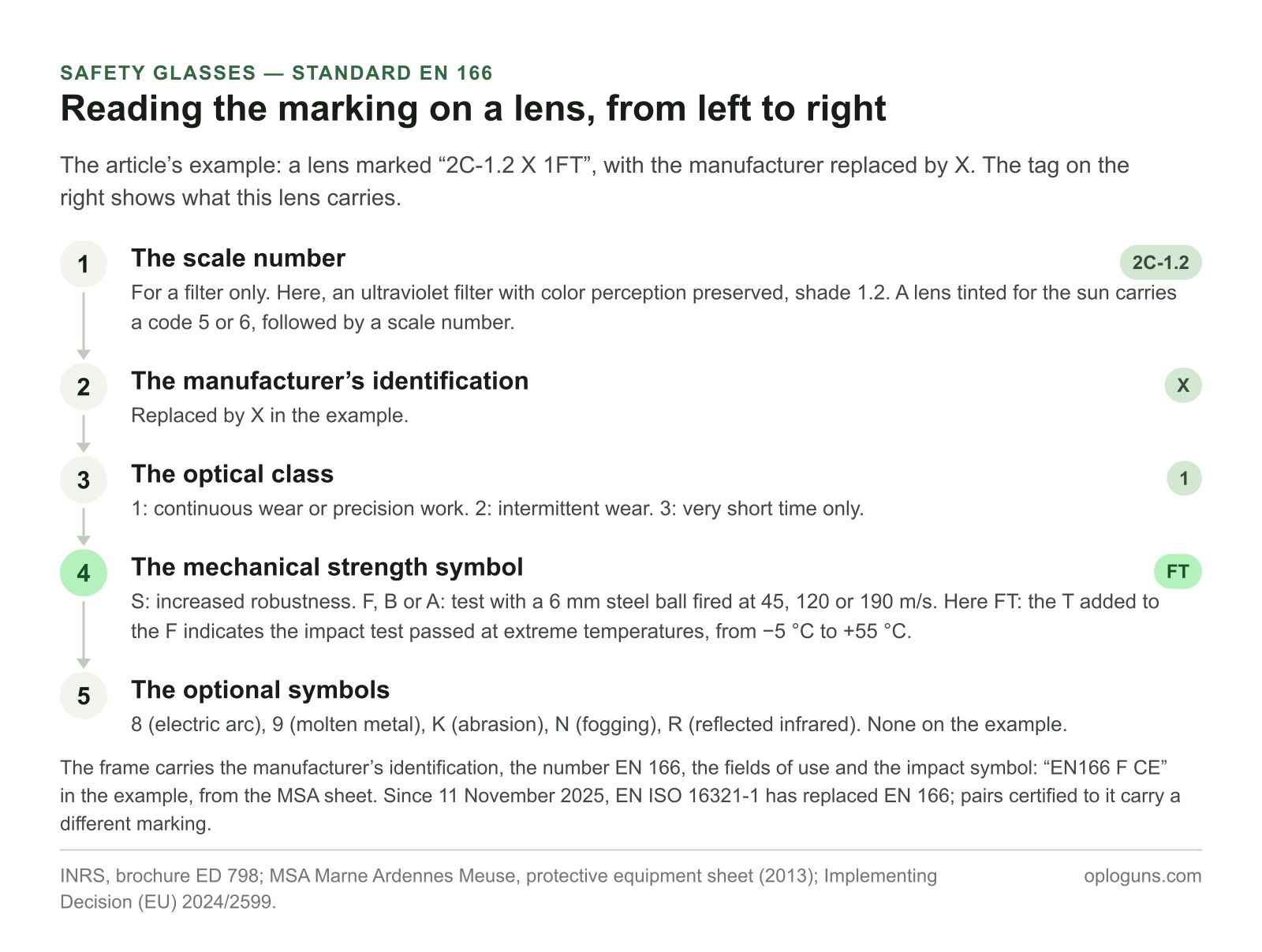
The marking on the lens is read from left to right1:
- the scale number, for a filter only;
- the manufacturer's identification;
- the optical class;
- the mechanical strength symbol;
- the optional symbols: 8 (electric arc), 9 (molten metal), K (abrasion), N (fogging), R (reflected infrared).
The frame carries the manufacturer's identification, the number EN 166, the fields of use and the impact symbol1. The fields are written as numbers: 3 for liquids, 4 for large dust particles, 5 for gases and fine dust1. When frame and lens are a single piece, the whole marking is carried by the frame1.
One example, with the manufacturer replaced by X. The lens carries "2C-1.2 X 1FT", the frame "EN166 F CE"2:
- 2C-1.2: ultraviolet filter with color perception preserved, shade 1.2;
- 1: optical class 1;
- F: low-energy impact, 45 m/s, on the lens as on the frame;
- T, added to the F on the lens: the impact test passed at extreme temperatures, from −5 °C to +55 °C12.
Tinted glasses: the sun filter carries a code 5 or 6
A lens tinted for the sun carries a code 5 or 6, followed by a scale number12. Code 6 adds protection against part of the infrared1. The scale runs from lightest to darkest1:
| Scale number | Type of filter |
|---|---|
| 5-1.1 or 6-1.1 | Photochromic in its light state, light zone of a gradient |
| 5-1.4 and 5-1.7 | Very light, light |
| 5-2 and 5-2.5 | Medium, dark |
| 5-3.1 | Very dark, not recommended for driving |
| 5-4.1 | Extremely dark, unusable for driving |
At dusk and at night, INRS, the French occupational safety institute, considers any filter other than 5-1.1 or 6-1.1 dangerous: these filters are designed for bright daylight1. Codes 2 and 3 denote filters against ultraviolet, the C indicating unaltered color perception2.
Tint and impact are read separately. A dark pair without F, B or A has not been tested against flying particles1.
EN 166 standard withdrawn: EN ISO 16321-1 since 2025
The European Commission had first set the withdrawal of EN 166:2001 for 11 November 2024. It postponed it by a year, to 11 November 2025, along with the filter standards EN 169, EN 170 and EN 1723. The reason: to give manufacturers and laboratories time to adapt3.
The new standards, the decision explains, have updated the test methods, added head forms and introduced new marking requirements. They also add tests for radiant heat, high-mass impacts and chemicals3. The Commission judged that this postponement would not harm safety, the effect of the revised standards being « principalement d'améliorer les procédures d'essai » [mainly to improve the test procedures]3.
The list published on 16 June 2026 confirms the changeover. It gives EN ISO 16321-1:2022 for the general requirements of eye and face protectors for occupational use, and EN 166 no longer appears in it4. Pairs certified to the new standard carry a different marking, defined by EN ISO 16321-13.
At the range: clay shooting, cleanup, prescription glasses
Three situations come up at the range:
- Clay targets in competition. The ISSF technical rules, in the French shooting federation's 2026 translation, impose « lunettes de tir incassables » [shatterproof shooting glasses] and hearing protection5. The discipline is introduced in Olympic trap.
- Cleaning the range. The French federation's sheet on protective equipment against lead provides for safety glasses, along with the FFP3 mask and the coverall6. The reasons are set out in lead at the shooting range.
- Wearers of prescription glasses. The MSA distinguishes over-glasses, for occasional use, from safety glasses with corrective lenses, on prescription, for regular use2.
The temples matter for the ears as well. INRS lists the temples of glasses among the things that reduce the attenuation of earmuffs7. The effect is measured in hearing protection for shooting. The French shooting federation has listed the prevention of eye and hearing injuries among the themes of its prevention policy8. For airguns, see what doctors say about pellet injuries.
Three misconceptions about safety glasses for shooting
- "Sunglasses will do." Sunglasses for general use come under another standard, EN ISO 12312-14. Only F, B or A attest to a particle impact test1.
- "The darker the tint, the better the eye is protected." The scale number measures only how much light is filtered, and at dusk only scale number 1.1 is suitable1.
- "A pair marked EN 166 has become dangerous." The Commission attributed to the revised standards mainly an improvement in test procedures3.
The cost of starter equipment appears in the first-year budget, and the order of the steps in the path into sport shooting.
Shooting glasses: what the marking lets you check
Depending on what you are looking for
Resistance to flying fragments. The letter F, B or A, present on the lens and on the frame, gives the ball speed withstood: 45, 120 or 190 m/s.
Comfort over a long session. The number 1 on the lens denotes the optical class intended for continuous wear.
Shooting outdoors. A code 5 or 6 followed by the scale number tells you the tint; at nightfall, only scale number 1.1 remains suitable.
A new pair. It now comes under EN ISO 16321-1, whose marking differs from that of EN 166.
Sources 8 references
Documents from INRS, the MSA, the European Commission and the Fédération française de tir, read on 1 November 2026 unless stated otherwise. All were read in French. Click a note marker in the text to highlight the matching source.
- INRS — « Les équipements de protection individuelle des yeux et du visage », brochure ED 798 [personal protective equipment for the eyes and face], 3rd edition (2009), October 2010 reprint, consulted on 1 November and again on 16 November 2026: 6 mm, 0.86 g ball at 45 m/s (« F »), 120 m/s (« B »), 190 m/s (« A »), at 23 °C; « solidité renforcée » [increased robustness] (« S ») with a 22 mm, 43 g ball at 5.1 m/s, mandatory « pour les oculaires sans action filtrante et pour toute monture » [for lenses with no filtering action and for every frame]; tests at « – 5 °C et + 55 °C » and symbols « FT », « BT », « AT »; optical classes: « la classe 1 est recommandée pour un port permanent ou l'exécution d'un travail minutieux » [class 1 is recommended for continuous wear or precision work], « la classe 2 est utilisable pour un port intermittent » [class 2 can be used for intermittent wear], « la classe 3 n'est utilisable que pour une très brève durée » [class 3 can be used only for a very short time]; order of the marking on the lens and on the frame, fields 3, 4, 5, 8, 9, symbols K, N, R; marking on the frame when it forms a single unit with the lens; table 5 of sun filter scale numbers (EN 172), code 6 against « certains rayonnements UV, et parfois IR » [certain UV radiation, and sometimes IR]; « il est dangereux d'utiliser des filtres autres que 5-1,1 ou 6-1,1 au crépuscule et la nuit » [it is dangerous to use filters other than 5-1.1 or 6-1.1 at dusk and at night]. ⚠️ Brochure predates EN ISO 16321-1: it describes the EN 166 marking.
- MSA Marne Ardennes Meuse — « Les lunettes de protection dans les vignes » [safety glasses in the vineyard], protective equipment sheet, 2013, consulted on 1 November and again on 16 November 2026: filters 2 or 3 against ultraviolet, « + C = perception des couleurs non altérée » [+ C = unaltered color perception], 4 infrared, 5 or 6 sun; shade number « du plus clair au plus foncé » [from lightest to darkest]; optical class « 1 port permanent (qualité optique parfaite, pas de distorsion) » [1, continuous wear: perfect optical quality, no distortion], « 2 port intermittent », « 3 port exceptionnel » [3, exceptional wear]; S, F (« + T = températures extrêmes » [+ T = extreme temperatures]), B, A; example of a lens marking « 2C - 1,2 [fabricant] 1FT » and of a frame marking « EN166 F CE »; for wearers of prescription glasses, « des sur-lunettes pour un travail occasionnel » [over-glasses for occasional work] or « des lunettes de protection à verres correcteurs pour un travail régulier » [safety glasses with corrective lenses for regular work], with a prescription.
- European Commission — décision d'exécution (UE) 2024/2599 du 4 octobre 2024 [Implementing Decision (EU) 2024/2599 of 4 October 2024], OJ L of 8 October 2024 (text read in the copy circulated by Eurogip), consulted on 1 November 2026: recital 12, withdrawal initially set for 11 November 2024, postponement « d'une année supplémentaire » [by a further year] for EN 166:2001, EN 169:2002, EN 170:2002, EN 172:1994 and EN 379:2003+A1:2009; new standards that « ont actualisé les méthodes d'essai » [have updated the test methods], add « de nouvelles formes de tête » [new head forms] and « de nouvelles exigences pour le marquage des produits » [new requirements for product marking], as well as requirements for « résistance à la chaleur rayonnante, aux impacts de masse élevée, aux produits chimiques, aux effets électrostatiques » [resistance to radiant heat, high-mass impacts, chemicals and electrostatic effects]; « l'effet des normes révisées est principalement d'améliorer les procédures d'essai » [the effect of the revised standards is mainly to improve the test procedures]; annex II: « EN 166:2001 11.11.2025 ».
- European Commission — décision d'exécution (UE) 2026/1279 du 12 juin 2026 [Implementing Decision (EU) 2026/1279 of 12 June 2026], OJ L of 16 June 2026 (text read in the copy circulated by Eurogip), consulted on 1 November 2026: annex I, no. 173, « EN ISO 16321-1:2022 Protection des yeux et du visage à usage professionnel — Partie 1: Exigences générales » [eye and face protection for occupational use, part 1: general requirements], nos. 174 and 175 for parts 2 and 3; no. 101, « EN ISO 12312-1:2022 », sunglasses for general use; no reference to EN 166 in annexes I and II.
- FFTir — Règles techniques ISSF du tir aux plateaux, édition 2026 [ISSF technical rules for clay target shooting, 2026 edition] (PDF, « Effective au 01/09/2026 »), consulted on 23 September 2026: rule 9.2.7, hearing protection and « lunettes de tir incassables » [shatterproof shooting glasses] mandatory. ⚠️ FFTir website unreachable on 1 November 2026: not reread on that date.
- Fédération française de tir — fiche ressource « EPI plomb » [resource sheet on protective equipment against lead], version of 21 October 2025 (copy circulated by the Ligue régionale de tir de Lorraine), consulted on 1 November 2026: for cleaning, collecting and melting lead, « Les lunettes de protections » [safety glasses], with the disposable coverall, the overshoes, the FFP3 half-mask and the gloves.
- INRS — « Valeurs limites d'exposition au bruit et port de protecteurs individuels », fiche ED 133 [noise exposure limit values and the wearing of personal protectors], 3rd edition, November 2021, consulted on 1 November 2026: among the causes of reduced attenuation, « Interposition d'éléments entre le PICB et le porteur (branches de lunettes, cheveux) » [items coming between the hearing protector and the wearer: temples of glasses, hair].
- Fédération française de tir — « La Fédération Française de Tir se dote d'un plan de prévention de l'exposition au plomb » [the French shooting federation adopts a plan to prevent lead exposure] (copy circulated by the ARS Normandie), consulted on 1 November 2026: themes of the federation's prevention policy, including « la prévention de traumatisme oculaire ou auditif » [the prevention of eye or hearing injury].
The standard in force prevails. This article describes the references published in the Official Journal of the European Union as of 1 November 2026. The rules of the range or of the competition set the equipment required.
Frequently asked questions
What does F mean on safety glasses?
F indicates resistance to low-energy particle impact: the lens withstood a 6 mm, 0.86 g steel ball fired at 45 m/s, under standard EN 166 as described by INRS, the French occupational safety institute. B corresponds to the same test at 120 m/s, A at 190 m/s. An added T (FT, BT, AT) indicates that the test was passed at −5 °C and at +55 °C.
Which optical class for shooting glasses?
Standard EN 166 defines three classes. According to INRS, class 1 is recommended for continuous wear or precision work, class 2 can be used for intermittent wear, and class 3 only for a very short time.
Is the EN 166 standard still valid?
Its reference was withdrawn from the Official Journal of the European Union on 11 November 2025, by Implementing Decision (EU) 2024/2599. Standard EN ISO 16321-1:2022 replaces it for eye and face protectors for occupational use. The Commission stated that the revised standards mainly improve the test procedures.
Are safety glasses mandatory for shooting?
In clay target shooting, the 2026 ISSF technical rules, as translated by the French shooting federation, impose « lunettes de tir incassables » [shatterproof shooting glasses] in competition. For cleaning the range, the French federation's sheet on protective equipment against lead provides for safety glasses. Outside these cases, the rule depends on the range's own regulations.
How do you protect your eyes when shooting with prescription glasses?
The MSA, the French agricultural social insurance fund, distinguishes two solutions: over-glasses worn on top of prescription glasses for occasional use, and safety glasses with corrective lenses for regular use, on prescription.
Spotted an error, or a rule that has changed since we checked? Report an error