Quiet air rifle: where the noise comes from, what a moderator changes
Published on · 9 min read · Anthony Baillon
No air rifle is silent: nine spring or gas-ram rifles measured in 2016 gave 117 to 134 decibels peak at the shooter's ear. The noise comes from the mechanism, from the air expanding at the muzzle and from the pellet itself. An integrated moderator removed only 5.6 dB of it on average.
At a glance
| Source of noise | Where it comes from | What a moderator does about it |
|---|---|---|
| The mechanism | Piston launched, then stopped dead, on a spring or a gas ram | Out of its reach: it works at the muzzle |
| The air at the muzzle | Expansion of the air behind the pellet | Its job: chambers and baffles |
| The pellet | Flight faster than sound, light pellet | Out of its reach: the pellet has left the gun |
- Published measurement: 5.6 dB peak less with an integrated moderator, on spring rifles.
- Hearing protection remains recommended by the study's authors, for all air rifle shooters.
Air rifle noise: 117 to 134 dB at the shooter's ear
An American audiology team, with a researcher from the occupational health institute NIOSH, measured nine 4.5 mm pellet rifles and one BB rifle in 20161. All the pellet rifles were spring or gas-ram guns. Five shots per gun and per pellet, microphones at the muzzle and at both of the shooter's ears.
| 4.5 mm rifle | Integrated moderator | Advertised velocity (US versions) | Peak at the ear |
|---|---|---|---|
| Gamo Whisper | Yes | 305 m/s | 117.0 dB |
| Gamo Hunter 220 | No | 305 m/s | 125.0 dB |
| Gamo Whisper Fusion | Yes | 396 m/s | 125.0 dB |
| RWS Diana 34B | No | 305 m/s | 128.6 dB |
| Gamo CFX | Yes | 366 m/s | 130.3 dB |
| Gamo Varmint Hunter HP | No | 427 m/s | 131.3 dB |
Six of the nine rifles, fired with a lead pellet, microphone at the left ear; US versions, velocities advertised by the manufacturers1.
Two benchmarks put these figures in context. No rifle exceeded 140 dB peak, the limit used for adults. Eight out of nine exceeded 120 dB, the limit the World Health Organization recommends for children1. The loudest stayed about 6 dB under a .22 powder-burning rifle measured by the same team1.
The table shows something else: an integrated moderator is not enough to rank a rifle. The Gamo CFX, which has one, is louder than two rifles that do not. To understand why, the three noises of an air gun shot have to be separated.
Spring air rifle: mechanism noise, inside the receiver
The first noise does not come out of the barrel. In a spring rifle, a piston is launched, then stops dead at the end of the cylinder: Umarex describes two impulses, in opposite directions3. The gas ram replaces the steel spring with a sealed gas; Gamo credits it with « moins de vibrations » [less vibration]4. The piston, for its part, stays.
A moderator is a muzzle part. Gamo describes its own as a noise reducer "molded onto the barrel"4. It sits far from the piston, at the other end of the gun.
The measurement points the same way. On the spring and gas-ram rifles of the study, the integrated moderator removed 5.6 dB peak, all other factors equal1. On firearms, the same team measured 17 to 24 dB6. Five and a half decibels divide the sound pressure by 1.9; twenty decibels, by ten11.
The two families of piston rifles are compared in spring, gas ram, CO2 or PCP. That leaves the noise the moderator is really aimed at.
Air expanding at the muzzle: what a moderator treats
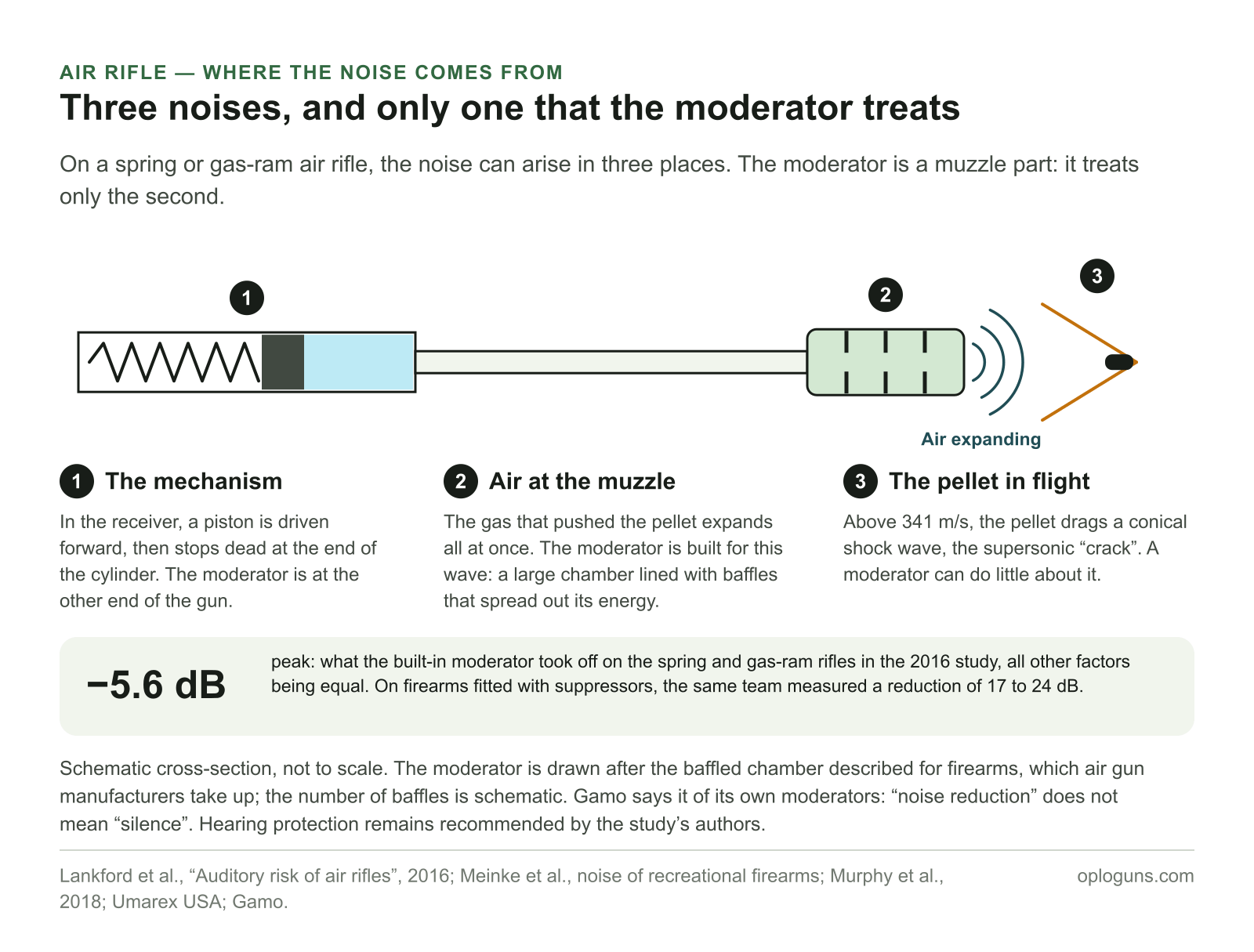
At the muzzle, the gas that was pushing the projectile expands all at once. On a firearm, audiologists describe a spherical blast wave, centered on the muzzle2. The moderator is made for it: a large-volume chamber coupled to the muzzle, fitted with baffles that diffuse the energy of the wave2.
Air gun manufacturers take up the principle:
- Gamo molds its moderator onto the barrel, as a single part: what everyday language calls an integrated silencer. On the Whisper Fusion and Whisper Maxxim models, the pellet travels through two chambers4.
- Weihrauch offers screw-on moderators, with a ½-inch UNF thread, and fully shrouded barrels with an integrated moderator, the "F.S.B." versions5.
- As standard, the HW 100 X comes with an air stripper; the moderator is a paid option5.
The noise is loudest at the muzzle. In the 2016 study, the level measured near the muzzle exceeded the level at the shooter's ear by 9 to 10 dB1. The authors draw from this an expectation for air pistols, which they did not measure: muzzle closer to the ear, hearing risk probably increased1.
Light, fast pellet: the noise of supersonic flight
The third noise leaves the gun with the pellet. A projectile faster than sound trails a conical shock wave, the sonic boom2. The threshold is at 341 m/s2. A moderator can do little about it: on firearms, it reduces the noise of fast ammunition less, because of the wave of the supersonic projectile6.
An air rifle can cross that threshold. The 2016 study notes it: the velocity of some exceeds the speed of sound1. Everything depends on the pellet's mass. At 19.9 joules, with two H&N pellets711:
| Pellet mass | Velocity at 19.9 joules | Relative to sound |
|---|---|---|
| 0.53 g, match pellet | 274 m/s | Below |
| 0.37 g, tin alloy | 328 m/s | Just below |
| Under 0.34 g | Over 341 m/s | Above |
Gamo says it bluntly about its moderators: "noise reduction" does not mean "silence", and a lighter, faster, smaller-caliber pellet « produira un son plus fort » [will produce a louder sound]4. H&N, for that matter, associates its 0.37 g pellet with the « vitesse du son » [speed of sound]7.
The study adds nuance. Between lead and alloy, it finds no consistent difference: six rifles out of nine were louder with the alloy, by 1.1 dB1. It does find that the rifles with the highest velocities were generally the most hazardous for hearing1. The relationship between mass, velocity and energy is in 20 joules: pellet velocity and range.
Quiet PCP air rifle: no published measurement
The nine rifles measured in 2016 all had a piston1. No PCP — a pre-charged pneumatic, which shoots on air stored in a reservoir — and no CO2 gun: the study says nothing about those two families. Weihrauch, which sells moderators, gives no figure for their effect in its documentation either5.
What the sources allow us to say comes down to three points:
- A PCP has no piston. Weihrauch advertises a "rückstoßfrei", recoil-free, shot for its HW 1005. There is no piston-mechanism noise.
- The muzzle noise remains, and it is the one the moderator treats. Weihrauch offers them on its HW 100 X5.
- The pellet follows the same rule as everywhere: the lighter and faster it is, the louder it is4.
How a PCP and its regulator work is described in the PCP air rifle; pistols, in the air pistol: CO2, spring or PCP.
Moderator on an air gun: what the French text says
The law on sound moderators comes down to one line of the French internal security code, the code de la sécurité intérieure, explained in sound moderators: what the law says. Article R311-1 lists among the things that are not weapons « les réducteurs de son constituant des pièces additionnelles ne modifiant pas le fonctionnement de l'arme » [sound reducers that are additional parts not altering the working of the gun]8.
Two observations, and no more:
- The text says « l'arme » [the gun], without specifying whether it shoots with powder or with air. The words « air comprimé » [compressed air] do not appear in it8.
- The classification does not mention it, neither under item h) of Category D, the heading for air guns of 2 to 20 joules, nor elsewhere9.
So neither article deals specifically with a moderator fitted to an air gun. That silence is not a rule: the status of a particular setup is checked with the gunsmith or the prefecture.
Sporting rulebooks, for their part, each decide for themselves:
- ISSF rifle, 10 m included: any device inside the barrel or a tube is prohibited10.
- Field target: "silencers" are permitted, subject to the law of the country hosting the championship10.
The discipline of field target is presented in shooting far with an air rifle.
Hearing protection with an air rifle: from 120 dB
An air rifle remains far from a firearm: most of those produce 150 to 165 dB peak2. That does not make it harmless to the ear. Eight rifles out of nine exceeded the 120 dB limit recommended for children1.
The study's authors draw three recommendations from it1:
- Hearing protection for all shooters of air rifles, adults included.
- For young shooters, an integrated moderator and a lower advertised velocity.
- Electronic protectors for young shooters and those who supervise them, which let the voice through.
The ratings of earmuffs and earplugs are compared in hearing protection for shooting. The age at which a minor may hold an air gun is in air rifles and the 20 joules.
Three misconceptions about the quiet air rifle
- "An air rifle makes no noise." From 117 to 134 dB peak at the shooter's ear, for the nine rifles measured1.
- "A moderator makes it silent." The integrated moderator removed 5.6 dB1, and Gamo itself writes that noise reduction does not mean silence4.
- "A fast pellet changes nothing about the noise." Above 341 m/s, the flight becomes a source of noise2, and the fastest rifles in the study were generally the most hazardous for hearing1.
A less noisy air rifle: by mechanism
Spring or gas-ram air rifle
An integrated moderator removes 5.6 dB peak on average, and a heavier pellet stays under the speed of sound. The catch: the piston noise remains, and no muzzle part reaches it.
PCP air rifle
With no piston, what remains is the muzzle noise, which the moderator treats, and that of the pellet. The catch: no published measurement puts a figure on the gain, and the rules of each discipline say whether the part is allowed.
For a young shooter
A rifle with an integrated moderator and a moderate velocity, with hearing protection. Even so, eight rifles out of nine still exceeded the limit recommended for children: hearing protection remains essential.
The measurements hold for the guns measured: nine 4.5 mm spring or gas-ram rifles, in US versions, in 2016. The text in force prevails: code de la sécurité intérieure in its version of 15 November 2026. The status of a moderator on a particular gun is checked with the gunsmith or the prefecture; the rules of a discipline, with the club.
Sources 11 references
The noise measurements come from peer-reviewed scientific journals; how moderators work, from the manufacturers; the legal texts, from Légifrance, in the version indicated. Everything was read on 15 November 2026. The velocities at 19.9 joules are calculated. Click a reference number in the text to highlight the matching source.
- Lankford J. E., Meinke D. K., Flamme G. A., Finan D. S., Stewart M., Tasko S., Murphy W. J. — "Auditory risk of air rifles", International Journal of Audiology, 2016, vol. 55, suppl. 1, pp. S51-S58, full text reread 15 November 2026: "Impulses were generated by nine pellet air rifles and one BB air rifle"; "The air rifles were .177 caliber"; "All of the pellet air rifles used a single-stoke spring-piston or a gas-spring charging mechanism"; "Three air rifles were designed with an integrated sound suppressor"; five shots per pellet, microphones at the muzzle and at both ears; "all of the pellet air guns had average peak levels between 117–134 dB SPL" at the left ear; "All but one of the nine pellet air guns exceeded the 120 dB peak level of the WHO criterion for youth. None of the pellet guns exceeded the 140 dB peak limit"; table 1, advertised velocities: Gamo Whisper 1,000 ft/s, Hunter 220 1,000, Diana 34B 1,000, CFX 1,200, Whisper Fusion 1,300, Varmint Hunter HP 1,400; table 2, left ear, lead pellet: Gamo Whisper 117.0 dB, Hunter 220 125.0, Whisper Fusion 125.0, RWS Diana 34B 128.6, Gamo CFX 130.3, Varmint Hunter HP 131.3 (133.5 with the alloy); "Peak sound pressure level differences at the muzzle averaged 9.2 dB (lead) to 10.2 dB (alloy) higher than the left ear values"; "the suppressor could be expected to reduce the peak SPL by 5.6 dB (95 % CI 4.5 to 6.8 dB)"; "Six (67%) of the air guns shooting pellets had higher peak levels (1.1 dB) for alloy pellets than with lead pellets"; "there was no consistent difference between lead and alloy projectiles"; "the pellet air rifles with higher velocities were generally more hazardous than those with lower velocities"; "Projectile velocities from some air rifles may exceed the speed of sound in air (~1100 feet per second)"; the loudest, 133.5 dB, "approximately 6 dB lower (139.6 dB) than the .22 caliber Remington 514"; "Although air pistols were not evaluated in this study, it might be expected that the auditory hazard may be increased due to the closer proximity of the muzzle to the ear"; "youth should utilize air rifles with an integrated suppressor and lower velocity ratings"; "all air rifle shooters should use hearing protection"; "Electronic level-dependent HPDs are strongly recommended for youth and adult mentors".
- Meinke D. K., Finan D. S., Flamme G. A., Murphy W. J., Stewart M., Lankford J. E., Tasko S. — "Prevention of Noise-Induced Hearing Loss from Recreational Firearms", Seminars in Hearing, 2017, vol. 38, no. 4, pp. 267-281, reread 15 November 2026: "The majority of recreational firearms (excluding small-caliber 0.17 and 0.22 rifles and air rifles) generate between 150 and 165 dB peak SPLs"; table 1, "Air rifles ∼117–134"; "producing a conical shock wave commonly called a sonic boom"; "a spherical blast wave initially centered on the muzzle will be produced"; a moderator works "by coupling a large-volume chamber to the muzzle of the firearm", "Baffles within the chamber act to diffuse the energy of the blast wave"; subsonic ammunition, "velocity less than 1,120 feet per second or 341 m/s", "eliminating the noise source caused by the supersonic flight of the projectile".
- Umarex USA — "What Kind of Scope Can I Put on my Spring or Gas Piston Air Rifle?", 28 March 2024, reread 15 November 2026: "The first impulse comes from the release of the spring and piston assembly. The second impulse occurs when the piston assembly comes to a stop at the end of the cylinder"; "the second impulse is going in the opposite direction of the first recoil impulse".
- Gamo — Technologie Gamo, French page, and Gamo Technology, English page, reread 15 November 2026: « « réduction du bruit » ne signifie pas «silence», car les niveaux sonores varient en fonction du choix des plombs. Un plomb de calibre plus léger, plus rapide et plus petit, par exemple, produira un son plus fort qu'un plomb de calibre plus lourd, plus lent et plus élevé » ["noise reduction" does not mean "silence", because sound levels vary with the choice of pellet; a lighter, faster, smaller-caliber pellet, for example, will produce a louder sound than a heavier, slower, larger-caliber one]; "The Whisper is an integrated noise and muzzle blast reducer molded onto the barrel, forming a single part"; Whisper Fusion, "The pellet travels through two different chambers"; Whisper Maxxim, « deux chambres d'atténuation du bruit » [two noise-dampening chambers]; IGT, « cylindre pneumatique qui remplace le ressort » [pneumatic cylinder that replaces the spring], « Moins de vibrations » [less vibration]. ⚠️ Manufacturer's commercial presentation.
- Weihrauch — 2026 catalog (PDF, German and English), reread 15 November 2026: moderators "XL and XL-K", "with thread ½ ″ UNF", presented for the HW 100 X; "HW 100 X with 310 mm barrel and moderator"; HW 100 F.S.B., "variants with fully shrouded barrel and integrated moderator (for an extra charge)"; HW 100 X, "Standard: With air-stripper", "Optional: Moderator for an extra-charge"; HW 100 series, "rückstoßfreie Schussabgabe". The catalog publishes no noise figure.
- Murphy W. J., Flamme G. A., Campbell A. R., Zechmann E. L., Tasko S. M., Lankford J. E., Meinke D. K., Finan D. S., Stewart M. — "The reduction of gunshot noise and auditory risk through the use of firearm suppressors and low-velocity ammunition", International Journal of Audiology, 2018, vol. 57, suppl. 1, pp. S28-S41, abstract reread 15 November 2026: "The suppressors reduced exposures at the ear between 17 and 24 dB peak sound pressure level"; "Sound power reductions were greater for the low-velocity ammunition than for the same firearms fired with high-velocity ammunition due to the effect of N-waves produced by a supersonic bullet".
- H&N Sport — Field Target Trophy Green, 4.5 mm product page, French page reread 15 November 2026: « Balle légère à vitesse rapide » [light, high-velocity pellet], « Vitesse du son et trajectoire plane pour des distances moyennes » [speed of sound and flat trajectory for medium distances], 0.37 g, tin alloy; Finale Match Heavy page, wadcutter match pellet, 0.53 g. ⚠️ Manufacturer's technical data.
- Légifrance — article R311-1 du code de la sécurité intérieure (in French), version in force since 7 September 2025 (decree no. 2025-894 of 5 September 2025, art. 1), consulted 15 November 2026: « IV.-Ne sont pas des armes au sens du présent titre : […] 2° Les réducteurs de son constituant des pièces additionnelles ne modifiant pas le fonctionnement de l'arme » [IV. The following are not weapons within the meaning of this title: 2° sound reducers that are additional parts not altering the working of the gun]. The words « air comprimé », « modérateur » and « silencieux » do not appear in it.
- Légifrance — article R311-2 du code de la sécurité intérieure (in French), version in force since 7 September 2025 (decree no. 2025-894, art. 2), consulted 15 November 2026: Category D, h), « Armes et lanceurs dont le projectile est propulsé de manière non pyrotechnique avec une énergie à la bouche comprise entre 2 et 20 joules » [guns and launchers whose projectile is propelled by non-pyrotechnic means with a muzzle energy between 2 and 20 joules]. The words « réducteur de son », « modérateur », « silencieux » and « accessoire » do not appear in it.
- Sporting rulebooks, reread 15 November 2026: ISSF, Rule Book, Edition 2025, Third Print 10/2026, in force since 19 October 2026, 7.4.1.5, "Any construction or device inside the barrel or tube, other than rifling and chambering for the cartridge or pellet, is prohibited"; World Field Target Federation, Competition Rules (2025 Edition), 1.4 o, "Silencers/Muzzle breaks are permitted. Provided the use of these items comply with the laws of the country hosting a WFTC".
- Calculations: velocity = √(2 × energy ÷ mass), that is √(2 × 19.9 ÷ 0.00053) = 274 m/s and √(2 × 19.9 ÷ 0.00037) = 328 m/s; mass below which a 19.9 J pellet exceeds 341 m/s: 2 × 19.9 ÷ 341² = 0.34 g; conversions 1 ft/s = 0.3048 m/s (1,000, 1,200, 1,300 and 1,400 ft/s = 305, 366, 396 and 427 m/s); sound pressure level equals 20 × log10 of the pressure ratio: 5.6 dB corresponds to a ratio of 1.9, 20 dB to a ratio of 10.
Frequently asked questions
How many decibels does an air rifle make?
From 117 to 134 decibels peak at the shooter's ear, for nine 4.5 mm spring or gas-ram rifles measured in 2016 by an American audiology team. None exceeded the 140 dB limit used for adults; eight out of nine exceeded the 120 dB limit the World Health Organization recommends for children.
Which air rifle is the quietest?
No published ranking covers every rifle. In the 2016 study, the least noisy of the nine was a Gamo Whisper with an integrated moderator, at one of the lowest advertised velocities: 117 dB peak. The authors single out two factors: an integrated moderator and a lower pellet velocity. No PCP was measured.
Does a moderator make an air rifle silent?
No. On the spring rifles of the 2016 study, the integrated moderator removed 5.6 dB peak on average, against 17 to 24 dB measured on firearms in 2018. Gamo says as much about its own moderators: noise reduction does not mean silence, and the sound level varies with the pellet.
Is a PCP air rifle quieter than a spring rifle?
No published measurement puts a figure on it: the 2016 study covered only spring or gas-ram rifles. A PCP has no piston: Weihrauch advertises a recoil-free shot. Its noise comes from the air expanding at the muzzle, which a moderator treats, and from the pellet. Weihrauch offers a moderator as an option on its HW 100 X.
Can you fit a silencer to an air rifle in France?
The French internal security code excludes from the definition of weapons the sound reducers that do not alter the working « de l'arme » [of the gun], without naming air guns; neither that article nor the classification treats this case separately, and the status of a given setup is checked with the gunsmith or the prefecture. In ISSF competition, any device inside the barrel is prohibited. Manufacturers offer them: Weihrauch, moderators with a ½-inch UNF thread and barrels with an integrated moderator.
Is an air pistol quieter than an air rifle?
Air pistols were not measured in the 2016 study. Its authors rather expect an increased hearing risk: the muzzle is closer to the ear. On the rifles, the level at the muzzle exceeded the level measured at the ear by about 9 to 10 dB.
Spotted an error, or a rule that has changed since we checked? Report an error