20 joules: pellet velocity, range and useful distance
Published on · 9 min read · Anthony Baillon
Twenty joules is a measure of energy: the velocity depends on the pellet's mass. At 20 joules, a 4.5 mm pellet of 0.56 g leaves at 267 m/s, or 962 km/h; a 5.5 mm pellet of 0.95 g, at 205 m/s. Zeroed at 30 m, the first one drops 10 cm at 50 m.
At a glance
| Pellet | Velocity at 20 joules | Drop at 50 m, at 19.9 J |
|---|---|---|
| 4.5 mm, 0.56 g | 267 m/s, 962 km/h | 10 cm |
| 4.5 mm, 0.69 g | 241 m/s, 867 km/h | 11 cm |
| 5.5 mm, 0.95 g | 205 m/s, 739 km/h | 17 cm |
| 5.5 mm, 1.37 g | 171 m/s, 615 km/h | 20 cm |
- The formula: energy = mass × velocity² ÷ 2. A pellet twice as heavy leaves the muzzle 1.4 times more slowly.
- The drop: calculated by H&N at 19.9 joules, rifle zeroed at 30 m, line of sight taken at the muzzle.
- The useful distance: 10 m for a wadcutter, 30 m for a pointed pellet, 50 m for a domed pellet, according to H&N.
20 joules in m/s and km/h: the table by pellet
A velocity read on a box says nothing without the pellet that goes with it. Energy equals mass multiplied by the square of velocity, divided by two13. Turned around, the formula gives the velocity: the square root of twice the energy, divided by the mass in kilograms.
For 20 joules and a 0.56 g pellet: 2 × 20 ÷ 0.00056 = 71,429, whose square root is 267 m/s. Multiplied by 3.6, that makes 962 km/h. At that speed, the pellet crosses a 10 m range in four hundredths of a second.
| Pellet | Mass | At 20 joules | In km/h |
|---|---|---|---|
| 4.5 mm lead-free, RWS Hypermatch | 0.33 g | 348 m/s | 1,253 |
| 4.5 mm wadcutter, H&N Sport | 0.53 g | 275 m/s | 989 |
| 4.5 mm domed, H&N Field Target Trophy | 0.56 g | 267 m/s | 962 |
| 4.5 mm heavy domed, H&N Baracuda | 0.69 g | 241 m/s | 867 |
| 5.5 mm domed, H&N Field Target Trophy | 0.95 g | 205 m/s | 739 |
| 5.5 mm heavy domed, H&N Baracuda | 1.37 g | 171 m/s | 615 |
Masses published by H&N2; mass of the RWS Hypermatch read at a gun shop7; velocities calculated13.
The 0.62 g pellet taken as an example in measuring velocity with a chronograph falls between two rows: 254 m/s. The masses of match pellets, from 0.45 to 0.535 g, are in choosing your 4.5 mm pellets.
The 20-joule threshold is an energy, not a velocity
The French internal security code, the code de la sécurité intérieure, does not speak of meters per second. It classifies air guns by their « énergie à la bouche » [muzzle energy]: between 2 and 20 joules in Category D, at 20 joules and above in Category C1. Ages, purchase and transport are in air rifles and the 20 joules.
A manufacturer's sheet shows the gap between the two quantities. Diana lists its 34 Panther at 270 m/s and 20 joules in 4.5 mm, 225 m/s and 22 joules in 5.5 mm5. The 5.5 mm pellet leaves more slowly, with more energy: it is heavier.
The most powerful rifles in Category D are advertised for sale at 19.9 joules7. The difference from 20 joules is less than one meter per second: 266.6 m/s instead of 267.3 for the 0.56 g pellet13. The classification, for its part, changes completely. What that energy is worth on the range is covered in the "most powerful" air rifle.
An air rifle's advertised velocity: with which pellet
A velocity figure has its pellet, rarely written in large type. Gamo advertises up to 1,300 feet per second in 4.5 mm for its gas ram, or 396 m/s, "with PBA Platinum": the figure holds for that pellet of the brand, not for another6.
The calculation sets a limit on these claims. At 19.9 joules, 400 m/s implies a projectile of 0.25 g13. The lightest pellet found weighs 0.33 g, and leaves at 347 m/s at that energy7. A 19.9-joule rifle is nonetheless advertised for sale « à près de 400 m/s » [at close to 400 m/s]7.
Three checks put a velocity figure in perspective:
- Velocity alone says nothing: you need the mass of the pellet used.
- Energy and velocity together give the mass. Weihrauch publishes both: 240 m/s for 16.3 joules, 170 m/s for 7.5 joules, in 4.5 mm4.
- A lead-free pellet goes faster at equal energy, because it is lighter: 0.33 g against 0.56 g.
Pellet drop: 10 to 22 cm at 50 m, zeroed at 30 m
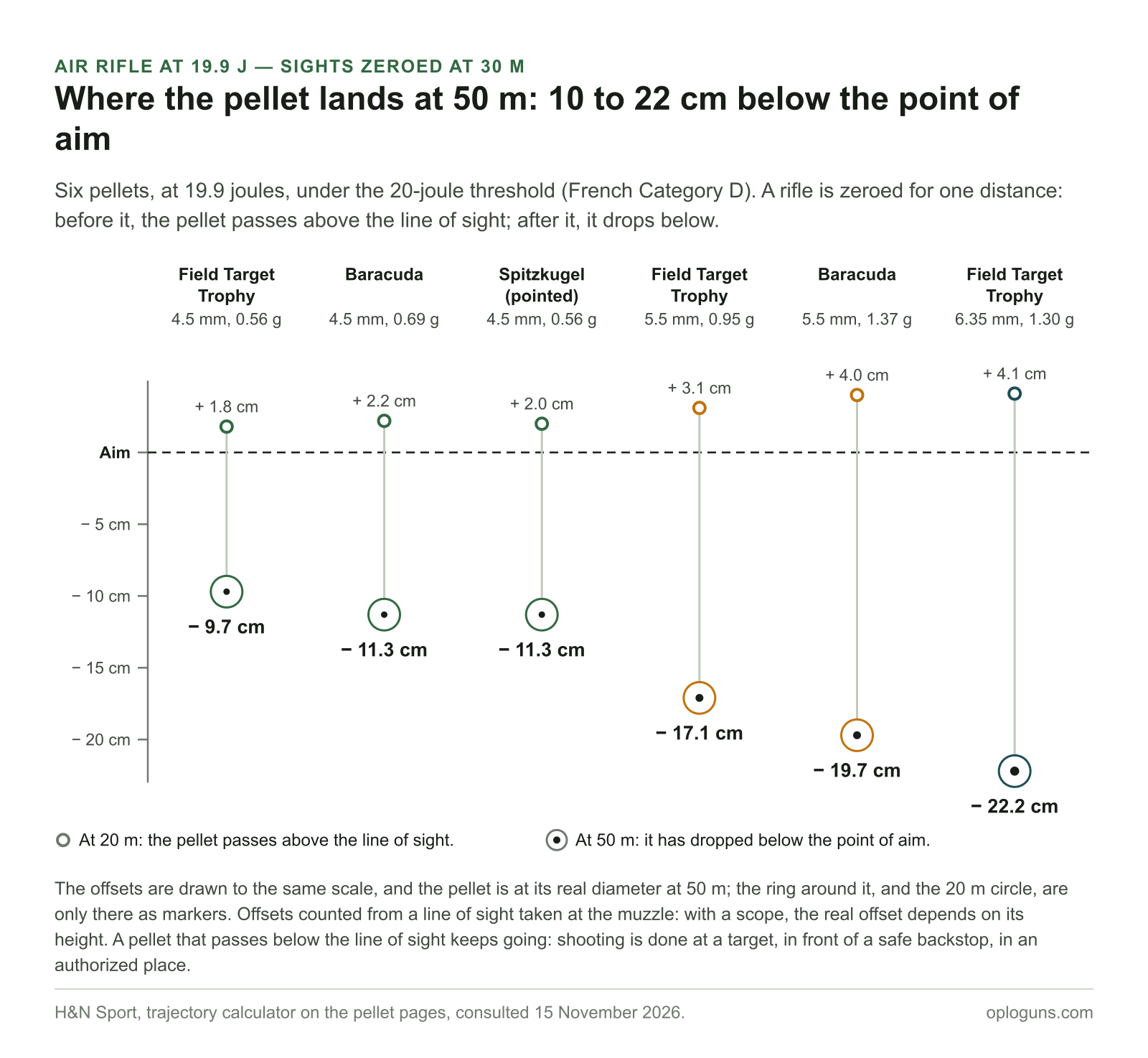
A rifle is zeroed for one distance; before and after it, the pellet moves away from the line of sight. H&N publishes a trajectory calculator on each pellet page3.
The offsets that follow are counted from a line of sight taken at the muzzle, with the form's sight height left at zero. With a scope, the real offset depends on its height above the barrel. At 19.9 joules, sights zeroed at 30 m:
| H&N pellet | At the muzzle | At 50 m | Offset at 20 m | Offset at 50 m |
|---|---|---|---|---|
| Field Target Trophy 4.5 mm, 0.56 g | 267 m/s | 189 m/s | + 1.8 cm | − 9.7 cm |
| Baracuda 4.5 mm, 0.69 g | 240 m/s | 178 m/s | + 2.2 cm | − 11.3 cm |
| Spitzkugel 4.5 mm, 0.56 g, pointed | 267 m/s | 165 m/s | + 2.0 cm | − 11.3 cm |
| Field Target Trophy 5.5 mm, 0.95 g | 205 m/s | 140 m/s | + 3.1 cm | − 17.1 cm |
| Baracuda 5.5 mm, 1.37 g | 170 m/s | 142 m/s | + 4.0 cm | − 19.7 cm |
| Field Target Trophy 6.35 mm, 1.30 g | 176 m/s | 125 m/s | + 4.1 cm | − 22.2 cm |
Offset from the line of sight, sight height not counted3.
Ten centimeters at 50 m: the width of a hand, below the point of aim. Between 10 and 20 m, in this calculation, the same pellet passes nearly two centimeters above it. A slower pellet drops more: 17 cm in 5.5 mm, 22 cm in 6.35 mm.
Energy counts too. At 16.3 joules, the 4.5 mm Field Target Trophy drops 11.8 cm at 50 m3. At 7.5 joules, zeroed at 10 m, it is already 4 cm low at 20 m and 13 cm low at 30 m3. What caliber changes for everything else, from the price of the pellet to the number of shots, is in 4.5 or 5.5 mm.
Useful distance: 10, 30 or 50 m by pellet head shape
The distance at which a pellet stays accurate depends first on its shape. H&N writes a maximum distance on each of its pages2:
- Wadcutter (flat head), Sport and Finale Match: 10 m.
- Pointed head, Spitzkugel: 30 m.
- Domed head, Field Target Trophy and Baracuda: 50 m.
At equal mass, the pointed head loses its velocity sooner than the domed head: 165 m/s against 189 at 50 m3. The choice of head is developed in 4.5 or 5.5 mm, domed, flat or pointed.
Rulebooks give the same orders of magnitude. The ISSF 10 m air rifle is capped at 7.5 joules9. The metallic silhouette rules provide, with those same rifles and 4.5 mm pellets, for targets at 18, 27, 33 and 41 m10. The rules do not require these air events to be held at continental and world championships.
Weihrauch writes that each of its guns shoots to the millimeter at ten meters8. Beyond 30 m, shooting calls for a scope and a drop table: the air rifle scope and long-range air rifle shooting deal with them. To see a 4.5 mm hole at 50 m, the calculation is in what magnification to see your hits.
Pellet range: past the useful distance, the safety rule
The pellet does not stop at its useful distance. H&N's calculator follows it out to 90 m: at 19.9 joules, the 4.5 mm Field Target Trophy is still flying there, 65 cm below the line of sight3. Everything that misses the target keeps going.
Weihrauch's manual gives no range figure by energy. Its warnings booklet gives a danger distance, the same for the whole range, versions above 20 joules included: 1,000 yards, or 915 m11. It is a safety instruction, not the measured range of a 20-joule rifle. The manufacturer's manual sets three more8:
- A safe backstop, fully visible, in all conditions.
- No hard ground and no water behind the target, and no shot at a target on the horizon or in the air.
- An immediate stop if projectiles bounce back or ricochet.
The French shooting federation, the Fédération française de tir, sets the rule that comes before all the others: a gun is always treated as loaded, and never pointed at anyone12. Pellet traps are compared in target holders and pellet traps, places to shoot in recreational shooting: license and places.
Three misconceptions about 20 joules and velocity
- "20 joules is a velocity." No: at 20 joules, a pellet leaves at 171 or at 275 m/s depending on whether it weighs 1.37 or 0.53 g13.
- "Faster, so more energy." No: Diana lists 270 m/s for 20 joules in 4.5 mm, 225 m/s for 22 joules in 5.5 mm5.
- "Past 50 m, the pellet goes no farther." No: H&N's calculator still follows it at 90 m3. That is why Weihrauch's manual requires a safe backstop behind the target8.
Pellet velocity and distance, by the shooting you do
Shooting at 10 m
A rifle of 7.5 joules at most, the cap in the rules, and a wadcutter pellet. In return, the trajectory drops quickly: 4 cm at 20 m, 13 cm at 30 m.
Shooting from 25 to 50 m
A domed pellet, rated for 50 m by H&N, and an energy of 16 to 19.9 joules. In return, a drop of 10 to 22 cm at 50 m to know by heart, and a backstop to match.
Knowing your rifle's real velocity
A chronograph, and the mass read on the tin: the energy follows from them. In return, a measuring device to buy or borrow, compared in the chronograph guide.
The choice of the rifle itself, by budget and by use, is in which air rifle to choose.
The text in force prevails. Article R311-2 of the code de la sécurité intérieure in its version in force on 15 November 2026. Velocities are calculated or published by the manufacturers; the energy of a particular rifle is read in its manual and checked at a gunsmith's.
Sources 13 references
The threshold comes from Légifrance, in its version in force; the masses, coefficients and trajectories, from H&N's pellet pages and calculator; rifle velocities, from the manufacturers' sheets; distances, from the rulebooks translated by the Fédération française de tir. Everything was reread on 15 November 2026. Click a reference number in the text to highlight the matching source.
- Légifrance — article R311-2 du code de la sécurité intérieure (in French), version in force since 7 September 2025 (decree no. 2025-894 of 5 September 2025, art. 2), consulted 15 November 2026: Category C, 4°, « Armes et lanceurs dont le projectile est propulsé de manière non pyrotechnique » [guns and launchers whose projectile is propelled by non-pyrotechnic means] « avec une énergie à la bouche supérieure ou égale à 20 joules » [with a muzzle energy of 20 joules or more]; Category D, h), same wording « avec une énergie à la bouche comprise entre 2 et 20 joules » [with a muzzle energy between 2 and 20 joules].
- H&N Sport — pellet pages, consulted 15 November 2026: Field Target Trophy .177, "Weight 8.64 gr", "Max. distance 50 m", "Bc 0.021"; Field Target Trophy .22, 14.66 gr, 50 m, Bc 0.019; Field Target Trophy .25, 20.06 gr, 50 m; Baracuda .177, 10.65 gr, 50 m, Bc 0.024; Baracuda .22, 21.14 gr, 50 m; Spitzkugel .177, 8.64 gr, "Max. distance 30 m", "Bc 0.015"; Sport .177, 8.18 gr, "Max. distance 10 m"; Finale Match Heavy .177, "Max. distance 10 m". On each page: "The ballistic coefficient (BC) describes the drag deceleration of the air gun pellet." ⚠️ Manufacturer's technical data.
- H&N Sport — ballistics calculator ("Ballistics Calculator") on the pages for the Field Target Trophy .177, .22 and .25, Baracuda .177 and .22, Spitzkugel .177, queried on 15 November 2026 in metric units, sight height "Skip", that is, a zero offset at 0 m in the tool's answer. At 19.9 J, zero at 30 m: Field Target Trophy .177, 266.6 m/s at 0 m, 189.4 at 50 m, 144.1 at 90 m, + 1.79 cm at 20 m, − 9.65 cm at 50 m, − 65.37 cm at 90 m; Baracuda .177, 240.2 and 178.1 m/s, + 2.15 and − 11.32 cm; Spitzkugel .177, 266.6 and 165.2 m/s, + 1.97 and − 11.32 cm; Field Target Trophy .22, 204.7 and 140.3 m/s, + 3.12 and − 17.06 cm; Baracuda .22, 170.4 and 141.8 m/s, + 3.95 and − 19.73 cm; Field Target Trophy .25, 175.6 and 124.8 m/s, + 4.13 and − 22.22 cm. At 16.3 J, zero at 30 m, Field Target Trophy .177: − 11.78 cm at 50 m. At 7.5 J, zero at 10 m: − 4.06 cm at 20 m, − 12.89 cm at 30 m. ⚠️ Manufacturer's calculation, read off the curves the tool returns; for the 6.35 mm pellet, it starts from 175.6 m/s where the formula gives 175.0 m/s for 1.30 g.
- Weihrauch — HW 100 X, Technische Daten / Technical data (PDF of 5 February 2026), reread 15 November 2026: HW 100 X-S in 4.5 mm, "240" m/s and "16,3" J, "170" m/s and "7,5" J.
- Diana — DIANA Panther 34 Professional (page in German), consulted 15 November 2026: "Kaliber: 4,5 mm (.177) | 5,5 mm (.22)", "Geschwindigkeit: 270 m/s (890 fps) | 225 m/s (740 fps)", "Energie: 20 J. (14.8 ft.lbs) | 22 J. (16.2 ft.lbs)". German-market sheet.
- Gamo — Gamo technology, page consulted 15 November 2026: the IGT gas ram allows "more terminal velocity (up to 1,300 fps with PBA Platinum .177 Cal. and up to 975 fps with PBA Platinum .22 Cal.)". ⚠️ The mass of the PBA Platinum pellet was not found on the manufacturer's site.
- Two gun shops (in French), prices and listings recorded 15 November 2026: Armurerie Loisir, carabines à air comprimé, models advertised at 19.9 joules, including « Crosman Mag-Fire Trail Hawk 4.5 mm (19.9 joules) », « 12 coups à tirer de diabolos 4,5 mm à près de 400 m/s » [12 shots of 4.5 mm diabolo pellets at close to 400 m/s]; Toro Distribution, billes et plombs, « Plombs 4.5mm RWS PREMIUM HYPERMATCH 0.33g ECOLOGIQUE SANS PLOMB PLATS X250 » [lead-free flat-head pellets, 0.33 g, tin of 250], and carabines de 4,5 mm, models marked "(E 19.9J)". ⚠️ Commercial data.
- Weihrauch — notice HW 100 X, texte français (PDF, edition 10-25, in French), reread 15 November 2026: « Chaque arme à air comprimé WEIHRAUCH tire au millimètre près à une distance de dix mètres avec les balles de forme diabolo. » [every Weihrauch air gun shoots to the millimeter at ten meters with diabolo pellets]; « Assurez-vous que vous avez un pare-balles sûr dans toutes les conditions. Il doit être entièrement visible. » [make sure you have a safe backstop in all conditions; it must be fully visible]; « Ne tirez jamais sur un sol dur ou sur de l'eau ... Le projectile pourrait rebondir. Ne tirez jamais sur une cible à l'horizon ou en l'air. » [never shoot at hard ground or water, the projectile could bounce back; never shoot at a target on the horizon or in the air]; « Si vous constatez que des projectiles rebondissent ou font des ricochets, vous devez arrêter aussitôt de tirer et remplacer votre pare-balles. » [if projectiles bounce back or ricochet, stop shooting at once and replace your backstop].
- Fédération française de tir, CNS Arbitrage — Règles Carabine ISSF, édition 2025, 2e impression en vigueur au 1er juillet 2026, mise à jour du 04/07/2026 [ISSF Rifle Rules in French, 2025 edition, 2nd printing in force on 1 July 2026] (PDF), reread 15 November 2026: 7.4.4, c), « Toute carabine à air comprimé ne doit pas dépasser 7,5 joules » [no air rifle may exceed 7.5 joules]; 7.4.6, 10 m rifle, caliber "4,5 mm (.177")".
- IMSSU, translated by the Fédération française de tir — Règlement IMSSU 2025, règlement air comprimé [IMSSU rules 2025, air gun rules, in French] (PDF, pp. 46-47), reread 15 November 2026: « Tout pistolet ou carabine de calibre 4,5mm (177”) conforme aux critères et spécifications du règlement ISSF. » [any 4.5 mm pistol or rifle meeting the criteria and specifications of the ISSF rules]; « Plombs de 4,5mm (177"). » [4.5 mm pellets]; « Carabines : Poulets : 18 m. Cochons : 27 m. Dindons : 33 m. Béliers : 41 m. » [rifles: chickens 18 m, pigs 27 m, turkeys 33 m, rams 41 m]; « L'organisation de matchs air comprimé n'est pas obligatoire lors des Championnats Continentaux et Mondiaux. » [holding air gun matches is not compulsory at continental and world championships].
- Weihrauch — Special and additional warnings and notices on Weihrauch / HW-airguns (PDF, edition 09-26, English), reread 15 November 2026: "May be dangerous up to 1000 yards (915 meters)." ⚠️ General warning, common to the manufacturer's whole range, versions above 20 joules included.
- Fédération française de tir — Les règles de sécurité [safety rules, in French], page consulted 15 November 2026: « Une arme doit TOUJOURS être considérée comme CHARGÉE et à ce titre ne doit JAMAIS être dirigée vers soi-même ou vers quelqu'un. » [a gun must ALWAYS be treated as LOADED and so must NEVER be pointed at yourself or at anyone].
- Calculations: energy = mass (in kilograms) × velocity² ÷ 2, so velocity = √(2 × energy ÷ mass); 1 m/s = 3.6 km/h; 1 grain = 0.064799 g (8.18 gr = 0.53 g; 8.64 gr = 0.56 g; 10.65 gr = 0.69 g; 14.66 gr = 0.95 g; 20.06 gr = 1.30 g; 21.14 gr = 1.37 g). At 20.0 J: 0.33 g, 348 m/s (1,253 km/h); 0.45 g, 298 m/s; 0.53 g, 275 m/s (989 km/h); 0.56 g, 267.3 m/s (962 km/h); 0.62 g, 254 m/s; 0.69 g, 241 m/s (867 km/h); 0.95 g, 205 m/s (739 km/h); 1.37 g, 171 m/s (615 km/h). At 19.9 J: 0.56 g, 266.6 m/s; 0.33 g, 347 m/s; 400 m/s implies 2 × 19.9 ÷ 400² = 0.25 g. Mass doubled: velocity divided by √2, or 1.41. Time of flight over 10 m: 10 ÷ 258 m/s of average velocity = 0.04 s. 1,300 feet per second × 0.3048 = 396 m/s; 1,000 yards × 0.9144 = 914 m.
Frequently asked questions
How fast is 20 joules in km/h?
It depends on the pellet's mass: velocity = square root of (2 × energy ÷ mass). At 20 joules, a 4.5 mm pellet of 0.56 g leaves at 267 m/s, or 962 km/h; a heavy 0.69 g pellet at 241 m/s, or 867 km/h; a 5.5 mm pellet of 0.95 g at 205 m/s, or 739 km/h. The mass is printed on the tin.
How fast is 20 joules in m/s?
From 171 to 275 m/s for pellets of 1.37 g down to 0.53 g. A 4.5 mm pellet of 0.56 g leaves at 267 m/s, a heavy 0.69 g pellet at 241 m/s, a 5.5 mm pellet of 0.95 g at 205 m/s. Lead-free pellets, which are lighter, go faster: 348 m/s for 0.33 g.
What is the range of a 20-joule air rifle?
Weihrauch's manual gives no range figure by energy. The pellet flies beyond the distance at which it stays accurate: H&N's calculator follows it out to 90 m. The manufacturer gives a danger distance of 915 m, valid for its whole range, versions above 20 joules included: it is a safety instruction, not the range of a 20-joule rifle. Its manual requires a safe backstop behind the target.
At what distance does a 20-joule air rifle stay accurate?
H&N gives a maximum distance per pellet: 10 m for its wadcutters, 30 m for its pointed pellet, 50 m for its domed Field Target Trophy and Baracuda. At 19.9 joules, zeroed at 30 m, the pellet drops 10 to 22 cm at 50 m depending on caliber and mass.
How much power should an air rifle have?
As much as the distance you shoot requires. The ISSF rules cap the 10 m air rifle at 7.5 joules. From 16 to 19.9 joules, the trajectory is flatter: 12 cm of drop at 50 m at 16.3 joules, 10 cm at 19.9 joules, with the same 0.56 g pellet zeroed at 30 m. At 20 joules and above, French law puts the rifle in Category C.
Spotted an error, or a rule that has changed since we checked? Report an error