Shooting chronograph: measuring your ammunition's velocity, and how many shots it takes
Published on · Updated on · 10 min read · Anthony Baillon
A shooting chronograph measures the velocity of a projectile, by optical gate, Doppler radar or sensors attached to the barrel. Manufacturers state ±0.1 to ±0.5%. The measurement settles the power factor in IPSC, the 20-joule threshold of an air gun, the consistency of a load. Prices recorded: €145 to €749.
At a glance
| Chronograph | Stated accuracy | Prices recorded |
|---|---|---|
| Optical gate | ±0.25 to ±0.5% | €145 to €355 |
| Doppler radar | ±0.1% | €195 to €749 |
| Sensors on the barrel | 99.5 to 99.9% | €325 to €590 |
- How many shots: at 5 shots, the true standard deviation is 0.65 to 2.37 times the one displayed; at 20 shots, 0.79 to 1.37 times.
- Three uses: the power factor in IPSC, the energy of an air gun around 20 joules, the consistency of a reloaded charge.
Optical chronograph: the light decides
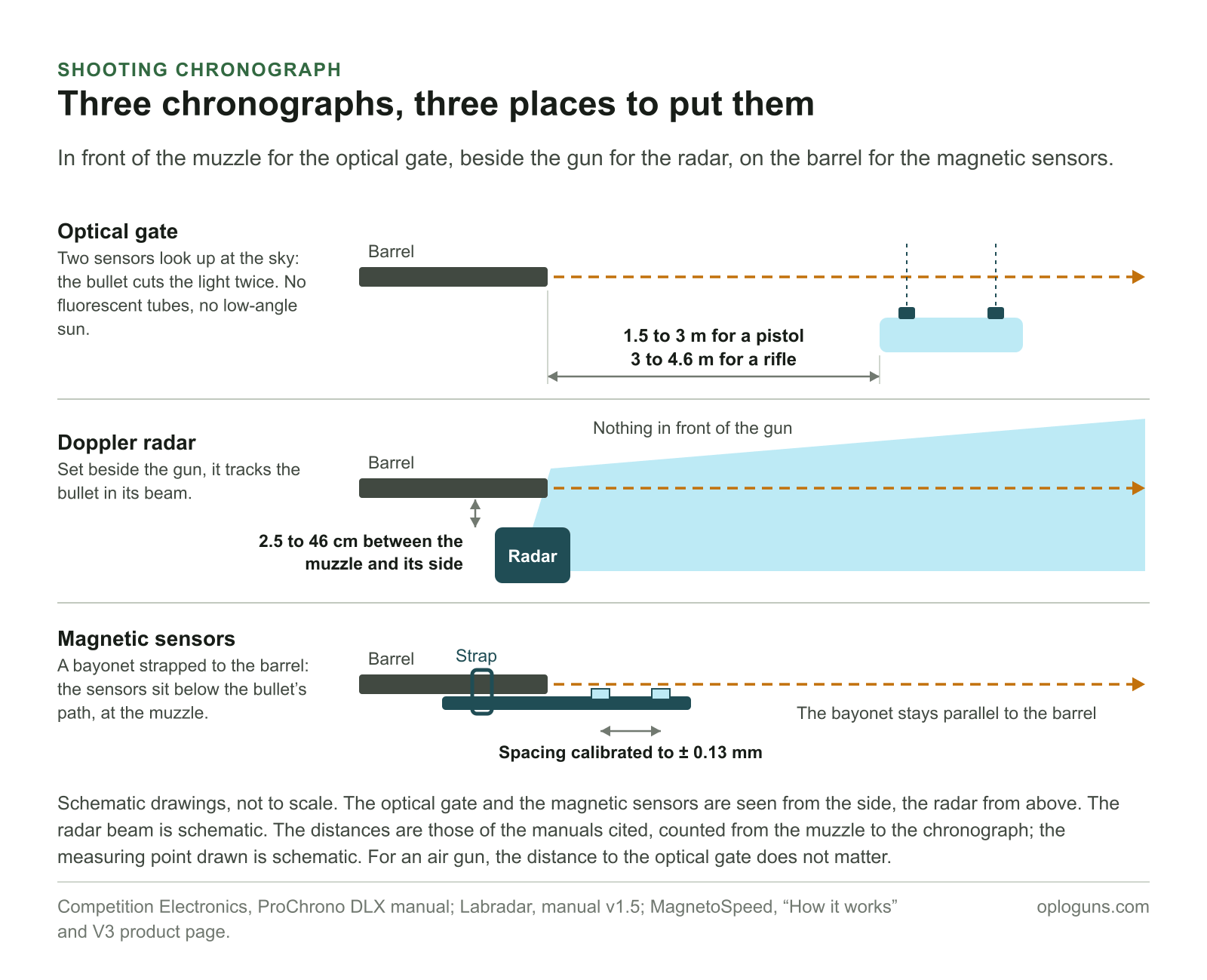
Two sensors, housed in the body, look at the sky. The projectile passing above them cuts the light twice; the device measures the time between the two shadows and converts it into velocity2. Caldwell states ±0.25% for its Ballistic Precision, from 5 to 9,999 feet per second3, Competition Electronics ±0.5% for its ProChrono DLX1.
The light decides the measurement. The ProChrono does not work under fluorescent tubes: their flicker mimics a passing bullet. At sunrise and sunset, reflections and low shadows distort the readings2. So does muzzle blast: Competition Electronics places the chronograph 1.5 to 3 m from the muzzle for a pistol, 3 to 4.6 m for a rifle. For air guns, the distance does not matter219.
The velocity read is therefore that of the measuring point, not that of the muzzle. The gap stays small: an RWS .308 loses 36 m/s over its first 50 meters according to the manufacturer, or about 3 m/s over 4.6 m, 0.4%1419. That is the order of the accuracy the device states.
Pros
Doppler radar chronograph: beside the gun
The radar sits beside the gun and tracks the bullet in its beam. LabRadar states ±0.1%, or ±1 m/s at 1,000 m/s, from 65 to 3,900 feet per second4. Athlon's Velocity Pro radar shows the same accuracy, up to 5,000 feet per second, and itself calculates the energy and the power factor5.
Setup needs care. The LabRadar asks for the muzzle to be 1 to 18 inches from its side, or 2.5 to 46 cm, and the distance is entered in the device419.
Pros
Barrel-mounted chronograph: magnetic sensors
MagnetoSpeed mounts its sensors on a bayonet, strapped to the barrel. They detect the change in magnetic field as the bullet passes, and their spacing is calibrated to ±0.005 inch, or ±0.13 mm619. The manufacturer states an accuracy "between 99.5% and 99.9%"7.
Pros
Average, standard deviation, extreme spread: the readout
A chronograph displays three figures per string24:
- The average of the string's velocities.
- The extreme spread, the highest velocity minus the lowest.
- The standard deviation, the typical distance of the velocities from the average.
Competition Electronics explains how to read them. With an average of 1,000 feet per second and a standard deviation of 10, 68% of shots fall between 990 and 1,010; two standard deviations, from 980 to 1,020, cover 95.4% of them2.
The extreme spread has a flaw: it grows with the number of shots. For velocities that follow a normal distribution, it averages 2.33 standard deviations over 5 shots, and 3.73 over 20, or 60% more919. A 5-shot spread compares only with another 5-shot spread.
Chronograph shots: 5 at least, 20 for standard deviation
Competition Electronics sets a floor: at least 5 shots for a standard deviation, and the more you fire, the more accurate it is2. The calculation says by how much.
What a measured standard deviation is worth, by number of shots
90% confidence interval of the true standard deviation, as a multiple of the standard deviation displayed; velocities assumed to follow a normal distribution
Interval calculated from the chi-square distribution, following the NIST method819. At 3 shots, it would run from 0.58 to 4.42 times the standard deviation displayed.
View the data
| Shots measured | Lower bound | Upper bound | For 10 m/s displayed |
|---|---|---|---|
| 3 | 0.58 | 4.42 | 5.8 to 44.2 m/s |
| 5 | 0.65 | 2.37 | 6.5 to 23.7 m/s |
| 10 | 0.73 | 1.65 | 7.3 to 16.5 m/s |
| 20 | 0.79 | 1.37 | 7.9 to 13.7 m/s |
| 30 | 0.83 | 1.28 | 8.3 to 12.8 m/s |
At 5 shots, a displayed standard deviation of 10 m/s leaves the true one between 6.5 and 23.7 m/s, with 90% confidence819. At 20 shots, between 7.9 and 13.7 m/s. Beyond that, each shot adds little: going from 20 to 30 shots narrows the interval only from 0.79-1.37 to 0.83-1.28.
The average makes do with less. Its uncertainty falls as the square root of the number of shots: that of 3 shots is already 1.7 times tighter than a single shot19. That is the number IPSC uses.
IPSC power factor: the match chronograph decides
In an IPSC match, the official chronograph decides. The procedure in the January 2026 edition10:
- 8 cartridges taken from the shooter, tested with their gun, in the condition in which they use it.
- 1 bullet pulled and weighed, 3 cartridges fired over the chronograph.
- The calculation: weight in grains × average velocity in feet per second ÷ 1,000, decimals ignored.
- In case of failure, 3 more shots: the average of the 3 fastest out of 6 is kept. The shooter can then have the last cartridge weighed or fired.
The match chronograph is only checked to ±5% from one day to the next, with calibration ammunition, and its figure is the one that counts10. The rulebook sets the threshold, the powder manufacturer's table sets the charge, the match chronograph does the checking. The thresholds of each division are in our guide to IPSC in France, the match check and Major in the Standard division, the choice of bullet in 9 mm ammunition.
Precision Rifle has its ceiling too: 3,200 feet per second, or 975 m/s, for all rifles, and 2,800 feet per second in Limited. The chronograph check is recommended there at national matches, compulsory at continental and world level11.
Air gun and 20 joules: the energy is calculated
The chronograph gives a velocity. The energy follows from it:
0.000620 × 254² ÷ 2 = 20.0 joules
The pellet in the example is a 4.5 mm H&N Baracuda FT, listed at 9.57 grains, or 0.62 g1219. It crosses 20 joules at 254 m/s. At 250 m/s, it develops 19.4; at 255 m/s, 20.219. The threshold velocity, pellet by pellet, is in 20 joules in m/s and km/h.
The gap matters, because French law draws the line at exactly 20 joules. An air gun whose muzzle energy is « supérieure ou égale à 20 joules » [greater than or equal to 20 joules] is in Category C, 4°; between 2 and 20 joules, in Category D13. The detail is in our guide air rifles and the 20 joules.
Energy also follows the square of velocity: an error of 0.5% on the velocity makes one of 1% on the energy, 0.2 joule at that level19. A pellet of another mass also changes the result: the mass is read on the tin.
Reloading and .22 LR: the velocity of your gun
Manufacturers' velocities are measured in their test barrel: 830 m/s for an RWS .308 Speed Tip Pro, in a 500 mm barrel14. A shorter barrel, another lot or another temperature give something else, as our guide subsonic, standard or high-velocity .22 LR explains. The measured velocity then replaces the listed one in a ballistic table.
For reloading, 9 mm as well as .223 or .308, the chronograph compares two loads in the same gun: average, standard deviation, and spread for an equal number of shots. The values go into a reloading log, on paper or in a spreadsheet. The legal framework for the practice is in reloading your ammunition in France.
Shooting chronograph price: €145 to €749
Prices recorded on 4 November 2026 at four French gun shops15161718:
| Type | Models recorded | Price |
|---|---|---|
| Optical gate | Chrony M1, Caldwell Ballistic Precision, DAA ARC, Caldwell G2 | €145 to €355 |
| Radar for air guns | FX Airguns Pocket D1 | €195 |
| Radar for firearms | LabRadar, Garmin Xero C2 Pro | €649 to €749 |
| Sensors on the barrel | MagnetoSpeed Sporter, MagnetoSpeed V3 | €325 to €590 |
The same device changes price from one gun shop to another: €161 or €215 for the same Caldwell Ballistic Precision, €699 or €749 for the same Garmin Xero C2 Pro151618.
Three misconceptions about the shooting chronograph
- "Radar is the only accurate device." Stated accuracies run from ±0.1% for radar to ±0.25% for the Caldwell optical gate: at 360 m/s, 0.36 m/s against 0.9 m/s3419.
- "Three shots are enough for a standard deviation." Competition Electronics asks for at least 5; at 3 shots, the true standard deviation can be up to 4.4 times the one displayed219.
- "My chronograph says Minor, the match will say Minor." The match chronograph is only held to ±5% from one day to the next, and its figure is the one that counts10.
Which chronograph for your use
Action shooting
An optical gate is enough to place your ammunition relative to the threshold before the match, for €145 to €355; the match chronograph remains the only judge. In return, the gate needs daylight and a distance of 1.5 to 3 m. The rest of an action shooter's gear is in our guide to IPSC equipment.
Air gun around 20 joules
An optical gate measures pellets with no distance constraint, and dedicated radars exist from €195. In return, energy amplifies the velocity error: 0.5% in velocity, 1% in energy.
Reloading and long range
The radar or the barrel-mounted sensor measures every shot without aiming at the device, which makes it easier to fire the 20-shot strings a reliable standard deviation requires. The catch: €325 to €749 for the models recorded.
Sources 19 references
Operation and accuracy as stated by the chronograph manufacturers; checking procedure taken from the IPSC and FRPRA rules in force; NIST statistical method; legal threshold reread on Légifrance; prices recorded on 4 November 2026 at four French gun shops; energies and intervals calculated. Click a reference number in the text to highlight the matching source.
- Competition Electronics — ProChrono DLX, product page reread 4 November 2026: "Reads velocity within ±0.5% for firearms, shotguns, archery, airguns and paintball"; "Accurate to ±0.5%"; list price $139.95. ⚠️ Manufacturer's data.
- Competition Electronics — ProChrono DLX, User Manual (PDF, September 2026), reread 4 November 2026: sensors that detect the change in light as the projectile passes and convert the time between two interruptions into velocity; fluorescent lamps unusable; reflections and low shadows at sunrise and sunset; "For pistols, the muzzle to chronograph distance should be 5 to 10 feet", "For rifles, we recommend a muzzle to chronograph distance of 10 to 15 feet"; with a scope, aim to be raised by the height of the optic "otherwise the projectile may hit the chronograph"; for air guns, "Muzzle to chronograph distance is not a factor"; extreme spread, highest velocity minus lowest; standard deviation of 10 ft/s around 1,000: 68% of shots between 990 and 1,010, 95.4% between 980 and 1,020; "The more shots you fire, the more accurate the standard deviation. A minimum of 5 shots is necessary".
- Caldwell — Ballistic Precision Chronograph, product page reread 4 November 2026: accuracy "(+/- .25%)", "Measures from 5 to 9,999 FPS", calculation of average velocity, standard deviation, minimum, maximum and spread; $129.99. ⚠️ Manufacturer's data.
- Labradar — User Manual v1.5 (PDF), reread 4 November 2026: "Accuracy: +/-0.1% (+/-1 m/s @ 1,000 m/s)"; "Velocity Range: 65 - 3900 feet per second"; "Minimum Time Between Shots: 2 seconds"; muzzle placed "between 1-6"", "7-12"" or "13-18" from the side" of the device depending on the setting entered; extreme spread, "the lowest velocity subtracted from the highest velocity"; standard deviation, distance of the measurements from the average.
- Athlon Optics — Velocity Pro Radar Chronograph, spec sheet (PDF, February 2025), reread 4 November 2026: "Doppler Radar", "Velocity Range 65-5000 FPS", "Velocity Accuracy +/- 0.1%"; display of average velocity, standard deviation, extreme spread, energy and power factor. ⚠️ Manufacturer's data.
- MagnetoSpeed — How it works, reread 4 November 2026: electromagnetic sensors "designed to operate in the harsh environment at the muzzle of firearms", placed below the bullet's path by spacers; sensor spacing calibrated "+/-.005 of an inch".
- MagnetoSpeed — V3 Ballistic Chronograph, product page reread 4 November 2026: "The accuracy of our chronographs can be expected to be between 99.5% and 99.9%"; bayonet "designed to be used on barrels and suppressors from 1/2 inch all the way up to 2 inches in diameter", strapped to the barrel; air gun mode; "DO NOT MOUNT BAYONET ON ANY SUPPRESSOR COVERS", bayonet set directly on the suppressor to stay parallel and avoid being hit. ⚠️ Manufacturer's data.
- NIST/SEMATECH — e-Handbook of Statistical Methods, 1.3.5.8, Chi-Square Test for the Variance, reread 4 November 2026: confidence interval of the variance (N−1)s²/χ²(α/2, N−1) ≤ σ² ≤ (N−1)s²/χ²(1−α/2, N−1), that of the standard deviation following from it by the square root.
- NIST/SEMATECH — e-Handbook of Statistical Methods, 6.3.2.1, Shewhart X-bar and R and S Control Charts, reread 4 November 2026: the mean of the range R of a sample equals d₂σ, d₂ depending on the number of measurements.
- IPSC — IPSC Handgun Competition Rules, January 2026 Edition (PDF, final version of 29 December 2025, linked from IPSC's "Rule Books" page), reread 4 November 2026: 5.6.2.1 to 5.6.2.3, chronograph verified each day on 3 shots of a calibration ammunition, "within +/- 5%" of the first day; 5.6.3.1, ammunition tested with the shooter's gun, without modification; 5.6.3.2 and 5.6.3.3, "An initial 8 sample rounds", "1 bullet is removed and weighed", "3 bullets are fired over the chronograph"; 5.6.3.5, factor = weight in grains × average velocity of the 3 shots in feet per second ÷ 1,000, "a result of 124.9999 is not 125"; 5.6.3.6, 3 more shots and average of the "3 highest velocity rounds from the 6 rounds fired"; 5.6.3.7, weighing or firing of the last cartridge; Appendix D, Minor at 125.
- FRPRA — Règlement Precision Rifle IPRF, version française v1.3 [IPRF Precision Rifle rules, French version v1.3] (PDF, « Mis à jour : 9 septembre 2026 » [updated 9 September 2026]), reread 4 November 2026: 4.1.1, guns not exceeding « le calibre .30 ou une vitesse de 3 200 fps./ 975 m/s » [.30 caliber or a velocity of 3,200 fps / 975 m/s]; 4.1.6.1, Limited, projectile of « 179 grains et 2800 fps » [179 grains and 2,800 fps] at most; table of match levels, line 15 « Chronographe et contrôle des armes » [chronograph and gun check], recommended at national level, compulsory at continental and world level.
- H&N Sport — Baracuda FT, product page reread 4 November 2026: .177 caliber, 4.50 and 4.51 mm heads, "Weight 9.57 gr", designed for guns of 16 joules (12 ft-lb). ⚠️ Manufacturer's data.
- Légifrance — article R311-2 du code de la sécurité intérieure (in French), version in force since 7 September 2025 (decree no. 2025-894 of 5 September 2025), reread 4 November 2026: Category C, 4°, « Armes et lanceurs dont le projectile est propulsé de manière non pyrotechnique » [guns and launchers whose projectile is propelled by non-pyrotechnic means] « avec une énergie à la bouche supérieure ou égale à 20 joules » [with a muzzle energy of 20 joules or more]; Category D, h), same propulsion « avec une énergie à la bouche comprise entre 2 et 20 joules » [with a muzzle energy between 2 and 20 joules].
- RWS — .308 Win. Speed Tip Pro Short Rifle 10.7 g, product page reread 4 November 2026: "Barrel length 500 mm", 830 m/s at the muzzle and 794 m/s at 50 m. ⚠️ Manufacturer's technical data.
- Armurerie de la Bourse (in French) — prices recorded 4 November 2026: Chrony M1 €145.00; DAA ARC €259.00; LabRadar, presented as a « Chronographe Doppler » [Doppler chronograph], €649.00; LabRadar LX Compact €680.00; Garmin Xero C2 Pro €699.00; MagnetoSpeed Sporter €325.00; MagnetoSpeed V3, hard case €590.00. ⚠️ Commercial data; MagnetoSpeed recorded at this one French reseller.
- Armurerie Auxerre (in French) — prices recorded 4 November 2026: Caldwell Ballistic Precision €161.00; FX Airguns Pocket Chronograph D1, presented as a pocket radar, €195.00; Garmin Xero C2 Pro, presented as a Doppler radar, €748.50. ⚠️ Commercial data.
- Armurerie Douillet (in French) — prices recorded 4 November 2026: Caldwell Ballistic Precision G2 €355.00. ⚠️ Commercial data.
- Deville Armory (in French) — prices recorded 4 November 2026: Caldwell Ballistic Precision €215.39; DAA ARC, presented as a gate « à lumière infrarouge modulée, de 10 à 10 000 pi/s » [using modulated infrared light, from 10 to 10,000 ft/s], €315.00. ⚠️ Commercial data.
- Calculations: 1 foot = 0.3048 m (5 to 10 feet = 1.5 to 3 m; 10 to 15 feet = 3 to 4.6 m) and 1 inch = 25.4 mm (1 to 18 inches = 2.5 to 46 cm; 0.005 inch = 0.13 mm; ½ to 2 inches = 12.7 to 50.8 mm); 1 grain = 0.064799 g, so 9.57 grains = 0.620 g; energy = m × v² ÷ 2: 0.000620 × 250² ÷ 2 = 19.4 J, × 254² ÷ 2 = 20.0 J, × 255² ÷ 2 = 20.2 J; energy proportional to the square of velocity, a relative error of 0.5% on v giving 1% on the energy; ±0.1% of 360 m/s = 0.36 m/s, ±0.25% = 0.9 m/s; 90% interval of the standard deviation σ for n shots: s × √((n−1)/χ²(0.95; n−1)) to s × √((n−1)/χ²(0.05; n−1)), with χ² = 0.103 and 5.991 for n = 3, 0.711 and 9.488 for n = 5, 3.325 and 16.919 for n = 10, 10.117 and 30.144 for n = 20, 17.708 and 42.557 for n = 30; mean range of a normal sample d₂ = 2.326 σ for 5 shots and 3.735 σ for 20; uncertainty of the average as σ ÷ √n, or 1.73 times smaller at 3 shots; velocity loss of the RWS .308: (830 − 794) ÷ 50 = 0.72 m/s per meter, or 3.3 m/s over 4.6 m, 0.4% of 830 m/s.
The rules in force prevail. In competition, only the official chronograph counts, under the rules of the discipline: IPSC in its January 2026 edition, the FRPRA in its version of 9 September 2026. A personal measurement does not classify a gun. The legal class of an air gun is read in the text and in its documentation; any doubt is settled at the gunsmith's.
Frequently asked questions
Which chronograph should you choose for sport shooting?
There are three families. The optical chronograph sits in front of the gun and sees the projectile's shadow pass: ±0.25 to ±0.5% according to Caldwell and Competition Electronics, €145 to €355 recorded. The Doppler radar sits beside the gun: ±0.1% stated, €649 to €749 for the models recorded that are meant for firearms. The magnetic sensor attaches to the barrel: 99.5 to 99.9% accuracy according to MagnetoSpeed, €325 to €590 at the only reseller recorded.
How many shots should you fire over the chronograph?
Competition Electronics asks for at least 5 shots for a standard deviation. The statistics show that at 5 shots, the true standard deviation can be 0.65 to 2.37 times the one displayed, with 90% confidence; at 20 shots, 0.79 to 1.37 times. An average settles faster: IPSC calculates it on 3 shots for the power factor.
How is the power factor measured in IPSC?
The officials take 8 cartridges from the shooter, pull one apart to weigh the bullet and fire 3 over the chronograph, with the shooter's gun. The factor is the bullet weight in grains multiplied by the average velocity in feet per second, divided by one thousand, with no rounding. If it misses the threshold, 3 more shots are fired and the 3 fastest of the 6 are kept.
Can a chronograph tell whether an air rifle reaches 20 joules?
It gives an estimate, by calculation: energy = mass × velocity² ÷ 2. A 0.62 g pellet reaches 20 joules at 254 m/s; at 250 m/s, it develops 19.4. An error of 0.5% on the velocity makes one of 1% on the energy, or 0.2 joule at that level. French law puts in category C, 4°, a gun whose muzzle energy is 20 joules or more.
What is the difference between standard deviation and extreme spread?
The extreme spread is the gap between the highest and the lowest velocity of a string; the standard deviation measures how far, on average, the velocities sit from the mean. The extreme spread grows with the number of shots: on average 2.33 standard deviations over 5 shots, 3.73 over 20. Two extreme spreads therefore compare only for an equal number of shots.
Spotted an error, or a rule that has changed since we checked? Report an error