Reading a ballistic table: drop, drift, velocity, energy — .308, 6.5 Creedmoor, .300 Win Mag, .243, 7x64
Published on · 9 min read · Anthony Baillon
A ballistic table gives, at each distance, the velocity, energy and position of the bullet relative to the line of sight, for a given barrel, zero and scope height. Zeroed at 100 m, the 168-grain .308 Norma Golden Target passes 499 mm below the line of sight at 300 m. Change one assumption and the line changes.
At a glance
| Distance | Velocity | Below the line of sight |
|---|---|---|
| 100 m | 736 m/s | 0, zero distance |
| 300 m | 617 m/s | 499 mm |
| 600 m | 463 m/s | 3,349 mm |
Ballistic table assumptions: barrel, zero, sight height
A table copied without its assumptions gives wrong clicks at the first distance. Three pieces of data set them, and the manufacturers write them on the product page:
- The test barrel: 610 mm at Norma, "This product data is zeroed with a 610 mm / 24 in barrel"1; 24 inches, or 610 mm, at Hornady4.
- The zero distance, where the bullet crosses the line of sight: 100 or 300 m as you choose at Norma, 200 yards at Hornady, or 182.9 m14.
- The sight height, the gap between the axis of the barrel and that of the scope: 40 mm at Norma; Hornady places the bullet 1.5 inches, or 38 mm, below the line of sight at the muzzle14.
The barrel matters first for velocity. GGG measures its .308 loads in a C.I.P. test barrel, 568 mm for its 147-grain full metal jacket bullet and 600 mm for its match bullets: 823 ± 15 m/s for the first, 805 ± 7 m/s for the 168-grain10. A barrel shorter or longer than the table's gives another velocity: your rifle's is measured, as the shooting chronograph explains.
Drop and zero distance: one bullet, two tables
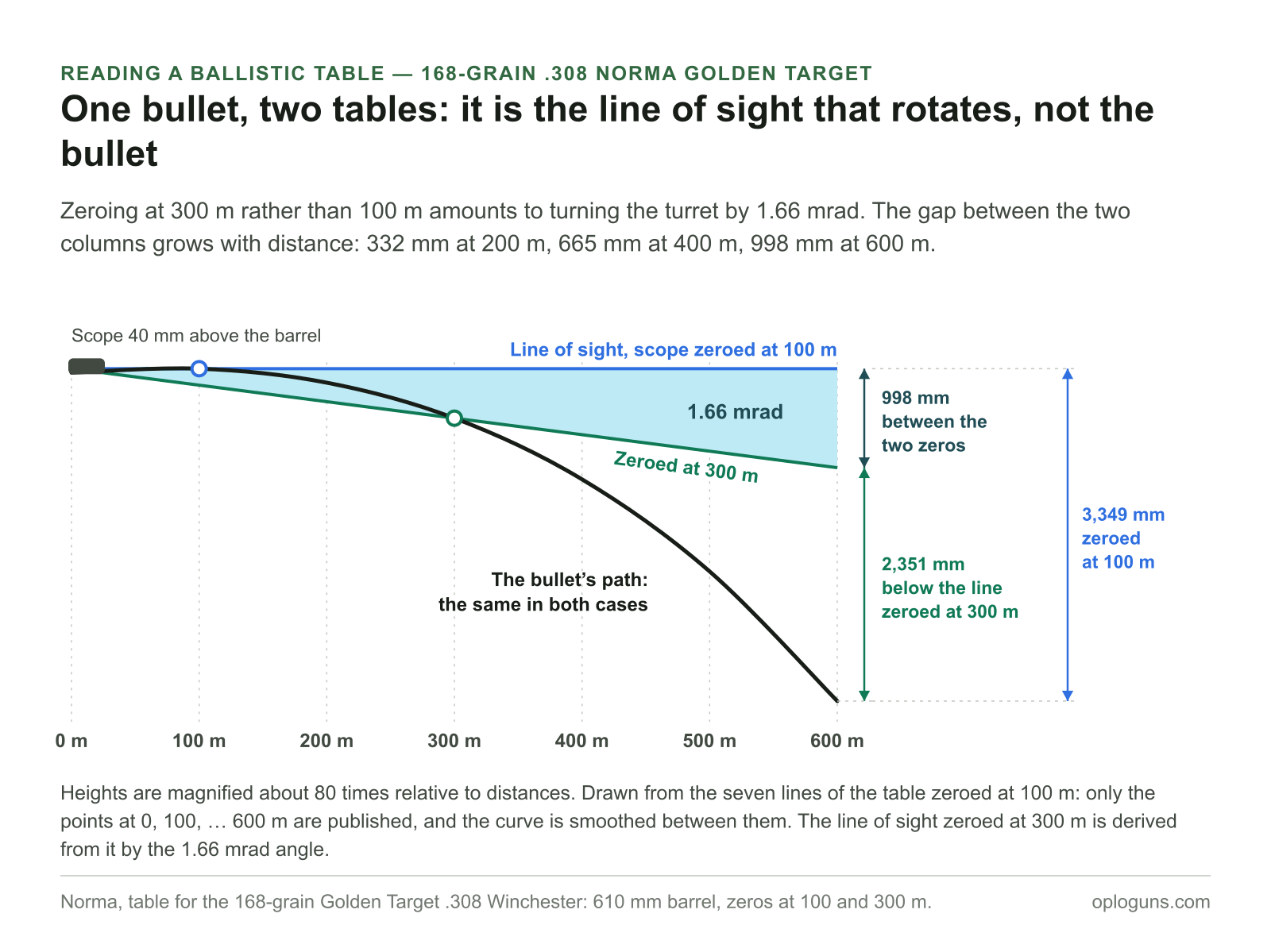
Norma publishes the same load zeroed at 100 m, then at 300 m. The figures change completely1.
| Distance | Zeroed at 100 m | Zeroed at 300 m |
|---|---|---|
| 0 m | -40 mm | — |
| 100 m | 0 | +166 mm |
| 200 m | -141 mm | +191 mm |
| 300 m | -499 mm | 0 |
| 400 m | -1,115 mm | -450 mm |
| 500 m | -2,043 mm | -1,211 mm |
| 600 m | -3,349 mm | -2,351 mm |
Norma Golden Target .308 Winchester, 168 grains, 610 mm barrel, scope at 40 mm1.
The gap between the two columns grows with distance: 332 mm at 200 m, 665 mm at 400 m, 998 mm at 600 m. It is an angle, 1.66 mrad, the same at every distance. Changing the zero distance amounts to turning the turret by that angle: the bullet's path, for its part, does not change.
Drop in milliradians: from the table to the turret
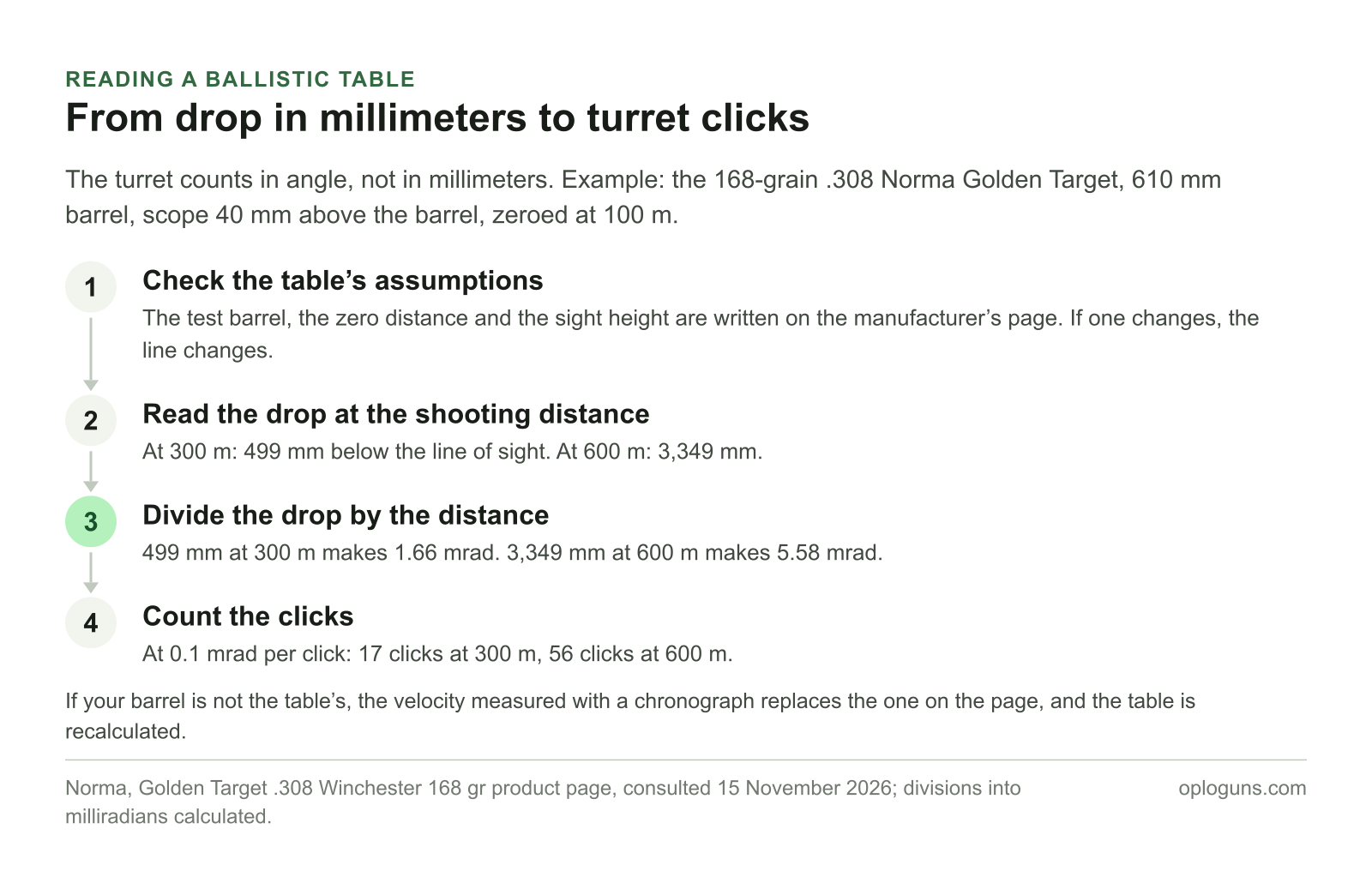
Your turret does not count in millimeters, but in angle. To go from the table to the scope, you divide the drop by the distance. With the table zeroed at 100 m, 499 mm at 300 m makes 1.66 mrad; 3,349 mm at 600 m, 5.58 mrad1.
At 0.1 mrad per click, that makes 17 clicks at 300 m and 56 at 600 m. The value of a click at each distance, in milliradians and in minutes of angle, is in adjusting a rifle scope. The adjustment range such a drop requires is in the long-range rifle scope.
Remaining velocity and ballistic coefficient
Two Norma .308 loads leave at the same velocity, 800 m/s, with the same barrel. At 600 m, the 168-grain Golden Target keeps 463 m/s; the 150-grain Range & Training, 430 m/s12. Zeroed at 100 m, the first is 3,349 mm below the line of sight at 600 m, the second 3,582 mm.
The difference comes down to the ballistic coefficient (BC), the way the bullet resists the air: 0.462 in G1 and 0.224 in G7 for the Golden Target, 0.410 and 0.205 for the Range & Training12. G1 and G7 are two reference models; a BC can only be compared with a BC from the same model.
The 168-grain Diamond Line Match, with the same G1 BC of 0.462 as the Golden Target, leaves at 777 m/s and keeps 447 m/s at 600 m3. Lapua lists for its 167-grain Scenar a BC of 0.446 in G1 and 0.223 in G711. What becomes of velocity beyond 800 m, and the transonic threshold, are compared in the caliber for shooting at 1,000 m.
Wind drift: the column that depends on a wind
Norma's table for the Golden Target gives 27 mm of drift at 100 m, 261 mm at 300 m, 1,199 mm at 600 m; that of the Range & Training, 1,400 mm at 600 m12. Norma's page does not state the wind speed for this column. Between two loads from the same manufacturer, calculated the same way, the gap can be read directly: 201 mm at 600 m.
A drift column holds only for the wind speed and direction the manufacturer chose. Between manufacturers, columns can only be compared at the same wind. The Lapua tables, compared in the caliber for shooting at 1,000 m, state their crosswind. The wind of the day, for its part, is measured at the range: the instruments are in long-range shooting gear.
Energy in a table: a physical quantity
The energy in the table is the bullet's kinetic energy: half its mass multiplied by the square of its velocity. For the Golden Target, 10.9 g at 800 m/s gives 3,488 J; Norma displays 3,490 J1. At 600 m, the table gives 1,167 J.
Because it follows the square of the velocity, energy falls faster than velocity: the Golden Target loses 42% of its velocity between the muzzle and 600 m, and 67% of its energy1. American tables express it in foot-pounds: 1 foot-pound equals 1.3558 J.
Tables in yards: converting a Hornady table
Hornady publishes in yards, feet per second, foot-pounds and inches. Its 168-grain .308 ELD Match, 24-inch test barrel, zeroed at 200 yards4:
| Distance | Velocity | Energy | Line of sight |
|---|---|---|---|
| Muzzle | 2,700 fps (823 m/s) | 2,719 ft-lb (3,686 J) | -1.5 in (-38 mm) |
| 100 yd (91.4 m) | 2,530 fps (771 m/s) | 2,388 ft-lb (3,238 J) | +2 in (+51 mm) |
| 200 yd (182.9 m) | 2,366 fps (721 m/s) | 2,089 ft-lb (2,832 J) | 0 |
| 300 yd (274.3 m) | 2,209 fps (673 m/s) | 1,820 ft-lb (2,468 J) | -8.2 in (-208 mm) |
| 500 yd (457.2 m) | 1,912 fps (583 m/s) | 1,364 ft-lb (1,849 J) | -47.1 in (-1,196 mm) |
Conversions: 1 yard equals 0.9144 m, 1 inch 25.4 mm, 1 foot per second 0.3048 m/s.
This table cannot be compared line by line with Norma's: a 200-yard zero instead of 100 m, a sight height of 38 mm instead of 40, distances in yards. To compare two loads, you have to bring them back to the same assumptions, or compare what does not depend on them: velocity and BC.
Where to find the ballistic table for your caliber
The table is on the page of each load, at its manufacturer. One line from each, to get your bearings:
| Caliber | Load, table | One line of the table |
|---|---|---|
| .308 Win | Norma Golden Target 168 gr, meters, 100 or 300 m zero1 | 300 m: 617 m/s, -499 mm (100 m zero) |
| 6.5 Creedmoor | Hornady 140 gr ELD Match, yards, 200 yd zero5 | 300 yd: 2,285 fps (696 m/s), -7.8 in (-198 mm) |
| .300 Win Mag | Hornady 195 gr ELD Match, yards, 200 yd zero6 | 300 yd: 2,465 fps (751 m/s), -6.6 in (-168 mm) |
| .243 Win | Hornady 95 gr SST Superformance, yards, 200 yd zero7 | 300 yd: 2,404 fps (733 m/s), -6.3 in (-160 mm) |
| .270 Win | Hornady 130 gr SST Superformance, yards, 200 yd zero8 | 300 yd: 2,583 fps (787 m/s), -5.7 in (-145 mm) |
| 7x64 | Norma Oryx 170 gr, meters, zeros from 80 to 200 m9 | 300 m: 583 m/s, -497 mm (100 m zero) |
Each table holds only for its load: another bullet in the same caliber has its own table. The Hornady tables on these pages stop at 500 yards, the Oryx table at 300 m, the Golden Target table at 600 m491. Commercial .308 loads, by use, are in .308 Winchester ammunition.
Three misconceptions about the ballistic table
- "The table holds for every rifle." It assumes a test barrel, 610 mm at Norma, 568 or 600 mm at GGG depending on the cartridge110.
- "The drop at 300 m is a fixed figure." The same bullet is 499 mm below the line of sight at 300 m when zeroed at 100 m, and on the line of sight when zeroed at 300 m1.
- "The caliber makes the trajectory." Two Norma .308 loads leaving at 800 m/s differ by 233 mm of drop at 600 m, depending on their BC12.
Reading your ballistic table according to your use
What the table says, and what it assumes
If you zero your rifle at 100 m, the Norma table zeroed at 100 m can be used as is; the drop is divided by the distance to give the milliradians to dial.
If your table is in yards, each column converts, but the zero distance remains the manufacturer's: 200 yards at Hornady.
If your barrel is not the table's, the velocity measured with a chronograph replaces the one on the page, and the table is recalculated on the device or at the manufacturer.
The manufacturers' pages prevail. The lines cited come from the tables published by Norma, Hornady, Lapua and GGG, consulted on 15 November 2026, with their assumptions. Check the table again on the load's page before each session: manufacturers update it.
Sources 11 references
Every table line comes from the ammunition pages published by the manufacturers, with the test barrel, zero distance and sight height they state; the conversions to metric units and the divisions into milliradians are made from those lines. Click a reference number in the text to highlight the matching source.
- Norma — Golden Target .308 Winchester 10.9 g (168 gr), consulted 15 November 2026: HPBT, BC "0.462 G1 / 0.224 G7"; "This product data is zeroed with a 610 mm / 24 in barrel"; "Sight height is 40mm/1.6in"; velocities 800, 736, 675, 617, 562, 510 and 463 m/s from 0 to 600 m; energy 3,490 J at the muzzle, 2,075 J at 300 m, 1,167 J at 600 m; drift 27 mm at 100 m, 261 mm at 300 m, 1,199 mm at 600 m (wind not stated on the page); 100 m zero: -40, 0, -141, -499, -1,115, -2,043 and -3,349 mm from 0 to 600 m; 300 m zero: +166, +191, 0, -450, -1,211 and -2,351 mm from 100 to 600 m. Calculations: 499 / 300 = 1.66 mrad; 3,349 / 600 = 5.58 mrad; ½ × 0.0109 × 800² = 3,488 J. ⚠️ Manufacturer's data.
- Norma — Range & Training .308 Winchester 9.7 g (150 gr), consulted 15 November 2026: FMJ, BC "0.410 G1 / 0.205 G7"; 610 mm barrel, sight at 40 mm; 800 m/s at the muzzle, 430 m/s at 600 m; drift 1,400 mm at 600 m; 100 m zero: -3,582 mm at 600 m. ⚠️ Manufacturer's data.
- Norma — Diamond Line Match .308 Winchester 10.9 g (168 gr), consulted 15 November 2026: "Moly Coated HPBT", BC "0.462 G1 / 0.231 G7", 777 m/s at the muzzle, 447 m/s at 600 m. ⚠️ Manufacturer's data.
- Hornady — 308 Win 168 gr ELD Match (#80966), consulted 15 November 2026: "Test Barrel (24")"; muzzle, 2,700 fps, 2,719 ft-lb, -1.5 in; 100 yd, 2,530 fps, 2,388 ft-lb, 2 in; 200 yd, 2,366 fps, 2,089 ft-lb, 0; 300 yd, 2,209 fps, 1,820 ft-lb, -8.2 in; 400 yd, 2,057 fps, -23.5 in; 500 yd, 1,912 fps, 1,364 ft-lb, -47.1 in. ⚠️ Manufacturer's data.
- Hornady — 6.5 Creedmoor 140 gr ELD Match (#81500), consulted 15 November 2026: 24-inch test barrel; muzzle, 2,710 fps, -1.5 in; 200 yd, 0; 300 yd, 2,285 fps, -7.8 in; 500 yd, 2,023 fps, -44.4 in. ⚠️ Manufacturer's data.
- Hornady — 300 Win Mag 195 gr ELD Match (#82180), consulted 15 November 2026: 24-inch test barrel; muzzle, 2,930 fps; 200 yd, 0; 300 yd, 2,465 fps, -6.6 in; 500 yd, -37.7 in. ⚠️ Manufacturer's data.
- Hornady — 243 Win 95 gr SST Superformance (#80463), consulted 15 November 2026: 24-inch test barrel; muzzle, 3,185 fps; 200 yd, 0; 300 yd, 2,404 fps, -6.3 in. ⚠️ Manufacturer's data.
- Hornady — 270 Win 130 gr SST Superformance (#80543), consulted 15 November 2026: 24-inch test barrel; muzzle, 3,200 fps; 200 yd, 0; 300 yd, 2,583 fps, -5.7 in. ⚠️ Manufacturer's data.
- Norma — Oryx 7x64 11 g (170 gr), consulted 15 November 2026: BC "0.324 G1", 610 mm barrel, sight at 40 mm; 840, 749, 663 and 583 m/s from 0 to 300 m; zeros of 80, 100, 150 and 200 m; 100 m zero: -497 mm at 300 m. ⚠️ Manufacturer's data.
- GGG — pages .308 Win GPX11 and .308 Win GPX13, consulted 15 November 2026: "Bullet average velocity values. shooting from C.I.P. testing barrel"; GPX11, 147 gr FMJ, 823 ± 15 m/s, 568 mm barrel, 12-inch twist; GPX13, 168 gr HPBT, 805 ± 7 m/s, 600 mm barrel, 11-inch twist. ⚠️ Manufacturer's data.
- Lapua — .308 Win. 10,85 g (167 gr) Scenar, consulted 15 November 2026: "Muzzle velocity 820 m/s (2690 fps)", "BC G1 0.446", "BC G7 0.223", 12-inch twist. ⚠️ Manufacturer's data.
Frequently asked questions
How do you read a ballistic table?
Each line gives, at one distance, the bullet's velocity, its energy and its position below or above the line of sight. Before the figures, read the assumptions: test barrel length, zero distance and scope height. At Norma, the 168-grain .308 Golden Target is calculated with a 610 mm barrel, a 100 m zero and a scope 40 mm above the barrel.
Where can you find the ballistic table for .308 Winchester?
On the page of each load, at its manufacturer. Norma publishes its table in meters out to 600 m, with two zero distances, 100 and 300 m. Hornady publishes its tables in yards out to 500 yards, with a 24-inch test barrel; judging by the line where the trajectory reads 0, they are zeroed at 200 yards.
6.5 Creedmoor ballistic table: what does Hornady give?
For its 140 gr ELD Match, Hornady lists 2,710 feet per second at the muzzle, or 826 m/s, with a 24-inch test barrel. Zeroed at 200 yards, the bullet is 7.8 inches below the line of sight at 300 yards, or 198 mm at 274 m, and 44.4 inches at 500 yards.
7x64 ballistic table: where can you find it?
At the manufacturers that load it. Norma publishes the table for its 170-grain Oryx in meters out to 300 m: 840 m/s at the muzzle, 583 m/s at 300 m, 610 mm barrel, with zeros from 80 to 200 m. Zeroed at 100 m, the bullet is 497 mm below the line of sight at 300 m.
Why doesn't my rifle shoot like the table?
Because the table assumes a barrel, a zero distance and a scope height that are not necessarily yours. GGG measures the velocity of its .308 loads in a 568 or 600 mm test barrel depending on the cartridge, Norma in a 610 mm barrel. Your rifle's velocity is measured with a chronograph.
Spotted an error, or a rule that has changed since we checked? Report an error