.223 Remington ammunition: GGG, PMC, Fiocchi, bullet weight and which to choose
Published on · 11 min read · Anthony Baillon
Manufacturers load .223 Remington with full metal jacket bullets of 55 to 62 grains and HPBT match bullets of 69 to 77 grains. Your barrel's twist rate decides which one it stabilizes. On 15 November 2026 in France, a round cost €0.58 to €0.82 in boxes of 50, €0.95 to €1.50 with a match bullet.
At a glance
| Bullet | Twist rate | Price per round |
|---|---|---|
| Full metal jacket, 55 to 62 gr | GGG test barrels with a 7 in or 9 in (12 in) twist | €0.58 to €0.82 |
| HPBT match, 69 gr | 1:10 or faster, required by Sierra | €0.95 to €1.35 |
| HPBT match, 77 gr | 1:8 or faster, required by Sierra | €1.45 to €1.50 |
Prices recorded on 15 November 2026 from at least two French gun shops, in boxes of 20 to 50121314.
Bullet weight: 55 to 77 grains depending on twist rate
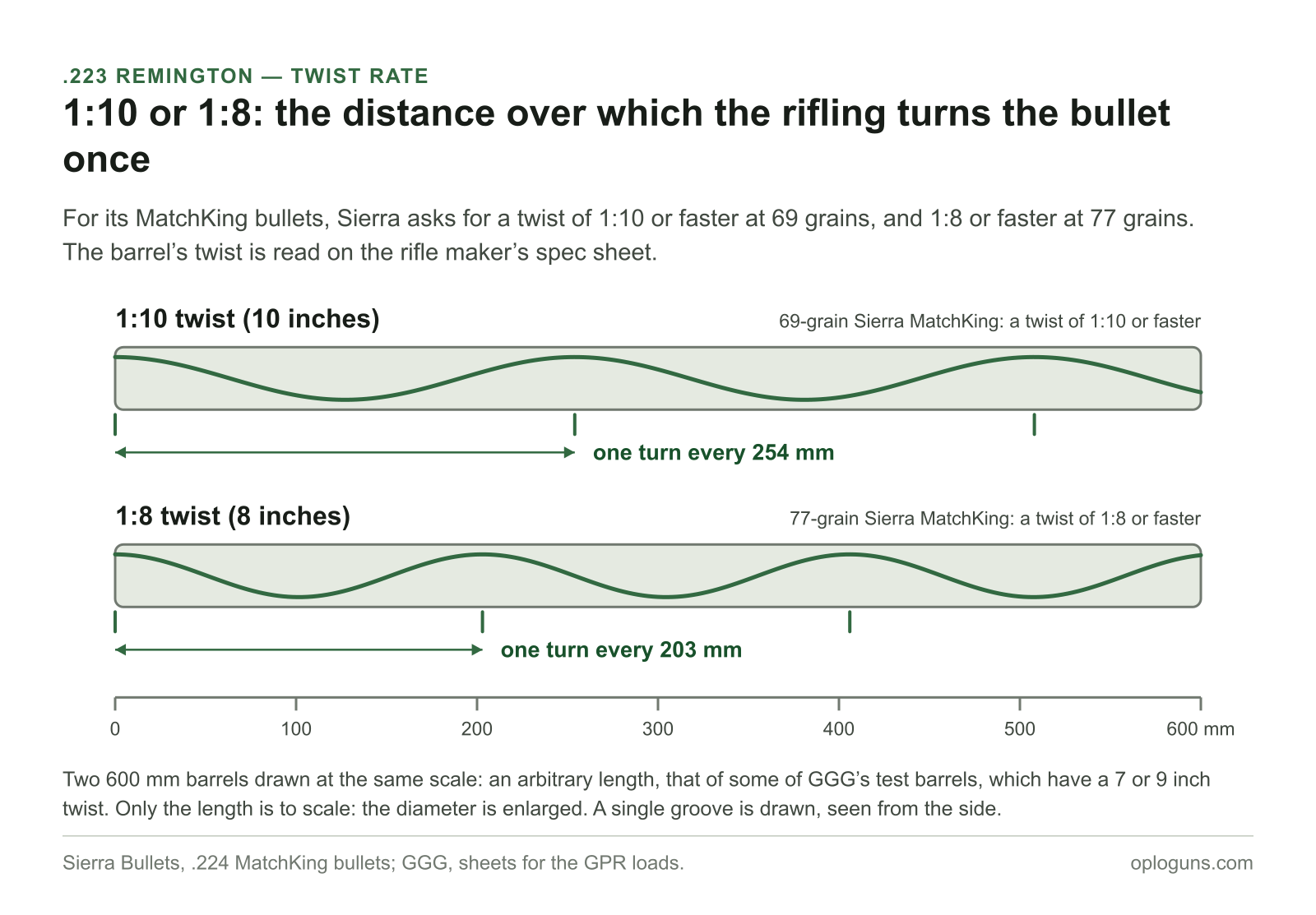
A 77-grain bullet does not suit every barrel. Sierra writes it for its match bullets: its 69-grain MatchKing "requires a barrel twist rate of 1×10” or faster", its 77-grain, 1:8 or faster2. A 1:10 twist turns the bullet once every 254 mm; a 1:8, every 203 mm, the length of a 20 cm school ruler.
GGG publishes, cartridge by cartridge, the velocity measured in a C.I.P. test barrel, with that barrel's length and twist1:
| GGG load | Bullet | Average velocity and tolerance | Maximum standard deviation | Test barrel | Published BC |
|---|---|---|---|---|---|
| GPR11 | FMJ, 55 gr (3.56 g) | 1,015 ± 15 m/s | 12.0 m/s | 600 mm, 9 in (12 in) twist | 0.272 |
| GPR12 | FMJ, 62 gr (4.00 g) | 950 ± 15 m/s | 12.0 m/s | 508 mm, 7 in twist | 0.298 |
| GPR13 | HPBT, 69 gr (4.47 g) | 900 ± 7 m/s | 7.2 m/s | 600 mm, 9 in (12 in) twist | 0.301 |
| GPR14 | HPBT, 77 gr (4.99 g) | 855 ± 10 m/s | 7.8 m/s | 600 mm, 7 in twist | 0.362 |
GGG sheets consulted on 15 November 2026, test-barrel twist as published1.
The ballistic coefficient, or BC, says how well the bullet holds its velocity in the air: the higher it is, the better it holds it. The 77-grain leaves more slowly than the 55-grain, but its BC goes from 0.272 to 0.3621. Sierra also states that its 77-grain loads to a length that fits an AR-15 magazine, and that its 80-grain has to be single-loaded in one2.
Your barrel's twist is read on the rifle maker's spec sheet. Tikka ships its T3x in .223 with a 1:8 or a 1:12 twist depending on the version4: the detail for AR-15s is in which AR-15 to choose, for bolt-action rifles in the .223 Remington rifle.
GGG, PMC, Fiocchi ammunition: what the catalogs say
The three brands shooters look for do not publish the same data. GGG publishes the most.
- GGG presents its .223 as intended in particular for practical and precision shooting, and says it makes it with "GGG FMJ and Sierra HPBT MatchKing" bullets1. Its 55 and 62-grain bullets have a lead-antimony core1.
- PMC publishes the Bronze 223A, a 55-grain full metal jacket boat-tail bullet, BC 0.243, which it aims at target shooters in particular. Its X-TAC Match 223XM, a 77-grain match bullet, BC 0.372, is presented by PMC as paired with Sierra bullets3. The French gun shops checked on 15 November 2026 carried no PMC .22312131415.
- Fiocchi is sold in France with a 55-grain full metal jacket bullet and, under the Exacta name, with a 69-grain Sierra HPBT bullet. One gun shop presents it as made of « composants de compétition » [competition components]1215.
Other brands are offered in .223 Remington at the same gun shops: Geco, Partizan, STV, Swiss P, Winchester121314. A load's accuracy is judged in your own rifle. To compare two lots, velocity and its standard deviation are measured with a chronograph.
.223 and 5.56 NATO ammunition: the rifle's chamber
The .223 Remington and the 5.56 × 45 share one label in France's firearms reference database, not one chamber. SAAMI, the American ammunition standards body, considers it safe to fire .223 Remington in a military-specification 5.56 chamber5. It considers the reverse dangerous: a barrel marked .223 Remington has a shorter throat into the rifling, and 5.56 ammunition can raise the pressure in it5.
SAAMI also notes the many 5.56 chambers outside military specification, and refers shooters to the rifle's manual or its manufacturer5. The standards of the C.I.P., which are the reference in Europe, were not consulted on this point. The ammunition to buy is therefore read first on the barrel marking and in the manual.
.223 ammunition: tied to B, 4° by the caliber
Article R311-2 of the code de la sécurité intérieure (France's internal security code) places in Category B, 4° the « armes chambrant les calibres suivants, quel que soit leur type ou le système de fonctionnement ainsi que leurs munitions, douilles et douilles amorcées, à l'exception de celles classées dans la catégorie A » [firearms chambered for the following calibers, whatever their type or operating system, together with their ammunition, cases and primed cases, except those classed in Category A], among them « calibre 5,56 × 45 » [caliber 5.56 × 45]6. The référentiel général des armes, the state's reference database of firearms, lists the .223 Remington under that caliber16. But that database records firearms, not ammunition, and no official text spells out the category of .223 Remington ammunition. The link runs through the database's label and through article R312-47, which ties ammunition to the firearm's authorization. In practice, which category is applied at the counter is a question for the gun shop.
The arrêté (ministerial order) of 2 September 2013 moves certain ammunition into Category C, including the .308 Winchester at 7°. It names neither the .223 nor the 5.568. For a sport shooter who holds the rifle under an authorization, the ceilings are those of articles R312-47 and R312-49:
- Purchase: the firearm's authorization « vaut autorisation d'acquisition et de détention des munitions correspondantes » [counts as authorization to acquire and hold the corresponding ammunition], within the limit of « 3 000 cartouches par arme » [3,000 cartridges per firearm] for a sport shooter, per twelve-month period from the date it was issued (R312-47)9.
- Holding: « Nul ne peut détenir plus de 1 000 munitions par arme » [No one may hold more than 1,000 rounds per firearm] (R312-49)10.
Category C ammunition has other articles. R312-61: « Nul ne peut détenir plus de 1 000 munitions du 6° ou du 7° de la catégorie C par arme détenue légalement » [No one may hold more than 1,000 rounds of 6° or 7° of Category C per firearm lawfully held]. R312-63: « Nul ne peut détenir plus de 500 munitions classées dans les 6°, 7° et 8° de la catégorie C sans détenir l'arme correspondante » [No one may hold more than 500 rounds classed in 6°, 7° and 8° of Category C without holding the corresponding firearm]11. The comparison with the .308 is in .308 Winchester ammunition, the quota arithmetic in firearm and ammunition quotas.
Armor-piercing or incendiary projectiles: Category A2
The cartridge's classification is not enough. The projectile's can override it. Article R311-2 places in Category A2, 2° « munitions à projectiles perforants, explosifs ou incendiaires et leurs éléments » [ammunition with armor-piercing, explosive or incendiary projectiles and its components]. Category A brings together « les matériels de guerre et armes interdits à l'acquisition et à la détention » [war materiel and weapons whose acquisition and holding are forbidden]6.
Article R311-1 defines these projectiles7:
- Armor-piercing, for a long gun: a projectile, « identifié visuellement le cas échéant par un code couleur » [visually identified where applicable by a color code], containing « un noyau dur en acier trempé ou en carbure de tungstène » [a hard core of hardened steel or tungsten carbide].
- Explosive: a projectile « contenant une charge explosant lors de l'impact » [containing a charge that explodes on impact].
- Incendiary: a projectile « contenant un mélange chimique s'enflammant au contact de l'air ou lors de l'impact » [containing a chemical mixture that ignites on contact with air or on impact].
A surplus lot is therefore read projectile by projectile. The 2025-2026 rulebook for TAR (Tir aux Armes Réglementaires, the French federation's service-arms discipline) goes further for its events. It forbids ammunition that is « incendiaires, explosives, perforantes, traçantes » [incendiary, explosive, armor-piercing, tracer], and in long guns accepts only jacketed or semi-jacketed bullets17.
.223 ammunition prices: €0.58 to €1.50 a round
| .223 Remington load | Packaging | Price per round | Per year, 100 rounds a month |
|---|---|---|---|
| Fiocchi FMJ 55 gr | box of 50 | €0.58 to €0.63 | €694 to €756 |
| GGG FMJ 55 gr | case of 1,000 | €0.67 to €0.69 | €804 to €828 |
| Geco Target FMJ 55 gr | box of 50 | €0.70 to €0.73 | €838 to €881 |
| GGG FMJ 55 gr | box of 50 | €0.70 to €0.75 | €838 to €895 |
| GGG FMJ 62 gr | box of 50 | €0.80 to €0.82 | €959 to €982 |
| Partizan HPBT Match 69 gr | box of 20 | €0.95 to €1.07 | €1,134 to €1,278 |
| Fiocchi Exacta HPBT 69 gr | box of 50 | €1.12 | €1,342 to €1,344 |
| GGG HPBT 69 gr | box of 20 | €1.35 | €1,614 to €1,617 |
| GGG HPBT 77 gr | box of 20 | €1.45 to €1.50 | €1,737 to €1,794 |
Checks of 15 November 2026 at two to three French gun shops, box price divided by the number of cartridges; one shop's prices are discounted12131415. Assumption of 1,200 cartridges a year, under the quota of 3,000 per firearm9. On 9 November 2026, other items recorded in boxes of 50 cost €0.62 to €0.68 a round18, the figure used in AR-15 or AK for sport shooting.
Between the 55-grain Fiocchi full metal jacket and the 77-grain GGG, the gap runs from €981 to €1,100 a year at the same pace. Reloading, which narrows it, is covered in reloading .223 and .308.
Full metal jacket or match bullet: pros and cons
Full metal jacket, 55 to 62 grains
Pros
HPBT match bullet, 69 to 77 grains
Pros
Which .223 ammunition to choose for your use
What you gain, what you give up
If you practice a lot, the 55-grain full metal jacket, at €0.58 to €0.75 a round depending on brand and packaging. In return, a lower BC and, at GGG, a higher published velocity standard deviation.
If you shoot for precision, the 69 or 77-grain HPBT, if your barrel's twist stabilizes it: 1:10 or faster for the 69-grain, 1:8 for the 77-grain according to Sierra. In return, €0.95 to €1.50 a round.
If you shoot TAR, a jacketed bullet, FMJ or HPBT: the rulebook excludes bare lead and incendiary, explosive, armor-piercing or tracer ammunition. In return, a surplus lot has to be identified projectile by projectile before the match.
Three misconceptions about .223 ammunition
- "A heavier bullet is always more accurate." Sierra requires a 1:8 twist for its 77-grain; a 1:12 barrel does not stabilize it according to that maker2.
- "The .223 and the 5.56 can be fired in each other's chambers." SAAMI considers 5.56 dangerous in a barrel marked .223 Remington5.
- "Surplus ammunition is a .223 like any other." Armor-piercing, explosive or incendiary projectiles fall under Category A26.
The text in force prevails. Articles R311-1 and R311-2 in their version of 7 September 2025, R312-47 and R312-49 of 1 January 2024, R312-61 and R312-63 of 1 August 2018, arrêté of 2 September 2013, reread on 15 November 2026; TAR rulebook 2025-2026. Sheets and prices of 15 November 2026. The rifle's manual says which ammunition it accepts.
Sources 18 references
Bullets, velocities and twist rates come from the manufacturers' catalogs; the rules, from the code de la sécurité intérieure, the arrêté classifying ammunition and the TAR rulebook; the prices, from dated checks at French gun shops. Click a reference number in the text to highlight the matching source.
- GGG — civil range and sheets for the GPR11, GPR12, GPR13 and GPR14 in .223 Rem, consulted 15 November 2026: “.223 REM calibre ammunition, designed for hunting, practical and precision shooting enthusiasts and professionals who use rifles”, “manufactured with different types of bullets, including GGG FMJ and Sierra HPBT MatchKing”; “Bullet average velocity values. shooting from C.I.P. testing barrel”; GPR11, FMJ 3.56 g / 55 gr, “barrel length 600 mm, twist 9" (12")”, 1015 ± 15 m/s, BC 0.272 (“Ballistic coefficient”, with no drag model stated), “Velocity maximum standard deviation” 12.0, “Core – lead-antimony”; GPR12, FMJ 4.00 g / 62 gr, “barrel length 508 mm, twist 7"”, 950 ± 15 m/s, maximum standard deviation 12.0, BC 0.298, “Core – lead-antimony (2,5%)”; GPR13, HPBT 4.47 g / 69 gr, “barrel lenght 600 mm, twist 9" (12")”, 900 ± 7 m/s, maximum standard deviation 7.2, BC 0.301; GPR14, HPBT 4.99 g / 77 gr, “barrel length 600 mm, twist 7””, 855 ± 10 m/s, maximum standard deviation 7.8, BC 0.362; the “±” goes with the “Bullet mean velocity”. ⚠️ Manufacturer's data.
- Sierra Bullets — pages 22 cal 69 gr HPBT MatchKing, 22 cal 77 gr HPBT MatchKing and 22 cal 80 gr HPBT MatchKing, read 15 November 2026: 69 gr, "This bullet requires a barrel twist rate of 1×10” or faster"; 77 gr, "requires a barrel twist rate of 1×8” or faster", "allows seating to an OAL that permits cartridges to be loaded into M16/AR15 magazines"; 80 gr, "it must be seated to an OAL that requires single loading in the M16/AR-15 series". Conversions: 1:8 = 203 mm, 1:10 = 254 mm. ⚠️ Manufacturer's data.
- PMC — Bronze 223A and X-TAC Match 223XM, consulted 15 November 2026: Bronze 223A, "FMJ-BT", "55 grain", BC 0.243, "Bronze bridges a gap for target shooters or hunters"; X-TAC Match 223XM, "OTM", "77 grain", BC 0.372, "We combined the exceptional performance of our X-TAC ammunition with the world-class ballistics of Sierra Bullets in our .223 Remington and .308 Winchester cartridges". ⚠️ Manufacturer's data.
- Tikka — T3x Varmint and T3x Lite, version tables read 15 November 2026: in “223 Rem.”, “Rate of twist” “1:8"” or “1:12"” depending on the version. ⚠️ Manufacturer's data.
- SAAMI — FAQ, "Are 223 Remington (223 Rem) and 5.56 (5.56x45mm / 5.56 NATO) ammunition interchangeable?", read 15 November 2026: "It is safe to shoot 223 Remington ammunition in a 5.56 military specification chamber"; "due to the sizeable number of “wildcat” or non-military specification 5.56 chamber geometries in existence, SAAMI recommends that you consult the firearm owner's manual or contact the firearm manufacturer"; "it is not safe to shoot “5.56,” “5.56 NATO,” or “5.56x45mm” ammunition in a barrel marked as being chambered in 223 Remington", such a barrel having "a shorter throat into the rifling than a “5.56” barrel which may cause increased pressure". An American body; the C.I.P. was not consulted; the rifle's manual prevails.
- Légifrance — article R311-2 du code de la sécurité intérieure (in French), version in force since 7 September 2025, reread 15 November 2026: I, « Les matériels de guerre et armes interdits à l'acquisition et à la détention qui relèvent de la catégorie A » [war materiel and weapons whose acquisition and holding are forbidden, which fall under Category A]; A2, 2°, « Munitions à projectiles perforants, explosifs ou incendiaires et leurs éléments » [ammunition with armor-piercing, explosive or incendiary projectiles and its components]; B, 4°, « Armes chambrant les calibres suivants, quel que soit leur type ou le système de fonctionnement ainsi que leurs munitions, douilles et douilles amorcées, à l'exception de celles classées dans la catégorie A : […] b) Calibre 5,56 × 45 » [firearms chambered for the following calibers, whatever their type or operating system, together with their ammunition, cases and primed cases, except those classed in Category A: … b) caliber 5.56 × 45]; C, 7°, « Munitions et éléments de munitions classés dans cette catégorie par arrêté conjoint du ministre de l'intérieur et du ministre chargé des douanes » [ammunition and ammunition components classed in this category by joint order of the interior minister and the minister in charge of customs]; C, 8°, « Autres munitions et éléments de munitions des armes de catégorie C » [other ammunition and ammunition components for Category C firearms]. No paragraph mentions tracer ammunition.
- Légifrance — article R311-1 du code de la sécurité intérieure (in French), in force since 7 September 2025, reread 15 November 2026: 23°, explosive-projectile ammunition, « munition avec projectile contenant une charge explosant lors de l'impact » [ammunition with a projectile containing a charge that explodes on impact]; 24°, incendiary-projectile ammunition, « munition avec projectile contenant un mélange chimique s'enflammant au contact de l'air ou lors de l'impact » [ammunition with a projectile containing a chemical mixture that ignites on contact with air or on impact]; 25°, a), armor-piercing-projectile ammunition: « Munition pour arme d'épaule, avec projectile identifié visuellement le cas échéant par un code couleur, contenant un noyau dur en acier trempé ou en carbure de tungstène » [ammunition for a long gun, with a projectile visually identified where applicable by a color code, containing a hard core of hardened steel or tungsten carbide].
- Légifrance — arrêté du 2 septembre 2013 portant classement de munitions en application du 10° de la catégorie B et du 7° de la catégorie C de l'article R. 311-2 du code de la sécurité intérieure (in French), « En vigueur au 15/11/2026 » [in force on 15/11/2026], reread 15 November 2026: article 1, in force since 1 December 2014, ammunition « classés au 6° de la catégorie C » [classed at 6° of Category C] (25-20 Winchester, 32-20 Winchester, 38-40, 44-40, 44 Remington magnum, 45 Colt); article 2, in force since 6 September 2013, « Sont classés au 7° de la catégorie C les munitions et éléments de munitions suivants » [the following ammunition and ammunition components are classed at 7° of Category C]: 7.5 × 54 MAS, 7.5 × 55 Swiss, 30 M1, 7.62 × 51 or 308 Winchester, 7.92 × 57, 7.62 × 54 R, 30-06, 303 British. Neither the .223, nor the 5.56, nor the .222 appears in it.
- Légifrance — article R312-47 du code de la sécurité intérieure (in French), in force since 1 January 2024, reread 15 November 2026: « L'autorisation d'acquisition et de détention d'une arme ou d'un élément d'arme permettant la conversion du calibre vaut autorisation d'acquisition et de détention des munitions correspondantes sous réserve des dispositions du présent article » [the authorization to acquire and hold a firearm, or a firearm component allowing caliber conversion, counts as authorization to acquire and hold the corresponding ammunition, subject to the provisions of this article]; the holder may acquire « par période de douze mois à compter de la date de délivrance de celle-ci » [per twelve-month period from the date it was issued] « 3 000 cartouches par arme au titre du 2° de l'article R. 312-40 » [3,000 cartridges per firearm under 2° of article R. 312-40].
- Légifrance — article R312-49 du code de la sécurité intérieure (in French), in force since 1 January 2024, reread 15 November 2026: « Nul ne peut détenir plus de 1 000 munitions par arme. » [No one may hold more than 1,000 rounds per firearm.]
- Légifrance — articles R312-61 et R312-63 du code de la sécurité intérieure (in French), in force since 1 August 2018, reread 15 November 2026: R312-61, « Nul ne peut détenir plus de 1 000 munitions du 6° ou du 7° de la catégorie C par arme détenue légalement » [no one may hold more than 1,000 rounds of 6° or 7° of Category C per firearm lawfully held]; R312-63, « Nul ne peut détenir plus de 500 munitions classées dans les 6°, 7° et 8° de la catégorie C sans détenir l'arme correspondante » [no one may hold more than 500 rounds classed in 6°, 7° and 8° of Category C without holding the corresponding firearm].
- Tactirshop — munitions de catégorie B pour armes longues (in French), prices recorded 15 November 2026: Fiocchi FMJ 55 gr €28.90 per 50; GGG FMJ 55 gr €34.90 per 50; Geco Target FMJ 55 gr €34.90 per 50; Partizan PPU 69 gr HPBT Match €18.90 per 20; STV Scorpio and Winchester FMJ 55 gr €11.90 per 20; Fiocchi « Sierra HPBT 69gr » €55.90 per 50, « Les munitions Fiocchi Exacta utilisent des composants de compétition » [Fiocchi Exacta ammunition uses competition components]. ⚠️ Commercial data.
- Armurerie Centrale — munitions .223 Remington (in French), prices recorded 15 November 2026: GGG FMJ 55 gr €35.40 per 50; GGG FMJ 62 gr €40.90 per 50; GGG HPBT 69 gr €26.90 per 20; GGG HPBT 77 gr €29.90 per 20; GGG FMJ 55 gr case €669.90 per 1,000; other .223 brands in the catalog: STV Scorpio, Winchester, Swiss P, Geco, MFS. ⚠️ Commercial data.
- Armurerie Lavaux — munitions .223 Rem (in French), discounted prices recorded 15 November 2026, struck-through price in parentheses: Fiocchi FMJ 55 gr €31.50 per 50 (€36.00); Geco Target FMJ 55 gr €36.70 per 50 (€38.40); GGG FMJ 55 gr €37.30 per 50 (€42.00); GGG FMJ 62 gr €39.95 per 50 (€42.00); GGG « SIERRA HPBT Matchking 69gr » €26.95 per 20 (€29.00); GGG « SIERRA HPBT Matchking 77gr » €28.95 per 20 (€34.00); Partizan HP BT 69 gr €21.30 per 20 (€26.90); GGG FMJ 55 gr case €689.95 per 1,000 (€759.00). ⚠️ Commercial data.
- Armurerie Auxerre — search for « 223 rem » (in French), unit prices recorded 15 November 2026, excluding volume discounts: Fiocchi HPBT Sierra 69 gr €56.00 per 50, « Munitions de Match pour TLD » [match ammunition for long-range shooting]; Geco Target FMJ 55 gr €35.90 per 50. ⚠️ Commercial data.
- Ministère de l'Intérieur, data.gouv.fr — Référentiel général des armes [general reference database of firearms] (in French), export of 11 September 2026, consulted 15 November 2026: caliber labeled « 5,56 X 45 (223 REM)(223 WYLDE) ».
- Fédération française de tir — Règlement TAR, saison 2025-2026 [TAR rulebook, 2025-2026 season] (PDF, in French, circulated 12 January 2026), long guns, general provisions, reread 15 November 2026: « Les munitions de type incendiaires, explosives, perforantes, traçantes, époxy, les balles plombs hors 22LR, Wad-cutter sont interdites » [incendiary, explosive, armor-piercing, tracer and epoxy ammunition, lead bullets other than .22 LR, and wadcutters are forbidden]; « À l'exception du calibre .22LR, les projectiles autorisés en armes longues à répétition manuelle et semi-automatiques sont du type chemisé FMJ, semi-chemisé SP avec pointe creuse HP & HP-BT ou avec inserts en polymère genre A-MAX » [except in .22 LR, the projectiles allowed in manually operated and semi-automatic long guns are jacketed FMJ, semi-jacketed SP, hollow point HP & HP-BT, or polymer-tipped of the A-MAX kind].
- Armurerie Centrale and Armurerie Douillet — checks of 9 November 2026 cited by the article AR-15 or AK for sport shooting (in French): Geco Target FMJ 63 gr €33.90 per 50; Fiocchi .223 FMJ 55 gr €31.00 per 50. ⚠️ Commercial data.
Frequently asked questions
What is the best .223 ammunition?
The one your barrel's twist rate stabilizes. Sierra requires a twist of 1:10 or faster for its 69-grain match bullet, and 1:8 for its 77-grain. For practice, 55 to 62-grain full metal jacket cost €0.58 to €0.82 a round in boxes of 50 on 15 November 2026; 69 to 77-grain HPBT match bullets, €0.95 to €1.50.
How good is GGG .223 ammunition?
For each cartridge GGG publishes its average velocity in a C.I.P. test barrel, with its tolerance: 1,015 ± 15 m/s for the GPR11 with a 55-grain full metal jacket bullet, 950 ± 15 m/s for the 62-grain GPR12, 900 ± 7 m/s for the 69-grain GPR13 HPBT, 855 ± 10 m/s for the 77-grain GPR14 HPBT. Separately, it publishes the maximum standard deviation of velocity: 12.0 m/s for the first two, 7.2 and 7.8 m/s for the two HPBTs. The manufacturer says it makes its .223 with GGG FMJ and Sierra HPBT MatchKing bullets.
69-grain .223 ammunition: for which barrel?
For a twist rate of 1:10 or faster, according to Sierra for its 69-grain MatchKing. Tikka offers its T3x in .223 with a 1:8 or a 1:12 twist depending on the version: only the first stabilizes it according to Sierra. On 15 November 2026, the 69-grain cost €0.95 to €1.35 a round depending on the brand.
What does PMC offer in .223 ammunition?
PMC publishes two lines in .223 Remington: the Bronze 223A, with a 55-grain full metal jacket boat-tail bullet, and the X-TAC Match 223XM, a 77-grain match bullet with a ballistic coefficient of 0.372, which PMC presents as paired with Sierra bullets. The French gun shops checked on 15 November 2026 did not carry it.
How much .223 ammunition can you buy and hold in France?
The 5.56 × 45 is named at B, 4° of article R311-2 of the code de la sécurité intérieure (France's internal security code), ammunition included, and the national firearms reference database lists the .223 Remington under it. No text names .223 Remington ammunition: which category is applied at the counter is a question for the gun shop. For a sport shooter who holds the rifle under an authorization, article R312-47 allows 3,000 cartridges per firearm per twelve-month period, and article R312-49 limits holdings to 1,000 rounds per firearm.
Can you shoot 5.56 NATO ammunition in a .223 rifle?
SAAMI, the American standards body, considers it dangerous to fire 5.56 in a barrel marked .223 Remington, whose chamber has a shorter throat into the rifling. The reverse, .223 in a military-specification 5.56 chamber, is considered safe. The rifle's manual prevails.
Spotted an error, or a rule that has changed since we checked? Report an error