Zeroing a riflescope: from 50 to 100 m, in two shots, and when it loses zero
Published on · 12 min read · Anthony Baillon
A hunting rifle zeroed dead-on at 50 m shoots a little over a centimeter high at 100 m, according to the RWS tables for a .308 and a 7x64. The "two-shot" zero corrects a zero in a single movement of the reticle. When the point of impact shifts, seven causes are checked before blaming the scope.
At a glance
| Situation | What the tables give |
|---|---|
| .308 or 7x64 zeroed dead-on at 100 m | 6 to 7 mm low at 50 m |
| The same, zeroed dead-on at 50 m | 1.2 to 1.4 cm high at 100 m |
| Zeroed "4 cm high at 100 m" | ±4 cm out to about 200 m |
| .22 LR zeroed at 25 m | 26.7 cm low at 100 m |
| Air rifle | first adjustments at around 20 m |
- One click is worth 1 cm at 100 m in 0.1 mrad, about 7 mm in ¼ MOA, and half that at 50 m.
- A scope that loses zero is diagnosed through the mounting and the ammunition before the scope.
One scope click: 7 mm or 1 cm at 100 m
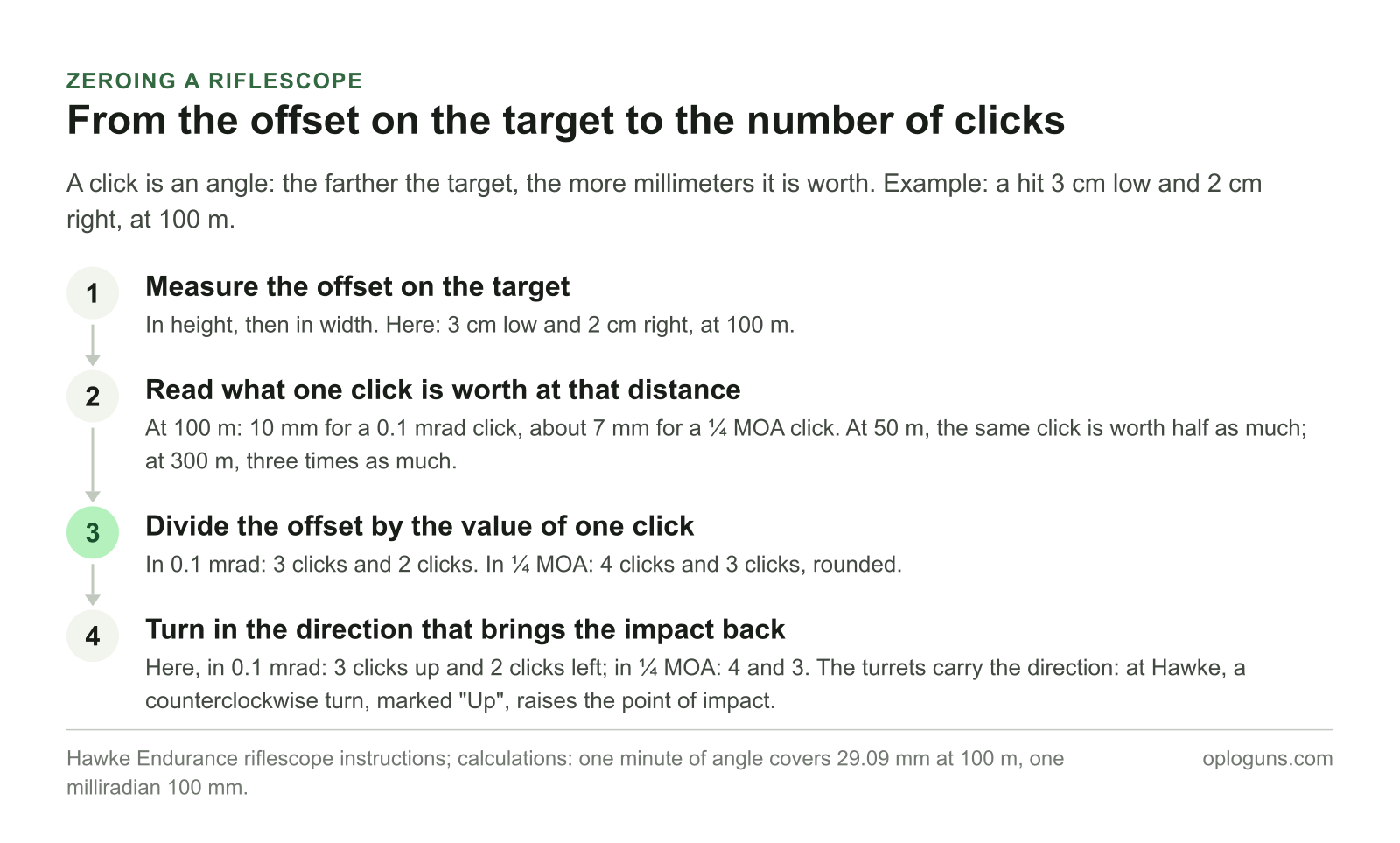
The value of a click is an angle. On most scopes, it is ¼ minute of angle (MOA) or 0.1 milliradian (mrad, or "mil"). Hawke spells it out in its manual: a ¼ MOA click moves the point of impact about 7 mm at 100 m, a 0.1 mrad click 10 mm1.
An angle covers a length proportional to distance. The same click is therefore worth half as much at 50 m. It is worth three times as much at 300 m13.
| Distance | ¼ MOA click | 0.1 mrad click | ½ MOA click |
|---|---|---|---|
| 20 m | 1.5 mm | 2 mm | 2.9 mm |
| 25 m | 1.8 mm | 2.5 mm | 3.6 mm |
| 50 m | 3.6 mm | 5 mm | 7.3 mm |
| 100 m | 7.3 mm | 10 mm | 14.5 mm |
| 200 m | 14.5 mm | 20 mm | 29.1 mm |
| 300 m | 21.8 mm | 30 mm | 43.6 mm |
The calculation fits on one line. The offset measured on the target is divided by the value of one click at that distance. A hit 3 cm low and 2 cm right, at 100 m, is corrected by 3 clicks up and 2 clicks left in 0.1 mrad; in ¼ MOA, by 4 clicks and 3 clicks, rounded. The turrets carry the direction: at Hawke, a counterclockwise turn, marked "Up", raises the point of impact1.
The same reasoning, applied to a pistol's red dot, is detailed in our red dot guide. That leaves the case that raises the most questions: the hunter who only has a 50 m range.
Zeroing from 50 to 100 m: the hunting rifle
RWS publishes, load by load, the gap between point of aim and point of impact by distance. Two hunting cartridges, a .308 Winchester and a 7x64, zeroed dead-on at 100 m56:
| Distance | .308 Win., Speed Tip Pro 10.7 g | 7x64, Evolution 10.3 g |
|---|---|---|
| 50 m | 0.6 cm low | 0.7 cm low |
| 100 m | point of aim | point of aim |
| 150 m | 3.7 cm low | 3.4 cm low |
| 200 m | 12.0 cm low | 11.2 cm low |
| 250 m | 25.5 cm low | 23.9 cm low |
| 300 m | 44.6 cm low | 42.1 cm low |
At 50 m, the bullet has not yet reached the line of sight. It passes 6 to 7 mm below the point of aim. Two ways of zeroing at 50 m follow from that.
- Set the impact 6 to 7 mm low at 50 m: the rifle ends up dead-on at 100 m.
- Zero dead-on at 50 m: the impact then rises 1.2 cm (.308) to 1.4 cm (7x64) above the point of aim at 100 m, since the angular offset doubles with distance13. One click of 0.1 mrad, or two of ¼ MOA, brings it back.
These offsets depend on the ammunition, the test barrel and the scope height the manufacturer used. They get the zero close; only a check at 100 m, with the hunting cartridge itself, confirms it. Tikka, for that matter, has the final zero of its rifles done on a target set between 100 and 150 m4. The .308 and the 7x64 are only two of the big-game calibers: each has its trajectory, and each load its table.
Zeroed "4 cm high at 100 m": range without correction
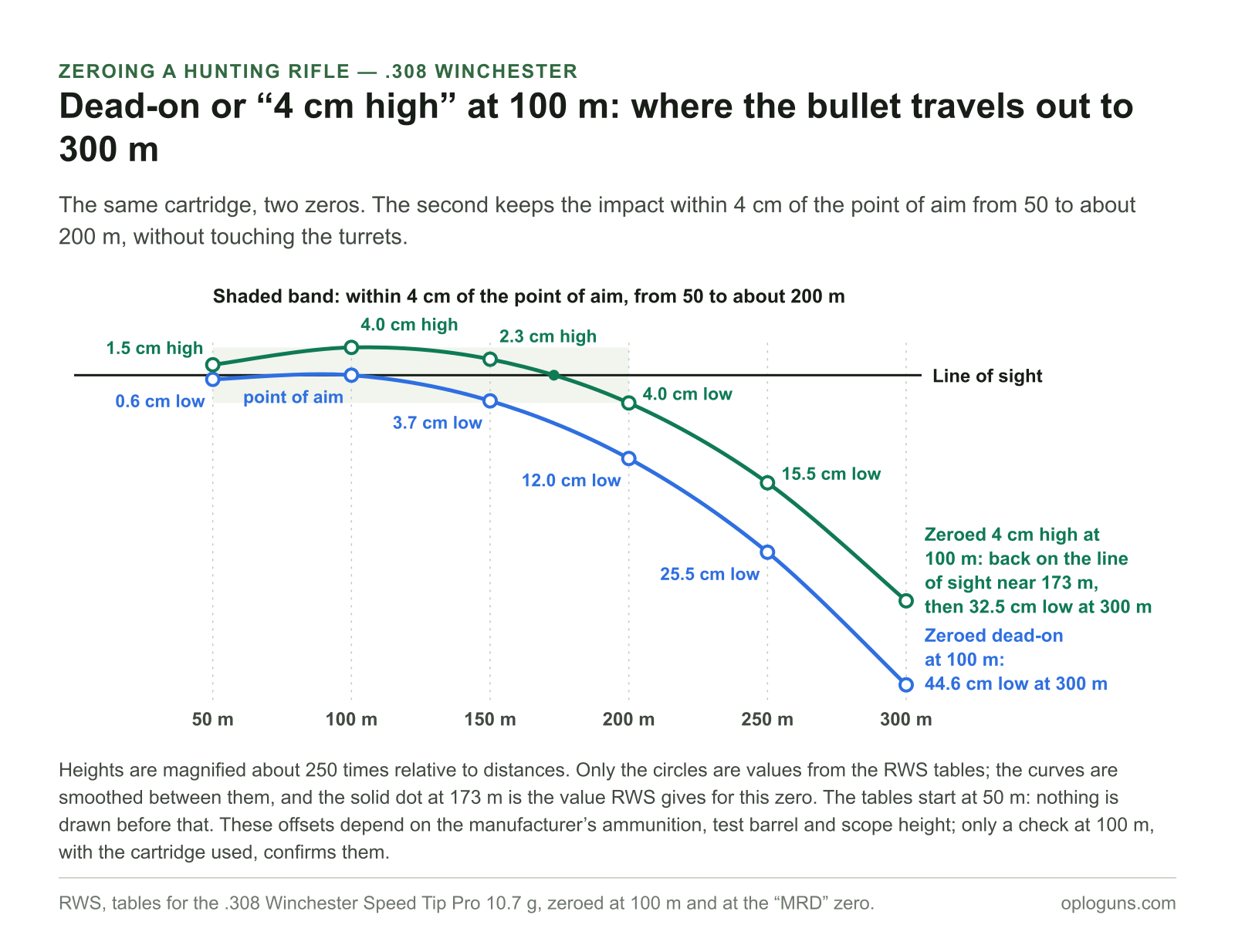
Another zero puts the impact higher than the point of aim. RWS publishes it under the abbreviation MRD: the impact rises to 4 cm above the point of aim at 100 m, and comes back to it at around 173 m for the .308, 177 m for the 7x6456.
| Distance | .308 Win., zeroed 4 cm high | 7x64, zeroed 4 cm high |
|---|---|---|
| 50 m | 1.5 cm high | 1.3 cm high |
| 100 m | 4.0 cm high | 4.0 cm high |
| 150 m | 2.3 cm high | 2.6 cm high |
| 200 m | 4.0 cm low | 3.2 cm low |
| 250 m | 15.5 cm low | 14.0 cm low |
| 300 m | 32.5 cm low | 30.1 cm low |
This zero keeps the impact within 4 cm of the point of aim from 50 to about 200 m. The turrets do not move. The price is paid at short range: 1.3 to 1.5 cm high at 50 m. Beyond 200 m, the drop picks up quickly, and the two zeros are equivalent: either one then needs a correction.
Two-shot zero: one movement of the reticle
The method corrects a zero with two cartridges. It rests on a simple idea: if the rifle does not move, shifting the reticle onto the hole from the first shot amounts to making point of aim and point of impact coincide9.
- Settle the rifle on a rest that holds both the forearm and the buttstock: sandbags, or better, a shooting rest9.
- Aim at the center of the target and fire one shot, taking care over the release.
- Come back to aim at the center, then, without moving the rifle, turn the turrets until the reticle sits on the hole. A second person can do the turning while the shooter holds the rifle9.
- Aim at the center again and fire: the second shot should land in the center9.
- Confirm with a third shot, or even a fourth: the method's author does so every time9.
A variant, published by American Hunter, measures with a ruler the offset of the first hole from the center, converts it into clicks, then fires the confirming shot10. It avoids turning the turrets while the rifle is aimed.
In two shots
Pros
- Two cartridges: one shot, one movement of the reticle, one confirming shot9.
- No conversion: the reticle is set on the hole, with no ruler and no click calculation.
On a three-shot group
Pros
Cons
- More cartridges: three per correction, then three to confirm.
- A measurement to take: the offset of the group's center, converted into clicks.
Scope zeroed at 25 m: the .22 LR error at 100 m
A bullet first rises toward the line of sight, crosses it, then falls back. The scope sits above the barrel, 40 mm on Lapua's table. The 25 m zero fixes the first crossing. It says nothing about the second.
.22 LR: the offset at 100 m by zero distance
Lapua Center-X, scope 40 mm above the bore line, 660 mm test barrel: centimeters below the point of aim at 100 m
Trajectory table published by Lapua for its Center-X7. At 50 m, the same ammunition zeroed at 25 m hits 2.2 cm low; zeroed at 75 m, 5.1 cm high.
View the data
| Zeroed dead-on at | Offset at 50 m | Offset at 100 m |
|---|---|---|
| 25 m | 2.2 cm low | 26.7 cm low |
| 50 m | 0 | 22.4 cm low |
| 75 m | 5.1 cm high | 12.2 cm low |
Zeroed dead-on at 25 m, a .22 LR Center-X already passes 2.2 cm below the point of aim at 50 m, and 26.7 cm at 100 m7. On an ISSF 50 m target, where each ring adds 8 mm of radius11, those 2.2 cm amount to nearly three rings. The rule is the same the other way around: RWS publishes its R+ Long Range, zeroed at 100 m, at 9.5 cm above the point of aim at 50 m8.
The .22 LR is therefore zeroed at the shooting distance. In ISSF competition, the question does not arise: no scope may be fitted to the rifle11. It arises in benchrest, in long-range shooting and in Precision Rifle, which is also shot in .22 LR.
Air rifle scope: 20 m, parallax, recoil
Hawke, which devotes a line of scopes to air rifles, has their zeroing start at around 20 m, not 50 m1. Three differences from a powder-burning rifle.
- Parallax. A scope without parallax adjustment is factory-set for 100 yards, or 91 m. At any other distance, the reticle seems to slide across the target when the eye moves behind the eyepiece1. Scopes designed for airguns adjust down to 10 yards, about 9 m2. The zero is set with parallax locked on the shooting distance1.
- The click. At 20 m, a ¼ MOA click moves the impact only 1.5 mm13. A 1 cm correction takes seven clicks.
- Recoil. Hawke justifies a dedicated line by the recoil peculiar to air rifles3. Its manual also provides, for hard-recoiling guns, rings fitted with a recoil stop pin1.
On the legal side in France, an air rifle falls in category D between 2 and 20 joules, and in category C from 20 joules up12, as our guide to firearm categories details.
Choosing the scope itself, 11 mm rail and magnification, is in the air rifle scope.
My scope loses zero: seven causes to check
A scope that "won't hold zero" is rarely the first suspect in the manuals. Each cause leaves its signature on the target.
| What you see | Cause to check | What the manuals say |
|---|---|---|
| The impact shifts as you shoot | Loose ring or base screws | Hawke: 1.8 N·m on the ring cap screws, 3.4 N·m on the base screws; over-tightening damages the scope1 |
| A huge offset from the first shots | Misaligned mounting | Hawke: remove the scope and the rings, then start again1 |
| The zero moved after the stock was removed | Action screws, recoil lug | Tikka: 7 N·m with a metal trigger guard, 5 N·m at most with a plastic one, barrel pulled rearward before tightening4 |
| The impact changed with a suppressor or a muzzle brake | Tightening of the device | Tikka: over-tightening shifts the group; zero to be checked after fitting4 |
| The impact changed with a new box | Ammunition or lot | Tikka: subsonics need a different zero4; each load has its table5 |
| The reticle slides across the target when the eye moves | Parallax | Hawke: without adjustment, the scope is parallax-free only at 91 m1 |
| The group opens up from session to session | Fouled barrel | Tikka: a badly fouled barrel shoots inaccurately4 |
The cheapest order. Check the screws with a torque wrench, then shoot your usual ammunition, from the same lot, off a stable rest. If the impact stays unstable with a mount torqued to spec, the scope itself becomes the suspect: the manufacturer's warranty then takes over.
Two settings from the manuals count more than people think. Torque, first. Hawke puts ring tightening at 1.8 N·m: the weight of a one-and-a-half-liter bottle at the end of a 12 cm wrench. Beyond that, the scope can be damaged1. Ammunition, next. Changing brand, type or lot moves the point of impact, and the trajectory tables show it from one cartridge to the next56. In .22 LR, the velocity gaps between families are detailed in our guide .22 LR subsonic, standard or high velocity.
Three misconceptions about zeroing a scope
- "Zeroed at 25 m, it is right at 100 m." Not in .22 LR: Lapua's table gives 26.7 cm low at 100 m for a rifle zeroed dead-on at 25 m7.
- "One click is one centimeter." Only in 0.1 mrad and at 100 m. In ¼ MOA, a click is worth about 7 mm at 100 m; at 50 m, the value of every click is halved1.
- "If the impact moves, it is the scope." The manuals name first the tightening of the rings and the action, the ammunition, the suppressor, parallax and fouling14.
Which zero for your shooting
Hunting, with only a 50 m range
The 50 m zero gets you close, provided you know your ammunition's offset: for a .308 or a 7x64, 6 to 7 mm below the point of aim at 50 m to be dead-on at 100 m. The trade-off: the manufacturer's table assumes its barrel and its scope height, so a check at 100 m is still needed.
Precision shooting in .22 LR
The rifle is zeroed at the distance of the target, 50 or 100 m, and checked at every change of lot. The magnification needed to see your hits there is worked out in our guide what magnification to see your hits. To go further, our guide to shooting at 1,000 m covers the calibers that take over.
Air rifle
Zeroing starts at around 20 m, with parallax locked on the same distance. The trade-off: each click is worth only a millimeter and a half, so corrections take a lot of clicks, and a scope designed for airguns.
Sources 13 references
Click values and torque figures from the manufacturers' manuals; trajectories from the tables published by the ammunition makers; conversions calculated. Click a reference number in the text to highlight the matching source.
- Hawke Optics — Endurance riflescope instructions (multilingual PDF, French text included), reread on 1 November 2026: "1 click = 1⁄4 MOA = 1⁄4 in at 100yds, or 7mm at 100m"; "1 click = 1⁄10 MRAD = 0.36in at 100yds, or 10mm at 100m"; torque « (1,8 Nm) (16 in/lbs) (1,33 ft/lbs) pour les vis de capuchon de bague et (3,4 Nm) (30 in/lbs) (2,5 ft/lbs) pour les vis de base de bagues » [1.8 N·m for the ring cap screws and 3.4 N·m for the ring base screws]; « Sur les carabines à recul important, il peut être nécessaire d'installer une goupille butée de recul sur les bagues » [on hard-recoiling rifles, it may be necessary to fit a recoil stop pin to the rings]; zeroing on three shots, then "Repeat until point of aim and point of impact are the same"; air rifles: "start by taking aim at a nearby target (at approximately 20 yards/meters)", parallax set to that distance; « Les lunettes de carabine sans réglage de parallaxe sont réglées sur 100 yards (91 mètres) » [riflescopes without parallax adjustment are set for 100 yards (91 meters)]; if the impact is far off target, "inspect the mounting of the riflescope", or even "removing the riflescope from the mounts and mounts from the rifle and starting again". The click values in the manual are rounded to the millimeter. ⚠️ Manufacturer's document hosted by a retailer.
- Hawke Optics — Airmax 3-9x40 AO AMX, product page reread on 1 November 2026: "Parallax: Adjustable Objective", "PX/Focus (yds) 10 - ∞".
- Hawke Optics — press release for the launch of the Airmax 30 Compact SF, reread on 1 November 2026: "the need for optics that can withstand the rigors of air-rifle recoil, and provide the optical quality to match had to be met".
- Sako — Tikka T1x and T3x instruction manual, version 5.3 (multilingual PDF, 2023, French text included), reread on 1 November 2026: final zero "at a target set at 100-150 m distance", three shots then "Adjust the sight (elevation and windage) so that reticle moves to the center of the shot grouping"; action screws tightened "to a torque of 7 Nm (62 in-lbs) in metallic trigger guards and max. 5 Nm (44 in-lbs) in plastic trigger guards", after pulling the barrel rearward "in order to remove the slack from the recoil lug"; suppressor: « Un serrage excessif peut résulter dans un décalage excessif du groupage de coups ou dans une perte de précision au tir » [over-tightening can result in an excessive shift of the shot group or a loss of accuracy], zero to be checked after fitting; « Les munitions subsoniques ont des vitesses sensiblement moins élevées et exigent une mise à zéro différente » [subsonic ammunition has markedly lower velocities and requires a different zero]; "Badly fouled barrels can shoot inaccurately".
- RWS — .308 Win. Speed Tip Pro Short Rifle 10.7 g, data sheet reread on 1 November 2026: 830 m/s, 500 mm test barrel; zeroed at 100 m, −0.6 cm at 50 m, −3.7 at 150 m, −12 at 200 m, −25.5 at 250 m, −44.6 at 300 m; "MRD 173 m" zero: +1.5 at 50 m, +4 at 100 m, +2.3 at 150 m, −4 at 200 m, −15.5 at 250 m, −32.5 at 300 m. ⚠️ Manufacturer's technical data; scope height used not stated on the sheet.
- RWS — 7x64 Evolution 10.3 g, data sheet reread on 1 November 2026: 855 m/s, 600 mm test barrel; zeroed at 100 m, −0.7 cm at 50 m, −3.4 at 150 m, −11.2 at 200 m, −23.9 at 250 m, −42.1 at 300 m; "MRD 177 m" zero: +1.3 at 50 m, +4 at 100 m, +2.6 at 150 m, −3.2 at 200 m, −14 at 250 m, −30.1 at 300 m. ⚠️ Manufacturer's technical data; scope height used not stated on the sheet.
- Lapua — .22 LR Center-X, trajectory table reread on 1 November 2026: scope "40 mm above bore line", 660 mm test barrel; zeroed at 25 m: −17 mm at 10 m, −22 mm at 50 m, −267 mm at 100 m; zeroed at 50 m: −13 mm at 10 m, −224 mm at 100 m; zeroed at 75 m: −2 mm at 10 m, +51 mm at 50 m, −122 mm at 100 m. ⚠️ Manufacturer's technical data.
- RWS — R+ Long Range .22 LR, data sheet reread on 1 November 2026: zeroed at 100 m ("Fleckschuss"), +9.5 cm at 50 m, −37.5 cm at 150 m. ⚠️ Manufacturer's technical data.
- Jo Deering, NRA Women — Quick Tip: The Two-Shot Zero, 12 December 2025, reread on 1 November 2026: "Shoot one shot at the bullseye"; "Ensure the gun does not move, and dial your turrets […] until the crosshairs are situated exactly over the hole from your first shot"; a rest "that will hold the forearm and the buttstock of the gun"; method not intended for "a new rifle that you've never shot or […] a rifle with a new scope you've just mounted"; "if you jerk or pull your first shot, the whole method is thrown off"; the author fires a third, sometimes a fourth, confirming shot.
- Bryce M. Towsley, NRA American Hunter — How to Zero Your Scope with Two Shots, 23 July 2015, reread on 1 November 2026: measuring with a ruler the offset of the first hole from the target's axes, conversion into clicks ("4 clicks for each inch of movement at 100 yards" in ¼ MOA), then "Fire another shot. It should impact exactly in the center of the target".
- ISSF — Rule Book, Edition 2025, Third Print 10/2026, in force since 19 October 2026: 6.3.4.2, 50 m rifle target, 10 ring 10.4 mm and 9 ring 26.4 mm in diameter; 7.4.1.6, "No Light enhancing system, optical sight, optical system or telescope may be attached to the rifle".
- Légifrance — article R311-2 du code de la sécurité intérieure (in French), version in force since 7 September 2025: airguns with an energy of 20 joules or more in category C, 4°; between 2 and 20 joules in category D, h).
- Calculations: one minute of angle covers 29.09 mm at 100 m, one milliradian 100 mm; the values scale to any distance in proportion; an angular offset measured at 50 m doubles at 100 m; the standard deviation of the center of n shots is that of one shot divided by √n (√3 ≈ 1.73); 1 cm correction at 20 m in ¼ MOA: 10 ÷ 1.45 ≈ 7 clicks; 1.8 N·m is equivalent to the weight of about 1.5 kilograms (14.7 N) at the end of a 12 cm arm.
The tables hold for the manufacturer's test barrel and test ammunition. Your rifle, with its barrel length, its mount height and its ammunition, will give other values: only shooting at the real distance confirms them. The torque figures for your scope, your rings and your rifle are those in their own manuals.
Frequently asked questions
How do you zero a scope at 50 m to shoot at 100 m?
It all depends on the ammunition. For a hunting .308 Winchester or 7x64, the RWS tables show that a rifle zeroed dead-on at 100 m shoots 6 to 7 mm low at 50 m. Zeroed dead-on at 50 m, it will therefore shoot about 1.2 to 1.4 cm high at 100 m. The 50 m zero gets you close; a check at 100 m confirms it, with the hunting ammunition itself.
How many clicks to move the point of impact one centimeter?
At 100 m, a 0.1 mrad click is worth 1 cm and a ¼ MOA click about 7 mm. The value halves at 50 m and triples at 300 m. Correcting 3 cm at 100 m therefore takes 3 clicks of 0.1 mrad, or 4 clicks of ¼ MOA. The exact value is marked on the turret or given in the manual.
What is the two-shot zero?
A correction method using two cartridges. You fire one shot at the center of the target, come back to aim at the center without moving the rifle on its rest, then turn the turrets until the reticle sits on the hole. The second shot should land in the center. It assumes a very stable rest and a cleanly released first shot; it does not suit a scope that has just been mounted.
Why does my riflescope lose its zero?
The scope itself is rarely the first cause to examine. The Hawke and Tikka manuals point first to the mounting (ring, base or action screws not properly tightened), a change of ammunition or lot, an over-tightened suppressor, parallax and barrel fouling. Each leaves a different signature on the target.
At what distance should you zero an air rifle scope?
Hawke recommends starting at around 20 m, the usual shooting distance for an air rifle, with parallax set to that same distance on scopes that allow it. A scope without parallax adjustment is factory-set for 100 yards, or 91 m: at 20 m, the reticle then seems to slide across the target when the eye moves.
Spotted an error, or a rule that has changed since we checked? Report an error