Breathing and tremor in sport shooting: what the studies measure
Published on · 8 min read · Anthony Baillon
In sport shooting, tremor is normal: every outstretched arm oscillates, and the best shooters simply oscillate less. Studies measure that well; breathing, far less. Shooting guides agree on one point: the shot breaks during a pause, after an exhale. Published studies do not separate the ways of getting there.
At a glance
| Question | What the studies measure |
|---|---|
| Tremor | Present in everyone; lower in the elite |
| Its link with the score | Real, but modest |
| Breathing | No measured link between way of breathing and score |
| The heart | Champions who release between two beats; heart rate unrelated to score |
| Beta-blockers | Banned in shooting, in and out of competition |
- What can be trained: the consistency of the respiratory pause and the aiming time, with a stopwatch.
- What cannot be controlled: the background tremor and the heartbeat.
Tremor in sport shooting: normal, lower in the elite
An outstretched arm never comes to rest. The useful question is whether tremor costs points, and how many.
Two air pistol studies answer it with sensors fixed to the gun and the hand:
- Air pistol, 2008: ten elite shooters, ten pre-elite, at 10 m. The elite shook less, in the pistol and in the forearm. The score fell as tremor amplitude rose, and with the 8-to-12-hertz frequency peak of the lateral tremor1.
- Air pistol, 2024: seventeen shooters from the national team and an air pistol center, 40 shots each. The link between tremor and score was weak overall, clearer in the elite group, absent in the other. The biceps was the muscle whose activity tracked the tremor best2.
Eight to twelve hertz means eight to twelve oscillations per second. The 2024 authors suggest balancing the muscles that pull and restrain the shoulder2. Their sample is small, and their correlations modest.
Sway and tremor: a prerequisite, not a tiebreaker
The whole body moves too, not just the hand. The systematic review by Spancken, Steingrebe and Stein, which brings together fourteen studies on air rifle and smallbore rifle, makes a two-part finding3:
- Between levels, the difference is clear: elite shooters sway less than national-level shooters, and those less than beginners.
- Among elite shooters, it no longer separates: there, sway does not predict the score of the shot.
The authors read this cautiously: low sway may be a prerequisite for performance rather than a factor that separates the best3. For pistol, foot position affects that sway; the available measurements are in the article on the pistol shooting stance.
Breathing when shooting: the pause after the exhale
The pistol guide of the Army Marksmanship Unit, the U.S. Army's shooting unit, starts from a physical observation: the chest, abdomen and shoulders move with every breath, and the gun with them4. From this it draws a rule: do not breathe while releasing the shot.
The figures it gives:
| Reference point | Value given by the guide |
|---|---|
| Respiratory cycles at rest | 12 to 13 per minute |
| Duration of a cycle | 4 to 5 seconds |
| Natural pause after the exhale | 2 to 3 seconds |
| Breath held without discomfort | 15 to 20 seconds |
| Time beyond which to take another breath | 8 to 10 seconds without a shot |
The pause falls after the exhale, when the muscles are relaxed4. The guide of the Civilian Marksmanship Program, a U.S. marksmanship training organization, sums up the order in three words: exhale, stop breathing, aim5. That leaves the question that divides the advice: empty everything or keep a little air.
Exhale fully or partly: the studies do not settle it
The same Army Marksmanship Unit guide contains both versions. It wants a natural, effortless exhale, and warns against air held in the lungs: an incomplete exhale creates tension and distracts4. But it also describes experienced shooters who inhale deeply, exhale slowly and hold progressively, and it advises exhaling "to the point of comfort" before the string4.
Science does not settle it. The 2021 review finds only one study on breathing in smallbore rifle: breathing patterns did not differ between national-level and junior shooters, and they had no effect on the score in beginners and national-level shooters36. Another study cited by the review did not see the score improve with balance training, alone or combined with breathing training3.
The takeaway fits in one sentence. What counts about the pause is its consistency, from one shot to the next; the amount of air kept has not proven its effect.
Slow breathing: less anxiety, no extra points
Slow breathing is often presented as a remedy for match stress. A team at the University of Bath tested it on 67 people, split into three groups7:
- Diaphragmatic breathing at 6 cycles per minute, for five minutes;
- Paced breathing at 12 cycles per minute;
- No instruction, for comparison.
Then all of them shot a pistol under pressure. The result: cognitive anxiety fell with slow breathing, heart rate did not move, and performance changed little7. The authors conclude that the exercise can relieve stress without necessarily helping to shoot under pressure. The points do not follow.
Heart and trigger release: what the studies measure
The heart moves the gun too. In 1987, a study recorded six Finnish rifle and pistol champions and three beginners: the champions released their shots during diastole, the heart's resting phase between two contractions; the beginners fired in both phases, and their shots released in diastole were better8.
Other measurements qualify this. In expert pistol shooters, at 25 m, a 2001 study observed a cardiac deceleration before the shot. It was longer and more regular before the best shots than before the worst9. But in beginner and junior rifle shooters, the 2021 review notes a preference for the start of the cardiac cycle, and almost nowhere a link between heart rate and score3.
The heartbeat cannot be controlled at will. The 2001 authors read in the expert's deceleration a state of arousal and vigilance, tied to their engagement in the task9: a state, not an action.
Holding your breath: 8 to 10 seconds at most
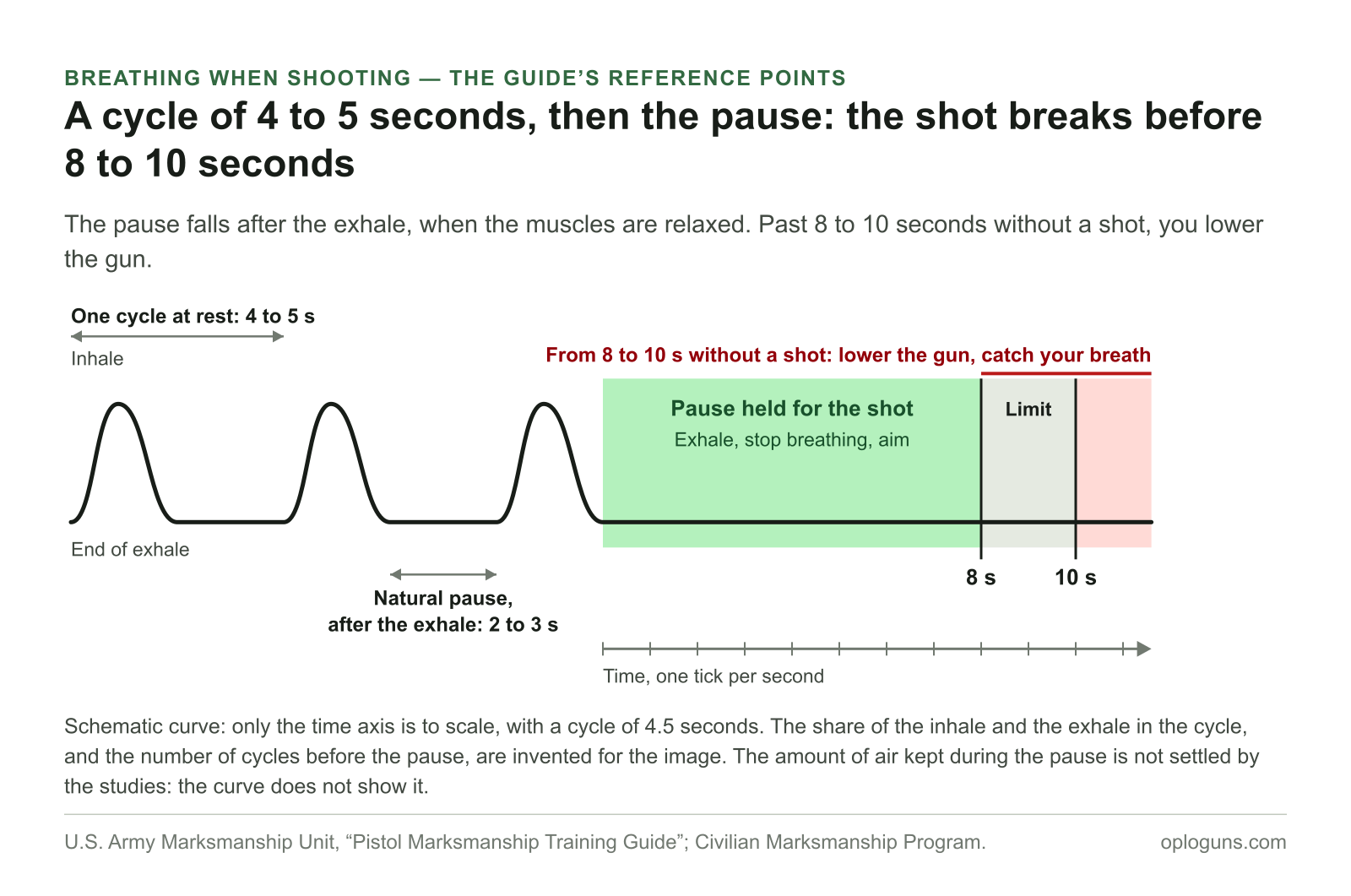
The Army Marksmanship Unit guide describes the movement of the gun during aiming as a wave: large at the start, it shrinks as the body settles, then rises again when the muscles tire and air runs short4. Hence its 8-to-10-second rule: past that time without a shot, you lower the gun and take another breath4.
That duration can be measured with no device at all. A partner, a stopwatch and a sheet of paper are enough:
- The partner starts the stopwatch at the end of the exhale, and stops it when the shot breaks.
- Each duration is written down next to the value of the shot, on a two-column sheet.
- Over a string of ten or more, you compare the average of the shots fired before 8 seconds with that of the shots fired after.
A single string proves nothing: the variation from one shot to the next is too large. The measurement principles that apply to dry fire apply here, see dry-fire drills and how to measure them. The training plan that frames these sessions is described in the article on improving at sport shooting.
Beta-blockers: banned in shooting, out of competition too
Tremor has a chemical remedy, and it is banned. The World Anti-Doping Agency's Prohibited List, in force since 1 January 2026, prohibits beta-blockers in shooting, for the ISSF and the Paralympic Committee, in competition and out of competition alike10. Shooting shares this double ban with archery and underwater sports1011.
The list recalls that these substances are part of treatments for heart failure or hypertension10. The Cologne anti-doping laboratory explains their misuse by the effect of competition stress on performance11. A shooter under treatment therefore has a question to ask their doctor before entering competition. The other levers of stress management, measured in shooters, are in the article on mental preparation.
Three misconceptions about breathing and tremor
- "A good shooter does not shake." They shake less: the air pistol elite shakes less than pre-elite shooters, but it shakes12.
- "There is a way of breathing that wins points." The 2021 review finds no link between breathing pattern and score3, and slow breathing calms without improving shooting under pressure7.
- "You have to shoot between two beats." Champions do8, but the moment cannot be controlled, and heart rate almost never predicts the score3.
Breathing and tremor: what to do with them
As a beginner, what matters is the pause: exhale, hold, release, and lower the gun when the shot does not break. Background tremor is lower in elite shooters: that is what separates the levels in the studies.
In 10 m competition, aiming time is measured with a stopwatch, shot by shot. Late shots are spotted on the sheet, before being corrected in training.
In rapid fire, the pause has to cover a whole string: the Army Marksmanship Unit guide aims for a comfortable breath hold for five shots in ten or twenty seconds4.
The rules in force prevail. The Prohibited List cited is the World Anti-Doping Agency's list in force since 1 January 2026; it changes every year. The studies cited rest on small samples: they describe trends, not rules for each shooter.
Sources 11 references
The measurements come from studies published in peer-reviewed journals and from a systematic review, whose abstracts or text were read. The breathing instructions come from two marksmanship training guides. The anti-doping rule comes from the text of the list in force, cross-checked with an accredited laboratory.
- Tang W. T., Zhang W. Y., Huang C. C., Young M. S., Hwang I. S. — "Postural tremor and control of the upper limb in air pistol shooters", Journal of Sports Sciences, 2008, 26(14), pp. 1579-1587, abstract consulted 1 November 2026: ten elite and ten pre-elite shooters, pistol at 10 m, accelerometers; tremor amplitude lower in the elite in the pistol and the distal segments of the arm; performance inversely related to the amplitude and to the 8-to-12 Hz spectral peak of the lateral tremor.
- Liu Y., Hu N., Sun M., Qu F., Zhou X. — "The Effects of Hand Tremors on the Shooting Performance of Air Pistol Shooters with Different Skill Levels", Sensors, 2024, 24(8), 2438, abstract consulted 1 November 2026: seventeen shooters, elite and sub-elite groups, 40 shots; weak correlations between tremor and score overall, present in the elite group, absent in the other; moderate correlations between tremor and biceps activity.
- Spancken S., Steingrebe H., Stein T. — "Factors that influence performance in Olympic air-rifle and small-bore shooting: A systematic review", PLOS ONE, 2021, 16(3), e0247353, consulted 1 November 2026: fourteen studies; lower sway in the elite, with no effect on the score among elite shooters; "Breathing patterns did not differ between national- and junior-level shooters" and without influence on performance (ref. 29); balance training alone or with breathing training without score gain (ref. 15); air rifle beginners and juniors releasing preferably early in the cardiac cycle; heart rate uncorrelated with score at almost every level.
- U.S. Army Marksmanship Unit — "Pistol Marksmanship Training Guide" (PDF, U.S. government publication, public domain), consulted 1 November 2026: introduction (wave-like movement of the gun during aiming, which rises again with fatigue and lack of air); chapter I, "Breath control" (12 to 13 cycles per minute, cycle of 4 to 5 s, pause of 2 to 3 s, comfortable breath hold of 15 to 20 s, holding after the exhale, taking another breath after 8 to 10 s without a shot, experienced shooters who inhale deeply then exhale slowly, exhaling "to the point of comfort", breath hold for five shots in 20 or 10 s).
- Civilian Marksmanship Program — "The CMP Guide to Rimfire Sporter Shooting" (PDF, NLU 702), consulted 1 November 2026, p. 23: the five steps of the shot, including "Exhale, stop breathing and Aim".
- Konttinen N., Lyytinen H. — "Physiology of preparation: brain slow waves, heart rate, and respiration preceding triggering in rifle shooting", 1992, vol. 23, pp. 110-127: study cited by the review in source 3 for breathing patterns, reference as the review gives it. ⚠️ Read through the review, original text not consulted.
- Conlon A., Arnold R., Preatoni E., Moore L. — "Pulling the trigger: The effect of a five-minute slow diaphragmatic breathing intervention on psychophysiological stress responses and pressurized pistol shooting performance", Journal of Sport and Exercise Psychology, 2022, 44(3), pp. 206-219, abstract consulted 1 November 2026: 67 participants, diaphragmatic breathing at 6 cycles per minute, paced at 12, or no instruction, for five minutes; heart rate unchanged, cognitive anxiety reduced, "little effect on performance".
- Helin P., Sihvonen T., Hänninen O. — "Timing of the triggering action of shooting in relation to the cardiac cycle", British Journal of Sports Medicine, 1987, 21(1), pp. 33-36, abstract consulted 1 November 2026: six Finnish rifle and pistol champions and three beginners; "champion shooters triggered during diastole whereas the beginners triggered both during diastole and systole"; beginners better in diastole.
- Tremayne P., Barry R. J. — "Elite pistol shooters: physiological patterning of best vs. worst shots", International Journal of Psychophysiology, 2001, 41(1), pp. 19-29, abstract consulted 1 November 2026: shooting at 25 m; in experts, cardiac deceleration before the shot "longer and more systematic for best than for worst shots"; pattern absent in beginners.
- World Anti-Doping Agency — "Prohibited List 2026" (WADA PDF, "This List shall come into effect on 1 January 2026", copy distributed by the Hellenic athletics federation), consulted 1 November 2026: section P1, beta-blockers prohibited in competition in certain sports, including "Shooting (ISSF, IPC)*", the asterisk meaning "Also prohibited Out-of-Competition"; same mark for archery and underwater sports; substances present in treatments for heart failure and hypertension. ⚠️ Copy of the official file, the WADA page not having responded on 1 November 2026.
- Deutsche Sporthochschule Köln, Institute of Biochemistry — "P1 Beta-blockers", consulted 1 November 2026: restatement of the list as of 1 January 2026, shooting under the ISSF and the IPC, out-of-competition ban; misuse where competition stress can lower performance.
Frequently asked questions
How should you breathe in sport shooting?
Shooting guides agree on the essentials: the shot breaks during a respiratory pause, after an exhale. The pistol guide of the U.S. Army Marksmanship Unit describes a natural pause of 2 to 3 seconds, which can be extended without discomfort, and advises taking another breath if the shot has not broken after 8 to 10 seconds. A 2021 systematic review finds no link between the way of breathing and the score.
Is it normal to shake while shooting?
Yes. Every outstretched arm oscillates, and elite shooters oscillate too: they oscillate less. A study of twenty air pistol shooters measured a lower tremor in the elite than in pre-elite shooters, in the gun and in the forearm alike. The link with the score exists, but it remains modest.
Should you shoot between two heartbeats?
You cannot control that moment. A 1987 study observed that six Finnish champions released their shots between two contractions of the heart, while beginners fired at any moment. A 2021 review, on the other hand, finds almost no link between heart rate and score.
Are beta-blockers allowed in sport shooting?
No. The World Anti-Doping Agency's Prohibited List, in force since 1 January 2026, bans beta-blockers in shooting (ISSF and IPC), in competition and out of competition. These substances are part of treatments for hypertension or heart failure.
Spotted an error, or a rule that has changed since we checked? Report an error