Aiming a pistol: what an alignment error becomes on target, at 10 and 25 m
Published on · 10 min read · Anthony Baillon
Aiming a pistol means aligning the front sight in the rear notch, then placing the whole on the target. Alignment matters most: an error is multiplied by the distance divided by the sight radius. A quarter millimeter of offset becomes 7 mm at 10 m with an air pistol, 38 mm at 25 m with a service pistol.
At a glance
| Aiming a pistol | |
|---|---|
| Correct alignment | Front sight centered in the notch, tops level |
| Focus | On the front sight; the target stays blurred |
| Calculating the offset | Error × distance ÷ sight radius |
| 0.25 mm of error | 7 mm at 10 m (340 mm radius), 38 mm at 25 m (165 mm) |
| Adjusting the rear sight | The way the impact must go |
- What costs points: the front sight misplaced in the notch, far more than the pistol moving.
- What you can check yourself: the table can be redone with a steel rule and a simple proportion.
Aiming a pistol: front sight centered, level with the notch
Correct alignment is described in one sentence. The front sight sits in the middle of the rear sight notch, with an equal gap of light on each side, and its top is flush with the top of the notch23. This aligned sight picture is then placed on the aiming area. With the stance and the trigger release, aiming is one of the basics summed up in learning to shoot a pistol and a rifle.
The eye, for its part, cannot see everything sharp. It does not focus on a near object and a far object at the same time: the pistol guide of the U.S. Army Marksmanship Unit says so in a figure caption, "Impossible!"2. The same guide comes down on the side of a sharp front sight: it is what lets you control alignment, the rear sight staying almost sharp and the target blurred2. Which eye aims, and how to find it, is covered in the article on the dominant eye.
The choice has a price. A blurred target gives the impression of a pistol that moves more. The guide explains it the other way round: when the eye focuses on the target, the small movements of the arm appear magnified; on the front sight, they seem reduced2. The question is what a misplaced front sight costs. The calculation fits on one line.
Alignment error: the proportion that puts a number on it
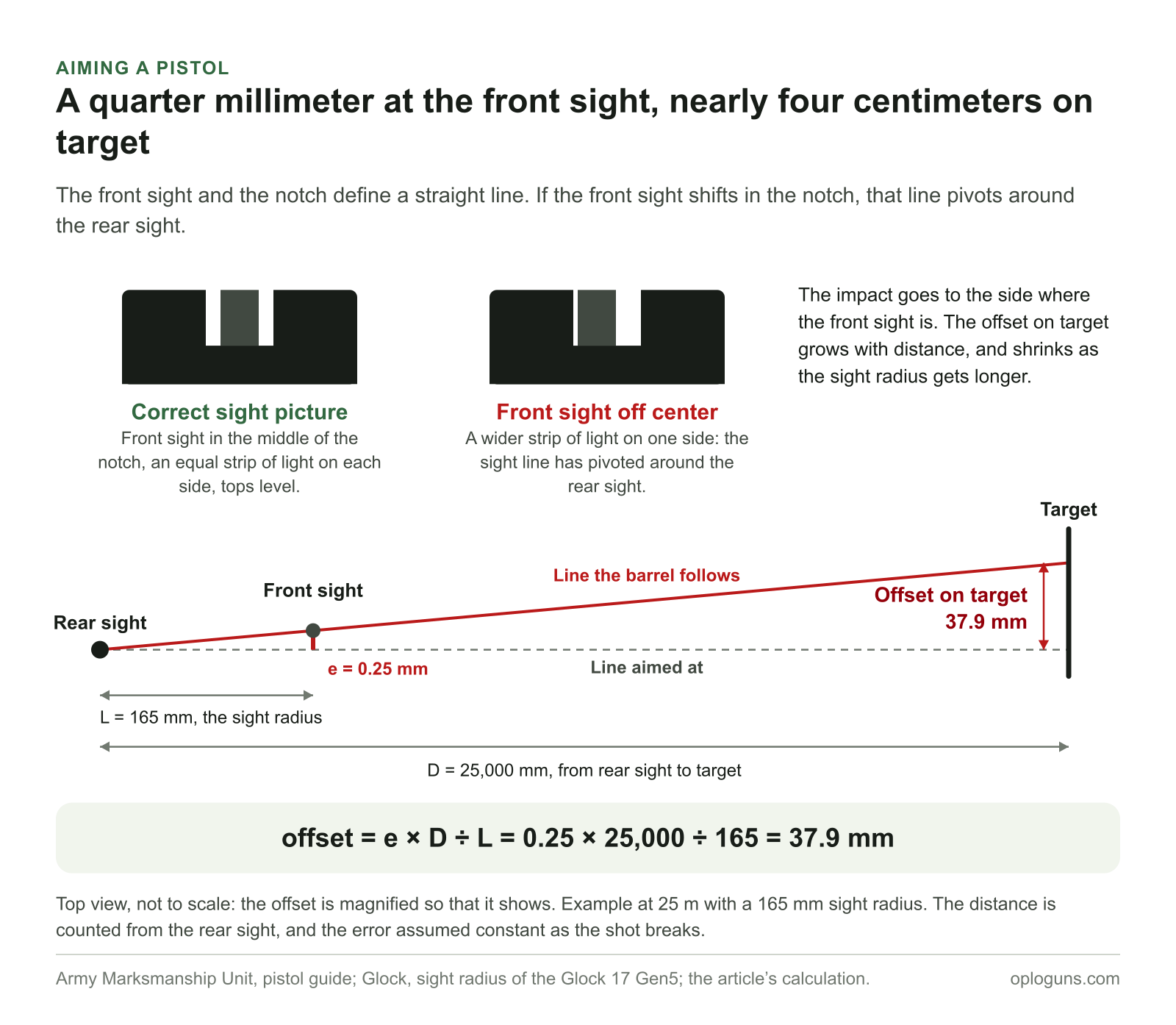
The front sight and the notch define a straight line, the one the barrel follows. If the front sight shifts in the notch, the line pivots around the rear sight. The impact goes to the side where the front sight is2. Geometry gives the offset:
| Quantity | Notation | Example |
|---|---|---|
| Alignment error, at the front sight | e | 0.25 mm |
| Sight radius, from front sight to rear sight | L | 165 mm |
| Distance from the rear sight to the target | D | 25,000 mm |
| Offset on target | e × D ÷ L | 37.9 mm |
Two assumptions are made, and they are stated. The distance is counted from the rear sight and taken as equal to the shooting distance: at arm's length, the rear sight is a little closer to the target, which reduces the offset by a few percent. And the error is assumed constant at the moment the shot breaks.
The formula can be checked without tools: 0.25 × 25,000 ÷ 165 = 37.9. A quarter millimeter, a quarter of one graduation on a steel rule, becomes nearly four centimeters on the target card.
Sighting table: the offset on target at 10 and 25 m
Three sight radii were used, each taken from a source: 340 mm, the shortest setting of a Pardini K12 match air pistol, adjustable from 340 to 385 mm5; 220 mm, the maximum the ISSF allows for 25 m pistol1; 165 mm, the sight radius of the Glock 17 Gen5 with polymer sights4.
| Alignment error | 10 m, 340 mm radius | 10 m, 165 mm radius | 25 m, 220 mm radius | 25 m, 165 mm radius |
|---|---|---|---|---|
| 0.1 mm | 2.9 mm | 6.1 mm | 11.4 mm | 15.2 mm |
| 0.25 mm | 7.4 mm | 15.2 mm | 28.4 mm | 37.9 mm |
| 0.5 mm | 14.7 mm | 30.3 mm | 56.8 mm | 75.8 mm |
| 1 mm | 29.4 mm | 60.6 mm | 113.6 mm | 151.5 mm |
Offset on target by alignment error of the front sight in the notch
Offset = error × distance ÷ sight radius. Distance counted from the rear sight and taken as equal to the shooting distance; at arm's length, the rear sight is a little closer to the target, which reduces the offset by a few percent. A calculation, not a measurement
Sight radii used: 340 mm, the shortest setting of a Pardini K12 match air pistol (340 to 385 mm)5; 220 mm, the maximum the ISSF allows for 25 m pistol1; 165 mm, Glock 17 Gen5 with polymer sights4. The relationship is linear: doubling the error doubles the offset.
View the data
| Alignment error | 10 m, 340 mm radius | 25 m, 220 mm radius | 25 m, 165 mm radius |
|---|---|---|---|
| 0.1 mm | 2.9 mm | 11.4 mm | 15.2 mm |
| 0.25 mm | 7.4 mm | 28.4 mm | 37.9 mm |
| 0.5 mm | 14.7 mm | 56.8 mm | 75.8 mm |
| 1 mm | 29.4 mm | 113.6 mm | 151.5 mm |
Read across, the table shows the same error, from one column to the next, weighs from 2.9 to 15.2 mm for a tenth of a millimeter. Read down, it shows that the relationship is linear: doubling the error doubles the offset. For another gun, you only need to measure its sight radius with a steel rule, from the top of the front sight to the notch, and redo the division.
In points: a quarter millimeter costs one to two rings
Millimeters say nothing until you lay them on a target. The ISSF rulebook sets the width of the rings: 8 mm for 10 m pistol, 25 mm on the precision target for 25 and 50 m pistol, 40 mm on the rapid-fire one1. Each width crossed is worth one point.
| Alignment error | 10 m, 340 mm radius | 25 m precision, 220 mm radius | 25 m precision, 165 mm radius |
|---|---|---|---|
| 0.1 mm | 0.4 ring | 0.5 ring | 0.6 ring |
| 0.25 mm | 0.9 ring | 1.1 rings | 1.5 rings |
| 0.5 mm | 1.8 rings | 2.3 rings | 3 rings |
| 1 mm | 3.7 rings | 4.5 rings | 6.1 rings |
The reverse calculation gives the margin. For a perfectly held shot to stay within half a ring, alignment must be right to within 0.14 mm with the 340 mm air pistol, to within 0.11 mm at 25 m with 220 mm, and to within 0.08 mm with 165 mm. The dimensions of the targets themselves are detailed in the article on official target dimensions.
Long sight radius: the same error weighs less
The sight radius divides the error. At 10 m, a tenth of a millimeter becomes 2.9 mm with a 340 mm sight radius, and 6.1 mm with 165 mm: twice as much, for a gun half as long. It is arithmetic.
The rulebooks cap this length. For 25 m pistol, the ISSF limits the sight radius to 220 mm and the barrel to 153 mm. For air pistol, only the measuring box counts: 420 × 200 × 50 mm1. A match air pistol like the Pardini K12 thus reaches 340 to 385 mm5, against 165 mm for a service pistol like the Glock 174. Choosing a precision gun in .22 LR is covered in the precision .22 LR pistol guide.
Parallel error: the pistol's movement weighs less
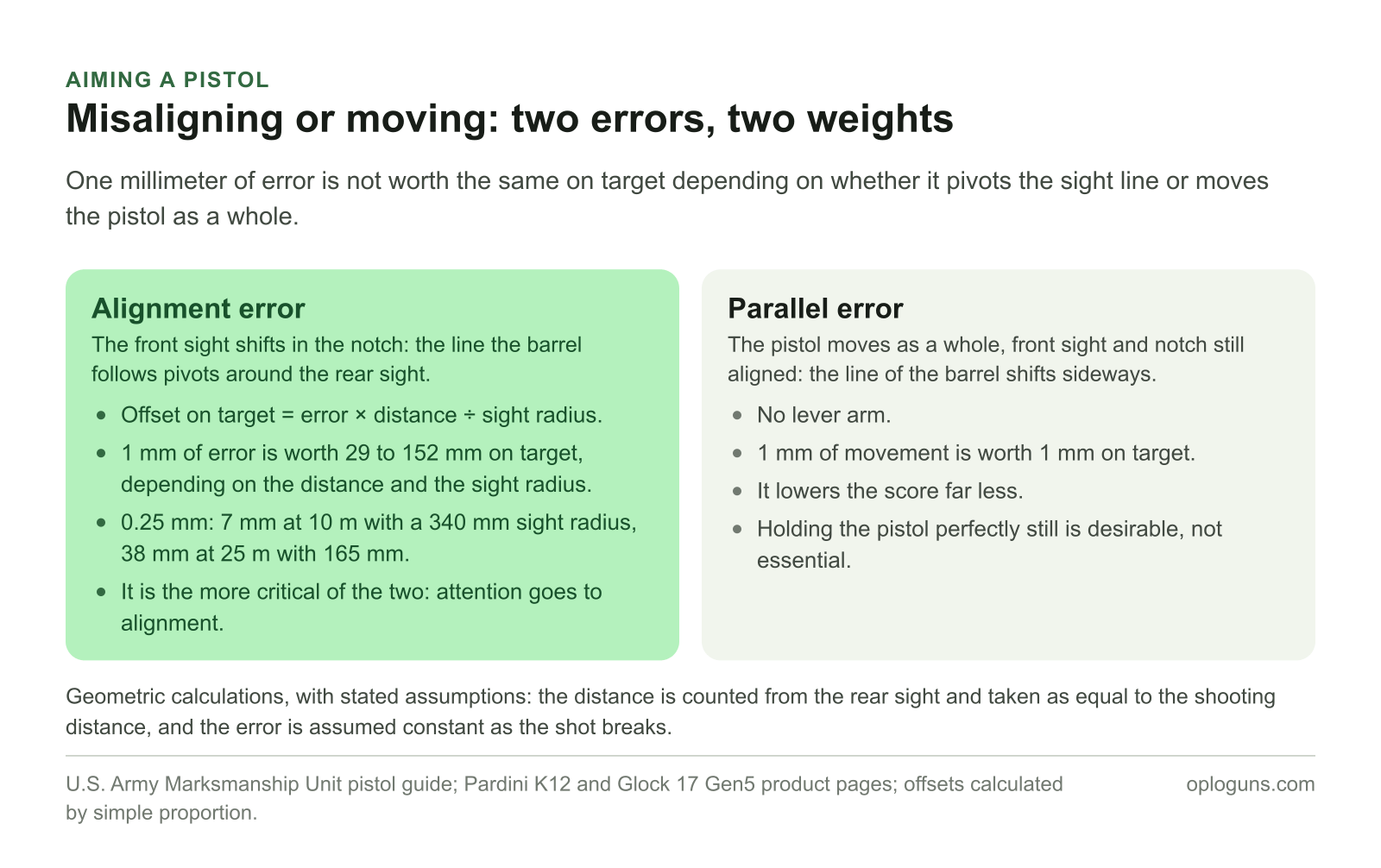
A pistol that moves as a whole, by one millimeter, sights still aligned, moves the impact by one millimeter. There is no lever arm: the line of the barrel shifts sideways instead of pivoting. The Army Marksmanship Unit guide calls this fault the parallel shift error, and sets it against the angular shift error of alignment2.
Its conclusion is clear: the parallel error lowers the score far less, and alignment is the more critical of the two; holding the pistol perfectly still is desirable, not essential2. The table above gives the reason: one millimeter of angular error is worth 29 to 152 mm on target, one millimeter of parallel error is worth one.
Two practical consequences follow:
- Visible movement is deceptive. The blurred target seems swept by the front sight. As long as alignment holds, the impact stays in the aiming area2.
- Attention goes to alignment. The shooter who thinks about their movement lets alignment slip, the guide notes. That is where the shot is lost2.
What you do with the remaining movement is trained separately. What studies measure about breathing and tremor is in the article devoted to them; dry fire is the testing ground, see the five dry-fire drills.
6 o'clock or center hold: where to place the front sight
With alignment settled, it still has to be placed somewhere. Two practices coexist.
- 6 o'clock hold: the black aiming mark rests on top of the front sight, like a ball on a post. The Ruger Mark IV manual describes this picture: top of the front sight level with the rear sight, front sight centered in the notch, aiming mark centered on top of the front sight3.
- Center hold: the front sight sits in the black, at the point you want to hit. The Army Marksmanship Unit guide speaks of an aiming area and of holding in the center of that area2.
The black aiming mark measures 59.5 mm for 10 m pistol and 200 mm on the 25 m precision target1. In both cases, the rear sight is adjusted to bring the impacts to the center with the hold chosen. Changing hold during a session amounts to throwing off the zero.
Adjusting the rear sight: the way the impact must go
Moving the rear sight to the right forces you, in order to realign, to push the muzzle to the right: the impact follows the rear sight. The front sight, at the other end of the sight radius, is corrected the opposite way. On a screw-adjustable rear sight, the manual gives the direction of rotation; at Ruger, the windage screw turned clockwise sends the impact to the right, and the elevation screw turned clockwise lowers it3.
The same proportion gives the size of the movement. A rear sight moved by 0.1 mm, on a 165 mm sight radius, moves the impact by 15.2 mm at 25 m. A fixed dovetail rear sight, drifted with a mallet, is therefore adjusted in almost invisible taps.
The method itself fits in three steps:
- Shoot a group of five to ten shots, with your usual hold, without correcting between shots.
- Measure with a steel rule the gap between the center of the group and the center aimed at, in width and in height.
- Convert to rear sight movement: gap × sight radius ÷ distance. At 25 m, with 165 mm, a group 38 mm to the left calls for 0.25 mm to the right.
Three misconceptions about aiming a pistol
- "You have to see the target sharp." The eye cannot focus on the front sight and the target at once; the Army Marksmanship Unit guide makes a sharp front sight the condition of controlled alignment2.
- "What makes you miss is tremor." The same guide ranks the parallel error, that of the pistol moving, far behind the alignment error2; geometry confirms it, one millimeter against 29 to 152 mm.
- "A tenth of a millimeter does not count." At 25 m, with a 165 mm sight radius, it is worth 15 mm on target, more than half a ring.
Aiming a pistol: what to remember, by discipline
With an air pistol, at 10 m, the long sight radius forgives: a quarter millimeter costs less than a ring. The margin remains thin, 0.14 mm to stay within half a ring.
With a 25 m match pistol, the sight radius tops out at 220 mm: the same error spreads nearly four times more than at 10 m in millimeters. The wider rings make up most of it, 1.1 rings against 0.9 for a quarter millimeter. Alignment comes before stillness.
With a service handgun, at 25 m, 165 mm of sight radius turns a tenth of a millimeter into 15 mm. The rear sight is adjusted in taps of a few hundredths to a few tenths of a millimeter, after a measured group.
The rules in force prevail. The dimensions cited are those of the ISSF rulebook, 2025 edition, third print in force since 19 October 2026. The offsets on target are geometric calculations, with stated assumptions; the gun's manual prevails for its adjustment.
Sources 5 references
The dimensions of targets and competition guns come from the ISSF rulebook in force, the sight radii from the manufacturers' pages. The offsets on target are recalculated by the proportion written in the article, from those values. The aiming technique comes from the guide of the U.S. Army Marksmanship Unit, cross-checked against a manufacturer's manual.
- ISSF — ISSF Rule Book 2026, Edition 2025 (Third Print 10/2026), in force since 19 October 2026 (PDF), consulted 1 November 2026: rule 6.3.4.6, 10 m pistol target (10 ring of 11.5 mm, 9 of 27.5 mm, black of rings 7 to 10 of 59.5 mm); rule 6.3.4.5, 25 and 50 m precision target (10 ring of 50 mm, 9 of 100 mm, black of 200 mm); 25 m rapid-fire target (10 ring of 100 mm, 9 of 180 mm); rule 8.12, pistol table (air pistol: box of 420 × 200 × 50 mm; 25 m pistols: barrel of 153 mm and sight radius of 220 mm at most).
- U.S. Army Marksmanship Unit — "Pistol Marksmanship Training Guide" (PDF, U.S. government publication, public domain), consulted 1 November 2026: chapter II, alignment (front sight in the middle of the notch, equal light on each side, tops level); angular error, the impact goes to the side where the front sight is; parallel error, "will not lower the score to the extent of angular shift error", alignment "is the most critical of the two"; focus on the front sight; movement of the arm that appears magnified when the eye focuses on the target; aiming area and holding in the center.
- Sturm, Ruger & Co. — Mark IV pistol manual (PDF), consulted 1 November 2026, p. 30: "Sight adjustment" (elevation screw clockwise, impact lower; windage screw clockwise, impact to the right; fixed rear sight drifted sideways in its dovetail with a wooden or plastic mallet) and "Suggested sight picture" (top of the front sight level with the rear sight, front sight centered in the notch, aiming mark centered on top of the front sight).
- Glock — G17 Gen5 product page (cutaway version), consulted 1 November 2026: "Sight Radius POLYMER 165 mm", steel 164 mm, GNS sights 163 mm; 114 mm barrel.
- Pardini — K12 air pistol product page, consulted 1 November 2026: sight radius "da 340 a 385", 240 mm barrel, length of 415 mm. ⚠️ Commercial source; unit not written on the page, deduced from the millimeters of the other dimensions.
Frequently asked questions
How do you aim a pistol properly?
The front sight sits in the middle of the rear sight notch, with an equal strip of light on each side, its top level with the top of the notch. The eye focuses on the front sight, and the target stays blurred. Alignment counts more than stillness: a front sight off by a quarter millimeter moves the impact 7 to 38 mm depending on the gun and the distance.
Should the target or the front sight be sharp?
The front sight. The eye cannot focus on a near object and a far object at the same time; the pistol guide of the U.S. Army Marksmanship Unit makes a sharp front sight the condition of controlled alignment. The rear sight stays almost sharp, the target blurred.
Which way do you adjust a pistol's rear sight?
The way the impact must go: moving the rear sight to the right forces you to push the muzzle to the right to realign, and the impact follows. The front sight is corrected the opposite way. On a screw-adjustable rear sight, the gun's manual gives the direction of rotation: at Ruger, windage screw clockwise, impact to the right.
6 o'clock hold or center hold: which should you choose?
Both are used. At 6 o'clock, the black aiming mark rests on top of the front sight, which the Ruger Mark IV manual suggests, for example; with a center hold, the front sight sits in the black. The rear sight is adjusted for the hold chosen, and the hold does not change afterward.
Spotted an error, or a rule that has changed since we checked? Report an error