Shooting a revolver: single and double action, the grip
Published on · 10 min read · Anthony Baillon
Revolver shooting starts with a rule: outside firing, cylinder open and barrel in a safe direction. Then two ways of shooting. In double action, a single press cocks and releases the hammer; in single action, the thumb cocks the hammer and the trigger breaks lighter. No finger ahead of the cylinder, in either case.
At a glance
| Double action | Single action | |
|---|---|---|
| Cocking | The trigger cocks and releases the hammer | The thumb cocks the hammer, then the trigger |
| Measured trigger pull | 4,990 to 6,169 g | 1,533 to 2,523 g |
| Next shot | Let the trigger return | Recock the hammer |
Press measurements on three .357 Magnum revolvers.
- At the firing point, outside firing: gun unloaded, cylinder swung out, barrel in a safe direction.
- No finger ahead of the cylinder: gas and particles come out of it at every shot.
Revolver at the range: cylinder open, safe direction
You shoot a revolver at a range, under its rules. The framework and the places are in recreational shooting: license and where to shoot.
The 2025-2026 rulebook for TAR (tir aux armes réglementaires, the French federation's service-arms discipline) sums up the rule of the firing point. The gun is always pointed in a safe direction3. Outside firing periods, it is unloaded, cylinder swung out, safety flag inserted in the chamber3. The cylinder is closed only once the barrel is pointed toward the target or the backstop3. The gun is loaded only at the firing point, at the command « CHARGEZ » [LOAD]3.
The Smith & Wesson revolver manual says the same thing in its own terms. Cylinder and action open, chambers empty, gun pointed in a safe direction1. Hearing and eye protection for every shot, for the shooter and those nearby1. And the range officer's instructions, always1.
A loaded revolver with the hammer down is not a gun at rest. The same manual says so in a warning: the revolver fires if the trigger is pulled1.
Revolver grip: no finger ahead of the cylinder
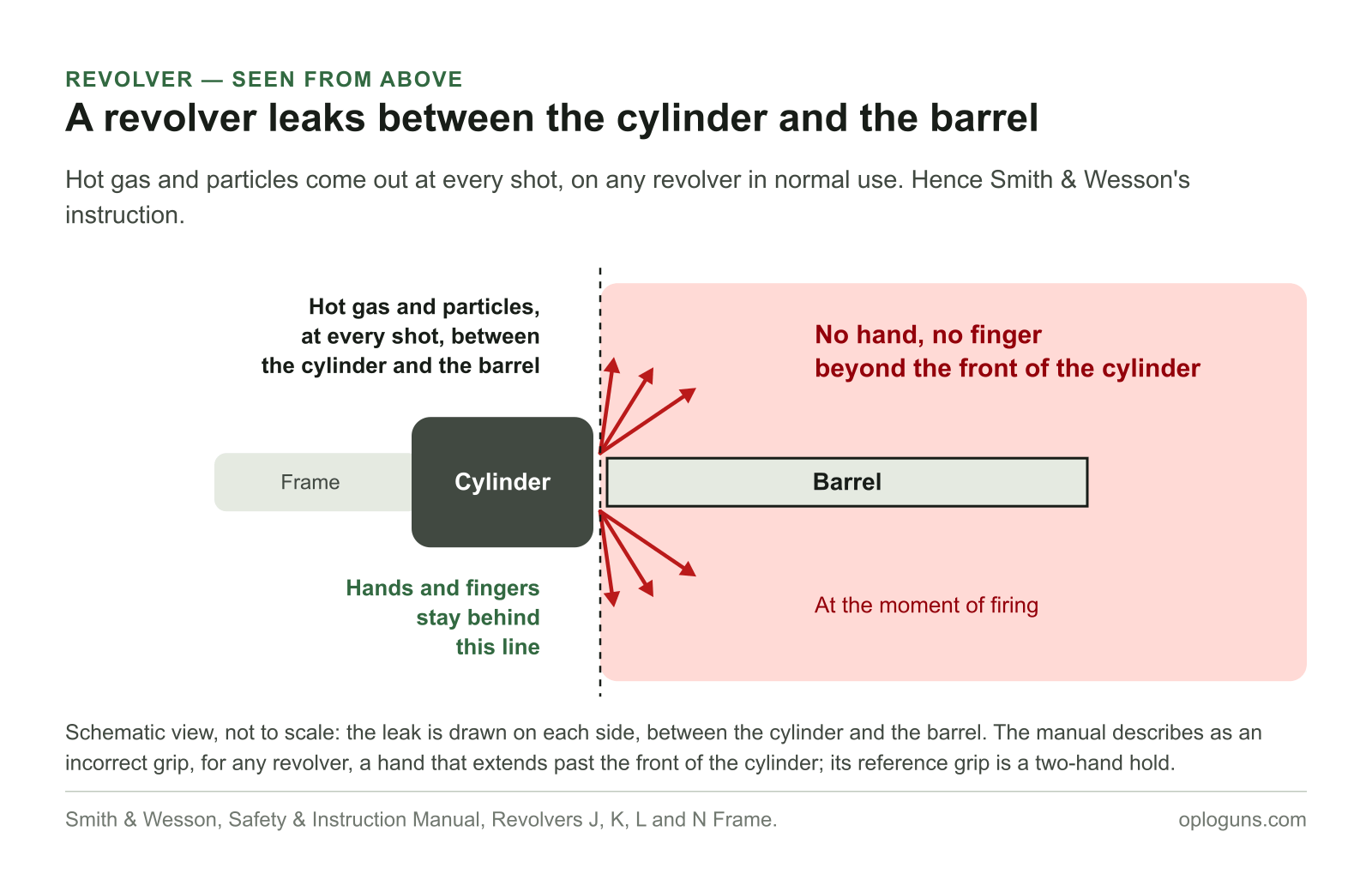
A revolver leaks. Between the cylinder and the barrel, hot gas and particles come out at every shot, on any revolver in normal use1. Hence Smith & Wesson's instruction: never a hand or a finger beyond the front of the cylinder when firing1.
The reference grip in its manual is a two-hand hold, and it is designed to keep hands and fingers away from that gap1. The manual describes as an incorrect grip, for any revolver, a hand that extends past the front of the cylinder1.
The rules of your event decide the number of hands:
- ISSF 25 m: the gun is held and fired with one hand only, the wrist free of any support4.
- TAR, event 830: one hand in precision, one or two hands in rapid fire3.
- Metallic silhouette: the "Revolver" event is shot in a free position5.
At the start of rapid-fire series, ISSF and TAR impose the "READY" position: arm lowered to 45° at most from the vertical43. The stance itself is detailed in the pistol shooting stance, and sight alignment in aiming a pistol.
Double action: press all the way, let it return
In double action, the shooter presses the trigger all the way and holds it: the hammer travels fully back, then falls1. For the next shot, the trigger must return fully forward. Otherwise, the mechanism does not finish its cycle and the shot does not fire1. The thumb does not touch the hammer during its travel1.
That press takes strength. Three press tests measured 4,990 to 6,169 g in double action on a Smith & Wesson 686 Plus, a Ruger GP100 and a Colt Python789. Roughly the weight of four 1.5-liter water bottles under the index finger. The model-by-model detail is in 686, GP100 or Python.
While waiting for the shot, you may be tempted to hold the trigger halfway. Smith & Wesson expressly advises against it. This "staging" breaks the rule of the finger outside the trigger guard until the decision to fire is made, reduces control of the gun and can cause an unintentional discharge, including when releasing the trigger1.
In 25 m centerfire pistol, the rapid-fire stage leaves 3 seconds per shot, and 7 seconds between two4. The arm comes back down to the "READY" position before each shot4.
Single action: cock the hammer with the thumb, then press
In single action, the hammer is cocked first. On a double-action revolver, the Smith & Wesson manual places the non-shooting hand on the hammer spur and pulls it fully back1. The trigger moves back at the same time. It then breaks with markedly less force and travel than in double action1: from 1,533 to 2,523 g on the same three revolvers tested789.
The single-action-only revolver, like Uberti's 1873 Cattleman, fires only with the hammer at full cock, at every shot2. Its hammer has three positions: at rest, loading and firing2. Uberti forbids pressing the trigger in any position other than the firing one: the mechanism is strained and the gun becomes unsafe2.
Two instructions hold for both families:
- Cock the hammer only when about to fire: Smith & Wesson asks you to go to single action only when ready to fire1.
- Let the trigger return after each shot, before recocking1.
The rulebooks' minimum trigger pulls stay below these values: 1,360 g in TAR, 1,000 g in ISSF 25 m34.
Decocking a revolver: the hammer held by the thumbs
A cocked hammer and a shot you no longer want to fire: the maneuver is done with the barrel in a safe direction. Smith & Wesson describes it step by step1:
- Slide the thumb of the free hand between the hammer and the frame.
- Place the thumb of the shooting hand on the hammer spur.
- Press the trigger just enough to release the hammer, then release the trigger at once and take the finger out of the trigger guard.
- Ease the hammer down to its rest position, withdrawing the thumb of the free hand.
The manufacturer asks you to practice this with the gun unloaded until you master the movement1. With the gun empty, the trigger then releases the hammer without a cartridge. The Smith & Wesson manual does not mention dry firing; the Uberti manual forbids it on its .22 revolvers, "NEVER DRY FIRE your revolver", as it ruins the cylinder2; Pietta's forbids it on its black powder revolvers, whose nipple it damages10. Your gun's manual says whether the exercise is permitted. If the hammer stops between two positions, it is brought back with the thumb to full cock, finger outside the trigger guard, and the maneuver starts again1.
On a single-action-only revolver, Uberti's procedure differs: hammer held with the thumb, trigger pressed, hammer lowered slowly past the loading notch, then trigger released and finger taken out of the trigger guard2. The cartridge left under the hammer is still live. It rotates back to the firing position at the next cocking2.
Cylinder rotation: the mechanism drives it
You do not turn the cylinder to shoot. The IMSSU rulebook in fact requires it in competition: the cylinder rotates through the cocking of the hammer in single action, or the press on the trigger in double action, with no other intervention5. It adds that a double-action revolver must be able to fire in double action5.
On a single-action-only revolver, rotation by hand serves only for loading. Hammer at the loading notch, the cylinder turns freely toward the loading gate, and presents the chambers one by one2.
Reloading a revolver: cylinder out, cases counted
On a swing-out cylinder revolver, the Smith & Wesson manual gives the order of the steps1:
- Barrel in a safe direction, finger outside the trigger guard.
- Push the thumbpiece forward and swing the cylinder out to the left.
- Barrel pointing up, press the ejector rod to expel cases and cartridges.
- Count the cases, and check by eye that each chamber is empty.
- Place a cartridge of the correct caliber in each chamber, then close the cylinder until it locks.
On a single-action-only revolver, everything goes through the loading gate: hammer at the loading notch, one cartridge per chamber, gate closed; when unloading, each case comes out by the ejector rod under the barrel2. In .22, Uberti asks you to seat each cartridge fully, so that its rim catches neither on the frame nor on the gate2.
The number of cartridges is set by your event. In ISSF 25 m, five at most at the command "LOAD", and nothing else in the cylinder4. In TAR, five shots per series3. In silhouette, five rounds loaded outside Unlimited5. For 2026-2027, the national program of event 830 moves to 10 shots in precision and 20 on gongs6.
A round that does not fire in a revolver: ten seconds
If a cartridge does not fire, Smith & Wesson asks you to wait ten seconds, the barrel still in a safe direction and the finger outside the trigger guard1. Then cylinder swung out, faulty cartridge removed and set aside to be destroyed by a suitable method1.
If the operation changes, by feel or by sound, the manual asks you to stop shooting, unload, and have the gun checked by a gunsmith1. In an ISSF match, the official who examines a revolver presses the trigger only if the hammer is cocked4. In TAR, no malfunction is recognized: the shooter remedies it and finishes within the allotted time3. The causes of malfunctions on the pistol side are in pistol malfunctions.
Single or double action, depending on your event
What each mode brings, and what it demands
In 25 m centerfire pistol, the rapid-fire stage leaves 3 seconds per shot, arm lowered between two. Single action lightens the break in precision, at the price of one more movement at every shot.
In TAR, rapid-fire series are shot with one or two hands, on gongs. The 1,360 g minimum stays below the single-action weights measured.
In silhouette, the rulebook requires that a double-action revolver be able to fire in double action, and that the cylinder rotate without help from the shooter.
For recreation, single action gives the lightest break. In return, every shot goes through the thumb, and a cocked hammer calls for a precise maneuver if it is not fired.
The choice between revolver and pistol is covered in pistol or revolver, and that of a first small-caliber revolver in .22 LR revolver: which one to choose. The mechanics of double action, on the pistol side, are in single action, double action, striker-fired.
Three misconceptions about revolver shooting
- "Hammer down, a loaded revolver cannot go off." The Smith & Wesson manual says so: it fires if the trigger is pulled1.
- "Holding the trigger halfway helps in double action." The manufacturer sees it as a cause of unintentional discharge1.
- "A revolver is held like a pistol." No finger goes ahead of the cylinder1.
The rules in force prevail. TAR rulebook for the 2025-2026 season, ISSF 2025 rules in force on 1 July 2026, IMSSU 2025 rulebook, 2026-2027 sporting management rules; Smith & Wesson (2019) and Uberti manuals. Your revolver's manual and the range officer's instructions take precedence over any general description.
Sources 10 references
The handling steps come from the manufacturers' manuals, Smith & Wesson for double-action revolvers, Uberti for single action only; the range and event rules, from the rulebooks in force; the trigger pull weights, from published press tests.
- Smith & Wesson — Safety & Instruction Manual, Revolvers J, K, L and N Frame (PDF, © 2019, copy of the official manual), read 15 November 2026: p. 18, "ALWAYS BE SURE THAT THE CYLINDER AND ACTIONS OF FIREARMS ARE OPEN", hearing and eye protection, instructions of the "RANGE OFFICER"; p. 19, loading, "Press the thumbpiece forward to unlock the cylinder", "Push the cylinder to the left", "the revolver will fire if the trigger is pulled!"; pp. 20-21, "Particles and hot gas will be forced out from between the barrel and cylinder in any revolver during normal use", grip "for a two-hand hold", "Never allow hands or fingers to extend beyond the front of the cylinder when firing", heavy recoil of some calibers, warning against "staging"; p. 22, double action, "you must allow the trigger to move forward fully before you can fire another shot", single action, "place your non-shooting hand on the hammer spur", "Only place the revolver in the single action mode when you are fully prepared To fire"; pp. 23-24, decocking and "Incomplete Decocking"; p. 24, "wait ten seconds" on a misfire; pp. 24-25, unloading, ejector rod, "Carefully count the cartridges or spent casings"; ammunition table, "357 Magnum — 38 S&W Special and 38 S&W Special +P".
- A. Uberti — Instruction Manual, Single Action Revolver and Revolving Carbine (PDF), published on the Uberti USA manuals page, read 15 November 2026: three hammer positions, "at rest", "half cock", "full cock"; "Never attempt to fire your revolver in any position except the full cock position", "will strain the mechanism and make it unsafe"; loading and unloading through the loading gate, loading notch, ejector rod; decocking procedure; "CAUTION … This round is still live and will rotate back towards the firing position with each cocking"; "SPECIAL WARNING FOR CAL. 22", cartridges seated fully, "NEVER DRY FIRE your revolver. If you do this you will ruin your cylinder".
- Fédération française de tir — Règlement TAR, saison 2025-2026 [TAR rulebook, 2025-2026 season] (PDF, in French, released 12 January 2026), read 15 November 2026: 5.1, gun pointed « dans une direction sûre » [in a safe direction], unloaded « barillet basculé » [cylinder swung out], « drapeau de sécurité introduit dans la chambre » [safety flag inserted in the chamber], action closed with the barrel toward « la cible ou la butte de tir » [the target or the backstop]; 5.4, loading at the firing point after « CHARGEZ » [LOAD]; 5.6, « Il n'y a pas d'incident de tir admis ou non admis » [there is no allowable or non-allowable malfunction]; event 830, « 1 main (Précision) » [1 hand (precision)], « 1 ou 2 mains (Vitesse) » [1 or 2 hands (rapid fire)], 5 shots per series, trigger pull of at least 1.360 kg, « Les armes chambrées en 357 Magnum sont autorisées si elles utilisent la munition de 38 Spécial » [guns chambered in 357 Magnum are allowed if they use 38 Special ammunition]; VI.3.2, « PRÊT » [READY] position, arm at 45° at most from the vertical.
- Fédération française de tir — Règles Pistolet ISSF, édition 2025, 2e impression en vigueur au 1er juillet 2026 [ISSF Pistol Rules, 2025 edition, 2nd print in force on 1 July 2026] (PDF, in French, updated 04/07/2026), read 15 November 2026: 8.7.1, « Le pistolet doit être tenu et déclenché d'une seule main. Le poignet doit être visiblement libre de tout support » [the pistol must be held and fired with one hand only; the wrist must be visibly free of any support]; 8.7.2, « PRÊT » [READY] position, arm « pas … levé à plus de 45° de la verticale » [not raised more than 45° from the vertical]; 8.7.6.2 c, « 5 cartouches au maximum au commandement « CHARGEZ ». Rien d'autre ne doit être placé dans le chargeur ou le barillet » [5 cartridges at most at the command LOAD; nothing else may be placed in the magazine or the cylinder]; 8.7.6.4 j, « PRÊT » [READY] position before each shot in the rapid-fire stage; 8.9.4.3.1, « Si l'arme est un revolver l'arbitre ne doit pas presser la détente sauf si le chien est armé » [if the gun is a revolver the official must not press the trigger unless the hammer is cocked]; 8.4.4, in 25 m centerfire pistol, ammunition « de type « magnum » » [of the magnum type] forbidden; table 8.11, rapid-fire stage "3s/7s"; table 8.12, trigger pull of at least 1,000 g in 25 m centerfire pistol.
- IMSSU, FFTir translation — Règlement sportif officiel IMSSU 2025 [official IMSSU sporting rules 2025] (PDF, in French, updated March 2025), read 15 November 2026: « Un revolver double action DOIT pouvoir tirer en double action » [a double-action revolver MUST be able to fire in double action]; « Le barillet d'un revolver DOIT tourner sans intervention du tireur autre que l'armement du chien (simple action) ou la pression sur la détente (double action) » [a revolver's cylinder MUST rotate without any intervention by the shooter other than cocking the hammer (single action) or pressing the trigger (double action)]; gun « chargée à cinq coups » [loaded with five rounds] outside Unlimited; "Revolver" event, position « Libre » [free].
- Fédération française de tir — Règlement de gestion sportive 2026-2027, vie nationale [sporting management rules 2026-2027, national level] (PDF, in French, version of 29/09/2026), read 15 November 2026: « 830 – Pistolet/Revolver », « programme de tir modifié avec 10 coups en précision et 20 coups sur gongs pour les épreuves 830 et 832 » [shooting program changed to 10 shots in precision and 20 shots on gongs for events 830 and 832].
- Shooting Times, Brad Miller — "Smith & Wesson Model 686 Plus Revolver", 15 May 2024, read 9 November 2026: 7-inch 686 Plus, trigger 3.38 lb (1,533 g) in single action, 12.5 lb (5,670 g) in double action. ⚠️ Specialist press: one gun, one tester.
- Gun Tests, Todd Woodard — "Ruger GP100 No. 1707 357 Magnum", 18 May 2022, read 9 November 2026: "Single Action 4.0 lbs" (1,814 g), "Double Action 13.6 lbs" (6,169 g). ⚠️ Specialist press: one gun, one tester.
- Shooting Times — "Colt's New Blued Model Python .357 Magnum Revolver: Review", 6 November 2024, read 9 November 2026: single action "5 pounds, 9 ounces" (2,523 g), double action 11 lb (4,990 g), RCBS trigger gauges. ⚠️ Specialist press: one gun, one tester.
- F.lli Pietta — manuel d'instructions des revolvers et carabines à poudre noire [instruction manual for black powder revolvers and rifles] (Italian-French PDF of November 2011), read 15 November 2026, p. 41, instruction 22: « Ne tirez pas à vide, vous abîmeriez la cheminée. » [do not dry fire, you would damage the nipple].
Frequently asked questions
How do you hold a revolver properly?
With no finger or part of the hand ahead of the front of the cylinder. The Smith & Wesson manual says so for any revolver: hot gas and particles come out between the cylinder and the barrel at every shot. Its reference grip is a two-hand hold, designed to keep the fingers away from that gap. In ISSF 25 m, the pistol or revolver is held and fired with one hand only; in TAR, the French service-arms discipline, one hand in precision, one or two in rapid fire.
What is the difference between shooting single and double action?
In double action, one full press of the trigger cocks the hammer then releases it: a long, heavy pull, from 4,990 to 6,169 g on the .357s tested by the press. In single action, the hammer is first cocked with the thumb, and the trigger breaks with markedly less force and travel, from 1,533 to 2,523 g in the same tests.
How do you shoot a .357 Magnum revolver?
Smith & Wesson warns that some calibers of its revolvers produce heavy recoil, especially in a light gun, and asks for a firm grip. A revolver marked .357 Magnum also fires .38 Special according to the same manual. In TAR, a .357 revolver is allowed only with .38 Special ammunition, and ISSF 25 m forbids magnum-type ammunition.
What should you do if a revolver fails to fire?
Smith & Wesson asks you to wait ten seconds, the barrel still pointed in a safe direction and the finger outside the trigger guard, then to open the cylinder and remove the faulty cartridge. In competition, the rules of the event apply: in TAR, no malfunction is recognized, and the shooter finishes within the allotted time.
Can you hold the trigger halfway in double action?
Smith & Wesson expressly advises against it: holding tension on the trigger while waiting for the shot, 'staging', goes against the rule of the finger outside the trigger guard until the decision to fire is made, and can cause an unintentional discharge, including when releasing the trigger.
Spotted an error, or a rule that has changed since we checked? Report an error