Pistol shooting stance: one hand in ISSF, two hands in IPSC and TAR
Published on · 9 min read · Anthony Baillon
The pistol shooting stance depends first on the rulebook. In ISSF, the pistol is held in one hand, standing, unsupported. In IPSC, the stance is free; in TAR, the French federation's service-firearm discipline, precision is shot one-handed and rapid fire with one hand or two. Technique comes afterward.
At a glance
| Discipline | Hands | Required position |
|---|---|---|
| ISSF pistol, 10, 25, 50 m | One only, wrist free | Standing, unsupported |
| TAR 830 and 832 | One for precision, one or two for rapid fire | Standing |
| TAR 831 | One or two | Standing |
| IPSC | Free, unless strong or weak hand is required | Free, except short courses |
- What the rulebook does not say: stance width, body angle, where the free hand goes.
- What the studies measure: one-handed, feet close together reduce body sway.
Pistol shooting stance: what each rulebook requires
A series shot two-handed in 10 m pistol is a fault. Conversely, denying yourself the second hand on the steel gongs of TAR means giving up what the rulebook grants. The beginner's other skills, aiming and trigger release, are summed up in learning to shoot a pistol and a rifle.
| Discipline | What is required | Text |
|---|---|---|
| ISSF pistol | Standing, free of any support, both feet inside the firing point; gun held and fired with one hand; wrist visibly free | Rule 8.7.11 |
| ISSF pistol, 25 m rapid fire | Start with the arm lowered, at no more than 45° from the vertical | Rule 8.7.21 |
| TAR 830 and 832 | Standing; precision one-handed, « bras franc » [arm free, unsupported], rapid fire with one or two hands | TAR rulebook 2025-20262 |
| TAR 831 | Standing; one or two hands | TAR rulebook 2025-20262 |
| IPSC, known in France as TSV | Freestyle stages; strong or weak hand only when the stage requires it | Rules 1.1.5 and 1.1.5.33 |
Outside competition, no sporting rulebook sets the stance; the range's own rules set safety. That leaves what the rulebooks do not say, and that is where technique begins.
ISSF pistol: one hand, standing, wrist free
The text is short. The shooter stands, with no support at all, both feet entirely inside the firing point. The pistol is held and fired with one hand only, the wrist visibly free1.
Three neighboring rules spell out its scope:
- The grip stops at the hand. No part of the grip may touch beyond it; glue and resin are forbidden, chalk is allowed; bracelets and watches are banned on the arm holding the gun1.
- The shoes stay low. They do not cover the ankle bone, and the sole flexes across the whole forefoot1.
- In 25 m rapid fire, the arm starts from below. At no more than 45° from the vertical, without pointing at the ground in front of the firing point, and without moving before the target appears or the green light comes on1.
Breaking the third rule is costly. At the first fault, the jury gives a warning, the series is repeated and credited with the lowest-value hits; at the second in the same stage, two penalty points are added; at the third, the shooter is disqualified1. The events themselves are detailed in the article on getting started with 10-meter air pistol and in the one on 25-meter pistol.
One-handed stance: feet close together, angle measured
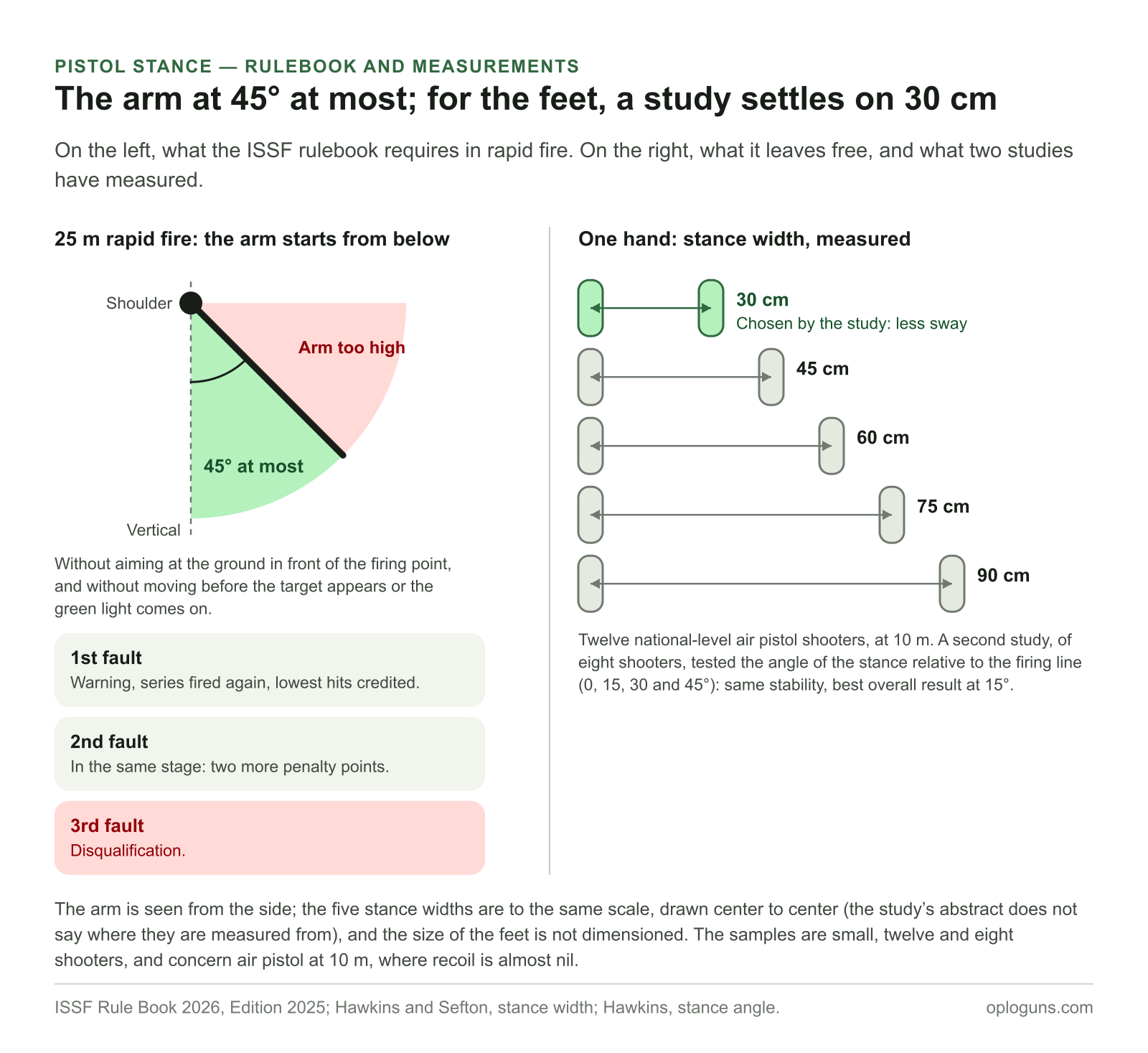
The rulebook says nothing about the feet. Two studies by Ryan Hawkins, on national-standard air pistol shooters, measured what it left free.
| What varies | Shooters | Values tested | Result |
|---|---|---|---|
| Stance width | 12 | 30, 45, 60, 75 and 90 cm | Sideways sway reduced as the feet come closer; 30 cm recommended4 |
| Stance angle relative to the line of fire | 8 | 0, 15, 30 and 45° | Body stability identical; best overall result at 15°5 |
Thirty centimeters, roughly the length of an A4 sheet, between the two feet. The first study contradicts the common advice of a wide base; its author invites shooters to reconsider it4. The second finds no difference in sway from one angle to another, but a gap in results5.
Two limits come with these figures. The samples are small, twelve and eight shooters. And they concern air pistol, at 10 m, where recoil is almost nil. The tradition of one-handed precision shooting, for its part, describes a torso turned 90° from the direction of fire, arm extended in line with the shoulder6.
The extended arm still has to bring the rear sight in front of the aiming eye: for a shooter whose dominant eye is not on the hand's side, the article on eye dominance describes the possible adjustments.
TAR: one hand for precision, two allowed in rapid fire
Tir aux armes réglementaires, or TAR, is the French federation's discipline for service firearms, and it is shot standing. The 2025-2026 rulebook, circulated by the federation on 12 January 2026, distinguishes precision from rapid fire2.
| Event at 25 m | Sighters | Precision | Rapid fire |
|---|---|---|---|
| 830, modern guns | 5 shots in 3 min, with one or two hands | 2 × 5 shots in 7 min, one-handed « bras franc » [arm unsupported] | 2 × 5 shots in 20 s, then 2 × 5 in 10 s, with one or two hands, on steel gongs |
| 832, original guns | Same program | Same program | Same program |
| 831, service rapid fire | 5 shots in 20 s, with one or two hands | — | 2 × 5 in 20 s, then 2 × 5 in 10 s, with one or two hands |
The grip is regulated too: adjustable or anatomical grips forbidden, factory grip panels only, no part of the gun may rest beyond the hand, and the wrist stays free in the normal firing position2. The TAR shooter therefore changes hold in the middle of the match: one hand on the precision target, two hands, if they wish, on the gongs.
IPSC: free stance, except strong hand or weak hand
Tir sportif de vitesse, TSV, is the French name for IPSC shooting, and it follows the IPSC rulebook7. Its basic rule fits in one word: freestyle. After the start signal, a stage may dictate neither position, nor location, nor stance3.
Three exceptions still bring constraints back:
- Obstacles. The designer may build barriers that force the shooter to fire kneeling, leaning or from behind a wall3.
- Short courses, classifiers and small matches. The first two may impose a position. Level I and II matches are not bound by strict freestyle3.
- Strong hand or weak hand only. The stage specifies it. Touching the gun with the other hand costs one procedural penalty each time, except to release a safety, reload or clear a malfunction3.
The strong hand is defined by the holster: the one that grips the gun when drawing it3. The rest of the discipline is described in the guide to IPSC in France.
Two-handed stance: Isosceles or Weaver
With two hands, two stances share the ranges. Two NRA publications describe them the same way.
| Isosceles | Weaver | |
|---|---|---|
| Feet | Shoulder-width apart, facing the target8 | Shoulder-width apart, strong-side foot back about one step8 |
| Torso | Facing the target6 | Slightly bladed, leaning forward68 |
| Arms | Both extended, in a triangle8 | Strong arm extended, weak arm bent, elbow down68 |
| What holds the gun | The two-handed grip, arms pushed out from the shoulders6 | The strong hand pushes, the weak hand pulls back6 |
The Isosceles takes its name from the triangle drawn by the two extended arms. The Weaver takes its name from Jack Weaver, an American sheriff's deputy who shot two-handed in the first practical shooting matches, where nothing dictated the stance6. Instructors do not all agree on the elbows: some lock them in Isosceles, others do not6.
Neither the TAR rulebook nor the IPSC rulebook chooses between the two: they allow either, as long as the second hand is permitted23.
Pistol stance: the rulebook versus technique
| Question | What the rulebook requires | What technique advises |
|---|---|---|
| One hand or two | One in ISSF; one in TAR precision; free in IPSC | — |
| Support | None in ISSF; wrist free in ISSF and in TAR | — |
| Stance width | Nothing, other than feet inside the firing point in ISSF | Close together one-handed: 30 cm with air pistol4 |
| Stance angle | Nothing | 15° gave the best result across eight shooters5; torso at 90° in the tradition6 |
| Two-handed stance | Nothing | Isosceles or Weaver, depending on the shooter68 |
| Shoes | Low, flexible sole at the front in ISSF | — |
The left-hand column is not negotiable: a referee enforces it. The right-hand one is checked at the range, on your own target: ten-shot series alternated from one stance to the other, the hits plotted on paper, the group measured with a ruler. A single series settles nothing. What the eye has to do once the stance is taken is worked out in the article on aiming a pistol. The principles of measurement apply here as they do to dry-fire drills.
Three misconceptions about the pistol stance
- "The wider the feet, the steadier you are." With air pistol, the opposite was measured: sideways sway decreased as the feet came together, from 90 to 30 cm4.
- "In competition, you always shoot one-handed." Only in ISSF events. IPSC leaves the choice, and TAR allows two hands in rapid fire23.
- "In IPSC, the Range Officer dictates the stance." The IPSC rulebook forbids it in principle; only obstacles, short courses and one-handed stages constrain the shooter3.
Pistol stance: what to take away for your discipline
In ISSF pistol, one hand, standing, unsupported, and low shoes: the only debate is about the feet. The measurements available argue for feet close together and a slight angle, on small samples of air pistol shooters.
In TAR, precision is shot one-handed, as in ISSF; rapid fire on gongs allows the second hand. The switch from one to the other is trained as a skill in its own right.
In IPSC, nothing dictates the stance, except the strong-hand or weak-hand stage; Isosceles and Weaver are tried against each other, on target.
The rulebook in force prevails. The rules cited are those of the ISSF rulebook, 2025 edition, third print in force since 19 October 2026, the TAR rulebook for the 2025-2026 season circulated on 12 January 2026, and the IPSC rules of January 2026. The referee decides in competition.
Sources 8 references
The rules come from the texts of the ISSF, the FFTir (the French shooting federation) and IPSC in force. The effects of stance width and stance angle come from two published studies. The two-handed stances are described by two NRA publications, which agree with each other.
- ISSF — ISSF Rule Book 2026, Edition 2025 (Third Print 10/2026), in force since 19 October 2026 (PDF), consulted on 1 November 2026: rule 8.7.1 ("The pistol must be held and fired with one (1) hand only. The wrist must be visibly free of support."); 8.7.2 (ready position, arm at no more than 45° from the vertical); 8.7.4 (warning, series repeated and credited with the lowest-value hits, two penalty points at the second fault, disqualification at the third); 8.4.1.1 (grip, wrist free, glue and resin forbidden, chalk allowed, bracelets and watches forbidden); 8.5.1 (low shoes below the ankle bone, flexible sole at the front).
- FFTir, CNS TAR — Règlement du tir aux armes réglementaires, saison 2025-2026 [TAR rulebook, 2025-2026 season] (PDF, in French, circulated 12 January 2026, approved by the executive committee on 6 December 2025), consulted on 1 November 2026: events 830 and 832, position « debout » [standing], hold « 1 main (Précision) » and « 1 ou 2 mains (Vitesse) » [1 hand for precision, 1 or 2 hands for rapid fire], 2 × 5 shots « à 1 main bras franc » [one-handed, arm unsupported] on the C 50 target in 7 min; event 831, one or two hands; adjustable or anatomical grips forbidden, wrist « visiblement libre de tout support » [visibly free of any support] in the normal firing position.
- IPSC — Handgun Competition Rules, January 2026 Edition (PDF, official link from the IPSC rules page), consulted on 1 November 2026: rule 1.1.5 ("IPSC matches are freestyle", no position, location or stance dictated after the start signal, with exceptions; obstacles allowed); 1.1.5.1 (Level I and II matches exempt from applying the rule strictly); 1.1.5.2 (short courses and classifiers); 1.1.5.3 (strong hand or weak hand only); 10.2.8 (one procedural penalty for each touch by the other hand); glossary, "Strong Hand".
- Hawkins R. N., Sefton J. M. — "Effects of stance width on performance and postural stability in national-standard pistol shooters", Journal of Sports Sciences, 2011, 29(13), pp. 1381-1387, abstract consulted on 1 November 2026: twelve air pistol shooters, ten shots at each of five stance widths of 30, 45, 60, 75 and 90 cm; lateral excursion and velocity of the center of pressure reduced as stance width decreases; 30 cm recommended.
- Hawkins R. N. — "Effects of stance angle on postural stability and performance with national-standard air pistol competitors", European Journal of Sport Science, 2013, 13(5), pp. 483-489, abstract consulted on 1 November 2026: eight shooters, 60 shots at each of the angles of 0, 15, 30 and 45° relative to the line of fire; no difference in postural stability, significant effect on two performance measures ("hit fine" and adjusted score), best overall result at 15°.
- NRA, American Rifleman — "Handgun Shooting Stances: History & Development", Wiley Clapp, published November 2005, posted online 5 June 2022: classic one-handed precision stance, torso "a full 90 degrees away from direction of fire"; Weaver (left foot slightly forward for a right-hander, right arm extended, left arm bent, forward push and rearward pull); Isosceles (facing the target, arms pushed out from the shoulders); two-handed stance of a sheriff's deputy, Jack Weaver, born in practical shooting matches with no restriction on position; instructors' disagreement over locking the elbows.
- FFTir — Règlement administratif du tir sportif de vitesse 2019-2020 [TSV administrative regulations] (PDF, in French), consulted on 1 November 2026: article I, discipline « régie au niveau international par l'IPSC » [governed internationally by IPSC]; article VII, « seul le règlement officiel de l'IPSC en anglais est valable sur les compétitions de Niveau III et plus » [only the official IPSC rulebook in English is valid at Level III competitions and above].
- NRA Family — "Pistol Shooting Positions: Part I", Larry Quandahl, 15 April 2017: Isosceles (feet shoulder-width apart facing the target, arms extended "forming an A frame"); Weaver (strong-side foot back about one step, slight forward lean, weak elbow down, weak hand pulling back).
Frequently asked questions
Can you shoot a pistol two-handed in competition?
Yes, depending on the discipline. In IPSC, the stance is free, except when a stage requires strong hand or weak hand only. In TAR, the French federation's service-firearm discipline, rapid fire is shot with one or two hands, precision with one hand. In the ISSF events at 10, 25 and 50 m, the pistol is held and fired with one hand only.
How far apart should the feet be for one-handed pistol shooting?
No rulebook sets it. A study of twelve national-standard air pistol shooters compared five stance widths, from 30 to 90 cm: the body's sideways sway decreased as the feet came closer together, and the author settled on 30 cm. The sample is small, and the result holds for air pistol.
What happens if you raise your arm too early in 25 m pistol?
In rapid fire, the series starts with the arm lowered, at no more than 45° from the vertical. At the first fault, the jury warns the shooter, and the series is repeated and credited with the lowest-value hits. At the second in the same stage, two points are deducted as well. At the third, the shooter is disqualified.
Does IPSC impose a shooting stance?
In principle no: the IPSC rulebook wants freestyle stages, which dictate neither position nor stance after the start signal. Short courses and classifiers may impose one, and a stage may require strong hand or weak hand only. Obstacles may also constrain the position.
Spotted an error, or a rule that has changed since we checked? Report an error