Eye dominance in sport shooting: the test, then what to do with a pistol and a rifle
Published on · 10 min read · Anthony Baillon
The dominant eye is the one that aims when both are open. A thirty-second test picks it out, hands in a triangle on a distant object. About one right-hander in three has a dominant left eye. With a pistol, the gun comes in front of that eye; with a rifle, you choose the shoulder or mask an eye.
At a glance
| Eye dominance in shooting | |
|---|---|
| The test | Hands in a triangle, distant object, both eyes open |
| Left eye dominant | One person in three; one right-hander in three |
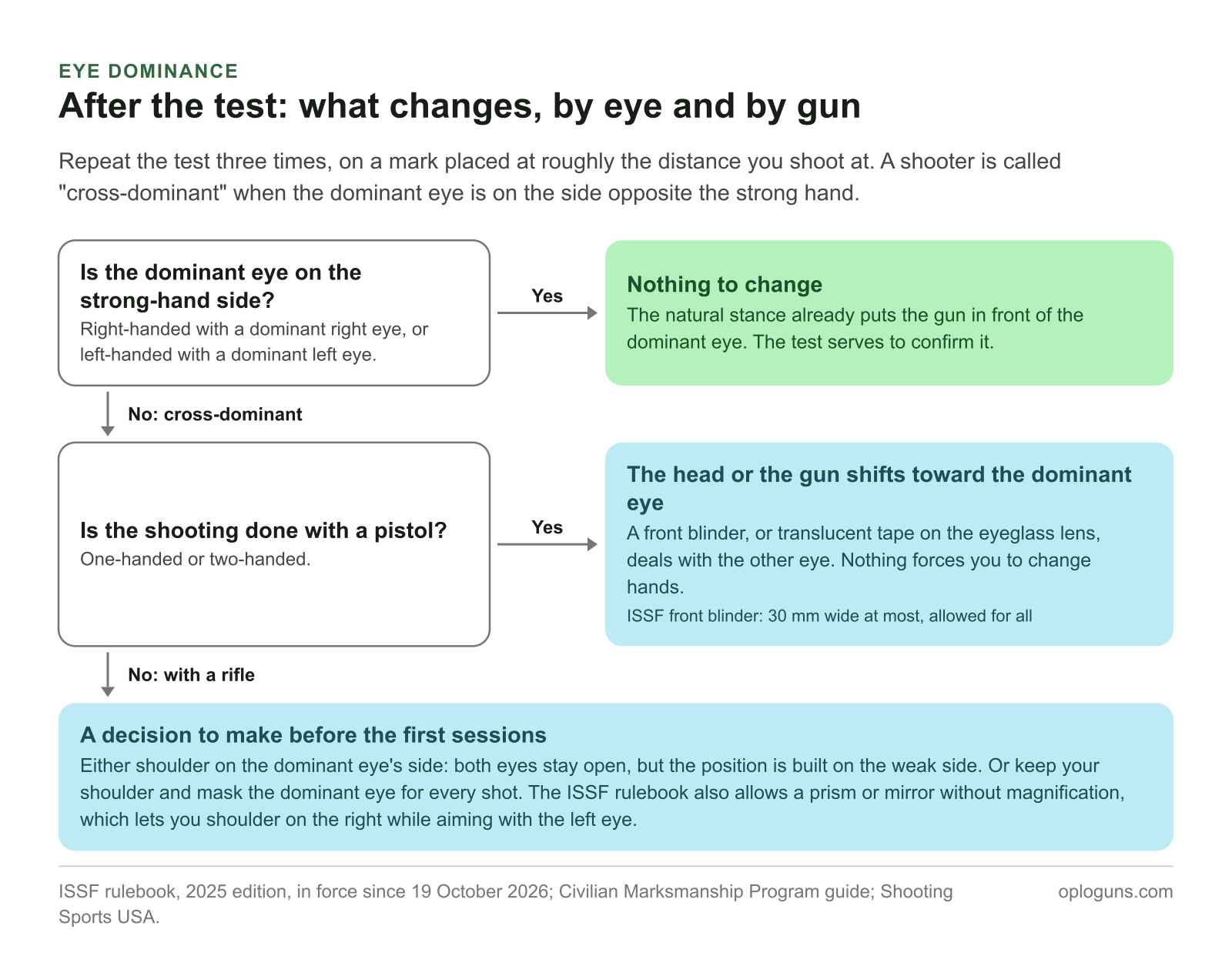
| Pistol | The gun or the head moves in front of the dominant eye |
| Rifle | Shoulder on the eye's side, or mask the dominant eye |
| ISSF blinder | Front blinder, 30 mm wide at most, allowed for all |
- Right-handed, right eye dominant: nothing to change, the natural stance already lines up eye and gun.
- Eye and hand on opposite sides: the pistol copes; the rifle calls for a decision before the first sessions.
Eye dominance test: hands in a triangle
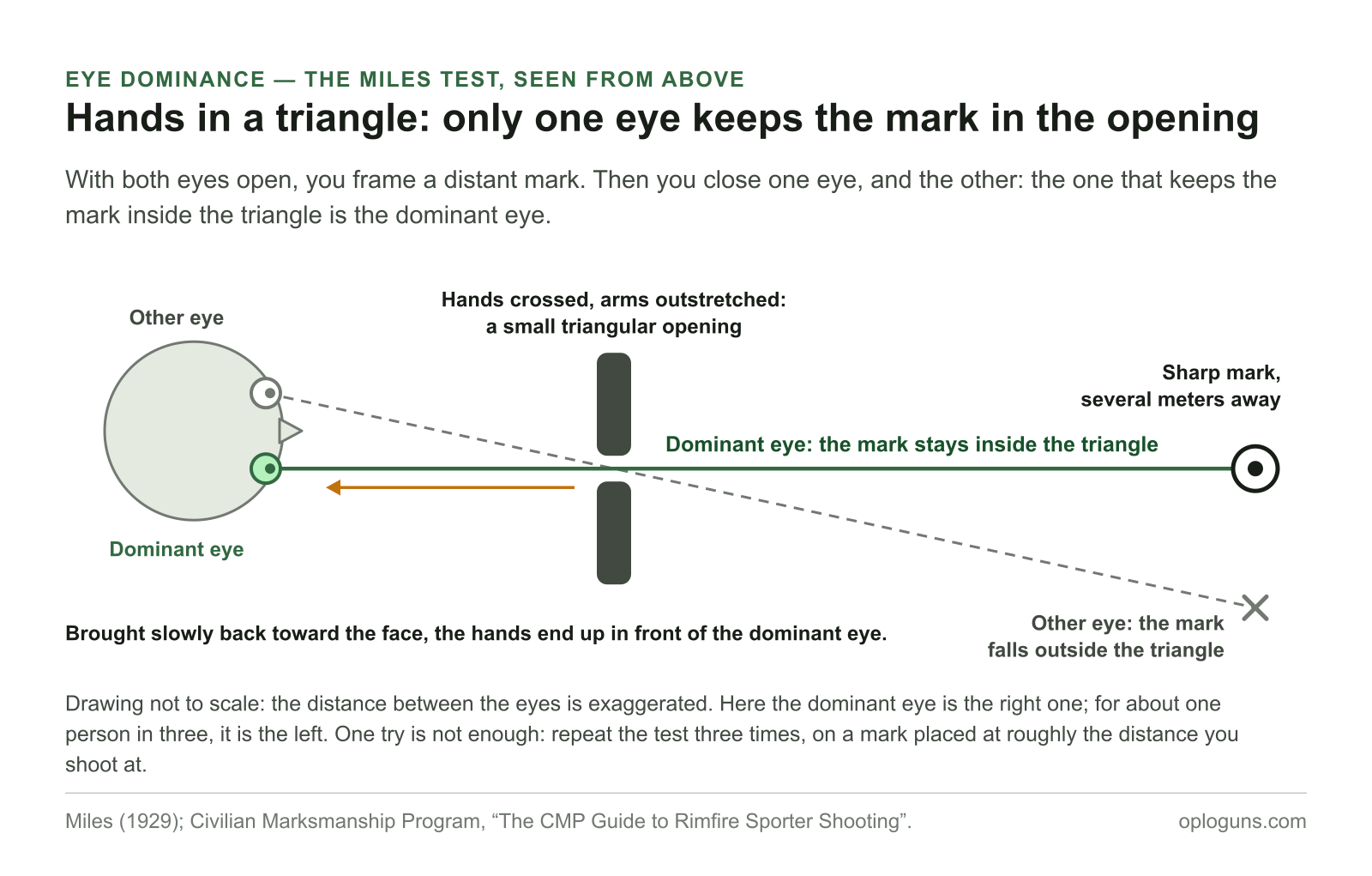
A distant object, two hands, thirty seconds. The most widespread test is named after the psychologist Walter Miles, who described it in 19293.
- Pick a sharp mark several meters away: a door handle, a light switch, the center of a target.
- Stretch out both arms and cross your hands to leave a small triangular opening5.
- Frame the mark in the opening, both eyes open.
- Close one eye, then the other. The eye that keeps the mark inside the triangle is the dominant eye.
- Or bring the hands slowly back toward the face without losing the mark: they end up in front of the dominant eye6.
A variant uses one hand only: the index finger or the thumb, arm outstretched, covers the mark, then you close one eye after the other5. The shooting guide of the Civilian Marksmanship Program, an American marksmanship training body, uses the ring formed by the thumb and index finger, brought back toward the eyes6.
One try is not enough. A study published in 2008 put 46 adults through four eye dominance tests: each gave the same result from one session to the next, but the four agreed only moderately with one another, and the test distance changed the answer4. Hence two precautions: repeat the test three times, and run it on a mark placed at roughly the distance you shoot at.
Left eye dominant: one right-hander in three
The hand does not tell you the eye. The meta-analysis by Bourassa, McManus and Bryden, which pools dozens of published studies, arrives at a population where 36.5% of people have a dominant left eye: 34.4% of right-handers and 57.1% of left-handers2.
Share of people whose left eye is dominant
Reference population of the meta-analysis by Bourassa, McManus and Bryden (1996), which counts 9.25% left-handers
Figures for the meta-analysis's reference population2. The proportion varies from one study to the next with the test used4.
View the data
| Group | Left eye dominant | Right eye dominant |
|---|---|---|
| Right-handers | 34.4% | 65.6% |
| Everyone | 36.5% | 63.5% |
| Left-handers | 57.1% | 42.9% |
A shooter whose dominant eye is on the side opposite the strong hand is called "cross-dominant." There is nothing rare about it: it applies to one right-hander in three. It weighs little with a pistol, a great deal with a rifle, where the cheek rests on the stock and fixes which eye aims.
One-handed pistol: the gun in front of the dominant eye
In ISSF pistol, at 10, 25 and 50 m, the gun is held and fired with one hand only, the wrist visibly free of any support1. The outstretched arm can be angled so that the sights arrive in front of the aiming eye; what the rulebook requires and what the studies on stance measure is in the article on the pistol shooting stance.
For the cross-dominant shooter, two adjustments come up among the American champions interviewed by the NRA's magazine, Shooting Sports USA:
- Tilt or turn the head slightly to bring the dominant eye behind the rear sight, without changing the grip7.
- Mask the non-aiming eye rather than close it: a piece of translucent tape on the top of the eyeglass lens is enough7.
Opinions differ on the closed eye. One precision pistol champion rates it clearly inferior to masking; an Action Pistol champion closes the eye and rolls his head toward the gun7. Both schools win titles. Dry practice at home settles it without burning a cartridge: five dry-fire drills and how to measure them.
Two-handed pistol: shift the gun or the head
With two hands — in IPSC-style action shooting, in service-firearm events or in recreational shooting — the arms form a triangle with the gun at its tip, facing the chest. The dominant eye is not necessarily behind it.
The cross-dominant shooter has the same options as with one hand, with one more constraint: the two-handed grip fixes the gun in the center. Tilting the head toward the gun is the solution given by two action-shooting champions interviewed by the NRA7. The movement has to be repeated identically every time the gun is presented, otherwise the sight picture changes from one string to the next.
The divisions, guns and stages of this discipline are set out in the guide to IPSC in France.
Rifle: the dominant eye's shoulder, or one eye masked
With a rifle, the cheek rests on the stock: the aiming eye is the one behind the rear sight, on the shoulder's side. For the cross-dominant shooter, the Civilian Marksmanship Program describes two good options6. A Shooting Illustrated columnist advises trying the other shoulder before deciding, since some shooters are simply better there8. The rifles and pistols supplied in left-handed versions are listed in guns for left-handers.
Shouldering on the dominant eye's side
Pros
- Both eyes open: the dominant eye aims, nothing needs masking6.
- A decision made once: at the very start, before the position sets in.
Cons
- A position to build on the weak side: the strong hand becomes the fore-end hand.
- Learning to start over for anyone who has already shot from the other side.
Keeping your shoulder and masking the dominant eye
Pros
- The strong hand stays on the grip: the position already learned does not change.
- Simple equipment: a strip of translucent tape on the lens, or a piece of card 2.5 to 3.8 cm wide slipped into the cap6.
The ISSF rulebook provides a third route for rifle: a prism or mirror device, without magnification, that lets you shoulder on the right while aiming with the left eye1. The basics of the discipline are in the article on getting started with 10-meter air rifle.
Red dot: the dominant eye behind the window
With an optical sight, only the eye placed behind the window sees the dot; the other sees the target, with no reticle8. The cross-dominant problem therefore arises less than with iron sights, where the non-aiming eye also sees a front sight, offset8.
The red dot is not welcome everywhere. The ISSF rulebook allows only open sights on a pistol and forbids any optical or projected-dot sight1. In IPSC, it is allowed in Open, compulsory in Production Optics and Optics, forbidden in Production, Standard, Classic and Revolver9. Choosing the sight and zeroing it are covered in the pistol red dot guide.
Eye blinders in sport shooting: what the ISSF allows
The ISSF rulebook in force since 19 October 2026 distinguishes three devices1.
| Device | Who may use it | Limit |
|---|---|---|
| Front blinder, in front of the non-aiming eye | All shooters | 30 mm wide at most |
| Side blinders (cap, glasses, headband) | Shotgun only | 60 mm deep; front edge no more than 30 mm from the forehead |
| Blinder attached to the rifle or the rear sight | Rifle | 30 mm deep, no more than 100 mm from the center of the rear sight aperture, never on the side of the aiming eye |
For pistol as for rifle, the front blinder therefore leaves the eye open, which is what shooters who refuse to close an eye are after7.
In France, the disciplines specific to the FFTir, the French shooting federation — such as tir aux armes réglementaires, its service-firearm events — have their own rulebook: that is the one that prevails for them.
Prescription glasses in shooting: what the ISSF permits
The ISSF rulebook forbids attaching a correcting lens or a filter to the pistol, and lets the shooter wear correcting lenses, glasses, filters or tinted lenses1. On a rifle, a single correcting lens may be attached to the rear sight, on the outside; contact lenses are allowed1.
For anyone who wears glasses, three practical points come up:
- Protection first: the Civilian Marksmanship Program guide treats shooting in prescription or shooting glasses as a necessity6.
- The masking goes on the lens: the translucent tape sticks to the top of the lens of the non-aiming eye7.
- Focus is a matter for the optician: with a pistol, the front sight is at arm's length, the target at 10 or 25 m. When near vision weakens, the rear and front sights, the closest to the eye, go blurred first. Shooting frames with a correcting lens are presented in prescription shooting glasses.
The red dot, where the rulebook allows it, sidesteps the difficulty: its reticle sits on a target that has stayed sharp. With iron sights, what an alignment error costs on target is worked out in the article on aiming a pistol.
Three misconceptions about eye dominance
- "A right-hander aims with the right eye." For a third of right-handers, no: 34.4% have a dominant left eye2.
- "The test gives a final answer." The answer changes with the test and the distance; four methods agreed only moderately across 46 adults4. A result is confirmed by repeating it.
- "You have to close the non-aiming eye." The ISSF rulebook allows a front blinder for all shooters1, and several champions prefer masking the eye to closing it7.
Eye dominance: what to do in your case
Right-handed with a dominant right eye, or left-handed with a dominant left eye, the natural stance already puts the gun in front of the dominant eye. The test serves to confirm it, once.
Cross-dominant with a pistol, one-handed or two-handed, the head or the gun shifts toward the dominant eye; the front blinder or the tape on the lens deals with the other eye. Nothing forces you to change hands.
Cross-dominant with a rifle, the decision is made before the first sessions. Either shoulder on the dominant eye's side. Or keep your shoulder and mask the dominant eye for every shot.
If you wear glasses, the correction is worn on you for pistol and may be attached to the rear sight for rifle; focus on the front sight is worked out with the optician.
The rulebook in force prevails. The rules cited are those of the ISSF rulebook, 2025 edition, third print in force since 19 October 2026. The French federation's national disciplines follow their own rulebook, and the referee decides in competition.
Sources 9 references
The competition rules were read in the ISSF text in force. The frequency of left-eye dominance comes from a published meta-analysis, the reliability of the tests from a clinical study. The practical advice comes from a marksmanship training guide and two American shooting magazines, which quote named shooters.
- ISSF — ISSF Rule Book 2026, Edition 2025 (Third Print 10/2026), in force since 19 October 2026 (PDF), consulted on 1 November 2026: rule 6.7.8 (side blinders no more than 60 mm deep, reserved for shotgun; "One Front Blinder to cover the non-aiming eye that is not more than 30mm wide is permitted for all athletes"); rule 7.4.1.6 (rifle: a single correcting lens attached to the outside of the rear sight, contact lenses allowed, blinder on the gun or the rear sight 30 mm deep and 100 mm at most, never on the side of the aiming eye, prism or mirror without magnification allowed for shouldering on the right while aiming with the left eye); rule 8.4.1.2 (pistol: open sights only, optical and projected-dot sights forbidden, no correcting lens on the gun, correcting lenses and glasses worn by the shooter allowed); rule 8.7.1 (pistol held and fired with one hand only, wrist visibly free).
- Bourassa D. C., McManus I. C., Bryden M. P. — "Handedness and eye-dominance: a meta-analysis of their relationship", Laterality, 1996, 1(1), pp. 5-34, abstract consulted on 1 November 2026: in a population counting 9.25% left-handers and 36.53% dominant left eyes, 34.43% of right-handers and 57.14% of left-handers have a dominant left eye.
- Miles W. R. — "Ocular dominance demonstrated by unconscious sighting", Journal of Experimental Psychology, 1929, 12(2), pp. 113-126: original description of the test that bears his name.
- Rice M. L., Leske D. A., Smestad C. E., Holmes J. M. — "Results of ocular dominance testing depend on assessment method", Journal of AAPOS, 2008, 12(4), pp. 365-369, abstract consulted on 1 November 2026: 46 adults, four tests including the distance hole-in-the-card test; excellent test-retest reliability for each test, "moderate to slight" agreement between tests, results dependent on distance and task.
- Wikipedia (English) — "Ocular dominance", consulted on 1 November 2026: description of the Miles test (both hands form a small opening, arms outstretched) and the Porta test (thumb or index finger lined up on a distant object). ⚠️ Secondary source, cross-checked against sources 3 and 6.
- Civilian Marksmanship Program — "The CMP Guide to Rimfire Sporter Shooting" (PDF, NLU 702), consulted on 1 November 2026: test with the thumb-and-index ring brought back toward the eyes; two options for the cross-dominant shooter, shouldering on the dominant eye's side or blocking its view with a translucent strip on the lens or a strip of card 1 to 1.5 inches wide slipped into the cap; prescription or shooting glasses treated as a necessity (pp. 10 and 23).
- NRA, Shooting Sports USA — "Expert Forum: Eye Dominance", Chip Lohman, 7 March 2016: answers from Julie Golob (tilting the head), Carroll Pilant (closes the right eye and rolls the head), Judy Tant (translucent tape, closing the eye rated "an obvious inferior approach"), Bruce Piatt and Dennis DeMille (tape on the top of the lens), Lones Wigger (blinder on the rear sight or on the lens if the non-dominant eye takes over).
- NRA, Shooting Illustrated — "Cross-Eye Dominance: How It Affects Rifle Shooting", Steve Adelmann, 25 July 2019: with an optic, only the eye on the gun's side sees the aiming point; with iron sights, the other eye sees an offset front sight; try the other hand and the other shoulder; closing the dominant eye impossible for some.
- IPSC — IPSC Handgun Competition Rules, January 2026 Edition (PDF, official link from the IPSC rules page), consulted on 1 November 2026: optical sight allowed in Open, compulsory in Production Optics and Optics, forbidden in Standard, Classic, Production and Revolver.
Frequently asked questions
How do you find your dominant eye for shooting?
With arms outstretched, the hands form a small triangle in which you frame a distant object, both eyes open. Close one eye, then the other: the eye that keeps the object inside the triangle is the dominant eye. Bringing the hands slowly back toward the face gives the same answer: they end up in front of that eye. Repeat the test several times, at a distance close to the one you shoot at.
Should a right-hander with a dominant left eye shoot left-handed?
With a pistol, rarely: the gun shifts in front of the left eye, or the head tilts. With a rifle, there are two routes: shoulder it on the left, on the dominant eye's side, or keep the right shoulder and mask the left eye. The ISSF rulebook even allows a prism to aim with the left eye while shouldering on the right.
Is an eye blinder allowed in ISSF competition?
Yes. The ISSF rulebook in force since 19 October 2026 allows every shooter a front blinder no more than 30 mm wide in front of the non-aiming eye. Side blinders are reserved for shotgun events. On a rifle, a blinder may also be attached to the gun or the rear sight, never on the side of the aiming eye.
Can you shoot in your prescription glasses?
Yes. For pistol, the ISSF forbids attaching a correcting lens to the gun, but lets the shooter wear correcting lenses or glasses. For rifle, a single correcting lens may be attached to the rear sight; contact lenses are allowed. The choice of correction belongs to the optician or the ophthalmologist.
Spotted an error, or a rule that has changed since we checked? Report an error