Shooting logbook: free PDF template, paper or digital, and what it proves
Published on · Updated on · 10 min read · Anthony Baillon
The shooting logbook PDF template offered here is free: three A4 pages, 61 session lines, six columns. On paper, as a PDF or in a spreadsheet, a logbook has had the same status in France since 1 July 2020: optional, with no value as proof. The only regulatory record of sessions is the list by name kept by the club.
At a glance
| Document | What it proves | Who keeps it |
|---|---|---|
| PDF or spreadsheet logbook | Nothing: personal tracking | The shooter |
| The club's logbook | The record of the shooter's visits, if the club keeps one | The club |
| List by name | The controlled sessions | The club president |
- The template: three A4 pages, 61 sessions, date, club, discipline, firearm and caliber, shots, remarks.
- For a first authorization: three controlled sessions at least two months apart, over twelve months.
- For renewal: never twelve consecutive months without practice.
Shooting logbook PDF: three A4 pages, six columns
The template prints in black and white on a desktop printer. It is made up as follows:
- A header: surname and first name, season, club, license number (optional).
- Six columns: date, club or range, discipline, firearm and caliber, shots, remarks.
- 61 session lines: 13 on the first page, which carries the header and a notice, then 24 on each of the next two.
- A notice at the top: the document is an optional tracking tool, with no regulatory value, and is not part of the prefecture file.
- No box for a signature or stamp: it does not claim to record a check, and cannot be mistaken for a club logbook.
Download the shooting session tracking template (PDF, 3 A4 pages, in French)
The firearm, caliber and shots columns serve the shooter: knowing how many shots were fired with which firearm in the season, spotting a volume that is dropping, or relating malfunctions to a volume fired, as in our method for tracking a pistol's reliability.
The shooting logbook, optional since 1 July 2020
Article R312-43 of the code de la sécurité intérieure (the French internal security code), which required the shooter to hold a logbook « indiquant la date de chaque séance contrôlée » [showing the date of each controlled session], was repealed with effect from 1 July 202012. The official templates, annexed to the arrêté of 16 December 1998 without ever appearing in the Journal officiel, the French official gazette, had disappeared on 30 April34. Since then, no text requires of the sport shooter a logbook, an entry or a format. The rule that remains, that of the controlled sessions, and its day-by-day calculation are in the three controlled sessions.
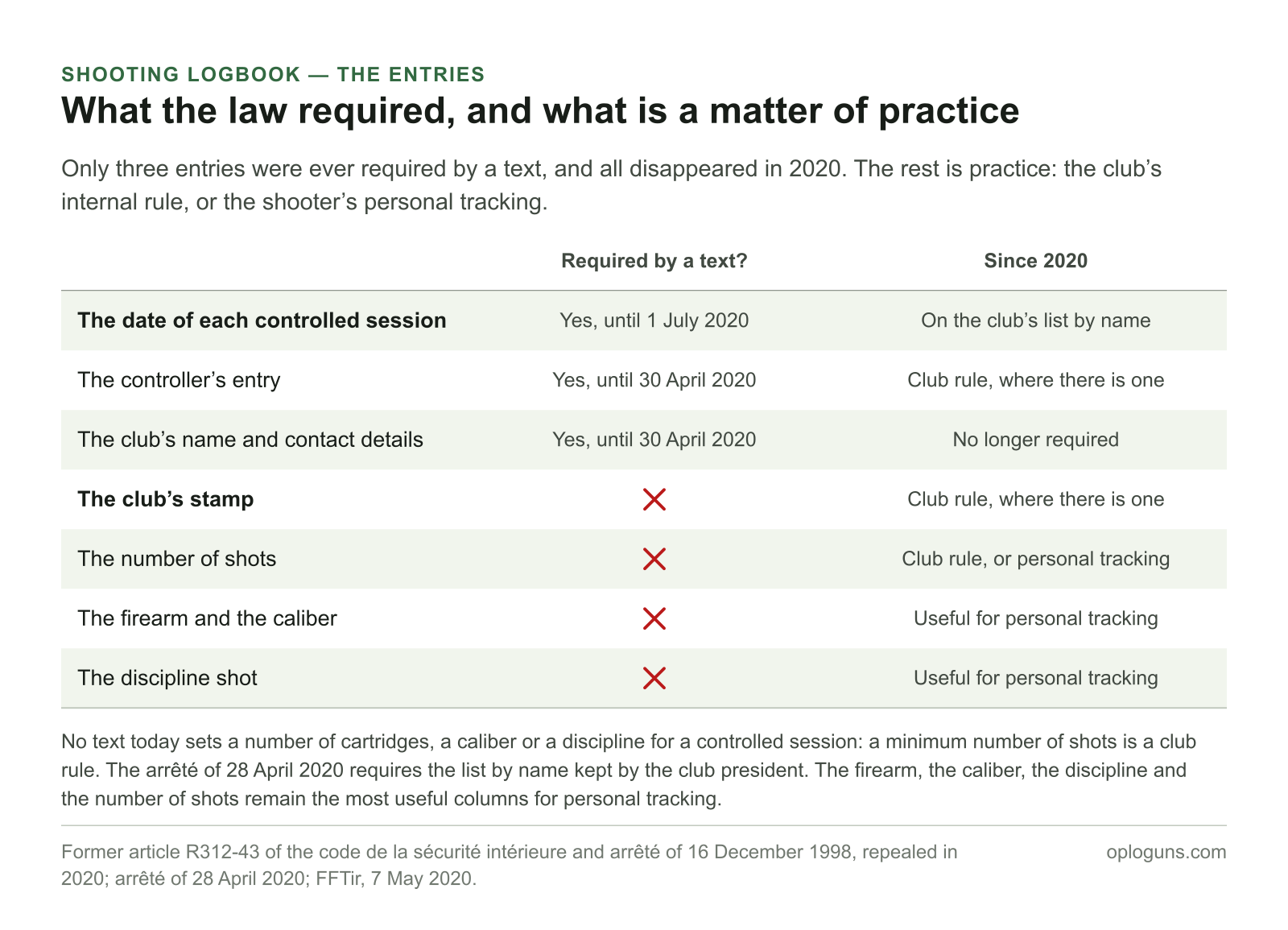
What a shooting logbook records: one line per session
A logbook filled in from memory, on the day a file is submitted, is useless. One line per session, on the day itself:
- The date, which makes it possible to check the two-month spacing of controlled sessions and the absence of a twelve-month gap4.
- The club or the range, since controlled sessions are held in an approved association4.
- The discipline, the firearm, the caliber and the number of shots, even when the club does not ask for them.
- Whether the session was controlled or not, with the name of the person who checked it.
- Malfunctions, with the ammunition lot, so that each can be related to the volume fired.
The text speaks of « deux mois » [two months] without converting them into days4. Counted from date to date, two months cover 59 to 62 days depending on the starting month: 59 from 1 February to 1 April outside a leap year, 62 from 1 July to 1 September. Two sessions too close together, and the second does not count toward a first application.
When the authorization is renewed, the requirement changes: the attestation covers regular practice throughout the previous authorization, and twelve consecutive months without practice bar it4. The FFTir, the French shooting federation, deduces that « un tir par an, au moins, demeure donc nécessaire » [at least one shoot a year therefore remains necessary]5. The list by name belongs to the club: after a change of club, the date column is the only way to spot a gap before renewal.
A club that requires a minimum number of shots or a caliber is applying its internal rule: the arrêté of 28 April 2020 sets no number of cartridges, no caliber and no discipline4. The federation lets clubs keep a record of their members' visits « par le moyen de leur choix (cahier de présence, badge d'entrée, carnet de passage etc.) » [by the means of their choice: attendance book, entry badge, visit log and so on]5.
Digital shooting logbook: a spreadsheet has the same status
A digital logbook does not need to be "authorized": for the sport shooter, the logbook no longer has any regulatory purpose, whatever its format. The consequence cuts both ways:
- Nothing forbids keeping your records in a spreadsheet; the FFTir license itself can be downloaded to be shown on a phone11.
- Nothing gives it any value: on paper or digital, a logbook replaces neither the club's list by name nor the favorable opinion, and a club is not bound to accept it in place of its own practices.
Some clubs still sign a paper logbook at each session. The FFTir writes that it « n'impose rien de plus que ce qui est prévu dans l'arrêté » [imposes nothing beyond what the arrêté provides]5, but the club remains free in its internal organization. Keeping both formats, paper for the club's signature and the spreadsheet for the history, avoids any disagreement.
PDF logbook, spreadsheet or club logbook: pros and cons
The printed PDF template
Pros
- Free, printable as often as you like.
- Filled in on the firing line, with no battery or network.
- Columns useful to the shooter: firearm and caliber, shots, remarks.
- Usable at any club, and from one club to another.
Cons
- No signature: it proves no controlled session.
- No calculation: gaps between sessions and volumes fired are counted by hand.
- A single copy: lost, it takes the history with it.
- 61 lines: a busy season fills the template before it ends.
The spreadsheet
Pros
- The calculations do themselves: gap between two sessions, shots fired per firearm, malfunction rate.
- Free and durable: a file can be copied and reread in ten years.
Cons
- Rarely filled in at the range: notes are copied out in the evening, with the risk of forgetting some.
- No signature: no more than paper does it prove a controlled session.
The logbook kept by the club
Pros
- Signed at each session by an authorized person.
- Accepted automatically by the club that set it up.
Cons
- An imposed format, rarely designed for tracking the firearm or the shots.
- Specific to the club: a change of club may mean starting all over again in another format.
Controlled sessions: proof is at the club, not the logbook
Whatever the format, the proof lies elsewhere. The favorable opinion « est délivré par le président de la Fédération française de tir » [is issued by the president of the French shooting federation] and « vaut attestation de l'assiduité au tir » [counts as attestation of regular shooting attendance]4. The club president checks the sessions and keeps the list of participants by name up to date, available to the FFTir and to authorized state officials4.
The certifications by the league and the federation « sont effectuées via ITAC » [are carried out through ITAC], the federal platform5: no step in it reads the shooter's logbook. The interior ministry has noted that most clubs also keep their own attendance register, and that presidents take on liability, « y compris pénale » [criminal liability included], when they draw up the attestations7. The rest of the route is described in our articles on the prior opinion and on the Category B authorization.
Transport: the license is enough, not the shooting logbook
The transport title is the license. Article R315-2 of the code de la sécurité intérieure provides that « la licence de tir en cours de validité délivrée par une fédération sportive » [the valid shooting license issued by a sports federation] holding a delegation « vaut titre de transport légitime des armes, éléments d'arme, systèmes d'alimentation et munitions des catégories A, B et C » [counts as a legitimate title for transporting firearms, firearm components, feeding devices and ammunition of Categories A, B and C]6.
The FFTir pointed this out as early as 7 May 2020: because the logbook was abolished, the obligation to carry it during transport and to show it to the police has disappeared5. The other rules for the journey are in our article on transporting a firearm.
Five misconceptions about the shooting logbook
- "There is an official shooting logbook to download." The only regulatory templates were annexed to the 1998 arrêté, never published in the Journal officiel and repealed on 30 April 202034.
- "A controlled session means 40 cartridges at least." No text sets a number of cartridges4; such a minimum is a club rule.
- "The shooting logbook is part of the authorization file." The official fact sheet for sport shooters does not mention it: it retains only the federation's favorable opinion, tied to the « pratique régulière du tir » [regular shooting practice]8.
- "You need three controlled sessions a year to keep your authorization." The three sessions concern the first application only. At renewal, what counts is the absence of twelve consecutive months without practice4.
- "The shooting logbook has disappeared for everyone." Since 1 March 2025, article R625-35 requires a shooting logbook, on a template set by arrêté, of people training for private security activities involving the handling of firearms910. The sport shooter is not concerned.
Which logbook, according to the goal
For a first authorization application, the club's logbook, if there is one, is the one that counts in its eyes; the PDF template lets you, alongside it, check the spacing of the three sessions before submitting the file.
For renewal, the date column, on paper or in a spreadsheet, shows a gap in practice at a glance; the catch: neither replaces the club's list.
To track your practice and your firearm, the PDF template brings the columns club logbooks do not always have: firearm, caliber, shots. The spreadsheet does the calculations, at the price of notes copied out in the evening.
To keep a history over several seasons, the spreadsheet takes over from paper, which fills up in one busy season.
Sources 11 references
Each text was reread on Légifrance in its version in force, or in its last version before repeal, on 24 September 2026. All documents are in French. Click a note marker in the text to highlight the matching source.
- Légifrance — article R312-43 du code de la sécurité intérieure, version abrogée [repealed version], « en vigueur du 11 mai 2017 au 1er juillet 2020 » [in force from 11 May 2017 to 1 July 2020]: shooters « doivent être titulaires d'un carnet de tir indiquant la date de chaque séance contrôlée de pratique du tir » [must hold a shooting logbook showing the date of each controlled shooting session], a logbook issued by the approved association and shown on any request; reference to an arrêté setting « le modèle type du carnet de tir et du registre journalier » [the standard template of the shooting logbook and the daily register].
- Légifrance — décret n° 2020-486 du 28 avril 2020 (JORF of 29 April 2020): article 3, repeal of article R312-43; article 13, entry into force « le premier jour du troisième mois » [on the first day of the third month], that is 1 July 2020.
- Légifrance — arrêté du 16 décembre 1998, dernière version en vigueur (29 avril 2020) [last version in force], consulted on 24 September 2026: article 3, entry made in the shooting logbook by the controller, the association's name and contact details carried over to the documents; article 4, « Les modèles du carnet de tir et du registre journalier mentionnés à l'article R. 312-43 du code de la sécurité intérieure sont annexés au présent arrêté » [the templates of the shooting logbook and the daily register mentioned in article R. 312-43 are annexed to this arrêté], note (1) referring their consultation to the departmental youth and sports directorates.
- Légifrance — arrêté du 28 avril 2020 relatif aux avis favorables et aux attestations délivrés par les fédérations [order on the favorable opinions and attestations issued by the federations], in force since 30 April 2020, consulted on 24 September 2026: article 2, the favorable opinion « est délivré par le président de la Fédération française de tir » and « vaut attestation de l'assiduité au tir du demandeur » [is issued by the president of the federation and counts as attestation of the applicant's regular attendance]; article 3, three controlled sessions « espacées d'au moins deux mois » [at least two months apart] within the twelve months before the application, in an approved association that is a member of the FFTir, checked by the association's president or a person appointed by them, who « tient à jour la liste nominative des personnes ayant participé à ces séances » [keeps up to date the list by name of the people who took part in these sessions]; article 4, attestation covering « la pratique régulière du tir […] pendant toute la période de la précédente autorisation » [regular shooting practice throughout the period of the previous authorization], an absence of practice for twelve consecutive months barring the attestation and the favorable opinion; article 7, repeal of the arrêté of 16 December 1998. No number of cartridges, caliber or discipline is set in it.
- FFTir — « 2020, nouveau régime de la délivrance des avis préalables » [2020, new regime for issuing prior opinions], published on 7 May 2020, consulted on 24 September 2026: abolition of the logbook and of the obligation to carry it during transport; record of members' visits « par le moyen de leur choix (cahier de présence, badge d'entrée, carnet de passage etc.) », a matter « de la seule décision de leur Conseil d'administration » [for their board of directors alone to decide]; « Un tir par an, au moins, demeure donc nécessaire » [at least one shoot a year therefore remains necessary]; certifications by the league and the federation: « ces deux opérations sont effectuées via ITAC » [these two operations are carried out through ITAC]; « La Fédération Française de Tir n'impose rien de plus que ce qui est prévu dans l'arrêté » [the federation imposes nothing beyond what the arrêté provides].
- Légifrance — article R315-2 du code de la sécurité intérieure, in force since 1 August 2018, consulted on 24 September 2026: « La licence de tir en cours de validité délivrée par une fédération sportive ayant reçu délégation du ministre chargé des sports […] vaut titre de transport légitime des armes, éléments d'arme, systèmes d'alimentation et munitions des catégories A, B et C » [the valid shooting license issued by a sports federation holding a delegation from the sports minister counts as a legitimate title for transporting firearms, firearm components, feeding devices and ammunition of Categories A, B and C]. No mention of a shooting logbook.
- Assemblée nationale — question écrite n° 29746 [written question no. 29746], answer from the interior ministry published in the Journal officiel on 17 November 2020: « la plupart des clubs de tir ont choisi de tenir leur propre registre d'assiduité de leurs adhérents » [most shooting clubs have chosen to keep their own attendance register of their members]; « les présidents engagent leur responsabilité, y compris pénale, dans la rédaction des nouvelles attestations » [presidents engage their responsibility, criminal liability included, in drawing up the new attestations].
- Service-public.gouv.fr — armes de catégorie B pour un tireur sportif [Category B firearms for a sport shooter], fact sheet F2250 verified on 20 March 2025, consulted on 24 September 2026: FFTir favorable opinion tied to the « pratique régulière du tir » [regular shooting practice]; no mention of a shooting logbook.
- Légifrance — article R625-35 du code de la sécurité intérieure, in force since 1 March 2025, consulted on 24 September 2026: « Les personnes recevant une formation doivent être détentrices d'un carnet de tir, dont le modèle est fixé par arrêté du ministre de l'intérieur. » [People receiving training must hold a shooting logbook, whose template is set by arrêté of the interior minister.]
- Légifrance — décret n° 2024-311 du 4 avril 2024, article 12: entry into force on 1 March 2025 of the provisions on firearms-handling training for private security activities, including article R625-35.
- FFTir — « 2022, l'année de la dématérialisation » [2022, the year of going paperless], published on 3 January 2022: in EDEN, the license holder can « télécharger sa licence en cours (afin de pouvoir la présenter sur son smartphone par exemple) » [download their current license, to be able to show it on a smartphone for example] and upload their medical certificate.
This template attests to nothing. It has no official character and is not a document of the prefecture file. If the club keeps a logbook, its own is the one that counts for it. The law cited is that in force on 24 September 2026; the applicable version can be checked on Légifrance.
Frequently asked questions
Is there an official shooting logbook template to download?
No. The only template prescribed for the French sport shooter was annexed to the arrêté of 16 December 1998, repealed on 30 April 2020. Its annexes were never published in the Journal officiel, the French official gazette: a note in the text referred readers to the departmental youth and sports directorates. No official template is prescribed today.
Is the shooting logbook still compulsory in 2026?
Not for the sport shooter. The obligation appeared in article R312-43 of the code de la sécurité intérieure, repealed on 1 July 2020 by decree no. 2020-486. A club or a league may keep a logbook as an internal rule. What the text now requires is the list by name of controlled sessions, kept by the club.
Is a digital shooting logbook legal?
Yes, like a paper logbook. Since 1 July 2020, no text requires a logbook of the sport shooter or sets its format. A spreadsheet therefore has the same status as a printed logbook: a personal tracking tool, with no value as proof against the club's list by name, and one a club is not bound to accept in place of its own practices.
What must a shooting logbook contain?
Until 2020, three entries were required: the date of each controlled session, an entry by the controller attesting to the check, and the club's name and contact details. None is any longer. For personal tracking, the firearm, the caliber, the discipline and the number of shots are the most useful columns.
Does a PDF shooting logbook have any value?
No value as an attestation. Attendance is attested by the favorable opinion issued by the president of the Fédération française de tir, on the basis of the sessions the club checks and enters on its list by name. A printed template is for personal tracking, and for cross-checking the club's list.
What do you need to renew an authorization?
Regular shooting practice throughout the previous authorization. Twelve consecutive months without practice bar the attestation and the federation's favorable opinion. The FFTir deduces that at least one shoot a year remains necessary; the text itself sets no figure.
Do you need a shooting logbook to transport a Category B firearm?
No. A valid shooting license counts as a legitimate title for transporting firearms of Categories A, B and C, under article R315-2 of the code de la sécurité intérieure. The FFTir wrote as early as May 2020 that the obligation to carry the logbook during transport had been repealed.
Has the shooting logbook disappeared for everyone?
No. Since 1 March 2025, article R625-35 of the code de la sécurité intérieure requires a shooting logbook, on a template set by arrêté, of people training for private security activities involving the handling of firearms. The disappearance concerns the sport shooter only.
Spotted an error, or a rule that has changed since we checked? Report an error