Transporting your firearm to the range in France: license, case and penalties
Published on · Updated on · 13 min read · Anthony Baillon
In France, transporting your firearm to the range is lawful with a legitimate reason, and a current shooting license is one. The firearm travels not immediately usable: in a soft case, in a hard case, with a trigger lock or stripped. Neither key nor padlock is required; the gear costs €12 to €40.
At a glance
| Rule | What it requires | Text |
|---|---|---|
| Legitimate reason | A current shooting license | R315-2 |
| Firearm unusable | Soft case, hard case, trigger lock or removed part | R315-4 |
| By car | Locked vehicle | R315-17, R317-12 |
- Without a legitimate reason, transporting a Category B firearm exposes you to seven years' imprisonment and a €100,000 fine.
- Budget: €12 to €40 once for a case or a lock, nothing in the following years.
Transporting a firearm: valid shooting license, no carrying
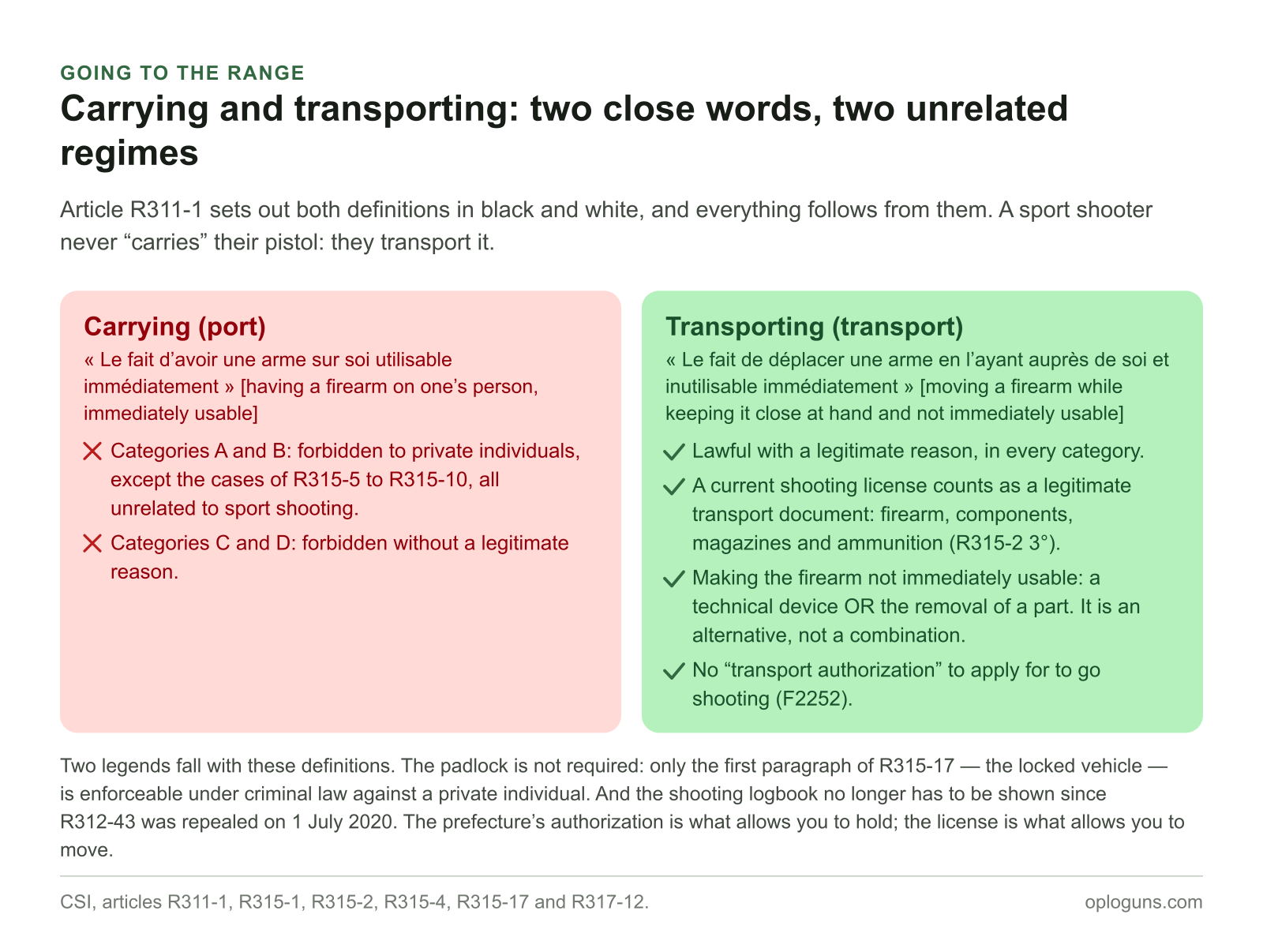
Article R311-1 of the code de la sécurité intérieure, France's internal security code, separates two acts. Carrying (port) is the « fait d'avoir une arme sur soi utilisable immédiatement » [having a firearm on one's person, immediately usable], transporting the « fait de déplacer une arme en l'ayant auprès de soi et inutilisable immédiatement » [moving a firearm while keeping it close at hand and not immediately usable]1. Article R315-1 forbids carrying Category A and B firearms, outside the cases of articles R315-5 to R315-10, which have nothing to do with sport shooting, and forbids transporting them only « sans motif légitime » [without a legitimate reason]2.
For the shooter, that reason is written down: a current shooting license issued by a delegated federation « vaut titre de transport légitime des armes, éléments d'arme, systèmes d'alimentation et munitions des catégories A, B et C » [counts as a legitimate transport document for firearms, firearm components, feeding systems and ammunition in Categories A, B and C], as well as for the Category D guns of its discipline (R315-2)3.
- No transport authorization has to be applied for to go shooting4.
- The holding authorization is not the transport document: the license is what must be valid on the day of the trip. See the Category B authorization and renewing your FFTir license.
- The place of use does not change: a Category B pistol is used only at the ranges of approved associations4.
Firearm not immediately usable: four ways
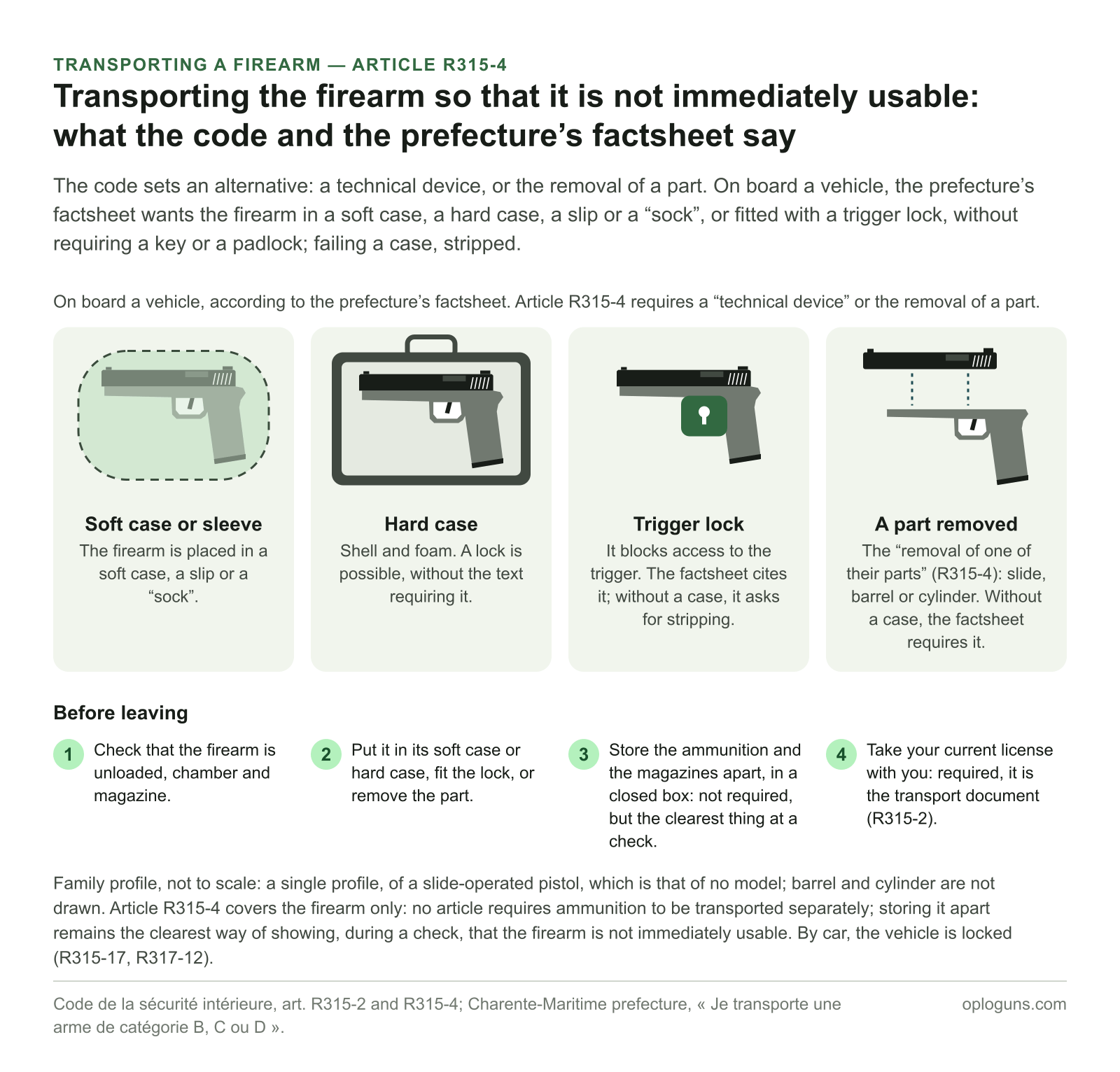
Article R315-4 sets a single material requirement: firearms are transported « de manière à ne pas être immédiatement utilisables, soit en recourant à un dispositif technique répondant à cet objectif, soit par démontage d'un de leurs éléments » [so as not to be immediately usable, either by using a technical device that meets this aim, or by removing one of their parts]5. It is an alternative, not a combination. The factsheet of the Charente-Maritime prefecture translates it into practice: the firearm is placed « sous étui, dans une mallette, un fourreau, "une chaussette" ou munie d'un verrou à pontet » [in a soft case, in a hard case, a slip, a "sock", or fitted with a trigger lock]; « l'utilisation d'une clé ou d'un cadenas n'est pas exigée » [the use of a key or a padlock is not required]; failing a case, it is stripped6.
Before leaving, the steps are the same whatever the option:
- Check that the firearm is unloaded, chamber and magazine.
- Put it in its soft case or hard case, or fit the lock, or remove the part.
- Store the ammunition and the magazines apart, in a closed box.
- Take your current license with you.
To transport a suppressor, the rule depends on its situation: on its own, or fitted to the firearm.
Soft case, hard case, lock or removed part: pros and cons
The soft case or sleeve
Pros
- The cheapest: €15 to €17 for a handgun sleeve13.
- Light and discreet: it slips into a range bag.
Cons
- Limited protection: a soft sleeve does little to cushion a knock to the sights.
- The firearm comes out in one movement: with no lock, only the unloaded firearm and the ammunition stored apart make it unusable in practice.
The hard case
Pros
Cons
- Bulkier than a sleeve, especially with several firearms.
- One size per firearm: a compact-pistol case does not take a long-barreled target pistol. Interior dimensions are compared in choosing your gun case.
The trigger lock
Pros
- It blocks access to the trigger, by key or combination: €12 to €35 depending on the model131415.
- Cited by the prefecture's factsheet, which wants the firearm on board a vehicle « sous étui, dans une mallette, un fourreau, "une chaussette" ou munie d'un verrou à pontet » [in a soft case, in a hard case, a slip, a "sock", or fitted with a trigger lock]6.
Cons
- No protection against knocks: it is often combined with a sleeve.
- A key or a code not to forget: without them, no shooting at the range.
- Without a case, the factsheet asks for stripping: « À défaut d'être placée sous étui, l'arme doit être démontée » [failing being placed in a case, the firearm must be stripped]6.
Removing a part
Pros
- No purchase: taking off the slide, the barrel or the cylinder is enough (R315-4)5.
Cons
- Reassembly at the range, and a part that can get left at home.
- Impractical on some firearms, whose disassembly takes a tool or time.
Transport by car: locked vehicle
Article R315-17 requires firearms shipped by road to travel in locked vehicles; its second paragraph adds strapped crates, padlocked containers and a permanent guard, including during stops7. Article R317-12 penalizes the private individual for the first paragraph only: transporting « à titre particulier par voie routière » [in a private capacity by road] a firearm without observing that paragraph's security measure, the locked vehicle8. Padlocked containers are penalized only in a professional capacity.
No text imposes a direct route on the shooter or forbids a stop. Leaving the firearm out of sight, in a locked vehicle, and not leaving it overnight in a car are matters of prudence. The SIA FAQ (the SIA being the state's firearms information system) lets you declare up to four secondary residences, which serves to « légitimer le transport des armes entre les différentes résidences » [legitimize the transport of firearms between the different residences]9.
Ammunition: transported on the license, no separation
The license counts as a transport document for ammunition and magazines as for the firearm3. R315-4 covers the firearm only5: no article requires the shooter to transport ammunition separately. An unloaded firearm, with its ammunition in a separate box, remains the clearest way of showing during a check that it is not immediately usable. Ammunition ceilings do not change during the trip: see firearm and ammunition quotas.
Roadside check: the shooting license is enough
During a check, the prefecture's factsheet names, for the shooter, the « licence de la FFTIR ou FFBT en cours de validité » [current license of the FFTir or the FFBT, the target shooting and clay shooting federations]6. The shooting logbook is no longer required: article R312-43, which made it compulsory to show it « à toute réquisition » [whenever required], has been repealed since 1 July 202010. Controlled sessions are now entered in the club's register: see the rule of the three controlled sessions.
Transport by train: the conditions of R315-4 since 2026
Since 30 March 2026, article R2242-18 of the code des transports allows a firearm on public passenger transport « dans les conditions fixées par l'article R. 315-4 du code de la sécurité intérieure » [under the conditions set by article R. 315-4 of the internal security code]11: not immediately usable, as in a car. A breach is a 4th-class contravention11, €750 at most12. In a train car, a closed case or sleeve also keeps the firearm out of sight.
Transporting a firearm by air or to the European Union
- By air, the IATA regulations allow ammunition « solidement emballées » [securely packed] up to 5 kg gross per person, with no pooling between passengers16. The firearm and its ammunition are also subject to each airline's own conditions.
- In another EU member state, the shooter creates their European firearms pass in their SIA account and shows a sport shooting purpose; if the destination state bans the firearm or makes it subject to authorization, a prior authorization from that state is added (R316-9)17. See the SIA account.
Transport with no legitimate reason: 7 years in Category B
| Breach | Maximum penalty | Text |
|---|---|---|
| No legitimate reason, Category A or B | 7 years and €100,000; 10 years and €500,000 for two or more | Code pénal, 222-54 |
| No legitimate reason, Category C | 2 years and €30,000 | CSI, L317-8 |
| No legitimate reason, Category D | 1 year and €15,000 | CSI, L317-8 |
| Firearm immediately usable | €750 | CSI, R317-11 |
| Vehicle not locked | €750 | CSI, R317-12 |
| Train, bus, metro outside the conditions of R315-4 | €750 | Code des transports, R2242-18 |
Article 222-54 of the code pénal punishes carrying or transporting outside the home, without a legitimate reason, Category A or B firearms, even lawfully held18; Categories C and D come under article L317-819. Packing failures are 4th-class contraventions20811, €750 at most12. The gap shows the text's order of priorities: a valid license first, the case second.
What the license does not cover: knife, spray, baton
The license covers the firearms used in shooting, not the rest of the range bag. Article R315-2 makes it a transport document only for firearms in Categories A, B and C. In Category D, it covers only the weapons and ammunition « utilisés dans la pratique du sport relevant de ladite fédération » [used in practicing the sport that comes under the said federation]3. A knife, a tear gas spray or a baton is not among them.
These objects are Category D. The knife, the dagger and the baton fall into it as « objets susceptibles de constituer une arme dangereuse pour la sécurité publique » [objects capable of constituting a weapon dangerous to public safety]. A tear gas spray of 100 ml at most falls into it as an aerosol2521. Carrying and transporting them without a legitimate reason are forbidden (R315-1, 3°)2, and punished by one year's imprisonment and a €15,000 fine (L317-8)19.
Transport never becomes carrying, even in the face of danger. The license only allows the firearm to be moved while not immediately usable13. Carrying a Category B firearm remains forbidden outside the authorizations of articles R315-5 to R315-102, and the shooter « peut avoir l'arme en main uniquement devant le pas de tir » [may have the firearm in hand only at the firing point]4.
A fine for a knife can cost you your firearms
Carrying or transporting a Category D weapon without a legitimate reason can end in a fixed fine (amende forfaitaire), against surrender of the object. It is €500, €400 if paid early, €1,000 if paid late19. In June 2025, in an answer to a member of parliament, the interior ministry said it had been on trial since 17 April 2024 in the jurisdictions of thirteen courts, including Paris, Lyon and Marseille21.
Paying is far from trivial. According to the same answer, payment « vaut ainsi reconnaissance de culpabilité » [thus counts as an admission of guilt] and enters the offense in the criminal record, bulletin no. 2 included21. Since 20 August 2026, a fixed fine for a misdemeanor stays on bulletin no. 2 for three years, from the date it is paid (article 775, 17°, of the code de procédure pénale)26. What follows is written in the code:
- Bulletin no. 2: a conviction for carrying or transporting a Category C or D weapon without a legitimate reason bars you from acquiring and holding firearms in Categories A, B and C (L312-3)22.
- FINIADA: the national file of people barred from firearms lists the persons barred in this way (L312-16)23.
- Surrender: the prefect may order you to give up the firearms already held; for a ban drawn from L312-3, without an adversarial procedure (L312-11)24.
For a shooter, a knife in the range bag can therefore cost their Category B and C firearms. The ministerial answer mentions a request to have the entry removed from bulletin no. 2, submitted to the public prosecutor (article 775-1 of the code de procédure pénale)21.
Soft case, hard case or lock, depending on your use
What you gain, what you give up
For a short car trip with a handgun, the sleeve or the simple hard case, €14 to €20, satisfies the text. In return, the firearm comes out in one movement: ammunition stored apart makes the difference during a check.
To protect a target firearm or its sights, the hard case keeps the firearm in place. It takes more room, especially with several firearms.
To block the trigger, the trigger lock, €12 to €35. Article R315-4 accepts a technical device that makes the firearm not immediately usable, or the removal of a part5. The prefecture's factsheet cited goes further: « À défaut d'être placée sous étui, l'arme doit être démontée » [failing being placed in a case, the firearm must be stripped]6. In a case, the lock satisfies both. It does not protect the firearm from knocks, and its key becomes one more thing to take along.
To buy nothing, removing a part meets the text, at the price of reassembly at the range.
Four misconceptions about transporting a firearm
- "You need a padlocked case." Neither R315-4 nor the prefecture's factsheet requires a key or a padlock; the padlocked containers of R315-17 are penalized only in a professional capacity568.
- "The shooting logbook is shown at a check." The obligation disappeared with article R312-43, repealed on 1 July 202010.
- "The prefecture's authorization is the transport document." A current shooting license is what counts as a legitimate transport document3.
- "On the train, the firearm must be stripped." Since 30 March 2026, the code des transports refers to the conditions of R315-4: a technical device or the removal of a part, as in a car115.
Sources 26 references
The articles of the code de la sécurité intérieure, the code pénal and the code des transports were reread on Légifrance in their version in force on 24 September 2026, and the official factsheets on the same day. Prices come from dated surveys at three French gun shops, flagged ⚠️ as commercial data. All documents are in French. Click a note marker in the text to highlight the matching source.
- Légifrance — article R311-1 du code de la sécurité intérieure, version in force since 7 September 2025 (decree no. 2025-894 of 5 September 2025), consulted on 24 September then on 1 November 2026: III, 10° carrying a firearm, « fait d'avoir une arme sur soi utilisable immédiatement »; 13° transporting a firearm, « fait de déplacer une arme en l'ayant auprès de soi et inutilisable immédiatement ».
- Légifrance — article R315-1 du code de la sécurité intérieure, version in force since 1 August 2018, consulted on 24 September then on 1 November 2026: « Sont interdits : 1° Sauf dans les cas prévus aux articles R. 315-5 à R. 315-10, le port des armes, éléments d'arme et munitions des catégories A et B ; 2° Le transport sans motif légitime des armes, éléments d'arme et munitions des catégories A et B ; 3° Le port et le transport sans motif légitime des armes, éléments d'arme et munitions des catégories C et D. » [forbidden: 1° except in the cases of articles R. 315-5 to R. 315-10, carrying Category A and B firearms, components and ammunition; 2° transporting them without a legitimate reason; 3° carrying and transporting Category C and D firearms, components and ammunition without a legitimate reason].
- Légifrance — article R315-2 du code de la sécurité intérieure, version in force since 1 August 2018, consulted on 24 September then on 1 November 2026: 3° « La licence de tir en cours de validité délivrée par une fédération sportive ayant reçu délégation du ministre chargé des sports au titre de l'article L. 131-14 du code des sports pour la pratique du tir vaut titre de transport légitime des armes, éléments d'arme, systèmes d'alimentation et munitions des catégories A, B et C ainsi que des armes, éléments d'arme et munitions de la catégorie D utilisés dans la pratique du sport relevant de ladite fédération » [a current shooting license issued by a delegated sports federation for shooting counts as a legitimate transport document for firearms, components, feeding systems and ammunition in Categories A, B and C, and for the Category D weapons, components and ammunition used in the sport that comes under that federation].
- Service-Public (DILA) — Qui peut porter et transporter une arme ?, fiche F2252 [who may carry and transport a firearm?, factsheet F2252], verified on 4 March 2026, consulted on 24 September then on 1 November 2026: « La licence de tir en cours de validité délivrée par la Fédération française de tir donne le droit de transporter une arme » [a current shooting license issued by the FFTir gives the right to transport a firearm]; « L'arme doit être transportée de manière à ne pas être immédiatement utilisable par un dispositif technique ou en démontant un de ses éléments » [the firearm must be transported so as not to be immediately usable, by a technical device or by removing one of its parts]; « Un tireur sportif peut utiliser son arme uniquement dans le stand de tir d'une association sportive agréée » [a sport shooter may use their firearm only at the range of an approved sports association]; « Il peut avoir l'arme en main uniquement devant le pas de tir ».
- Légifrance — article R315-4 du code de la sécurité intérieure, version in force since 1 August 2018 (decree no. 2018-542 of 29 June 2018), consulted on 24 September 2026: « Les armes à feu mentionnées aux 2° et 3° de l'article R. 315-1 sont transportées de manière à ne pas être immédiatement utilisables, soit en recourant à un dispositif technique répondant à cet objectif, soit par démontage d'un de leurs éléments. » [the firearms mentioned in 2° and 3° of article R. 315-1 are transported so as not to be immediately usable, either by using a technical device that meets this aim, or by removing one of their parts].
- Préfecture de la Charente-Maritime, sous-préfecture de Jonzac — « Je transporte une arme de catégorie B, C ou D » [I am transporting a Category B, C or D firearm] (PDF, 31 July 2025), consulted on 24 September then on 16 November 2026: « A bord d'un véhicule, l'arme doit être placée : - sous étui, dans une mallette, un fourreau, "une chaussette" ou munie d'un verrou à pontet, l'utilisation d'une clé ou d'un cadenas n'est pas exigée. À défaut d'être placée sous étui, l'arme doit être démontée » [on board a vehicle, the firearm must be placed in a soft case, in a hard case, a slip, a "sock", or fitted with a trigger lock; a key or a padlock is not required; failing a case, the firearm must be stripped]; documents to show during checks, including « licence de la FFTIR ou FFBT en cours de validité ».
- Légifrance — article R315-17 du code de la sécurité intérieure, version in force since 1 August 2018, consulted on 24 September 2026: shipping by road in locked vehicles (first paragraph); strapped cartons or crates or padlocked metal containers, under the permanent guard of the driver or an escort, including during stops (second paragraph).
- Légifrance — article R317-12 du code de la sécurité intérieure, version in force since 1 December 2014, consulted on 24 September 2026: 4th-class contravention; 4° and 5° transport or shipping « à titre professionnel » [in a professional capacity] without observing the measures of R315-17; 6° « Toute personne de transporter à titre particulier par voie routière une arme mentionnée au premier alinéa de l'article R. 315-17 sans respecter la mesure de sécurité édictée à cet alinéa » [for any person to transport in a private capacity by road a firearm mentioned in the first paragraph of article R. 315-17 without observing the security measure laid down in that paragraph].
- Ministère de l'Intérieur, DEPSA — Foire aux questions sur le SIA, détenteurs particuliers [SIA frequently asked questions, private holders], version of 15 October 2024 (PDF distributed by the Pyrénées-Orientales prefecture), consulted on 24 September 2026: declaration of the secondary residence « si vos armes peuvent se trouver dans votre résidence secondaire » [if your firearms may be at your secondary residence]; « Cette formalité permet de déclarer jusqu'à 4 résidences secondaires, d'assurer la traçabilité et de légitimer le transport des armes entre les différentes résidences. » [this formality lets you declare up to 4 secondary residences, ensure traceability and legitimize the transport of firearms between the different residences].
- Légifrance — sous-section « Tir sportif » du code de la sécurité intérieure [sport shooting subsection], consulted on 24 September 2026: article R312-43, which required holding a shooting logbook and showing it whenever required, is repealed by decree no. 2020-486 of 28 April 2020, with effect on 1 July 2020.
- Légifrance — article R2242-18 du code des transports, version in force since 30 March 2026 (decree no. 2026-216 of 28 March 2026, art. 3), consulted on 24 September 2026: « Toute personne autorisée à porter ou transporter une arme à feu ne peut accéder aux véhicules affectés au transport public de voyageurs avec cette arme que dans les conditions fixées par l'article R. 315-4 du code de la sécurité intérieure. Le fait de contrevenir aux dispositions du présent article est puni de l'amende prévue pour les contraventions de la quatrième classe. » [any person authorized to carry or transport a firearm may board public passenger transport vehicles with it only under the conditions set by article R. 315-4 of the internal security code; a breach is punished by the fine for 4th-class contraventions]. The earlier version, of 4 December 2024, required a firearm « non chargée, démontée » [unloaded, stripped] in a closed soft or hard case.
- Légifrance — article 131-13 du code pénal, consulted on 24 September 2026: €750 at most for 4th-class contraventions.
- Armurerie Loisir — housses et mallettes [sleeves and cases] and verrous de pontet [trigger locks], prices recorded on 24 September 2026: Umarex handgun sleeve €14.90; handgun transport sleeve €16.50; Stilcrin handgun case €19.90; Blackstorm Firearms 17 cm case with combination lock €39.90; combination trigger lock €15.90; keyed trigger lock €19.90. ⚠️ Commercial data.
- Natusport — mallette de protection pour pistolet [protective pistol case], verrou de pontet à clé Fuzyon [Fuzyon keyed trigger lock] and verrou de pontet à combinaison [combination trigger lock], prices recorded on 24 September 2026: ABS case 35 × 25 × 7 cm €14.00; keyed lock €12.00; combination lock €22.00. ⚠️ Commercial data.
- Safepro24 France — accessoires et coffres pour armes de poing [handgun accessories and safes], price recorded on 24 September 2026: Profirst Gunforce trigger lock €34.60. ⚠️ Commercial data.
- IATA — Réglementation pour le transport des marchandises dangereuses, tableau 2.3.A [Dangerous Goods Regulations, table 2.3.A] (62nd edition, 2021), consulted on 24 September 2026: « À condition d'être solidement emballées, munitions (division 1.4S, ONU 0012 ou ONU 0014 seulement) en quantités ne dépassant pas 5 kg de poids brut par personne, réservées à l'usage personnel de celle-ci. Les franchises de plusieurs personnes ne doivent pas être combinées en un ou plusieurs colis » [provided it is securely packed, ammunition (division 1.4S, UN 0012 or UN 0014 only) in quantities not exceeding 5 kg gross weight per person, for that person's own use; the allowances of several persons must not be combined into one or more packages]. ⚠️ 2021 edition.
- Légifrance — articles R316-7 à R316-11 du code de la sécurité intérieure, carte européenne d'arme à feu [European firearms pass], consulted on 24 September 2026: R316-9 — holding a firearm during a trip to a member state is allowed to a French resident only if they create their European firearms pass in their SIA account and show a purpose of hunting, sport shooting or historical reenactment; failing that, or toward a state that bans the firearm or makes it subject to authorization, prior authorization from the destination state; R316-7 (version of 31 December 2022) — pass issued for five years, or for the duration of the authorization when it carries a firearm subject to authorization.
- Légifrance — article 222-54 du code pénal, version in force since 5 June 2016 (law no. 2016-731), consulted on 24 September 2026: carrying or transporting outside the home, without a legitimate reason, Category A or B firearms, even lawfully held, punished by seven years' imprisonment and a €100,000 fine; ten years and €500,000 in the event of a qualifying earlier conviction or when at least two persons are found carrying together or carry out the transport.
- Légifrance — article L317-8 du code de la sécurité intérieure, version in force since 26 January 2023, consulted on 24 September then on 1 November 2026: carrying or transporting without a legitimate reason; 1° repealed; 2° Category C, two years' imprisonment and a €30,000 fine; 3° Category D, one year and €15,000, except low-danger weapons listed by arrêté; for Category D, firearms excepted, prosecution is extinguished by payment of a fixed fine of €500, €400 reduced, €1,000 increased, with voluntary surrender of the object to the reporting officer « aux fins de transfert de propriété à l'Etat et de destruction éventuelle » [for transfer of ownership to the state and possible destruction].
- Légifrance — article R317-11 du code de la sécurité intérieure, version in force since 1 August 2018, consulted on 24 September 2026: fine for 4th-class contraventions for anyone who does not observe the security provisions of article R315-4.
- Assemblée nationale — question écrite n° 1081 de M. Pierre Cordier, réponse du ministère de l'Intérieur [written question no. 1081 by Mr. Pierre Cordier, answer from the interior ministry], question published on 22 October 2024, answer published on 3 June 2025, consulted on 1 November 2026: fixed fine for the misdemeanor of carrying or transporting a Category D weapon on trial « depuis le 17 avril 2024 » [since 17 April 2024] in the jurisdictions of thirteen courts (Rennes, Lille, Nantes, Bobigny, Pontoise, Bordeaux, Lyon, Saint-Étienne, Marseille, Nice, Montpellier, Paris, Toulouse); €500, €400 reduced, €1,000 increased; « Le versement de l'amende forfaitaire délictuelle pour les faits de port ou transport d'arme de catégorie D vaut ainsi reconnaissance de culpabilité » [payment of the fixed fine for carrying or transporting a Category D weapon thus counts as an admission of guilt]; entry in the criminal record, then, « En application de l'article L312-3 » [under article L312-3], in the FINIADA; request for removal from bulletin no. 2 under article 775-1 of the code de procédure pénale; knives, « également ceux appelés "de poche" » [including those called pocket knives], come under Category D. A ministerial answer does not have the force of law.
- Légifrance — article L312-3 du code de la sécurité intérieure, version in force since 20 March 2024 (law no. 2024-233 of 18 March 2024, art. 7), consulted on 1 November 2026: barred from acquiring and holding firearms in Categories A, B and C, 1°, are persons whose « le bulletin n° 2 du casier judiciaire comporte une mention de condamnation » [bulletin no. 2 of the criminal record carries a conviction] for one of the offenses listed, including « port, transport et expéditions d'armes, de munitions ou de leurs éléments des catégories C ou D sans motif légitime » [carrying, transporting and shipping Category C or D weapons, ammunition or their components without a legitimate reason].
- Légifrance — article L312-16 du code de la sécurité intérieure, version in force since 30 December 2019 (law no. 2019-1480), consulted on 1 November 2026: the national automated file of named persons lists, 2°, « Les personnes interdites d'acquisition et de détention d'armes » [persons barred from acquiring and holding firearms] in Categories A, B and C under article L312-3.
- Légifrance — article L312-11 du code de la sécurité intérieure, version in force since 26 January 2022, consulted on 1 November 2026: the state's representative may « ordonner à tout détenteur d'une arme, de munitions et de leurs éléments de toute catégorie de s'en dessaisir » [order any holder of a firearm, ammunition and their components of any category to give them up], within the time they set; the adversarial procedure does not apply to a ban made under L312-3 or L312-3-2.
- Légifrance — article R311-2 du code de la sécurité intérieure, version in force since 7 September 2025 (decree no. 2025-894), consulted on 1 November 2026: Category D, a) « Tous objets susceptibles de constituer une arme dangereuse pour la sécurité publique » [all objects capable of constituting a weapon dangerous to public safety], including daggers and batons; b) tear gas or incapacitating aerosol dispensers with a capacity of 100 ml or less.
- Légifrance — article 775 du code de procédure pénale, version in force since 20 August 2026 (law no. 2026-798 of 18 August 2026, art. 29), consulted on 1 November 2026: not shown on bulletin no. 2, 17° « Les amendes forfaitaires délictuelles à l'expiration d'un délai de trois ans à compter de leur paiement ou à l'expiration du délai mentionné au second alinéa de l'article 495-19 » [fixed fines for misdemeanors once three years have passed since their payment, or once the period mentioned in the second paragraph of article 495-19 has passed].
The text in force prevails. This article describes the texts as of 24 September 2026, including article R2242-18 of the code des transports amended on 30 March 2026; R311-2, R315-1, R315-2, L312-3, L312-11, L312-16 and L317-8 reread on 1 November 2026. For a particular situation, the point of contact is the prefecture of your home address.
Frequently asked questions
Is the shooting license enough to transport a Category B firearm?
Yes. Article R315-2 of the code de la sécurité intérieure makes a current shooting license a « titre de transport légitime » [legitimate transport document] for the firearms, components, feeding systems and ammunition in Categories A, B and C used in shooting. There is no transport authorization to apply for. The firearm must also travel not immediately usable (article R315-4).
Do you need a locked case or a padlock?
No. Article R315-4 requires only that the firearm not be immediately usable, through a technical device or the removal of a part. The factsheet of the Charente-Maritime prefecture cites the soft case, the hard case, the slip or the trigger lock, and states that « l'utilisation d'une clé ou d'un cadenas n'est pas exigée » [the use of a key or a padlock is not required]. A lock remains a security choice, not an obligation.
Must ammunition travel separately from the firearm?
No article imposes it on the shooter: the license counts as a transport document for the ammunition as for the firearm, and R315-4 covers the firearm only. Traveling with the firearm unloaded and the ammunition in a separate box remains the simplest way of showing, during a check, that the firearm is not immediately usable.
Can you take the train with your firearm?
Yes. Since 30 March 2026, article R2242-18 of the code des transports allows a firearm on public passenger transport under the conditions of article R315-4 of the code de la sécurité intérieure: not immediately usable. A breach is a 4th-class contravention, €750 at most.
What do you risk by transporting a firearm without a legitimate reason?
For a Category A or B firearm, seven years' imprisonment and a €100,000 fine (article 222-54 of the code pénal), ten years and €500,000 for two or more people. For Category C, two years and €30,000; for Category D, one year and €15,000 (article L317-8 of the code de la sécurité intérieure). A current license provides that reason.
Is the shooting logbook required during a check?
No. Article R312-43, which made it compulsory to hold a shooting logbook and to show it « à toute réquisition » [whenever required], has been repealed since 1 July 2020. During a check, the sport shooter's document is a current FFTir or FFBT license, according to the factsheet of the Charente-Maritime prefecture.
Can you stop on the way with your firearm?
No text imposes a direct route on the shooter or forbids a stop; article R315-17, which requires a permanent guard during stops, covers the shipping of firearms by road. The legitimate reason remains that of the trip to the range, and the vehicle must be locked. The SIA FAQ lets you declare up to four secondary residences, to legitimize transport between them.
Spotted an error, or a rule that has changed since we checked? Report an error