Old .22 LR rifles (Gevarm, Manufrance, Gaucher, FN): identifying one, its category, declaring it
Published on · 11 min read · Anthony Baillon
An old .22 LR rifle is classified like a new one. Single-shot: C, 1°, c); bolt or pump action, 11 rounds at most: C, 1°, b); barrel of 45 cm or less, or firearm of 80 cm or less: B. Tube-fed semi-automatic of more than 3 rounds: B, 2°, a bis).
At a glance
| Old .22 LR | Heading | What changes it |
|---|---|---|
| Single-shot: Gaucher, Manufrance, FN | C, 1°, c) | Barrel ≤ 45 cm: B, 2°, c) |
| Bolt or pump action, 11 rounds at most | C, 1°, b) | 12 rounds and more: B, 2°, b); barrel ≤ 45 cm: B, 2°, c) |
| Tube-fed semi-auto: Winchester 190, SA-22 | B, 2°, a bis) | Authorization to obtain |
| Semi-auto, fixed 2-round | C, 1°, a) | Separate entry in the reference database |
- Inherited and kept, it is declared without delay in the SIA account, the French firearms information system; in Category B, it is deposited where applicable with a gunsmith within three months, while the authorization is obtained within twelve months.
- A model that predates 1900 falls under Category D, e), unless it appears in table B of the arrêté of 24 August 2018: the model's entry says so.
Old .22 LR rifle: identify it first
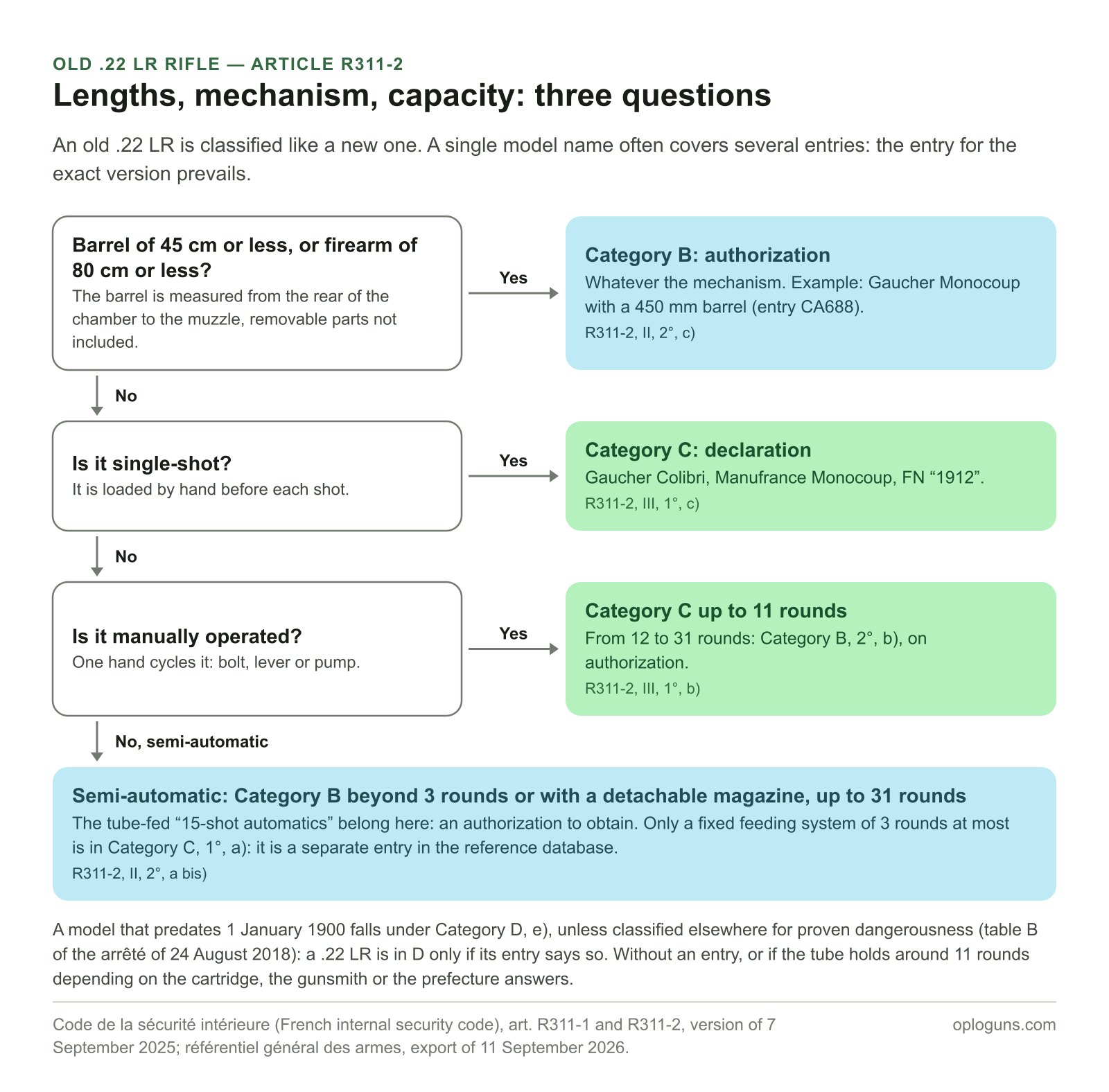
If you have inherited a family .22 or found one in the attic, its classification rests on four elements that article R311-2 of the code de la sécurité intérieure, the French internal security code, names1. The first three are read on the firearm, the fourth is measured:
- The make, model and caliber, engraved on the firearm: the référentiel général des armes (RGA), the official reference database of firearm models, opens one entry per model and per caliber, and distinguishes "22 Long Rifle" from "22 Short"3.
- The mechanism: single-shot, the firearm is loaded by hand before each shot; manually operated, one hand cycles it by bolt, lever or pump; semi-automatic, it reloads itself after each shot2.
- The feeding system: none, a detachable magazine, or a tubular magazine under the barrel or in the stock.
- The lengths: the barrel is measured « de l'extrémité arrière de la chambre jusqu'à l'autre extrémité du canon, les parties démontables non comprises » [from the rear end of the chamber to the other end of the barrel, removable parts not included]2.
Proof marks tell you something too. Since 1960, proof testing has been compulsory for all civilian firearms in France, and the firearms that pass are « poinçonnées, certifiées et enregistrées » [stamped, certified and recorded]6. The member countries of the Commission internationale permanente (C.I.P.), the international proof commission, recognize one another's proof marks. The Banc national d'épreuve in Saint-Étienne, the French national proof house, advises a re-proof after 30 years; according to it, any modification or repair of a safety-critical part « rend la ré-épreuve obligatoire » [makes re-proof compulsory]6.
Gevarm, Manufrance, Gaucher, FN: one entry per version
A single model name often covers several entries, whose heading changes with the mechanism, the feeding system or the length3.
| Reference database entry | Mechanism and feeding system | Heading |
|---|---|---|
| Gevarm A 6, AF714 | Semi-auto, detachable magazine | B, 2°, a bis) |
| Gevarm A 6, BW734 | Semi-auto, fixed, 2 rounds | C, 1°, a) |
| Gevarm A 6, CM106 | Manually operated, magazine | C, 1°, b) |
| Gevarm E 1, CH967 | Single-shot | C, 1°, c) |
| Manufrance Mercure, AI720 | Semi-auto, detachable magazine | B, 2°, a bis) |
| Manufrance Reina 450, AI733 | Manually operated | C, 1°, b) |
| Manufrance Monocoup, AI721 | Single-shot | C, 1°, c) |
| Gaucher Colibri, AF633 | Single-shot | C, 1°, c) |
| Gaucher Monocoup, CA688 | Single-shot, 450 mm barrel | B, 2°, c) |
| FN "1912", BP155 | Single-shot | C, 1°, c) |
| FN M 69, AF398 | Manually operated, magazine | C, 1°, b) |
The Gaucher Monocoup CA688 shows the length condition at work: its 450 mm barrel reaches the 45 cm of B, 2°, c), which covers any long gun « dont la longueur du canon est inférieure ou égale à 45 centimètres » [whose barrel length is 45 centimeters or less]13. Entry CF994, with the same name and the same overall length, 930 mm, has a 460 mm barrel: it is in C, 1°, c). One centimeter of barrel separates the two categories.
The rarer mechanisms, pump-action, folding or takedown, are detailed in pump-action, folding or takedown .22 LR rifles.
Old tube-fed semi-automatic: Category B
Article R311-1 lists tubular magazines among the feeding systems « faisant partie intégrante de l'arme » [forming an integral part of the firearm]2. A tube is therefore part of the firearm. But Category C, 1°, a) requires two conditions together: a fixed feeding system and « 3 munitions au plus » [3 rounds at most]1. Beyond 3 rounds, B, 2°, a bis) takes over: a rimfire semi-automatic « d'une capacité supérieure à 3 coups ou équipée d'un système d'alimentation amovible et n'excédant pas 31 coups » [with a capacity of more than 3 rounds or fitted with a detachable feeding system, and not exceeding 31 rounds]1. Beyond thirty-one rounds, with a magazine of more than thirty cartridges built in or inserted, A1, 3° takes over; a semi-automatic « ayant l'apparence d'une arme automatique » [having the appearance of an automatic firearm] falls under B, 2°, e)1.
The "15-shot automatics" that families hand down belong here. The reference database places them in B, 2°, a bis)3:
- Winchester Model 190, 15-round tube, AR058; Winchester 63, 10-round tube, AQ853.
- Browning SA-22, with the tube housed in the stock and loaded through a port on its right side, according to Browning8: 9 or 11 rounds depending on the entry.
- Remington 241 and 552 Speedmaster, 15-round tube; Marlin 60, 14 or 18 rounds.
No .22 LR semi-automatic with a built-in feeding system exceeds 18 rounds there: the 31 rounds of B, 2°, a bis) are never reached3.
The reference database also holds separate entries with a « tige magasin inamovible » [fixed magazine rod] of 2 rounds, in C, 1°, a): Winchester Model 190 (AR059), Winchester 63 (BR439), Browning SA-22 (AD419), Marlin 60 (BW395)3. A rifle belongs under one of them only if it is that version: the gunsmith checks it on the firearm.
Counting the rounds in a tube: what the text leaves out
A .22 tube does not hold the same number of cartridges depending on their length. For a current pump-action rifle, Henry lists "16 LR / 18 L / 23 S" in the same tube7. The code speaks of « coups » [shots] and « munitions » [rounds] fired « sans qu'intervienne le réapprovisionnement » [without reloading], without specifying the cartridge1. The reference database entries record a single capacity per version3.
The tube-fed semi-automatic entries cited above, recorded at 9 to 18 rounds, are in B, 2°, a bis); for the versions recorded at 2 rounds, the text does not say how to count by cartridge either. For a pump- or lever-action rifle close to 11 rounds in .22 LR, the cartridge can matter: the reference database places a Remington 572, sold as a pump-action rifle, with a 10-round tube in C, 1°, b), and another entry of 20 rounds in B, 2°, b)39. The text does not allow a conclusion for a tube that holds 11 Long Rifle and more Short: the answer is asked of the gunsmith or the prefecture.
Before 1900: Category D, with exceptions
Category D, e) covers « armes historiques et de collection dont le modèle est antérieur au 1er janvier 1900 à l'exception de celles classées dans une autre catégorie en raison de leur dangerosité avérée » [historical and collector's firearms whose model predates 1 January 1900, except those classified in another category because of their proven dangerousness], by arrêté1. That arrêté is the one of 24 August 2018 setting the regime for historical and collector's firearms and their reproductions: its article 2 excepts the firearms « dont la dangerosité est avérée et qui sont énumérées dans le tableau B de l'annexe 1 » [whose dangerousness is proven and which are listed in table B of annex 1], which « ne sont pas classées au e de la catégorie D mais dans les catégories A, B ou C » [are not classified under e of Category D but in Categories A, B or C]10. The date that opens D, e) is that of the model; the year of manufacture, for its part, can justify a classification elsewhere, and a name counts for nothing.
The reference database thus places a MAS « Mle 1890 de cavalerie » [Model 1890 cavalry] rifle in .22 Long Rifle, single-shot, in C, 1°, c)3. D, g) adds firearms of a model later than 1900 « énumérées par un arrêté » [listed by an arrêté] for their cultural, historical or scientific interest1. A .22 LR rifle is in Category D only if its entry says so. The regime of each category is summarized in firearm categories A, B, C and D.
Inherited old .22 LR rifle: declaring it
If you keep the rifle, the procedure depends on the category read on its entry. It is detailed in inherited firearm: what to do; the texts are the same.
- Category C: article R312-55 requires the coming into possession of an inherited or found firearm to be declared « sans délai » [without delay], through the personal SIA account4. A medical certificate less than a month old is added « dans un délai de trois mois » [within three months], unless the account already contains one of the documents of article R312-53: a validated hunting permit, a shooting, ball-trap or biathlon license, a collector's card. Failing that, the prefect orders the firearm to be relinquished.
- Category B: article R312-51 requires the same declaration « sans délai », then deposit with a gunsmith authorized for the category « au plus tard trois mois à compter de la déclaration » [no later than three months from the declaration]; failing that, the prefect orders the firearm to be relinquished5. The code imposes this route only « le cas échéant » [where applicable], that is, when the heir does not already meet the conditions: according to factsheet F11629, a licensed shooter who already holds the authorization and has not reached their maximum number of firearms has no deposit to make11. The twelve months run from the declaration and serve to obtain the authorization; at the end of the twelve months, if the conditions are not met, the heir relinquishes the firearm or has it deactivated5.
The online declaration of a Category C firearm is described in declaring a Category C firearm. The trip to the gunsmith is made with the firearm not immediately usable: see transporting your firearm.
When the text is not enough: gunsmith or prefecture
The text and the reference database do not allow a conclusion in four cases:
- No entry under the name read on the firearm, or an illegible marking.
- A tube whose capacity varies around 11 rounds depending on the cartridge.
- A firearm modified from its entry: feeding system, barrel or stock.
- A doubt about the model's date with regard to Category D, e).
In these cases, you present the firearm to a gunsmith, who identifies it and finds its entry; the prefecture settles the classification. A firearm on which a safety-critical part has been repaired or modified calls, for the Banc national d'épreuve, for a compulsory re-proof6.
Three misconceptions about old .22 LR rifles
- "An old .22 is Category D." Only a model that predates 1 January 1900, outside the exceptions set by arrêté, falls there; a "Mle 1890" in .22 LR is in the reference database in C, 1°, c)13.
- "A fixed magazine means Category C." A tube of more than 3 rounds puts the semi-automatic in B, 2°, a bis)12.
- "A rifle inherited from grandfather does not have to be declared." Kept, it is declared without delay, in Category C as in B45.
The text and the entry prevail. The headings cited are those of article R311-2, version in force since 7 September 2025, reread on 15 November 2026; the entries, those of the export of the référentiel général des armes of 11 September 2026. An old rifle whose version remains uncertain is identified by a gunsmith before the declaration.
Sources 11 references
The articles of the code de la sécurité intérieure were reread on Légifrance on 15 November 2026, the référentiel général des armes counted in its export of 11 September 2026, the pages of the Banc national d'épreuve and of the manufacturers consulted on 15 November 2026. French documents keep their French titles and quotations, with a short translation in brackets. Click a note marker in the text to highlight the matching source.
- Légifrance — article R311-2 du code de la sécurité intérieure, « En vigueur depuis le 07 septembre 2025 » [in force since 7 September 2025] (decree no. 2025-894 of 5 September 2025), reread on 15 November 2026: A1, 3°, « Armes à feu d'épaule à répétition semi-automatique à percussion annulaire permettant le tir de plus de trente et une munitions sans qu'intervienne un réapprovisionnement, dès lors qu'un chargeur d'une capacité supérieure à trente cartouches fait partie intégrante de l'arme à feu ou, s'il est amovible, y a été inséré » [rimfire semi-automatic long guns able to fire more than thirty-one rounds without reloading, where a magazine of more than thirty cartridges is built in or, if detachable, inserted]; B, 2°, e), « A répétition semi-automatique ayant l'apparence d'une arme automatique » [semi-automatic with the appearance of an automatic firearm]; B, 2°, a bis), « A répétition semi-automatique à percussion annulaire, dont le projectile a un diamètre inférieur à 20 mm, d'une capacité supérieure à 3 coups ou équipées d'un système d'alimentation amovible et n'excédant pas 31 coups sans qu'intervienne un réapprovisionnement » [rimfire semi-automatic, projectile under 20 mm, capacity above 3 rounds or detachable feeding system, not exceeding 31 rounds without reloading]; B, 2°, b), manually operated « d'une capacité supérieure à 11 coups et n'excédant pas 31 coups » [with a capacity above 11 rounds and not exceeding 31]; B, 2°, c), « Dont la longueur totale minimale est inférieure ou égale à 80 centimètres ou dont la longueur du canon est inférieure ou égale à 45 centimètres » [minimum overall length of 80 centimeters or less, or barrel length of 45 centimeters or less]; C, 1°, a), « A répétition semi-automatique dont le projectile a un diamètre inférieur à 20 mm équipées de systèmes d'alimentation inamovibles permettant le tir de 3 munitions au plus sans qu'intervienne le réapprovisionnement » [semi-automatic, fixed feeding system allowing 3 rounds at most without reloading]; C, 1°, b), « A répétition manuelle dont le projectile a un diamètre inférieur à 20 mm équipées de systèmes d'alimentation permettant le tir de 11 munitions au plus, sans qu'intervienne le réapprovisionnement » [manually operated, feeding system allowing 11 rounds at most without reloading]; C, 1°, c), « A un coup par canon » [single-shot per barrel]; D, e), « Armes historiques et de collection dont le modèle est antérieur au 1er janvier 1900 à l'exception de celles classées dans une autre catégorie en raison de leur dangerosité avérée, notamment en raison de leur année de fabrication par arrêté conjoint du ministre de l'intérieur et du ministre chargé des douanes » [historical and collector's firearms whose model predates 1 January 1900, except those classified elsewhere for proven dangerousness, notably because of their year of manufacture, by joint arrêté of the interior and customs ministers]; D, g), « Armes historiques et de collection dont le modèle est postérieur au 1er janvier 1900 et qui sont énumérées par un arrêté conjoint du ministre de l'intérieur et de la défense compte tenu de leur intérêt culturel, historique ou scientifique » [historical and collector's firearms whose model is later than 1 January 1900, listed by joint arrêté for their cultural, historical or scientific interest].
- Légifrance — article R311-1 du code de la sécurité intérieure, « En vigueur depuis le 07 septembre 2025 », reread on 15 November 2026: 7°, manual repetition, a firearm « rechargée manuellement par introduction dans le canon d'une munition prélevée dans un système d'alimentation et transportée à l'aide d'un mécanisme » [reloaded manually by feeding into the barrel a round taken from a feeding system and carried by a mechanism]; 8°, semi-automatic repetition, a firearm that « se recharge automatiquement » [reloads automatically] and releases only one shot per pull of the trigger; 9°, single-shot firearm, « sans système d'alimentation, qui est chargée avant chaque coup par introduction manuelle de la munition » [without a feeding system, loaded before each shot by inserting the round by hand]; 27°, feeding systems, « les magasins faisant partie intégrante de l'arme, tubulaires ou intégrés dans la boîte de culasse, et les magasins indépendants de l'arme » [magazines forming an integral part of the firearm, tubular or built into the receiver, and magazines independent of the firearm]; « La longueur de référence du canon d'une arme d'épaule se mesure de l'extrémité arrière de la chambre jusqu'à l'autre extrémité du canon, les parties démontables non comprises » [the reference barrel length of a long gun is measured from the rear end of the chamber to the other end of the barrel, removable parts not included]. No rule for counting capacity according to cartridge length.
- Ministère de l'Intérieur, SCAE, data.gouv.fr — Référentiel général des armes (RGA), export of 11 September 2026, consulted on 15 November 2026 (calibers "22 LONG RIFLE" and "22 SHORT" distinct; overall length / barrel in mm): Gevarm AF714 A 6, semi-automatic, detachable magazine, 1040/550, B 2° a bis); BW734 A 6, built-in 2 rounds, C 1° a); CM106 A 6, manually operated, C 1° b); AF718 E 1, semi-automatic, B 2° a bis); CH967 E 1, single-shot, C 1° c); Manufrance AI720 Mercure, semi-automatic, B 2° a bis); AI733 Reina 450, manually operated, C 1° b); AI734 Reina 450, semi-automatic, B 2° a bis); AI721, BW934, CC059 Monocoup, C 1° c); Gaucher AF633, BM484, BT370 Colibri, single-shot, barrels of 510 to 650 mm, C 1° c); CA688 Gaucher Monocoup, 930/450, B 2° c); CF994 Gaucher Monocoup, 930/460, C 1° c); FN BP155 and BU714 "1912", C 1° c); AF398 FN M 69, C 1° b); Winchester AR058 Model-190, 15-round tube, B 2° a bis), and AR059, 2 rounds, C 1° a); AQ853 Winchester 63, 10-round tube, B 2° a bis), and BR439 « tige magasin inamovible » [fixed magazine rod], 2 rounds, C 1° a); Browning BN532 SA-22, 9-round tube, and AD421 SA-22 (Takedown), 11-round tube, B 2° a bis); AD419 SA-22 « tige magasin inamovible », 2 rounds, C 1° a); AL951 Remington 241 and AL984 552 Speedmaster, 15-round tube, B 2° a bis); Marlin AI821 and AI822 model 60, 14- and 18-round tube, B 2° a bis); BW395 Marlin 60 « tige magasin inamovible », 2 rounds, C 1° a); .22 LR semi-automatic rifles with a built-in feeding system: capacities recorded from 2 to 18 rounds; Remington 572, AL986 10-round tube, C 1° b), and AL987 20-round tube, B 2° b); CE797 MAS « Mle 1890 de cavalerie », 22 Long Rifle, single-shot, 940/470, C 1° c).
- Légifrance — article R312-55 du code de la sécurité intérieure, « En vigueur depuis le 29 juin 2024 » [in force since 29 June 2024], reread on 15 November 2026: « Toute personne mise en possession d'une arme ou d'un élément d'arme de la catégorie C » [any person who comes into possession of a Category C firearm or firearm component] « trouvés par elle ou qui lui sont dévolus par voie successorale » [found by them or passed to them by inheritance] declares this coming into possession « sans délai » through the personal account; medical certificate « de moins d'un mois » [less than a month old] added « dans un délai de trois mois » [within three months], replaced by « la copie de l'un des titres prévus au premier alinéa de l'article R. 312-53 » [a copy of one of the documents provided for in the first paragraph of article R. 312-53] in the account (validated hunting permit, shooting, ball-trap or biathlon license, collector's card, according to R312-53 as cited by the category guide, read on 1 November 2026); « A défaut, le préfet en ordonne le dessaisissement » [failing that, the prefect orders it to be relinquished].
- Légifrance — article R312-51 du code de la sécurité intérieure, « En vigueur depuis le 29 juin 2024 », reread on 15 November 2026: Category A or B firearm « trouvés par elle ou qui lui sont dévolus par voie successorale et qu'elle souhaite conserver » [found by them or passed to them by inheritance and which they wish to keep]; declaration « sans délai »; deposit with a professional « au plus tard trois mois à compter de la déclaration » [no later than three months from the declaration]; « A défaut, le préfet en ordonne le dessaisissement », failing that deposit, under articles R. 312-74 and R. 312-75; « Le cas échéant, cette personne dispose d'un délai de douze mois à compter de sa déclaration » [where applicable, this person has twelve months from their declaration] to obtain the authorization or come back under the quotas; when that period expires, if they do not meet the conditions, they relinquish the firearm under the same articles « ou fait neutraliser l'arme » [or have the firearm deactivated].
- Banc national d'épreuve de Saint-Étienne — Éprouver une arme [proof-testing a firearm], consulted on 15 November 2026: « En 1960, l'épreuve est rendue obligatoire pour toutes les armes à feu civiles » [in 1960, proof testing was made compulsory for all civilian firearms]; « Les armes acceptées sont alors poinçonnées, certifiées et enregistrées »; mutual recognition of proof marks between the signatory states of the C.I.P.; « Toute modification ou réparation d'une pièce de sécurité rend la ré-épreuve obligatoire » [any modification or repair of a safety-critical part makes re-proof compulsory]; the Banc « conseille une ré-épreuve après 30 ans » [advises a re-proof after 30 years].
- Henry Repeating Arms — H3 Frontier Pump Action Rifle, consulted on 15 November 2026: model H003T, ".22 S/L/LR", "Capacity 16 LR / 18 L / 23 S". Current American version, cited for the difference in capacity depending on the cartridge.
- Browning — SA-22, consulted on 15 November 2026: "the tubular magazine is located in the stock. Cartridges load through a port in the right side of the buttstock".
- Armurerie Loisir — carabines .22 LR, read on 15 November 2026: « Carabine à pompe Remington 572 Fieldmaster .22Lr » [Remington 572 Fieldmaster .22 LR pump-action rifle]. ⚠️ Commercial data.
- Légifrance — arrêté du 24 août 2018 fixant le régime des armes historiques et de collection et de leurs reproductions, version in force on 15 November 2026 (last updated on 7 July 2025), consulted on 15 November 2026: article 2, firearms of a model that predates 1 January 1900 in Category D, e), « à l'exception de celles dont la dangerosité est avérée et qui sont énumérées dans le tableau B de l'annexe 1 » [except those whose dangerousness is proven and which are listed in table B of annex 1]; annex: « Ne sont pas classées au e de la catégorie D mais dans les catégories A, B ou C » [not classified under e of Category D but in Categories A, B or C].
- Site guide — inherited firearm: what to do, citing Service-Public factsheet F11629 (verified on 6 January 2025, consulted on 24 September 2026): an FFTir license holder who already holds the authorization and has not reached their maximum number of firearms has no deposit to make; the code imposes this route only « le cas échéant »; at the end of the twelve months, the heir relinquishes the firearm or has it deactivated.
Frequently asked questions
What category is a 15-shot automatic Winchester .22 LR rifle in?
A semi-automatic rifle with a 15-round tubular magazine exceeds the 3 rounds of Category C, 1°, a): article R311-2 places it in B, 2°, a bis), up to 31 rounds. The référentiel général des armes, the official French reference database of firearm models, accordingly classifies the Winchester Model 190 with a 15-round tube in B, 2°, a bis). Inherited and kept, it is declared without delay; if the heir does not already meet the conditions for holding it, it is deposited with a gunsmith within three months, while the authorization is obtained within twelve months.
Is a Browning .22 LR rifle that loads through the stock in Category B?
The Browning SA-22, a semi-automatic whose tubular magazine sits in the stock, appears in the référentiel général des armes in B, 2°, a bis) with a 9- or 11-round tube. A separate entry, with a fixed 2-round magazine rod, is in C, 1°, a). The version is checked with a gunsmith before any declaration.
What category is a Gevarm .22 LR rifle in?
It depends on the version. The reference database places the semi-automatic Gevarm A 6 with a detachable magazine in B, 2°, a bis), the same rifle with a fixed 2-round feeding system in C, 1°, a), and a manually operated version in C, 1°, b). The Gevarm E 1 exists as a semi-automatic, in B, and as a single-shot, in C, 1°, c).
Is a single-shot Manufrance .22 LR rifle in Category C?
A rifle that is single-shot per barrel falls under C, 1°, c), and the reference database places the Manufrance single-shots there. A barrel of 45 cm or less, or a minimum overall length of 80 cm or less, would move the firearm to Category B: one Gaucher Monocoup entry with a 450 mm barrel is classified in B, 2°, c).
Is a Gaucher Colibri in Category C?
The référentiel général des armes holds three Gaucher Colibri entries in .22 Long Rifle, all single-shot and all in C, 1°, c), with barrels of 510 to 650 mm. It is declared in the SIA account; inherited and kept, without delay, with a medical certificate less than a month old within three months if the account contains no shooting, ball-trap or biathlon license, no validated hunting permit and no collector's card.
Is an old FN Herstal rifle in .22 LR a collector's firearm?
Not automatically. Category D, e) covers firearms whose model predates 1 January 1900, except those an arrêté classifies elsewhere. The reference database places FN rifles in .22 Long Rifle in C: the "1912" and the single-shots in C, 1°, c), the manually operated M 69 in C, 1°, b).
Spotted an error, or a rule that has changed since we checked? Report an error