Inherited firearm in France: what to do, and by when
Published on · Updated on · 10 min read · Anthony Baillon
An inherited firearm that you keep is declared without delay in the SIA account. In Category A or B, it is then deposited with a gunsmith within three months, while the authorization is obtained within twelve months. A firearm not kept is not declared: it is sold, destroyed or handed over, within three months in A or B.
At a glance
| Situation | Procedure | Deadline |
|---|---|---|
| Keeping, Category A or B | Declare in the SIA, deposit with a gunsmith | Without delay, then 3 and 12 months |
| Keeping, Category C | Declare in the SIA, certificate if no qualifying document | Without delay, then 3 months |
| Not keeping | Sell, have destroyed or hand over to the State | A or B: 3 months after coming into possession |
- Two starting points: the deposit is counted from the declaration, the relinquishment from the coming into possession.
- Deposit with a gunsmith designated by the State appears in the code, not among the options of factsheet F11629.
- A found firearm follows exactly the same rules as an inherited one.
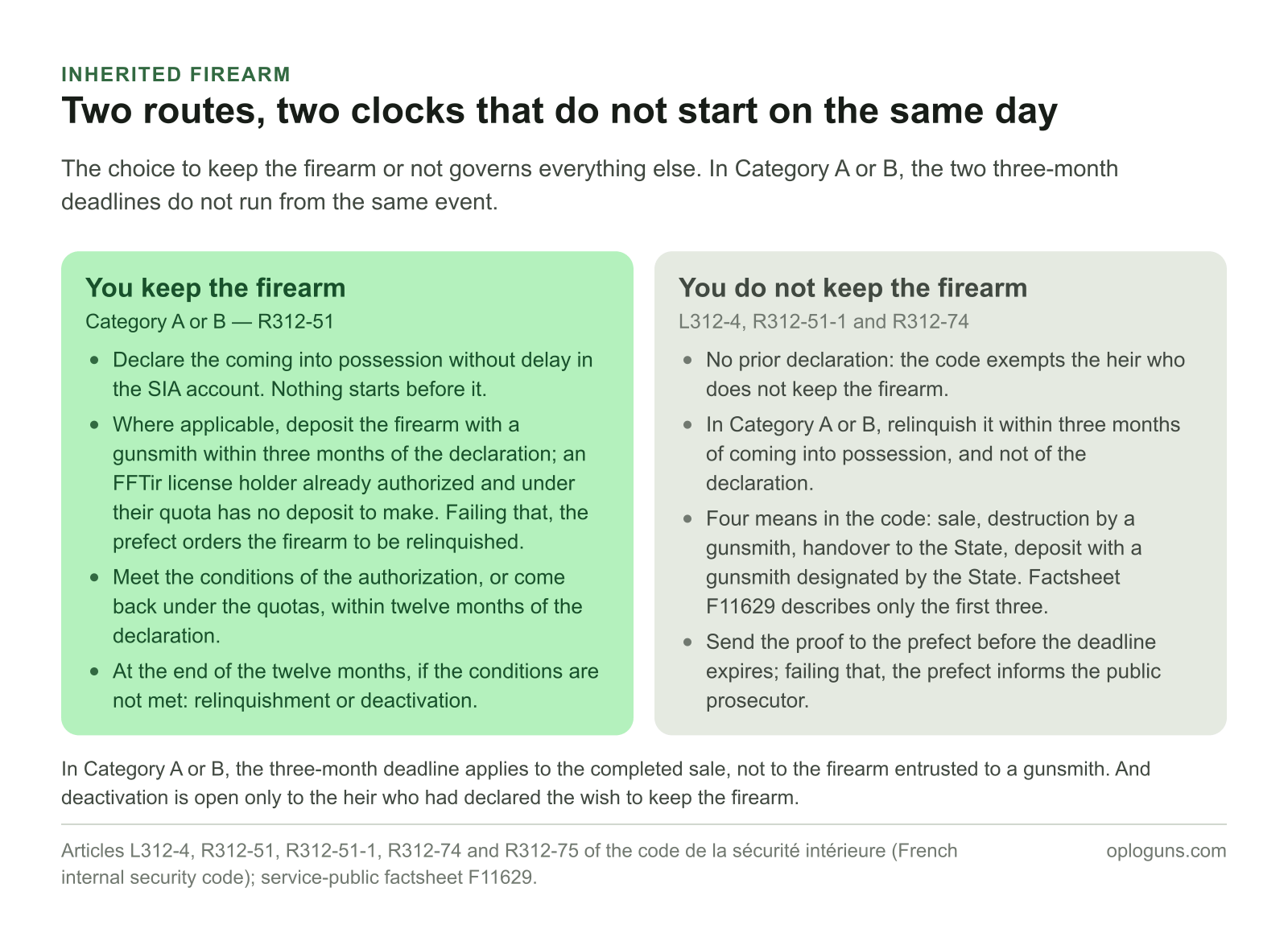
Inherited firearm: keeping it or not decides the whole route
The code de la sécurité intérieure, the French internal security code, lays out two distinct paths depending on whether the heir wishes to keep the firearm or not23. The heir who keeps it declares, then regularizes. The heir who does not keep it has nothing to declare and parts with it, in Category A or B, within three months of coming into possession5.
- The category governs the deadlines: authorization for Category B, where every cartridge-firing pistol falls, a simple declaration for Category C. The classification is in firearm categories A, B, C and D; the case of an old .22 LR rifle is treated separately.
- A found firearm follows the same rules: articles R312-51 and R312-55 cover the firearm that is « trouvée » [found] and the one « dévolue par voie successorale » [passed on by inheritance] in the same sentence24.
- Hesitating suspends nothing: the relinquishment deadline runs from the coming into possession, not from the decision.
Keeping an inherited firearm: SIA declaration without delay
Article R312-51 requires any person who comes into possession of a Category A or B firearm they wish to keep to declare « cette mise en possession sans délai par l'intermédiaire du compte individualisé » [this coming into possession without delay through the personal account]2. Article R312-55 uses the same wording for Category C4.
« Sans délai » [without delay] means that no waiting is provided for, not even for the settlement of the estate. The declaration requires an account in the SIA, the French firearms information system, whose creation is described in the SIA account and the digital gun rack. It regularizes nothing on its own: it opens the deadlines that follow.
Category A or B: the firearm at a gunsmith within 3 months
The firearm is deposited with a gunsmith authorized for its category, who records it in the livre de police, the register gun dealers must keep, « au plus tard trois mois à compter de la déclaration » [no later than three months from the declaration]; failing that, the prefect orders the firearm to be relinquished2. Factsheet F11629 on service-public, the French government's information site, adds that the gunsmith keeps the firearm for one year1.
The code imposes this route only « le cas échéant » [where applicable], that is, when the heir does not already meet the conditions2. Factsheet F11629 gives the typical case: a license holder of the FFTir, the French shooting federation, who already holds the authorization and has not reached their maximum number of firearms has no deposit to make1. That number is fifteen firearms, six for five years for a first-time holder9.
Twelve months to obtain the authorization
The twelve months run from the declaration, not from the death. They serve to meet the conditions of the Category B authorization or to come back under the quotas2.
The deadlines for an inherited firearm, depending on what you do with it
In days; three months counted as 90 days, twelve months as 365. The declaration, due without delay, is not counted in days.
Deposit and twelve-month period: article R312-512. Medical certificate for Category C: article R312-554. Relinquishment of a Category A or B firearm not kept, counted from the coming into possession: article L312-45.
View the data
| Deadline | Period | Starting point |
|---|---|---|
| Declaration of coming into possession | Without delay | The coming into possession |
| Deposit with a gunsmith (A or B) | 3 months | The declaration |
| Medical certificate (C, no qualifying document) | 3 months | The declaration |
| Relinquishment of a firearm not kept (A or B) | 3 months | The coming into possession |
| Authorization or return under the quotas (A or B) | 12 months | The declaration |
The period is enough for a beginner's route: three controlled sessions at least two months apart10, then the processing of the application, that is 4 to 7 months between the license and the authorization. The detail is in the Category B firearm authorization and in controlled sessions.
At the end of the twelve months, if the conditions are not met, the heir relinquishes the firearm or has it deactivated2.
Inherited Category C: medical certificate within 3 months
Category C requires neither deposit nor authorization. A single deadline is added to the declaration: a medical certificate less than a month old, attesting to a state of health compatible with holding the firearm, to be added « dans un délai de trois mois » [within three months]. Failing that, the prefect orders the firearm to be relinquished4.
The certificate is not required if the SIA account already contains a copy of a validated hunting permit, a shooting, ball-trap or biathlon license, or a collector's card41. The general procedure is in declaring a Category C firearm.
Inheriting a hunting shotgun without a hunting permit
An inherited hunting shotgun can be kept without a hunting permit. Over-and-under, side-by-side or single-barrel, it is « à un coup par canon » [single-shot per barrel]; bolt-action, up to eleven rounds, it is « à répétition manuelle » [manually operated]. In both cases, it falls under Category C7. A semi-automatic belongs there only if its magazine, fixed, fires three rounds at most: otherwise, its classification is checked in firearm categories.
Keeping it takes two steps: declaring it without delay in the SIA account, then adding within three months a medical certificate less than a month old4. Without a validated hunting permit, a shooting, ball-trap or biathlon license, or a collector's card in the account, this certificate is compulsory41. Failing that, the prefect orders the firearm to be relinquished4.
Inherited firearm not kept: four means in the code
The heir who does not keep the firearm parts with it without declaring it first3, within three months of coming into possession for a Category A or B firearm5. Article R312-74 provides four means6; factsheet F11629 details the first three1:
- Sale to a gunsmith, or to a private individual through a gunsmith or an approved broker.
- Destruction by a gunsmith, a service the gunsmith may charge for.
- Handing in at the police station or the gendarmerie, for destruction or reuse, with cerfa form no. 11845.
- Deposit with a gunsmith designated by the State « et agissant sous son contrôle aux fins de la remise » [and acting under its control for the purposes of the handover] to the State6. Factsheet F11629 does not count it among the options it describes1.
The professional asks for a valid identity document13. Proof of the relinquishment is sent to the prefect before the deadline expires; failing that, the prefect informs the public prosecutor6. The code pénal, the French criminal code, punishes by five years' imprisonment and a €75,000 fine the holding of a Category A or B firearm without the required authorization, « en violation des articles L. 312-1 à L. 312-4 » [in breach of articles L. 312-1 to L. 312-4] of the code de la sécurité intérieure, under which this three-month deadline falls (article 222-52); holding a Category C firearm « en l'absence de la déclaration prévue » [without the required declaration] is punished by two years' imprisonment and a €30,000 fine (article L317-4-1)17.
The trip to the gunsmith or the gendarmerie is made with the firearm not immediately usable, by a technical device or by removing a component11; a call beforehand avoids turning up unannounced with a firearm. The transport rules are in transporting a firearm, the sale in selling or buying a firearm between private individuals, and the penalties for holding without entitlement in a separate guide.
Keeping, selling or handing over the firearm: pros and cons
Keeping the firearm
Pros
Selling it
Pros
- The firearm keeps its value for the estate.
- No prior declaration and no license to obtain3.
Handing it over for destruction
Pros
- The most direct route: one appointment and one cerfa form no. 118451.
- No buyer to find and no sale to close within the deadline.
Cons
- The firearm's value is lost to the heirs.
- Destruction may be charged for if it goes through a gunsmith1.
According to what you expect from the firearm
To shoot with it, keeping the firearm goes through the license and the authorization, which the twelve months leave time to obtain. In return, the firearm stays at the gunsmith's during the formalities, except for a license holder who is already authorized and under their quota.
To get a price for it, a sale through a gunsmith or a broker preserves the firearm's value. In return, in Category A or B, the three-month deadline applies to the completed sale, not to the firearm entrusted.
To be done quickly, handing it in at the police station or the gendarmerie settles the matter in one appointment. In return, the firearm is lost to the estate.
Deactivating the inherited firearm: after the twelve months
The code opens deactivation only to the heir who declared they were keeping the firearm and who, after the twelve months, does not meet the conditions2. It does not appear among the means of relinquishment of article R312-746.
- Who deactivates: the Banc national d'épreuve in Saint-Étienne, the French national proof house, not the gunsmith, who can only destroy8.
- What is left: a deactivated firearm enters Category C, 9°, and remains subject to declaration7.
Keeping an inherited Category B firearm: yearly budget
For an heir who does not yet hold a license, excluding the gunsmith's storage fees, agreed with them.
| Item | First year | Following years |
|---|---|---|
| License and club membership fee | €165 to €3201213 | €165 to €2701213 |
| Medical certificate | €3014 | €30 |
| Handgun safe | €123 to €2591516 | — |
- First year: €318 to €609.
- Following years: €195 to €300, license and medical certificate.
The storage obligations are detailed in what the law requires of a gun safe.
Four misconceptions about inherited firearms
- "You have twelve months to declare the firearm." No: the declaration is due without delay; the twelve months run from it2.
- "The firearm can stay at home during the formalities." Not in Category A or B: deposit with a gunsmith within three months2, except for an FFTir license holder who is already authorized and under their quota1.
- "A gunsmith designated by the State takes back firearms from estates." The code provides for this deposit, for the purposes of a handover to the State6, but factsheet F11629 does not count it among the options it describes: sale, destruction by a gunsmith, handing in at the police station or the gendarmerie1.
- "The State confiscates the firearm after a year." No automatic forfeiture is provided for: the heir relinquishes the firearm, sale included, or has it deactivated26.
Sources 17 references
The articles of the code de la sécurité intérieure were reread on Légifrance in their version in force on 24 September 2026, L312-4, R312-74 and the penalty articles on 16 November 2026, like the service-public.gouv.fr factsheet. French documents keep their French titles and quotations, with a short translation in brackets. Click a note marker in the text to highlight the matching source.
- Service-Public (DILA) — Comment faire si l'on trouve ou si l'on hérite d'une arme ?, fiche F11629 [What to do if you find or inherit a firearm?, factsheet F11629], « Vérifié le 13 octobre 2026 » [verified on 13 October 2026], consulted on 16 November 2026: firearm you do not wish to keep, « Vous avez 4 possibilités pour abandonner l'arme trouvée ou héritée » [you have 4 options for giving up the found or inherited firearm]: « Vendre l'arme à un armurier » [sell the firearm to a gunsmith]; « Vendre l'arme à un particulier par l'intermédiaire d'un armurier ou d'un courtier agréé » [sell the firearm to a private individual through a gunsmith or an approved broker]; « Remettre l'arme à un armurier, pour destruction (prestation que l'armurier peut facturer) » [hand the firearm to a gunsmith for destruction (a service the gunsmith may charge for)]; « Remettre l'arme à un commissariat ou à une brigade de gendarmerie, pour destruction ou valorisation » [hand the firearm in at a police station or a gendarmerie unit, for destruction or reuse], with the « formulaire cerfa n°11845 »; valid proof of identity shown to the gunsmith; Category A or B firearm kept: declaration in the SIA, « Vous devez remettre l'arme à un armurier dans un délai de 3 mois à partir de la déclaration de l'arme. Cet armurier conserve l'arme pendant 1 an. » [You must hand the firearm to a gunsmith within 3 months of declaring it. That gunsmith keeps the firearm for 1 year.]; license holder of the Fédération française de tir who has a current authorization and has « pas atteint le nombre maximal d'armes autorisées » [not reached the maximum number of authorized firearms]: « vous devez ajouter l'arme dans votre râtelier numérique via votre compte SIA » [you must add the firearm to your digital gun rack through your SIA account], with no handover to a gunsmith; Category C, without a hunting permit, collector's card or license: medical certificate added « dans un délai de 3 mois » [within 3 months]; hunters and holders of a shooting, ball-trap or biathlon license: online declaration, with no certificate; « Détenir une arme de catégorie A ou B sans autorisation en cours de validité est puni de 5 ans d'emprisonnement maximum et de 75 000 € d'amende » [holding a Category A or B firearm without a current authorization is punished by up to 5 years' imprisonment and a €75,000 fine]; « Détenir une arme de catégorie C sans respecter les règles de déclaration et de justificatifs est puni de 2 ans d'emprisonnement maximum et de 30 000 € d'amende » [holding a Category C firearm without complying with the declaration and supporting-document rules is punished by up to 2 years' imprisonment and a €30,000 fine]. The factsheet mentions neither a deadline for giving up a firearm you do not keep, nor deposit with a gunsmith designated by the State.
- Légifrance — article R312-51 du code de la sécurité intérieure, version in force since 29 June 2024 (decree no. 2024-615 of 27 June 2024), consulted on 24 September 2026: Category A or B firearm « trouvés par elle ou qui lui sont dévolus par voie successorale et qu'elle souhaite conserver » [found by them or passed to them by inheritance and which they wish to keep]: declaration « sans délai » [without delay] through the personal account; « Le cas échéant » [where applicable], twelve months from the declaration to meet the conditions of the authorization or comply with the quotas; deposit with a professional authorized for the category, entered in the electronic police register, « au plus tard trois mois à compter de la déclaration » [no later than three months from the declaration], failing which the prefect orders the firearm to be relinquished; when the twelve months expire, relinquishment under R312-74 and R312-75 « ou fait neutraliser l'arme » [or has the firearm deactivated].
- Légifrance — article R312-51-1 du code de la sécurité intérieure, version in force since 29 June 2024, consulted on 24 September 2026: the heir or finder of a Category A or B firearm who does not wish to keep it relinquishes it under R312-74 « sans avoir à les déclarer préalablement » [without having to declare them beforehand]; the professional asks to see an identity document. Article R312-55-1 sets the same rule for Category C.
- Légifrance — article R312-55 du code de la sécurité intérieure, version in force since 29 June 2024, consulted on 24 September then on 1 November 2026: found or inherited Category C firearm that you wish to keep, declaration « sans délai » through the personal account; medical certificate less than a month old « joint à la déclaration dans un délai de trois mois » [added to the declaration within three months], failing which the prefect orders the firearm to be relinquished; « La présence de la copie de l'un des titres prévus au premier alinéa de l'article R. 312-53 dans le compte individualisé […] supplée à la production du certificat médical » [the presence in the personal account of a copy of one of the documents of the first paragraph of article R. 312-53 stands in for the medical certificate].
- Légifrance — article L312-4 du code de la sécurité intérieure, version in force since 21 June 2019, consulted on 24 September then on 16 November 2026: « Quiconque devient propriétaire par voie successorale ou testamentaire d'une arme, d'un élément d'arme ou de munitions de catégorie A ou B, sans être autorisé à la détenir, doit s'en défaire dans un délai de trois mois à compter de la mise en possession » [anyone who becomes the owner, by inheritance or by will, of a Category A or B firearm, firearm component or ammunition without being authorized to hold it must part with it within three months of coming into possession].
- Légifrance — articles R312-74 et R312-75 du code de la sécurité intérieure, consulted on 24 September then on 16 November 2026: R312-74 (version in force since 29 June 2024) — 1° sale to a gunsmith or to a private individual, 2° repealed, 3° destruction by a gunsmith, 4° handover to the State for destruction or reuse, « 5° Dépôt auprès d'un armurier désigné par l'Etat et agissant sous son contrôle aux fins de la remise mentionnée au 4° » [5° deposit with a gunsmith designated by the State and acting under its control for the purposes of the handover mentioned in 4°]; R312-75 (version of 1 December 2014) — the holder sends the prefect proof of the relinquishment; failing that, the prefect informs the public prosecutor.
- Légifrance — article R311-2 du code de la sécurité intérieure, version in force since 7 September 2025 (decree no. 2025-894), consulted on 24 September then on 1 November 2026: Category C, 1°, long guns « a) A répétition semi-automatique » [semi-automatic] with fixed feeding systems « permettant le tir de 3 munitions au plus » [allowing 3 rounds at most], « b) A répétition manuelle » [manually operated] of 11 rounds at most, « c) A un coup par canon » [single-shot per barrel], d) rifled pump-action under conditions; Category C, 9°, deactivated firearms of Categories A, B or C.
- Banc national d'épreuve de Saint-Étienne — neutraliser une arme [deactivating a firearm], consulted on 24 September 2026: the deactivation of small-caliber firearms is entrusted to the Saint-Étienne proof house, under implementing regulation (EU) 2015/2403; deposit form for deactivation.
- Légifrance — articles R312-40 et R312-41-1 du code de la sécurité intérieure, version in force since 1 January 2024, consulted on 24 September 2026: « dans la limite de quinze armes » [within the limit of fifteen firearms]; « un maximum de six armes » [a maximum of six firearms] for five years for a first-time holder.
- Légifrance — arrêté du 28 avril 2020 relatif aux avis favorables et aux attestations délivrés par les fédérations, article 3, in force on 24 September 2026: « trois séances contrôlées de pratique du tir, espacées d'au moins deux mois » [three controlled shooting sessions, at least two months apart], during the twelve months before the application.
- Légifrance — article R315-4 du code de la sécurité intérieure, version in force since 1 August 2018: firearms transported « de manière à ne pas être immédiatement utilisables, soit en recourant à un dispositif technique répondant à cet objectif, soit par démontage d'un de leurs éléments » [so as not to be immediately usable, either by a technical device serving that purpose or by removing one of their components].
- USO Tir, FFTir-affiliated club — tarifs, saison 2026-2027 [fees, 2026-2027 season], consulted on 24 September 2026: adult €165, federation license, insurance and membership fee included.
- Tir Club Alpin — inscription et tarifs [registration and fees], 2026-2027 season, consulted on 24 September 2026: €318 for a new member, €268 at renewal.
- Assurance maladie — tarifs conventionnels des médecins généralistes [regulated fees for general practitioners], consulted on 24 September 2026: G consultation, €30.00 in mainland France.
- Natusport — coffres-forts et armoires fortes pour arme [gun safes and strong cabinets], prices read on 24 September 2026: Infac individual safe with shelf €123.00, Infac safe with shelves for handguns €161.00. ⚠️ Commercial data.
- Armurerie Centrale — coffres-forts [safes], prices read on 24 September 2026: Fortify Delta 1, €149.90; Infac C3A, 3 mm walls, €259.00. ⚠️ Commercial data.
- Légifrance — article 222-52 du code pénal, « En vigueur depuis le 05 juin 2016 » [in force since 5 June 2016], reread on 16 November 2026: « Le fait d'acquérir, de détenir ou de céder des matériels de guerre, armes, éléments d'armes ou munitions relevant des catégories A ou B, sans l'autorisation prévue au I de l'article L. 2332-1 du code de la défense, en violation des articles L. 312-1 à L. 312-4, L. 312-4-3, L. 314-2 et L. 314-3 du code de la sécurité intérieure, est puni de cinq ans d'emprisonnement et de 75 000 € d'amende. » [Acquiring, holding or transferring Category A or B war materiel, firearms, components or ammunition without the required authorization, in breach of articles L. 312-1 to L. 312-4, L. 312-4-3, L. 314-2 and L. 314-3 of the code de la sécurité intérieure, is punished by five years' imprisonment and a €75,000 fine.]; article L317-4-1 du code de la sécurité intérieure, « En vigueur depuis le 21 juin 2019 » [in force since 21 June 2019], reread on 16 November 2026: « Sont punies de deux ans d'emprisonnement et de 30 000 € d'amende l'acquisition, la cession ou la détention d'une ou de plusieurs armes, de munitions ou de leurs éléments de la catégorie C en l'absence de la déclaration prévue à l'article L. 312-4-1 ou à l'article L. 314-2-1. » [Acquiring, transferring or holding one or more Category C firearms, ammunition or their components without the declaration provided for in article L. 312-4-1 or article L. 314-2-1 is punished by two years' imprisonment and a €30,000 fine.]
The text in force prevails. This article describes the texts as of 24 September 2026; R311-2 and R312-55 reread on 1 November 2026; factsheet F11629, L312-4, R312-74 and the penalty articles reread on 16 November 2026. For a particular situation, the body to contact is the firearms department of the prefecture of your home.
Frequently asked questions
How long do you have to declare an inherited firearm?
No time at all: the declaration is made « sans délai » [without delay], as soon as you come into possession, through the SIA account (articles R312-51 for Categories A and B, R312-55 for Category C). The twelve months often quoted do not concern the declaration: they run from it and serve to obtain the authorization or to come back under the quotas. An heir who does not keep the firearm, for their part, has nothing to declare.
Can you keep an inherited Category B firearm at home during the formalities?
As a general rule, no. Article R312-51 requires it to be deposited with a gunsmith authorized for its category no later than three months after the declaration, and factsheet F11629 specifies that the gunsmith keeps it for one year. The factsheet makes an exception for an FFTir license holder who is already authorized and under their firearm quota: they then have no deposit to make.
What should you do with a firearm found in an attic?
The same as with an inherited firearm: articles R312-51 and R312-55 cover together the firearm that is « trouvée » [found] and the one « dévolue par voie successorale » [passed on by inheritance]. Same deadlines and same outcomes. The category decides everything else, hence the value of identifying it before any formality.
How do you get rid of an inherited firearm you do not want?
Without declaring it, and, for a Category A or B firearm, within three months of coming into possession: sell it to a gunsmith or to a private individual through a gunsmith or an approved broker, have it destroyed by a gunsmith, or hand it in at the police station or the gendarmerie with cerfa form no. 11845. The code also provides for « Dépôt auprès d'un armurier désigné par l'Etat et agissant sous son contrôle » [deposit with a gunsmith designated by the State and acting under its control] (article R312-74, 5°); factsheet F11629 does not count it among the options it describes.
Do you need a medical certificate to keep an inherited Category C firearm?
Only without a validated hunting permit, a shooting, ball-trap or biathlon license, or a collector's card in the SIA account. The certificate, less than a month old, is added to the declaration within three months; failing that, the prefect orders the firearm to be relinquished.
Does the State confiscate the firearm after the twelve months?
No. If the conditions are not met at the end of the twelve months, article R312-51 leaves the heir two outcomes: relinquishing the firearm by the means of article R312-74, sale included, or having it deactivated.
Spotted an error, or a rule that has changed since we checked? Report an error