Carrying a Category D weapon in France: fixed fine, criminal record and FINIADA
Published on · 11 min read · Anthony Baillon
In France, carrying or transporting a Category D weapon without a legitimate reason is a criminal offense: up to one year's imprisonment and a €15,000 fine. For anything but a firearm, a €500 fixed fine can end the prosecution. Paid, it counts as an admission of guilt: the record entry can close access to Category A, B and C weapons.
At a glance
| Situation | What is incurred | Text |
|---|---|---|
| Carrying or transporting without a legitimate reason | 1 year and €15,000 | CSI, L317-8 |
| Two or more people | 2 years and €30,000 | CSI, L317-9 |
| Fixed fine, firearms excluded | €500 (€400 reduced, €1,000 increased) | CSI, L317-8 |
- Payment counts as an admission of guilt: since 20 August 2026, the entry stays on bulletin no. 2 of the criminal record for three years.
- That entry bars acquiring and holding any Category A, B and C weapon, sport-shooting firearms included.
Carrying a Category D weapon: up to one year and €15,000
Category D groups the weapons « dont l'acquisition et la détention sont libres » [whose acquisition and holding are free] (article L311-2 of the code de la sécurité intérieure, the French internal security code, or CSI)1. Buying is reserved for adults, with exceptions (L312-1)2. Free at home, then. Not outside.
Article R315-1 bans « le port et le transport sans motif légitime » [carrying and transporting without a legitimate reason] weapons of Categories C and D3. Article L317-8 punishes this offense with one year's imprisonment and a €15,000 fine for Category D, « même s'il en est régulièrement détenteur » [even if he holds it lawfully]4. Article L317-9 doubles the penalty, two years and €30,000, when two or more people are found together carrying weapons5.
- Launchers of 2 to 20 joules, air guns or paintball, are an exception. Carrying them without a legitimate reason is a 4th-class contravention, a petty offense6, €750 at most7.
- Black-powder ammunition and deactivated war materiel (j, k and l) may be carried and transported freely (arrêté of 30 August 2013, art. 2)6.
- The rest of Category D falls under the criminal offense, for example knives, daggers, batons, tear-gas sprays of 100 ml at most and contact electric weapons7.
It remains to be seen what the law calls carrying.
Carrying or transporting: the definition in article R311-1
Carrying is the « fait d'avoir une arme sur soi utilisable immédiatement » [having a weapon on you, immediately usable]. Transporting, the « fait de déplacer une arme en l'ayant auprès de soi et inutilisable immédiatement » [moving a weapon while keeping it with you, not immediately usable] (R311-1, III, 10° and 13°)8. A knife in the pocket is carried: it is on you, immediately usable.
For Category D, the nuance saves nothing: R315-1 bans both without a legitimate reason3. Service-Public, the official government information site, takes the example everyone wonders about: the car. Carrying and transporting outside the home, « par exemple, dans votre voiture » [for example, in your car], are banned without a legitimate reason7.
The legitimate reason is assessed case by case. The police, or the judge, take into account « des circonstances de lieu, de temps, du type d'arme portée et du profil du détenteur » [the circumstances of place and time, the type of weapon carried and the holder's profile]7. The interior minister cites two recognized reasons: going to a hunt, or to a historical reenactment9. For the knife in particular, see knife carry.
Legitimate reason: self-defense is not enough in itself
Service-Public writes it bluntly: « prétendre que l'arme servirait à mieux affronter une altercation ou un danger ne constitue pas un motif légitime en soi » [claiming the weapon would serve to better face an altercation or a danger is not a legitimate reason in itself]7. The interior minister, questioned in 2025, refused to recognize « un droit à porter une arme de catégorie D pour se défendre » [a right to carry a Category D weapon to defend oneself]10. In June 2025, the government had no plans to change the rule.
The check is therefore decided on the spot, object in hand. And that is where the fixed fine comes in.
€500 fixed fine: non-firearms only, after handing it over
Article L317-8, in its version in force since 26 January 2023, opens a fast track for the Category D offense4. Three conditions, all required:
- A Category D weapon other than a firearm: the text expressly excludes firearms.
- Voluntary surrender of the weapon to the reporting officer, « aux fins de transfert de propriété à l'Etat » [for transfer of ownership to the State] and possible destruction.
- Payment of a fixed fine, the « amende forfaitaire », of €500, reduced to €400 or increased to €1,000 depending on how quickly it is paid.
The prosecution then ends, under the conditions of articles 495-17 to 495-25 of the code de procédure pénale, the code of criminal procedure4. No trial. The minister adds a factual condition: the procedure « exige la reconnaissance des faits par son auteur » [requires the person to admit the facts]9.
Fixed fine: thirteen courts in the experiment
The interior minister describes a « procédure expérimentale » [experimental procedure] run since 17 April 20249. On 3 June 2025, the date of his answer, it covered thirteen tribunaux judiciaires, the first-instance courts:
- Rennes, Lille, Nantes, Bobigny, Pontoise;
- Bordeaux, Lyon, Saint-Étienne, Marseille;
- Nice, Montpellier, Paris and Toulouse.
A circular from the justice minister of 7 November 2024 wants its use « adapté aux spécificités locales » [adapted to local circumstances]9. Whether or not it applies where you live, the next question is the same: what does it leave behind?
Fixed fine and record: three years on bulletin no. 2
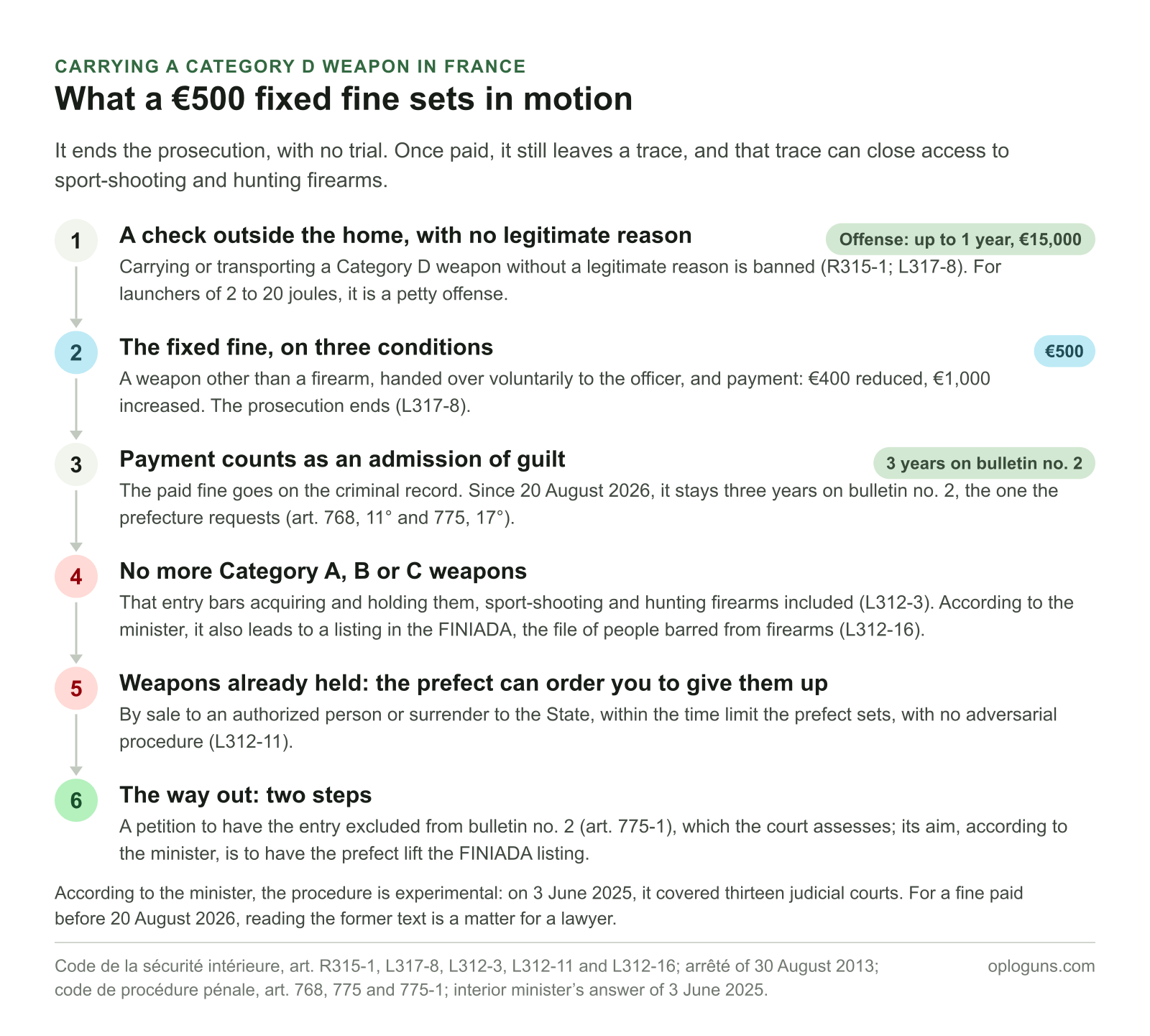
Paying does not erase. According to the minister, paying the fixed fine « vaut ainsi reconnaissance de culpabilité et entraîne l'inscription de cette infraction au casier judiciaire » [thus counts as an admission of guilt and leads to the offense being entered on the criminal record]9. The code de procédure pénale confirms it: the record receives « les amendes forfaitaires pour les délits » [fixed fines for criminal offenses] that have been paid (article 768, 11°)11.
Bulletin no. 2 is the extract of the criminal record that the administration consults, and it is the prefecture that requests it for a firearm authorization12. Since 20 August 2026, article 775 removes the fixed fine for a criminal offense from it only « à l'expiration d'un délai de trois ans à compter de leur paiement » [once three years have passed since payment] (17°)13. The rule comes from law no. 2026-798 of 18 August 2026. Three years: three full shooting seasons.
The entry leaves the record itself after the same period (article 769, 11°)14. On one condition: no sentence for a serious crime or criminal offense, and no new fixed fine for a criminal offense, during those three years. For a fine paid before 20 August 2026, reading the former article 775 is a matter for a lawyer.
Bulletin no. 2 and FINIADA: no more A, B or C weapons
Article L312-3, in force since 20 March 2024, covers people whose bulletin no. 2 carries an entry of conviction for certain offenses15. They are « interdites d'acquisition et de détention d'armes, de munitions et de leurs éléments des catégories A, B et C » [barred from acquiring and holding weapons, ammunition and their components of Categories A, B and C]. The list names « port, transport et expéditions d'armes […] des catégories C ou D sans motif légitime » [carrying, transporting and shipping weapons of Categories C or D without a legitimate reason], that is, L317-8 and L317-915.
These people are recorded in a national file, the FINIADA (L312-16), which the law allows to be interconnected with the criminal record (L312-16-1)16. The minister writes it in so many words: the entry on bulletin no. 2 « entraine également celle de l'individu » [also leads to the individual's listing] in the FINIADA9.
What closes, in practice:
- Sport-shooting firearms: Category B on authorization, Category C on declaration (see the Category B authorization and declaring a Category C firearm).
- Category C long guns for the hunter.
- Alarm weapons and weapons firing non-metallic projectiles in Category C, even though they are bought without license or permit (R312-54)21: not being listed in the FINIADA remains a condition12.
Category D, for its part, falls outside the scope of L312-3. Who reads the record and the file, and at what point: see the criminal record and the shooting license.
Weapons already held: divestment ordered by the prefect
The L312-3 ban also covers holding. Article L312-11 allows the prefect to order any holder to give up their weapons, by sale to an authorized person or surrender to the State, within the time limit the prefect sets17. When the ban comes from L312-3, the adversarial procedure, the one that lets you submit your observations before the decision, « n'est pas applicable » [does not apply]17.
If the weapons are not given up within the time limit, the prefect orders them handed over to the police or gendarmerie (L312-12)17. And the FINIADA keeps its data for twenty years from the lifting of the ban (R312-78)18.
Clearing the record entry: the article 775-1 petition
Article 775-1 of the code de procédure pénale allows the court to exclude a conviction from bulletin no. 219. It does so in the judgment, or later « sur la requête du condamné » [on the convicted person's petition]. That exclusion « emporte relèvement de toutes les interdictions, déchéances ou incapacités » [lifts all bans, forfeitures or incapacities]19.
The interior minister points to this route for the fixed fine: a petition for erasure to the public prosecutor9. The aim: « faire lever par le préfet son inscription au FINIADA » [to have the prefect lift the FINIADA listing]. Two steps, then: bulletin no. 2, then the file.
A Category D weapon in the range bag: outside the license
A current shooting license counts as a legitimate transport document for weapons of Categories A, B and C (R315-2, 3°)20. In Category D, only for those « utilisés dans la pratique du sport relevant de ladite fédération » [used in the practice of the sport governed by that federation]. An air pistol used in the discipline therefore travels covered by the license.
A knife, a tear-gas spray or a baton slipped into the same bag does not. And the license covers only transport, never carrying: the weapon travels not immediately usable. See transporting a firearm to the range.
Four misconceptions about carrying a Category D weapon
- "Free sale means free carry." Acquisition and holding are free (L311-2); carrying and transporting without a legitimate reason are banned (R315-1, 3°)13. See also the risk of holding a firearm without the required document.
- "Put away in the trunk, the weapon no longer counts." Carrying or transporting, within the meaning of R311-1: R315-1 bans both without a legitimate reason for Category D83.
- "Once the fine is paid, the matter is closed without a trace." Payment counts as an admission of guilt, and since 20 August 2026 the entry stays on bulletin no. 2 for three years913.
- "The license covers everything in the range bag." It covers only the Category D weapons used in the discipline (R315-2, 3°)20.
Carrying a Category D weapon: what changes in your case
Three situations, three consequences
For a licensed shooter who holds firearms, a fixed fine for a knife carried without a legitimate reason costs more than €500. It leaves a three-year entry on bulletin no. 2, the L312-3 ban, and a divestment that the prefect can order with no adversarial procedure.
For someone who has already paid a fixed fine, two steps exist: the petition for exclusion from bulletin no. 2 (775-1), then the lifting of the FINIADA listing by the prefect. The three years have applied since 20 August 2026.
For someone transporting a Category D object unrelated to shooting, everything is decided at the check. The legitimate reason is assessed case by case: the place, the time, the object, the person. Defending yourself is not one in itself, according to Service-Public.
Sources 21 references
The articles of the code de la sécurité intérieure (CSI) and of the code de procédure pénale (CPP) were reread on Légifrance in their version in force on 1 November 2026, with the in-force date displayed on each page. The ministerial answers and the Service-Public pages were read the same day. All documents are in French. Click a note marker in the text to highlight the matching source.
- Légifrance — article L311-2 du CSI, version in force since 21 June 2019 (ordonnance no. 2019-610 of 19 June 2019, art. 9), consulted on 1 November 2026: « 4° Catégorie D : armes et matériels de guerre dont l'acquisition et la détention sont libres. » [4° Category D: weapons and war materiel whose acquisition and holding are free.]
- Légifrance — article L312-1 du CSI, version in force since 21 June 2019 (ordonnance no. 2019-610, art. 10), consulted on 1 November 2026: no one may lawfully acquire and hold weapons of any category « s'il n'est pas âgé de dix-huit ans révolus » [unless aged eighteen or over], subject to the exceptions provided.
- Légifrance — article R315-1 du CSI, version in force since 1 August 2018 (decree no. 2018-542 of 29 June 2018, art. 16), consulted on 1 November 2026: « Sont interdits : […] 3° Le port et le transport sans motif légitime des armes, éléments d'arme et munitions des catégories C et D. » [Banned: carrying and transporting without a legitimate reason weapons, weapon components and ammunition of Categories C and D.]
- Légifrance — article L317-8 du CSI, version in force since 26 January 2023 (law no. 2023-22 of 24 January 2023, art. 25), consulted on 1 November 2026: carrying or transporting without a legitimate reason, « même s'il en est régulièrement détenteur »; 3° Category D, « à l'exception de ceux qui présentent une faible dangerosité et figurent sur une liste fixée par arrêté » [except those that present a low level of danger and appear on a list set by order], one year's imprisonment and a €15,000 fine; for this offense, « sauf s'il s'agit d'armes à feu, en cas de remise volontaire de l'arme […] à l'agent verbalisateur aux fins de transfert de propriété à l'Etat » [except for firearms, where the weapon is voluntarily handed to the reporting officer for transfer of ownership to the State], the prosecution ends under the conditions of articles 495-17 to 495-25 of the CPP through a fixed fine of €500, reduced €400, increased €1,000. A future version, from ordonnance no. 2025-1091 of 19 November 2025 (art. 40), will apply on 1 January 2029.
- Légifrance — article L317-9 du CSI, version in force since 21 June 2019 (ordonnance no. 2019-610, art. 14), consulted on 1 November 2026: transport carried out by at least two people, or at least two people found together carrying weapons; 3° Category D, two years' imprisonment and a €30,000 fine.
- Légifrance — arrêté du 30 août 2013 pris en application des articles L. 317-8, L. 317-9 et R. 317-11 du CSI, version in force on 1 November 2026 (last amended 17 May 2015), consulted on 1 November 2026: article 1, carrying or transporting outside the home, without a legitimate reason, the weapons of item h of Category D (non-pyrotechnic projectile, muzzle energy of 2 to 20 joules) is punished by the fine for 4th-class contraventions; article 2, carrying and transporting outside the home are free for the ammunition of item j (black powder for historic and collector weapons, ammunition for item h weapons) and the deactivated war materiel of items k and l.
- Service-Public (DILA) — Armes de catégorie D (acquisition et détention libres), fiche F2251 [Category D weapons, free acquisition and holding], checked on 24 October 2025, consulted on 1 November 2026: list of weapons classified in Category D (including D b, aerosol spray of 100 ml maximum; D c, contact electric-pulse weapon); « Le port et le transport d'une arme de catégorie D hors de votre domicile (par exemple, dans votre voiture) sont interdits sans motif légitime » [carrying and transporting a Category D weapon outside your home (for example, in your car) are banned without a legitimate reason]; « prétendre que l'arme servirait à mieux affronter une altercation ou un danger ne constitue pas un motif légitime en soi »; launcher of 2 to 20 joules: « Vous risquez une amende de 750 € » [you risk a €750 fine].
- Légifrance — article R311-1 du CSI, version in force since 7 September 2025 (decree no. 2025-894 of 5 September 2025, art. 1), consulted on 1 November 2026: III, 10° carrying a weapon, « fait d'avoir une arme sur soi utilisable immédiatement »; 13° transporting a weapon, « fait de déplacer une arme en l'ayant auprès de soi et inutilisable immédiatement ».
- Assemblée nationale — question écrite n° 1081 de M. Pierre Cordier, « Réglementation applicable au port d'un couteau de poche » [written question on the rules applicable to carrying a pocket knife], answer from the interior ministry published in the Journal officiel of 3 June 2025, page 4457, consulted on 1 November 2026: « Le fait de se rendre à une action de chasse ou de reconstitution historique est un motif légitime » [going to a hunt or a historical reenactment is a legitimate reason]; « la mise en œuvre de cette procédure exige la reconnaissance des faits par son auteur »; « Le versement de l'amende forfaitaire délictuelle pour les faits de port ou transport d'arme de catégorie D vaut ainsi reconnaissance de culpabilité et entraîne l'inscription de cette infraction au casier judiciaire de l'individu » [paying the fixed fine for carrying or transporting a Category D weapon thus counts as an admission of guilt and leads to the offense being entered on the individual's criminal record]; « En application de l'article L312-3 […] l'inscription de cette mention au bulletin n° 2 du casier judiciaire entraine également celle de l'individu au fichier national des interdits d'acquisition et détention d'armes (FINIADA) » [under article L312-3, the entry on bulletin no. 2 also leads to the individual's listing in the FINIADA]; petition for erasure to the public prosecutor (art. 775-1 CPP) « afin de faire lever par le préfet son inscription au FINIADA »; experiment « menée depuis le 17 avril 2024 », « actuellement mise en œuvre dans les ressorts des tribunaux judiciaires de Rennes, Lille, Nantes, Bobigny, Pontoise, Bordeaux, Lyon, Saint-Etienne, Marseille, Nice, Montpellier, Paris et Toulouse » [currently implemented in the jurisdictions of those thirteen courts]; circular from the justice minister of 7 November 2024.
- Assemblée nationale — question écrite n° 5868 de M. Pierre Cordier, « Réglementation applicable au port d'armes de catégorie D » [written question on the rules applicable to carrying Category D weapons], answer from the interior ministry published in the Journal officiel of 24 June 2025, page 5518, consulted on 1 November 2026: « Inverser la charge de la légitimité du motif en reconnaissant un droit à porter une arme de catégorie D pour se défendre reviendrait à encourager le port de telles armes » [reversing the burden of the reason's legitimacy by recognizing a right to carry a Category D weapon for self-defense would amount to encouraging the carrying of such weapons]; « il n'est pas dans les projets du Gouvernement de modifier la réglementation applicable au port et au transport d'armes de catégorie D » [the government has no plans to change the rules on carrying and transporting Category D weapons].
- Légifrance — article 768 du CPP, version in force since 30 September 2021 (law no. 2021-218 of 26 February 2021, art. 18), consulted on 1 November 2026: 11° « Les amendes forfaitaires pour les délits et pour les contraventions de la cinquième classe ayant fait l'objet d'un paiement ou à l'expiration des délais mentionnés au second alinéa de l'article 495-19 et au deuxième alinéa de l'article 530. » [Fixed fines for criminal offenses and fifth-class contraventions that have been paid, or on expiry of the time limits of articles 495-19 and 530.] The page reports a repeal by ordonnance no. 2025-1091 of 19 November 2025, with deferred effect.
- Service-Public (DILA) — Armes de catégorie C (soumise à déclaration), fiche F2246, and Armes de catégorie B pour un tireur sportif, fiche F2250 [Category C weapons, subject to declaration; Category B weapons for a sport shooter], checked on 20 March 2025, consulted on 1 November 2026: conditions « Ne pas être inscrit au FINIADA » and « Ne pas avoir sur votre bulletin n°2 du casier judiciaire de condamnations pour certaines infractions », « C'est la préfecture qui fait la demande de bulletin » [it is the prefecture that requests the bulletin]; same conditions for the defense weapon (C3) and the alarm and signal weapon (C12).
- Légifrance — article 775 du CPP, version in force since 20 August 2026 (law no. 2026-798 of 18 August 2026, art. 29), consulted on 1 November 2026: do not appear on bulletin no. 2, 16° « Les amendes forfaitaires contraventionnelles mentionnées au 11° de l'article 768 » [the fixed fines for contraventions mentioned at 11° of article 768]; 17° « Les amendes forfaitaires délictuelles à l'expiration d'un délai de trois ans à compter de leur paiement ou à l'expiration du délai mentionné au second alinéa de l'article 495-19. » [Fixed fines for criminal offenses once three years have passed since their payment, or on expiry of the time limit of article 495-19.] The previous version (from 30 September 2021 to 20 August 2026) excluded at 16° « Les amendes forfaitaires mentionnées au 11° de l'article 768 ».
- Légifrance — article 769 du CPP, version in force since 30 September 2021 (law no. 2021-218, art. 18), consulted on 1 November 2026: are removed from the record, 11°, the entries for the fixed fines of 11° of article 768 « à l'expiration d'un délai de trois ans à compter de leur paiement », « si la personne n'a pas, pendant ce délai, soit subi de condamnation à une peine criminelle ou correctionnelle, soit fait de nouveau l'objet d'une amende forfaitaire délictuelle » [if the person has not, during that period, either been sentenced for a serious crime or criminal offense, or again received a fixed fine for a criminal offense].
- Légifrance — article L312-3 du CSI, version in force since 20 March 2024 (law no. 2024-233 of 18 March 2024, art. 7), consulted on 1 November 2026: « Sont interdites d'acquisition et de détention d'armes, de munitions et de leurs éléments des catégories A, B et C »; 1° people whose bulletin no. 2 of the criminal record carries an entry of conviction for one of the listed offenses, including « port, transport et expéditions d'armes, de munitions ou de leurs éléments des catégories C ou D sans motif légitime » (articles L. 317-8 and L. 317-9).
- Légifrance — article L312-16 du CSI, version in force since 30 December 2019, and article L312-16-1, version in force since 26 January 2022, consulted on 1 November 2026: « fichier national automatisé nominatif » [automated national file of named individuals] of people barred from acquiring and holding weapons under, among others, L312-3; interconnection allowed between the automated national criminal record and this file for the bans of 1° of L312-3.
- Légifrance — articles L312-11 et L312-12 du CSI, versions in force since 26 January 2022, consulted on 1 November 2026: the prefect may order any holder of weapons of any category to give them up; « Le représentant de l'Etat dans le département fixe le délai au terme duquel le détenteur doit s'être dessaisi » [the State's representative in the département sets the time limit by which the holder must have given them up]; where the ban is made under L312-3 or L312-3-2, the provisions on the adversarial procedure do not apply; L312-12, surrender ordered to the police or gendarmerie « Lorsque l'intéressé ne s'est pas dessaisi de l'arme » [where the person has not given up the weapon].
- Légifrance — article R312-78 du CSI, version in force since 30 April 2020, consulted on 1 November 2026: the information in the file « peuvent être conservées durant vingt ans à compter de la date de levée de l'interdiction » [may be kept for twenty years from the date the ban is lifted].
- Légifrance — article 775-1 du CPP, version in force since 20 August 2026 (law no. 2026-798 of 18 August 2026, art. 29), consulted on 1 November 2026: « Le tribunal qui prononce une condamnation peut exclure expressément sa mention au bulletin n° 2 soit dans le jugement de condamnation, soit par jugement rendu postérieurement sur la requête du condamné » [the court that pronounces a conviction may expressly exclude its entry from bulletin no. 2, either in the judgment or by a later judgment on the convicted person's petition]; the exclusion « emporte relèvement de toutes les interdictions, déchéances ou incapacités ».
- Légifrance — article R315-2 du CSI, version in force since 1 August 2018 (decree no. 2018-542, art. 16), consulted on 1 November 2026: 3° the current shooting license « vaut titre de transport légitime des armes, éléments d'arme, systèmes d'alimentation et munitions des catégories A, B et C ainsi que des armes, éléments d'arme et munitions de la catégorie D utilisés dans la pratique du sport relevant de ladite fédération » [counts as a legitimate transport document for weapons, components, feeding systems and ammunition of Categories A, B and C, and for Category D weapons, components and ammunition used in the sport governed by that federation].
- Légifrance — article R312-54 du CSI, version in force since 1 July 2024, consulted on 1 November 2026: « N'est pas subordonnée à la présentation de l'un des titres prévus au premier alinéa de l'article R. 312-53 » [is not conditional on presenting one of the documents of the first paragraph of article R. 312-53] (hunting permit, license, collector's card): 2° « L'acquisition des armes du 3° de la catégorie C »; 3° bis « L'acquisition des armes du 12° de la catégorie C ».
The text in force prevails, and this is not legal advice. This article describes the texts in force on 1 November 2026. A new version of article L317-8 will apply on 1 January 2029. The scope of the fixed fine is the one the minister describes as of 3 June 2025. Next review: 1 May 2027 at the latest. If you are being prosecuted, the person to talk to is a lawyer.
Frequently asked questions
What is the penalty for carrying a Category D weapon without a legitimate reason?
Up to one year's imprisonment and a €15,000 fine (article L317-8 of the code de la sécurité intérieure, the French internal security code, in force on 1 November 2026), two years and €30,000 when two or more people are found together carrying weapons (article L317-9). Launchers of 2 to 20 joules fall under a 4th-class contravention, a petty offense (arrêté of 30 August 2013).
Does the €500 fixed fine go on the criminal record?
Yes. According to the ministerial answer published in the Journal officiel of 3 June 2025, paying it « vaut ainsi reconnaissance de culpabilité » [thus counts as an admission of guilt] and leads to an entry on the record. Since 20 August 2026, article 775 of the code de procédure pénale, the code of criminal procedure, removes it from bulletin no. 2 only once three years have passed since payment.
Does a fixed fine for carrying a weapon bar you from having firearms?
Article L312-3 of the code de la sécurité intérieure bars people whose bulletin no. 2 carries an entry for carrying or transporting Category C or D weapons without a legitimate reason from acquiring and holding Category A, B and C weapons. According to the ministerial answer of 3 June 2025, that entry also leads to a listing in the FINIADA, the national file of people barred from firearms.
Is transporting a Category D weapon in your car allowed?
Not without a legitimate reason. Article R315-1 of the code de la sécurité intérieure bans carrying and transporting Category C and D weapons without a legitimate reason, and Service-Public, the official government information site, cites the car precisely as its example. A weapon put away and not immediately usable is being transported, within the meaning of article R311-1: transport remains subject to the legitimate reason.
Can the entry be cleared from bulletin no. 2?
Article 775-1 of the code de procédure pénale allows a conviction to be excluded from bulletin no. 2 by petition, and that exclusion lifts the bans that flow from it. The ministerial answer of 3 June 2025 points to the same route, by petition to the public prosecutor, to then have the prefect lift the FINIADA listing.
Spotted an error, or a rule that has changed since we checked? Report an error